

|
시장보고서
상품코드
2118202
법률 사무 관리 소프트웨어 시장 : 시장 점유율 분석, 업계 동향 및 통계, 성장 예측(2026-2031년)Legal Practice Management Software - Market Share Analysis, Industry Trends & Statistics, Growth Forecasts (2026 - 2031) |
||||||
 Mordor Intelligence
Mordor Intelligence에 의하면, 법률 사무 관리 소프트웨어 시장 규모는 2025년 29억 7,000만 달러로 평가되었고, 2026년에는 33억 4,000만 달러로 추정되고, 2031년까지 69억 6,000만 달러에 이를 것으로 예상되며, 2026-2031년 CAGR 15.80%로 성장할 전망입니다.
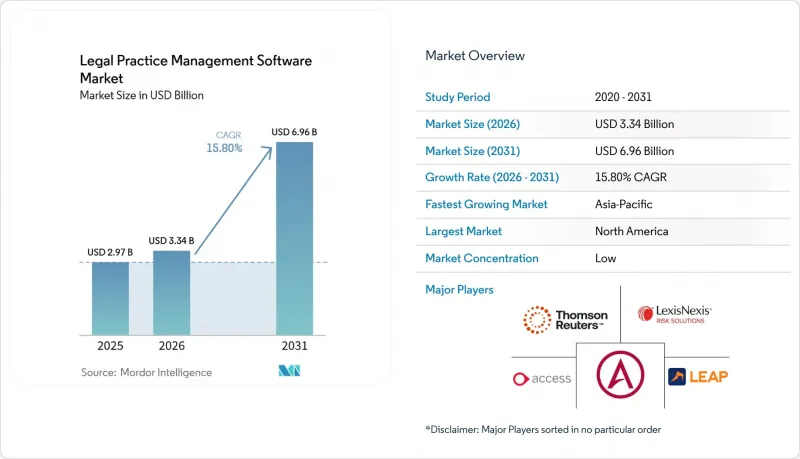
본 보고서는 구성 요소별(소프트웨어 및 서비스), 배포 방식별(클라우드 기반, 온프레미스형, 하이브리드형), 용도별(사건 관리, 문서 관리 등), 조직 규모별(대기업 및 중소기업), 최종 사용자별(법률 사무소, 법무 부서, 법원) 및 지역별로 분류되어 있습니다. 시장 전망은 금액(달러) 기준으로 제시되어 있습니다.
세계의 법률 사무 관리 소프트웨어 시장 동향 및 인사이트
법률 사무소의 ‘클라우드 우선’ 현대화 진전
온프레미스형 시스템으로는 동일한 속도와 일관성을 유지하며 제공할 수 없는 지속적인 제품 업데이트가 현재 요구되고 있기 때문에 클라우드로의 전환은 법률 사무 관리 소프트웨어 시장에서 경쟁상의 필수 요건이 되고 있습니다. 『Wolters Kluwer Benchmark Report 2026』에 따르면, 독일 로펌의 90.5%가 향후 3년 동안 리걸테크 지출을 늘릴 계획이며, 법률 사무 관리 소프트웨어, AI 용도, 사이버 보안이 그 지출 주기에서 최우선 과제로 꼽혔습니다. 이러한 지출 추세가 중요한 이유는 클라우드 서비스가 법률 사무소가 표준 서비스의 일환으로 점점 더 기대하는 지속적인 AI 기능 도입, 보안 업데이트 및 제품 구성 변경과 밀접하게 관련되어 있기 때문입니다. 또한, 유연한 종량제 요금제는 클라우드 환경에서 도입하기 쉬우며, 벤더가 초기 투자 부담을 줄이고 운영 비용의 예측 가능성을 높이고자 하는 로펌의 요구를 충족하는 데 도움이 되므로, 이 역시 중요한 점입니다. 일본에서는 GVA TECH와 요시즈미 인포메이션이 2026년 7월, 로펌을 위한 보안 설정 및 AI 워크플로 템플릿을 갖춘 ‘Benpal for Google Workspace’를 출시했습니다. 이는 벤더가 지역의 워크플로 및 규정 준수 요구 사항에 맞추어 클라우드 도입을 패키지화하고 있음을 보여주는 좋은 사례입니다. 따라서 법률 사무 관리 소프트웨어 시장은 인프라 선택, 제공 모델, 가격 체계가 개별적인 구매 결정이 아닌 밀접하게 연계되어 가는 현대화의 물결로부터 혜택을 받고 있습니다.
AI를 활용한 사건 관리 및 워크플로우 자동화
AI는 법률 사무 관리 소프트웨어 시장에서 단순한 보조 기능에서 핵심 운영 계층으로 전환되고 있으며, 2026년 투자 동향을 통해 구매자들이 이러한 변화를 점점 더 확고히 받아들이고 있음을 알 수 있었습니다. Harvey는 2026년 3월, 기업 가치 110억 달러로 2억 달러 규모의 자금 조달 라운드를 발표했습니다. 이 회사에 따르면, 1,300개 이상의 조직에 소속된 10만 명 이상의 변호사가 이 플랫폼을 이용하고 있으며, M&A, 실사, 계약서 작성, 문서 검토 각 워크플로우에 2만 5,000개 이상의 맞춤형 에이전트가 도입되어 있습니다. Intapp은 2026년 2월, 전문 서비스 기업을 대상으로 특화된 에이전트형 AI 플랫폼 ‘Celeste’를 출시했습니다. 이 플랫폼에는 윤리적 장벽(ethical wall), 이해 상충 심사, 감사 대응성 등의 거버넌스 도구가 아키텍처에 통합되어 있습니다. 이러한 추세가 중요한 이유는 대기업들이 일회성 업무에 AI를 시험적으로 도입하는 데 그치지 않고, 조사, 초안 작성, 협업, 사건 관리를 연결하는 워크플로우에 AI를 통합하고 있기 때문입니다. 이러한 워크플로우의 자동화가 진행됨에 따라 로펌은 기존에는 인력 배치의 경제성이 낮았던 사건을 더 많이 처리할 수 있게 됩니다. 그 결과, 사건의 전체 라이프사이클에 걸친 방대한 업무량을 조정할 수 있는 플랫폼에 대한 수요가 높아지고 있습니다. 따라서 AI 도입으로 인해 법률 사무 관리 소프트웨어 시장은 확대되고 있습니다. 이는 단위당 투입되는 노력이 감소함에 따라, 체계화된 소프트웨어 시스템이 관리해야 할 업무량이 증가하고 있으며, 해당 시스템의 필요성이 줄어든 것은 아니기 때문입니다.
데이터 기밀성 및 변호사 특권에 관한 위험에 대한 우려
기밀성은 여전히 법률 사무 관리 소프트웨어 시장에서 가장 큰 장벽 중 하나입니다. 왜냐하면 법률 실무자들은 정보 유출 위험뿐만 아니라, 부적절한 데이터 취급으로 인해 변호사 특권 보호가 약화될 위험도 관리해야 하기 때문입니다. 변호사 특권 보호에 실패할 경우의 법적 영향은 일반적인 데이터 보안 사고보다 심각해질 수 있으므로, 로펌들은 멀티테넌트형 클라우드 환경, 제3자의 접근 요청, 그리고 불충분한 분리 관리에 대해 우려하고 있습니다. 『Wolters Kluwer Benchmark Report 2026』에 따르면, 독일 로펌의 38.9%가 AI 및 리걸테크 도입의 주요 장벽으로 GDPR(EU 개인정보보호규정) 준수 및 기밀 정보 보안을 꼽고 있습니다. 이 시장에 서비스를 제공하는 벤더는 유럽, 북미, 아시아태평양에서 서로 다른 중복되는 규정 준수 요건에도 대응해야 하며, 이는 표준화된 배포를 지연시키고 제품 설계의 복잡성을 가중시키고 있습니다. 이 문제는 이해 상충을 고려해야 하는 업무를 다루는 대규모 로펌에게 특히 중요합니다. 왜냐하면 거버넌스 아키텍처가 윤리적 심사, 기밀 정보에 대한 접근 제한, 그리고 다수의 사용자에 걸친 입증 가능한 감사 추적을 지원해야 하기 때문입니다. 따라서 워크플로우상의 이점이 분명하더라도, 기능적 발전이 기밀성 관리의 진전을 앞지르고 있다고 구매자가 판단할 경우, 법률 사무 관리 소프트웨어 시장의 도입 속도는 둔화되는 경향을 보입니다.
부문 분석
2025년 시점에서 소프트웨어는 시장의 81.43%를 차지했으며, 법률 사무 관리 소프트웨어 시장의 주요 수익 기반일 뿐만 아니라 각 로펌이 청구, 사건, 문서, 협업 기능을 도입하기 위한 주요 플랫폼이 되었습니다. 서비스 부문은 2031년까지 17.92%의 성장이 예상되며, 구매자가 플랫폼의 범위와 AI 활용을 확대함에 따라 도입, 맞춤화, 교육 및 관리형 지원의 중요성이 점점 더 커지고 있음을 보여줍니다. 이러한 관계는 구조적인 것입니다. 워크플로우나 자동화 규칙, 데이터 마이그레이션 요구 사항이 추가될 때마다 소프트웨어의 초기 판매 후에도 추가 작업이 발생하기 때문입니다. 따라서 법률 사무 관리 소프트웨어 시장에서는 기존 프로세스를 표준화된 디지털 워크플로우로 전환하는 데 도움이 필요한 복잡한 도입 사례로부터 서비스에 대한 수요가 더욱 높아지고 있습니다. 이러한 추세는 더 광범위한 사용자 그룹 간에 사건 데이터, 보고서, 거버넌스 관리를 연계하고자 하는 대형 로펌이나 기업의 법무 부서에서 특히 두드러지게 나타납니다.
Clio는 2025년 11월, vLex를 10억 달러에 인수하였고, 이에 맞추어 5억 달러 규모의 시리즈 G 자금 조달 라운드를 진행했습니다. 이는 주요 벤더들이 라이선스 비용을 훨씬 뛰어넘는 가치를 창출할 수 있는 더 대규모의 플랫폼 생태계를 구축하고 있음을 시사합니다. 또한 이러한 움직임은 소프트웨어의 폭이 넓어짐에 따라 서비스 수요에도 영향을 미치고 있음을 보여줍니다. 왜냐하면 더욱 충실한 제품 스택을 구축하려면 대규모 법무 팀 전체에 걸친 도입 지원, 워크플로우 설정 및 교육이 필요하기 때문입니다. 고객 기반의 다른 한쪽 끝에서는 소규모 로펌에 서비스를 제공하는 각 벤더들이 여전히 신속한 도입과 최소한의 서비스 요건을 무기로 경쟁을 이어가고 있으며, 이는 법률 사무 관리 소프트웨어 시장 내에서도 가격에 민감한 분야의 마찰을 완화하는 데 기여하고 있습니다. 엔터프라이즈 고객은 대개 맞춤형 사후 지원을 필요로 하는 반면, 소규모 로펌은 신속한 사용 개시와 간단한 셀프 서비스 설정을 더 중요하게 여기기 때문에 이 두 가지 패턴은 공존할 수 있습니다. 그 결과, 매출 점유율 면에서는 소프트웨어가 여전히 지배적인 반면, 플랫폼이 더욱 복잡해지고 법무 업무의 일상적인 절차에 깊이 통합됨에 따라 서비스의 전략적 중요성은 계속해서 높아지고 있습니다.
2025년에는 클라우드 기반 도입이 시장의 71.28%를 차지했으며, 법률 사무 관리 소프트웨어 시장에서 가장 큰 점유율을 기록했습니다. 이는 원격 액세스, 지속적인 업데이트, 구독을 통한 제공의 용이성 등 클라우드의 장점이 반영된 결과입니다. 하이브리드 도입은 2031년까지 18.54%의 성장이 예상되며, 이는 많은 대규모 구매자들이 여전히 업무 부하를 클라우드와 사무소가 관리하는 환경 사이에 분산시키고자 한다는 것을 보여줍니다. 이러한 경향은 클라우드에 대한 거부감이라기보다는 선택적 관리에 기인한 것으로, 특히 로펌이 기밀성이 높은 사건 데이터를 기밀성이 낮은 협업 및 분석 계층으로부터 분리해야 할 때 두드러집니다. 따라서 법률 사무 관리 소프트웨어 시장은 비클라우드 환경에서의 단순한 일방적 전환이 아닌, 혼합 아키텍처로 진화하고 있습니다. 구매자들은 단일하고 광범위한 기술적 선호도에 기반하기보다는 사건의 기밀성, 비밀 유지 의무 요건, 그리고 관할 구역별 데이터 처리 의무에 따라 도입 구조를 선택하는 경향이 강해지고 있습니다.
하이브리드 모델의 성장은 AI 도입 속도와도 밀접한 관련이 있습니다. 로펌은 특정 워크플로우를 보다 엄격한 내부 통제 하에 두면서도, 클라우드 기반 도구를 통해 생산성을 높이고자 하는 경우가 많기 때문입니다. 온프레미스 구축은 법원, 공공기관 및 보다 엄격한 현지화나 보안 요건 하에서 운영되는 조직에게는 여전히 중요하지만, 그 장기적인 역할은 클라우드나 하이브리드 모델에 비해 제한적입니다. 법률 사무 관리 소프트웨어 시장에서는 고객에게 단일하고 고정된 인프라를 강요하지 않으면서 다층적인 도입 옵션을 제공할 수 있는 벤더가 높이 평가받고 있습니다. 이러한 유연성은 대규모 법률 사무소에서 특히 중요합니다. 대형 로펌에서는 이해 상충 심사, 윤리적 심사, 그리고 비밀 유지 특권이 관련된 기록에 대해, 고객과의 커뮤니케이션이나 조사 업무와는 다른 처리 규칙이 필요한 경우가 있기 때문입니다. 따라서 도입 환경은 더욱 미묘한 뉘앙스를 띠게 되었으며, 클라우드는 규모와 속도 면에서 우위를 유지하고 있는 반면, 하이브리드는 복잡한 법무 업무의 운영 위험 프로파일에 더 잘 부합하기 때문에 더 빠른 성장을 이루고 있습니다.
지역별 분석
2025년, 북미는 법률 사무 관리 소프트웨어 시장 규모의 40.87%를 차지했으며, 지역별 최대 점유율을 기록했습니다. 이는 해당 지역의 법률 기술 생태계의 강점, 대규모 로펌 기반, 그리고 충분히 발달된 사내 법무 부서의 구매자 커뮤니티를 반영한 결과입니다. 미국은 대형 로펌의 존재, 공급업체 간의 활발한 경쟁, 그리고 개인 로펌과 기업 법무 부서 모두에서 AI 주도형 법무 워크플로우의 조기 도입이 결합되어 계속해서 핵심 시장으로서의 지위를 유지했습니다. 캐나다 역시 2026년, Clio가 43개 법원에서 47만 건 이상의 사건을 보유한 법무 데이터 스타트업인 Jurisage를 인수함으로써 그 역할을 강화했습니다. 이를 통해 캐나다 내 ‘Clio Work’의 출시가 가속화되었으며, 지역 특화 법무 데이터 자산의 중요성이 더욱 부각되었습니다. 톰슨 로이터도 2026년 5월 Anthropic과의 제휴를 확대하고, Claude를 CoCounsel Legal과 연동함으로써 해당 지역 워크플로우 분야에서의 입지를 강화했습니다. 이는 에이전트형 워크플로우를 둘러싼 제품 개발 속도를 여실히 보여주는 사례였습니다. 남미에서는 도입이 여전히 초기 단계에 머물러 있지만, 브라질은 계속해서 두드러진 존재감을 보이고 있습니다. 이는 법무 부문의 제도화가 진행되고 있으며, 규정 준수를 주도하는 기업 법무 투자가 구조화된 소프트웨어 수요를 위한 보다 명확한 기반을 마련하고 있기 때문입니다.
아시아태평양은 2031년까지 연평균 20.36%의 성장이 예상되며, 이는 법률 사무 관리 소프트웨어 시장에서 가장 빠르게 성장하는 지역 부문이 될 전망입니다. 이는 법원의 디지털화, 법무 서비스의 확대, 그리고 기업용 소프트웨어 도입 가속화가 복합적으로 작용한 결과입니다. 일본, 인도, 호주는 디지털 법원 시스템 및 관련 개혁 프로그램으로 인해 로펌들이 새로운 사법·행정 절차에 대응할 수 있는 플랫폼으로의 전환을 요구받고 있어 중요한 시장으로 부상하고 있습니다. 일본에서는 Legalscape사가 2026년 6월, 도쿄의 3개 변호사회에 소속된 변호사 3명 중 1명이 자사 플랫폼을 이용하고 있다고 보고하여, 도입이 이미 대규모, 중규모 및 개인 사무소로 확산되고 있음을 보여주었습니다. 또한 톰슨 로이터(Thomson Reuters)도 2026년 3월, 해당 시장에서 최초의 수탁자 등급 대리형 AI 조사 기능인 ‘Westlaw Advantage Australia’를 출시하며, 아시아태평양이 기업용 제품 출시 우선순위에서 더 높은 위치를 차지하고 있음을 시사했습니다. 이 지역에서 법률 사무 관리 소프트웨어 시장이 탄력을 받고 있는 것은 규제 현대화와 민간 부문의 법무 업무 디지털화가 별도로 진행되는 것이 아니라 하나로 통합되어 진행되고 있기 때문입니다.
유럽은 법률 사무 관리 소프트웨어 시장에서 여전히 확고한 입지를 구축하고 있으며, 독일, 영국, 프랑스가 주요 수요 거점으로 자리 잡고 있습니다. 이는 성숙한 법률 서비스 부문과 더욱 엄격해진 규정 준수 요건이 결합된 결과입니다. 월터스 크루어(Wolters Kluwer)의 2026년 조사에 따르면, 독일 로펌의 90% 이상이 향후 3년 동안 리걸테크에 대한 지출이 증가할 것으로 예상하고 있으며, 이는 해당 지역에서 법률 사무 관리 소프트웨어, AI 도구 및 사이버 보안에 대한 투자 의지가 높음을 여실히 보여주었습니다. 동 보고서에 따르면, 독일 로펌의 38.9%가 GDPR(EU 개인정보보호규정) 및 기밀 정보 보안을 AI 도입의 주요 장벽으로 간주하고 있으며, 이는 규정 준수가 장벽이 되는 한편, 보다 강력한 데이터 관리 체계를 갖춘 벤더에게는 차별화의 길이 되고 있음을 의미합니다. 중동 및 아프리카에서는 UAE와 사우디아라비아가 법률 서비스의 현대화 및 법원의 디지털화 추진을 통해 성장을 주도한 반면, 나이지리아와 남아프리카공화국은 업무의 점진적인 제도화에 따른 초기 단계의 기회에 그쳤습니다.
기타 혜택 :
- 엑셀 형식 시장 전망(ME) 시트
- 3개월간의 애널리스트 지원
자주 묻는 질문
목차
제1장 서론
제2장 조사 방법
제3장 주요 요약
제4장 시장 구도
제5장 시장 규모 및 성장 예측
제6장 경쟁 구도
제7장 시장 기회 및 향후 전망
AJY 26.09.03According to Mordor Intelligence, the legal practice management software market size is expected to increase from USD 2.97 billion in 2025 to USD 3.34 billion in 2026 and reach USD 6.96 billion by 2031, growing at a CAGR of 15.80% over 2026-2031.
This report is Segmented by Component (Software and Services), by Deployment Mode (Cloud-Based, On-Premises, and Hybrid), by Application (Case Management, Document Management, and More), by Organization Size (Large Enterprises, and SMEs), by End User (Law Firms, Legal Departments, and Courts), and Geography. The Market Forecasts are Provided in Terms of Value (USD).
Global Legal Practice Management Software Market Trends and Insights
Rising Cloud-First Modernization In Law Firms
Cloud migration has become a competitive requirement in the legal practice management software market because firms now need continuous product updates that on-premises systems cannot deliver at the same speed or with the same consistency. The Wolters Kluwer Benchmark Report 2026 found that 90.5% of German law firms planned to increase legal tech spending over the next 3 years, and law firm management software, AI applications, and cybersecurity stood among the leading priorities in that spending cycle. This spending pattern matters because cloud delivery is closely tied to ongoing AI feature deployment, security updates, and product configuration changes that firms increasingly expect as part of standard service. It also matters because flexible, usage-based pricing is easier to support in cloud environments, helping vendors address firms that want lower upfront commitments and more predictable operating costs. In Japan, GVA TECH and Yoshizumi Information launched Benpal for Google Workspace in July 2026, with law-firm-specific security settings and AI workflow templates, demonstrating how vendors are packaging cloud adoption around local workflow and compliance needs. The legal practice management software market is therefore benefiting from a modernization cycle where infrastructure choice, delivery model, and pricing structure are becoming closely linked rather than separate buying decisions.
AI-Assisted Matter And Workflow Automation
AI has moved from a supporting feature into a central operating layer in the legal practice management software market, and investment patterns in 2026 showed that buyers increasingly view this shift as durable. Harvey announced a USD 200 million funding round in March 2026 at an USD 11 billion valuation, and the company said more than 100,000 lawyers across 1,300+ organizations used the platform, with 25,000+ custom agents deployed across Mergers and Acquisitions, due diligence, contract drafting, and document review workflows. Intapp launched Celeste in February 2026 as a purpose-built agentic AI platform for professional services firms, with governance tools such as ethical walls, conflict screening, and auditability built into deployment architecture. This pattern is important because large firms are not only testing AI for isolated tasks, they are embedding it into the workflows that connect research, drafting, collaboration, and matter oversight. As those workflows become more automated, firms can handle more matters that previously carried weak staffing economics, which increases demand for platforms that can coordinate higher activity volumes across the full matter lifecycle. The legal practice management software market is therefore expanding with AI because lower unit effort is increasing the amount of work that organized software systems must manage, not reducing the need for those systems.
Data Confidentiality And Privilege Risk Concerns
Confidentiality remains one of the strongest barriers in the legal practice management software market because legal users must manage not only breach exposure, but also the risk that privilege protections could be weakened through poor data handling. Firms are concerned about multi-tenant cloud environments, third-party access requests, and weak segregation controls because the legal consequences of privilege failure can be more serious than ordinary data security incidents. The Wolters Kluwer Benchmark Report 2026 found that 38.9% of German law firms identified GDPR compliance and sensitive information security as primary barriers to AI and legal tech adoption. Vendors serving this market must also account for overlapping compliance requirements that vary across Europe, North America, and Asia-Pacific, which slows standardized rollout and increases product design complexity. The issue is especially important for larger firms handling conflict-sensitive work, because the governance architecture must support ethical screens, restricted access to sensitive matters, and defensible audit trails across many users. The legal practice management software market, therefore, faces slower adoption where buyers believe functionality is advancing faster than confidentiality controls, even when workflow benefits are clear.
Other drivers and restraints analyzed in the detailed report include:
- Remote And Hybrid Legal Work Operating Models
- Client Demand For Faster Status Visibility And Self-Service Portals
- Complex Integration With Disparate Legal And Accounting Stacks
For complete list of drivers and restraints, kindly check the Table Of Contents.
Segment Analysis
Software held 81.43% of the market in 2025, which made it the core revenue base for the legal practice management software market and the main platform through which firms adopted billing, matter, document, and collaboration functions. Services are projected to grow at 17.92% through 2031, indicating that implementation, customization, training, and managed support are becoming increasingly important as buyers expand platform scope and AI usage. This relationship is structural because every added workflow, automation rule, or data migration requirement creates more work after the initial software sale. The legal practice management software market is therefore seeing stronger service pull from complex deployments where firms need help translating legacy processes into standardized digital workflows. That trend is particularly visible in large firms and corporate legal teams that want to connect matter data, reporting, and governance controls across broader user groups.
Clio completed its USD 1 billion acquisition of vLex in November 2025 and paired that move with a USD 500 million Series G funding round, signaling that major vendors were building larger platform ecosystems capable of capturing value well beyond license fees. The same move also showed that software breadth now influences services demand, because richer product stacks require onboarding support, workflow configuration, and training across larger legal teams. At the other end of the customer base, vendors serving smaller firms are still competing through fast deployment and lighter service requirements, which helps reduce friction in a price-sensitive part of the legal practice management software market. Those two patterns can coexist because enterprise buyers often need tailored post-sale support, while small firms place more value on quick time to use and simpler self-service setup. The result is a component mix where software remains dominant in revenue share, but services continue to gain strategic weight as platforms become more complex and more embedded in legal operating routines.
Cloud-based deployment accounted for 71.28% of the market in 2025, which gave it the largest position in the legal practice management software market and reflected the pull of remote access, continuous updates, and easier subscription delivery. Hybrid deployment is projected to grow at 18.54% through 2031, which shows that many larger buyers still want to split workloads between cloud and firm-controlled environments. This pattern is less about resistance to cloud and more about selective control, especially where firms need to separate highly sensitive matter data from less sensitive collaboration or analytics layers. The legal practice management software market is therefore evolving toward mixed architectures rather than a simple one-direction move away from all non-cloud environments. Buyers are increasingly selecting deployment structures based on matter sensitivity, privilege needs, and jurisdictional data handling obligations rather than on one broad technology preference.
Hybrid growth is also tied to the pace of AI adoption because firms often want the productivity gains of cloud-based tools while keeping certain workflows under tighter internal control. On-premises deployment still matters for courts, public bodies, and organizations operating under stricter localization or security mandates, although its long-term role is narrower than that of cloud or hybrid models. The legal practice management software market is rewarding vendors that can offer layered deployment choices without forcing clients into one fixed infrastructure path. That flexibility becomes more important in large-firm environments where conflict review, ethical screening, and privilege-sensitive records may need different handling rules than client communication or research tasks. The deployment landscape is therefore becoming more nuanced, with cloud retaining leadership because of scale and speed, while hybrid gains faster growth because it better matches the operational risk profile of complex legal work.
Complete Report Scope:
- By Component
- Software
- Services
- By Deployment Mode
- Cloud-Based
- On-Premises
- Hybrid
- By Application
- Case and Matter Management
- Document and Knowledge Management
- Financial and Practice Management
- Client Collaboration and Workflow
- By Organization Size
- Large Enterprises
- Small And Medium Enterprises
- By End User
- Law Firms
- Legal Departments
- Courts
- By Geography
- North America
- United States
- Canada
- Mexico
- South America
- Brazil
- Rest Of South America
- Europe
- Germany
- United Kingdom
- France
- Italy
- Spain
- Russia
- Rest Of Europe
- Asia-Pacific
- China
- India
- Japan
- South Korea
- Australia
- Rest Of Asia-Pacific
- Middle East And Africa
- Middle East
- Turkey
- Saudi Arabia
- United Arab Emirates
- Rest Of Middle East
- Africa
- South Africa
- Nigeria
- Rest Of Africa
- Middle East
- North America
Geography Analysis
North America held 40.87% of the legal practice management software market size in 2025, which made it the largest regional contributor and reflected the strength of its legal technology ecosystem, large law firm base, and well-developed in-house legal buyer community. The United States remained the anchor market because it combines enterprise law firms, active vendor competition, and early adoption of AI-led legal workflows across both private practice and corporate legal departments. Canada also strengthened its role in 2026 when Clio acquired Jurisage, a legal data startup with more than 470,000 cases from 43 courts, supporting the launch of Clio Work in Canada and reinforcing the importance of localized legal data assets. Thomson Reuters also expanded its workflow position in the region through a May 2026 partnership expansion with Anthropic that connected Claude to CoCounsel Legal, which underscored the speed of product development around agentic workflows. South America remained earlier in adoption, but Brazil continued to stand out because growing legal sector formalization and compliance-driven corporate legal investment are creating a clearer base for structured software demand.
Asia-Pacific is projected to grow at 20.36% through 2031, which makes it the fastest-growing regional segment in the legal practice management software market and reflects a mix of court digitization, legal services expansion, and faster enterprise software rollout. Japan, India, and Australia are important because digital court systems and related reform programs are pushing firms toward platforms that can work with newer judicial and administrative processes. In Japan, Legalscape reported in June 2026 that 1 in 3 attorneys across the 3 Tokyo bar associations used its platform, which showed that adoption had already spread across large, mid-sized, and solo practices. Thomson Reuters also launched Westlaw Advantage Australia in March 2026 as its first fiduciary-grade agentic AI research capability in that market, signaling that Asia-Pacific was moving higher in enterprise product rollout priorities. The legal practice management software market is gaining speed in the region because regulatory modernization and private sector legal digitization are moving together rather than separately.
Europe remained a well-established region in the legal practice management software market, with Germany, the United Kingdom, and France serving as major demand centers because they combine mature legal services sectors with stronger compliance expectations. Wolters Kluwer found in 2026 that more than 90% of German law firms expected legal tech spending to increase over the next 3 years, which highlighted the region's appetite for law firm software, AI tools, and cybersecurity investment. The same report showed that 38.9% of German law firms viewed GDPR and sensitive information security as major barriers to AI adoption, which means compliance creates both friction and a differentiation path for vendors with stronger data controls. In the Middle East and Africa, the UAE and Saudi Arabia led growth activity through legal services modernization and court digitization agendas, while Nigeria and South Africa remained earlier-stage opportunities tied to gradual practice formalization.
- Clio Inc.
- Thomson Reuters Corporation
- The Access Group
- Aderant, LLC
- LEAP Legal Software Pty Ltd
- Themis Solutions Inc.
- PracticePanther LLC
- MyCase, Inc.
- Rocket Matter, LLC
- CosmoLex Cloud LLC
- Actionstep Group Limited
- Smokeball, Inc.
- Filevine, Inc.
- Intapp, Inc.
- Litify, Inc.
- RELX PLC
- Abacus Data Systems, Inc.
- Lexicon Services, Inc.
- CARET Legal
- Tabs3 Software, LLC
- SurePoint Technologies, Inc.
- Bill4Time, LLC
- TimeSolv Corporation
- Legal Files Software, Inc.
- App4Legal LLC
Additional Benefits:
- The market estimate (ME) sheet in Excel format
- 3 months of analyst support
TABLE OF CONTENTS
1 INTRODUCTION
- 1.1 Study Assumptions And Market Definition
- 1.2 Scope Of The Study
2 RESEARCH METHODOLOGY
3 EXECUTIVE SUMMARY
4 MARKET LANDSCAPE
- 4.1 Market Overview
- 4.2 Market Drivers
- 4.2.1 Rising Cloud-First Modernization In Law Firms
- 4.2.2 AI-Assisted Matter And Workflow Automation
- 4.2.3 Remote And Hybrid Legal Work Operating Models
- 4.2.4 Client Demand For Faster Status Visibility And Self-Service Portals
- 4.2.5 Compliance-Driven Auditability And Retention Controls
- 4.2.6 Consumption-Based Pricing Pressure On Legacy Per-Attorney Licenses
- 4.3 Market Restraints
- 4.3.1 Data Confidentiality And Privilege Risk Concerns
- 4.3.2 Complex Integration With Disparate Legal And Accounting Stacks
- 4.3.3 Extended Change Management In Partner-Led Firms
- 4.3.4 Jurisdiction-Specific Compliance And Data Residency Friction
- 4.4 Industry Value Chain Analysis
- 4.5 Regulatory Landscape
- 4.6 Technological Outlook
- 4.7 Porter's Five Forces Analysis
- 4.7.1 Bargaining Power Of Buyers
- 4.7.2 Bargaining Power Of Suppliers
- 4.7.3 Threat Of New Entrants
- 4.7.4 Threat Of Substitutes
- 4.7.5 Industry Rivalry
- 4.8 Impact Of Macroeconomic Factors On The Market
5 MARKET SIZE AND GROWTH FORECASTS (VALUE)
- 5.1 By Component
- 5.1.1 Software
- 5.1.2 Services
- 5.2 By Deployment Mode
- 5.2.1 Cloud-Based
- 5.2.2 On-Premises
- 5.2.3 Hybrid
- 5.3 By Application
- 5.3.1 Case and Matter Management
- 5.3.2 Document and Knowledge Management
- 5.3.3 Financial and Practice Management
- 5.3.4 Client Collaboration and Workflow
- 5.4 By Organization Size
- 5.4.1 Large Enterprises
- 5.4.2 Small And Medium Enterprises
- 5.5 By End User
- 5.5.1 Law Firms
- 5.5.2 Legal Departments
- 5.5.3 Courts
- 5.6 By Geography
- 5.6.1 North America
- 5.6.1.1 United States
- 5.6.1.2 Canada
- 5.6.1.3 Mexico
- 5.6.2 South America
- 5.6.2.1 Brazil
- 5.6.2.2 Rest Of South America
- 5.6.3 Europe
- 5.6.3.1 Germany
- 5.6.3.2 United Kingdom
- 5.6.3.3 France
- 5.6.3.4 Italy
- 5.6.3.5 Spain
- 5.6.3.6 Russia
- 5.6.3.7 Rest Of Europe
- 5.6.4 Asia-Pacific
- 5.6.4.1 China
- 5.6.4.2 India
- 5.6.4.3 Japan
- 5.6.4.4 South Korea
- 5.6.4.5 Australia
- 5.6.4.6 Rest Of Asia-Pacific
- 5.6.5 Middle East And Africa
- 5.6.5.1 Middle East
- 5.6.5.1.1 Turkey
- 5.6.5.1.2 Saudi Arabia
- 5.6.5.1.3 United Arab Emirates
- 5.6.5.1.4 Rest Of Middle East
- 5.6.5.2 Africa
- 5.6.5.2.1 South Africa
- 5.6.5.2.2 Nigeria
- 5.6.5.2.3 Rest Of Africa
- 5.6.5.1 Middle East
- 5.6.1 North America
6 COMPETITIVE LANDSCAPE
- 6.1 Market Concentration
- 6.2 Strategic Moves
- 6.3 Market Share Analysis
- 6.4 Company Profiles (includes Global Level Overview, Market Level Overview, Core Segments, Financials as available, Strategic Information, Market Rank/Share, Products and Services, Recent Developments)
- 6.4.1 Clio Inc.
- 6.4.2 Thomson Reuters Corporation
- 6.4.3 The Access Group
- 6.4.4 Aderant, LLC
- 6.4.5 LEAP Legal Software Pty Ltd
- 6.4.6 Themis Solutions Inc.
- 6.4.7 PracticePanther LLC
- 6.4.8 MyCase, Inc.
- 6.4.9 Rocket Matter, LLC
- 6.4.10 CosmoLex Cloud LLC
- 6.4.11 Actionstep Group Limited
- 6.4.12 Smokeball, Inc.
- 6.4.13 Filevine, Inc.
- 6.4.14 Intapp, Inc.
- 6.4.15 Litify, Inc.
- 6.4.16 RELX PLC
- 6.4.17 Abacus Data Systems, Inc.
- 6.4.18 Lexicon Services, Inc.
- 6.4.19 CARET Legal
- 6.4.20 Tabs3 Software, LLC
- 6.4.21 SurePoint Technologies, Inc.
- 6.4.22 Bill4Time, LLC
- 6.4.23 TimeSolv Corporation
- 6.4.24 Legal Files Software, Inc.
- 6.4.25 App4Legal LLC
7 MARKET OPPORTUNITIES AND FUTURE OUTLOOK
- 7.1 White-Space And Unmet-Need Assessment


