

|
시장보고서
상품코드
2118884
중동의 5G 인프라 시장 : 시장 점유율 분석, 업계 동향 및 통계, 성장 예측(2026-2031년)Middle East 5G Infrastructure - Market Share Analysis, Industry Trends & Statistics, Growth Forecasts (2026 - 2031) |
||||||
 Mordor Intelligence
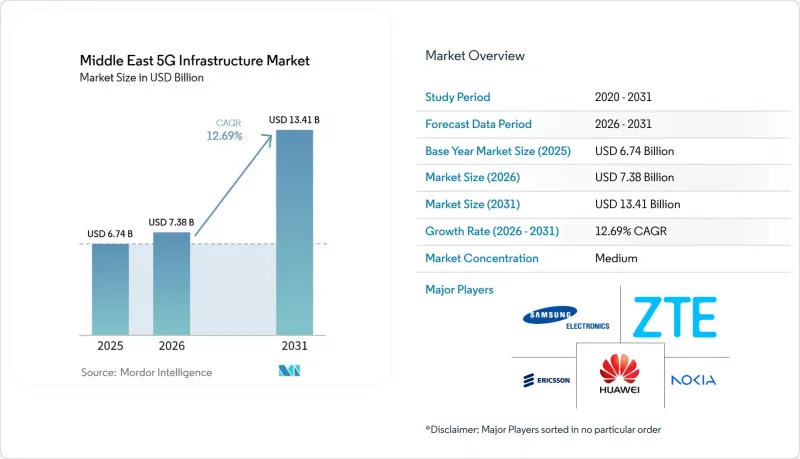
Mordor Intelligence에 의하면, 중동의 5G 인프라 시장 규모는 2025년 67억 4,000만 달러로 평가되었고, 2026년에는 73억 8,000만 달러로 추정되고, 2031년까지 134억 1,000만 달러에 이를 것으로 예상되며, 2026-2031년 CAGR 12.69%로 성장할 전망입니다.
본 보고서는 통신 인프라별(5G 무선 액세스 네트워크(RAN) 등), 주파수 대역별(저주파 대역 등), 네트워크 아키텍처별(비독립형(NSA) 및 독립형(SA)), 코어 네트워크 기술별(소프트웨어 정의 네트워크(SDN) 등), 최종 사용자 산업별(가전제품 등), 그리고 국가별로 분류되어 있습니다. 시장 전망은 금액(달러) 기준으로 제시되어 있습니다.
중동의 5G 인프라 시장 동향 및 인사이트
5G 단말 및 IoT 노드 밀도 증가
5G 단말기 및 IoT 노드 수 증가로 인해 기존 무선 네트워크상의 트래픽이 증가하고 있습니다. 이에 따라 통신 사업자들은 단순히 지리적 커버리지를 확대하는 것뿐만 아니라 용량을 증강할 수밖에 없게 되었습니다. 2026년 1분기 전 세계 5G 가입자 수는 31억 건을 넘어섰으며, GCC 국가들에는 데이터 소비량이 많은 소비자층이 존재합니다. 증강현실(XR), 차량 텔레매틱스, AI 추론은 일반적인 모바일 광대역 이용보다 기지국에 더 큰 부하를 줄 가능성이 있습니다. 사우디아라비아의 디지털 경제 전략에서도 IoT는 산업 및 스마트 시티 활동의 핵심 분야로 자리 잡고 있습니다. 유전, 항만, 물류 허브 등의 운영 환경에서는 단말기 밀도가 높아짐에 따라, 공유된 매크로 RAN 인프라를 활용하는 프라이빗 네트워크 슬라이스의 도입이 더욱 정당화됩니다. 이러한 사이트에서는 대개 동일한 운영 구역 내에서 센서, 차량, 카메라, 작업자의 단말기가 함께 사용됩니다. 지속적인 모니터링이나 시간적 제약이 따르는 운영 프로세스가 수반되기 때문에 그 연결 요구 사항은 일반 모바일 트래픽의 것과는 다를 수 있습니다.
정부 주도의 주파수 재할당 및 경매의 모멘텀
주파수 재할당은 중동 5G 인프라 시장에서 5G 고밀도화에 대한 큰 제약 요인을 완화하고 있습니다. 사우디아라비아는 3.8-4.0GHz 대역의 주파수를 할당했으며, EMEA 및 ITU 제1지역에서 최초로 600 MHz 대역을 할당한 국가가 되었습니다. 이러한 조합을 통해 통신 사업자는 커버리지 확보를 위한 저대역 주파수와 용량 확보를 위한 서브 6GHz 대역 주파수를 확보할 수 있습니다. 또한 이를 통해 실내 커버리지와 실외 매크로 기지국 구축을 동시에 실현하는 네트워크 계획이 가능해집니다. 튀르키예의 주파수 대역 개방은 대규모 국내 네트워크 구축을 가져왔으며, 지역의 투자 주기를 확대시켰습니다. 이러한 조치로 인해 RAN 및 전송망 투자에 필요한 주파수 대역 확보가 진행되고 있지만, 통신 사업자의 구축 일정은 여전히 상업적 우선순위에 따라 좌우됩니다. 주파수 대역 확보를 통해 통신 사업자는 계획의 유연성을 높일 수 있지만, 용량 도입 시기는 여전히 설치 장소에 대한 접근성, 장비 조달 및 고객 수요에 따라 결정됩니다. 따라서 규제 측면의 추진력은 구축을 뒷받침할 뿐, 실행상의 모든 위험을 제거해 주지는 않습니다.
고밀도 무선 및 광 백홀 구축의 높은 비용
고밀도 미드밴드 및 mm파 네트워크에는 무선 장비와 광섬유 백홀이 모두 필요합니다. 이러한 요건으로 인해 도심 및 기타 혼잡한 지역에서의 구축에 필요한 자본 집약도가 높아집니다. 리야드, 두바이, 이스탄불에서는 많은 수의 스몰 셀과 광섬유 연결이 필요하지만, 이러한 지역에서는 토목 공사에 대한 접근이 어려울 수 있습니다. 그 결과, 통신 사업자는 중규모 상업 지역으로 고밀도 네트워크를 확장하기 전에, 이용량이 가장 많은 장소에 지출을 집중할 가능성이 있습니다. 여러 통신 사업자가 공통의 광섬유 연결형 무선 플랫폼을 이용할 경우, 인프라 공유를 통해 비용을 절감할 수 있습니다. 따라서 중동의 5G 인프라 시장에서는 실내 시설이나 수요가 높은 도시 지역에서 중립 호스트 모델에 대한 관심이 높아질 가능성이 있습니다. 특히 건물 접근이나 토목 공사 허가에 제약이 있는 곳에서는 공유 방식을 통해 사이트 설비 및 광섬유 공사의 중복을 줄일 수 있습니다. 또한 시설 소유자가 각 통신 사업자로부터 개별 인프라를 구축받지 않고도 일관된 통신 커버리지를 제공할 수 있도록 지원할 수도 있습니다.
부문 분석
2025년, 중동의 5G 인프라 시장 점유율의 64.23%를 5G RAN이 차지했습니다. 이러한 상황은 매크로셀 구축, Massive MIMO로의 업그레이드, 그리고 멀티밴드 안테나 설치에 지속적으로 비용이 소요되고 있음을 반영합니다. 통신 사업자들은 기존 도시 네트워크 전반에 걸쳐 더 광범위한 커버리지와 더 높은 용량을 필요로 하기 때문에 RAN은 여전히 중심적인 위치를 차지하고 있습니다. 프론트홀, 미드홀, 백홀을 포함한 전송 및 xHaul은 중요한 두 번째 구성 요소가 되었습니다. 이러한 링크는 스몰 셀 클러스터와 마이크로 엣지 시설을 더 광범위한 네트워크에 연결하는 데 필요합니다. 클라우드 네이티브 5G 코어는 이 부문에서 가장 높은 성장률을 나타낼 것으로 예상되며, 2026-2031년 연평균 성장률(CAGR) 15.21%를 나타낼 것으로 전망됩니다. 이러한 성장은 모놀리식 코어 시스템에서 컨테이너형 서비스로의 전환을 반영합니다. 이러한 시스템은 네트워크 슬라이싱 및 저지연 서비스 관리를 지원할 수 있습니다. 또한 코어는 인증, 정책, 세션 제어도 조정하므로, 코어의 현대화는 네트워크 전반에 걸친 서비스 제공에 영향을 미칩니다. 통신 사업자는 소비자 대상 서비스 제공을 유지하면서 이 계층을 기존 시스템과 통합해야 합니다. 바로 이러한 요건 때문에 전환이 즉시 이루어지지 않고 단계적으로 진행되는 것입니다. 또한 통신 사업자는 새로운 모델에 맞추어 팀 교육을 실시하고, 운영 절차를 업데이트하며, 벤더와 조율해야 합니다. 실제 도입 속도는 이러한 조직적 요건과 기술의 가용성을 반영하게 될 것입니다.
통신 사업자가 무선 네트워크 업그레이드와 코어 네트워크 현대화를 더욱 밀접하게 연계함에 따라, 통신 인프라의 구성은 변화하고 있습니다. 중동의 5G 인프라 시장에서는 커버리지 및 용량 확충 프로젝트가 아직 완료되지 않았기 때문에 여전히 RAN(무선 액세스 네트워크)에 막대한 예산이 필요합니다. 반면, 클라우드 네이티브 코어 플랫폼은 4G 기반 네트워크에서는 완전히 제공할 수 없는 서비스를 지원합니다. 소프트웨어 주도형 코어 네트워크를 통해 네트워크 기능의 업데이트 및 자동화가 용이해집니다. 또한 통신 사업자의 비용 구조 일부를 초기 장비 투자에서 지속적인 소프트웨어 비용 및 관리형 서비스로 전환하는 것도 가능합니다. 멀티 액세스 엣지 컴퓨팅(MAEC)의 경우, 엣지 사이트에 전용 연결성과 컴퓨팅 하드웨어가 필요하기 때문에 추가적인 전송 요건이 발생합니다. 기가 프로젝트에서는 무선, 전송, 코어, 엣지를 통합한 구축이 필요할 가능성이 높습니다. 그 결과, 표준적인 매크로셀 업그레이드만으로는 제공할 수 없는 보다 광범위한 인프라 패키지가 실현되게 됩니다. 무선 설비의 업그레이드는 눈에 띄는 커버리지 개선을 가져오지만, 그 가치는 각 사이트의 충분한 전송 용량과 코어 처리 능력에 달려 있습니다. 따라서 통신 사업자는 여러 네트워크 도메인에 걸쳐 투자 결정을 조정할 가능성이 높습니다. 이러한 접근 방식을 통해 데이터 수요와 기업 요구 사항이 증가함에 따라 병목 현상을 완화할 수 있습니다.
1-6GHz를 포괄하는 미드밴드 주파수 대역은 2025년 중동 5G 인프라 시장 점유율의 61.10%를 차지했습니다. 이러한 우위는 GCC(걸프협력회의) 회원국 통신 사업자들의 C-밴드 광범위한 도입에 힘입은 것입니다. 미드밴드는 대도시권의 방대한 인구에 대해 커버리지와 용량의 균형을 제공합니다. 또한, 2.6GHz 및 1800 MHz 대역의 주파수 재할당은 전용 주파수 정책이 아직 충분히 마련되지 않은 지역에서의 5G 구축을 촉진했습니다. 1GHz 미만의 저대역 주파수는 사우디아라비아의 농촌 지역이나 오만의 내륙 지역에서 커버리지를 확보하는 데 여전히 중요한 역할을 하고 있습니다. 그러나 첨단 안테나 기술로 인해 중대역 매크로셀의 도달 범위와 용량이 향상됨에 따라, 그 상대적 중요성은 점차 낮아지고 있습니다. 주파수 확보를 위한 규제 조치는 중동의 5G 인프라 시장에 있어 여전히 중요한 토대가 되고 있습니다. 사우디아라비아의 주파수 할당은 저대역과 중대역 주파수 대역을 어떻게 조합하여 활용할 수 있는지를 보여주고 있습니다.
고대역/mm파는 2026년부터 2031년까지 연평균 성장률(CAGR) 18.34%를 나타낼 것으로 예측됩니다. 이 부문은 고밀도 시설의 연결, 산업용 링크, 그리고 주거용 고정 무선 접속에 의해 뒷받침되고 있습니다. mm파는 높은 처리량을 제공하지만, 신중한 설치 장소 선정과 더 숙련된 현장 작업 인력이 필요합니다. 그 역할은 광섬유 구축이 어렵고 트래픽이 집중되는 곳에서 가장 두드러집니다. 이 기술은 가정용 고정 무선 접속 및 기업용 라스트 마일 연결을 지원할 수 있습니다. 또한 데이터 수요가 집중되는 행사장, 교통 허브, 스마트 시티의 회랑에도 서비스를 제공할 수 있습니다. 저대역, 중대역, 고대역 자원이 공존함으로써 통신 사업자는 주파수 대역의 특성을 특정 커버리지나 용량 요구 사항에 맞추어 활용할 수 있습니다. 이러한 다층적 접근 방식은 해당 지역이 5G-Advanced 서비스로 전환하는 데 있어 중요합니다. 저대역 주파수 대역은 서비스를 더 광범위하게 확장할 수 있고, 중대역은 도시 지역의 주류 트래픽을 지원하며, mm파(mmWave)는 국지적인 트래픽 피크에 대응합니다. 각 대역의 전파 특성 및 용량 특성은 서로 다르기 때문에 이들은 직접적인 대체재가 될 수 없습니다. 효과적인 계획을 수립하기 위해서는 통신 사업자가 지역 수요와 설치 장소의 조건에 따라 이를 조합해야 합니다. 지리적 지형, 건물 밀도, 이용 가능한 광섬유, 그리고 소비자 및 기업의 트래픽 예상 구성 비율 등이 이러한 결정에 영향을 미칩니다. 따라서 주파수 전략은 일회성 라이선싱 행사가 아니라 지속적인 운영상의 과제가 됩니다.
기타 혜택 :
- 엑셀 형식 시장 예측(ME) 시트
- 3개월간의 애널리스트 지원
자주 묻는 질문
목차
제1장 서론
제2장 조사 방법
제3장 개요
제4장 시장 구도
제5장 시장 규모 및 성장 예측
제6장 경쟁 구도
제7장 시장 기회 및 향후 전망
AJY 26.09.01According to Mordor Intelligence, the Middle East 5G infrastructure market size is expected to increase from USD 6.74 billion in 2025 to USD 7.38 billion in 2026 and reach USD 13.41 billion by 2031, growing at a CAGR of 12.69% over 2026-2031.
This report is Segmented by Communication Infrastructure (5G Radio Access Network (RAN), and More), Spectrum Band (Low-Band and More), Network Architecture (Non-Standalone (NSA), and Standalone (SA)), Core Network Technology (Software-Defined Networking (SDN), and More), End-User Vertical (Consumer Electronics and More), and Country. The Market Forecasts are Provided in Terms of Value (USD).
Middle East 5G Infrastructure Market Trends and Insights
Rising 5G Device and IoT Node Density
The rising number of 5G devices and IoT nodes is increasing traffic on existing radio networks. This is pushing operators to add capacity rather than only expand geographic coverage. Global 5G subscriptions exceeded 3.1 billion in the first quarter of 2026, while the GCC has a high data-intensity consumer base. Extended reality, vehicle telematics, and AI inference can place more demand on cell sites than standard mobile broadband use. Saudi Arabia's digital economy strategy has also identified IoT as an important area for industrial and smart-city activity. In operational settings such as oil fields, ports, and logistics hubs, greater device density strengthens the case for private network slices that use shared macro RAN infrastructure. These sites often combine sensors, vehicles, cameras, and worker devices within the same operating area. Their connectivity requirements may differ from those of public mobile traffic, as they involve continuous monitoring and time-sensitive operational processes.
State-Led Spectrum Refarming and Auction Momentum
Spectrum refarming is easing a major constraint on 5G densification in the Middle East 5G infrastructure market. Saudi Arabia assigned spectrum in the 3.8-4.0 GHz range and was the first country in EMEA and ITU Region 1 to assign the 600 MHz band. The combination gives operators low-band spectrum for coverage and sub-6 GHz spectrum for capacity. It also allows network plans to address indoor coverage and outdoor macro deployment simultaneously. Turkey's spectrum release broadened the regional investment cycle by adding a large national network buildout. These actions improve the availability of spectrum needed for RAN and transport investment, although operator deployment schedules will still depend on commercial priorities. Spectrum availability gives operators more planning flexibility, but site access, equipment procurement, and customer demand still determine when capacity is installed. Regulatory momentum, therefore, supports deployment without removing every execution risk.
High Cost of Dense Radio and Fiber Backhaul Builds
Dense mid-band and mmWave networks require both radio equipment and fiber backhaul. These requirements raise the capital intensity of deployment in central business districts and other congested locations. Riyadh, Dubai, and Istanbul need many small cells and fiber connections, where access to civil works can be difficult. As a result, operators may focus spending on the busiest locations before extending dense networks to mid-tier commercial areas. Shared infrastructure can reduce costs when several operators use a common fiber-connected radio platform. The Middle East 5G infrastructure market may therefore see stronger interest in neutral-host models for indoor venues and high-demand urban locations. A shared approach can reduce duplicated site equipment and fiber work, especially where building access or civil permits are constrained. It can also help venue owners offer consistent coverage without requiring separate infrastructure from every operator.
Other drivers and restraints analyzed in the detailed report include:
- Fixed Wireless Access Expansion in Underserved Sites
- Carrier Migration Toward Cloud-Native Open RAN
- Vendor Sanctions and Procurement Fragmentation
For complete list of drivers and restraints, kindly check the Table Of Contents.
Segment Analysis
5G RAN accounted for 64.23% of the Middle East 5G infrastructure market share in 2025. This position reflected the continued cost of macro-cell deployment, Massive MIMO upgrades, and multi-band antenna installations. RAN remains central because operators need broader coverage and higher capacity across established urban networks. Transport and xHaul, including fronthaul, midhaul, and backhaul, formed a meaningful secondary component. These links are needed to connect small-cell clusters and micro-edge facilities with the wider network. The cloud-native 5G core is projected to record the highest growth in this category, at a 15.21% CAGR from 2026 to 2031. Its growth reflects the move from monolithic core systems toward containerized services. Such systems can support network slicing and lower-latency service management. The core also coordinates authentication, policy, and session control, so its modernization affects service delivery across the wider network. Operators must integrate this layer with existing systems while keeping consumer services available. This requirement explains why the migration is phased rather than immediate. Operators also need to train teams, update operating procedures, and coordinate vendors around the new model. The practical pace of adoption will reflect these organizational requirements and the availability of technology.
The communications infrastructure mix is changing as operators link radio upgrades more closely to core modernization. The Middle East 5G infrastructure market continues to require large RAN budgets because coverage and capacity projects remain unfinished. At the same time, cloud-native core platforms support services that cannot be fully delivered through a 4G-anchored network. A more software-led core can make network functions easier to update and automate. It can also shift part of the operator cost base from upfront equipment spending toward recurring software and managed services. Multi-access edge computing adds additional transport requirements, as edge sites require dedicated connectivity and computing hardware. Giga projects are likely to require these integrated radio, transport, core, and edge deployments. The result is a broader infrastructure package than a standard macro-cell upgrade alone would provide. Radio upgrades deliver visible coverage improvements, but their value depends on sufficient transport capacity and core processing at each site. Operators are therefore likely to coordinate investment decisions across several network domains. This approach can reduce bottlenecks as data demand and enterprise requirements increase.
Mid-band spectrum, covering 1-6 GHz, held 61.10% of the Middle East 5G infrastructure market share in 2025. Its lead was supported by extensive C-band deployment among GCC operators. Mid-band provides a balance between coverage and capacity for large urban populations. Refarming of 2.6 GHz and 1800 MHz spectrum has also supported 5G deployment, where dedicated spectrum policies were less mature. The low-band spectrum below 1 GHz remains important for coverage in rural Saudi Arabia and in Oman's inland areas. Its relative role is declining as advanced antennas improve the reach and capacity of mid-band macro cells. Regulatory action to make spectrum available remains an important foundation for the Middle East 5G infrastructure market. Saudi Arabia's spectrum assignments show how low-band and mid-band holdings can be used together.
High-band/mmWave is projected to grow at an 18.34% CAGR from 2026 to 2031. This segment is being supported by dense-venue connectivity, industrial links, and residential fixed wireless access. mmWave offers high throughput but requires careful site selection and a stronger field workforce. Its role is most compelling in locations where fiber is difficult to deploy, and high traffic is concentrated. The technology can support fixed wireless access for households and enterprise last-mile connections. It can also serve event venues, transport hubs, and smart-city corridors with concentrated data demand. The coexistence of low-, mid-, and high-band assets allows operators to match spectrum characteristics to specific coverage and capacity needs. This layered approach will be important as the region moves toward 5G-Advanced services. Low-band spectrum can extend services across wider areas, while mid-band supports mainstream urban traffic, and mmWave addresses localized peaks. The bands are not direct substitutes because their propagation and capacity characteristics differ. Effective planning requires operators to combine them according to local demand and site conditions. Geographic terrain, building density, available fiber, and the expected mix of consumer and enterprise traffic influence these decisions. Spectrum strategy is consequently a continuing operating issue rather than a one-time licensing event.
Complete Report Scope:
- By Communication Infrastructure
- 5G Radio Access Network (RAN)
- Transport / xHaul (Front-, Mid-, Back-haul)
- Core Network (Cloud-native 5GC)
- By Spectrum Band
- Low-Band (less than 1 GHz)
- Mid-Band (1-6 GHz)
- High-Band / mmWave (above 24 GHz)
- By Network Architecture
- Non-Standalone (NSA)
- Standalone (SA)
- By Core Network Technology
- Software-Defined Networking (SDN)
- Network Function Virtualization (NFV)
- Multi-access Edge Computing (MEC)
- Network Slicing
- By End-User Vertical
- Consumer Electronics
- Automotive and Mobility
- Industrial Manufacturing
- Healthcare and Life Sciences
- Energy and Utilities
- Public Safety and Defense
- Smart Cities and Infrastructure
- Other End-User Verticals (Retail, Media, Agriculture)
- By Country
- Saudi Arabia
- United Arab Emirates
- Turkey
- Rest of the Middle East
List of Companies Covered in this Report:
- Huawei Technologies Co., Ltd.
- Telefonaktiebolaget LM Ericsson
- Nokia Corporation
- ZTE Corporation
- Samsung Electronics Co., Ltd.
- Cisco Systems, Inc.
- Broadcom Inc.
- Hewlett Packard Enterprise Company
- Mavenir Systems, Inc.
- NEC Corporation
- CommScope Holding Company, Inc.
- Juniper Networks, Inc.
- Ciena Corporation
- Oracle Corporation
- Airspan Networks Holdings Inc.
- Dell Technologies Inc.
- Radisys Corporation
- Rakuten Symphony, Inc.
- Ribbon Communications Inc.
- Fujitsu Limited
Additional Benefits:
- The market estimate (ME) sheet in Excel format
- 3 months of analyst support
TABLE OF CONTENTS
1 INTRODUCTION
- 1.1 Study Assumptions and Market Definition
- 1.2 Scope of the Study
2 RESEARCH METHODOLOGY
3 EXECUTIVE SUMMARY
4 MARKET LANDSCAPE
- 4.1 Market Overview
- 4.2 Market Drivers
- 4.2.1 Rising 5G Device and IoT Node Density
- 4.2.2 Fixed Wireless Access Expansion in Underserved Sites
- 4.2.3 State-Led Spectrum Refarming and Auction Momentum
- 4.2.4 Carrier Migration Toward Cloud-Native Open RAN
- 4.2.5 Private 5G Demand in Industrial Zones and Giga Projects
- 4.2.6 Network Monetization Pressure From 5G-Advanced Use Cases
- 4.3 Market Restraints
- 4.3.1 High Cost of Dense Radio and Fiber Backhaul Builds
- 4.3.2 Vendor Sanctions and Procurement Fragmentation
- 4.3.3 mmWave Skill Gaps and Field-Force Constraints
- 4.3.4 Slow Payback on Enterprise Network-Slicing Monetization
- 4.4 Industry Value Chain Analysis
- 4.5 Regulatory Landscape
- 4.6 Technological Outlook
- 4.7 Investment and Funding Trends
- 4.8 Porter's Five Forces Analysis
- 4.8.1 Bargaining Power of Suppliers
- 4.8.2 Bargaining Power of Buyers
- 4.8.3 Threat of New Entrants
- 4.8.4 Intensity of Competitive Rivalry
- 4.8.5 Threat of Substitute Products
5 MARKET SIZE AND GROWTH FORECASTS (VALUE)
- 5.1 By Communication Infrastructure
- 5.1.1 5G Radio Access Network (RAN)
- 5.1.2 Transport / xHaul (Front-, Mid-, Back-haul)
- 5.1.3 Core Network (Cloud-native 5GC)
- 5.2 By Spectrum Band
- 5.2.1 Low-Band (less than 1 GHz)
- 5.2.2 Mid-Band (1-6 GHz)
- 5.2.3 High-Band / mmWave (above 24 GHz)
- 5.3 By Network Architecture
- 5.3.1 Non-Standalone (NSA)
- 5.3.2 Standalone (SA)
- 5.4 By Core Network Technology
- 5.4.1 Software-Defined Networking (SDN)
- 5.4.2 Network Function Virtualization (NFV)
- 5.4.3 Multi-access Edge Computing (MEC)
- 5.4.4 Network Slicing
- 5.5 By End-User Vertical
- 5.5.1 Consumer Electronics
- 5.5.2 Automotive and Mobility
- 5.5.3 Industrial Manufacturing
- 5.5.4 Healthcare and Life Sciences
- 5.5.5 Energy and Utilities
- 5.5.6 Public Safety and Defense
- 5.5.7 Smart Cities and Infrastructure
- 5.5.8 Other End-User Verticals (Retail, Media, Agriculture)
- 5.6 By Country
- 5.6.1 Saudi Arabia
- 5.6.2 United Arab Emirates
- 5.6.3 Turkey
- 5.6.4 Rest of the Middle East
6 COMPETITIVE LANDSCAPE
- 6.1 Market Concentration
- 6.2 Strategic Moves
- 6.3 Market Share Analysis
- 6.4 Company Profiles (includes Global Level Overview, Market Level Overview, Core Segments, Financials as available, Strategic Information, Market Rank/Share, Products and Services, Recent Developments)
- 6.4.1 Huawei Technologies Co., Ltd.
- 6.4.2 Telefonaktiebolaget LM Ericsson
- 6.4.3 Nokia Corporation
- 6.4.4 ZTE Corporation
- 6.4.5 Samsung Electronics Co., Ltd.
- 6.4.6 Cisco Systems, Inc.
- 6.4.7 Broadcom Inc.
- 6.4.8 Hewlett Packard Enterprise Company
- 6.4.9 Mavenir Systems, Inc.
- 6.4.10 NEC Corporation
- 6.4.11 CommScope Holding Company, Inc.
- 6.4.12 Juniper Networks, Inc.
- 6.4.13 Ciena Corporation
- 6.4.14 Oracle Corporation
- 6.4.15 Airspan Networks Holdings Inc.
- 6.4.16 Dell Technologies Inc.
- 6.4.17 Radisys Corporation
- 6.4.18 Rakuten Symphony, Inc.
- 6.4.19 Ribbon Communications Inc.
- 6.4.20 Fujitsu Limited
7 MARKET OPPORTUNITIES AND FUTURE OUTLOOK
- 7.1 White-Space and Unmet-Need Assessment


