

|
시장보고서
상품코드
2118885
아프리카의 5G 인프라 시장 : 시장 점유율 분석, 업계 동향 및 통계, 성장 예측(2026-2031년)Africa 5G Infrastructure - Market Share Analysis, Industry Trends & Statistics, Growth Forecasts (2026 - 2031) |
||||||
 Mordor Intelligence
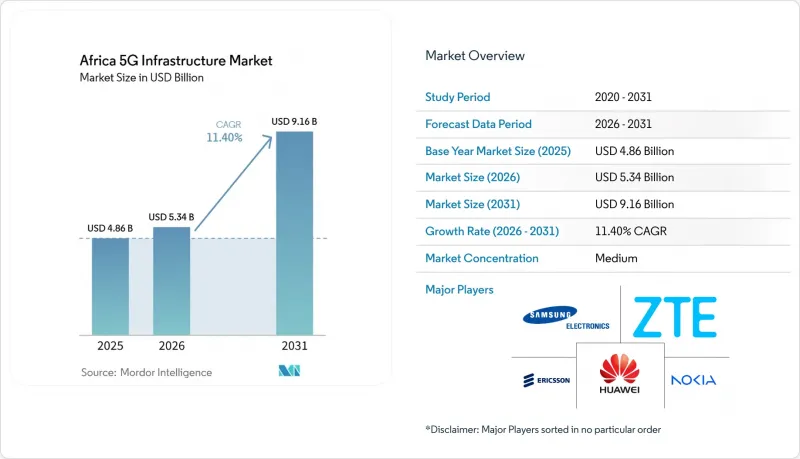
Mordor Intelligence에 의하면, 아프리카의 5G 인프라 시장 규모는 2025년에 48억 6,000만 달러로 평가되었고, 2026년 53억 4,000만 달러에서 2031년까지 91억 6,000만 달러에 이를 것으로 추정되며, 예측 기간(2026-2031년) CAGR은 11.40%를 나타낼 전망입니다.
본 보고서는 통신 인프라별(5G 무선 액세스 네트워크(RAN) 등), 주파수 대역별(저대역 등), 네트워크 아키텍처별(비독립형(NSA) 및 독립형(SA)), 코어 네트워크 기술별(소프트웨어 정의 네트워크(SDN) 등), 최종 사용자 산업 분야별(소비자용 전자기기 등), 그리고 국가별로 분류되어 있습니다. 시장 예측은 금액(달러) 기준으로 제시되어 있습니다.
아프리카의 5G 인프라 시장 동향 및 인사이트
모바일 데이터 트래픽의 급증과 5G 커버리지 격차
아프리카의 5G 인프라 시장은 장기적인 기술 계획뿐만 아니라, 기존 4G 용량에 가해지는 압박에 대응하는 것을 점점 더 중요시하고 있습니다. 사하라 이남 아프리카의 활성 스마트폰 1대당 월평균 데이터 사용량은 2025년에 5.3 GB였으나, 2031년까지 12 GB에 달할 것으로 예측됩니다. MTN 나이지리아의 설비 투자액은 데이터 트래픽이 36% 증가한 데 따라 2025년에 7,574억 나이라(5억 2,700만 달러)에 달했습니다. 이는 어려운 사업 환경 속에서 트래픽 부하가 네트워크 지출을 증가시킬 가능성이 있음을 여실히 보여줍니다. 2025년 9월 기준, 아프리카 29개 시장 중 상용 5G 서비스를 시작한 통신사는 불과 53개사에 그쳤으며, 25개 이상 시장에서는 4G 네트워크 용량 부족에 직면해 있습니다. 주로 혼잡 완화를 목적으로 5G를 활용하는 통신 사업자는 기업용 서비스나 고정 무선 접속 서비스를 병행하여 제공하지 않는 한, 수익 회복까지 걸리는 기간이 짧아질 가능성이 있습니다. 따라서 아프리카의 5G 인프라 시장은 용량에 대한 투자와 추가 수익을 창출하는 서비스 간의 균형을 적절히 맞출 수 있느냐에 달려 있습니다.
정부의 디지털 경제 프로그램과 주파수 해방의 기세
주파수 정책은 통신 사업자가 언제 장비를 발주하고 상용 서비스 제공을 시작할 수 있는지를 결정함으로써, 아프리카 5G 인프라 시장의 단기적인 전개를 좌우하고 있습니다. 이집트 국가통신규제청은 2026년 3월 ‘모바일 주파수 로드맵 2026-2030’을 발표하여, 3개 주파수 대역에 걸쳐 총 410 MHz를 추가하고, 그 할당 기간을 2039년까지 연장했습니다. 가나의 국가통신청은 2026년 7월, 700 MHz, 2.3GHz 및 3GHz 대역의 5G 주파수에 대해 경쟁적인 상업적 기반의 신청 접수를 시작했습니다. 모로코는 2025년 11월, Maroc Telecom, Orange, inwi 등 3개사에 동시에 면허를 부여했습니다. ‘디지털 모로코 2030’ 계획에 따라 2026년까지 인구의 45%, 2030년까지 85%를 커버해야 할 의무가 부과되었습니다. 이 전략은 2035년까지 800억 모로코 디르함(80억 달러)의 예산으로 지원됩니다. 면허에 따른 의무는 규제상의 기한을 설비 투자 확약으로 전환하여, 공급업체에 보다 명확한 조달 일정을 제공합니다. 아프리카 통신 연합(ATU)은 이 과정을 지원하기 위해 기술 중립적인 라이선싱과 중파대 및 고주파 대역의 조기 활용을 권장하고 있습니다.
높은 설비 투자액과 긴 회수 기간
높은 네트워크 밀도 요건과 낮은 1 사용자당 평균 수익(ARPU)으로 인해 아프리카의 5G 인프라 시장에서는 회수 기간이 장기화되고 있습니다. 중대역 및 고대역 구축에는 4G 구축보다 더 많은 기지국이 필요한 반면, 많은 아프리카 시장의 1 사용자당 평균 수익은 여전히 월 5달러 미만입니다. 에어텔 아프리카는 2026 회계연도의 설비 투자액을 7억 2,500만-7억 5,000만 달러로 전망하고 있으며, 이는 2025 회계연도의 6억 7,000만 달러에서 증가한 수치입니다. 인프라 설비는 일반적으로 달러로 구매되는 반면, 통신 사업자의 수익은 현지 통화로 계상되기 때문에 환율 변동에 따른 위험이 커지고 있습니다. MTN 나이지리아가 계획하고 있는 IHS Towers의 22억 달러 규모 인수는 타워 인프라를 관리하는 데 필요한 재정적 부담이 증가하고 있음을 보여줍니다. 이러한 자금 조달 환경으로 인해 통신 사업자들은 대규모 네트워크 투자에 있어 개발 금융이나 상업 부채에 의존할 수밖에 없는 상황에 몰릴 가능성이 있습니다.
부문별 분석
2025년, 5G 무선 액세스 네트워크 부문은 총 매출의 62.42%를 차지한 것으로 평가되었으며, 이는 통신 사업자들이 무선 인터페이스의 커버리지 확대를 우선시하고 있음을 반영합니다. 매크로 사이트 구축 활동은 남아프리카공화국, 나이지리아, 모로코, 케냐를 중심으로 진행되었습니다. 미드밴드 주파수 대역은 커버리지와 용량의 균형을 실용적으로 제공함으로써 이러한 초기 상용 구축의 상당 부분을 뒷받침했습니다. 전송 및 xHaul 네트워크에서는 광섬유 설치가 제한된 지역에서 마이크로파 및 밀리파 링크의 활용이 점점 더 증가하고 있습니다. 아프리카 5G 인프라 시장에서 무선 액세스 장비 시장 규모는 계속해서 사이트 구축 및 주파수 대역 가용성과 밀접한 관련이 있습니다. 또한, 트래픽 증가는 무선 장비의 업그레이드만으로는 대응할 수 없기 때문에 통신 사업자들은 백홀 용량 확충도 추진하고 있습니다. 이로 인해 무선, 전송 및 전원 시스템은 각 구축 프로그램에서 상호 의존적인 요소가 되었습니다. 커버리지 사각지대가 여전히 큰 한, 무선 계층은 당분간 최대 투자 대상 분야로 남을 것입니다.
클라우드 네이티브 5G 코어는 2031년까지 연평균 성장률(CAGR) 14.34%로 확대될 것으로 예측되며, 통신 인프라 중 가장 빠르게 성장하는 부문이 될 전망입니다. 이 부문은 네트워크 슬라이싱 및 엣지 컴퓨팅을 가능하게 하는 컨테이너화된 마이크로서비스 기반 설계로의 전환에 힘입어 성장하고 있습니다. MTN 남아프리카와 에릭슨은 2025년에 에릭슨의 ‘클라우드 네이티브 인프라 솔루션’을 활용하여 5G 코어의 현대화를 완료했습니다. 화웨이는 에티오 텔레콤을 위해 클라우드 네이티브 5.5G 코어를 도입하며, 코어 현대화를 동아프리카로 확대했습니다. 코어에 대한 투자는 일반적으로 초기 무선 커버리지 구축에 뒤따르지만, 통신 사업자가 보다 고도화된 엔터프라이즈 서비스를 추구할 때는 필수적입니다. 통신 사업자들이 비자립형(NSA) 네트워크에서 자립형(SA) 네트워크로 전환함에 따라, 아프리카의 5G 인프라 시장에서는 클라우드 네이티브 코어 플랫폼에 대한 수요가 점점 더 높아질 것입니다. 이러한 전환으로 인해 대상 장비 기반은 무선 하드웨어의 범위를 넘어 확대될 것입니다. 또한 소프트웨어 통합 및 운영 기술에 대한 수요도 증가할 것입니다.
2025년에는 1-6GHz의 중대역 주파수가 총 수익의 59.89%를 차지했습니다. 이 대역은 커버리지와 데이터 처리량의 균형이 잘 잡혀 있어 주요 상용 5G 주파수 대역이 되었습니다. 3.5GHz 대역은 이집트,모로코, 나이지리아, 남아프리카공화국, 케냐에서 초기 상용 서비스 개시에 사용되었습니다. 이 대역이 널리 활용됨에 따라 각국 시장에서 장비 조달 및 벤더 계획이 간소화됩니다. 저대역 주파수 대역은 농촌 지역에서 보다 광범위한 커버리지를 확보하는 데 있어 중요성이 커지고 있습니다. 나이지리아의 ‘2026-2030년 주파수 로드맵’에서는 600 MHz 대역이 우선순위로 지정되었으며, 가나의 2026년 7월 신청 절차에는 700 MHz 대역이 포함되었습니다. 아프리카의 5G 인프라 시장은 거리나 지형의 영향으로 기지국의 고밀도 구축에 비용이 많이 들기 때문에 이러한 저주파 대역에 의존하고 있습니다. 한편, 중대역은 도시 및 교외 지역에서 용량을 중시하는 공공 네트워크의 기반으로서 계속해서 중요한 역할을 할 것입니다.
24GHz를 초과하는 고대역/mm파는 2031년까지 연평균 성장률(CAGR) 16.11%로 확대될 것으로 예측되며, 이는 주파수 대역 중 가장 빠른 성장률입니다. 주요 용도는 광범위한 소비자용 모바일 통신이 아닌, 광산, 항만, 공장의 사설 네트워크가 될 것으로 전망됩니다. Rain South Africa와 Huawei는 2026년 7월, 수천 곳에 달하는 서브 1GHz 대역의 Massive MIMO 5G 구축을 시작했습니다. 이번 구축에서는 저주파 대역 구성이 채택되었지만, 극히 높은 용량과 낮은 지연 시간이 요구되는 장소에서는 밀리파가 여전히 중요한 역할을 하고 있습니다. 아프리카 규제 당국이 각국의 주파수 할당 계획을 갱신하는 가운데, 국제적인 주파수 체계가 mm파(mmWave) 라이선싱의 기반이 되고 있습니다. 장비 공급업체는 여러 주파수 대역의 조합을 지원함으로써 공공 네트워크와 사설 사이트 양쪽 수요를 모두 충족시킬 수 있습니다. 아프리카의 5G 인프라 시장에서는 주파수 대역 선택을 통해 지방 통신 지역, 도시 지역 통신 용량, 산업용 연결을 차별화하게 됩니다. 이를 통해 단일 주파수 대역 접근 방식이 아닌 개별적인 투자 사례가 창출됩니다.
기타 혜택 :
- 엑셀 형식 시장 예측(ME) 시트
- 3개월간의 애널리스트 지원
자주 묻는 질문
목차
제1장 서론
제2장 조사 방법
제3장 개요
제4장 시장 구도
제5장 시장 규모 및 성장 예측
제6장 경쟁 구도
제7장 시장 기회 및 향후 전망
AJY 26.09.01According to Mordor Intelligence, the Africa 5G infrastructure market size was valued at USD 4.86 billion in 2025 and is estimated to grow from USD 5.34 billion in 2026 to reach USD 9.16 billion by 2031, at a CAGR of 11.40% during the forecast period (2026-2031).
This report is Segmented by Communication Infrastructure (5G Radio Access Network (RAN), and More), Spectrum Band (Low-Band and More), Network Architecture (Non-Standalone (NSA), and Standalone (SA)), Core Network Technology (Software-Defined Networking (SDN), and More), End-User Vertical (Consumer Electronics and More), and Country. The Market Forecasts are Provided in Terms of Value (USD).
Africa 5G Infrastructure Market Trends and Insights
Mobile Data Traffic Surge and 5G Coverage Gaps
The Africa 5G infrastructure market is increasingly responding to pressure on existing 4G capacity rather than only to long-range technology plans. Average monthly data use per active smartphone in Sub-Saharan Africa was 5.3 GB in 2025 and is forecast to reach 12 GB by 2031. MTN Nigeria's capital expenditure reached NGN 757.4 billion (USD 527 million) in 2025, as data traffic rose 36%, underscoring how traffic pressure can increase network spending under difficult operating conditions. Only 53 operators in 29 African markets had launched commercial 5G by September 2025, leaving more than 25 markets facing capacity pressure on 4G networks. Operators that use 5G mainly to ease congestion may face shorter revenue recovery periods unless they also add enterprise and fixed wireless access services. The Africa 5G infrastructure market, therefore, depends on matching capacity investment with services that create additional revenue.
Government Digital Economy Programs and Spectrum Release Momentum
Spectrum policy is shaping the near-term pace of the Africa 5G infrastructure market by determining when operators can place equipment orders and begin commercial coverage. Egypt's National Telecommunications Regulatory Authority published its Mobile Spectrum Roadmap 2026-2030 in March 2026, adding 410 MHz across 3 bands with assignments extending through 2039. Ghana's National Communications Authority opened applications in July 2026 for 5G spectrum in the 700 MHz, 2.3 GHz, and 3 GHz bands on a competitive commercial basis. Morocco licensed Maroc Telecom, Orange, and inwi at the same time in November 2025, with coverage obligations of 45% of the population by 2026 and 85% by 2030 under Digital Morocco 2030. The strategy is supported by MAD 80 billion (USD 8 billion) through 2035. License obligations turn regulatory deadlines into capital expenditure commitments and give vendors clearer procurement schedules. The African Telecommunications Union recommends technology-neutral licensing and faster availability of mid-band and high-band spectrum to support this process.
High Capital Expenditure and Long Payback Cycles
High network density requirements and low average revenue per user create long recovery periods for the 5G infrastructure market in Africa. Mid-band and high-band deployments need more sites than 4G deployments, while average revenue per user in many African markets remains below USD 5 per month. Airtel Africa guided FY2026 capital expenditure at USD 725-750 million, up from USD 670 million in FY2025. Infrastructure equipment is generally purchased in USD, while operators earn revenue in local currencies, which increases exposure to foreign exchange movements. MTN Nigeria's planned USD 2.2 billion acquisition of IHS Towers showed the growing balance-sheet commitment required to control tower infrastructure. These funding conditions can leave operators dependent on development finance and commercial debt for large-scale network investment.
Other drivers and restraints analyzed in the detailed report include:
- Fixed Wireless Access as a Fast Path to Broadband Expansion
- Enterprise Demand for Private 5G in Mining, Ports, and Industrial Sites
- Delayed Spectrum Assignment and Regulatory Fragmentation
For complete list of drivers and restraints, kindly check the Table Of Contents.
Segment Analysis
The 5G radio access network segment accounted for 62.42% of total revenue in 2025, reflecting the priority operators placed on expanding air-interface coverage. Macro-site rollout activity centered on South Africa, Nigeria, Morocco, and Kenya. Mid-band spectrum supported many of these initial commercial deployments because it offers a practical balance between coverage and capacity. Transport and xHaul networks increasingly use microwave and millimeter-wave links where fiber is limited. The Africa 5G infrastructure market size for radio access equipment remains closely linked to site deployment and spectrum availability. Operators are also improving backhaul capacity because heavier traffic cannot be handled solely through radio upgrades. This makes radio, transport, and power systems interdependent parts of each rollout program. The radio layer will remain the largest immediate area of spending while coverage gaps remain significant.
Cloud-native 5G core is projected to expand at a 14.34% CAGR through 2031, making it the fastest-growing segment of communication infrastructure. The segment is supported by migration to containerized, microservices-based designs that enable network slicing and edge computing. MTN South Africa and Ericsson completed a 5G core modernization in 2025 using Ericsson Cloud Native Infrastructure Solution. Huawei deployed a cloud-native 5.5G core for Ethio Telecom, extending core modernization into East Africa. Core investment normally follows initial radio coverage, but it becomes essential when operators seek more advanced enterprise services. The Africa 5G infrastructure market will increasingly require cloud-native core platforms as operators move from non-standalone to standalone networks. This shift expands the addressable equipment base beyond radio hardware. It also increases demand for software integration and operational skills.
Mid-band spectrum from 1-6 GHz accounted for 59.89% of total revenue in 2025. It was the main commercial 5G spectrum range because it balances coverage with data throughput. The 3.5 GHz band was used for early commercial activations in Egypt, Morocco, Nigeria, South Africa, and Kenya. Common use of this band can simplify equipment procurement and vendor planning across national markets. Low-band spectrum is gaining importance for wider rural coverage. Nigeria's 2026-2030 Spectrum Roadmap prioritizes the 600 MHz band, while Ghana's July 2026 application process included the 700 MHz band. The Africa 5G infrastructure market depends on these lower frequencies, where distance and terrain make dense site deployment expensive. Mid-band will still anchor capacity-focused public networks in urban and suburban areas.
High-band/mmWave above 24 GHz is projected to expand at a 16.11% CAGR through 2031, the fastest rate among spectrum bands. Its main use is expected to be private networks at mines, ports, and factories rather than broad consumer mobile coverage. Rain South Africa and Huawei initiated a multi-thousand-site sub-1 GHz Massive MIMO 5G deployment in July 2026. The deployment used a low-frequency configuration, while mmWave remains relevant for locations requiring very high capacity and low latency. International spectrum frameworks provide a basis for mmWave licensing as African regulators update national frequency allocation plans. Equipment suppliers can serve both public-network and private-site demand by supporting several band combinations. The Africa 5G infrastructure market will use spectrum choice to differentiate rural coverage, urban capacity, and industrial connectivity. This creates separate investment cases rather than a single spectrum approach.
Complete Report Scope:
- By Communication Infrastructure
- 5G Radio Access Network (RAN)
- Transport / xHaul (Front-, Mid-, Backhaul)
- Core Network (Cloud-Native 5GC)
- By Spectrum Band
- Low-Band (Less Than 1 GHz)
- Mid-Band (1-6 GHz)
- High-Band / mmWave (Above 24 GHz)
- By Network Architecture
- Non-Standalone (NSA)
- Standalone (SA)
- By Core Network Technology
- Software-Defined Networking (SDN)
- Network Function Virtualization (NFV)
- Multi-Access Edge Computing (MEC)
- Network Slicing
- By End-User Vertical
- Consumer Electronics
- Automotive and Mobility
- Industrial Manufacturing
- Healthcare and Life Sciences
- Energy and Utilities
- Public Safety and Defense
- Smart Cities and Infrastructure
- Other End-User Verticals (Retail, Media, Agriculture)
- By Country
- South Africa
- Nigeria
- Rest of Africa
List of Companies Covered in this Report:
- Huawei Technologies Co., Ltd.
- Telefonaktiebolaget LM Ericsson
- Nokia Corporation
- ZTE Corporation
- Samsung Electronics Co., Ltd.
- Cisco Systems, Inc.
- Mavenir Systems, Inc.
- Airspan Networks Holdings Inc.
- Parallel Wireless, Inc.
- NEC Corporation
- Fujitsu Limited
- CommScope Holding Company, Inc.
- Juniper Networks, Inc.
- Ceragon Networks Ltd.
- Comba Telecom Systems Holdings Ltd.
- MTN Group Limited
- Vodacom Group Limited
- Safaricom PLC
Additional Benefits:
- The market estimate (ME) sheet in Excel format
- 3 months of analyst support
TABLE OF CONTENTS
1 INTRODUCTION
- 1.1 Study Assumptions and Market Definition
- 1.2 Scope of the Study
2 RESEARCH METHODOLOGY
3 EXECUTIVE SUMMARY
4 MARKET LANDSCAPE
- 4.1 Market Overview
- 4.2 Market Drivers
- 4.2.1 Mobile Data Traffic Surge and 5G Coverage Gaps
- 4.2.2 Government Digital Economy Programs and Spectrum Release Momentum
- 4.2.3 Fixed Wireless Access as a Fast Path to Broadband Expansion
- 4.2.4 Enterprise Demand for Private 5G in Mining, Ports, and Industrial Sites
- 4.2.5 Microwave and Millimeter-Wave Backhaul Modernization in Fiber-Scarce Corridors
- 4.2.6 AI-RAN, Network Automation, and Energy-Efficient Operations Lowering OPEX
- 4.3 Market Restraints
- 4.3.1 High Capital Expenditure and Long Payback Cycles
- 4.3.2 Delayed Spectrum Assignment and Regulatory Fragmentation
- 4.3.3 Unreliable Grid Power and High Dependence on Diesel Backup
- 4.3.4 Foreign Exchange Constraints and Vendor Financing Pressure
- 4.4 Industry Value Chain Analysis
- 4.5 Regulatory Landscape
- 4.6 Technological Outlook
- 4.7 Investment and Funding Trends
- 4.8 Porter's Five Forces Analysis
- 4.8.1 Bargaining Power of Suppliers
- 4.8.2 Bargaining Power of Buyers
- 4.8.3 Threat of New Entrants
- 4.8.4 Intensity of Competitive Rivalry
- 4.8.5 Threat of Substitute Products
5 MARKET SIZE AND GROWTH FORECASTS (VALUE)
- 5.1 By Communication Infrastructure
- 5.1.1 5G Radio Access Network (RAN)
- 5.1.2 Transport / xHaul (Front-, Mid-, Backhaul)
- 5.1.3 Core Network (Cloud-Native 5GC)
- 5.2 By Spectrum Band
- 5.2.1 Low-Band (Less Than 1 GHz)
- 5.2.2 Mid-Band (1-6 GHz)
- 5.2.3 High-Band / mmWave (Above 24 GHz)
- 5.3 By Network Architecture
- 5.3.1 Non-Standalone (NSA)
- 5.3.2 Standalone (SA)
- 5.4 By Core Network Technology
- 5.4.1 Software-Defined Networking (SDN)
- 5.4.2 Network Function Virtualization (NFV)
- 5.4.3 Multi-Access Edge Computing (MEC)
- 5.4.4 Network Slicing
- 5.5 By End-User Vertical
- 5.5.1 Consumer Electronics
- 5.5.2 Automotive and Mobility
- 5.5.3 Industrial Manufacturing
- 5.5.4 Healthcare and Life Sciences
- 5.5.5 Energy and Utilities
- 5.5.6 Public Safety and Defense
- 5.5.7 Smart Cities and Infrastructure
- 5.5.8 Other End-User Verticals (Retail, Media, Agriculture)
- 5.6 By Country
- 5.6.1 South Africa
- 5.6.2 Nigeria
- 5.6.3 Rest of Africa
6 COMPETITIVE LANDSCAPE
- 6.1 Market Concentration
- 6.2 Strategic Moves
- 6.3 Market Share Analysis
- 6.4 Company Profiles (includes Global Level Overview, Market Level Overview, Core Segments, Financials as available, Strategic Information, Market Rank/Share, Products and Services, Recent Developments)
- 6.4.1 Huawei Technologies Co., Ltd.
- 6.4.2 Telefonaktiebolaget LM Ericsson
- 6.4.3 Nokia Corporation
- 6.4.4 ZTE Corporation
- 6.4.5 Samsung Electronics Co., Ltd.
- 6.4.6 Cisco Systems, Inc.
- 6.4.7 Mavenir Systems, Inc.
- 6.4.8 Airspan Networks Holdings Inc.
- 6.4.9 Parallel Wireless, Inc.
- 6.4.10 NEC Corporation
- 6.4.11 Fujitsu Limited
- 6.4.12 CommScope Holding Company, Inc.
- 6.4.13 Juniper Networks, Inc.
- 6.4.14 Ceragon Networks Ltd.
- 6.4.15 Comba Telecom Systems Holdings Ltd.
- 6.4.16 MTN Group Limited
- 6.4.17 Vodacom Group Limited
- 6.4.18 Safaricom PLC
7 MARKET OPPORTUNITIES AND FUTURE OUTLOOK
- 7.1 White-Space and Unmet-Need Assessment


