

|
시장보고서
상품코드
2119072
막 : 시장 점유율 분석, 산업 동향 및 통계 데이터, 성장 예측(2026-2031년)Membranes - Market Share Analysis, Industry Trends & Statistics, Growth Forecasts (2026 - 2031) |
||||||
 Mordor Intelligence
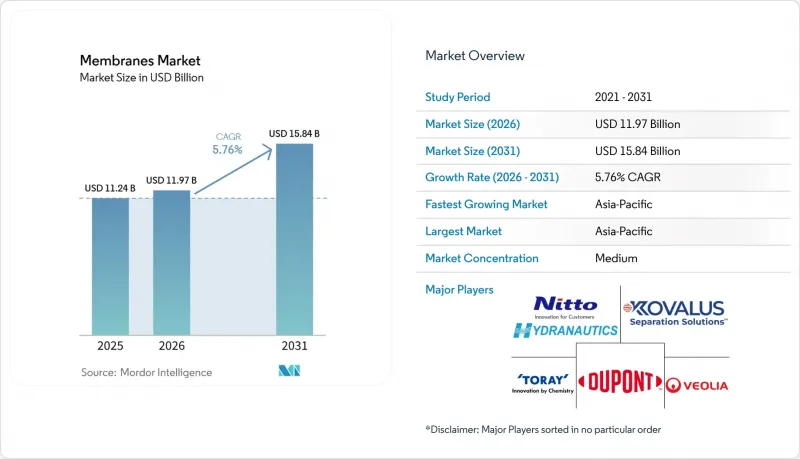
Mordor Intelligence에 따르면 막(멤브레인) 시장 규모는 2025년에 112억 4,000만 달러로 평가되며, 2026년 119억 7,000만 달러에서 2031년까지 158억 4,000만 달러에 달할 것으로 예측되고 있으며, 예측 기간(2026-2031년)에 CAGR은 5.76%에 달할 전망입니다.
이 보고서는 소재별(고분자 막 등), 기술별(역삼투(RO) 등), 모듈 구성별(나선형 권선 등),용도(상수도·하수도 처리, 식품 및 음료 가공 등), 최종 용도 산업(상하수도 등) 및 지역(아시아태평양, 북미 등)별로 분류되어 있습니다. 시장 예측은 금액(달러) 기준으로 제시되어 있습니다.
세계 막 시장의 동향 및 인사이트
물 부족의 심화와 해수 담수화 인프라의 확대
2025년, 전 세계 177개국에서 가동중인 22,000개 이상의 플랜트에서 생산되는 해수 담수화 능력은 하루 1억 3,000만 m³를 넘어섰으나, 여전히 20억 명 이상이 안전하게 관리된 식수를 확보하지 못하고 있습니다. 이러한 불균형으로 인해 대규모 해수 담수화 프로젝트와 장기적인 막 공급 계약의 필요성이 더욱 높아지고 있습니다. 사우디아라비아, 이라크, 이집트에서 계획되고 있는 새로운 시설들은 막 시장에 수년에 걸친 조달 파이프라인을 창출하고 있습니다. 물 확보는 제한된 공공사업의 문제라기보다는 국가적 인프라 문제로 변모하고 있습니다. 프로젝트 소유자가 납품의 확실성을 우선시하는 경우, 현지에서 제조 및 서비스 체계를 갖춘 공급업체는 경쟁력을 더욱 높일 수 있습니다. 또한 특히 해수 담수화가 물 안보의 핵심이 되는 지역에서는 에너지 효율이 높은 막을 선정하는 것이 재정적, 기후적 측면에서도 중요한 의미를 지닙니다.
폐수 처리, 물 재이용 및 환경 규정 준수에 관한 엄격한 규제
규제 요건으로 인해 멤브레인 시장 전반에서 처리 설비의 교체 주기가 단축되고 있습니다. 인도에서는 주요 산업 분야에서 멤브레인을 이용한 제로 액체 배출 시스템이 의무화되어 있을 뿐만 아니라, 2024년 정수 프로그램에서는 농촌 지역의 처리 시설에 역삼투법 및 한외여과법의 도입을 지원했습니다. 중국의 수질 오염 대책 계획 또한 한외여과 및 역삼투법을 이용한 산업 폐수의 보다 광범위한 재사용을 지원하고 있습니다. 유럽연합(EU)은 폐수 처리 및 신종 오염 물질 제거에 관한 요건을 지속적으로 강화하고 있습니다. 규제 대상인 처리 공정이 도입되면, 설치 후 정기적인 막 구매가 필요하게 됩니다. 이로 인해 설비 투자가 부진한 시기에는 미뤄지기 쉬운 설비 구매에 비해, 막 시장에 있으며, 보다 안정적인 수요 기반이 형성됩니다.
시스템 성능에 영향을 미치는 막의 파울링, 스케일, 바이오파울링
바이오파울링은 역삼투법을 이용한 해수 담수화 시스템에서 여전히 주요한 운영상의 제약 요인으로 남아 있습니다. 2025년에 발표된 조사에 따르면 표준적인 전처리를 거친 후에도 내염소성 박테리아가 해수 역삼투막 위에 구조화된 바이오필름을 형성할 가능성이 있는 것으로 밝혀졌습니다. 파울링이 발생하면 필요한 압력이 상승하고 에너지 소비가 증가할 뿐만 아니라, 멤브레인의 열화를 가속시킬 우려가 있습니다. 또한 실험실 모델에서는 합성 급수가 실제 가동 조건을 완벽하게 재현할 수 없기 때문에 가동중인 플랜트에서 발생하는 파울링의 심각성을 과소평가할 가능성이 있습니다. 이에 따라 막의 해부학적 분석 및 현장 고유의 특성 평가에 대한 관심이 높아지고 있습니다. 듀폰사가 2026년 3월에 발표한 NF270-400/34 업데이트에서는 초기 압력 손실 감소와 바이오 파울링 방지 성능 향상을 통해 이 문제를 해결했습니다.
부문 분석
2025년, 고분자 막은 막 시장 매출의 62.83%를 차지했습니다. 이러한 위상은 처리의 유연성, 비용 경쟁력, 그리고 도시 하수 처리 및 제약 분야의 여과에 광범위하게 활용되고 있음을 반영합니다. 폴리비닐리덴 플루오라이드(PVDF) 중공사막은 내화학성과 기계적 강도 덕분에 산업 폐수 재이용 분야에서 활용이 확대되고 있습니다. 이러한 막은 파울링이 심한 유체에서 아세트산 셀룰로오스 대체재보다 우수한 성능을 발휘합니다. 이러한 확고한 기반을 바탕으로 폴리머 제품은 주요 용도 전반에 걸쳐 막 시장 업계에서 중심적인 위치를 계속 차지하고 있습니다.
탄소 및 그래핀 기반 막은 2031년까지 연평균 성장률(CAGR) 8.61%로 성장할 것으로 예측됩니다. 2025년 조사에 따르면 저비용 동박 기판을 사용하여 500cm2의 다공성 그래핀 막 제조가 입증되었으며, 그 비용은 1 m2당 10달러로 보고되었습니다. 세라믹 막은 까다로운 온도 및 화학적 조건이 요구되는 화학, 석유화학, 식품 가공 분야에서 활용이 확대되고 있습니다. 금속 막은 에너지 및 화학 분야의 특수한 고온 분리 용도에서 여전히 중요한 역할을 하고 있습니다. 제올라이트 막, 복합 막 및 하이브리드 막은 가스 분리, 탈수, 의약품 정제, 식품 등급 농축과 같은 초기 단계 또는 특수한 용도를 지원하고 있습니다.
2025년에는 역삼투가 34.61%의 점유율을 차지하며 가장 큰 기술 부문이 되었습니다. 높은 제거율과 낮은 에너지 소비를 자랑하는 엘리먼트가 표준 교체 주기에 맞춰 구형 장치를 대체하고 있습니다. 한외여과 및 정밀여과는 계속해서 역삼투 및 나노여과의 전처리 시스템으로서 역할을 수행하고 있습니다. 도레이는 2026년 5월, 기공 크기 0.005μm의 한외여과 모듈 ‘F-HFUG 시리즈’를 출시하며, 하류 역삼투막에서 발생하는 바이오파울링의 감소를 내세우고 있습니다. 나노 여과, 막 증류, 전기 투석 및 막 바이오리액터는 식수, 염수 관리, 해수 담수화 및 도시 용수 재사용에 대한 수요를 충족시키고 있습니다.
포워드 오스모시스 시장은 2031년까지 연평균 성장률(CAGR) 9.27%로 성장할 것으로 예측됩니다. 액체 배출 제로 전처리 및 농축액 농축에 이 기술이 활용되는 것은 압력 구동형 대체 기술에 비해 에너지 소비량이 적음을 반영합니다. 이 기술은 관련 용도에서 에너지 소비를 30%에서 50%까지 줄일 수 있습니다. 2025년 인도에서 실시된 산업용 파일럿 시험에서는 나노 선택적 정방향 삼투 기술을 사용하여 1제곱미터당 1시간(LMH)의 유량으로 99.5%의 염료 제거율을 달성했습니다. 이러한 결과는 초기 도입 사례에서 보였던 비상 상황이나 군사 용도에 그치지 않는 진전을 보여줍니다.
지역별 분석
아시아태평양은 2025년에 막 시장의 42.27%를 차지하며, 2031년까지 연평균 성장률(CAGR) 6.52%로 성장할 것으로 전망됩니다. 중국의 수요는 대규모 역삼투막 생산 능력과 정부의 물 관련 프로그램에 의해 지원되고 있습니다. 중국의 생산 기반은 연간 1,000만개 이상의 역삼투막 요소를 넘어섭니다. 인도에서는 ‘나마미 강가’ 프로그램, 산업 분야의 액체 배출 제로 의무, 해안 지역의 해수 담수화 사업 확대가 수요를 견인하고 있습니다. 국내 생산량은 인도의 수요 일부만을 충족시키고 있으며, 수입 필요성이 지속되고 있으며, 이는 글로벌 공급업체들에게 협력 기회를 제공하고 있습니다.
북미는 규제 요건과 시스템 현대화에 의해 형성된 성숙한 지역입니다. 미국의 지방 자치 단체는 퍼플루오로알킬 물질 및 폴리플루오로알킬 물질(PFAS) 제거 필요성, 음용수 기준, 인프라에 대한 예산 배분에 대응하여 시스템 업그레이드를 추진하고 있습니다. 캐나다에서는 지자체 및 산업을 대상으로 한 안정적인 처리 수요가 있는 반면, 멕시코에서는 제조 거점이 공정용수 처리 수요 확대를 지원하고 있습니다. 유럽은 ‘물 프레임워크 지침’ 및 ‘도시 폐수 처리 지침’에 의해 주도되고 있습니다. 독일, 프랑스, 영국이 제약, 식품 및 음료 및 지자체용 분야에서 도입을 주도하고 있습니다. 독일, 네덜란드, 아일랜드의 반도체 프로젝트는 초순수용 막에 대한 새로운 수요 기반을 창출하고 있습니다.
중동 및 아프리카는 막 시장에서 자본 집약도가 가장 높은 지역 중 하나입니다. 사우디아라비아의 라스 모하이센 해수 담수화 프로젝트는 2025년에 6억 8,600만 달러의 투자로 금융 계약을 완료할 예정이며, 2030년까지 완전 가동시 하루 30만 m³의 생산을 계획하고 있습니다. 이 지역의 해수 담수화 입찰에서는 공급업체 선정에 있으며, 현지 생산의 중요성이 점점 더 커지고 있습니다. 브라질과 아르헨티나는 도시 용수 및 산업 폐수 처리를 통해 남미의 수요를 지원하고 있습니다. 거시경제의 변동과 인프라 자금 부족으로 인해 이 지역 일부에서는 프로젝트 활동이 위축되고 있습니다. 이 지역들의 막 시장 규모는 공공 사업에 대한 투자 및 산업용수 재이용 프로젝트의 시행 시기에 크게 좌우됩니다.
기타 혜택:
- Excel 형식의 시장 예측(ME) 시트
- 3개월간의 애널리스트 지원
자주 묻는 질문
목차
제1장 서론
제2장 분석 방법
제3장 개요
제4장 시장 구도
제5장 시장 규모·성장률 예측
제6장 경쟁 구도
제7장 시장 기회와 향후 전망
KSA 26.09.02According to Mordor Intelligence, the membranes market was valued at USD 11.24 billion in 2025 and is estimated to grow from USD 11.97 billion in 2026 to reach USD 15.84 billion by 2031, at a CAGR of 5.76% during the forecast period (2026-2031).
This report is Segmented by Material (Polymeric Membranes, and More), Technology (Reverse Osmosis (RO), and More), Module Configuration (Spiral Wound, and More), Application (Water and Wastewater Treatment, Food and Beverage Processing, and More), End-Use Industry (Municipal Water and Wastewater, and More), and Geography (Asia-Pacific, North America, and More). The Market Forecasts are Provided in Terms of Value (USD).
Global Membranes Market Trends and Insights
Increasing Water Scarcity and Expansion of Desalination Infrastructure
Global desalination capacity exceeded 130 million m3 per day in 2025 across more than 22,000 operating plants in 177 countries, while more than 2 billion people still lacked safely managed drinking water. This imbalance is strengthening the case for large-scale desalination projects and long-term membrane supply agreements. New facilities planned in Saudi Arabia, Iraq, and Egypt create a multi-year procurement pipeline for the membranes market. Water availability is becoming a national infrastructure issue rather than a limited utility concern. Suppliers with local manufacturing and service capabilities can become more competitive when project owners prioritize delivery certainty. Energy-efficient membrane selection also carries fiscal and climate importance, particularly where desalination is central to water security.
Stringent Regulations for Wastewater Treatment, Water Reuse, and Environmental Compliance
Regulatory requirements are shortening replacement cycles for treatment equipment across the membranes market. India requires membrane-based zero-liquid-discharge systems in critical industrial sectors, while its 2024 clean-water program supported reverse osmosis and ultrafiltration in rural treatment plants. China's water pollution plan also supports broader industrial wastewater reclamation using ultrafiltration and reverse osmosis. The European Union continues to raise requirements for wastewater treatment and removal of emerging contaminants. A regulated treatment step creates recurring membrane purchases once it is installed. This supports a more stable demand base for the membranes market than equipment purchases that can be deferred during periods of weaker capital spending.
Membrane Fouling, Scaling, and Biofouling Affecting System Performance
Biofouling remains a major operating constraint in reverse osmosis desalination systems. Research published in 2025 found that chlorine-resistant bacteria can form structured biofilms on seawater reverse osmosis membranes after standard pretreatment. Fouling raises pressure requirements, which increases energy use and can speed membrane aging. Laboratory models can also understate the severity of fouling in operating plants because synthetic feedwater does not fully reproduce field conditions. This has increased interest in membrane autopsies and site-specific characterization. DuPont's March 2026 NF270-400/34 update addressed this issue with lower initial pressure drop and improved biofouling protection.
Other drivers and restraints analyzed in the detailed report include:
- Rapid Industrialization and Urbanization Driving Demand for Advanced Water Treatment Solutions
- Growing Purity Requirements in Pharmaceutical and Biopharmaceutical Manufacturing
- High Energy Consumption Associated with Pressure-Driven Membrane Processes
For complete list of drivers and restraints, kindly check the Table Of Contents.
Segment Analysis
Polymeric membranes held 62.83% of the membranes market revenue in 2025. Their position reflects processing flexibility, cost competitiveness, and extensive use in municipal water treatment and pharmaceutical filtration. Polyvinylidene fluoride hollow fiber membranes are gaining use in industrial wastewater reuse because of their chemical resistance and mechanical strength. They can perform better than cellulose acetate alternatives in high-fouling streams. This established base keeps polymeric products central to the membranes market industry across major applications.
Carbon and graphene-based membranes are forecast to grow at an 8.61% CAGR through 2031. Research from 2025 demonstrated porous graphene membrane production at 500 cm2 using low-cost copper foil substrates with a reported cost of USD 10 per m2. Ceramic membranes are gaining use in chemical, petrochemical, and food processing settings with demanding temperature and chemical conditions. Metallic membranes remain relevant for specialized high-temperature separations in energy and chemical applications. Zeolite, composite, and hybrid membranes support earlier-stage or specialized uses in gas separation, dehydration, pharmaceutical clarification, and food-grade concentration.
Reverse osmosis was the largest technology segment in 2025 with a 34.61% share. High-rejection and lower-energy elements are replacing older units during standard replacement cycles. Ultrafiltration and microfiltration continue to serve as pretreatment systems for reverse osmosis and nanofiltration. Toray introduced the F-HFUG Series ultrafiltration module in May 2026, with a 0.005 µm pore size and a stated reduction in downstream reverse osmosis biofouling. Nanofiltration, membrane distillation, electrodialysis, and membrane bioreactors serve drinking water, brine management, desalination, and municipal reuse needs.
Forward osmosis is projected to expand at a 9.27% CAGR through 2031. Its use in zero-liquid-discharge pretreatment and brine concentration reflects lower energy use than pressure-driven alternatives. The technology can reduce energy consumption by 30% to 50% in relevant applications. A 2025 industrial pilot in India achieved 99.5% dye rejection at 10 liters per square meter per hour (LMH) flux with nano-selective forward osmosis technology. These results indicate progress beyond the emergency and military uses that characterized earlier installations.
Complete Report Scope:
- By Material
- Polymeric Membranes
- Ceramic Membranes
- Metallic Membranes
- Carbon and Graphene-Based Membranes
- Zeolite Membranes
- Composite and Hybrid Membranes
- By Technology
- Reverse Osmosis (RO)
- Forward Osmosis (FO)
- Ultrafiltration (UF)
- Microfiltration (MF)
- Nanofiltration (NF)
- Membrane Distillation (MD)
- Electrodialysis and Electrodialysis Reversal (ED/EDR)
- Pervaporation
- Membrane Bioreactors (MBR)
- Other Technologies
- By Module Configuration
- Spiral Wound
- Hollow Fiber
- Tubular
- Plate and Frame
- Capillary
- By Application
- Water and Wastewater Treatment
- Food and Beverage Processing
- Pharmaceutical and Medical Processing
- Chemical and Petrochemical Processing
- Electronics and Semiconductor Processing
- Pulp and Paper Processing
- Oil and Gas Processing
- Other Applications
- By End-Use Industry
- Municipal Water and Wastewater
- Food and Beverage
- Pharmaceuticals and Healthcare
- Chemical and Petrochemical
- Electronics and Semiconductors
- Power Generation
- Oil and Gas
- Pulp and Paper
- Other End-Use Industries
- By Geography
- Asia-Pacific
- China
- India
- Japan
- South Korea
- Rest of Asia-Pacific
- North America
- United States
- Canada
- Mexico
- Europe
- Germany
- United Kingdom
- France
- Italy
- Russia
- Rest of Europe
- South America
- Brazil
- Argentina
- Rest of South America
- Middle-East and Africa
- Saudi Arabia
- South Africa
- Rest of Middle-East and Africa
- Asia-Pacific
Geography Analysis
Asia-Pacific commanded 42.27% of the membranes market share in 2025 and is forecast to grow at a 6.52% CAGR through 2031. China's demand is supported by large reverse osmosis manufacturing capacity and government water programs. Its production base exceeds 10 million reverse osmosis elements annually. In India, demand is supported by the Namami Gange program, industrial zero-liquid-discharge mandates, and coastal desalination expansion. Domestic production meets only a portion of Indian demand, maintaining the need for imports and creating partnership opportunities for global suppliers.
North America is a mature region shaped by regulatory requirements and system modernization. U.S. municipal utilities are upgrading systems in response to per- and polyfluoroalkyl substances (PFAS) remediation needs, drinking water standards, and infrastructure allocations. Canada supplies stable municipal and industrial treatment demand, while Mexico's manufacturing base supports greater process-water treatment needs. Europe is driven by the Water Framework Directive and the Urban Wastewater Treatment Directive. Germany, France, and the United Kingdom lead adoption in pharmaceutical, food and beverage, and municipal applications. Semiconductor projects in Germany, the Netherlands, and Ireland are adding a newer demand base for ultrapure water membranes.
The Middle-East and Africa is among the most capital-intensive regions for the membranes market. Saudi Arabia's Ras Mohaisen desalination project reached financial close in 2025 with an investment of USD 686 million and is planned to produce 300,000 m3 per day at full capacity by 2030. Local production is becoming more relevant in supplier selection for regional desalination tenders. Brazil and Argentina anchor South American demand through municipal water and industrial effluent treatment. Macroeconomic volatility and infrastructure finance gaps moderate project activity in parts of the region. The membranes market size across these regions depends heavily on the timing of utility investment and industrial water reuse projects.
- Alfa Laval
- Applied Membranes, Inc.
- DuPont
- GEA Group Aktiengesellschaft
- Hydranautics - A Nitto Group Company
- Kovalus Separation Solutions
- MANN+HUMMEL
- Nanostone Water, Inc.
- Pall Corporation
- Pentair
- Sterlitech Corporation
- Synder Filtration, Inc.
- Thermo Fisher Scientific Inc.
- TORAY INDUSTRIES, INC.
- TOYOBO CO., LTD.
- Veolia
- Xylem
Additional Benefits:
- The market estimate (ME) sheet in Excel format
- 3 months of analyst support
TABLE OF CONTENTS
1 Introduction
- 1.1 Study Assumptions and Market Definition
- 1.2 Scope of the Study
2 Research Methodology
3 Executive Summary
4 Market Landscape
- 4.1 Market Overview
- 4.2 Market Drivers
- 4.2.1 Increasing Water Scarcity and Expansion of Desalination Infrastructure
- 4.2.2 Stringent Regulations for Wastewater Treatment, Water Reuse, and Environmental Compliance
- 4.2.3 Rapid Industrialization and Urbanization Driving Demand for Advanced Water Treatment Solutions
- 4.2.4 Growing Purity Requirements in Pharmaceutical and Biopharmaceutical Manufacturing
- 4.2.5 Rising Water Demand from Semiconductor Manufacturing and Electronics Production
- 4.3 Market Restraints
- 4.3.1 Membrane Fouling, Scaling, and Biofouling Affecting System Performance
- 4.3.2 High Energy Consumption Associated with Pressure-Driven Membrane Processes
- 4.3.3 High Capital Investment and Membrane Replacement Costs
- 4.4 Value Chain Analysis
- 4.5 Porter's Five Forces Analysis
- 4.5.1 Threat of New Entrants
- 4.5.2 Bargaining Power of Suppliers
- 4.5.3 Bargaining Power of Buyers
- 4.5.4 Threat of Substitutes
- 4.5.5 Competitive Rivalry
5 Market Size and Growth Forecasts (Value)
- 5.1 By Material
- 5.1.1 Polymeric Membranes
- 5.1.2 Ceramic Membranes
- 5.1.3 Metallic Membranes
- 5.1.4 Carbon and Graphene-Based Membranes
- 5.1.5 Zeolite Membranes
- 5.1.6 Composite and Hybrid Membranes
- 5.2 By Technology
- 5.2.1 Reverse Osmosis (RO)
- 5.2.2 Forward Osmosis (FO)
- 5.2.3 Ultrafiltration (UF)
- 5.2.4 Microfiltration (MF)
- 5.2.5 Nanofiltration (NF)
- 5.2.6 Membrane Distillation (MD)
- 5.2.7 Electrodialysis and Electrodialysis Reversal (ED/EDR)
- 5.2.8 Pervaporation
- 5.2.9 Membrane Bioreactors (MBR)
- 5.2.10 Other Technologies
- 5.3 By Module Configuration
- 5.3.1 Spiral Wound
- 5.3.2 Hollow Fiber
- 5.3.3 Tubular
- 5.3.4 Plate and Frame
- 5.3.5 Capillary
- 5.4 By Application
- 5.4.1 Water and Wastewater Treatment
- 5.4.2 Food and Beverage Processing
- 5.4.3 Pharmaceutical and Medical Processing
- 5.4.4 Chemical and Petrochemical Processing
- 5.4.5 Electronics and Semiconductor Processing
- 5.4.6 Pulp and Paper Processing
- 5.4.7 Oil and Gas Processing
- 5.4.8 Other Applications
- 5.5 By End-Use Industry
- 5.5.1 Municipal Water and Wastewater
- 5.5.2 Food and Beverage
- 5.5.3 Pharmaceuticals and Healthcare
- 5.5.4 Chemical and Petrochemical
- 5.5.5 Electronics and Semiconductors
- 5.5.6 Power Generation
- 5.5.7 Oil and Gas
- 5.5.8 Pulp and Paper
- 5.5.9 Other End-Use Industries
- 5.6 By Geography
- 5.6.1 Asia-Pacific
- 5.6.1.1 China
- 5.6.1.2 India
- 5.6.1.3 Japan
- 5.6.1.4 South Korea
- 5.6.1.5 Rest of Asia-Pacific
- 5.6.2 North America
- 5.6.2.1 United States
- 5.6.2.2 Canada
- 5.6.2.3 Mexico
- 5.6.3 Europe
- 5.6.3.1 Germany
- 5.6.3.2 United Kingdom
- 5.6.3.3 France
- 5.6.3.4 Italy
- 5.6.3.5 Russia
- 5.6.3.6 Rest of Europe
- 5.6.4 South America
- 5.6.4.1 Brazil
- 5.6.4.2 Argentina
- 5.6.4.3 Rest of South America
- 5.6.5 Middle-East and Africa
- 5.6.5.1 Saudi Arabia
- 5.6.5.2 South Africa
- 5.6.5.3 Rest of Middle-East and Africa
- 5.6.1 Asia-Pacific
6 Competitive Landscape
- 6.1 Market Concentration
- 6.2 Strategic Moves
- 6.3 Market Share (%)/Ranking Analysis
- 6.4 Company Profiles (includes Global Overview, Market Overview, Core Segments, Financials as available, Strategic Information, Products and Services, and Recent Developments)
- 6.4.1 Alfa Laval
- 6.4.2 Applied Membranes, Inc.
- 6.4.3 DuPont
- 6.4.4 GEA Group Aktiengesellschaft
- 6.4.5 Hydranautics - A Nitto Group Company
- 6.4.6 Kovalus Separation Solutions
- 6.4.7 MANN+HUMMEL
- 6.4.8 Nanostone Water, Inc.
- 6.4.9 Pall Corporation
- 6.4.10 Pentair
- 6.4.11 Sterlitech Corporation
- 6.4.12 Synder Filtration, Inc.
- 6.4.13 Thermo Fisher Scientific Inc.
- 6.4.14 TORAY INDUSTRIES, INC.
- 6.4.15 TOYOBO CO., LTD.
- 6.4.16 Veolia
- 6.4.17 Xylem
7 Market Opportunities and Future Outlook
- 7.1 White-Space and Unmet-Need Assessment


