

|
시장보고서
상품코드
2119079
점토 : 시장 점유율 분석, 산업 동향 및 통계 데이터, 성장 예측(2026-2031년)Clay - Market Share Analysis, Industry Trends & Statistics, Growth Forecasts (2026 - 2031) |
||||||
 Mordor Intelligence
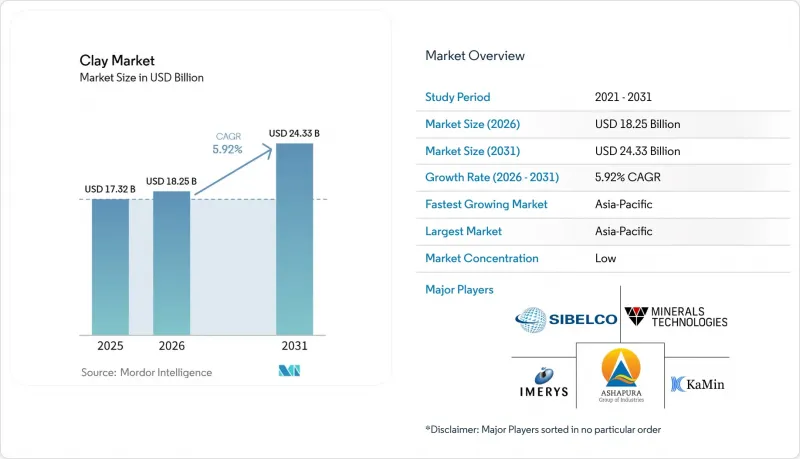
Mordor Intelligence에 따르면 점토 시장 규모는 2025년에 173억 2,000만 달러로 추계되고 있으며, 예측 기간(2026-2031년)에 CAGR 5.92%로 확대하며, 2026년 182억 5,000만 달러에서 2031년에는 243억 3,000만 달러에 달할 것으로 전망되고 있습니다.
이 보고서는 형태(덩어리, 분말 등), 점토의 유형(카올린(차이나 클레이), 벤토나이트 등), 용도(도자기·세라믹, 건설 자재 등) 및 지역(아시아태평양, 북미, 유럽, 남미, 중동 및 아프리카)별로 분류되어 있습니다. 시장 전망은 금액(달러) 기준으로 제시되어 있습니다.
세계 점토 시장의 동향 및 인사이트
세라믹, 위생도기, 건설 분야의 수요 확대
점토는 주택 및 상업 프로젝트와 리모델링 공사에서 벽돌, 타일, 위생도기 및 관련 건축자재로 사용되므로 건설 업계는 여전히 점토 시장의 주요 수요 기반입니다. 카올린과 볼클레이는 위생 도기에 요구되는 성형 가소성과 소성 후의 백색도를 제공하므로 중소득 국가에서의 주택 준공 및 개보수 지출이 수요와 관련이 있습니다. 소성 점토는 소성 세라믹 제품뿐만 아니라 저탄소 시멘트의 배합에도 사용할 수 있으며, 건설 분야의 또 다른 용도로 활용되고 있습니다. 석회석·소성 점토 시멘트(LC3) 방식에서는 클링커의 50%를 소성 점토와 석회석으로 대체함으로써 시멘트 관련 이산화탄소 배출량을 최대 40%까지 줄일 수 있습니다. LC3의 소성 온도는 약 800°C인 반면, 클링커는 약 1,450°C로, 이러한 낮은 소성 온도가 시멘트 탈탄소화에서 LC3의 중요성을 지원하고 있습니다. 세계 시멘트·콘크리트 협회(GCCA)는 플라이애시 및 분쇄 고로 슬래그의 공급량이 감소하는 가운데, 소성 점토를 확립된 기술 중 하나로 자리매김하고 있습니다. 몰린즈(Mollins)사는 2025년 7월까지 스페인 국내에 122,000 m3 이상의 LC3 콘크리트 및 모르타르를 납품했습니다.
종이 포장, 코팅, 기능성 충전재 분야에서 점토의 활용 확대
디지털화로 인해 그래픽 인쇄용 등급의 수요는 감소했으나, 포장 수요가 종이 용도에서의 카올린 소비를 지원하며 점토 시장에서 중요한 역할을 유지하고 있습니다. 코팅 포장지, 라벨, 특수 용지에서는 광도, 불투명도, 잉크 유지력, 표면 외관이 완제품에 영향을 미치기 때문에 카올린이 사용됩니다. E-Commerce는 코팅 포장지 수요를 지원하며, 그래픽 중심의 종이 수요 감소를 부분적으로 상쇄하고 있습니다. 소성 카올린은 가공을 통해 백색도와 유변학적 특성이 향상되므로 더 높은 부가가치가 인정받고 있습니다. 한편, 자동차용 플라스틱에는 더 엄격한 성능 요건을 충족하는 표면 개질된 필러가 요구되고 있습니다. 이메리스는 2025년 8월, 지속가능한 포장 및 제지용 코팅용 카올린 제품을 출시했습니다. 이는 차별화되지 않은 필러 소재보다 가공된 등급에 더 큰 가치가 부여되고 있음을 반영합니다.
광업, 토지 복원 및 물 이용에 관한 엄격한 환경 규제
광산 복구 요건으로 인해 채굴에 드는 자본적·기술적 부담이 증가하고 있으며, 폐산 비용을 조기에 계획하지 않은 생산자에게는 이러한 의무가 이익률을 압박할 가능성이 있습니다. 호주에서는 광업권 보유자가 채굴로 인한 토지 변형 후, 합리적으로 실행 가능한 한 신속히 복구 작업을 시작하고, 광구에 대해 의도된 최종 토지 이용을 실현해야 합니다. 플로리다주에서는 풀러스 어스 채굴 사업자에게 운영 전 및 운영 중에 채굴 의향 통지, 승인된 복원 계획, 그리고 우수 배수 허가 취득이 의무화되어 있습니다. 규정 준수 비용은 기존 생산자들에게 압박을 가하고 신규 생산 능력 확장을 지연시킬 수 있지만, ISO 14001 시스템과 국가의 복원 관련 법규는 여전히 중요한 운영상의 고려 사항입니다. 환경 관리 인프라가 제대로 갖춰지지 않은 소규모 지역 생산자들은 더 큰 위험에 직면해 있으며, 점토 시장에서는 생산의 지속성과 토지, 물, 복원에 관한 의무 간의 균형을 맞춰야 합니다.
부문 분석
2025년 현재, 분말은 점토 시장 점유율의 44.57%를 차지하고 있으며, 세라믹, 도료, 건설 자재 등 폭넓은 분야에서 취급이 용이하므로 여전히 주요 형태를 유지하고 있습니다. 아시아의 많은 세라믹 중심 시장에서는 건식 혼련이 표준으로 자리 잡고 있으며, 타일 및 위생 도기 원료 제조에 대한 분말 수요를 지원하고 있습니다. 과립은 점유율은 작지만 농업 및 서방형 용도로 이용되고 있으며, 분진 억제 및 유동 특성이 이러한 용도에서의 사용을 지원하고 있습니다.
덩어리 형태의 점토는 가공도가 가장 낮은 형태이며, 일반적인 벽돌이나 경량 골재 등 부가가치가 낮은 용도에서 널리 사용되고 있습니다. 이러한 용도에서는 운송 비용이나 현지 조달 가능성이 구매 결정의 주요 요인이 되는 경우가 많습니다. 슬러리는 2031년까지 연평균 성장률(CAGR) 6.18%로 확대될 것으로 예측되며, 가장 빠르게 성장하는 형태가 될 것입니다. 슬러리에 대한 수요는 미리 분산된 고고형분 원료를 선호하는 제지 및 도료 제조업체들에 의해 지원되고 있습니다. 슬러리를 조제함으로써 출하 전 입자 크기 분포와 표면 화학적 특성을 제어하기 쉬워집니다. 이 형태는 조제 및 펌프 이송을 위한 인프라가 필요하므로 광물 가공을 일체화한 기업에 유리하게 작용할 가능성이 있습니다.
지역별 분석
아시아태평양은 2025년에 시장 매출의 46.87%를 차지하며, 2031년까지 연평균 성장률(CAGR) 6.43%로 성장하여 가장 크게 성장 속도가 가장 빠른 지역 시장이 될 것으로 전망됩니다. 이 지역의 점토 시장은 대규모 세라믹 생산, 활발한 건설 활동, 그리고 다양한 등급의 점토를 소비하는 광범위한 산업 고객 기반에 의해 지원되고 있습니다. 중국은 여전히 세계 최대 세라믹 생산국이자 주요 제지 시장으로, 건설용 및 가공용 카올린 제품 모두에 대한 수요를 주도하고 있습니다. 인도는 중요한 성장 거점이며, 그 수요는 건설 활동, 걸프 지역 유전 서비스 사업자에 대한 벤토나이트 수출, 그리고 의약품 용도에서 비롯됩니다. 아샤프라 마인켐 리미티드는 2026년 상반기 인도 사업 매출이 25% 이상 증가했다고 보고했으며, 이는 지속적으로 확대되는 국내 및 수출 시장의 상업적 중요성을 반영합니다.
일본과 한국은 전자기기, 세라믹, 특수 코팅용으로 미국 및 호주에서 고순도 카올린을 수입하고 있으며, 이러한 분야에서는 가격보다 품질 요건이 조달 결정의 주요 요인이 되고 있습니다. 북미는 두 번째로 큰 지역 시장으로, 제지, 환경 복원, 반려동물 용품, 유전 서비스 분야의 수요에 힘입어 성장했습니다. 이러한 분야에서는 각각 다른 유형의 점토와 등급이 요구됩니다. 2025년, 미국의 점토 생산량은 2,600만 톤, 생산액은 18억 달러에 달했으며, 38개 주에서 약 120개 기업이 운영되고 있습니다. 2025년, 미국은 330만 메트릭 톤의 점토 제품을 수출했습니다. 여기에는 64만 메트릭톤의 벤토나이트와 160만 메트릭톤의 카올린이 포함됩니다. 멕시코는 이 지역내 두 번째 공급원이며, 연간 210만 메트릭톤의 카올린을 생산할 뿐만 아니라 미국의 벤토나이트 수출 주요 목적지이기도 합니다.
유럽 및 기타 지역은 각각 다른 발전 단계에 있으며, 수요는 산업 정책, 지역 광물 자원, 건설 계획, 그리고 석유 및 가스 관련 활동에 따라 좌우됩니다. 체코는 2024년에 240만 톤의 카올린을 생산했으나, 유럽의 생산자들은 벽돌 제조용 저부가가치 일반 점토 외에도 시멘트 및 도료용 고규격 소성 점토도 공급하고 있습니다. 유럽의 탈탄소화 정책은 소성 점토와 시멘트의 혼합재 사용을 장려하고 있습니다. 남미 시장은 브라질의 카올린 매장량을 중심으로 전개되고 있으며, 중동 및 아프리카는 사우디아라비아의 건설, 세라믹, 광업, 그리고 걸프 지역의 시추 활동으로 인한 혜택을 받고 있습니다. 이 지역들은 현지 건설 수요의 혜택도 누리고 있으며, 인도와 터키의 수출업체들은 유전 관련 벤토나이트 공급을 지속하고 있습니다.
기타 혜택:
- Excel 형식의 시장 예측(ME) 시트
- 3개월간의 애널리스트 지원
자주 묻는 질문
목차
제1장 서론
제2장 분석 방법
제3장 개요
제4장 시장 구도
제5장 시장 규모·성장률 예측
제6장 경쟁 구도
제7장 시장 기회와 향후 전망
KSA 26.09.02According to Mordor Intelligence, the clay market size was estimated at USD 17.32 billion in 2025 and is estimated to grow from USD 18.25 billion in 2026 to USD 24.33 billion by 2031, at a CAGR of 5.92% during the forecast period (2026-2031).
This report is Segmented by Form (Lump, Powder, and More), Clay Type (Kaolin (China Clay), Bentonite, and More), Application (Ceramics and Pottery, Construction Materials, and More), and Geography (Asia-Pacific, North America, Europe, South America, and Middle-East and Africa). The Market Forecasts are Provided in Terms of Value (USD).
Global Clay Market Trends and Insights
Expansion of Ceramic, Sanitaryware, and Construction Demand
Construction remains a major demand base for the clay market, as clay is used in bricks, tiles, sanitaryware, and related building materials across housing, commercial projects, and renovation work. Kaolin and ball clay provide the forming plasticity and post-firing whiteness required in sanitaryware, making housing completions and renovation spending in middle-income economies relevant to demand. Calcined clay represents a separate construction application, as it can be used in lower-carbon cement formulations rather than only in fired ceramic products. The Limestone Calcined Clay Cement (LC3) approach can reduce cement-related carbon dioxide emissions by up to 40% when 50% of clinker is replaced by calcined clay and limestone. LC3 is calcined at around 800°C, compared to around 1,450°C for clinker, and this lower temperature supports its relevance to cement decarbonization. The Global Cement and Concrete Association identifies calcined clays as an established route as the availability of fly ash and ground granulated blast-furnace slag declines. Molins had delivered more than 122,000 m3 of LC3 concrete and mortar in Spain by July 2025.
Increasing Use of Clay in Paper Packaging, Coatings, and Functional Fillers
Digitalization has reduced demand for graphical printing grades, but packaging demand has supported kaolin consumption in paper applications and retained an important role for the clay market. Coated packaging boards, labels, and specialty papers use kaolin because brightness, opacity, ink holdout, and surface appearance affect the finished product. E-commerce supports demand for coated packaging and partly offsets the decline in graphics-focused paper demand. Calcined kaolin commands greater value because processing improves its whiteness and rheological properties, while automotive plastics require surface-engineered fillers that meet tighter performance requirements. Imerys launched kaolin products for sustainable packaging and paper coatings in August 2025, reflecting the value placed on processed grades over undifferentiated filler material.
Stringent Environmental Regulations Governing Mining, Land Rehabilitation, and Water Usage
Mine rehabilitation requirements raise the capital and technical demands of extraction, and these obligations can compress margins for producers that do not plan for closure costs early. In Australia, mining lease holders must begin rehabilitation as soon as reasonably practicable after disturbance and deliver the intended final land use for the mining area. In Florida, fuller's earth operators require notices of intent to mine, approved reclamation plans, and stormwater permits before and during operations. Compliance costs can pressure existing producers and delay new capacity, while ISO 14001 systems and national rehabilitation laws remain important operating considerations. Smaller regional producers face greater risk where they lack environmental management infrastructure, leaving the clay market to balance production continuity with land, water, and rehabilitation obligations.
Other drivers and restraints analyzed in the detailed report include:
- Rising Consumption of Bentonite in Drilling Fluids, Foundry Applications, and Civil Engineering
- Increasing Focus on Mineral Beneficiation and Mine Waste Recovery to Enhance Resource Utilization
- Competition from Alternative Materials such as Calcium Carbonate, Talc, Silica, and Synthetic Functional Fillers
For complete list of drivers and restraints, kindly check the Table Of Contents.
Segment Analysis
Powder held 44.57% of the clay market share in 2025 and remained the leading form due to ease of handling across ceramics, paints, and construction materials. Dry mixing is standard in many ceramics-focused markets in Asia, supporting demand for powder in the preparation of tile and sanitaryware bodies. Granules held a smaller share but serve agriculture and controlled-release applications, where dust control and flow characteristics support their use.
Lump clay is the least processed form and is commonly used in lower-value applications, such as common brick and lightweight aggregate, where transportation costs and local availability often guide purchasing decisions. Slurry is projected to expand at a 6.18% CAGR through 2031, making it the fastest-growing form. Demand for slurry is supported by paper and coatings producers that prefer pre-dispersed, high-solids inputs. Slurry preparation helps control particle size distribution and surface chemistry before shipment. This format requires preparation and pumping infrastructure, which can favor integrated mineral processors.
Complete Report Scope:
- By Form
- Lump
- Powder
- Granules
- Slurry
- By Clay Type
- Kaolin (China Clay)
- Bentonite
- Ball Clay
- Fire Clay
- Fuller's Earth
- Common Clay
- Illite
- Other Clay Types
- By Application
- Ceramics and Pottery
- Construction Materials
- Oil and Gas Drilling Fluids
- Paper
- Paints and Coatings
- Rubber and Plastics
- Cosmetics and Personal Care
- Pharmaceuticals
- Agriculture
- Water Treatment and Environmental Applications
- Other Applications
- By Geography
- Asia-Pacific
- China
- India
- Japan
- South Korea
- Rest of Asia-Pacific
- North America
- United States
- Canada
- Mexico
- Europe
- Germany
- United Kingdom
- France
- Italy
- Russia
- Rest of Europe
- South America
- Brazil
- Argentina
- Rest of South America
- Middle-East and Africa
- Saudi Arabia
- South Africa
- Rest of Middle-East and Africa
- Asia-Pacific
Geography Analysis
Asia-Pacific held 46.87% of market revenue in 2025 and is projected to grow at a 6.43% CAGR through 2031, making it both the largest and fastest-growing regional market. The region's clay market is supported by large-scale ceramics production, extensive construction activity, and a broad industrial customer base that consumes multiple clay grades. China remained the world's largest ceramics producer and a major paper market, driving demand for both construction-oriented and processed kaolin products. India represents an important growth center, with demand stemming from construction activity, bentonite exports to Gulf oilfield service providers, and pharmaceutical applications. Ashapura Minechem Limited reported India business revenue growth of more than 25% in H1 FY2026, reflecting the commercial significance of this expanding domestic and export base.
Japan and South Korea import high-purity kaolin from the United States and Australia for electronics, ceramics, and specialty coatings, where quality requirements rather than price drive procurement decisions. North America was the second-largest regional market, supported by demand from paper, environmental remediation, pet care, and oilfield services, each requiring different clay types and grades. United States clay production reached 26 million tons valued at USD 1.8 billion in 2025, with around 120 companies operating across 38 states. The United States exported 3.3 million metric tons of clay products in 2025, including 640 thousand metric tons of bentonite and 1.6 million metric tons of kaolin. Mexico is a secondary regional supplier, producing 2,100 thousand metric tons of kaolin annually and serving as a key destination for United States bentonite exports.
Europe and the remaining regions are at different stages of development, with demand shaped by industrial policy, local mineral resources, construction programs, and oil and gas activity. The Czech Republic produced 2,400 thousand metric tons of kaolin in 2024, while European producers supply high-specification calcined clay for cement and coatings alongside lower-value common clay for brickmaking. European decarbonization policy supports the use of calcined clay cement blends. South America's market is centered on Brazil's kaolin reserves, while the Middle-East and Africa benefit from Saudi Arabian construction, ceramics, mining, and Gulf drilling activity. These regions also benefit from local construction demand, with Indian and Turkish exporters continuing to supply oilfield-related bentonite.
- 20 Microns
- Ashapura Minechem Ltd.
- BASF
- Bentonite Performance Minerals LLC
- EICL
- Eurobent Sp. z o.o.
- Imerys S.A.
- KaMin LLC
- Kunimine Industries Co., Ltd.
- LKAB Minerals
- Minerals Technologies Inc.
- Sibelco
- Thiele Kaolin Company
- WA Kaolin Limited
- Wyo-Ben, Inc.
Additional Benefits:
- The market estimate (ME) sheet in Excel format
- 3 months of analyst support
TABLE OF CONTENTS
1 Introduction
- 1.1 Study Assumptions and Market Definition
- 1.2 Scope of the Study
2 Research Methodology
3 Executive Summary
4 Market Landscape
- 4.1 Market Overview
- 4.2 Market Drivers
- 4.2.1 Expansion of Ceramic, Sanitaryware and Construction Demand
- 4.2.2 Increasing Use of Clay in Paper Packaging, Coatings, and Functional Fillers
- 4.2.3 Rising Consumption of Bentonite in Drilling Fluids, Foundry Applications, and Civil Engineering
- 4.2.4 Integration of AI-Enabled Process Control to Improve Product Quality and Production Efficiency
- 4.2.5 Increasing Focus on Mineral Beneficiation and Mine Waste Recovery to Enhance Resource Utilization
- 4.3 Market Restraints
- 4.3.1 Stringent Environmental Regulations Governing Mining, Land Rehabilitation, and Water Usage
- 4.3.2 Competition from Alternative Materials such as Calcium Carbonate, Talc, Silica, and Synthetic Functional Fillers
- 4.3.3 Declining Availability of High-Quality Clay Deposits and Increasing Raw Material Specification Challenges
- 4.4 Value Chain Analysis
- 4.5 Porter's Five Forces Analysis
- 4.5.1 Threat of New Entrants
- 4.5.2 Bargaining Power of Suppliers
- 4.5.3 Bargaining Power of Buyers
- 4.5.4 Threat of Substitutes
- 4.5.5 Competitive Rivalry
5 Market Size and Growth Forecasts (Value)
- 5.1 By Form
- 5.1.1 Lump
- 5.1.2 Powder
- 5.1.3 Granules
- 5.1.4 Slurry
- 5.2 By Clay Type
- 5.2.1 Kaolin (China Clay)
- 5.2.2 Bentonite
- 5.2.3 Ball Clay
- 5.2.4 Fire Clay
- 5.2.5 Fuller's Earth
- 5.2.6 Common Clay
- 5.2.7 Illite
- 5.2.8 Other Clay Types
- 5.3 By Application
- 5.3.1 Ceramics and Pottery
- 5.3.2 Construction Materials
- 5.3.3 Oil and Gas Drilling Fluids
- 5.3.4 Paper
- 5.3.5 Paints and Coatings
- 5.3.6 Rubber and Plastics
- 5.3.7 Cosmetics and Personal Care
- 5.3.8 Pharmaceuticals
- 5.3.9 Agriculture
- 5.3.10 Water Treatment and Environmental Applications
- 5.3.11 Other Applications
- 5.4 By Geography
- 5.4.1 Asia-Pacific
- 5.4.1.1 China
- 5.4.1.2 India
- 5.4.1.3 Japan
- 5.4.1.4 South Korea
- 5.4.1.5 Rest of Asia-Pacific
- 5.4.2 North America
- 5.4.2.1 United States
- 5.4.2.2 Canada
- 5.4.2.3 Mexico
- 5.4.3 Europe
- 5.4.3.1 Germany
- 5.4.3.2 United Kingdom
- 5.4.3.3 France
- 5.4.3.4 Italy
- 5.4.3.5 Russia
- 5.4.3.6 Rest of Europe
- 5.4.4 South America
- 5.4.4.1 Brazil
- 5.4.4.2 Argentina
- 5.4.4.3 Rest of South America
- 5.4.5 Middle-East and Africa
- 5.4.5.1 Saudi Arabia
- 5.4.5.2 South Africa
- 5.4.5.3 Rest of Middle-East and Africa
- 5.4.1 Asia-Pacific
6 Competitive Landscape
- 6.1 Market Concentration
- 6.2 Strategic Moves
- 6.3 Market Share (%)/Ranking Analysis
- 6.4 Company Profiles (includes Global Overview, Market Overview, Core Segments, Financials as available, Strategic Information, Products and Services, and Recent Developments)
- 6.4.1 20 Microns
- 6.4.2 Ashapura Minechem Ltd.
- 6.4.3 BASF
- 6.4.4 Bentonite Performance Minerals LLC
- 6.4.5 EICL
- 6.4.6 Eurobent Sp. z o.o.
- 6.4.7 Imerys S.A.
- 6.4.8 KaMin LLC
- 6.4.9 Kunimine Industries Co., Ltd.
- 6.4.10 LKAB Minerals
- 6.4.11 Minerals Technologies Inc.
- 6.4.12 Sibelco
- 6.4.13 Thiele Kaolin Company
- 6.4.14 WA Kaolin Limited
- 6.4.15 Wyo-Ben, Inc.
7 Market Opportunities and Future Outlook
- 7.1 White-Space and Unmet-Need Assessment
- 7.2 High-Purity Grades for Pharmaceutical and Cosmetic Formulations
- 7.3 Low-Carbon Calcined Clay and Metakaolin for Cement Decarbonization


