

|
시장보고서
상품코드
2119194
유럽의 저연무 무할로겐 케이블 : 시장 점유율 분석, 업계 동향 및 통계, 성장 예측(2026-2031년)Europe Low Smoke Zero Halogen (LSZH) Cables - Market Share Analysis, Industry Trends & Statistics, Growth Forecasts (2026 - 2031) |
||||||
 Mordor Intelligence
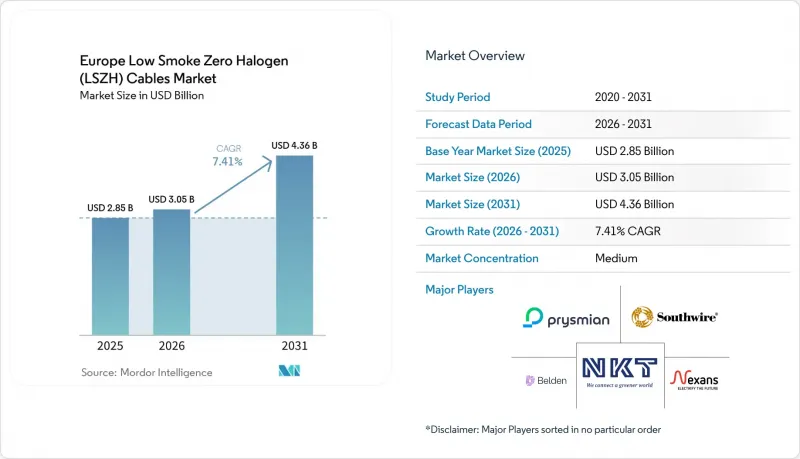
Mordor Intelligence에 의하면, 유럽의 저연무 무할로겐 케이블 시장 규모는 2025년 28억 5,000만 달러로 평가되었습니다. 2026년에는 30억 5,000만 달러로 확대되어 2031년까지 43억 6,000만 달러에 이를 것으로 예측되며, 2026년부터 2031년에 걸쳐 CAGR 7.41%를 나타낼 전망입니다.
본 보고서는 케이블 유형(전력 케이블, 제어·계측 케이블 등), 정격 전압(1kV 미만, 1-35kV, 36-65kV, 65kV 이상),절연 재료(PVC(폴리염화비닐) 등), 최종 사용자 산업(상업용 건물, 산업 제조 등), 국가별로 분류되어 있습니다. 시장 전망은 금액(달러) 기준으로 제시되어 있습니다.
유럽의 저연무 무할로겐 케이블 시장 동향 및 인사이트
건설 제품 규정 및 의무화된 내화 성능 분류
규정(EU) 2024/3110 및 유럽위원회 위임 규정(EU) 2026/331은 EN 50575를 준수하며, Aca에서 Fca에 이르는 유로클래스 화재 반응 분류 체계를 유지하고 있습니다. 이 프레임워크는 규제의 연속성을 유지하면서 제조업체가 최신 적합 요건으로 전환할 수 있도록 돕습니다. ‘성능 선언(Declaration of Performance)’에 따라 케이블 성능에 관한 문서화 책임이 시공업체에서 제조업체로 더 많이 이전됩니다. B2ca 이상으로 분류되는 케이블에는 시스템 1+에 기반한 지속적인 공장 생산 모니터링 및 연 1회의 인증 기관에 의한 감사 시험이 요구됩니다. 프로젝트에서 특정 유로클래스 등급이 요구되는 경우, 일반적인 LSZH 표시만으로는 적합성이 인정되지 않습니다. 따라서 유럽의 LSZH 케이블 시장에서는 제품의 표시보다 인증된 생산 능력이 더 중요해집니다.
데이터센터의 확장과 고밀도 디지털 인프라
데이터센터 건설로 인해 실내 시설에서 사용되는 광섬유 및 구조화된 구리 케이블 시스템에 대한 수요가 증가하고 있습니다. 프리즈미안(Prismian)은 2026년 7월, 데이터센터 내부에서 사용되는 광케이블과 관련하여 모렉스(Molex)와 최대 55억 유로(62억 9,000만 달러) 규모의 계약을 체결했습니다. 또한, 이 회사는 2031년까지 유럽 및 미국의 생산 능력 확충에 12억 5,000만 유로(14억 3,000만 달러)를 투자하기로 결정했습니다. 규제 대상 건물에 영구적으로 고정 설치하려면 적절한 CPR 인증을 받은 케이블 설계가 요구되며, 규정 준수 수준이 낮은 대체품의 사용 범위는 제한됩니다. AI 컴퓨팅 환경에서 광섬유 밀도가 향상됨에 따라 상호 연결 요구 사항이 증가하면서 랙당 케이블 수요도 증가하고 있습니다. 이에 따라 데이터센터 프로젝트가 설계 단계에서 설치 단계로 진행됨에 따라 유럽의 저연무 무할로겐(LSZH) 케이블 시장에서 견고한 수요 기반이 뒷받침되고 있습니다.
할로겐 함유 대체품보다 높은 재료비 및 인증 비용
삼수산화알루미늄(Al(OH)₃) 또는 이수산화마그네슘(Mg(OH)₂)을 기반으로 하는 무할로겐 화합물의 경우, 난연성을 확보하기 위해 중량비로 60%-65%의 충전제 함유율이 필요합니다. 반면, 기존의 PVC 배합에서는 충전제 함유율이 15%-25%를 나타낼 전망입니다. 충전제 함유량이 증가하면 컴파운드의 밀도가 높아져 압출 성형 금형의 마모가 가속화되며, PVC 케이블에 비해 완제품 비용이 20%-40% 상승합니다. 또한, B2ca 등급 이상의 케이블에 대해서는 지속적인 공장 생산 관리에 더해, EU 지정 기관에 의한 연례 감사 시험도 필요합니다. 연간 인증에 소요되는 제반 비용은 제품군당 3만-8만 유로(3만 4,000-9만 1,000달러)였습니다. 이러한 비용 부담은 남유럽 및 동유럽의 중소 제조업체나 비용을 중시하는 입찰 프로젝트에서 특히 크게 작용합니다.
부문별 분석
2025년, 유럽의 저연무 무할로겐 케이블 시장에서 전력 케이블은 33.23%의 점유율을 차지했습니다. 이는 독일, 프랑스 및 중부 유럽의 전력망 투자와 산업 전기화 활동에 힘입은 결과입니다. 그 규모는 계통 연계 설비에 필요한 장거리 케이블 부설과 밀폐형 변전소에서 PVC 절연 중전압 케이블로의 전환을 반영하고 있습니다. 밀폐형 변전소에서는 화재 봉쇄 요건으로 인해 무할로겐 시스템의 도입이 점점 더 요구되고 있습니다. 제어·계장용 케이블은 산업 플랜트, 공정 제어 시설, 철도 신호 네트워크 등에서 이용되고 있으며, 이러한 분야에서는 LSZH 요건 외에도 ATEX 및 IECEx 위험 구역 인증이 요구되는 사례가 증가하고 있습니다. 데이터·통신용 케이블은 스마트 빌딩 시스템 및 산업용 IoT의 백본을 뒷받침하고 있으며, 상업용 건축물에서 케이블 트레이의 고밀도화는 화염 전파 위험을 높이고 있습니다. 이러한 상황으로 인해 CPR을 준수하는 LSZH 제품은 여러 케이블 범주에 걸친 신규 설치 시 일반적인 사양으로 자리 잡고 있습니다.
광섬유 케이블은 2026년부터 2031년까지 연평균 성장률(CAGR) 9.15%로 확대될 것으로 예측되며, 유럽 LSZH 케이블 시장에서 가장 두드러진 성장을 보일 것으로 전망됩니다. 데이터센터 간 상호 연결, 각국의 광대역 계획, 그리고 캠퍼스 백본 업그레이드가 이러한 전망을 뒷받침하고 있습니다. 한편, 다중 코어 광섬유에는 외경 및 방화 등급 요건을 충족하는 엄격하게 관리된 무할로겐 피복이 요구됩니다. 후루카와 전기 공업은 2026년 3월, AI 데이터센터용도로 외경 40mm 미만의 13,824심 케이블 양산을 시작했습니다. 건축용 전선은 단독 주택 및 저층 상업 건축물에서 여전히 수요가 많은 부문이며, 친환경 설계 요건에 따라 기존의 PVC 전선을 대체할 인증된 대체 제품의 채택이 촉진되고 있습니다. 선박, 광업, 원자력, 철도 차량 용도로 사용되는 특수 LSZH 케이블은 EN 45545, NEK 606 또는 해양 규격 인증을 취득한 제조업체에게 여전히 중요한 위치를 차지하고 있습니다.
2025년 시점에서 1kV 미만 부문은 64.78%를 차지했으며, 이는 CPR 규제의 적용을 받는 건설 및 개보수 프로젝트에서 사용되는 건축용 전선, 구조화 케이블, 제어 케이블의 설치량이 매우 많음을 반영합니다. 이 광범위한 부문은 가격 경쟁이 치열하고 규정 준수 비용이 균일하기 때문에 이익률에 대한 압박이 집중되어 있으며, 특수 컴파운드 제조 능력이 없으면 제품 차별화가 어렵습니다. 36-65 kV 및 65 kV 이상의 범위는 송전 및 상호 연결 용도에 해당하며, 대상 수량은 적지만 1미터당 케이블 단가가 높아 균형을 이루고 있습니다. 이 범위에서는 밀폐형 덕트나 케이블 갤러리에서 XLPE 절연 및 LSZH 피복 시스템이 일반적으로 사용됩니다. ENTSO-E의 계획 관행 및 각국의 송전망 규격에서는 제한된 경로에 설치되는 고전압 케이블에 대해 무할로겐 피복 재료를 참조하는 경향이 강해지고 있습니다.
1-35kV 분야는 재생에너지 발전에서 송전망으로의 연결, 배터리 에너지 저장 시스템에 대한 링 메인 연결, 그리고 도시 배전망의 업그레이드에 힘입어 2026년부터 2031년까지 연평균 성장률(CAGR) 8.25%로 확대될 것으로 예측됩니다. 넥산즈는 2026년 2월, 프랑스 배전망 현대화를 위한 중전압 케이블 공급과 관련하여 에네디스(Enedis)사와 6억 유로(6억 8,400만 달러) 규모의 7년 계약을 체결했습니다. 축전지 프로젝트에 사용되는 중전압 LSZH 케이블 시스템은 CPR의 내화 성능 요건 및 IEC 60502-2의 전기적 성능 요건을 충족해야 합니다. 이러한 이중 인증 요건으로 인해 인증 공급업체의 선택 폭이 좁아지고, 인증을 받은 제조업체의 가격 결정력이 강화될 가능성이 있습니다. 계통 연계 허가 취득은 2026년 및 2027년에도 공급량에 대한 위험 요인으로 남아 있지만, ‘유럽 그리드 패키지’에서는 승인 절차의 합리화를 통해 이 문제를 해결하고자 하고 있습니다.
기타 혜택 :
- 엑셀 형식 시장 예측(ME) 시트
- 3개월간의 애널리스트 지원
자주 묻는 질문
목차
제1장 서론
제2장 조사 방법
제3장 개요
제4장 시장 구도
제5장 시장 규모 및 성장 예측
제6장 경쟁 구도
제7장 시장 기회 및 향후 전망
KTH 26.09.02According to Mordor Intelligence, the Europe low-smoke zero-halogen cables (LSZH) market size is projected to expand from USD 2.85 billion in 2025 to USD 3.05 billion in 2026, and to USD 4.36 billion by 2031, registering a CAGR of 7.41% from 2026 to 2031.
This report is Segmented by Cable Type (Power Cables, Control and Instrumentation Cables, and More), Voltage Rating (Less Than 1 KV, 1-35 KV, 36-65 KV, and Above 65 KV), Insulation Material (PVC (Polyvinyl Chloride), and More), End-User Industry (Commercial Buildings, Industrial Manufacturing, and More), and Country. The Market Forecasts are Provided in Terms of Value (USD).
Europe Low Smoke Zero Halogen (LSZH) Cables Market Trends and Insights
Construction Products Regulation and Mandatory Reaction-to-Fire Classification
Regulation (EU) 2024/3110 and Commission Delegated Regulation (EU) 2026/331 retain the Euroclass reaction-to-fire system from Aca through Fca in accordance with EN 50575. The framework preserves regulatory continuity while moving manufacturers toward updated compliance requirements. A Declaration of Performance shifts more responsibility for documented cable performance from contractors to manufacturers. Cables classified B2ca and above require continuous factory production surveillance and annual notified-body audit testing under System 1+. Generic LSZH labeling does not establish compliance when a project requires a defined Euroclass rating. This makes certified production capacity more important than product labeling alone in the Europe LSZH cables market.
Expansion of Data Centers and High-Density Digital Infrastructure
Data center construction is increasing the demand for fiber-optic and structured copper cable systems used in enclosed facilities. Prysmian signed an agreement with Molex in July 2026 worth up to EUR 5.5 billion (USD 6.29 billion) for optical cables used inside data centers. The company also committed EUR 1.25 billion (USD 1.43 billion) to European and U.S. production capacity through 2031. Permanent fixed installations in regulated buildings require appropriate CPR-rated cable designs, limiting the scope for lower-compliance substitutions. Greater fiber density in AI computing environments adds cable demand per rack as interconnect requirements increase. This supports a durable demand base for the European low-smoke zero-halogen (LSZH) cables market as data-center projects progress from design to installation.
Higher Material and Qualification Cost Than Halogenated Alternatives
Halogen-free compounds based on aluminum trihydrate, Al(OH)3, or magnesium dihydroxide, Mg(OH)2, require 60%-65% filler loading by weight to provide flame suppression. Conventional PVC formulations use 15%-25% filler content. Higher filler loading increases compound density, accelerates extrusion-tooling wear, and raises the cost of finished cable by 20%-40% relative to PVC alternatives. Cables classified B2ca and above also require continuing factory production control and annual audit testing by an EU-notified body. Annual certification overhead was EUR 30,000-80,000 (USD 34,000-91,000) per product family. This cost burden is most significant for smaller manufacturers and cost-sensitive tenders in Southern and Eastern Europe.
Other drivers and restraints analyzed in the detailed report include:
- Rail, Metro, Tunnel, and Airport Safety-Critical Cabling Projects
- Renewable Power, Grid Modernization, and Battery Energy Storage Build-Out
- Fragmented National Interpretation of CPR Euroclasses
For complete list of drivers and restraints, kindly check the Table Of Contents.
Segment Analysis
Power cables held 33.23% of the Europe low smoke zero halogen (LSZH) cables market share in 2025, supported by utility grid investment and industrial electrification activity in Germany, France, and Central Europe. Their scale reflects the long cable runs required for grid-connected installations and the move away from PVC-insulated medium-voltage cables in enclosed substations, where fire-containment requirements increasingly support halogen-free systems. Control and instrumentation cables serve industrial plants, process-control facilities, and rail signaling networks, where LSZH requirements are increasingly paired with ATEX or IECEx hazardous-area certifications. Data and communication cables support smart-building systems and industrial internet of things backbones, and dense cable trays increase the potential for flame propagation in commercial construction. These conditions make CPR-compliant LSZH products a common specification for new installations across several cable categories.
Fiber optic cables are projected to expand at a 9.15% CAGR from 2026 to 2031, making them the fastest-growing cable type in the Europe LSZH cables market. Data-center interconnects, national broadband programs, and campus-backbone upgrades support this outlook, while high-count fiber needs closely controlled halogen-free jackets that meet outside-diameter and fire-classification requirements. Furukawa Electric began mass production of 13,824-fiber cables in March 2026, with a sub-40 mm outer diameter for AI data center applications. Building wires remain a high-volume category for single-dwelling and low-rise commercial construction, with Ecodesign requirements encouraging certified alternatives to conventional PVC wire. Specialty LSZH cables used in marine, mining, nuclear, and rolling-stock applications retain a premium position for manufacturers with EN 45545, NEK 606, or offshore-standard certifications.
The below-1 kV tier held 64.78% in 2025, reflecting the substantial volume of building wire, structured cabling, and control-cable installations used in CPR-regulated construction and renovation projects. This broad tier is highly price-competitive, which concentrates margin pressure where compliance costs are uniform, and product differentiation is difficult without specialty compound capability. The 36-65 kV and above-65 kV ranges serve transmission and interconnector applications, where smaller addressable volumes are balanced by higher cable value per meter. These ranges commonly use XLPE insulation and LSZH sheath systems in enclosed ducts and cable galleries. ENTSO-E planning practices and national grid codes increasingly reference halogen-free sheath materials for high-voltage cables installed in confined routes.
The 1-35 kV tier is projected to expand at an 8.25% CAGR from 2026 to 2031, supported by renewable generation-to-grid interconnects, battery energy storage ring-main connections, and urban distribution-network upgrades. Nexans signed a EUR 600 million (USD 684 million) 7-year agreement with Enedis in February 2026 for medium-voltage cables for France's distribution grid modernization. Medium-voltage LSZH cable systems used in battery storage projects must meet CPR reaction-to-fire requirements and IEC 60502-2 electrical performance requirements. This dual qualification narrows the field of certified suppliers and can bolster pricing power for qualified producers. Grid-connection permitting remains a volume risk for 2026 and 2027, and the European Grids Package seeks to address it through streamlined approval processes.
Complete Report Scope:
- By Cable Type
- LSZH Power Cables
- LSZH Control and Instrumentation Cables
- LSZH Data and Communication Cables
- LSZH Fiber Optic Cables
- LSZH Building Wires
- Specialty LSZH Cables
- By Voltage Rating
- Less Than 1 kV
- 1-35 kV
- 36-65 kV
- Above 65 kV
- By Insulation Material
- PVC (Polyvinyl Chloride)
- XLPE (Cross-linked Polyethylene)
- PE (Polyethylene)
- Other Specialty Insulation Materials
- By End-User Industry
- Commercial Buildings
- Industrial Manufacturing
- Data Centers
- Energy and Utilities
- Transportation Infrastructure
- Telecommunications
- Renewable Energy
- Other End-User Industries
- By Country
- Germany
- United Kingdom
- France
- Italy
- Spain
- Rest of Europe
List of Companies Covered in this Report:
- Prysmian Group
- Nexans S.A.
- Southwire Company, LLC
- Belden Inc.
- CommScope Holding Company, Inc. (Amphenol Corporation)
- TE Connectivity Ltd.
- Corning Incorporated
- LS Cable and System Ltd.
- Furukawa Electric Co., Ltd.
- Leoni Cable Inc.
- NKT A/S
- Brugg Cables AG
- Superior Essex Inc.
- AFL Telecommunications LLC
- Alpha Wire
- HELUKABEL GmbH
- SAB Brockskes GmbH & Co. KG
- Hellenic Cables
- Eland Cables
Additional Benefits:
- The market estimate (ME) sheet in Excel format
- 3 months of analyst support
TABLE OF CONTENTS
1 INTRODUCTION
- 1.1 Study Assumptions and Market Definition
- 1.2 Scope of the Study
2 RESEARCH METHODOLOGY
3 EXECUTIVE SUMMARY
4 MARKET LANDSCAPE
- 4.1 Market Overview
- 4.2 Market Drivers
- 4.2.1 Construction Products Regulation and Mandatory Reaction-to-Fire Classification
- 4.2.2 Expansion of Data Centers and High-Density Digital Infrastructure
- 4.2.3 Rail, Metro, Tunnel, and Airport Safety-Critical Cabling Projects
- 4.2.4 Renewable Power, Grid Modernization, and Battery Energy Storage Build-Out
- 4.2.5 Industrial Electrification and Automation in Existing European Plants
- 4.2.6 Retrofit Demand from Legacy PVC Installations in High-Occupancy Buildings
- 4.3 Market Restraints
- 4.3.1 Higher Material and Qualification Cost than Halogenated Alternatives
- 4.3.2 Fragmented National Interpretation of CPR Euroclasses
- 4.3.3 Long Replacement Cycles for Installed Cable Infrastructure
- 4.3.4 Processing and Installation Complexity of High-Filler Halogen-Free Compounds
- 4.4 Industry Value Chain Analysis
- 4.5 Porter's Five Forces Analysis
- 4.5.1 Threat of New Entrants
- 4.5.2 Bargaining Power of Suppliers
- 4.5.3 Bargaining Power of Buyers
- 4.5.4 Threat of Substitutes
- 4.5.5 Rivalry Among Existing Competitors
5 MARKET SIZE AND GROWTH FORECASTS (VALUE)
- 5.1 By Cable Type
- 5.1.1 LSZH Power Cables
- 5.1.2 LSZH Control and Instrumentation Cables
- 5.1.3 LSZH Data and Communication Cables
- 5.1.4 LSZH Fiber Optic Cables
- 5.1.5 LSZH Building Wires
- 5.1.6 Specialty LSZH Cables
- 5.2 By Voltage Rating
- 5.2.1 Less Than 1 kV
- 5.2.2 1-35 kV
- 5.2.3 36-65 kV
- 5.2.4 Above 65 kV
- 5.3 By Insulation Material
- 5.3.1 PVC (Polyvinyl Chloride)
- 5.3.2 XLPE (Cross-linked Polyethylene)
- 5.3.3 PE (Polyethylene)
- 5.3.4 Other Specialty Insulation Materials
- 5.4 By End-User Industry
- 5.4.1 Commercial Buildings
- 5.4.2 Industrial Manufacturing
- 5.4.3 Data Centers
- 5.4.4 Energy and Utilities
- 5.4.5 Transportation Infrastructure
- 5.4.6 Telecommunications
- 5.4.7 Renewable Energy
- 5.4.8 Other End-User Industries
- 5.5 By Country
- 5.5.1 Germany
- 5.5.2 United Kingdom
- 5.5.3 France
- 5.5.4 Italy
- 5.5.5 Spain
- 5.5.6 Rest of Europe
6 COMPETITIVE LANDSCAPE
- 6.1 Market Concentration
- 6.2 Strategic Moves
- 6.3 Market Share Analysis
- 6.4 Company Profiles (includes Global Level Overview, Market Level Overview, Core Segments, Financials as available, Strategic Information, Market Rank/Share, Products and Services, Recent Developments)
- 6.4.1 Prysmian Group
- 6.4.2 Nexans S.A.
- 6.4.3 Southwire Company, LLC
- 6.4.4 Belden Inc.
- 6.4.5 CommScope Holding Company, Inc. (Amphenol Corporation)
- 6.4.6 TE Connectivity Ltd.
- 6.4.7 Corning Incorporated
- 6.4.8 LS Cable and System Ltd.
- 6.4.9 Furukawa Electric Co., Ltd.
- 6.4.10 Leoni Cable Inc.
- 6.4.11 NKT A/S
- 6.4.12 Brugg Cables AG
- 6.4.13 Superior Essex Inc.
- 6.4.14 AFL Telecommunications LLC
- 6.4.15 Alpha Wire
- 6.4.16 HELUKABEL GmbH
- 6.4.17 SAB Brockskes GmbH & Co. KG
- 6.4.18 Hellenic Cables
- 6.4.19 Eland Cables
7 MARKET OPPORTUNITIES AND FUTURE OUTLOOK
- 7.1 White-Space and Unmet-Need Assessment


