

|
시장보고서
상품코드
2119195
아시아태평양의 저연무 무할로겐 케이블 : 시장 점유율 분석, 업계 동향 및 통계, 성장 예측(2026-2031년)Asia-Pacific Low Smoke Zero Halogen (LSZH) Cables - Market Share Analysis, Industry Trends & Statistics, Growth Forecasts (2026 - 2031) |
||||||
 Mordor Intelligence
Mordor Intelligence에 의하면, 아시아태평양의 저연무 무할로겐 케이블 시장 규모는 2025년 20억 8,000만 달러로 평가되었습니다. 2026년에는 22억 7,000만 달러로 확대되어 2031년까지 35억 4,000만 달러에 이를 것으로 예측되며, 2026년부터 2031년에 걸쳐 CAGR 9.29%를 나타낼 전망입니다.
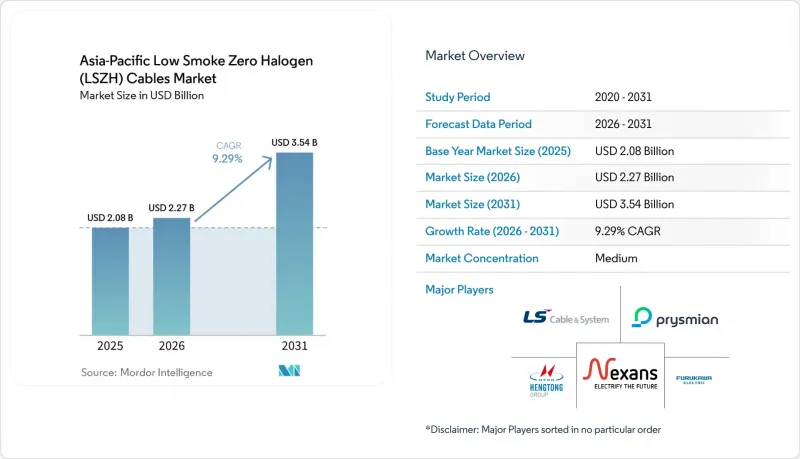
본 보고서는 케이블 유형(전력 케이블, 제어·계측 케이블 등), 정격 전압(1 kV 미만, 1-35 kV, 36-65 kV, 65 kV 이상),절연 재료(PVC(폴리염화비닐) 등), 최종 사용자 산업(상업용 건물, 산업 제조 등), 국가별로 분류되어 있습니다. 시장 전망은 금액(미 달러) 기준으로 제시되어 있습니다.
아시아태평양의 저연무 무할로겐 케이블 시장 동향 및 인사이트
하이퍼스케일 데이터센터 및 AI 인프라 구축
Digital Edge사는 2026년 1월, 인도네시아 부카시에 500 MW 규모의 AI 지원 하이퍼스케일 캠퍼스를 건설하기 위해 45억 달러를 투자한다고 발표했습니다. 이 프로젝트는 대규모 전력, 광섬유 및 지원 시설 시스템을 핵심으로 구축되고 있습니다. 이 회사는 2026년 3월, 프로젝트의 1단계 추진을 위해 6억 6,500만 달러 규모의 그린론을 확보했습니다. AI에 최적화된 랙은 랙당 50-120 kW의 전력을 필요로 할 수 있으며, 이로 인해 밀폐형 트레이 시스템 내의 케이블 밀도가 높아져 화재 발생 시 장비 보호의 중요성이 더욱 강조됩니다. 이러한 환경에서 저연무 무할로겐 케이블이 중요한 이유는 PVC가 연소할 때 발생하는 염화수소(HCl)가 대피가 어려워지기 전에 가동 중인 장비를 부식시켜 서버, 신호 장비 및 그리드 보호 시스템에 악영향을 미칠 가능성이 있기 때문입니다. SK텔레콤은 2026년 7월, 한국 내에서 최대 15GW 규모의 AI 데이터센터용량을 구축할 계획이라고 발표했습니다. 그 첫 단계로, 남동부 지역에 2GW를 초과하는 초기 클러스터 건설을 시작합니다. 이러한 움직임에 따라 아시아태평양의 저연무 무할로겐 케이블 시장의 기회는 기존의 건축 배선에 그치지 않고 고밀도 전력, 광섬유 및 제어 시스템으로 확대되고 있습니다.
고밀도·밀폐 공간에서의 방화 기준 채택
중국의 GB/T 31247 규격은 상업용 및 공공 부문 케이블에 대해 B1 등급의 성능을 요구하며, 이 지역 최대의 케이블 조달 시장에서 높은 최소 요건을 규정하고 있습니다. 이 규격은 IEC 60332-3의 화염 전파 기준을 넘어 발열량, 화염을 동반한 비말 및 부식성 가스에 대한 성능을 평가합니다. 인도의 ‘2016년 국가 건축 기준’ 제4부에서는 대피와 자산 보호가 모두 중요한 병원, 지하철 지하역,공항, 그리고 지상 15층(G+15)을 초과하는 주거용 건물에서 IS 17048 : 2018을 준수하는 무할로겐 난연 케이블의 사용이 의무화되어 있습니다. 인도 표준국(BIS)은 IS 17048 : 2018을 정격 전압 1,100 V까지의 무할로겐 난연 케이블 규격으로 정하고 있습니다. 싱가포르에서는 10년 이상 동안 인명 안전 및 교통 시스템에서 저연무 무할로겐 케이블의 사용이 의무화되어 있으며, 이러한 유사한 프로젝트 관행이 공공 자금에 의한 인프라 구축 및 자금 조달 요건을 통해 말레이시아, 태국, 베트남의 조달에도 영향을 미치고 있습니다. 한국에서는 KS C IEC 60754-2 및 KS C IEC 61034-2가 적용되고 있으며, 일본에서는 밀폐 환경에서의 사용에 대해 JIS C 3665 및 JIS C 3666이 채택되어 있습니다. 이처럼 아시아태평양의 저연무 무할로겐 케이블 시장은 여러 국가의 규제 체계에 의해 형성되고 있습니다.
PVC 케이블 시스템에 비해 높은 초기 비용
LSZH 컴파운드는 케이블 수준에서 표준 PVC 피복보다 15-30% 더 비쌉니다. 이 가격 차이는 인도네시아, 베트남, 필리핀에서 특히 두드러지며, 이들 국가에서는 민간 건설 발주자가 IEC 61034 준수를 요구하지 않는 경우가 많습니다. 아시아개발은행(ADB)이나 일본국제협력기구(JICA)의 프로젝트 금융 계약에서는 저연무 무할로겐 케이블을 요구할 수 있으며, 이는 국내 건축 기준이 변경될 때까지 이러한 가격 차이를 메우는 데 도움이 되고 있습니다. 데이터센터나 의료시설에서는 화재 후 부식으로 인해 대규모 오염 제거가 필요할 수 있으며, 그 비용은 초기 케이블 비용의 추가분을 초과할 가능성이 있습니다. 중국과 인도에서 컴파운드 생산량 및 제조 능력이 확대됨에 따라 이러한 제약은 점차 완화되고 있습니다. 그러나 시공업체의 PVC에 대한 익숙함이나 일부 LSZH 컴파운드에 요구되는 더 엄격한 굽힘 반경 요건 등으로 인해, 비용에 민감한 아시아태평양의 저연 무할로겐(LSZH) 케이블 시장에서 전환이 여전히 더디게 진행되고 있습니다.
부문별 분석
2025년, LSZH 전력 케이블은 상업용 건물, 산업 시설, 전력 배전 시스템 및 데이터센터의 저전압 배전반에 대한 지속적인 조달에 힘입어 케이블 유형 부문의 34.55%를 차지했습니다. LSZH 광섬유 케이블은 하이퍼스케일 데이터센터의 상호 연결 요건과 정부가 지원하는 광섬유 구축 프로그램의 뒷받침을 받아 2026년부터 2031년까지 연평균 성장률(CAGR) 11.78%를 나타낼 것으로 예측됩니다. 후루카와 전기공업은 2026년 3월 미에 제2공장에서 13,824심 광섬유 케이블의 양산을 시작했습니다. 이 회사에 따르면, 이 새로운 시설은 2023년 대비 생산 능력을 2배 이상 확대했으며, 고밀도 광케이블 수요에 대응할 수 있도록 설계되었다고 합니다. LSZH 데이터·통신 케이블 및 제어·계측 케이블은 빌딩 관리, 공정 자동화, 감시 제어·데이터 수집(SCADA) 시스템, 그리고 산업용 네트워크 설비에서 계속해서 활용되고 있습니다.
LSZH 빌딩용 전선은 인도, 중국, 호주의 주거 및 상업 건축과 밀접한 관련이 있으며, 이들 지역에서는 건축 기준 개정에 따라 저연기 케이블 시스템의 채택이 확대되고 있습니다. 원자력, 선박, 수소 수송 용도의 특수 케이블은 환경 및 안전 요건이 더 엄격하기 때문에 규모는 작지만 부가가치가 높은 용도 분야를 차지하고 있습니다. 아시아태평양의 저연무 무할로겐 케이블 시장에서 전력 케이블 시장 규모는 2025년에 34.55%의 점유율을 기록하며 성장세를 이어갔습니다. IEC 60332 및 IEC 61034는 일본, 한국, 중국에서 제조되는 광섬유 케이블에 공통된 기술적 기준을 제공하여, 국경을 초월한 인프라 프로젝트에서 호환 가능한 제품을 지정할 수 있게 합니다. 수소 수송, 일본 및 한국의 원자력 발전소 재가동, 선박의 전기화는 LSZH 성능과 내염수 분무성 재킷 성능을 모두 필요로 하는 특수 용도를 촉진할 것으로 예측됩니다.
2025년, 아시아태평양의 저연무 무할로겐 케이블 시장에서 1kV 미만 부문은 시장 점유율의 61.12%를 차지했습니다. 이 부문은 상업시설 및 공장 시설의 건물 내 배선, 데이터센터의 전력 배전, 교통 기관의 역 내 회로, 경공업용 자동화, 저전압 배전반 등에 이용되고 있습니다. 이처럼 폭넓은 용도 기반을 가지고 있기 때문에 이 부문 수요는 도시 건설 및 분산형 전력 이용과 밀접하게 관련되어 있어 판매량 감소 위험은 비교적 낮다고 할 수 있습니다. 1-35 kV의 중전압 부문은 2026년부터 2031년에 걸쳐 연평균 성장률(CAGR) 10.56%로 확대될 것으로 예측됩니다. 중국, 인도, 동남아시아 전역의 산업단지, 재생에너지 변전소 연결, 송전망 확장 및 신규 개발 지역이 이러한 수요를 뒷받침하고 있습니다.
라오스·태국·말레이시아·싱가포르 간 연계 프로젝트에서는 습한 환경 및 염분을 포함한 토양 조건 하에서 중전압 배선을 위해 XLPE 저연무 무할로겐 케이블의 사용이 규정되어 있습니다. 이 요건은 내습성과 내화 성능을 동시에 확보해야 하는 지역 송전망 프로젝트에서 조달 지침이 됩니다. IEC 60502-1 및 IEC 60332-3은 묶음 케이블의 매설에 널리 채택되고 있는 기술 사양 기준입니다. 36-65 kV 및 65 kV 초과 범주는 초고압 송전망의 업그레이드나 변전소 및 변환소의 실내 부분에 사용됩니다. 도쿄전력은 2024년부터 2027년에 걸쳐 시행될 계획을 통해 가공 배전선의 지하화를 추진하고 있으며, 이로 인해 LSZH 피복의 지하용 초고압 케이블에 대한 수요가 뒷받침되고 있습니다. 공압출 성형을 통해 XLPE 절연체와 LSZH 피복을 한 번의 공정으로 제조할 수 있으므로, PVC 구조와의 비용 격차가 줄어들어 중전압 및 산업용 분야에서 사양 전환이 촉진됩니다.
기타 혜택 :
- 엑셀 형식 시장 예측(ME) 시트
- 3개월간의 애널리스트 지원
자주 묻는 질문
목차
제1장 서론
제2장 조사 방법
제3장 개요
제4장 시장 구도
제5장 시장 규모 및 성장 예측
제6장 경쟁 구도
제7장 시장 기회 및 향후 전망
KTH 26.09.02According to Mordor Intelligence, the Asia-Pacific low smoke zero halogen (LSZH) cables market size is projected to expand from USD 2.08 billion in 2025 to USD 2.27 billion in 2026, and to USD 3.54 billion by 2031, registering a CAGR of 9.29% from 2026 to 2031.
This report is Segmented by Cable Type (Power Cables, Control and Instrumentation Cables, and More), Voltage Rating (Less Than 1 KV, 1-35 KV, 36-65 KV, and Above 65 KV), Insulation Material (PVC (Polyvinyl Chloride), and More), End-User Industry (Commercial Buildings, Industrial Manufacturing, and More), and Country. The Market Forecasts are Provided in Terms of Value (USD).
Asia-Pacific Low Smoke Zero Halogen (LSZH) Cables Market Trends and Insights
Hyperscale Data Center and AI Infrastructure Buildout
Digital Edge announced a USD 4.5 billion investment in January 2026 for a 500 MW AI-ready hyperscale campus in Bekasi, Indonesia, a project built around large-scale power, fiber, and supporting facility systems. The company secured a USD 665 million green loan for the project's first phase in March 2026. AI-optimized racks can require 50-120 kW per rack, increasing cable density in enclosed tray systems and underscoring the importance of equipment protection during a fire. LSZH cable is important in these settings because hydrogen chloride (HCl) from burning PVC can corrode active equipment before conditions become unsafe for evacuation, affecting servers, signaling equipment, and grid protection systems. SK Telecom announced in July 2026 that it was pursuing up to 15 GW of AI data center capacity in South Korea, starting with an initial cluster above 2 GW in the southeast. These developments extend the Asia-Pacific low smoke zero halogen (LSZH) cables market opportunity beyond conventional building wiring into high-density power, fiber, and control systems.
Fire-Safety Code Adoption in High-Occupancy and Enclosed Spaces
China's GB/T 31247 standard requires B1-class performance for commercial and public-sector cables, establishing a high minimum requirement in the region's largest cable procurement base. The standard assesses heat release, flaming droplets, and corrosive gas performance beyond the IEC 60332-3 flame-propagation baseline. India's National Building Code 2016, Part 4, requires IS 17048:2018 halogen-free, flame-retardant cables in hospitals, underground metro stations, airports, and residential buildings above G+15 floors, where both evacuation and asset protection are important. The Bureau of Indian Standards identifies IS 17048:2018 as the standard for halogen-free flame-retardant cables rated up to 1,100 V. Singapore has required LSZH cables in life-safety and transport systems for more than a decade, and similar project practices influence procurement in Malaysia, Thailand, and Vietnam through publicly funded infrastructure and financing requirements. South Korea applies KS C IEC 60754-2 and KS C IEC 61034-2, while Japan uses JIS C 3665 and JIS C 3666 for enclosed applications, leaving the Asia-Pacific low smoke zero halogen (LSZH) cables market shaped by multiple national compliance frameworks.
Higher Upfront Cost Versus PVC Cable Systems
LSZH compounds cost 15-30% more than standard PVC sheaths at the cable level. This difference is especially significant in Indonesia, Vietnam, and the Philippines, where private construction buyers often do not require IEC 61034 compliance. ADB and Japan International Cooperation Agency project-finance agreements may require LSZH cable, which helps bridge the gap until domestic building codes change. In data centers and health care facilities, post-fire corrosion can require extensive decontamination and may cost more than the initial cable premium. Greater regional compounding output and manufacturing capacity in China and India are reducing this constraint. Installer familiarity with PVC and the tighter bending-radius requirements of some LSZH compounds still slow switching in cost-sensitive parts of the Asia-Pacific low smoke zero halogen (LSZH) cables market.
Other drivers and restraints analyzed in the detailed report include:
- Electrification of Rail, Metro, Ports, and Commercial Transport
- Renewable Power, Grid Modernization, and Battery Storage Expansion
- Copper Price Volatility and Material-Cost Pass-Through Risk
For complete list of drivers and restraints, kindly check the Table Of Contents.
Segment Analysis
LSZH power cables accounted for 34.55% of the cable-type segment in 2025, supported by recurring procurement for commercial buildings, industrial sites, utility distribution systems, and data center low-voltage panels. LSZH fiber-optic cables are projected to grow at an 11.78% CAGR from 2026 to 2031, supported by hyperscale data center interconnect requirements and government-backed fiber rollout programs. Furukawa Electric began mass production of 13,824-count optical fiber cable at Mie Works No. 2 in March 2026. The company stated that the new facility more than doubled capacity compared with 2023 and was designed to serve dense optical cable requirements. LSZH data and communication cables, plus control and instrumentation cables, continue to serve building management, process automation, supervisory control and data acquisition systems, and industrial network installations.
LSZH building wires remain linked to residential and commercial construction in India, China, and Australia, where code revisions are expanding the use of lower-smoke-cable systems. Specialty cables for nuclear, marine, and hydrogen-transit uses occupy smaller but higher-value application areas because their environmental and safety requirements are more demanding. The Asia-Pacific low smoke zero halogen (LSZH) cables market size for power cables was supported by their 34.55% share in 2025. IEC 60332 and IEC 61034 provide a common technical baseline for fiber-optic cables produced in Japan, South Korea, and China, enabling compatible products to be specified for cross-border infrastructure projects. Hydrogen transit, nuclear recommissioning in Japan and South Korea, and marine electrification are expected to support specialty applications that require both LSZH performance and salt-spray-resistant jacket performance.
The less-than-1-kV segment accounted for 61.12% of the Asia-Pacific low smoke zero halogen (LSZH) cables market share in 2025. It serves building wiring, data center power distribution, transit-station circuits, light industrial automation, and low-voltage panels in commercial and factory facilities. This broad base of applications makes the segment less exposed to volume displacement, as its demand is tied to urban construction and distributed electricity use. The 1-35 kV medium-voltage category is projected to expand at a 10.56% CAGR from 2026 to 2031. Industrial parks, renewable energy substation connections, grid distribution extensions, and new development zones across China, India, and Southeast Asia support this demand.
The Lao-Thailand-Malaysia-Singapore connection specifies XLPE LSZH cable for medium-voltage runs in humid and saline-soil conditions. This requirement provides a procurement reference point for regional grid programs where moisture resistance and fire performance must be addressed together. IEC 60502-1 and IEC 60332-3 are widely used engineering submission frameworks for the installation of grouped cables. The 36-65 kV and above-65 kV categories serve extra-high-voltage grid upgrades and the enclosed portions of substations and converter stations. Tokyo Electric Power Company is undergrounding overhead distribution lines through a program running from 2024 to 2027, which supports demand for LSZH-sheathed underground extra-high-voltage cable. Co-extrusion can produce XLPE insulation and an LSZH sheath in a single pass, narrowing the cost gap with PVC constructions and facilitating specification migration for medium-voltage and industrial applications.
Complete Report Scope:
- By Cable Type
- LSZH Power Cables
- LSZH Control and Instrumentation Cables
- LSZH Data and Communication Cables
- LSZH Fiber Optic Cables
- LSZH Building Wires
- Specialty LSZH Cables
- By Voltage Rating
- Less Than 1 kV
- 1-35 kV
- 36-65 kV
- Above 65 kV
- By Insulation Material
- PVC (Polyvinyl Chloride)
- XLPE (Cross-linked Polyethylene)
- PE (Polyethylene)
- Other Specialty Insulation Materials
- By End-User Industry
- Commercial Buildings
- Industrial Manufacturing
- Data Centers
- Energy and Utilities
- Transportation Infrastructure
- Telecommunications
- Renewable Energy
- Other End-User Industries
- By Country
- China
- India
- Japan
- South Korea
- Rest of Asia-Pacific
List of Companies Covered in this Report:
- Prysmian S.p.A.
- Nexans S.A.
- LS Cable & System Ltd.
- Sumitomo Electric Industries, Ltd.
- Furukawa Electric Co., Ltd.
- Hengtong Group Co., Ltd.
- Jiangsu Zhongtian Technology Co., Ltd.
- Fujikura Ltd.
- Polycab India Limited
- Finolex Cables Limited
- KEI Industries Limited
- Havells India Limited
- Belden Inc.
- TE Connectivity Ltd.
- Leoni AG
- Yazaki Corporation
- Amphenol Corporation
- HELUKABEL GmbH
- Jiangnan Group Limited
- Sterlite Technologies Ltd.
- Yangtze Optical Fibre and Cable Joint Stock Limited Company (YOFC)
- Eland Cables Ltd.
- Relemac Technologies Pvt. Ltd.
- Borealis AG
- Avient Corporation
Additional Benefits:
- The market estimate (ME) sheet in Excel format
- 3 months of analyst support
TABLE OF CONTENTS
1 INTRODUCTION
- 1.1 Study Assumptions and Market Definition
- 1.2 Scope of the Study
2 RESEARCH METHODOLOGY
3 EXECUTIVE SUMMARY
4 MARKET LANDSCAPE
- 4.1 Market Overview
- 4.2 Market Drivers
- 4.2.1 Hyperscale Data Center and AI Infrastructure Buildout
- 4.2.2 Fire-Safety Code Adoption in High-Occupancy and Enclosed Spaces
- 4.2.3 Electrification of Rail, Metro, Ports, and Commercial Transport
- 4.2.4 Renewable Power, Grid Modernization, and Battery Storage Expansion
- 4.2.5 Industrial Automation and High-Density Manufacturing Cabling
- 4.2.6 Export-Oriented Procurement Requiring International Fire-Performance Certification
- 4.3 Market Restraints
- 4.3.1 Higher Upfront Cost Versus PVC Cable Systems
- 4.3.2 Copper Price Volatility and Material-Cost Pass-Through Risk
- 4.3.3 Fragmented National Standards and Approval Requirements
- 4.3.4 Processing Trade-Offs Between Smoke Performance, Flexibility, and Installability
- 4.4 Industry Value Chain Analysis
- 4.5 Porter's Five Forces Analysis
- 4.5.1 Threat of New Entrants
- 4.5.2 Bargaining Power of Suppliers
- 4.5.3 Bargaining Power of Buyers
- 4.5.4 Threat of Substitutes
- 4.5.5 Rivalry Among Existing Competitors
5 MARKET SIZE AND GROWTH FORECASTS (VALUE)
- 5.1 By Cable Type
- 5.1.1 LSZH Power Cables
- 5.1.2 LSZH Control and Instrumentation Cables
- 5.1.3 LSZH Data and Communication Cables
- 5.1.4 LSZH Fiber Optic Cables
- 5.1.5 LSZH Building Wires
- 5.1.6 Specialty LSZH Cables
- 5.2 By Voltage Rating
- 5.2.1 Less Than 1 kV
- 5.2.2 1-35 kV
- 5.2.3 36-65 kV
- 5.2.4 Above 65 kV
- 5.3 By Insulation Material
- 5.3.1 PVC (Polyvinyl Chloride)
- 5.3.2 XLPE (Cross-linked Polyethylene)
- 5.3.3 PE (Polyethylene)
- 5.3.4 Other Specialty Insulation Materials
- 5.4 By End-User Industry
- 5.4.1 Commercial Buildings
- 5.4.2 Industrial Manufacturing
- 5.4.3 Data Centers
- 5.4.4 Energy and Utilities
- 5.4.5 Transportation Infrastructure
- 5.4.6 Telecommunications
- 5.4.7 Renewable Energy
- 5.4.8 Other End-User Industries
- 5.5 By Country
- 5.5.1 China
- 5.5.2 India
- 5.5.3 Japan
- 5.5.4 South Korea
- 5.5.5 Rest of Asia-Pacific
6 COMPETITIVE LANDSCAPE
- 6.1 Market Concentration
- 6.2 Strategic Moves
- 6.3 Market Share Analysis
- 6.4 Company Profiles (includes Global Level Overview, Market Level Overview, Core Segments, Financials as available, Strategic Information, Market Rank/Share, Products and Services, Recent Developments)
- 6.4.1 Prysmian S.p.A.
- 6.4.2 Nexans S.A.
- 6.4.3 LS Cable & System Ltd.
- 6.4.4 Sumitomo Electric Industries, Ltd.
- 6.4.5 Furukawa Electric Co., Ltd.
- 6.4.6 Hengtong Group Co., Ltd.
- 6.4.7 Jiangsu Zhongtian Technology Co., Ltd.
- 6.4.8 Fujikura Ltd.
- 6.4.9 Polycab India Limited
- 6.4.10 Finolex Cables Limited
- 6.4.11 KEI Industries Limited
- 6.4.12 Havells India Limited
- 6.4.13 Belden Inc.
- 6.4.14 TE Connectivity Ltd.
- 6.4.15 Leoni AG
- 6.4.16 Yazaki Corporation
- 6.4.17 Amphenol Corporation
- 6.4.18 HELUKABEL GmbH
- 6.4.19 Jiangnan Group Limited
- 6.4.20 Sterlite Technologies Ltd.
- 6.4.21 Yangtze Optical Fibre and Cable Joint Stock Limited Company (YOFC)
- 6.4.22 Eland Cables Ltd.
- 6.4.23 Relemac Technologies Pvt. Ltd.
- 6.4.24 Borealis AG
- 6.4.25 Avient Corporation
7 MARKET OPPORTUNITIES AND FUTURE OUTLOOK
- 7.1 White-Space and Unmet-Need Assessment


