

|
시장보고서
상품코드
2119264
AI 활용 마케팅 서비스 : 시장 점유율 분석, 업계 동향 및 통계, 성장 예측(2026-2031년)AI-Powered Marketing Services - Market Share Analysis, Industry Trends & Statistics, Growth Forecasts (2026 - 2031) |
||||||
 Mordor Intelligence
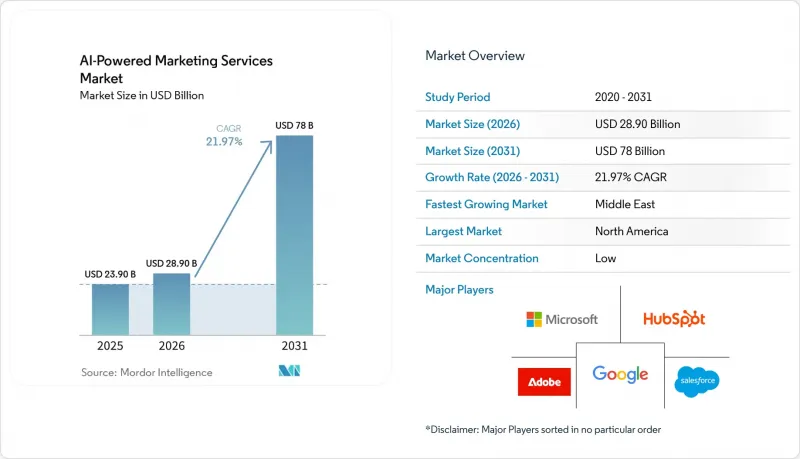
Mordor Intelligence에 의하면, AI 활용 마케팅 서비스 시장 규모는 2025년 239억 달러로 평가되었습니다. 2026년에는 289억 달러로 확대되어 2026년부터 2031년에 걸쳐 CAGR 21.97%로 성장을 지속하여, 2031년까지 780억 달러에 이를 것으로 예측됩니다.
본 보고서는 도입 형태(클라우드, On-Premise, 하이브리드), 조직 규모(대기업, 중소기업), 최종 사용자 산업(소매 및 전자상거래, IT 및 통신, 헬스케어 및 생명과학, 미디어 및 엔터테인먼트, 제조·산업, 기타) 및 지역별로 분류되어 있습니다. 시장 예측은 금액(달러) 기준으로 제시되어 있습니다.
세계의 AI 활용 마케팅 서비스 시장 동향 및 인사이트
초개인화된 고객 참여에 대한 수요 증가
AI 활용 마케팅 서비스 시장은 개인화가 단순한 선택적 전술에서 고객 참여의 핵심 요소로 전환되고 있는 데 따른 혜택을 누리고 있습니다. 현재 각 브랜드는 채널 전반에 걸쳐 고객의 행동에 실시간으로 대응해야 할 필요가 있으며, 이로 인해 정체성, 콘텐츠, 의사 결정을 단일 워크플로우로 통합할 수 있는 플랫폼에 대한 수요가 증가하고 있습니다. 어도비는 2025년 보고서에서 조직의 63%가 이미 AI 활용 개인화를 도입하거나 시범 운영 중이며, 86%가 고객 상호작용을 분석하기 위한 시범 운영 또는 상용화 단계의 솔루션을 도입하고 있다고 보고했습니다. 이는 기업들의 도입이 이미 초기 탐색 단계를 벗어났음을 보여줍니다. 더 이상 주요 병목 현상은 모델에 대한 접근성만이 아닙니다. 왜냐하면 더 강력한 차별화 요소는 전체 스택에 걸친 신원 식별과 실시간 신호 수집에 있기 때문입니다. 이러한 추세는 개인화 로직을 적용하기 전에 고객 데이터를 적절히 연계할 수 있는 AI 활용 마케팅 서비스 시장의 벤더들에게 유리하게 작용합니다. 또한, 고객 기록이 파편화된 상태로 운영되는 브랜드의 경우 고객 유지 위험이 높아집니다. 더 큰 규모의 플랫폼에서 제공되는 일관된 경험이 AI 활용 마케팅 서비스 시장 전체에서 사용자의 기대치를 재정의하고 있기 때문입니다.
생성형 AI를 통한 콘텐츠 제작의 효율화
AI 활용 마케팅 서비스 시장은 콘텐츠 제작이 더 이상 고정적인 운영상의 병목 현상이 아니게 되고 있다는 점에서도 혜택을 보고 있습니다. 생성형 AI 도구를 통해 팀 규모를 그만큼 확대하지 않고도 더 많은 변형 버전과 현지화 버전, 타겟층에 특화된 자산을 제작할 수 있게 되었습니다. 어도비는 2025년 6월, Lumen Technologies사가 ‘Adobe GenStudio for Performance Marketing’을 도입한 결과, 캠페인 론칭 기간을 25일에서 9일로 단축했으며, 메타의 각 플랫폼에서 2개의 타겟 페르소나를 대상으로 한 광고 변형 제작 시간이 65% 단축되었다고 발표했습니다. 또한 어도비는 2025년 10월 ‘GenStudio’를 확장하여 대규모 콘텐츠 제작 기능인 ‘Firefly Design Intelligence’, ‘Firefly Creative Production for Enterprise’ 및 보다 광범위한 광고 배포 생태계를 추가했습니다. 이는 인프라와 같은 역할을 하는 콘텐츠 운영에 대한 수요가 증가하고 있음을 보여줍니다. 콘텐츠 생성 속도가 향상됨에 따라, AI 활용 마케팅 서비스 시장에서는 자산 생성 속도를 따라잡을 수 있는 측정, 거버넌스, 그리고 성과 피드백 계층에 대한 수요가 높아지고 있습니다. 이는 콘텐츠 자동화로 인해 플랫폼에 대한 수요가 감소하고 있는 것이 아니라, AI 활용 마케팅 서비스 시장 전반에서 기업의 구매 담당자가 필요로 하는 관련 시스템의 수가 늘어나고 있음을 의미합니다.
데이터 개인정보 보호, 동의 및 자동 프로파일링에 대한 면밀한 검토
개인정보 보호 규제가 자동화된 프로파일링 및 콘텐츠 생성의 실제 운영 방식과 점점 더 밀접하게 연관됨에 따라, AI 활용 마케팅 서비스 시장은 더욱 엄격한 규정 준수 압박에 직면하고 있습니다. EU AI법의 다음 이행 단계는 2026년 8월에 시작되며, 세분화, 개인화 및 자동화된 의사 결정 지원에 AI를 활용하는 기업에 대한 부담이 커질 것입니다. 유럽 데이터 보호 감독관은 2025년 10월, 생성형 AI 시스템을 규정 준수 방식에 따라 활용하기 위한 최신 지침을 발표했습니다. 이 지침에서는 기업의 도입 기준에 직접적인 영향을 미치는 합법적 처리, 거버넌스 및 데이터 보호 관리에 중점을 두고 있습니다. 이에 따라 AI 활용 마케팅 서비스 시장의 구매자들은 자동화를 더 광범위하게 확대하기 전에 데이터 파이프라인, 동의 획득 절차 및 인적 모니터링 체계를 재설계해야 할 필요에 직면하고 있습니다. 또한, 제공 모델의 일환으로 감사 가능성, 문서화 및 정책 관리 기능을 이미 제공하고 있는 벤더의 입지도 강화될 것입니다. AI 활용 마케팅 서비스 시장의 많은 기업 간 거래에서 규정 준수 기능은 단순한 조달 우선순위에서 시장 진입을 위한 최소 요건으로 전환되고 있습니다.
부문별 분석
2025년, AI 활용 마케팅 서비스 시장에서 클라우드 도입은 62.24%의 점유율을 차지했습니다. 이는 빈번한 모델 업데이트와 대용량 처리를 지원할 수 있는 확장 가능하고 API 우선적인 환경에 대한 강한 선호도를 반영한 것입니다. 또한, 벤더가 긴 업그레이드 주기를 거치지 않고도 기능 변경, 보안 업데이트, 규정 준수 관리를 전체 고객에게 적용할 수 있기 때문에 클라우드는 이 부문의 발전 속도에도 적합합니다. 금융 서비스, 국방 및 규제가 엄격한 의료 분야에서는 고객 데이터 취급 규정이 여전히 엄격하고 내부 통제가 우선시되기 때문에 On-Premise 환경의 중요성은 여전히 남아 있습니다. 그렇지만 AI 활용 마케팅 서비스 시장의 중심은 보다 신속한 도입과 고객 참여 스택 전반에 걸친 폭넓은 통합을 실현하는 클라우드 플랫폼에 여전히 머물러 있습니다.
하이브리드 배포는 AI 활용 마케팅 서비스 시장 규모에서 2026년부터 2031년까지 연평균 성장률(CAGR) 24.91%로 가장 빠른 성장을 기록할 것으로 예측됩니다. 이는 많은 기업이 현재 기밀성이 높은 ID 데이터를 관리된 환경 내에 남겨두면서, 추론 및 콘텐츠 생성을 클라우드로 이전하기를 원하기 때문입니다. 다국적 기업들이 지역별로 상이한 개인정보 보호 및 데이터 거주지 요건에 직면함에 따라, 이 아키텍처의 중요성은 더욱 커지고 있습니다. 어도비와 엔비디아는 2026년 3월, 차세대 Firefly 모델과 클라우드 네이티브 3D 디지털 트윈 워크플로우를 지원하기 위한 전략적 제휴를 발표했습니다. 이는 주요 브랜드들이 더욱 복잡한 마케팅 업무를 위해 도입을 준비하고 있는 연동된 환경의 모습을 시사하는 것입니다. AI 활용 마케팅 서비스 업계에서 On-Premise 데이터 저장소와 클라우드 기반 실행 계층 간의 규정 준수 데이터 마이그레이션을 조정할 수 있는 벤더는 규제 요건이 강화됨에 따라 더욱 견고한 입지를 다지게 될 것입니다.
지역별 분석
2025년, 북미는 AI 활용 마케팅 서비스 시장 점유율의 47.78%를 차지하며 다른 지역을 크게 앞지르고 최대 기여 지역이 되었습니다. 이 지역은 기업용 소프트웨어에 대한 막대한 투자, 디지털 광고 예산의 집중, 그리고 AI 네이티브 마케팅 기술 벤더들이 밀집해 있는 기반이라는 이점을 누리고 있습니다. 미국은 답변 엔진 최적화, 에이전트형 캠페인 관리, AI 네이티브 CRM과 같은 새로운 카테고리의 주요 실증 무대로 계속해서 자리 잡고 있습니다. 캐나다와 멕시코는 소매 및 금융 서비스 분야의 활용 사례에서 눈에 띄는 도입이 진행되고 있어 이 지역 시장을 더욱 활성화시키고 있습니다. 남미는 상용화의 초기 단계에 있지만, 브라질에서는 디지털 커머스 및 통신 마케팅이 점점 더 데이터 중심적으로 변함에 따라 지역 특유 수요가 발생하고 있습니다.
유럽은 AI 활용 마케팅 서비스 시장에서 독특한 위치를 차지하고 있습니다. 그 이유는 이 지역의 도입이 순수한 수요 증가뿐만 아니라 거버넌스 요건에 의해서도 크게 형성되고 있기 때문입니다. GDPR(EU 개인정보보호규정)의 시행, EU AI 법의 단계적 도입, 그리고 AI 활용 프로파일링에 대한 더욱 엄격한 지침으로 인해 구매자들은 보다 통제된 도입 모델로 향하고 있습니다. 이는 적극적인 개인화에 대한 장벽이 되는 한편, 규정 준수를 문서화하고 조달 위험을 줄일 수 있는 공급업체에 대한 프리미엄 수요를 뒷받침하는 요인이 되고 있습니다. 독일과 영국은 여전히 유럽에서 가장 큰 두 시장이며, 독일은 산업 분야의 자동화 요구와, 영국은 첨단 디지털 광고 수요와 더 밀접하게 연결되어 있습니다.
아시아태평양은 두 번째로 큰 지역 시장이지만, 도입 패턴은 국가와 플랫폼 구조에 따라 크게 다릅니다. 중국에서는 상거래, 소셜 참여, AI 추천을 폐쇄형 루프로 결합한 국내 생태계가 여전히 지배적이며, 많은 세계 벤더의 직접적인 접근이 제한되어 있습니다. 인도 및 동남아시아에서는 인터넷 사용자가 디지털 상거래 및 서비스에 깊이 관여하게 됨에 따라 클라우드 기반 플랫폼을 위한 더 큰 성장 기회가 창출되고 있습니다. 중동은 AI 활용 마케팅 서비스 시장에서 가장 빠른 성장세를 기록할 것으로 예상되며, 사우디아라비아와 아랍에미리트의 국가 주도 디지털 경제 프로그램에 힘입어 2026년부터 2031년까지 연평균 성장률(CAGR) 25.56%를 기록할 전망입니다. 아프리카는 여전히 규모가 가장 작은 지역이지만, 남아프리카공화국, 나이지리아, 이집트에서는 AI 주도 세분화 및 현지화된 콘텐츠를 효율적으로 확대할 수 있는 통신 및 금융 서비스 분야에서 수요가 발생하고 있습니다.
기타 혜택 :
- 엑셀 형식 시장 예측(ME) 시트
- 3개월간의 애널리스트 지원
자주 묻는 질문
목차
제1장 서론
제2장 조사 방법
제3장 개요
제4장 시장 구도
제5장 시장 규모 및 성장 예측(금액 : 10억 달러)
제6장 경쟁 구도
제7장 시장 기회 및 향후 전망
KTH 26.09.02According to Mordor Intelligence, the AI-powered marketing services market size is expected to grow from USD 23.9 billion in 2025 to USD 28.9 billion in 2026 and is forecast to reach USD 78 billion by 2031 at 21.97% CAGR over 2026-2031.
This report is Segmented by Deployment Mode (Cloud, On-Premises, and Hybrid), Organization Size (Large Enterprises, and Small and Medium-Sized Enterprises), End-User Industry (Retail and E-Commerce, IT and Telecommunications, Healthcare and Life Sciences, Media and Entertainment, Manufacturing and Industrials, and More), and Geography. The Market Forecasts are Provided in Terms of Value (USD).
Global AI-Powered Marketing Services Market Trends and Insights
Rising Demand for Hyper-Personalized Customer Engagement
The AI-powered marketing services market is benefiting from the shift in personalization from an optional tactic to a core part of customer engagement. Brands are now under pressure to respond to behavior in real time across channels, which raises demand for platforms that can unify identity, content, and decisioning in one workflow. Adobe reported in 2025 that 63% of organizations were already using or piloting AI-powered personalization, and 86% had pilot or working solutions in place to analyze customer interactions, which shows that enterprise adoption has moved past early exploration. The main bottleneck is no longer model access alone, because the stronger differentiator sits in identity resolution and real-time signal ingestion across the stack. That dynamic favors vendors in the AI-powered marketing services market that can connect customer data cleanly before applying personalization logic. It also raises the retention risk for brands that still operate with fragmented customer records, because more consistent experiences on larger platforms are resetting user expectations across the AI-powered marketing services market.
Generative AI-Driven Content Production Efficiency
The AI-powered marketing services market is also gaining from the move away from content creation as a fixed operational bottleneck. Generative tools are making it possible to produce more variations, localizations, and audience-specific assets without expanding teams at the same pace. Adobe said in June 2025 that Lumen Technologies cut campaign launch time from 25 days to 9 days after deploying Adobe GenStudio for Performance Marketing, while ad variation production time for Meta properties across 2 target personas fell by 65%. Adobe also expanded GenStudio in October 2025 with scaled content production capabilities, Firefly Design Intelligence, Firefly Creative Production for Enterprise, and a wider ad delivery ecosystem, which points to growing demand for content operations that behave more like infrastructure. As content velocity rises, the AI-powered marketing services market is seeing stronger demand for measurement, governance, and performance feedback layers that can keep pace with asset output. This means content automation is not reducing platform demand; it is broadening the number of adjacent systems that enterprise buyers need across the AI-powered marketing services market.
Data Privacy, Consent, And Automated Profiling Scrutiny
The AI-powered marketing services market is facing heavier compliance pressure as privacy rules move closer to how automated profiling and content generation work in practice. The next implementation phase of the EU AI Act begins in August 2026, and that raises the burden on enterprises that use AI for segmentation, personalization, and automated decision support. The European Data Protection Supervisor published updated orientations in October 2025 on using generative AI systems in a compliant way, with a focus on lawful processing, governance, and data protection controls that directly affect enterprise deployment standards. This pushes buyers in the AI-powered marketing services market to redesign data pipelines, consent flows, and human oversight mechanisms before scaling automation more broadly. It also strengthens the position of vendors that already offer auditability, documentation, and policy controls as part of their delivery model. For many enterprise deals in the AI-powered marketing services market, compliance features are moving from procurement preference to a minimum entry requirement.
Other drivers and restraints analyzed in the detailed report include:
- Expansion Of Omnichannel Commerce And Performance Marketing
- Integration Of AI With CRM And Marketing Automation Platforms
- High Implementation Costs And AI Talent Gaps
For complete list of drivers and restraints, kindly check the Table Of Contents.
Segment Analysis
Cloud deployment held 62.24% of the AI-powered marketing services market share in 2025, reflecting the strong preference for scalable, API-first environments that can support frequent model updates and high-volume processing. Cloud also suits the pace of this category, because vendors can push feature changes, security updates, and compliance controls across customers without long upgrade cycles. On-premises setups still matter in financial services, defense, and regulated healthcare, where customer data handling rules remain strict and internal control is prioritized. Even so, the center of gravity in the AI-powered marketing services market remains with cloud platforms, which offer faster deployment and broader integration across customer engagement stacks.
Hybrid deployment is expected to post the fastest growth in the AI-powered marketing services market size at a 24.91% CAGR from 2026 to 2031, because many enterprises now want sensitive identity data to remain in controlled environments while inference and content generation move to the cloud. This architecture is becoming more relevant as multinational organizations face different privacy and residency requirements across regions. Adobe and NVIDIA announced a strategic partnership in March 2026 to support next-generation Firefly models and cloud-native 3D digital twin workflows, pointing to the type of connected environment large brands are preparing to use for more complex marketing operations. In the AI-powered marketing services industry, vendors that can orchestrate compliant movement between on-premises data stores and cloud-based execution layers are likely to hold a stronger position as regulatory expectations tighten.
Complete Report Scope:
- By deployment mode
- Cloud
- On-premises
- Hybrid
- By organization size
- Large Enterprises
- Small and Medium-sized Enterprises
- By End-User Industry
- Retail and E-commerce
- IT and Telecommunications
- BFSI
- Healthcare and Life Sciences
- Media and Entertainment
- Travel and Hospitality
- Manufacturing and Industrials
- Others (Automotive, Public Sector, Others)
- By Geography
- North America
- United States
- Canada
- Mexico
- South America
- Brazil
- Argentina
- Chile
- Rest of South America
- Europe
- Germany
- United Kingdom
- France
- Italy
- Spain
- Rest of Europe
- Asia-Pacific
- China
- Japan
- India
- South Korea
- Australia
- Rest of Asia-Pacific
- Middle East
- United Arab Emirates
- Saudi Arabia
- Qatar
- Rest of Middle East
- Africa
- South Africa
- Egypt
- Nigeria
- Rest of Africa
- North America
Geography Analysis
North America accounted for 47.78% of the AI-powered marketing services market share in 2025, making it the largest regional contributor by a wide margin. The region benefits from deep enterprise software spending, a large concentration of digital advertising budgets, and a dense base of AI-native marketing technology vendors. The United States remains the main proving ground for newer categories such as answer engine optimization, agentic campaign management, and AI-native CRM. Canada and Mexico add to regional depth, with visible adoption in retail and financial services use cases. South America is at an earlier stage of commercialization, but Brazil is creating localized demand as digital commerce and telecom marketing become more data-driven.
Europe holds a distinct place in the AI-powered marketing services market because adoption there is being shaped as much by governance requirements as by pure demand growth. GDPR enforcement, the phased rollout of the EU AI Act, and stricter guidance on AI-driven profiling have pushed buyers toward more controlled deployment models. That creates friction for aggressive personalization, but it also supports premium demand for vendors that can document compliance and reduce procurement risk. Germany and the United Kingdom remain the two largest European markets, with Germany tied more closely to industrial-sector automation needs and the United Kingdom to advanced digital advertising demand.
Asia-Pacific is the second-largest regional market, although adoption patterns vary widely by country and platform structure. China remains dominated by domestic ecosystems that combine commerce, social engagement, and AI recommendations in closed loops, which limits direct access for many global vendors. India and Southeast Asia offer greater growth opportunities for cloud-based platforms as internet users move deeper into digital commerce and services. The Middle East is projected to record the fastest expansion in the AI-powered marketing services market, with a 25.56% CAGR from 2026 to 2031, supported by state-backed digital economy programs in Saudi Arabia and the United Arab Emirates. Africa remains the smallest region, but South Africa, Nigeria, and Egypt are creating demand in telecommunications and financial services where AI-led segmentation and localized content can scale efficiently.
- Salesforce, Inc.
- Adobe Inc.
- Google LLC
- Microsoft Corporation
- HubSpot, Inc.
- Oracle Corporation
- SAP SE
- International Business Machines Corporation
- Amazon.com, Inc.
- Accenture plc
- Publicis Groupe S.A.
- WPP plc
- Omnicom Group Inc.
- The Interpublic Group of Companies, Inc.
- The Trade Desk, Inc.
- Klaviyo, Inc.
- Sprinklr, Inc.
- Braze, Inc.
- ActiveCampaign, Inc.
- Bloomreach, Inc.
- Zoho Corporation Pvt. Ltd.
Additional Benefits:
- The market estimate (ME) sheet in Excel format
- 3 months of analyst support
TABLE OF CONTENTS
1 INTRODUCTION
- 1.1 Study Assumptions and Market Definition
- 1.2 Scope of the Study
2 RESEARCH METHODOLOGY
3 EXECUTIVE SUMMARY
4 MARKET LANDSCAPE
- 4.1 Market Overview
- 4.2 Impact of Macroeconomic Factors on the Market
- 4.3 Market Drivers
- 4.3.1 Rising Demand for Hyper-Personalized Customer Engagement
- 4.3.2 Generative AI-Driven Content Production Efficiency
- 4.3.3 Expansion of Omnichannel Commerce and Performance Marketing
- 4.3.4 Integration of AI With CRM and Marketing Automation Platforms
- 4.3.5 Generative Engine Optimization and AI Search Visibility Spend
- 4.3.6 Agentic Campaign Execution and Human-in-the-Loop Productivity Gains
- 4.4 Market Restraints
- 4.4.1 Data Privacy, Consent, and Automated Profiling Scrutiny
- 4.4.2 High Implementation Costs and AI Talent Gaps
- 4.4.3 Zero-Click AI Search and Attribution Compression
- 4.4.4 Synthetic Media Disclosure and Brand Trust Burden
- 4.5 Industry Value Chain Analysis
- 4.6 Regulatory Landscape
- 4.7 Technological Outlook
- 4.8 Porter's Five Forces Analysis
- 4.8.1 Threat of New Entrants
- 4.8.2 Bargaining Power of Buyers
- 4.8.3 Bargaining Power of Suppliers
- 4.8.4 Threat of Substitutes
- 4.8.5 Competitive Rivalry
5 MARKET SIZE AND GROWTH FORECASTS, VALUE (USD BILLION)
- 5.1 By deployment mode
- 5.1.1 Cloud
- 5.1.2 On-premises
- 5.1.3 Hybrid
- 5.2 By organization size
- 5.2.1 Large Enterprises
- 5.2.2 Small and Medium-sized Enterprises
- 5.3 By End-User Industry
- 5.3.1 Retail and E-commerce
- 5.3.2 IT and Telecommunications
- 5.3.3 BFSI
- 5.3.4 Healthcare and Life Sciences
- 5.3.5 Media and Entertainment
- 5.3.6 Travel and Hospitality
- 5.3.7 Manufacturing and Industrials
- 5.3.8 Others (Automotive, Public Sector, Others)
- 5.4 By Geography
- 5.4.1 North America
- 5.4.1.1 United States
- 5.4.1.2 Canada
- 5.4.1.3 Mexico
- 5.4.2 South America
- 5.4.2.1 Brazil
- 5.4.2.2 Argentina
- 5.4.2.3 Chile
- 5.4.2.4 Rest of South America
- 5.4.3 Europe
- 5.4.3.1 Germany
- 5.4.3.2 United Kingdom
- 5.4.3.3 France
- 5.4.3.4 Italy
- 5.4.3.5 Spain
- 5.4.3.6 Rest of Europe
- 5.4.4 Asia-Pacific
- 5.4.4.1 China
- 5.4.4.2 Japan
- 5.4.4.3 India
- 5.4.4.4 South Korea
- 5.4.4.5 Australia
- 5.4.4.6 Rest of Asia-Pacific
- 5.4.5 Middle East
- 5.4.5.1 United Arab Emirates
- 5.4.5.2 Saudi Arabia
- 5.4.5.3 Qatar
- 5.4.5.4 Rest of Middle East
- 5.4.6 Africa
- 5.4.6.1 South Africa
- 5.4.6.2 Egypt
- 5.4.6.3 Nigeria
- 5.4.6.4 Rest of Africa
- 5.4.1 North America
6 COMPETITIVE LANDSCAPE
- 6.1 Market Concentration
- 6.2 Strategic Moves
- 6.3 Market Share Analysis
- 6.4 Company Profiles (includes Global Level Overview, Market Level Overview, Core Segments, Financials as available, Strategic Information, Market Rank/Share, Products and Services, Recent Developments)
- 6.4.1 Salesforce, Inc.
- 6.4.2 Adobe Inc.
- 6.4.3 Google LLC
- 6.4.4 Microsoft Corporation
- 6.4.5 HubSpot, Inc.
- 6.4.6 Oracle Corporation
- 6.4.7 SAP SE
- 6.4.8 International Business Machines Corporation
- 6.4.9 Amazon.com, Inc.
- 6.4.10 Accenture plc
- 6.4.11 Publicis Groupe S.A.
- 6.4.12 WPP plc
- 6.4.13 Omnicom Group Inc.
- 6.4.14 The Interpublic Group of Companies, Inc.
- 6.4.15 The Trade Desk, Inc.
- 6.4.16 Klaviyo, Inc.
- 6.4.17 Sprinklr, Inc.
- 6.4.18 Braze, Inc.
- 6.4.19 ActiveCampaign, Inc.
- 6.4.20 Bloomreach, Inc.
- 6.4.21 Zoho Corporation Pvt. Ltd.
7 MARKET OPPORTUNITIES AND FUTURE OUTLOOK
- 7.1 White-space and unmet-need assessment


