

|
시장보고서
상품코드
2119269
네트워크 API 수익화 : 시장 점유율 분석, 업계 동향 및 통계, 성장 예측(2026-2031년)Network API Monetization - Market Share Analysis, Industry Trends & Statistics, Growth Forecasts (2026 - 2031) |
||||||
 Mordor Intelligence
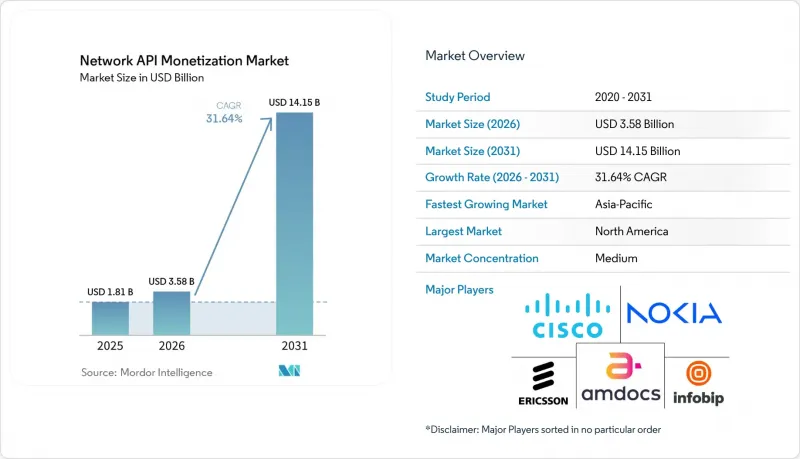
Mordor Intelligence에 의하면, 네트워크 API 수익화 시장 규모는 2025년 18억 1,000만 달러로 평가되었습니다. 2026년에는 35억 8,000만 달러로 확대되어 2031년까지 141억 5,000만 달러에 이를 것으로 예측되며, 2026년부터 2031년까지 연평균 복합 성장률(CAGR)은 31.64%를 나타낼 전망입니다.
본 보고서는 API 유형(온디맨드 품질 API, 전화번호 인증 및 SIM 스왑 API 등),구성 요소(API 수익화 플랫폼, API 게이트웨이 및 네트워크 노출 기능 등), 배포 모드(클라우드, On-Premise, 하이브리드), 최종 사용자 산업(자동차 및 커넥티드 모빌리티 등), 그리고 지역별로 분류되어 있습니다. 시장 예측은 금액(달러) 기준으로 제시되어 있습니다.
세계의 네트워크 API 수익화 시장 동향 및 인사이트
5G 독립형(SA) 네트워크 노출의 확대가 프로그래밍 가능한 수익화 가능성을 열어줍니다.
독립형 5G는 네트워크 노출 기능이 외부 용도에 대해 코어 네트워크 기능으로 연결되는 표준화된 경로를 제공하므로, 네트워크 API 수익화 시장의 기술적 기반이 됩니다. 이를 통해 개발자는 세션 관리, 대역폭 우선순위 지정, 슬라이스 제어를 실시간으로 요청할 수 있게 됩니다. 이러한 접근 방식을 통해 통신 사업자의 자체 시스템에 직접 액세스할 필요 없이 서비스 품질(QoS)을 보장할 수 있습니다. 에릭슨은 2026년 ‘코어 네트워크 서밋’에서 사기 감지, 기업 시설용 온디맨드 품질(QoD), 고정 무선 액세스를 통한 수익화를 상용화 가능한 API 그룹으로 선정했습니다. 기업이 밀집한 지역에서 스탠드얼론 구축을 완료한 통신 사업자는 다른 지역의 커버리지가 개선되기 전에 서비스 품질(QoS) 및 네트워크 슬라이싱 API에 대한 초기 수요에 대응할 수 있습니다. 2026년 1월 기준, 5G 서비스를 시작한 통신 사업자 중 컨버지드 네트워크 또는 완전한 독립형 네트워크를 구축한 곳은 불과 22%에 그쳐, 향후 구축에 따른 도입 여지가 여전히 많이 남아 있습니다.
실시간 부정 행위 감지 및 신원 확인 API에 대한 기업 수요가 단기 수익을 견인
금융 서비스는 네트워크 API 수익화 시장에서 가장 성숙한 수요 패턴을 보이고 있습니다. 이는 즉시 결제 시 사기를 평가할 시간이 거의 없기 때문입니다. 은행 및 핀테크 기업은 SIM 상태, 전화번호 보유 기간, 단말기 연계와 같은 통신 사업자의 신호를 활용하여 인증을 강화하고, SMS를 통한 일회용 비밀번호에 대한 의존도를 낮출 수 있습니다. GSMA Intelligence는 2025년 ‘Open Gateway Demand Index’에서 평가 대상 전체 부문 중 은행 및 금융 서비스를 1위로 선정했습니다. 번호 검증 및 SIM 스왑이 표준 서비스로 자리 잡음에 따라, 통신 사업자는 KYC 매칭, 가입자 행동 신호, 단말기 보유 기간 데이터 등을 통해 차별화를 꾀할 수 있습니다. 공급자가 단순히 기술적인 API 카탈로그를 제시하는 것이 아니라, 이러한 서비스를 사기 손실 감소, 온보딩 간소화, 규정 준수 요건 충족과 연계하여 제시함으로써 기업이 이러한 서비스를 채택할 가능성이 높아집니다. 이 프레임워크는 API에 대한 지출을 조달 팀이나 리스크 관리 팀이 평가할 수 있는 업무적 성과와 연결한다는 점에서 중요합니다.
통신 사업자별 도입 현황의 편차와 API 버전의 불일치가 여러 사업자에 걸친 확장을 지연시키고 있습니다.
구현 방식의 차이는 네트워크 API 수익화 시장에 있어 여전히 상업적 장벽으로 작용하고 있습니다. 이는 공통된 CAMARA 사양이라 하더라도 통신 사업자에 따라 지연, 동의, 구현 결과가 달라질 수 있기 때문입니다. 국경을 넘는 용도에서는 이러한 차이점을 고려해야 하므로 통합 비용이 증가하고 개발자의 투자가 지연됩니다. GSMA의 기술 지침에서는 온보딩, 보고, 동의의 전체 프로세스에 걸쳐 CAMARA 서비스 API와 TM Forum Operate API를 모두 지원해야 한다고 명시하고 있습니다. Enea사는 표준화된 노스바운드 인터페이스라 하더라도 여전히 각 통신사 고유의 네트워크 인프라와의 사우스바운드 통합이 필요하다고 지적하고 있습니다. 그 결과, 특히 유럽과 아시아태평양의 통신 사업자 간에 상용 출시 일정이나 기술적 준비 상태에 차이가 있는 경우, 다중 사업자 배포가 지연될 수 있습니다. 이는 시장 전체의 기회를 제한하는 것은 아니지만, 국경을 넘는 엔터프라이즈 용도에 필요한 규모 확대를 늦출 가능성이 있습니다.
부문 분석
2025년, 번호 검증 및 SIM 스왑 API는 네트워크 API 수익화 시장 점유율의 21.14%를 차지하며 가장 큰 API 카테고리가 되었습니다. 이러한 위상은 은행, 보험, 전자상거래 온보딩 과정에서 일회용 비밀번호로 인한 번거로움을 줄여주는 캐리어급 인증에 대한 기업 수요를 반영합니다. 가입자 수준의 SIM 데이터는 제3자가 동등한 권한이나 규모로 재현할 수 없는 사기 징후를 제공합니다. GSMA의 ‘Unscammed’ 프로그램은 미국, 캐나다, 영국, 호주에서 여러 통신사가 협력하여 사기 방지 API 도입을 추진하고 있습니다. 이러한 도입 사례는 사기 방지가 개별 시험 단계에서 네트워크 API 수익화 시장 전체에 걸친 협력적 구현으로 발전하고 있음을 보여줍니다.
네트워크 슬라이싱 및 엣지 지원 API는 2031년까지 연평균 성장률(CAGR) 33.41%로 확대될 것으로 예상되며, 이는 API 유형 중 가장 높은 성장률입니다. 자동차, 산업용 IoT 및 게임 용도에서는 베스트 에포트(best-effort)형 연결로는 제공할 수 없는 확실한 지연 시간과 대역폭이 요구됩니다. 온디맨드 품질 API는 특정 세션에 우선순위가 필요한 미디어 스트리밍 및 기업용 화상 협업 분야에서 활용이 확대되고 있습니다. 기기 위치 정보 및 지오펜싱 API는 물류, 차량 관리, 긴급 서비스 분야에서 초기 단계의 활용이 진행되고 있습니다. 통신사 과금, 결제, 기기 상태 및 연결성 API는 상업적 개발의 초기 단계에 있으며, 관련 활동은 기업용 과금 통합이 더 진전된 아시아태평양 시장에 집중되어 있습니다. 한편, AECC는 MWC25에서 커넥티드카를 위한 CAMARA 표준화된 ‘온디맨드 품질’ 및 ‘네트워크 슬라이싱’ API에 관한 요구 사항을 수립했습니다.
2025년 네트워크 API 수익화 시장 규모 중 API 수익화 플랫폼이 31.24%를 차지하며 가장 큰 구성 요소가 되었습니다. 통신 사업자들은 여러 CAMARA API 범주를 지원하는 코어 과금, 액세스 제어, 파트너 온보딩 기능에 초기 투자를 집중해 왔습니다. 이러한 지출 패턴은 상위 계층의 개발자 경험이나 분석 도구보다 기초적인 상용 인프라가 우선시되고 있음을 보여줍니다. 에릭슨은 2025년 12월 LotusFlare에 투자하고, 동의 관리 및 디지털 상거래를 위한 DNO Cloud 기능에 관한 전략적 파트너십을 체결했습니다. 이러한 움직임은 수익화 플랫폼을 동의, 액세스 및 개발자 워크플로우와 연계할 필요성을 반영한 것입니다.
개발자 포털 및 API 마켓플레이스의 각 구성 요소는 2026년부터 2031년까지 연평균 성장률(CAGR) 33.14%로 확대될 것으로 예측됩니다. 이러한 성장은 네트워크 API 수익화 시장에서 경쟁의 초점이 API 검색, 온보딩, 샌드박스 품질 및 배포로 이동하고 있기 때문입니다. 기본적인 문서 포털에 비해 더 우수한 셀프 서비스 액세스 및 소프트웨어 개발 키트(SDK)를 제공함으로써 API 활용을 촉진할 수 있습니다. 또한, 사용량 기반 과금에는 소비량, 지연, 오류율의 가시화가 필요하기 때문에 계량, 분석, 가시성도 중요해지고 있습니다. WSO2는 2025년 11월 Moesif를 인수하여 해당 분석 및 수익화 기능을 API 관리자의 라이프사이클에 통합했습니다. 청구, 수익 보장, 보안, ID 관리, 동의 관리, 관리형 서비스는 사내 역량이 각기 다른 사업자, 특히 사내 API 프로그램 관리 자원이 제한적인 사업자에게 여전히 중요한 지원 구성 요소로 남아 있습니다.
지역별 분석
2025년, 북미는 네트워크 API 수익화 시장 점유율의 34.12%를 차지했습니다. 미국 및 캐나다의 통신 사업자들은 CPaaS 유통업체를 통해 조기에 번호 검증 및 SIM 스왑 서비스를 도입했습니다. 확립된 기업 소프트웨어 조달 프로세스 또한 금융 서비스 및 소매 업계 고객들의 API 도입을 촉진하고 있습니다. 2025년 7월, Aduna는 에릭슨(Ericsson)과 AT&T, T-Mobile, Verizon을 포함한 12개 통신 사업자와 제휴를 체결하여 개발자를 위한 통합 배포 계층을 제공하게 되었습니다. 캐나다에서는 Enstream이 Bell Canada, Rogers, TELUS를 공통 CAMARA API 모델로 통합하고 있습니다. 한편, 멕시코는 개발 초기 단계에 있으며, 독립형 5G 커버리지 범위가 확대되고 있는 가운데, 수요는 금융 포용 및 결제 인증에 집중되고 있습니다.
유럽에서는 영국의 4개 통신 사업자가 주도한 CAMARA API 연동에 힘입어 2025년에 상당한 수익을 창출했습니다. Vodafone, Virgin Media O2, BT/EE, Three는 공유형 Open Gateway 접근 방식을 통해 SIM 스왑, 번호 검증, 연령 확인, 이용 기간 확인 등 각 API 제공에 전념하고 있습니다. 독일 역시 아두나, 노키아, 인포비프, 글라이드 아이덴티티와 독일텔레콤 T 도매의 유통 계약을 통해 지역적 성장을 지원하고 있습니다. 프랑스, 스페인, 이탈리아 및 기타 시장에서는 활발한 상용화가 진행되고 있으며, 텔레포니카는 GSMA 및 TM 포럼의 공동 적합성 인증 획득을 향해 진전을 보이고 있습니다. GDPR(EU 개인정보보호규정)에서는 가입자 정보를 공개하는 API에 대해 명시적인 동의를 요구하고 있으며, 2025년 11월에는 AZOP가 개인 데이터 처리 위반을 이유로 통신 사업자에게 450만 유로(490만 달러)의 벌금을 부과했습니다. 이는 유럽에서 동의 관리의 중요성을 여실히 보여주는 사례입니다.
아시아태평양은 2026년부터 2031년까지 연평균 성장률(CAGR) 33.28%로 확대될 것으로 예측되며, 이는 네트워크 API 수익화 시장에서 지역별 가장 높은 성장률입니다. 중국에서는 2025년에 5G 기지국이 340만 개 이상에 달하며, 네트워크 API 활동을 위한 광범위한 인프라가 구축되었습니다. 한편, 차이나 유니콤과 차이나 텔레콤은 GSMA 인증 ‘Open Gateway’ 도입을 시작했으며, 차이나 유니콤은 국내 커넥티드카 시장의 70%를 커버하고 있다고 보고했습니다. 노키아는 2025년에 바티 에어텔과 제휴하여, 해당 기업의 ‘Network as Code’ 포털을 통해 인도 전역을 대상으로 한 네트워크 API를 제공했습니다. 일본, 한국, 호주, 중동 및 아프리카에서도 활동이 활발해지고 있으며, 카타르의 통신 사업자는 2026년에 API 포트폴리오를 확충하겠다고 약속했습니다. 한편, 남미는 브라질의 픽스(Pix) 인프라와 핀테크 분야의 사기 방지 수요에 힘입어, 아르헨티나와 칠레에서의 API 시범 사업을 바탕으로 새로운 기회로 부상하고 있습니다.
기타 혜택 :
- 엑셀 형식 시장 예측(ME) 시트
- 3개월간의 애널리스트 지원
자주 묻는 질문
목차
제1장 서론
제2장 조사 방법
제3장 주요 요약
제4장 시장 구도
제5장 시장 규모 및 성장 예측
제6장 경쟁 구도
제7장 시장 기회 및 향후 전망
KTH 26.09.10According to Mordor Intelligence, the network API monetization market size is projected to expand from USD 1.81 billion in 2025 to USD 3.58 billion in 2026, and to USD 14.15 billion by 2031, registering a CAGR of 31.64% between 2026 and 2031.
This report is Segmented by API Type (Quality On Demand APIs, Number Verification and SIM Swap APIs, and More), Component (API Monetization Platform, API Gateway and Network Exposure Function, and More), Deployment Mode (Cloud, On-Premise, and Hybrid), End-User Industry (Automotive and Connected Mobility, and More), and Geography. The Market Forecasts are Provided in Terms of Value (USD).
Global Network API Monetization Market Trends and Insights
Expansion of 5G Standalone Network Exposure Unlocks Programmable Monetization
Standalone 5G provides the technical foundation for the Network API Monetization Market, as the Network Exposure Function offers external applications a standardized path to core network functions. It allows developers to request session management, bandwidth prioritization, and slice control in real time. This approach enables a guaranteed quality of service without requiring direct access to proprietary operator systems. Ericsson identified fraud detection, quality-on-demand for enterprise venues, and fixed wireless access monetization as commercially ready API groups at its 2026 Core Network Summit. Operators that complete standalone rollouts in enterprise-dense areas can address early demand for quality-of-service and network-slicing APIs before coverage improves elsewhere. In January 2026, only 22% of operators that had launched 5G had deployed converged or fully standalone networks, leaving material room for later rollout-led adoption.
Enterprise Demand for Real-Time Fraud and Identity APIs Drives Near-Term Revenue
Financial services provide the most mature demand pattern for the Network API Monetization Market because instant payments leave little time to evaluate fraud. Banks and fintech firms can use carrier signals such as SIM status, number tenure, and device associations to strengthen authentication and reduce reliance on SMS one-time passwords. GSMA Intelligence ranked banking and financial services first across the sectors assessed in its 2025 Open Gateway Demand Index. As Number Verification and SIM Swap become standard services, operators can seek differentiation through KYC Match, subscriber behavior signals, and device tenure data. Enterprises are more likely to adopt these services when providers link them to lower fraud losses, easier onboarding, and compliance needs rather than presenting a technical API catalog. This framing is important because it connects API spending to operational outcomes that procurement and risk teams can evaluate.
Fragmented Operator Rollouts and Inconsistent API Versions Slow Multi-Operator Deployments
Fragmented rollout practices remain a commercial obstacle for the Network API Monetization Market because a common CAMARA specification can still yield different latency, consent, and implementation outcomes across carriers. Cross-border applications must account for these differences, thereby raising integration costs and delaying developer investment. GSMA technical guidance requires support for both CAMARA Service APIs and TM Forum Operate APIs across onboarding, reporting, and consent processes. Enea noted that standardized northbound interfaces still require carrier-specific southbound integration with proprietary network infrastructure. The result is a delay in multi-operator deployments, particularly where commercial launch schedules and technical readiness differ across European and Asia-Pacific operators. It does not limit the overall opportunity, but it can postpone the scale needed for cross-border enterprise applications.
Other drivers and restraints analyzed in the detailed report include:
- Hyperscaler and Operator Distribution Partnerships Reshape the Monetization Value Chain
- API-First Digital Business Models and Partner Ecosystems Expand the Addressable Market
- Unclear Developer Willingness to Pay Suppresses Commercial Uptake Beyond Early Adopters
For complete list of drivers and restraints, kindly check the Table Of Contents.
Segment Analysis
Number Verification and SIM Swap APIs held 21.14% of the Network API Monetization Market share in 2025, making them the largest API category. Their position reflects enterprise demand for carrier-grade authentication that reduces friction from one-time passwords in banking, insurance, and e-commerce onboarding. Subscriber-level SIM data provides fraud signals that third parties cannot reproduce with the same authority or at the same scale. The GSMA Unscammed program is pursuing multi-operator fraud-prevention API deployments in the United States, Canada, the United Kingdom, and Australia. These deployments show that fraud prevention is progressing from isolated trials toward coordinated implementation across the Network API Monetization Market.
Network Slicing and Edge Enablement APIs are projected to expand at a 33.41% CAGR through 2031, the fastest growth rate among API types. Automotive, industrial IoT, and gaming applications require assured latency and bandwidth that best-effort connectivity cannot deliver. Quality-on-demand APIs are gaining use in media streaming and enterprise video collaboration, where selected sessions require priority. Device Location and Geofencing APIs are finding early use in logistics, fleet management, and emergency services. Carrier Billing, Payment, Device Status, and Connectivity APIs remain earlier in their commercial development, with activity concentrated in Asia-Pacific markets that have stronger enterprise billing integration, while the AECC set out requirements for CAMARA-standardized quality-on-demand and network-slicing APIs for connected vehicles at MWC25.
API Monetization Platform accounted for 31.24% of the Network API Monetization Market size in 2025, making it the largest component. Operators have focused the initial procurement on core billing, access control, and partner onboarding functions that support multiple CAMARA API categories. This spending pattern shows that foundational commercial infrastructure has taken priority over higher-layer developer experience and analytics tools. Ericsson invested in LotusFlare in December 2025 and formed a strategic partnership around DNO Cloud capabilities for consent management and digital commerce. The move reflected the need to connect monetization platforms with consent, access, and developer workflows.
Developer Portal and API Marketplace components are projected to expand at a 33.14% CAGR from 2026 to 2031. Their growth follows a shift in competition toward API discovery, onboarding, sandbox quality, and distribution across the Network API Monetization Market. Better self-service access and software development kits can increase API use compared with basic documentation portals. Metering, analytics, and observability are also becoming important because usage-based pricing requires visibility into consumption, latency, and error rates. WSO2 acquired Moesif in November 2025 and integrated its analytics and monetization capabilities into the API manager lifecycle. Billing, revenue assurance, security, identity, consent management, and managed services remain important supporting components for operators with different internal capabilities, particularly where in-house API program management resources are limited.
Complete Report Scope:
- By API Type
- Quality on Demand APIs
- Number Verification and SIM Swap APIs
- Device Location and Geofencing APIs
- Network Slicing and Edge Enablement APIs
- Carrier Billing and Payment APIs
- Device Status and Connectivity APIs
- Other API Types
- By Component
- API Monetization Platform
- API Gateway and Network Exposure Function
- Developer Portal and API Marketplace
- Metering, Analytics, and Observability
- Billing, Invoicing, and Revenue Assurance
- Security, Identity, and Consent Management
- Professional and Managed Services
- By Deployment Mode
- Cloud
- On-Premise
- Hybrid
- By End-User Industry
- Financial Services and Fraud Prevention
- Automotive and Connected Mobility
- Enterprise IoT and Smart Manufacturing
- Gaming and Real-Time Media Streaming
- Healthcare and Emergency Services
- Retail and E-commerce
- Aviation and Travel
- Government and Smart Cities
- By Geography
- North America
- United States
- Canada
- Mexico
- South America
- Brazil
- Argentina
- Chile
- Rest of South America
- Europe
- Germany
- United Kingdom
- France
- Italy
- Spain
- Rest of Europe
- Asia-Pacific
- China
- Japan
- India
- South Korea
- Australia
- Rest of Asia-Pacific
- Middle East
- United Arab Emirates
- Saudi Arabia
- Qatar
- Rest of Middle East
- Africa
- South Africa
- Egypt
- Nigeria
- Rest of Africa
- North America
Geography Analysis
North America held 34.12% of the Network API Monetization Market share in 2025. United States and Canadian carriers introduced Number Verification and SIM Swap services early through CPaaS distribution partners. Established enterprise software procurement processes also support API adoption among financial services and retail customers. Aduna was finalized in July 2025 with Ericsson and 12 operators, including AT&T, T-Mobile, and Verizon, to provide an aggregated distribution layer for developers. In Canada, Enstream brings Bell Canada, Rogers, and TELUS together around a shared CAMARA API model, while Mexico remains earlier in development, with standalone 5G coverage expanding and demand centered on financial inclusion and payment authentication.
Europe generated meaningful revenue in 2025, supported by the United Kingdom's four-operator CAMARA API collaboration. Vodafone, Virgin Media O2, BT/EE, and Three committed to SIM Swap, Number Verification, Age Verify, and Tenure APIs through a shared Open Gateway approach. Germany also supports regional growth through Deutsche Telekom T Wholesale distribution agreements with Aduna, Nokia, Infobip, and Glide Identity. France, Spain, Italy, and other markets are in active commercial stages, while Telefonica is progressing toward joint GSMA and TM Forum conformance certification. GDPR requires explicit consent for APIs that expose subscriber information, and the AZOP fined a telecommunications operator EUR 4,500,000 (USD 4,900,000) for personal data processing violations in November 2025, underscoring the importance of consent management in Europe.
Asia-Pacific is projected to expand at a 33.28% CAGR from 2026 to 2031, the highest regional rate in the Network API Monetization Market. China had more than 3.4 million 5G base stations in 2025, providing broad infrastructure for network API activity, while China Unicom and China Telecom launched GSMA-certified Open Gateway deployments, and China Unicom reported reach across 70% of the country's connected-vehicle market. Nokia partnered with Bharti Airtel in 2025 to provide pan-India network APIs through its Network as Code portal. Japan, South Korea, Australia, the Middle East, and Africa are also seeing activity develop, with Qatar operators committing to broaden their API portfolios in 2026, while South America is an emerging opportunity led by Brazil's Pix infrastructure and fintech fraud-prevention needs, and supported by API pilot activity in Argentina and Chile.
- Kong Inc.
- WSO2, Inc.
- Axway Software SA
- Boomi, LP
- Gravitee, Inc.
- Tyk Technologies Ltd
- MuleSoft, LLC
- LotusFlare, Inc.
- Sinch AB
- Zuplo, Inc.
- Moesif, Inc.
- Apiable, Inc.
- Cerillion plc
- Amberflo, Inc.
- Lago, Inc.
- RapidAPI, Inc.
- Nokia Corporation
- Telefonaktiebolaget LM Ericsson
- Amdocs Limited
- MATRIXX Software, Inc.
- Mavenir Systems, Inc.
- Comviva Technologies Limited
- Netcracker Technology Corporation
- Vonage Holdings Corp.
Additional Benefits:
- The market estimate (ME) sheet in Excel format
- 3 months of analyst support
TABLE OF CONTENTS
1 INTRODUCTION
- 1.1 Study Assumptions and Market Definition
- 1.2 Scope of the Study
2 RESEARCH METHODOLOGY
3 EXECUTIVE SUMMARY
4 MARKET LANDSCAPE
- 4.1 Market Overview
- 4.2 Market Drivers
- 4.2.1 Expansion of 5G Standalone Network Exposure
- 4.2.2 Enterprise Demand for Real-Time Fraud and Identity APIs
- 4.2.3 Hyperscaler and Operator Distribution Partnerships
- 4.2.4 API-First Digital Business Models and Partner Ecosystems
- 4.2.5 AI Agents and Event Data Creating New Billable API Consumption
- 4.2.6 CAMARA and GSMA Open Gateway Standardization Enabling Carrier-Agnostic Access
- 4.3 Market Restraints
- 4.3.1 Fragmented Operator Rollouts and Inconsistent API Versions
- 4.3.2 Unclear Developer Willingness to Pay for Network Capabilities
- 4.3.3 API Security, Consent, and Data-Protection Liability
- 4.3.4 Legacy OSS and BSS Integration Complexity
- 4.4 Impact of Macroeconomic Factors on the Market
- 4.5 Industry Value-Chain Analysis
- 4.6 Technology Outlook
- 4.7 Regulatory Landscape
- 4.8 Porter's Five Forces Analysis
- 4.8.1 Threat of New Entrants
- 4.8.2 Bargaining Power of Suppliers
- 4.8.3 Bargaining Power of Buyers
- 4.8.4 Threat of Substitutes
- 4.8.5 Intensity of Competitive Rivalry
5 MARKET SIZE AND GROWTH FORECASTS (VALUE)
- 5.1 By API Type
- 5.1.1 Quality on Demand APIs
- 5.1.2 Number Verification and SIM Swap APIs
- 5.1.3 Device Location and Geofencing APIs
- 5.1.4 Network Slicing and Edge Enablement APIs
- 5.1.5 Carrier Billing and Payment APIs
- 5.1.6 Device Status and Connectivity APIs
- 5.1.7 Other API Types
- 5.2 By Component
- 5.2.1 API Monetization Platform
- 5.2.2 API Gateway and Network Exposure Function
- 5.2.3 Developer Portal and API Marketplace
- 5.2.4 Metering, Analytics, and Observability
- 5.2.5 Billing, Invoicing, and Revenue Assurance
- 5.2.6 Security, Identity, and Consent Management
- 5.2.7 Professional and Managed Services
- 5.3 By Deployment Mode
- 5.3.1 Cloud
- 5.3.2 On-Premise
- 5.3.3 Hybrid
- 5.4 By End-User Industry
- 5.4.1 Financial Services and Fraud Prevention
- 5.4.2 Automotive and Connected Mobility
- 5.4.3 Enterprise IoT and Smart Manufacturing
- 5.4.4 Gaming and Real-Time Media Streaming
- 5.4.5 Healthcare and Emergency Services
- 5.4.6 Retail and E-commerce
- 5.4.7 Aviation and Travel
- 5.4.8 Government and Smart Cities
- 5.5 By Geography
- 5.5.1 North America
- 5.5.1.1 United States
- 5.5.1.2 Canada
- 5.5.1.3 Mexico
- 5.5.2 South America
- 5.5.2.1 Brazil
- 5.5.2.2 Argentina
- 5.5.2.3 Chile
- 5.5.2.4 Rest of South America
- 5.5.3 Europe
- 5.5.3.1 Germany
- 5.5.3.2 United Kingdom
- 5.5.3.3 France
- 5.5.3.4 Italy
- 5.5.3.5 Spain
- 5.5.3.6 Rest of Europe
- 5.5.4 Asia-Pacific
- 5.5.4.1 China
- 5.5.4.2 Japan
- 5.5.4.3 India
- 5.5.4.4 South Korea
- 5.5.4.5 Australia
- 5.5.4.6 Rest of Asia-Pacific
- 5.5.5 Middle East
- 5.5.5.1 United Arab Emirates
- 5.5.5.2 Saudi Arabia
- 5.5.5.3 Qatar
- 5.5.5.4 Rest of Middle East
- 5.5.6 Africa
- 5.5.6.1 South Africa
- 5.5.6.2 Egypt
- 5.5.6.3 Nigeria
- 5.5.6.4 Rest of Africa
- 5.5.1 North America
6 COMPETITIVE LANDSCAPE
- 6.1 Market Concentration
- 6.2 Strategic Moves
- 6.3 Market Share Analysis
- 6.4 Company Profiles (includes Global Level Overview, Market Level Overview, Core Segments, Financials as available, Strategic Information, Market Rank/Share, Products and Services, Recent Developments)
- 6.4.1 Kong Inc.
- 6.4.2 WSO2, Inc.
- 6.4.3 Axway Software SA
- 6.4.4 Boomi, LP
- 6.4.5 Gravitee, Inc.
- 6.4.6 Tyk Technologies Ltd
- 6.4.7 MuleSoft, LLC
- 6.4.8 LotusFlare, Inc.
- 6.4.9 Sinch AB
- 6.4.10 Zuplo, Inc.
- 6.4.11 Moesif, Inc.
- 6.4.12 Apiable, Inc.
- 6.4.13 Cerillion plc
- 6.4.14 Amberflo, Inc.
- 6.4.15 Lago, Inc.
- 6.4.16 RapidAPI, Inc.
- 6.4.17 Nokia Corporation
- 6.4.18 Telefonaktiebolaget LM Ericsson
- 6.4.19 Amdocs Limited
- 6.4.20 MATRIXX Software, Inc.
- 6.4.21 Mavenir Systems, Inc.
- 6.4.22 Comviva Technologies Limited
- 6.4.23 Netcracker Technology Corporation
- 6.4.24 Vonage Holdings Corp.
7 MARKET OPPORTUNITIES AND FUTURE OUTLOOK
- 7.1 White-Space and Unmet-Need Assessment


