

|
시장보고서
상품코드
2119357
이차 부틸 알코올 : 시장 점유율 분석, 업계 동향 및 통계, 성장 예측(2026-2031년)Secondary Butyl Alcohol - Market Share Analysis, Industry Trends & Statistics, Growth Forecasts (2026 - 2031) |
||||||
 Mordor Intelligence
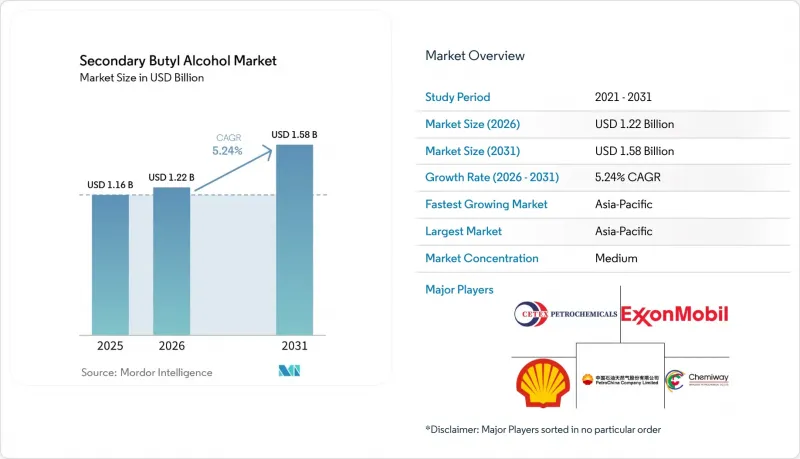
Mordor Intelligence에 의하면, 이차 부틸 알코올 시장은 2025년에 11억 6,000만 달러 규모로 평가되었습니다. 2026년 12억 2,000만 달러에서 2031년까지 15억 8,000만 달러에 이를 것으로 예상되며, 예측 기간(2026-2031년) CAGR은 5.24%를 나타낼 전망입니다.
본 보고서는 등급(산업용 등급, 의약품 등급, 고순도 등급, 기타),형태(액체, 용액 및 혼합물, 기타), 용도(메틸에틸케톤(MEK) 제조, 산업용 용제 등), 지역(아시아태평양, 북미, 유럽, 남미, 중동 및 아프리카)별로 분류되어 있습니다. 시장 예측은 금액(달러) 기준으로 제시되어 있습니다.
세계의 이차 부틸 알코올 시장 동향 및 인사이트
메틸에틸케톤(MEK) 생산 능력 확대
2차 부틸 알코올은 촉매 탈수소 반응을 통해 메틸에틸케톤의 직접 원료로 사용됩니다. 이 공정을 통해 메틸에틸케톤의 생산 능력 확대는 2차 부틸 알코올 수요의 직접적인 요인이 됩니다. 중국은 2025년에 109만 7,000메트릭톤의 메틸에틸케톤 유효 생산 능력을 보유하고 있었으나, 하류 시장 수요 부진으로 인해 가동률은 억제되었습니다. 주보 치샨 통더 화학은 연간 25만 메트릭톤의 이차 부틸 알코올 생산 능력과 연간 40만 메트릭톤의 2차 부틸아세테이트 생산 능력을 갖춘, 3억 6,000만 위안(약 5,000만 달러)규모의 최적화 프로젝트를 계획하고 있습니다. 이 프로젝트를 통해 해당 회사는 외부 판매, 메틸에틸케톤 생산, 그리고 이차 부틸 아세테이트 생산 사이에서 보다 유연한 대응이 가능해질 것으로 전망됩니다.
산업 용도료 및 접착제 시장의 성장
산업 용도료 및 접착제는 2차 부틸 알코올의 중요한 2차 수요 기반을 형성하고 있습니다. 이 용매는 수성 시스템에서 커플링제, 도료 박리제 및 특수 계면활성제의 중간체로 기능합니다. 자동차, 포장, 의료 분야의 접착 용도는 수성 시스템이 내열성 및 내화학성의 한계에 직면하는 상황에서 용제형 접착제에 대한 수요를 뒷받침해 왔습니다. 또한, 산업 인프라, 보호 구조물 및 유지보수 작업에서도 내구성이 뛰어난 도료가 요구되고 있습니다. 이러한 용도로 인해 이차 부틸알코올 시장은 제조 및 건설 분야의 여러 밸류체인에 진입할 기회를 얻고 있습니다. 나아가, 단일 화학제품 판매 경로에 대한 과도한 의존도를 완화하는 데에도 기여하고 있습니다.
C4 탄화수소 원료 비용의 변동
2급 부틸 알코올은 주로 C4 정유시설 또는 크래커에서 생산된 n-부틸렌을 산 촉매를 이용한 수화 반응을 통해 제조됩니다. 따라서 그 원가 구조는 정제 상황, 크래커 가동률 및 C4 공급 상황에 민감하게 반응합니다. 스팀 크래커의 가동률이 하락하면 하류 수요가 약화되는 동시에, 제품별 C4 생산량도 감소할 가능성이 있습니다. 이러한 요인들이 복합적으로 작용하여 원료 비용이 상승하고, 생산자의 이익률이 압박받을 우려가 있습니다. 통합형 정유 네트워크에 속하지 않는 생산자는 C4 원료를 현물 거래로 구매하고 있기 때문에 이러한 위험에 노출되기 쉬운 상황에 있습니다. 이러한 위험은 남아시아, 동남아시아 및 라틴아메리카에서 특히 두드러집니다.
부문 분석
2025년에는 산업용 등급이 전 세계 매출의 59.34%를 차지했습니다. 이 등급은 주로 메틸에틸케톤(MEK) 제조 및 산업용 용제 용도로 사용되었습니다. 많은 통합 시설에서 그 순도 요건은 약전 기준이 아닌 기능적 기준에 근거하고 있습니다. 이 물질의 상당 부분은 C4 가공업체에서 내부적으로 소비되거나 인접한 메틸에틸케톤(MEK) 제조 시설로 이송됩니다. 내부 이송이 이루어지기 때문에 가격 동향을 파악하기가 기존의 현물 시장 거래에 비해 어렵습니다.
고순도 등급 및 실험용·특수 등급을 포함한 기타 등급은 전자, 연구, 특수 화학제품 용도로 사용됩니다. 이러한 등급에는 보다 철저한 시험과 정제가 요구됩니다. 의약품 등급은 인도 및 중국의 원료의약품(API) 생산에 힘입어 2031년까지 연평균 성장률(CAGR) 6.14%로 확대될 것으로 예측됩니다. 인증된 공급은 확립된 정제 및 분석 능력을 갖춘 생산자에 집중되어 있습니다. 아시아 수요 성장과 유럽 및 미국의 특수 등급 공급 간의 이러한 차이는 인증된 원료 및 신뢰할 수 있는 납품 체계에 대한 수요를 뒷받침할 것으로 예측됩니다.
지역별 분석
아시아태평양은 2025년 2급 부틸 알코올 시장 점유율의 42.61%를 차지했으며, 2031년까지 연평균 성장률(CAGR) 5.92%로 확대될 것으로 예측됩니다. 중국, 인도, 일본, 한국 및 동남아시아 국가 연합(ASEAN) 국가들은 C4 원료, 산업 생산 능력 및 의약품 제조 수요를 모두 갖추고 있습니다. 중국은 국내 가공업체들이 정유시설 및 크래커 원료를 통합하고 있어 이 지역의 주요 생산 거점이 되고 있습니다. 2025년, 중국의 메틸에틸케톤(MEK) 생산 능력은 109만 7,000메트릭톤에 달했으나, 가동률이 낮았기 때문에 명목상의 생산 능력보다 가동률의 중요성이 부각되었습니다. 인도 및 동남아시아국가연합(ASEAN) 국가들은 의약품 생산 및 건설 관련 도료를 통해 계속해서 수요 증가를 뒷받침하고 있습니다.
이차 부틸 알코올 시장에서 북미는 안정적인 상황을 보이고 있으나, 공급이 제한되어 있습니다. 이는 미국에서 소비되는 메틸에틸케톤이 수입에 의존하고 있기 때문입니다. 따라서 국내 이차 부틸알코올 수요는 단독 용제, 특수 화학 중간체 및 윤활유 첨가제의 전구체로서의 용도에 집중되어 있습니다. 걸프 코스트 지역은 연간 20만-30만 미터톤의 이차 부틸 알코올 명목 생산 능력을 보유하고 있는 것으로 추정되며, 셰일가스와 관련된 천연가스 액체(NGL) 처리의 혜택을 받고 있습니다. 유럽에는 규격 적합 제품 공급업체가 확립되어 있으며, 화학 물질에 관한 엄격한 규정 준수 요건이 부과되고 있습니다. 유럽연합 집행위원회의 화학물질 등록, 평가, 허가 및 제한(REACH) 체계는 해당 지역에서 사업을 영위하거나 해당 지역으로 수출하는 기업에게 있어 규정 준수의 핵심으로 남아 있습니다. 이러한 상황은 등록된 제품, 충실한 문서, 그리고 일관된 품질을 제공할 수 있는 공급업체에게 유리하게 작용합니다.
남미는 수입에 의존하고 있으며, 건설 및 자동차 재도장용 도료 수요는 브라질과 아르헨티나가 주도하고 있습니다. 따라서 운임 및 관세 변동이 해당 지역의 용제 공급 비용에 영향을 미칠 가능성이 있습니다. 중동 및 아프리카 수요는 여전히 소규모이지만, 통합된 석유화학 투자를 통해 업스트림 부문과 연계되어 있습니다. SABIC의 푸젠성 프로젝트는 중국 내 새로운 에틸렌 생산 능력 증대로 이어져, 지역 가공업체를 위한 C4 스트림을 창출할 것으로 예측됩니다. NEOM과 관련된 건설 활동을 포함한 사우디아라비아의 산업 개발은 산업용 용제 수요 증가를 뒷받침하고 있습니다.
기타 혜택 :
- 엑셀 형식 시장 전망(ME) 시트
- 3개월간의 애널리스트 지원
자주 묻는 질문
목차
제1장 서론
제2장 조사 방법
제3장 주요 요약
제4장 시장 구도
제5장 시장 규모 및 성장 예측
제6장 경쟁 구도
제7장 시장 기회 및 향후 전망
KTH 26.09.10According to Mordor Intelligence, the secondary butyl alcohol market was valued at USD 1.16 billion in 2025 and is estimated to grow from USD 1.22 billion in 2026 to reach USD 1.58 billion by 2031, at a CAGR of 5.24% during the forecast period (2026-2031).
This report is Segmented by Grade (Industrial Grade, Pharmaceutical Grade, High-Purity Grade, and Other Grades), Form (Liquid, Solutions and Blends, and Other Forms), Application (Methyl Ethyl Ketone (MEK) Production, Industrial Solvents, and More), and Geography (Asia-Pacific, North America, Europe, South America, and Middle-East and Africa). The Market Forecasts are Provided in Terms of Value (USD).
Global Secondary Butyl Alcohol Market Trends and Insights
Expanding Methyl Ethyl Ketone Production Capacity
Secondary butyl alcohol is used as a direct feedstock for methyl ethyl ketone through catalytic dehydrogenation. This process makes additional methyl ethyl ketone capacity a direct source of secondary butyl alcohol demand. China had an effective methyl ethyl ketone capacity of 1.097 million metric tons in 2025, although weaker downstream demand limited operating rates. Zibo Qixiang Tengda Chemical Co., Ltd. planned a CNY 360 million (approximately USD 50 million) optimization project with 250,000 metric tons per year of secondary butyl alcohol capacity and 400,000 metric tons per year of secondary butyl acetate capacity. The project is expected to offer a producer greater flexibility between external sales, methyl ethyl ketone production, and sec-butyl acetate output.
Growth in Industrial Coatings and Adhesives
Industrial coatings and adhesives form an important secondary demand base for secondary butyl alcohol. The solvent can function as a coupling agent in water-reducible systems, a paint-stripping medium, and an intermediate for specialty surfactants. Automotive, packaging, and medical bonding applications have supported solvent-borne adhesive demand where water-based systems face heat or chemical resistance limits. Industrial infrastructure, protective structures, and maintenance work also require coatings with durable performance. These uses give the secondary butyl alcohol market exposure to several manufacturing and construction value chains. They also reduce exclusive reliance on a single chemical outlet.
Volatility in C4 Hydrocarbon Feedstock Costs
Secondary butyl alcohol is produced mainly through acid-catalyzed hydration of n-butylene from C4 refinery or cracker streams. Its cost base is therefore sensitive to refining conditions, cracker operating rates, and C4 availability. When steam crackers reduce operating rates, co-produced C4 volumes can decline at the same time as downstream demand weakens. This combination can raise feedstock costs and compress producer margins. Producers outside integrated refining networks are more exposed because they buy C4 feedstock on spot terms. This exposure is most acute in South Asia, Southeast Asia, and Latin America.
Other drivers and restraints analyzed in the detailed report include:
- Pharmaceutical and API Manufacturing Expansion
- Rising Demand for High-Purity Solvent Grades
- Substitution by Ethyl Acetate, Isopropanol and N-Butanol
For complete list of drivers and restraints, kindly check the Table Of Contents.
Segment Analysis
Industrial grade held 59.34% of global revenue in 2025. The grade was primarily used in methyl ethyl ketone production and industrial solvent applications. Its purity requirements are functional rather than pharmacopeial in many integrated facilities. Much of this material is consumed internally by C4 processors or transferred to adjacent methyl ethyl ketone units. Internal transfers make pricing less visible than a conventional spot market transaction.
High-purity grade and other grades, including laboratory and specialty grades, serve electronics, research, and specialty chemical applications. These grades require more extensive testing and purification. Pharmaceutical grade is projected to expand at a 6.14% CAGR through 2031, supported by active pharmaceutical ingredient production in India and China. Certified supply is concentrated among producers with established purification and analytical capabilities. This difference between Asian demand growth and Western specialty supply is expected to support demand for qualified material and dependable delivery programs.
Complete Report Scope:
- By Grade
- Industrial Grade
- Pharmaceutical Grade
- High-Purity Grade
- Other Grades (Laboratory Grade, Specialty Grades)
- By Form
- Liquid
- Solutions and Blends
- Other Forms (Custom Formulations, Reagent Preparations)
- By Application
- Methyl Ethyl Ketone (MEK) Production
- Industrial Solvents
- Paints and Coatings
- Pharmaceuticals
- Other Applications (Printing Inks, Chemical Intermediates, Plasticizers, Flavors and Fragrances, Specialty Chemicals)
- By Geography
- Asia-Pacific
- China
- India
- Japan
- South Korea
- ASEAN Countries
- Rest of Asia-Pacific
- North America
- United States
- Canada
- Mexico
- Europe
- Germany
- United Kingdom
- France
- Italy
- NORDIC Countries
- Russia
- Rest of Europe
- South America
- Brazil
- Argentina
- Rest of South America
- Middle-East and Africa
- Saudi Arabia
- South Africa
- Rest of Middle-East and Africa
- Asia-Pacific
Geography Analysis
Asia-Pacific held 42.61% of the secondary butyl alcohol market share in 2025 and is expected to advance at a 5.92% CAGR through 2031. China, India, Japan, South Korea, and the Association of Southeast Asian Nations countries combine C4 feedstock, industrial capacity, and pharmaceutical manufacturing demand. China is the leading regional production center because its processors have integrated refinery and cracker feedstock. Chinese methyl ethyl ketone capacity reached 1.097 million metric tons in 2025, while lower operating rates showed the importance of utilization rather than nameplate capacity. India and the Association of Southeast Asian Nations countries continue to support incremental demand through pharmaceutical production and construction-related coatings.
Within the secondary butyl alcohol market, North America has a stable but supply-constrained position because methyl ethyl ketone consumed in the United States is imported. Domestic secondary butyl alcohol demand is therefore concentrated in standalone solvent, specialty chemical intermediate, and lubricant additive precursor uses. The Gulf Coast has an estimated 200,000 to 300,000 metric tons per year of secondary butyl alcohol nameplate capacity and benefits from shale-linked natural gas liquids processing. Europe has established specification-grade suppliers and demanding chemical compliance requirements. The European Commission's Registration, Evaluation, Authorisation and Restriction of Chemicals (REACH) framework remains central to compliance for companies operating in or exporting to the region. These conditions favor suppliers that can provide registered products, strong documentation, and consistent quality.
South America is import-dependent and is led by Brazil and Argentina in construction and automotive refinish coatings demand. Freight costs and tariff changes can therefore influence delivered solvent costs in the region. The Middle-East and Africa demand remains smaller but has upstream relevance through integrated petrochemical investments. SABIC's Fujian project is expected to add new ethylene capacity in China and create associated C4 streams for regional processors. Saudi Arabian industrial development, including construction activity linked to NEOM, supports wider industrial solvent demand.
- ATAMAN KIMYA
- CETEX Petrochemicals Limited
- China Petroleum & Chemical Corporation
- Exxon Mobil Corporation
- Indorama Ventures Public Company Limited.
- INEOS
- LG Chem
- Maruzen Petrochemical
- Mitsui Chemicals, Inc.
- PetroChina Company Limited
- SABIC
- Shell plc
- Xinjiang Dushanzi TianLi High & New Tech
- Zhejiang Realsun Chemical Co., Ltd.
- Zhejiang Xinhua Chemical Co.,Ltd.
- Zibo Qixiang Tengda Chemical Co., Ltd.
Additional Benefits:
- The market estimate (ME) sheet in Excel format
- 3 months of analyst support
TABLE OF CONTENTS
1 Introduction
- 1.1 Study Assumptions and Market Definition
- 1.2 Scope of the Study
2 Research Methodology
3 Executive Summary
4 Market Landscape
- 4.1 Market Overview
- 4.2 Market Drivers
- 4.2.1 Expanding Methyl Ethyl Ketone Production Capacity
- 4.2.2 Growth in Industrial Coatings and Adhesives
- 4.2.3 Pharmaceutical and API Manufacturing Expansion
- 4.2.4 Rising Demand for High-Purity Solvent Grades
- 4.2.5 Integrated C4 Feedstock and Petrochemical Clusters
- 4.2.6 Low-VOC Formulation and Solvent-Recovery Optimization
- 4.3 Market Restraints
- 4.3.1 Volatility in C4 Hydrocarbon Feedstock Costs
- 4.3.2 Substitution by Ethyl Acetate, Isopropanol and N-Butanol
- 4.3.3 VOC, Worker-Exposure and Chemical-Compliance Costs
- 4.3.4 Limited Standalone SBA Capacity and MEK Value-Chain Dependence
- 4.4 Value Chain Analysis
- 4.5 Porter's Five Forces Analysis
- 4.5.1 Threat of New Entrants
- 4.5.2 Bargaining Power of Suppliers
- 4.5.3 Bargaining Power of Buyers
- 4.5.4 Threat of Substitutes
- 4.5.5 Competitive Rivalry
5 Market Size and Growth Forecasts (Value)
- 5.1 By Grade
- 5.1.1 Industrial Grade
- 5.1.2 Pharmaceutical Grade
- 5.1.3 High-Purity Grade
- 5.1.4 Other Grades (Laboratory Grade, Specialty Grades)
- 5.2 By Form
- 5.2.1 Liquid
- 5.2.2 Solutions and Blends
- 5.2.3 Other Forms (Custom Formulations, Reagent Preparations)
- 5.3 By Application
- 5.3.1 Methyl Ethyl Ketone (MEK) Production
- 5.3.2 Industrial Solvents
- 5.3.3 Paints and Coatings
- 5.3.4 Pharmaceuticals
- 5.3.5 Other Applications (Printing Inks, Chemical Intermediates, Plasticizers, Flavors and Fragrances, Specialty Chemicals)
- 5.4 By Geography
- 5.4.1 Asia-Pacific
- 5.4.1.1 China
- 5.4.1.2 India
- 5.4.1.3 Japan
- 5.4.1.4 South Korea
- 5.4.1.5 ASEAN Countries
- 5.4.1.6 Rest of Asia-Pacific
- 5.4.2 North America
- 5.4.2.1 United States
- 5.4.2.2 Canada
- 5.4.2.3 Mexico
- 5.4.3 Europe
- 5.4.3.1 Germany
- 5.4.3.2 United Kingdom
- 5.4.3.3 France
- 5.4.3.4 Italy
- 5.4.3.5 NORDIC Countries
- 5.4.3.6 Russia
- 5.4.3.7 Rest of Europe
- 5.4.4 South America
- 5.4.4.1 Brazil
- 5.4.4.2 Argentina
- 5.4.4.3 Rest of South America
- 5.4.5 Middle-East and Africa
- 5.4.5.1 Saudi Arabia
- 5.4.5.2 South Africa
- 5.4.5.3 Rest of Middle-East and Africa
- 5.4.1 Asia-Pacific
6 Competitive Landscape
- 6.1 Market Concentration
- 6.2 Strategic Moves
- 6.3 Market Share (%)/Ranking Analysis
- 6.4 Company Profiles (includes Global Overview, Market Overview, Core Segments, Financials as available, Strategic Information, Products and Services, and Recent Developments)
- 6.4.1 ATAMAN KIMYA
- 6.4.2 CETEX Petrochemicals Limited
- 6.4.3 China Petroleum & Chemical Corporation
- 6.4.4 Exxon Mobil Corporation
- 6.4.5 Indorama Ventures Public Company Limited.
- 6.4.6 INEOS
- 6.4.7 LG Chem
- 6.4.8 Maruzen Petrochemical
- 6.4.9 Mitsui Chemicals, Inc.
- 6.4.10 PetroChina Company Limited
- 6.4.11 SABIC
- 6.4.12 Shell plc
- 6.4.13 Xinjiang Dushanzi TianLi High & New Tech
- 6.4.14 Zhejiang Realsun Chemical Co., Ltd.
- 6.4.15 Zhejiang Xinhua Chemical Co.,Ltd.
- 6.4.16 Zibo Qixiang Tengda Chemical Co., Ltd.
7 Market Opportunities and Future Outlook
- 7.1 White-Space and Unmet-Need Assessment


