

|
시장보고서
상품코드
2119601
인도의 위성 통신 시장 : 점유율 분석, 업계 동향과 통계, 성장 예측(2026-2031년)India Satellite Communication - Market Share Analysis, Industry Trends & Statistics, Growth Forecasts (2026 - 2031) |
||||||
 Mordor Intelligence
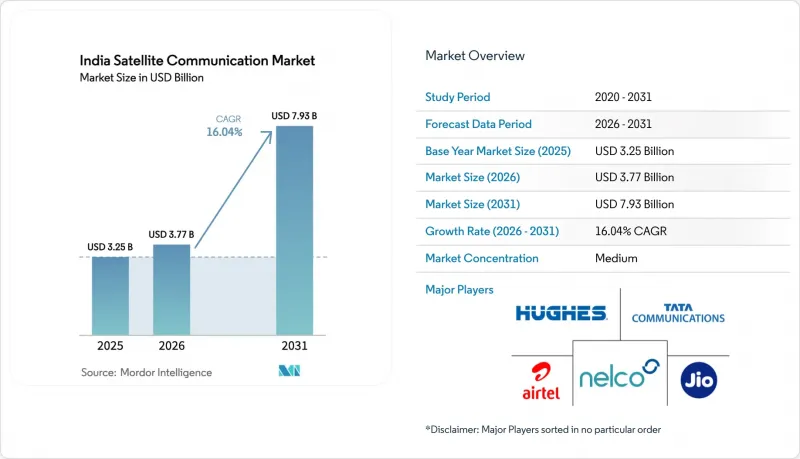
Mordor Intelligence에 의하면, 인도의 위성 통신 시장 규모는 2025년 32억 5,000만 달러에서 2026년에는 37억 7,000만 달러로 확대되어 2026년부터 2031년까지 CAGR 16.04%로 성장을 지속하여, 2031년에는 79억 3,000만 달러에 이를 것으로 예측됩니다.
본 보고서는 유형(지상 설비 및 서비스), 플랫폼(휴대용, 육상, 해상, 항공기 탑재), 주파수 대역(L대역, S대역, C대역, X대역, Ku대역, Ka대역), 최종 사용자 업종(국방·정부, 해양, 기업 등) 및 지역별로 분류되어 있습니다. 시장 예측은 금액(달러) 기준으로 제시되어 있습니다.
인도 위성 통신 시장 동향 및 인사이트
정부 주도의 ‘BharatNet’ 및 ‘Digital India’ 광대역 구축
공공 부문의 막대한 자금 투입이 장기적인 수요의 기반이 되고 있습니다. ‘바랏넷 3.0’에서는 2억 5,000만 명의 농촌 주민을 연결하기 위해 1.39 락 크롤(168억 달러)이 배정되었으며, 광섬유 설치가 불가능한 지역을 커버하기 위한 위성 백홀 수주가 촉진되고 있습니다. 10개 주에서 시행되는 ‘5G 지능형 마을’ 시범 사업에서는 1 Gbps의 위성 링크와 확장 가능한 10 Gbps 경로가 요구되고 있으며, 위성은 단순한 대체 수단이 아닌 지상 네트워크와 동등한 파트너로 자리매김하고 있습니다. 데이터 현지화 규정에 따라 의무화된 보안 게이트웨이는 국내 지상 부문에 대한 투자를 더욱 촉진하고 있습니다. 이러한 정책들이 맞물려 통신 사업자에게 예측 가능한 다년간의 수익을 가져다주며, 인도 위성 통신 시장의 지속적인 확장을 뒷받침하고 있습니다.
OTT/동영상 트래픽의 폭발적인 증가가 위성 대역폭 수요를 끌어올리고 있다.
피크 시간대의 동영상 스트리밍은 항상 지상 백본 회선을 포화 상태로 만들고 있습니다. IPL 2025 개최 기간 중에는 동시 시청자 수가 3,200만 명을 넘어섰으며, 그 초과 트래픽이 위성 용량 임대로 흘러갔습니다. 고화질 4K 및 HDR 형식으로 인해 사용자 1인당 데이터 전송 속도가 두 배로 증가함에 따라, 방송 사업자들은 2급 도시의 엣지 캐싱을 위해 GSAT-20의 Ka 대역 빔을 확보하고 있습니다. 주요 스트리밍 플랫폼이 체결한 장기 계약을 통해 안정적인 이용률이 확보되고, 메가헤르츠당 평균 수익이 향상되어 인도 위성 통신 시장의 수익성이 강화되고 있습니다.
사이버 침입 및 방해에 대한 취약성
NavIC의 보안 감사 결과, 민간 물류와 군사 항법 모두를 위협하는 스푸핑 위험이 드러났습니다. 중요한 국경 인근에서 발생한 전자전 사건은 서비스 중단 가능성을 부각시켰으며, TRAI는 종단 간암호화 및 2단계 단말 인증을 의무화하기에 이르렀습니다. 규정 준수 대응은 도입 주기에 지연을 초래하고 운영 비용을 상승시키기 때문에 단기적인 보급 속도는 둔화되고 있습니다.
부문 분석
기업들이 하드웨어 소유보다 턴키 방식의 대역폭 및 네트워크 관리 계약을 선호함에 따라, 서비스 부문은 2025년 매출의 68.05%를 차지했습니다. 인도 위성 통신 시장의 서비스 부문 규모는 은행 및 에너지 분야의 장기적인 VSAT 아웃소싱 계약에 힘입어 연평균 성장률(CAGR) 16.72%로 확대될 것으로 예측됩니다. 은행들은 ATM 가동 시간을 확보하기 위해 7만 대 이상의 Fuse 사산 VSAT에 의존하고 있으며, 이는 관리되는 용량이 규제상의 서비스 수준 목표를 확실히 달성하고 있음을 나타냅니다. OTT 플랫폼 및 통신 사업자들도 마찬가지로 주요 행사 기간 동안 99.9%의 가용성을 보장하기 위해 백업용 Ka-밴드 빔을 임대하고 있습니다.
지상 장비의 점유율은 31.95%를 유지했으나, 이 부문은 빔 방향을 원격으로 변경하고 트래픽 부하 분산을 수행하는 소프트웨어 정의 게이트웨이로 전환되고 있습니다. 통신 사업자들이 운영 비용(OPEX)을 절감하는 모델을 선호함에 따라 인도 위성 통신 시장에서 장비 공급업체의 점유율은 하락할 가능성이 있지만, 각 벤더들은 통합의 정착도를 높이는 보안, 분석, 오케스트레이션 소프트웨어를 번들로 제공함으로써 이러한 변화를 상쇄하고 있습니다.
2025년에는 BSNL이 북인도 3,500기의 4G 타워에 위성 백홀을 구축함에 따라 지상 플랫폼 매출이 58.85%를 차지했습니다. 인도의 지상 링크용 위성 통신 시장 규모는 주 정부 기관이 판차야트 전역에서 공공 서비스 제공을 디지털화해 나가면서 앞으로도 계속 확대될 것입니다. 휴대용 단말기는 높은 기동성과 신속한 설정이 필요한 재난 구호 기관이나 TV 뉴스 취재팀에서 사용되고 있습니다.
항공기 탑재 시스템은 승객들의 동영상 스트리밍 기대에 부응하기 위해 항공사들이 기체에 Ka-밴드 IFC를 사후 장착하는 추세에 힘입어 연평균 성장률(CAGR) 17.05%로 가장 빠르게 성장할 전망입니다. 인도 공군의 iDEX 기금으로 개발된 소형 위성은 UAV 스웜의 시야 밖 제어를 가능하게 하여 새로운 고대역폭 이용 사례를 보여주고 있습니다. 각 벤더사는 현재 소형 기체 공간에 들어맞는 전자 제어식 위상 배열 안테나를 맞춤 제작하여 설치상의 장벽을 제거하고 있습니다.
기타 혜택:
- 엑셀 형식 시장 예측(ME) 시트
- 3개월간의 애널리스트 지원
자주 묻는 질문
목차
제1장 서론
제2장 조사 방법
제3장 개요
제4장 시장 구도
제5장 시장 규모와 성장 예측
제6장 경쟁 구도
제7장 시장 기회와 향후 전망
JHS 26.09.03According to Mordor Intelligence, the India's satellite communication market size is expected to grow from USD 3.25 billion in 2025 to USD 3.77 billion in 2026 and is forecast to reach USD 7.93 billion by 2031 at 16.04% CAGR over 2026-2031.
This report is Segmented by Type (Ground Equipment and Services), Platform (Portable, Land, Maritime, and Airborne), Frequency Band (L-Band, S-Band, C-Band, X-Band, Ku-Band, and Ka-Band), End-User Vertical (Defence and Government, Maritime, Enterprises, and More), and Region. The Market Forecasts are Provided in Terms of Value (USD).
India Satellite Communication Market Trends and Insights
Government-Led BharatNet and Digital India Broadband Roll-Outs
Massive public-sector funding anchors long-term demand. BharatNet 3.0 allocates INR 1.39 lakh crore (USD 16.8 billion) to connect 250 million rural residents, funneling satellite backhaul orders to cover terrain where fiber is infeasible. The 5G Intelligent Village pilot in ten states calls for 1 Gbps satellite links with scalable 10 Gbps pathways, positioning satellites as equal partners to terrestrial networks rather than fallback options. Secure gateways mandated by data-localization rules further stimulate domestic ground-segment investments. Together, these policies provide operators with predictable multi-year revenue and underpin the continued expansion of the India satellite communication market.
OTT/Video Traffic Explosion Boosting Satellite Bandwidth Demand
Peak-time video streaming routinely saturates terrestrial backbones. During IPL 2025, concurrent viewership exceeded 32 million, sending spillover traffic to satellite capacity leases. High-definition 4K and HDR formats multiply per-user data rates, prompting broadcasters to reserve Ka-band beams on GSAT-20 for edge caching in Tier-2 cities. Long-term contracts signed by major streaming platforms create stable utilization rates that lift average revenue per megahertz and enhance the profitability of the India satellite communication market.
Cyber-Intrusion and Jamming Vulnerabilities
Security audits of NavIC exposed spoofing risks that threaten both civilian logistics and military navigation. Electronic warfare incidents near sensitive borders highlight potential service blackouts, prompting TRAI to mandate end-to-end encryption and two-factor terminal authentication. Compliance adds latency to deployment cycles and inflates opex, moderating near-term uptake.
Other drivers and restraints analyzed in the detailed report include:
- Defense and Homeland-Security Modernization Programs
- Mass-Scale IoT/M2M Roll-Outs in Agriculture and Utilities
- High CAPEX for Gateways/VSAT and Spectrum Fees
For complete list of drivers and restraints, kindly check the Table Of Contents.
Segment Analysis
Services commanded 68.05% of 2025 revenue as enterprises favored turnkey bandwidth and network-management contracts over owning hardware. India's satellite communication market size for services is projected to climb at a 16.72% CAGR, fueled by long-term VSAT outsourcing deals in banking and energy. Banks rely on 70,000+ Hughes VSATs for ATM uptime, illustrating how managed capacity assures regulatory service-level targets. OTT platforms and telecoms likewise lease backup Ka-band beams to guarantee 99.9% availability during marquee events.
Ground equipment retained a 31.95% share, yet the category is migrating toward software-defined gateways that remotely re-point beams and load-balance traffic. India's satellite communication market share for equipment suppliers could slide as operators prefer opex-light models, but vendors offset the shift by bundling security, analytics, and orchestration software that deepens integration stickiness.
Land platforms held 58.85% revenue in 2025, supported by BSNL's satellite backhaul roll-outs across 3,500 4G towers in North India. India's satellite communication market size for land-based links will continue growing as state agencies digitize public-service delivery across Panchayats. Portable terminals serve disaster-relief agencies and TV newsgathering units that need high mobility and quick setup.
Airborne systems will grow fastest at 17.05% CAGR as airlines retrofit fleets with Ka-band IFC to meet passenger expectations for streaming video. The Indian Air Force's iDEX-funded mini-satellites enable beyond-line-of-sight control of UAV swarms, showcasing new high-throughput use cases. Equipment vendors now tailor electronically steered phased-array antennas that fit small fuselage footprints, removing installation hurdles.
Complete Report Scope:
- By Type
- Ground Equipment
- Gateway
- Very Small Aperture Terminal (VSAT)
- Network Operation Centre (NOC)
- Satellite News Gathering (SNG)
- Services
- Mobile Satellite Services (MSS)
- Fixed Satellite Services (FSS)
- Earth-Observation Services
- Ground Equipment
- By Platform
- Portable
- Land
- Maritime
- Airborne
- By Frequency Band
- L-Band
- S-Band
- C-Band
- X-Band
- Ku-Band
- Ka-Band
- By End-user Vertical
- Defence and Government
- Maritime
- Enterprises
- Media and Entertainment
- Agriculture and Environmental Monitoring
- Other End-user Verticals
- By Region
- North India
- West India
- South India
- East and North-East India
- Central India
List of Companies Covered in this Report:
- Jio Satellite Communications Ltd.
- Hughes Communications India Ltd.
- Bharti Airtel Limited (incl. OneWeb India)
- Tata Communications Limited
- Nelco Limited
- ViaSat Inc.
- Thales Group
- ORBCOMM Inc.
- Precision Electronics Limited
- Avantel Limited
- Astrome Technologies Private Limited
- Dhruva Space Private Limited
- Pixxel Space Technologies Pvt. Ltd.
- Skylo Technologies, Inc.
- SES S.A.
- Inmarsat Global Limited
- Intelsat US LLC
- Eutelsat Group
- Antrix Corporation Limited
- NewSpace India Limited
- Kacific Broadband Satellites Group
- Larsen & Toubro Limited (Defence VSAT)
Additional Benefits:
- The market estimate (ME) sheet in Excel format
- 3 months of analyst support
TABLE OF CONTENTS
1 INTRODUCTION
- 1.1 Study Assumptions and Market Definition
- 1.2 Scope of the Study
2 RESEARCH METHODOLOGY
3 EXECUTIVE SUMMARY
4 MARKET LANDSCAPE
- 4.1 Market Overview
- 4.2 Market Drivers
- 4.2.1 Govt-led BharatNet and Digital India broadband roll-outs
- 4.2.2 OTT/video traffic explosion boosting satellite bandwidth demand
- 4.2.3 Defence and homeland-security modernisation programmes
- 4.2.4 Mass-scale IoT/M2M roll-outs in agriculture and utilities
- 4.2.5 Direct-to-Device (D2D) satellite smartphone services on the anvil
- 4.2.6 ISRO's low-cost small-sat launchers accelerating domestic constellations
- 4.3 Market Restraints
- 4.3.1 Cyber-intrusion and jamming vulnerabilities
- 4.3.2 High CAPEX for gateways/VSAT and spectrum fees
- 4.3.3 Spectrum-allocation delays and regulatory ambiguity
- 4.3.4 New debris-mitigation rules raising constellation costs
- 4.4 Industry Value Chain Analysis
- 4.5 Regulatory Landscape
- 4.6 Technological Outlook
- 4.7 Porter's Five Forces Analysis
- 4.7.1 Bargaining Power of Buyers
- 4.7.2 Bargaining Power of Suppliers
- 4.7.3 Threat of New Entrants
- 4.7.4 Threat of Substitutes
- 4.7.5 Intensity of Competitive Rivalry
- 4.8 Impact of Macroeconomic Factors on the Market
5 MARKET SIZE AND GROWTH FORECASTS (VALUES)
- 5.1 By Type
- 5.1.1 Ground Equipment
- 5.1.1.1 Gateway
- 5.1.1.2 Very Small Aperture Terminal (VSAT)
- 5.1.1.3 Network Operation Centre (NOC)
- 5.1.1.4 Satellite News Gathering (SNG)
- 5.1.2 Services
- 5.1.2.1 Mobile Satellite Services (MSS)
- 5.1.2.2 Fixed Satellite Services (FSS)
- 5.1.2.3 Earth-Observation Services
- 5.1.1 Ground Equipment
- 5.2 By Platform
- 5.2.1 Portable
- 5.2.2 Land
- 5.2.3 Maritime
- 5.2.4 Airborne
- 5.3 By Frequency Band
- 5.3.1 L-Band
- 5.3.2 S-Band
- 5.3.3 C-Band
- 5.3.4 X-Band
- 5.3.5 Ku-Band
- 5.3.6 Ka-Band
- 5.4 By End-user Vertical
- 5.4.1 Defence and Government
- 5.4.2 Maritime
- 5.4.3 Enterprises
- 5.4.4 Media and Entertainment
- 5.4.5 Agriculture and Environmental Monitoring
- 5.4.6 Other End-user Verticals
- 5.5 By Region
- 5.5.1 North India
- 5.5.2 West India
- 5.5.3 South India
- 5.5.4 East and North-East India
- 5.5.5 Central India
6 COMPETITIVE LANDSCAPE
- 6.1 Market Concentration
- 6.2 Strategic Moves
- 6.3 Market Share Analysis
- 6.4 Company Profiles (includes Global level Overview, Market level overview, Core Segments, Financials as available, Strategic Information, Market Rank/Share for key companies, Products and Services, and Recent Developments)
- 6.4.1 Jio Satellite Communications Ltd.
- 6.4.2 Hughes Communications India Ltd.
- 6.4.3 Bharti Airtel Limited (incl. OneWeb India)
- 6.4.4 Tata Communications Limited
- 6.4.5 Nelco Limited
- 6.4.6 ViaSat Inc.
- 6.4.7 Thales Group
- 6.4.8 ORBCOMM Inc.
- 6.4.9 Precision Electronics Limited
- 6.4.10 Avantel Limited
- 6.4.11 Astrome Technologies Private Limited
- 6.4.12 Dhruva Space Private Limited
- 6.4.13 Pixxel Space Technologies Pvt. Ltd.
- 6.4.14 Skylo Technologies, Inc.
- 6.4.15 SES S.A.
- 6.4.16 Inmarsat Global Limited
- 6.4.17 Intelsat US LLC
- 6.4.18 Eutelsat Group
- 6.4.19 Antrix Corporation Limited
- 6.4.20 NewSpace India Limited
- 6.4.21 Kacific Broadband Satellites Group
- 6.4.22 Larsen & Toubro Limited (Defence VSAT)
7 MARKET OPPORTUNITIES AND FUTURE OUTLOOK
- 7.1 White-space and Unmet-need Assessment


