

|
시장보고서
상품코드
2119602
인공 신장 시장 : 점유율 분석, 업계 동향과 통계, 성장 예측(2026-2031년)Artificial Kidney - Market Share Analysis, Industry Trends & Statistics, Growth Forecasts (2026 - 2031) |
||||||
 Mordor Intelligence
Mordor Intelligence에 의하면, 인공 신장 시장 규모는 2025년에 26억 2,000만 달러로 평가되었고 2026년 29억 8,000만 달러에서 2031년까지 56억 4,000만 달러에 이를 것으로 예측되며, 예측 기간(2026-2031년)에서 CAGR은 13.62%를 나타낼 전망입니다.
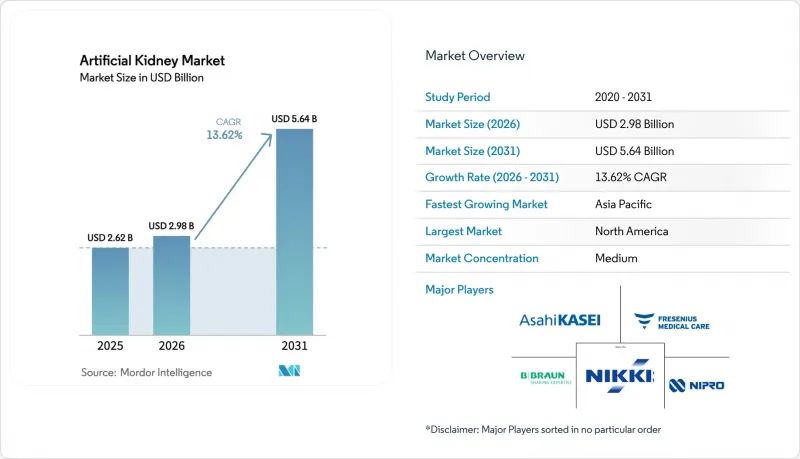
본 보고서는 기기 유형(웨어러블 인공 신장, 이식형 인공 신장 등), 기술(혈액투석 기반 기기, 복막투석 기반 기기 등), 최종 사용자(병원, 전문 클리닉, 재택 간호 환경 등), 지역(북미, 유럽, 아시아태평양 등)별로 분류되어 있습니다. 시장 예측은 금액(달러) 기준으로 제시되어 있습니다.
세계 인공 신장 시장 동향 및 인사이트
만성 신장 질환(CKD) 및 말기 신부전(ESRD) 유병률 증가
2024년, 전 세계 만성 신장 질환(CKD) 환자 수는 6억 7,300만 명에 달했으며, 전 세계 사망률은 인구 10만 명당 18.29명으로 상승했습니다. 이 수치의 대부분을 차지하는 것은 당뇨병 관련 CKD로 인한 사망이며, 이는 고령 환자에 초점을 맞춘 인공 신장 시장 솔루션에 대한 지속적인 수요를 견인하고 있습니다. 2024년, 메디케어는 혈액 투석에 290억 달러를 지출하여 의료 제도가 직면한 비용 압박을 여실히 드러내고 있습니다. 아시아태평양은 가장 큰 부담을 지고 있으며, 4억 5,000만 명이 이 질환을 앓고 있고, 환자 1인당 연간 치료비는 2만 3,358달러에 달할 전망입니다. 이러한 역학적 추세는 인공 신장 시장의 장기적인 성장 동력을 강화하고, 휴대형 및 이식형 대체 요법의 보급을 가속화하고 있습니다.
기증 신장 부족
2024년, 미국에서는 사망 기증자로부터의 신장 이식이 고작 2만 1,000건에 그쳤으며, 9만 2,000명 이상의 환자가 대기 명단에 남아 있습니다. 이식까지의 대기 기간 중앙값은 5년을 초과하고 있어, 이에 따라 생체 인공 신장이나 이종 이식과 같은 대안 수단에 대한 관심이 높아지고 있습니다. 2025년 2월, 유전자 변형 돼지 신장을 이용한 임상시험에 대해 FDA의 승인이 내려진 것은 인공 신장 시장을 뒷받침하는 규제 측면의 모멘텀을 보여줍니다. 전 세계 치료 커버리지 격차(대상 환자의 절반 이상을 치료할 수 있는 국가는 74%에 불과함)는 확장 가능한 인공 신장 솔루션 시장 기회를 더욱 넓혀주고 있습니다.
제품 및 시술의 높은 비용
2024년, 민간 보험사는 외래 투석에 대해월1만 149달러를 지급한 반면, 메디케어는 3,364달러에 그쳐 경제적 부담 능력에 큰 격차가 있음을 보여주고 있습니다. 인력 부족과 자재비 급등이 지방 진료소의 존립을 위협하고 있습니다. 중국에서는 향후 10년 동안 신장 치료비로 5,580억 달러의 손실이 발생할 가능성이 있습니다. 생체 적합성 소재에 대한 막대한 연구개발 투자와 장기간에 걸친 임상시험으로 인해 판매 가격이 급등하고 있어, 인공 신장 시장에서 고가 기기의 조기 보급이 제한되고 있습니다.
부문 분석
바이오 인공 신장은 2031년까지 연평균 성장률(CAGR) 21.58%를 기록하며, 인공 신장 시장 내에서 가장 빠른 성장세를 보이고 있습니다. KidneyX의 지원을 받는 캘리포니아 대학교 샌프란시스코 캠퍼스(UCSF)의 이식형 장치는 실리콘 나노 기공 필터와 살아있는 신장 세뇨관 세포를 통합하고 있어, 외부 전원에 대한 완전한 자립이 기대됩니다. Quanta사의 SC+와 같은 휴대용 혈액 투석 장치는 FDA 승인을 획득한 후, 2025년에도 매출 점유율 41.98%를 유지할 전망입니다.
UCLA 헬스에서 연구가 진행 중인 이식형 장치는 나노셀룰로오스를 이용한 한외여과와 전기 탈이온법을 통해 투석액을 제거합니다. 이식형 인공 신장 시장 규모는 주요 임상시험을 통해 안전성과 내구성이 입증되는 대로 급속히 확대될 것으로 예측됩니다. FDA의 신속 심사 절차를 통해 개발이 진행 중인, 벨트 착용형 11파운드 시스템을 포함한 웨어러블 콘셉트는 치료 중인 환자의 이동 능력을 회복시키는 것을 목표로 하고 있습니다.
지역별 분석
북미는 견고한 보상 체계와 웨어러블 시스템에 대한 여러 건의 FDA ‘획기적 치료(Breakthrough)’ 지정에 힘입어 2025년 인공 신장 시장 점유율의 39.55%를 차지하고 있습니다. ESRD(말기 신부전) 전향적 지불 시스템에서는 1회 치료당 273.82달러의 요금이 설정되어 있어, 이를 통해 의료 제공업체의 수익성이 유지되고 있습니다. 이러한 강점에도 불구하고, 2025년에 발생한 혈액투석용 혈액 회로 공급망 부족은 인프라의 취약성을 드러냈습니다. FTC(연방거래위원회)에 의한 경쟁 금지 조항에 대한 면밀한 검토는 인재의 유동성과 의료기기 혁신을 촉진할 가능성이 있습니다.
아시아태평양은 고령화와 당뇨병 유병률 증가로 인해 2031년까지 연평균 성장률(CAGR) 18.05%로 성장을 주도할 것입니다. 중국에서 신장 신경 차단 요법 및 경피적 GFR 모니터링이 승인됨에 따라 의료기기의 접근성이 가속화되고 있습니다. 일본의 AI 기반 만성 신장 질환(CKD) 데이터베이스는 조기 발견률을 높이고 치료의 조기 시작을 지원하고 있습니다. Vantive사가 디지털 투석에 10억 달러를 투자한 것은 이 지역에 대한 민간 부문의 신뢰를 뒷받침하고 있습니다.
유럽에서는 가치 기반 의료 정책 하에 꾸준한 확장이 이루어지고 있습니다. ‘Carry Life UF’ 시스템에 대한 다국적 임상시험은 첨단 복막투석 기술 분야에서 국경을 초월한 협력을 보여주고 있습니다. 재택투석의 불평등을 시정하기 위한 정책 포럼이 보험 지급 제도 개혁을 뒷받침하고 있으나, 의료 제공업체에 대한 인센티브가 제각각이어서 통일된 도입은 지연되고 있습니다. 유럽의약품청(EMA)에 의한 심사 절차의 통합으로 임상시험 관리가 간소화되어, 인공 신장 시장에서 사업 확장을 목표로 하는 수출 기업들에게 이점이 되고 있습니다.
기타 혜택:
- 엑셀 형식 시장 예측(ME) 시트
- 3개월간의 애널리스트 지원
자주 묻는 질문
목차
제1장 서론
제2장 조사 방법
제3장 개요
제4장 시장 구도
제5장 시장 규모와 성장 예측
제6장 경쟁 구도
제7장 시장 기회와 향후 전망
JHS 26.09.03According to Mordor Intelligence, the artificial kidney market size was valued at USD 2.62 billion in 2025 and estimated to grow from USD 2.98 billion in 2026 to reach USD 5.64 billion by 2031, at a CAGR of 13.62% during the forecast period (2026-2031).
This report is Segmented by Device Type (Wearable Artificial Kidney, Implantable Artificial Kidney, and More), Technology (Hemodialysis-Based Devices, Peritoneal Dialysis-Based Devices, and More), End User (Hospitals, Specialty Clinics, Home-Care Settings, and More), and Geography (North America, Europe, Asia-Pacific, and More). The Market Forecasts are Provided in Terms of Value (USD).
Global Artificial Kidney Market Trends and Insights
Rising CKD & ESRD Prevalence
Worldwide chronic kidney disease cases reached 673 million in 2024, with global mortality climbing to 18.29 per 100,000 population. Diabetes-linked CKD deaths dominate these figures, driving sustained demand for artificial kidney market solutions focused on aging patients. Medicare spent USD 29 billion on hemodialysis in 2024, underscoring the cost pressure on health systems. Asia-Pacific bears the heaviest load, with 450 million people affected and annual therapy costs at USD 23,358 per patient. These epidemiological trends amplify the artificial kidney market's long-term growth engine and accelerate adoption of portable and implantable alternatives.
Scarcity of Donor Kidneys
Only 21,000 deceased donor kidney transplants occurred in the United States during 2024, leaving more than 92,000 patients on waiting lists. The median transplant waiting time exceeds five years, elevating interest in bio-artificial and xenotransplantation alternatives. FDA clearance for trials using genetically modified pig kidneys in February 2025 signals regulatory momentum that reinforces the artificial kidney market. Global therapy coverage gaps, where only 74% of countries can treat more than half of eligible patients, further widen opportunity for scalable artificial kidney solutions.
High Product & Procedure Costs
Private insurers paid USD 10,149 per month for outpatient dialysis in 2024, compared with Medicare's USD 3,364, revealing significant affordability gaps. Labor shortages and rising material costs threaten rural clinic viability. China may lose USD 558 billion over the coming decade in kidney care expenses. High R&D investment in biocompatible materials and lengthy clinical trials push selling prices higher, limiting early uptake of premium devices in the artificial kidney market.
Other drivers and restraints analyzed in the detailed report include:
- Shift to Home & Ambulatory Dialysis
- AI-Enabled Personalized Dialysis Dosing
- Device Biocompatibility & Clotting Risks
For complete list of drivers and restraints, kindly check the Table Of Contents.
Segment Analysis
Bio-artificial kidneys post a 21.58% CAGR through 2031, the fastest expansion within the artificial kidney market. The KidneyX-backed implant from the University of California San Francisco integrates silicon nanopore filters with living renal tubule cells, promising complete autonomy from external power sources. Portable hemodialysis units, such as Quanta's SC+, maintain 41.98% revenue leadership in 2025 after securing FDA clearance.
Implantable designs under investigation at UCLA Health employ nanocellulose ultrafiltration and electrodeionization to eliminate dialysate. The artificial kidney market size for implantables is projected to expand rapidly once pivotal trials demonstrate safety and durability. Wearable concepts, including the belt-worn 11-pound system advanced through FDA expedited pathways, aim to restore patient mobility during therapy.
Complete Report Scope:
- By Device Type
- Wearable Artificial Kidney
- Implantable Artificial Kidney
- Portable Hemodialysis System
- Bio-artificial (Cell-seeded) Kidney
- By Technology
- Hemodialysis-based Devices
- Peritoneal Dialysis-based Devices
- Sorbent-based Regeneration Tech
- Nano-electrokinetic ICP Devices
- By End User
- Hospitals
- Specialty Clinics
- Ambulatory Surgical Centers
- Home-care Settings
- Other End Users
- Geography
- North America
- United States
- Canada
- Mexico
- Europe
- Germany
- United Kingdom
- France
- Italy
- Spain
- Rest of Europe
- Asia-Pacific
- China
- Japan
- India
- South Korea
- Australia
- Rest of Asia-Pacific
- Middle East and Africa
- GCC
- South Africa
- Rest of Middle East and Africa
- South America
- Brazil
- Argentina
- Rest of South America
- North America
Geography Analysis
North America holds 39.55% of artificial kidney market share in 2025, supported by robust reimbursement frameworks and multiple FDA breakthrough designations for wearable systems. The ESRD Prospective Payment System set a USD 273.82 per-treatment rate that sustains provider economics. Despite this strength, supply chain shortages of hemodialysis bloodlines in 2025 exposed infrastructure fragility. FTC scrutiny of noncompete clauses may boost talent mobility and device innovation.
Asia-Pacific leads growth at 18.05% CAGR through 2031 due to aging populations and rising diabetes prevalence. Chinese approvals for renal denervation and transdermal GFR monitoring speed device availability. Japan's AI-enabled CKD database improves early detection, supporting earlier therapy initiation. Vantive's USD 1 billion commitment to digital dialysis underscores private-sector confidence in the region.
Europe experiences steady expansion under value-based healthcare mandates. Multinational trials for the Carry Life UF system demonstrate cross-border collaboration on advanced peritoneal dialysis technologies. Policy forums that target home dialysis inequity spur reimbursement reforms, yet variability in provider incentives slows uniform adoption. Harmonized EMA pathways simplify clinical trial administration, benefitting exporters that aim to scale within the artificial kidney market.
- Fresenius
- Baxter
- Medtronic
- B. Braun
- DaVita
- Nipro
- Nikkiso Co. Ltd.
- Asahi Kasei
- AWAK Technologies
- Outset Medical
- Quanta Dialysis Technologies
- Xcorporeal Inc.
- Nanodialysis BV
- SB-KAWASUMI Laboratories Inc.
- Medica S.p.A.
- Toray Medical Co. Ltd.
- Cantel Medical
- Biolife Medical
- Blood Purification Technologies Inc.
- Diality Inc.
Additional Benefits:
- The market estimate (ME) sheet in Excel format
- 3 months of analyst support
TABLE OF CONTENTS
1 Introduction
- 1.1 Study Assumptions & Market Definition
- 1.2 Scope of the Study
2 Research Methodology
3 Executive Summary
4 Market Landscape
- 4.1 Market Overview
- 4.2 Market Drivers
- 4.2.1 Rising CKD & ESRD Prevalence
- 4.2.2 Scarcity Of Donor Kidneys
- 4.2.3 Shift To Home & Ambulatory Dialysis
- 4.2.4 AI-Enabled Personalized Dialysis Dosing
- 4.2.5 Nano-Electrokinetic Portable Device Breakthroughs
- 4.2.6 Government Pay-For-Outcomes Renal Programs
- 4.3 Market Restraints
- 4.3.1 High Product & Procedure Costs
- 4.3.2 Device Biocompatibility & Clotting Risks
- 4.3.3 Reimbursement Uncertainty For Novel Devices
- 4.3.4 Limited Surgical Skills For Implantables
- 4.4 Technological Outlook
- 4.5 Porter's Five Forces
- 4.5.1 Threat of New Entrants
- 4.5.2 Bargaining Power of Buyers
- 4.5.3 Bargaining Power of Suppliers
- 4.5.4 Threat of Substitutes
- 4.5.5 Intensity of Competitive Rivalry
5 Market Size & Growth Forecasts (Value, USD)
- 5.1 By Device Type
- 5.1.1 Wearable Artificial Kidney
- 5.1.2 Implantable Artificial Kidney
- 5.1.3 Portable Hemodialysis System
- 5.1.4 Bio-artificial (Cell-seeded) Kidney
- 5.2 By Technology
- 5.2.1 Hemodialysis-based Devices
- 5.2.2 Peritoneal Dialysis-based Devices
- 5.2.3 Sorbent-based Regeneration Tech
- 5.2.4 Nano-electrokinetic ICP Devices
- 5.3 By End User
- 5.3.1 Hospitals
- 5.3.2 Specialty Clinics
- 5.3.3 Ambulatory Surgical Centers
- 5.3.4 Home-care Settings
- 5.3.5 Other End Users
- 5.4 Geography
- 5.4.1 North America
- 5.4.1.1 United States
- 5.4.1.2 Canada
- 5.4.1.3 Mexico
- 5.4.2 Europe
- 5.4.2.1 Germany
- 5.4.2.2 United Kingdom
- 5.4.2.3 France
- 5.4.2.4 Italy
- 5.4.2.5 Spain
- 5.4.2.6 Rest of Europe
- 5.4.3 Asia-Pacific
- 5.4.3.1 China
- 5.4.3.2 Japan
- 5.4.3.3 India
- 5.4.3.4 South Korea
- 5.4.3.5 Australia
- 5.4.3.6 Rest of Asia-Pacific
- 5.4.4 Middle East and Africa
- 5.4.4.1 GCC
- 5.4.4.2 South Africa
- 5.4.4.3 Rest of Middle East and Africa
- 5.4.5 South America
- 5.4.5.1 Brazil
- 5.4.5.2 Argentina
- 5.4.5.3 Rest of South America
- 5.4.1 North America
6 Competitive Landscape
- 6.1 Market Concentration
- 6.2 Market Share Analysis
- 6.3 Company Profiles (includes Global level Overview, Market level overview, Core Business Segments, Financials, Headcount, Key Information, Market Rank, Market Share, Products and Services, and analysis of Recent Developments)
- 6.3.1 Fresenius Medical Care AG & Co. KGaA
- 6.3.2 Baxter International Inc.
- 6.3.3 Medtronic plc
- 6.3.4 B. Braun Melsungen AG
- 6.3.5 DaVita Inc.
- 6.3.6 Nipro Corporation
- 6.3.7 Nikkiso Co. Ltd.
- 6.3.8 Asahi Kasei Medical Co. Ltd.
- 6.3.9 AWAK Technologies
- 6.3.10 Outset Medical Inc.
- 6.3.11 Quanta Dialysis Technologies
- 6.3.12 Xcorporeal Inc.
- 6.3.13 Nanodialysis BV
- 6.3.14 SB-KAWASUMI Laboratories Inc.
- 6.3.15 Medica S.p.A.
- 6.3.16 Toray Medical Co. Ltd.
- 6.3.17 Cantel Medical (Steris)
- 6.3.18 Biolife Medical
- 6.3.19 Blood Purification Technologies Inc.
- 6.3.20 Diality Inc.
7 Market Opportunities & Future Outlook
- 7.1 White-space & Unmet-need Assessment


