

|
시장보고서
상품코드
2121839
인공 장기 : 시장 점유율 분석, 업계 동향과 통계, 성장 예측(2026-2031년)Artificial Organ - Market Share Analysis, Industry Trends & Statistics, Growth Forecasts (2026 - 2031) |
||||||
 Mordor Intelligence
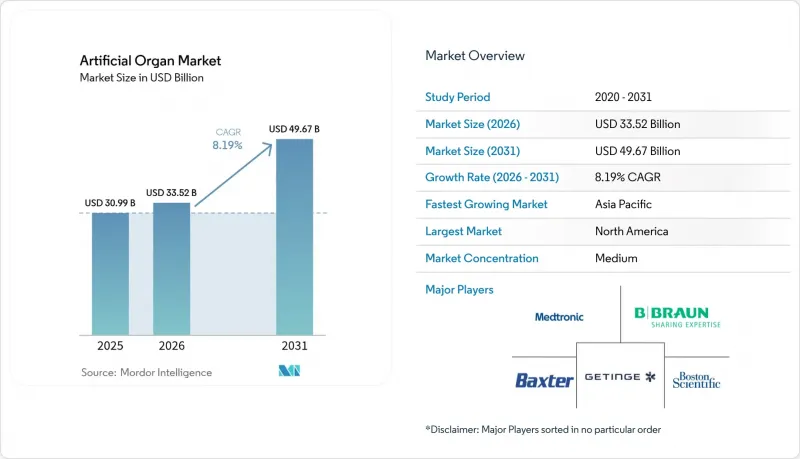
Mordor Intelligence에 따르면 2026년 인공 장기 시장 규모는 335억 2,000만 달러로 추정되고 있으며, 2025년 309억 9,000만 달러에서 확대하며, 2031년에는 496억 7,000만 달러에 달할 것으로 예측됩니다.
2026-2031년 동안 연평균 성장률(CAGR) 8.19%로 성장할 것으로 전망됩니다.
이 보고서는 장기 유형(인공심장[인공심장판막 등], 인공신장, 기타), 기술(기계식, 전자·생체공학, 기타), 고정 방식(완전 이식형, 기타), 최종사용자(병원(300병상 이상), 병원(300병상 미만), 기타), 지역(북미, 유럽, 기타)별로 분류되어 있습니다. 시장 예측은 금액(달러) 기준으로 제시되어 있습니다.
세계 인공 장기 시장의 동향 및 인사이트
만성질환 및 장기 부전의 유병률 증가
신장, 심장, 폐 질환은 장기 기증 속도를 능가하는 속도로 증가하고 있으며, 미국에서는 이미 3,550만 명의 성인이 만성 신장 질환을 앓고 있습니다. 말기 신부전 치료에는 미국의 메디케어 제도에서 매년 1,300억 달러의 비용이 소요되고 있으며, 이해관계자들은 내구성이 뛰어난 인공 장기의 대안을 모색하고 있습니다. 역학 모델에 따르면 2032년까지 8개 주요 경제권의 인구 중 최대 16.5%가 만성 신장 질환을 앓게 될 것이며, 투석 수요는 75% 이상 증가할 것으로 예측됩니다. 심장학 분야에서도 유사한 압박이 발생하고 있으며, 이식 대기자 명단에 등록된 환자 수와 이용 가능한 심장 수 간의 격차가 확대됨에 따라 인공 심장 이식 건수는 지금까지 2,000건을 넘어섰습니다. 이처럼 임상적 긴급성이 인공 장기 시장의 확산을 직접적으로 지원하고 있습니다.
연구개발 투자 확대
연방 정부의 보조금, 민관 협력, 벤처 캐피털을 통해 제품 파이프라인이 가속화되고 있습니다. 미국 국립보건원(NIH)은 2024년, 웨어러블 인공 신장 시스템의 개선을 위해 45만 9,824달러를 지원하며 공공 부문의 지속적인 지원을 지원하고 있습니다. 주요 의료 기술 기업은 4D 바이오프린팅 및 자기 부상 펌프에 대한 접근성을 확보하기 위해 틈새 시장의 혁신 기업을 인수하거나 제휴하고 있습니다. 한편, 바이오기술 부문 전체는 2030년까지 3조 2,000억 달러에 달할 것으로 예측됩니다. 자본은 인공 장기 시장에서 중요한 차별화 요소인 소형화, 혈액 적합성 코팅, AI를 활용한 제어 알고리즘에 집중되고 있습니다.
인공 장기 및 수술의 높은 비용과 제한된 보험 환급 옵션
인공 심장의 총 비용은 이식 1회당 20만 달러를 초과하기도 하며, 특히 저소득 국가에서는 보험 환급 체계가 크게 다릅니다. 지급 기관은 영구적인 청구 코드를 할당하기 전에 광범위한 실제 세계 증거를 요구하는 경우가 많아, 이로 인해 보급이 지연되고 있습니다. 업계 단체들은 현재 규제 당국에 지불 채널을 공식적으로 확립할 것을 촉구하고 있습니다. 이는 메디케어에 수명주기 비용 절감을 보상해 줄 것을 요구하는 ‘2025년 AI 정책 로드맵’에 요약되어 있는 바와 같습니다. 혁신적인 금액 기반 계약이 서서히 등장하기 시작하고 있지만, 인공 장기 시장에서 단기적인 가격 압박에 대응하기에는 여전히 그 수가 너무 적습니다.
부문 분석
2025년, 인공 신장 부문은 인공 장기 시장 매출의 56.42%를 차지했습니다. 이는 만성 신장 질환 환자 수의 증가와 확립된 투석 생태계에 힘입은 결과입니다. 외래 진료에서 지속적 신장 대체요법에 대한 수요가 증가함에 따라 기기 이용률은 높은 수준을 유지하고 있습니다. 웨어러블 신장 시스템의 인공 장기 시장 규모는 하루 8-10시간의 이동이 가능한 휴대용 나노전기역학 모듈에 힘입어, 2026-2031년까지 연평균 성장률(CAGR) 13.85%로 확대될 것으로 예측됩니다. 초기 임상 연구에 따르면 치료가 의료기관에서의 세션에서 외래형 자가 관리로 전환됨에 따라 환자 만족도가 향상되는 것으로 나타났습니다.
또한 임상의들은 독소 제거와 호르몬 보충 기능을 겸비한 카트리지에 대한 검사도 진행하고 있으며, 적응증을 말기 질환의 범위를 넘어 확대하고 있습니다. 인공 췌장은 다음 단계로 주목받고 있으며, 성숙된 연속 혈당 모니터와 폐쇄 루프형 인슐린 펌프의 혜택을 받고 있습니다. 한편, 인공 폐는 COVID-19 위기 속에서 주목을 받았으며, 바이오 인공 간 프로토타입은 급성 급성 간부전을 치료 대상으로 하고 있습니다. 이러한 혁신들이 결합되면서 수입원의 다각화가 진행되어, 인공 장기 시장에서 단일 주요 장기 부문에 대한 의존도가 낮아지고 있습니다.
기계식 플랫폼은 확립된 임상 프로토콜과 입증된 안전성 프로필 덕분에 2025년 매출의 66.15%를 차지했습니다. 투석 장치, 막형 산소화기, 원심 펌프는 여전히 병원의 주력 장비입니다. 그러나 전자식 및 생체공학식 아키텍처가 급속히 확대되고 있으며, 이 하위 부문은 2031년까지 연평균 성장률(CAGR) 10.74%로 성장할 것으로 예측됩니다. 스마트 센서, 폐루프 소프트웨어, 내장형 전력 관리 기능을 통해 동적인 유량 조절 및 실시간 혈전 감지가 가능해졌으며, 이는 현재 고급 심장 보조 장치에 요구되는 특성이 되었습니다. 그 결과, 병원의 구매 기준에서 연결성과 AI 분석이 점점 더 중요시되고 있으며, 이러한 변화로 인해 전자 기술 혁신 기업이 인공 장기 시장의 성장 동력 중심에 자리 잡고 있습니다.
비전 가이드형 4D 바이오프린팅은 최첨단 기술로, 미세혈관망을 갖춘 맞춤형 연조직 이식편을 실현할 것으로 기대됩니다. 이 부문에서의 성공은 완전한 세포화 장기의 대량 맞춤화를 현실로 만들고, 기계적 패러다임과 생물학적 패러다임을 연결하는 가교 역할을 할 것으로 보입니다.
지역별 분석
북미는 2025년에 전 세계 매출의 44.32%를 차지했습니다. 이는 생명 유지 장치에 대한 메디케어의 견고한 보험 적용과 투석 클리닉의 방대한 도입 실적이 지원한 결과입니다. 미국만으로도 전 세계 의료기기 소비량의 40%를 차지하고 있으며, FDA로부터 ‘획기적’ 지정을 받은 임플란트의 풍부한 파이프라인이 보다 신속한 상용화를 촉진하고 있습니다. 보험사가 진행하는 시범 프로그램에서는 현재 가입자 1인당 월 단위로 원격 모니터링 비용이 상환되고 있으며, 병원에서 재택 치료로의 전환이 촉진되고 있습니다.
아시아태평양은 가장 빠르게 성장하는 지역으로, 2031년까지 연평균 성장률(CAGR) 11.92%로 확대되고 있습니다. 중국과 인도에서는 국민건강보험 제도의 확대가 진행되고 있으며, 국가 조달 프로그램을 통해 투석 카트리지 및 심실 보조 장치의 대량 구매 가격이 협상되고 있습니다. 일본에서는 고령화가 진행되면서 심장 보조 장치에 대한 수요가 가속화되고 있는 반면, 한국에서는 자금력이 풍부한 연구개발(R&D) 지원 정책을 통해 현지 기업이 소형화된 구동 시스템을 수출하고 있습니다. 현지 생산을 통해 비용을 최대 30%까지 절감할 수 있으며, 접근성이 확대되고, 중산층을 중심으로 한 인공 장기 시장의 보급이 촉진되고 있습니다.
유럽은 의료기기 규정에 따른 통일된 품질 기준 덕분에 여전히 큰 영향력을 유지하고 있습니다. 독일과 영국은 생체 판막 및 장기 사용형 인슐린 펌프의 조기 도입을 주도하고 있는 한편, 유럽 장기이식 학회의 새로운 구상을 통해 첨단 의료에 대한 보험 급여의 조화가 도모되고 있습니다. 경제적 제약은 여전히 존재하지만, EU 차원의 협력적 조달을 통해 남유럽 및 동유럽 회원국에서의 보급이 더욱 확대될 것으로 예상됩니다.
중동 및 아프리카와 남미는 매출에서 차지하는 비중이 비교적 작습니다. 보급이 가장 진전된 곳은 사우디아라비아, 아랍에미리트, 브라질, 남아프리카공화국이며, 이들 국가에서는 민간 네트워크가 첨단 임플란트 비용을 부담하고 있습니다. 공립 병원의 예산 상황은 여전히 어려운 편이지만, 다국적 의료기기 공급업체와의 전략적 제휴를 통해 임상의 연수 및 보증 범위 개선이 진행되고 있습니다. 예측 기간 중, 다기관 연계 원격 ICU 허브 및 국경을 초월한 서비스 모델을 통해 접근 격차가 줄어들고, 인공 장기 시장으로의 지역적 진입이 촉진될 전망입니다.
기타 혜택
- 엑셀 형식의 시장 예측(ME) 시트
- 3개월간의 애널리스트 지원
자주 묻는 질문
목차
제1장 서론
제2장 조사 방법
제3장 개요
제4장 시장 구도
제5장 시장 규모와 성장 예측
제6장 경쟁 구도
제7장 시장 기회와 향후 전망
KSA 26.09.03According to Mordor Intelligence, the artificial organs market size in 2026 is estimated at USD 33.52 billion, growing from 2025 value of USD 30.99 billion with 2031 projections showing USD 49.67 billion, growing at 8.19% CAGR over 2026-2031.
This report is Segmented by Organ Type (Artificial Heart [Prosthetic Heart Valves, and More], Artificial Kidney, and More), Technology (Mechanical, Electronic / Bionics, and More), Fixation Method (Fully Implantable, and More), End User (Hospitals (>300 Beds), Hospitals (<300 Beds) and More) and Geography (North America, Europe, and More). The Market Forecasts are Provided in Terms of Value (USD).
Global Artificial Organ Market Trends and Insights
Increasing Prevalence of Chronic Diseases and Organ Failure
Kidney, cardiac and pulmonary diseases are climbing at rates that outpace organ donation, with 35.5 million adults in the United States already living with chronic kidney disease. End-stage renal disease treatment costs the US Medicare program USD 130 billion each year, pushing stakeholders toward durable artificial alternatives. Epidemiological modeling projects that up to 16.5% of the population in eight large economies will have chronic kidney disease by 2032, inflating dialysis demand by more than 75%. Similar pressures surface in cardiology, where a widening gap between listed transplant candidates and available hearts has pushed total artificial heart implant volume beyond 2,000 patients to date. As such, clinical urgency is directly feeding artificial organs market adoption.
Rising Investment in Research and Development
Federal grants, public-private alliances and venture capital are accelerating product pipelines. The National Institutes of Health awarded USD 459,824 in 2024 to refine the Wearable Artificial Kidney system, validating sustained public-sector support. Large med-tech firms are buying or partnering with niche innovators to gain access to 4D bioprinting and magnetically levitated pumps, while the broader biotechnology segment is forecast to reach USD 3.2 trillion by 2030. Capital is concentrating on miniaturization, hemocompatible coatings and AI-enabled control algorithms, key differentiators in the artificial organs market.
High Cost of Artificial Organs and Procedures Coupled with Limited Reimbursement Options
Total artificial hearts can exceed USD 200,000 per implant, and reimbursement frameworks vary widely, especially in low-income economies. Payers often require extensive real-world evidence before assigning permanent billing codes, slowing uptake. Trade groups now lobby regulators to formalize payment pathways, as outlined in a 2025 AI Policy Roadmap that calls on Medicare to reward life-cycle cost savings. Innovative value-based contracts are beginning to emerge but remain too scarce to offset near-term pricing pressure on the artificial organs market.
Other drivers and restraints analyzed in the detailed report include:
- Shortage of Donor Organs and Ethical Concerns
- Growing Aging Population Globally
- Device Longevity and Biocompatibility Issues
For complete list of drivers and restraints, kindly check the Table Of Contents.
Segment Analysis
The artificial kidney segment generated 56.42% of artificial organs market revenue in 2025, driven by the expanding chronic kidney disease population and the entrenched dialysis ecosystem. Growing preference for continuous renal replacement in outpatient settings keeps device utilization high. The artificial organs market size for wearable kidney systems is forecast to climb at a 13.85% CAGR from 2026-2031, supported by portable nanoelectrokinetic modules that permit 8-10 hours of daily mobility. Early clinical studies highlight improved patient satisfaction when therapy shifts from clinic-bound sessions to ambulatory self-care.
Clinicians are also trialing combined toxin removal and hormone-replacement cartridges, broadening indications beyond end-stage disease. Artificial pancreases are next in line, benefiting from mature continuous glucose monitors and closed-loop insulin pumps. Meanwhile, artificial lungs gained visibility during the COVID-19 crisis, and bio-artificial liver prototypes target acute fulminant hepatic failure. Together, these innovations diversify revenue streams and reduce reliance on a single dominant organ segment within the artificial organs market.
Mechanical platforms held 66.15% of 2025 revenue due to established clinical protocols and proven safety profiles. Dialysis machines, membrane oxygenators and centrifugal pumps remain hospital workhorses. Yet electronic and bionic architectures are scaling fast, and this sub-segment is predicted to grow at 10.74% CAGR through 2031. Smart sensors, closed-loop software and on-board power management allow dynamic flow regulation and real-time clot detection, properties now expected in premium cardiac support devices. As a result, hospital purchasing criteria increasingly consider connectivity and AI analytics, a shift that places electronic innovators at the center of artificial organs market momentum.
Vision-guided 4D bioprinting sits at the frontier, promising personalized soft-tissue grafts with microvascular networks. Success here would bring fully cellularized organs closer to mass-customization, bridging mechanical and biological paradigms.
Complete Report Scope:
- By Organ Type
- Artificial Heart
- Prosthetic Heart Valves
- Ventricular Assist Devices
- Cardiac Pacemakers & ICDs
- Artificial Kidney
- Implantable Devices
- Wearable / Portable Systems
- Artificial Pancreas
- Artificial Lungs/ECMO
- Cochlear & Auditory Brain-stem Implants
- Bio-artificial Liver
- Other Organs (Cornea, Spleen, Bladder, Trachea)
- Artificial Heart
- By Technology
- Mechanical
- Electronic / Bionics
- Wearable / Externally Worn
- 3D-Bioprinted Constructs
- By Fixation Method
- Fully Implantable
- Partially Implantable
- Externally Worn / Percutaneous
- By End User
- Hospitals (>300 Beds)
- Hospitals (<300 Beds)
- Ambulatory Surgical Centers
- Home-care & Remote Monitoring
- Geography
- North America
- United States
- Canada
- Mexico
- Europe
- Germany
- United Kingdom
- France
- Italy
- Spain
- Rest of Europe
- Asia-Pacific
- China
- Japan
- India
- South Korea
- Australia
- Rest of Asia-Pacific
- Middle East and Africa
- GCC
- South Africa
- Rest of Middle East and Africa
- South America
- Brazil
- Argentina
- Rest of South America
- North America
Geography Analysis
North America held 44.32% of global revenue in 2025, anchored by robust Medicare coverage for life-sustaining devices and a large installed base of dialysis clinics. The United States alone represents 40% of worldwide medical device consumption, with an extensive pipeline of FDA breakthrough-designated implants facilitating faster commercialization. Payer pilots now reimburse remote monitoring on a per-member-per-month basis, encouraging migration from hospital to home.
Asia-Pacific is the fastest growing region, advancing at a 11.92% CAGR through 2031. China and India are scaling universal health-insurance coverage, and national procurement programs are negotiating bulk prices for dialysis cartridges and ventricular assist devices. Population aging in Japan accelerates cardiac support demand, while South Korea's well-funded R&D incentives help local firms export miniaturized drive systems. Local manufacturing cuts cost by up to 30%, broadening access and propelling artificial organs market adoption across mid-income segments.
Europe remains influential, thanks to uniform quality standards under the Medical Device Regulation. Germany and the United Kingdom drive early adoption of bioprosthetic heart valves and long-wear insulin pumps, whereas newer European Society for Organ Transplantation initiatives seek to harmonize advanced-therapy reimbursement. Economic constraints persist, yet coordinated procurement at the EU level is expected to support wider diffusion across Southern and Eastern member states.
Middle East and Africa plus South America account for a smaller slice of revenue. Uptake is strongest in Saudi Arabia, the United Arab Emirates, Brazil and South Africa, where private networks finance sophisticated implants. Public hospital budgets remain under pressure, but strategic partnerships with multinational device suppliers are improving clinician training and warranty coverage. Over the forecast horizon, multicenter tele-ICU hubs and cross-border service models should narrow the accessibility gap, lifting regional participation in the artificial organs market.
- Medtronic
- Abbott Laboratories
- Boston Scientific
- Abiomed (Johnson & Johnson MedTech)
- SynCardia Systems
- Berlin Heart
- CARMAT SA
- Jarvik Heart
- BiVACOR Pty Ltd
- Terumo Corp.
- Getinge
- Fresenius Medical Care AG
- AWAK Technologies Pte Ltd
- ALung Technologies Inc.
- Cochlear
- Asahi Kasei
- B. Braun
- Baxter
- Edwards Lifesciences Corp.
- Tandem Diabetes Care
- 3D Systems Healthcare
Additional Benefits:
- The market estimate (ME) sheet in Excel format
- 3 months of analyst support
TABLE OF CONTENTS
1 Introduction
- 1.1 Study Assumptions & Market Definition
- 1.2 Scope of the Study
2 Research Methodology
3 Executive Summary
4 Market Landscape
- 4.1 Market Overview
- 4.2 Market Drivers
- 4.2.1 Increasing Prevalence of Chronic Diseases and Organ Failure
- 4.2.2 Rising Investment in Research and Development
- 4.2.3 Shortage of Donor Organs and Ethical Concerns
- 4.2.4 Growing Aging Population Globally
- 4.2.5 Advancements in Technology and Biocompatibility
- 4.2.6 Patient Preference for Improved Quality of Life
- 4.3 Market Restraints
- 4.3.1 High Cost of Artificial Organs and Procedures Coupled with Limited Reimbursement Options
- 4.3.2 Device Longevity and Biocompatibility Issues
- 4.3.3 Limited Awareness and Skilled Healthcare Professionals
- 4.3.4 Complex Surgical Procedures
- 4.4 Supply-Chain Analysis
- 4.5 Porter's Five Forces
- 4.5.1 Threat of New Entrants
- 4.5.2 Bargaining Power of Buyers
- 4.5.3 Bargaining Power of Suppliers
- 4.5.4 Threat of Substitutes
- 4.5.5 Competitive Rivalry
5 Market Size & Growth Forecasts (Value, USD)
- 5.1 By Organ Type
- 5.1.1 Artificial Heart
- 5.1.1.1 Prosthetic Heart Valves
- 5.1.1.2 Ventricular Assist Devices
- 5.1.1.3 Cardiac Pacemakers & ICDs
- 5.1.2 Artificial Kidney
- 5.1.2.1 Implantable Devices
- 5.1.2.2 Wearable / Portable Systems
- 5.1.3 Artificial Pancreas
- 5.1.4 Artificial Lungs/ECMO
- 5.1.5 Cochlear & Auditory Brain-stem Implants
- 5.1.6 Bio-artificial Liver
- 5.1.7 Other Organs (Cornea, Spleen, Bladder, Trachea)
- 5.1.1 Artificial Heart
- 5.2 By Technology
- 5.2.1 Mechanical
- 5.2.2 Electronic / Bionics
- 5.2.3 Wearable / Externally Worn
- 5.2.4 3D-Bioprinted Constructs
- 5.3 By Fixation Method
- 5.3.1 Fully Implantable
- 5.3.2 Partially Implantable
- 5.3.3 Externally Worn / Percutaneous
- 5.4 By End User
- 5.4.1 Hospitals (>300 Beds)
- 5.4.2 Hospitals (<300 Beds)
- 5.4.3 Ambulatory Surgical Centers
- 5.4.4 Home-care & Remote Monitoring
- 5.5 Geography
- 5.5.1 North America
- 5.5.1.1 United States
- 5.5.1.2 Canada
- 5.5.1.3 Mexico
- 5.5.2 Europe
- 5.5.2.1 Germany
- 5.5.2.2 United Kingdom
- 5.5.2.3 France
- 5.5.2.4 Italy
- 5.5.2.5 Spain
- 5.5.2.6 Rest of Europe
- 5.5.3 Asia-Pacific
- 5.5.3.1 China
- 5.5.3.2 Japan
- 5.5.3.3 India
- 5.5.3.4 South Korea
- 5.5.3.5 Australia
- 5.5.3.6 Rest of Asia-Pacific
- 5.5.4 Middle East and Africa
- 5.5.4.1 GCC
- 5.5.4.2 South Africa
- 5.5.4.3 Rest of Middle East and Africa
- 5.5.5 South America
- 5.5.5.1 Brazil
- 5.5.5.2 Argentina
- 5.5.5.3 Rest of South America
- 5.5.1 North America
6 Competitive Landscape
- 6.1 Market Concentration
- 6.2 Market Share Analysis
- 6.3 Company Profiles (includes Global level Overview, Market level overview, Core Business Segments, Financials, Headcount, Key Information, Market Rank, Market Share, Products and Services, and analysis of Recent Developments)
- 6.3.1 Medtronic plc
- 6.3.2 Abbott Laboratories
- 6.3.3 Boston Scientific Corp.
- 6.3.4 Abiomed (Johnson & Johnson MedTech)
- 6.3.5 SynCardia Systems LLC
- 6.3.6 Berlin Heart GmbH
- 6.3.7 CARMAT SA
- 6.3.8 Jarvik Heart Inc.
- 6.3.9 BiVACOR Pty Ltd
- 6.3.10 Terumo Corp.
- 6.3.11 Getinge AB
- 6.3.12 Fresenius Medical Care AG
- 6.3.13 AWAK Technologies Pte Ltd
- 6.3.14 ALung Technologies Inc.
- 6.3.15 Cochlear Ltd.
- 6.3.16 Asahi Kasei Medical Co. Ltd
- 6.3.17 B. Braun Melsungen AG
- 6.3.18 Baxter International Inc.
- 6.3.19 Edwards Lifesciences Corp.
- 6.3.20 Tandem Diabetes Care
- 6.3.21 3D Systems Healthcare
7 Market Opportunities & Future Outlook
- 7.1 White-space & Unmet-need Assessment


