

|
시장보고서
상품코드
2119629
중국의 MCU : 시장 점유율 분석, 업계 동향과 통계, 성장 예측(2026-2031년)China MCU - Market Share Analysis, Industry Trends & Statistics, Growth Forecasts (2026 - 2031) |
||||||
 Mordor Intelligence
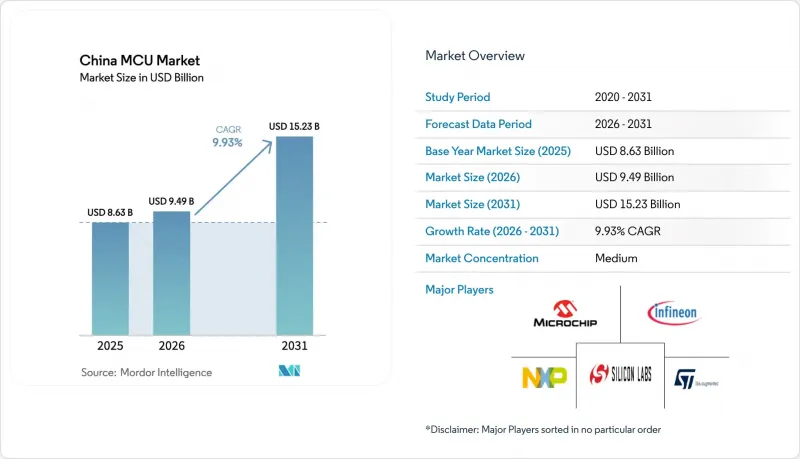
Mordor Intelligence에 따르면 중국의 MCU 시장 규모는 2025년에 86억 3,000만 달러로 평가되며, 2026년 94억 9,000만 달러에서 2031년까지 152억 3,000만 달러에 달할 것으로 예측되며, 예측 기간(2026-2031년) 동안 CAGR은 9.93%가 될 전망입니다.
본 보고서는 아키텍처(8비트, 16비트, 32비트, 64비트), 코어 IP(ARM Cortex-M 시리즈, RISC-V 코어 등), 공정 노드(90nm 초과, 65-90nm, 40-60nm, 28-40nm, 28nm 미만), 용도(소비자용 전자기기, 자동차, 산업 자동화,통신·IoT, 헬스케어·의료기기 등)별로 분류되어 있습니다. 시장 예측은 금액(달러) 기준으로 제시되어 있습니다.
중국 MCU 시장의 동향 및 분석
중국 전기자동차(EV) 생산의 폭발적인 성장이 고신뢰성 자동차용 MCU 수요를 견인
2024년, 신에너지차 생산 대수는 1,100만 대를 돌파했으며, 국내 시장 보급률은 40%를 넘어섰습니다. 이에 따라 1대당 MCU 탑재 금액은 900-1,000달러로 급증했습니다. 같은 해, 레벨 2+ 운전 지원 시스템의 보급률은 62.5%에 달하여, 센서 퓨전 및 제동 제어 로직을 위한 여러 고성능 MCU를 기반으로 한 중복 도메인 컨트롤러의 수요를 끌어올렸습니다. Zhaoyi Innovation 등 중국 벤더들은 ISO 26262 ASIL-D 준수를 향해 나아가고 있지만, 그 중 다수는 여전히 안전상 중요한 파워트레인 블록이 아닌 차체 ECU에 주력하고 있습니다. 인증된 32비트 자동차용 컨트롤러 분야에서는 해외 공급업체가 여전히 우위를 점하고 있지만, 국내 생산능력 확대와 정책 지원에 힘입어 그 격차는 점차 좁혀지고 있습니다. 그 결과, 중국 MCU 시장에서는 AEC-Q100 인증 부품의 급속한 증가, 사이버 보안 요건의 강화, 그리고 제품 수명주기의 장기화가 진행되고 있으며, 이는 견고한 기능 안전 툴체인을 갖춘 공급업체에게 유리한 상황이 되고 있습니다.
국가 ‘IoT+’ 전략이 커넥티드 기기의 MCU 수요를 견인
베이징 정부의 ‘IoT+’ 구상에 따라 2024년까지 8,000건 이상의 5G+ 산업용 인터넷 프로젝트가 추진되면서, 실시간 기계 제어를 위한 전용 32비트 MCU 수요가 급증했습니다. 중국의 AIoT 시장은 2024년에 1조 7,000억 위안 규모에 달할 전망이며, AI 지원 단말기가 출하대수의 55%를 차지하고 2027년까지 80%에 이를 것으로 예상됩니다. TWS 이어폰 및 웨어러블 기기에 필수적인 블루투스 저에너지(Bluetooth Low Energy) 모듈은 2025년까지 세계 시장에서 10억 달러를 넘어설 것으로 예측되며, 연평균 성장률(CAGR) 10%대 중반으로 확대되면서 무선 코어의 MCU 통합을 주도하고 있습니다. 엣지 측에서의 추론이 산업용 및 소비자용 기기에 점차 확산됨에 따라, 컨트롤러 공급업체들은 NPU 및 보안 요소를 핀 호환 패키지에 통합해야만 하는 상황에 처해 있습니다. 이러한 정책 주도형 스마트 노드의 보급으로 인해, 중국의 MCU 시장은 전 세계적으로 연계된 IoT 플랫폼의 양산 엔진으로서의 입지를 공고히 하고 있습니다.
미국의 수출 규제로 인해 첨단 EDA 및 리소그래피 툴에 대한 접근이 제한됨
미국이 시행한 규제로 인해 중국의 EUV 스캐너 및 첨단 EDA 제품군에 대한 접근이 저해되고 있으며, SMIC의 5nm 공정 예상 비용은 TSMC의 동급 제품에 비해 40-50% 상승한 반면, 수율은 최첨단 벤치마크의 약 3분의 1 수준에 그치고 있습니다. EUV 장비 부족으로 인해 DUV 멀티패터닝을 사용할 수밖에 없어, 마스크 수와 사이클 타임이 증가하고 있습니다. AI 엣지 노드나 차량용 인포테인먼트 등을 대상으로 하며 높은 로직 밀도가 필요한 MCU 설계에서는 와트당 성능이 저하되고 있습니다. 국내 툴체인은 발전하고 있지만, 타이밍 클로저 및 전력 최적화의 심도 면에서는 여전히 세계 주요 기업들에 뒤처져 있습니다. 이러한 기술적 격차는 중국 MCU 시장의 하이엔드 분야 성장을 저해하고 있으며, 14nm 이하 노드로의 도입을 지연시키고 있습니다.
부문 분석
중국의 32비트 시장 규모는 2025년에 46억 4,000만 달러에 달하여 매출 점유율의 53.78%를 차지했습니다. 엣지 AI 워크로드, 서라운드 뷰 스티칭, 고속 산업용 비전이 64비트 채택을 가속화하면서, 해당 부문은 연평균 성장률(CAGR) 10.88%로 확대되고 있습니다. 16비트 및 8비트 컨트롤러는 여전히 비용을 중시하는 가전제품이나 소형 센서 노드에서 사용되고 있지만, 28nm 32비트 제품의 가격 하락에 따라 두 제품의 합산 점유율은 해마다 감소하고 있습니다. Suzhou Guoxin의 CCR4001S는 230 MHz RISC-V 코어와 0.3 TOPS의 NPU를 결합한 것으로, 제어와 추론을 하나의 다이 위에 통합하려는 국내 제조사의 의지를 보여줍니다. 각 자동차 제조사는 차체 도메인용으로 멀티 코어 락스텝 방식의 32비트 부품을, 디지털 콕핏 클러스터용으로 듀얼 A76 64비트 SoC를 지정하고 있으며, 이를 통해 중국 MCU 시장의 계층형 아키텍처 로드맵이 강화되고 있습니다.
이에 따른 2차적인 영향으로, 메모리 밀도와 연산 처리량의 일관성이 더욱 엄격해지고 있습니다. 정전용량식 터치 HMI가 가전 제품에 도입됨에 따라 펌웨어 용량은 메가바이트 단위로 불어나, 온칩 플래시가 차별화의 핵심 요소가 되고 있습니다. 이에 따라 각 벤더는 미드레인지 32비트 MCU에 2-4MB의 eFlash를 내장하고 있습니다. 동시에 64비트 컨트롤러에는 LPDDR4 PHY가 통합되어 신경망 가중치를 스트리밍할 수 있게 되었습니다. 이러한 발전이 맞물리면서 중국의 MCU 시장은 제한된 전력 소비 범위 내의 이종 혼합 컴퓨팅 패러다임으로 서서히 전환되고 있습니다.
ARM은 2025년 매출의 61.05%를 차지했지만, 로열티가 없는 RISC-V 코어는 정부 보조금과 오픈 소스 툴체인의 지원을 받아 두 자릿수 성장을 기록했습니다. Zhenhua Fengguang은 2025년 1월, 자사 최초의 완전 국산 32비트 RISC-V MCU의 테이프아웃을 완료했으며, 연말까지 시범 생산을 목표로 하고 있습니다. 0.10달러 전후의 초저가 RISC-V 디바이스가 엔트리 레벨 IoT 노드를 활성화시키고 있습니다. 설계의 자유도가 높아 국내 기업들은 라이선스 비용을 지불하지 않고도 모터 제어용 맞춤형 DSP 블록이나 디지털 위안화 지갑용 암호화 가속기를 추가할 수 있습니다. 그러나 전환의 장벽으로 IDE의 성숙도, 미들웨어의 충실도, 안전 인증 라이브러리 등이 꼽히며, 이러한 요인들이 여전히 중국 MCU 시장에서 ARM의 우위를 뒷받침하고 있습니다.
전력계나 기본적인 조명 제어 장치에서는 여전히 기존의 8051 코어가 사용되고 있으며, 90nm 이상의 공정 노드에서 결정적인 사이클 타이밍과 극히 작은 다이 크기를 실현하고 있습니다. 그러나 ODM 각사가 비용 면에서 동등한 32비트 유닛을 중심으로 툴체인을 표준화하고 있기 때문에 새로운 8비트용 소켓에 대한 수요는 감소 추세에 있습니다. 그 결과, 중국 MCU 시장은 양극화가 점점 더 심화되고 있으며, 고성능 분야에서는 64비트 RISC-V가 주류를 이루고, 대중 시장을 겨냥한 제어 분야에서는 저비용 32비트 ARM 계열 제품이 자리 잡아가고 있습니다.
기타 혜택:
- 엑셀 형식의 시장 예측(ME) 시트
- 3개월간의 애널리스트 지원
자주 묻는 질문
목차
제1장 소개
제2장 조사 방법
제3장 주요 요약
제4장 시장 구도
제5장 시장 규모와 성장 예측
제6장 경쟁 구도
제7장 시장 기회와 향후 전망
KSM 26.09.03According to Mordor Intelligence, the China MCU market size was valued at USD 8.63 billion in 2025 and estimated to grow from USD 9.49 billion in 2026 to reach USD 15.23 billion by 2031, at a CAGR of 9.93% during the forecast period (2026-2031).
This report is Segmented by Architecture (8-Bit, 16-Bit, 32-Bit, and 64-Bit), Core IP (ARM Cortex-M Series, RISC-V Cores, and More), Process Node (above 90nm, 65-90nm, 40-60nm, 28-40nm, and Less Than 28nm), Application (Consumer Electronics, Automotive, Industrial Automation, Communication and IoT, Healthcare and Medical Devices, and More). The Market Forecasts are Provided in Terms of Value (USD).
China MCU Market Trends and Insights
Explosive Growth in China's EV Production Triggering High-Reliability Automotive MCU Demand
New-energy vehicle production broke the 11 million-unit mark in 2024 and delivered over 40% domestic penetration, sharply lifting MCU content per car to USD 900-1,000. Level 2+ driver-assistance systems reached 62.5% penetration the same year, pushing demand for redundant domain controllers built on multiple high-performance MCUs for sensor fusion and braking logic. Chinese vendors such as Zhaoyi Innovation advanced toward ISO 26262 ASIL-D compliance, though most still focus on body ECUs rather than safety-critical powertrain blocks. Foreign suppliers maintain the lead in qualified 32-bit automotive controllers, yet rising domestic capacity and policy support are narrowing the gap. The China MCU market is therefore experiencing a rapid uptick in AEC-Q100-qualified parts, tighter cybersecurity requirements, and longer product lifecycles that favor suppliers with robust functional-safety toolchains.
National "IoT+" Strategy Spurring Connected-Device MCU Volumes
Beijing's IoT+ blueprint underwrote more than 8,000 5G+Industrial-Internet projects by 2024, catapulting specialized 32-bit MCU demand for real-time machine control. China's AIoT sector reached RMB 1.7 trillion in 2024, with AI-enabled terminals accounting for 55% of shipments and headed toward 80% by 2027. Bluetooth Low Energy modules, integral to TWS earbuds and wearables, are projected to top USD 1 billion worldwide by 2025, expanding at mid-teen CAGRs and anchoring MCU integration of wireless cores. Edge-side inferencing is permeating factory and consumer devices, forcing controller vendors to embed NPUs and secure elements into pin-compatible packages. This policy-driven proliferation of smart nodes cements the China MCU market as a volume engine for globally aligned IoT platforms.
U.S. Export Controls Curbing Access to Advanced EDA and Lithography Tools
Restrictions enacted by the United States hamper Chinese access to EUV scanners and advanced EDA suites, lifting projected 5 nm costs at SMIC by 40-50% versus TSMC peers while yields sit at roughly one-third of leading-edge benchmarks. Lack of EUV machinery forces DUV multi-patterning, inflating mask counts and cycle times. MCU designs targeting AI edge nodes or in-vehicle infotainment that need high logic density face performance-per-watt penalties. Domestic toolchains are progressing but still trail global incumbents in timing-closure and power-optimization depth. This technological drag tempers top-end growth of the China MCU market and slows adoption of sub-14 nm nodes.
Other drivers and restraints analyzed in the detailed report include:
- Government Subsidies to Accelerate Domestic MCU Design-in (Made-in-China 2025)
- Industrial 4.0 Retrofits in SMEs Raising Adoption of 32-bit Industrial-Grade MCUs
- Persistent Wafer-Level Supply Bottlenecks in 40 nm and 28 nm Nodes
For complete list of drivers and restraints, kindly check the Table Of Contents.
Segment Analysis
The China MCU market size for 32-bit devices reached USD 4.64 billion in 2025, equating to 53.78% revenue share. Edge AI workloads, surround-view stitching, and high-speed industrial vision accelerate 64-bit adoption, lifting that segment at an 10.88% CAGR. Sixteen-bit and eight-bit controllers linger in cost-sensitive appliances and small sensor nodes, yet their combined share slips yearly as 28 nm 32-bit pricing compresses. Suzhou Guoxin's CCR4001S marries a 230 MHz RISC-V core with a 0.3 TOPS NPU, demonstrating domestic ambition to migrate control and inference onto one die. Automotive OEMs specify multicore lock-step 32-bit parts for body domain and dual-A76 64-bit SoCs for digital cockpit clusters, reinforcing a tiered architecture roadmap within the China MCU market.
Second-order effects include tighter alignment between memory density and compute throughput. As capacitive-touch HMIs enter appliances, firmware swells into the megabyte range, making on-chip flash a differentiation point. Vendors thus bundle 2-4 MB of eFlash in mid-range 32-bit MCUs. Concurrently, 64-bit controllers integrate LPDDR4 PHYs to stream neural-network weights. These advances collectively edge the China MCU market toward heterogeneous compute paradigms inside constrained power envelopes.
ARM retained 61.05% of 2025 revenue, but royalty-free RISC-V cores chalked up double-digit growth, aided by government grants and open-source toolchains. Zhenhua Fengguang taped out its first fully indigenous 32-bit RISC-V MCU in January 2025, positioning for pilot production by year-end. Ultra-low-cost RISC-V parts priced near USD 0.10 invigorate entry-level IoT nodes. Design freedom enables domestic firms to add custom DSP blocks for motor control or crypto accelerators for digital-yuan wallets without paying license fees. However, migration hurdles include IDE maturity, middleware depth, and safety certification libraries, factors that still buttress ARM's lead in the China MCU market.
Legacy 8051 cores persist in power meters and basic lighting controls, offering deterministic cycle timing and tiny die sizes on above 90 nm nodes. Yet new 8-bit sockets dwindle as ODMs standardize toolchains around 32-bit units with cost parity. The net result is an increasingly bifurcated China MCU market where premium performance leans toward 64-bit RISC-V and mass-market control consolidates on low-cost 32-bit ARM alternatives.
Complete Report Scope:
- By Architecture
- 8-bit
- 16-bit
- 32-bit
- 64-bit
- By Core IP
- ARM Cortex-M Series
- RISC-V Cores
- 8051 / MCS-51
- MIPS and Others
- By Process Node
- above 90 nm
- 65 - 90 nm
- 40 - 60 nm
- 28 - 40 nm
- less than 28 nm
- By Application
- Consumer Electronics
- Automotive
- Industrial Automation
- Communication and IoT
- Healthcare and Medical Devices
- Other Applications
List of Companies Covered in this Report:
- Microchip Technology Inc.
- NXP Semiconductors N.V.
- STMicroelectronics N.V.
- Texas Instruments Incorporated
- Renesas Electronics Corporation
- Infineon Technologies AG
- GigaDevice Semiconductor Inc.
- Nuvoton Technology Corporation
- Holtek Semiconductor Inc.
- Silicon Laboratories Inc.
- Nordic Semiconductor ASA
- Espressif Systems (Shanghai) Co., Ltd.
- Shanghai MindMotion Microelectronics Co., Ltd.
- Shanghai ChipON Micro-Electronics Co., Ltd.
- Wuhan Eastsoft Embedded System Co., Ltd.
- Nationz Technologies Inc.
- Hangzhou C-SKY Microsystems Co., Ltd.
- Actions Technology Co., Ltd.
- Sanechips Technology Co., Ltd.
- Hangzhou ASR Microelectronics Co., Ltd.
- Shenzhen Beken Corporation Ltd.
- Qingdao Eastsoft Microelectronics Co., Ltd.
- Zhuhai Abov Microelectronics Co., Ltd.
- Austriamicrosystems AG
- Chongqing Sino-MCU Technology Co., Ltd.
Additional Benefits:
- The market estimate (ME) sheet in Excel format
- 3 months of analyst support
TABLE OF CONTENTS
1 INTRODUCTION
- 1.1 Study Assumptions and Market Definition
- 1.2 Scope of the Study
2 RESEARCH METHODOLOGY
3 EXECUTIVE SUMMARY
4 MARKET LANDSCAPE
- 4.1 Market Overview
- 4.2 Market Drivers
- 4.2.1 Explosive growth in China's EV production triggering high-reliability automotive MCU demand
- 4.2.2 National "IoT +" strategy spurring connected-device MCU volumes
- 4.2.3 Government subsidies to accelerate domestic MCU design-in (Made-in-China 2025)
- 4.2.4 Industrial 4.0 retrofits in SMEs raising adoption of 32-bit industrial-grade MCUs
- 4.2.5 Emergence of RISC-V open ISA in Chinese MCUs lowering entry barriers
- 4.2.6 Digital-yuan hardware wallet roll-out creating an all-new secure-MCU niche
- 4.3 Market Restraints
- 4.3.1 U.S. export controls curbing access to advanced EDA and lithography tools
- 4.3.2 Persistent wafer-level supply bottlenecks in 40 nm, 28 nm nodes
- 4.3.3 Scarcity of functional-safety talent for ISO 26262-compliant MCU designs
- 4.3.4 Reliability certification hurdles for domestic MCUs in Tier-1 auto OEMs
- 4.4 Industry Value Chain Analysis
- 4.5 Regulatory Landscape
- 4.6 Technological Outlook
- 4.7 Porter's Five Forces Analysis
- 4.7.1 Threat of New Entrants
- 4.7.2 Bargaining Power of Suppliers
- 4.7.3 Bargaining Power of Buyers
- 4.7.4 Threat of Substitutes
- 4.7.5 Competitive Rivalry
5 MARKET SIZE AND GROWTH FORECASTS (VALUE)
- 5.1 By Architecture
- 5.1.1 8-bit
- 5.1.2 16-bit
- 5.1.3 32-bit
- 5.1.4 64-bit
- 5.2 By Core IP
- 5.2.1 ARM Cortex-M Series
- 5.2.2 RISC-V Cores
- 5.2.3 8051 / MCS-51
- 5.2.4 MIPS and Others
- 5.3 By Process Node
- 5.3.1 above 90 nm
- 5.3.2 65 - 90 nm
- 5.3.3 40 - 60 nm
- 5.3.4 28 - 40 nm
- 5.3.5 less than 28 nm
- 5.4 By Application
- 5.4.1 Consumer Electronics
- 5.4.2 Automotive
- 5.4.3 Industrial Automation
- 5.4.4 Communication and IoT
- 5.4.5 Healthcare and Medical Devices
- 5.4.6 Other Applications
6 COMPETITIVE LANDSCAPE
- 6.1 Market Concentration
- 6.2 Strategic Moves
- 6.3 Market Share Analysis
- 6.4 Company Profiles (includes Global level Overview, Market level overview, Core Segments, Financials as available, Strategic Information, Market Rank/Share, Products and Services, Recent Developments)
- 6.4.1 Microchip Technology Inc.
- 6.4.2 NXP Semiconductors N.V.
- 6.4.3 STMicroelectronics N.V.
- 6.4.4 Texas Instruments Incorporated
- 6.4.5 Renesas Electronics Corporation
- 6.4.6 Infineon Technologies AG
- 6.4.7 GigaDevice Semiconductor Inc.
- 6.4.8 Nuvoton Technology Corporation
- 6.4.9 Holtek Semiconductor Inc.
- 6.4.10 Silicon Laboratories Inc.
- 6.4.11 Nordic Semiconductor ASA
- 6.4.12 Espressif Systems (Shanghai) Co., Ltd.
- 6.4.13 Shanghai MindMotion Microelectronics Co., Ltd.
- 6.4.14 Shanghai ChipON Micro-Electronics Co., Ltd.
- 6.4.15 Wuhan Eastsoft Embedded System Co., Ltd.
- 6.4.16 Nationz Technologies Inc.
- 6.4.17 Hangzhou C-SKY Microsystems Co., Ltd.
- 6.4.18 Actions Technology Co., Ltd.
- 6.4.19 Sanechips Technology Co., Ltd.
- 6.4.20 Hangzhou ASR Microelectronics Co., Ltd.
- 6.4.21 Shenzhen Beken Corporation Ltd.
- 6.4.22 Qingdao Eastsoft Microelectronics Co., Ltd.
- 6.4.23 Zhuhai Abov Microelectronics Co., Ltd.
- 6.4.24 Austriamicrosystems AG
- 6.4.25 Chongqing Sino-MCU Technology Co., Ltd.
7 MARKET OPPORTUNITIES AND FUTURE OUTLOOK
- 7.1 White-space and Unmet-Need Assessment


