

|
시장보고서
상품코드
2119643
유럽의 역청 시장 : 점유율 분석, 업계 동향과 통계, 성장 예측(2026-2031년)Europe Bitumen - Market Share Analysis, Industry Trends & Statistics, Growth Forecasts (2026 - 2031) |
||||||
 Mordor Intelligence
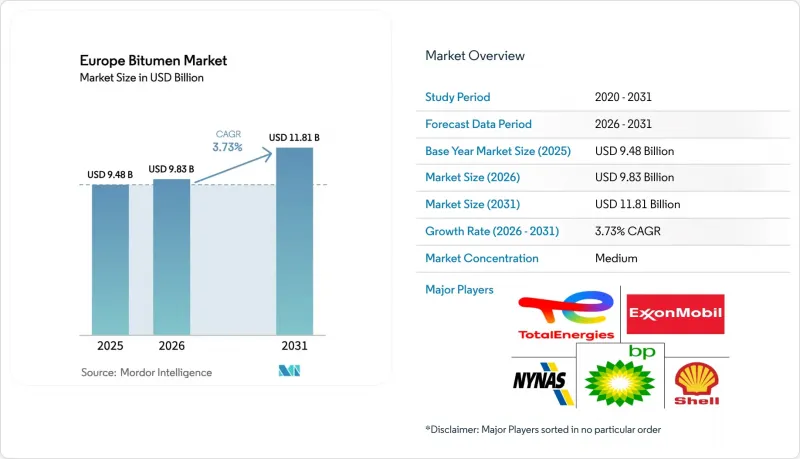
Mordor Intelligence에 의하면, 2026년 유럽 역청 시장 규모는 98억 3,000만 달러로 추정되고 있어 2025년 94억 8,000만 달러에서 확대해, 2031년에는 118억 1,000만 달러에 이를 것으로 예측됩니다.
2026년부터 2031년까지의 연평균 성장률(CAGR)은 3.73%가 될 것으로 전망됩니다.
본 보고서는 제품 유형(포장용 등급, 하드 등급 등), 용도(도로 건설, 방수·지붕 공사 등), 최종 용도 부문(공공 인프라, 주택 건축, 상업 및 산업 건축), 지역(독일, 영국, 이탈리아, 프랑스, 스페인 등)별로 분류되어 있습니다. 시장 전망은 금액(달러) 기준으로 제시되어 있습니다.
유럽 비투멘 시장 동향 및 인사이트
EU-27 전역에서 도로 개보수 및 신규 고속도로 건설에 대한 지출 증가
EU 교통 당국은 2024년에 도로 현대화를 위해 70억 유로(77억 달러)를 배정했으며, 독일만 해도 고속도로 개보수에 매년 28억 유로(30억 8,000만 달러)를 지출하고 있습니다. 개정된 TEN-T 규정에 포함된 의무 조항에 따라 수요 전망은 2050년까지 확대되고 있습니다. 입찰 사양서에서는 유지보수 주기를 연장하는 폴리머 개질 바인더의 채택이 점점 더 요구되고 있으며, 이는 유럽 비투멘 시장 전체의 프리미엄화 추세를 뒷받침하고 있습니다. 시공업체들은 기준 톤수 요건이 확정되고, 견고한 물류 기반을 갖춘 공급업체로부터 조달을 촉진하는 다년간의 지출 계획의 확실성으로부터 혜택을 받고 있습니다.
대형 트럭의 적재량 증가에 따라 폴리머 개질 바인더의 채택이 가속화되고 있습니다.
화물 운송량은 2019년 이후 23% 급증했으며, 주요 간선 도로의 차축 하중이 현재 44톤 상한선에 근접함에 따라 도로 관리 기관은 차선 파손 저항을 30-40% 향상시키는 것으로 알려진 SBS 개질 바인더의 사용을 지정하고 있습니다. 실지 시험 결과, 기존 포장용 등급에 비해 내구 연한이 최대 80% 연장되는 것으로 확인되어, 평균 15-20%의 가격 프리미엄이 정당화되고 있습니다. EN 14023은 조화된 성능 기준을 규정하고 있으며, 독일과 프랑스에서는 일일 교통량이 1만 대를 초과하는 고속도로에서 PMB 사용을 의무화하고 있습니다. 이러한 구조적 변화가 유럽의 비투멘 시장에서 폴리머 개질 제품이 가장 빠르게 확대되고 있는 배경이 되고 있습니다.
아스팔트 플랜트의 CO2/PAH 배출 규제 강화
개정된 ‘산업 배출 지침’에 따라 PAH 배출 제한치가 40% 인하되었으며, CO2 보고 의무가 확대되었습니다. 사업자에 따르면, 산화 처리 및 여과 장치의 개보수에는 시설 1곳당 200만-500만 유로(220만-550만 달러)의 비용이 소요될 것으로 예측됩니다. 소규모 배치 플랜트의 경우 개조 비용 조달에 어려움을 겪을 가능성이 있으며, 그 결과 가동 능력이 축소되어 일부 생산자가 유럽 비투멘 시장에서 철수할 수밖에 없을 우려가 있습니다. 최첨단 기술(BAT) 인증을 받은 선도 기업들은 규제 준수를 경쟁 우위로 활용하여 탄소 배출 저감에 민감한 입찰 프로젝트를 수주하고 있습니다.
부문 분석
폴리머 개질 역청(PMB)는 가장 빠른 성장세를 보이고 있으며, 2031년까지 연평균 성장률(CAGR)은 4.27%로 예측되지만, 2025년 시점에서도 기존 포장용 등급이 유럽 역청 시장 점유율의 54.85%를 차지하고 있습니다. 화물 운송 회랑에서는 차선이나 피로 현상의 발생을 지연시키는 결합재가 요구되고 있으며, EN 14023 규격이 국경을 초월한 품질의 일관성을 구매자에게 보장하고 있기 때문에 프리미엄화가 가속화되고 있습니다. PMB와 관련된 유럽 역청 시장 규모는 지중해 지역 허브에서의 리드 타임을 단축하는 물류 효율성 향상에 따라 확대되었습니다. 그 결과, SBS 및 크럼블 고무를 활용한 개질 능력을 통합한 공급업체들은 우수한 수주 잔고를 기록하고 있습니다.
바이오 아스팔트의 혁신은 웜 믹스의 물결을 타고 있습니다. 하프 웜 믹스에서 리그닌의 대체율은 5%에 육박하고 있으며, 사용 후 식용유에 대한 에폭시화 시험에서는 내구성 목표를 달성하는 결합재가 생성되고 있습니다. 하드 등급 및 산화 등급은 여전히 틈새 시장이지만, 산업 용도료나 방수 매트에는 필수적입니다. 아스팔트 에멀전은 특히 도로 관리 기관이 재생 아스팔트 포장(RAP)의 사용 상한선을 50%로 상향 조정한 경우, 저온 재활용 및 스프레이 실링에 유용합니다. 이처럼 유럽의 역청 업계는 지속가능성과 성능 양면에서 프리미엄 수요를 흡수하기 위해 제품 라인업을 확충하고 있습니다.
기타 혜택:
- 엑셀 형식 시장 예측(ME) 시트
- 3개월간의 애널리스트 지원
자주 묻는 질문
목차
제1장 서론
제2장 조사 방법
제3장 개요
제4장 시장 구도
제5장 시장 규모와 성장 예측
제6장 경쟁 구도
제7장 시장 기회와 향후 전망
JHS 26.09.03According to Mordor Intelligence, Europe bitumen market size in 2026 is estimated at USD 9.83 billion, growing from 2025 value of USD 9.48 billion with 2031 projections showing USD 11.81 billion, growing at 3.73% CAGR over 2026-2031.
This report is Segmented by Product Type (Paving Grade, Hard Grade, and More), Application (Road Construction, Waterproofing and Roofing, and More), End-Use Sector (Public Infrastructure, Residential Building, and Commercial and Industrial Building), and Geography (Germany, United Kingdom, Italy, France, Spain, and More). The Market Forecasts are Provided in Terms of Value (USD).
Europe Bitumen Market Trends and Insights
Growing Road-Rehabilitation and Greenfield Highway Spending Across EU-27
EU transport authorities earmarked EUR 7 billion (USD 7.7 billion) in 2024 for road modernization, with Germany alone spending EUR 2.8 billion (USD 3.08 billion) each year on motorway upgrades. Mandates embedded in the revised TEN-T regulation stretch demand visibility to 2050. Tender specifications increasingly call for polymer-modified binders that lengthen maintenance cycles, reinforcing premiumization trends across the Europe bitumen market. Contractors benefit from certainty in multi-year spending plans that lock in baseline tonnage requirements and tilt procurement toward suppliers with robust logistics footprints.
Accelerating Adoption of Polymer-Modified Binders for Heavier Truck Loads
Freight tonnage jumped 23% since 2019 and axle weights now approach the 44-ton limit along major corridors, prompting road agencies to specify SBS-modified binders known to raise rutting resistance by 30-40%. Field trials confirm service-life gains of up to 80% relative to conventional paving grade, validating price premiums that average 15-20%. EN 14023 provides a harmonized performance benchmark, while Germany and France codify mandatory PMB use on motorways exceeding 10,000 vehicles daily. This structural shift underpins the fastest expansion track for polymer-modified products within the Europe bitumen market.
Heightened CO2 / PAH Emission Regulations on Asphalt Plants
The revised Industrial Emissions Directive ratcheted PAH limits down 40% and expanded CO2 reporting duties. Operators estimate EUR 2-5 million (USD 2.2-5.5 million) per facility for oxidation and filtration retrofits. Smaller batch plants may struggle to fund upgrades, trimming available capacity and pushing some producers out of the Europe bitumen market. Early movers with best-available-technology status leverage compliance as a competitive moat and capture carbon-conscious tender lots.
Other drivers and restraints analyzed in the detailed report include:
- Surging Demand for Premium Waterproofing Membranes in Zero-Energy Buildings
- Mediterranean Surplus Filling Supply Gap After Russia Ban, Lowering NW Europe Costs
- Concrete and Composite Pavements Winning Share in Long-Life Motorway Projects
For complete list of drivers and restraints, kindly check the Table Of Contents.
Segment Analysis
Polymer-modified bitumen underpins the fastest trajectory, charting a 4.27% CAGR through 2031, although conventional paving grade still accounts for 54.85% of the Europe bitumen market share in 2025. Premiumization accelerates because freight corridors demand binders that postpone rutting and fatigue, while EN 14023 assures buyers of cross-border consistency. The Europe bitumen market size tied to PMB climbed in tandem with logistics efficiencies that shorten lead times from Mediterranean hubs. Suppliers with integrated SBS and crumb-rubber modification capacity therefore record superior order backlogs.
Bio-bitumen innovations ride on the warm-mix wave. Lignin substitution rates near 5% in half-warm mixes, and used-cooking-oil epoxidation trials produce binders that hit durability targets. Hard and oxidized grades remain niche yet critical for industrial coatings and waterproofing mats. Bitumen emulsions find relevance in cold recycling and spray seals, especially where road agencies lift reclaimed asphalt pavement (RAP) thresholds to 50%. The Europe bitumen industry thus stretches its product ladder to capture both sustainability and performance premiums.
Complete Report Scope:
- By Product Type
- Paving Grade
- Hard Grade
- Oxidized Grade
- Bitumen Emulsions
- Polymer-Modified Bitumen (PMB)
- Other Grades (Cutback, Crystal, Bio-bitumen)
- By Application
- Road Construction
- Waterproofing and Roofing
- Adhesives and Sealants
- Industrial and Specialty (Coating, Canal Lining, Pipe Wrap)
- By End-Use Sector
- Public Infrastructure
- Residential Building
- Commercial and Industrial Building
- By Geography
- Germany
- United Kingdom
- Italy
- France
- Spain
- NORDIC Countries
- Central and Eastern Europe
- Rest of Europe
List of Companies Covered in this Report:
- Bitumina Group
- BP Plc
- Colas Group (Bouygues)
- Eurovia (Vinci Group)
- Exxon Mobil Corporation
- Gazprom Neft
- Icopal / BMI Group
- KRATON CORPORATION
- Nynas AB
- Orlen Lietuva
- Puma Energy
- Shell Plc
- Sika AG
- STRABAG SE
- Suncor Energy Inc.
- TotalEnergies
Additional Benefits:
- The market estimate (ME) sheet in Excel format
- 3 months of analyst support
TABLE OF CONTENTS
1 Introduction
- 1.1 Study Assumptions and Market Definition
- 1.2 Scope of the Study
2 Research Methodology
3 Executive Summary
4 Market Landscape
- 4.1 Market Overview
- 4.2 Market Drivers
- 4.2.1 Growing Road-Rehabilitation and Greenfield Highway Spending Across EU-27
- 4.2.2 Accelerating Adoption of Polymer-Modified Binders for Heavier Truck Loads
- 4.2.3 Surging Demand for Premium Waterproofing Membranes in Zero-Energy Buildings
- 4.2.4 Mediterranean Surplus Filling Supply Gap After Russia Ban, Lowering NW Europe Costs
- 4.2.5 Rapid Shift Toward Warm-Mix Asphalt (WMA) to Meet Fit-For-55 Decarbonisation Targets
- 4.3 Market Restraints
- 4.3.1 Heightened CO2 / PAH Emission Regulations on Asphalt Plants
- 4.3.2 Concrete and Composite Pavements Winning Share in Long-Life Motorway Projects
- 4.3.3 Antitrust Fines on Regional Emulsion Cartels Inflating Compliance Costs
- 4.4 Value Chain Analysis
- 4.5 Regulatory Landscape
- 4.6 Porter's Five Forces
- 4.6.1 Bargaining Power of Suppliers
- 4.6.2 Bargaining Power of Buyers
- 4.6.3 Threat of New Entrants
- 4.6.4 Threat of Substitutes
- 4.6.5 Degree of Competition
5 Market Size and Growth Forecasts (Value)
- 5.1 By Product Type
- 5.1.1 Paving Grade
- 5.1.2 Hard Grade
- 5.1.3 Oxidized Grade
- 5.1.4 Bitumen Emulsions
- 5.1.5 Polymer-Modified Bitumen (PMB)
- 5.1.6 Other Grades (Cutback, Crystal, Bio-bitumen)
- 5.2 By Application
- 5.2.1 Road Construction
- 5.2.2 Waterproofing and Roofing
- 5.2.3 Adhesives and Sealants
- 5.2.4 Industrial and Specialty (Coating, Canal Lining, Pipe Wrap)
- 5.3 By End-Use Sector
- 5.3.1 Public Infrastructure
- 5.3.2 Residential Building
- 5.3.3 Commercial and Industrial Building
- 5.4 By Geography
- 5.4.1 Germany
- 5.4.2 United Kingdom
- 5.4.3 Italy
- 5.4.4 France
- 5.4.5 Spain
- 5.4.6 NORDIC Countries
- 5.4.7 Central and Eastern Europe
- 5.4.8 Rest of Europe
6 Competitive Landscape
- 6.1 Market Concentration
- 6.2 Strategic Moves
- 6.3 Market Share (%)/Ranking Analysis
- 6.4 Company Profiles (includes Global level Overview, Market level overview, Core Segments, Financials as available, Strategic Information, Market Rank/Share, Products and Services, Recent Developments)
- 6.4.1 Bitumina Group
- 6.4.2 BP Plc
- 6.4.3 Colas Group (Bouygues)
- 6.4.4 Eurovia (Vinci Group)
- 6.4.5 Exxon Mobil Corporation
- 6.4.6 Gazprom Neft
- 6.4.7 Icopal / BMI Group
- 6.4.8 KRATON CORPORATION
- 6.4.9 Nynas AB
- 6.4.10 Orlen Lietuva
- 6.4.11 Puma Energy
- 6.4.12 Shell Plc
- 6.4.13 Sika AG
- 6.4.14 STRABAG SE
- 6.4.15 Suncor Energy Inc.
- 6.4.16 TotalEnergies
7 Market Opportunities and Future Outlook
- 7.1 White-space and Unmet-Need Assessment


