

|
시장보고서
상품코드
2119742
인도의 데이터센터 서버 시장 : 점유율 분석, 업계 동향과 통계, 성장 예측(2026-2032년)India Data Center Server - Market Share Analysis, Industry Trends & Statistics, Growth Forecasts (2026 - 2032) |
||||||
 Mordor Intelligence
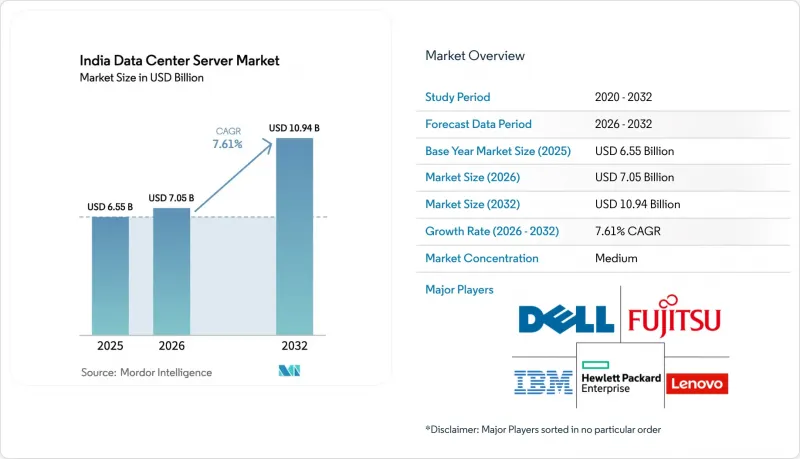
Mordor Intelligence에 의하면, 인도의 데이터센터 서버 시장 규모는 2025년 65억 5,000만 달러에서 2026년에는 70억 5,000만 달러로 확대되어 2026-2032년 CAGR 7.61%로 성장을 지속하여, 2032년에는 109억 4,000만 달러에 이를 것으로 예측됩니다.
본 보고서는 폼 팩터(블레이드 서버, 랙 서버 등), 프로세서 아키텍처(x86, ARM 등), 도입 모델(하이퍼스케일 클라우드, 코로케이션 등), 최종 사용자 산업(IT 및 통신, BFSI 등) 및 지역(북인도, 남인도 등)별로 분류되어 있습니다. 시장 전망은 금액(미 달러) 기준으로 제시되어 있습니다.
인도 데이터센터 서버 시장 동향 및 인사이트
하이퍼스케일러 및 코로케이션 분야의 자본 지출(CAPEX) 급증
릴라이언스 인더스트리즈는 구자라트 주에 3GW 규모의 데이터센터 캠퍼스를 건설할 것이라고 발표했습니다. 이로 인해 국내 현재 용량은 3배로 늘어나며, 재생에너지로 구동되는 NVIDIA의 AI 반도체가 채택될 예정입니다. 코로케이션 전문 기업인 CtrlS는 20억 달러의 신규 투자를 바탕으로 350 MW 규모의 ‘AI 지원’ 화이트 스페이스를 구축하고 있습니다. 정부 정책에 따라 데이터센터 인프라에 대한 100% 외국인 직접 투자가 허용되면서, 클라우드 리전 구축이 가속화되고 하드웨어 교체 주기가 단축되고 있습니다. 시설 설계도에는 GPU 클러스터에 최적화된 고밀도 랙, 액체 냉각, DCIM 시스템이 점점 더 명시되고 있습니다. 여러 사업자가 유리한 조건으로 부지와 전력을 확보하기 위해 경쟁하고 있어, 서버, 네트워크 장비, 배전 장치의 조달 주기가 12개월에서 6개월로 단축되었으며, 인도 데이터센터 서버 시장 전체의 기초 수요가 급격히 증가하고 있습니다.
5G 확산이 엣지 노드용 마이크로 서버 수요를 견인
인도의 통신 사업자들은 2025년까지 전국 규모의 5G망을 완성하기 위해 2,200만 명의 숙련된 노동자가 필요하며, 이는 설치가 필수적인 타워 측 컴퓨팅 설비의 규모가 매우 크다는 것을 보여줍니다. 견고하고 설치 면적이 작은 케이스를 갖춘 마이크로 서버 노드에는 소비 전력이 250W 미만임에도 불구하고 네트워크 에지에서 충분한 AI 추론 처리를 실현하는 ARM 기반 보드가 탑재되어 있습니다. 버티 에어텔과 릴라이언스 지오는 통합 냉각, 분산형 UPS, 제로 터치 프로비저닝을 결합한 다년간의 주문을 진행 중입니다. 오픈 액세스 광섬유와 개편된 주파수 정책 덕분에 백홀 비용은 관리 가능한 수준으로 억제되고 있으며, 한편 각 주의 PLI(생산 연계형 인센티브) 제도를 통해 현지에서 제조된 최적화된 에지 시스템에 대해 공장 출하 가격의 4-6%가 환급됩니다. 그 결과, 엣지 마이크로 데이터센터의 연평균 성장률(CAGR)은 8.1% 상승했으며, 인도 데이터센터 서버 시장에서 중앙 집중형 하이퍼스케일 랙의 점유율을 계속해서 빼앗아 갈 것으로 보입니다.
뭄바이의 전력 공급 부족과 전기 요금 급등
뭄바이는 여전히 인도의 주요 금융 허브이지만, 전력망이 포화 상태여서 대규모 데이터센터 증설 시 새로운 변전소에 연결하는 데 최대 18개월이 소요될 수 있습니다. 사업자들은 현재 구자라트주의 태양광 발전소와 1kWh당 3.1루피에 재생에너지 전력 구매 계약을 체결하여, 1kWh당 8.0루피를 초과하는 시내 전기 요금을 피하고 있습니다. 마하라슈트라 주의 정책에 따라 전용 테크놀로지 파크 내에 건설되는 시설에는 인지세 환급 및 신속한 승인이 제공되지만, 시설 가동은 2027년 이후가 될 예정입니다. 그 동안 하이퍼스케일러 기업들은 확장 계획을 나비 뭄바이와 푸네로 전환하고 있으며, 이로 인해 해당 도시로의 단기적인 서버 출하량은 감소하겠지만, 인도 데이터센터 서버 시장 전체의 성장은 유지되고 있습니다.
부문 분석
마이크로 서버, 모듈형 서버, 엣지 서버는 2032년까지 인도 데이터센터 서버 시장 규모에 15억 9,000만 달러를 기여하며, 연평균 성장률(CAGR) 7.76%로 성장할 전망입니다. 랙형 설계는 2025년 출하 대수의 37.45%를 차지하고 있지만, 타워형 쉘터에 직접 장착되는 2U 마이크로 노드에 점차 시장 점유율을 빼앗기고 있습니다. 이러한 움직임으로 인해 동영상, AR, 산업용 IoT 분야의 지연 시간이 단축되고 백홀 비용이 절감됩니다. 아폴로 병원(Apollo Hospitals)은 72개 시설에서 Nutanix의 하이퍼컨버지드 클러스터를 도입하여 실시간 모니터링을 강화하는 동시에 IT 관련 에너지 소비를 80% 절감하고 있습니다. 타워형 서버는 랙 인프라를 보유하지 않은 중소기업 사이에서 계속해서 지지를 얻고 있는 반면, 블레이드 프레임은 고밀도 가상화가 필요한 금융 워크로드의 표준으로 자리 잡았습니다.
엣지 캐비닛 내의 전력 밀도가 높아짐에 따라, 구리 손실을 줄여주는 직접 투 칩(Direct-to-Chip) 냉각 플레이트와 48V DC 버스바에 대한 수요가 증가하고 있습니다. 각 벤더사는 주변 온도 55°C에서 작동하며 팬이 없는 대류 냉각을 채택한 밀폐형 모듈 서버를 제공하고 있으며, 이는 지방 지역에서의 도입에 필수적입니다. 실리콘 포토닉스 등의 기술적 진보로 기능이 더욱 통합되어, 리터당 연산 능력이 더욱 향상되고 있습니다. 이러한 변화로 인해 마이크로 서버는 인도 데이터센터 서버 시장에서 가장 빠르게 성장하는 분야로서의 입지를 확고히 하고 있습니다.
인도의 데이터센터 서버 시장에서 x86이 차지하는 규모는 2025년에 40억 1,000만 달러에 달했지만, ARM 노드는 더 빠르게 성장하여 2032년까지 시장 점유율 19.60%에 도달할 전망입니다. ‘메이크 인 인디아(Make in India)’ 우대 조치 덕분에 Netweb Technologies사는 TDP 225W에 192코어를 탑재한 Tyrone ARM 서버를 출하할 수 있는 경제적 기반을 확보했습니다. ARM 시스템은 x86에 비해 전력 소비를 25-30% 줄일 수 있어, 냉각 능력이 제한된 엣지 환경에서 중요한 이점이 됩니다. RISC/Power는 34개 시설에 총 35 PF의 연산 능력을 도입한 ‘국가 슈퍼컴퓨팅 미션’ 하에서 과학 계산 워크로드를 위한 틈새 시장으로 자리 잡고 있습니다.
소프트웨어 스택은 빠르게 성숙하고 있습니다. Red Hat과 Canonical은 모두 ARM 기반 코어 뱅킹, ERP 및 분석 프레임워크에 대한 인증을 진행하여 전환 장벽을 낮추고 있습니다. x86은 Microsoft Windows 환경 및 레거시 VMware 환경에서 우위를 유지하고 있으며, 이는 Intel 및 AMD의 예측 가능한 로드맵에 의해 뒷받침되고 있습니다. 전반적으로, 아키텍처 선택은 현재 전력, 라이선싱, 공급망 리스크를 고려한 총비용 계산에 좌우되고 있으며, 인도 데이터센터 서버 시장 내에서 건전한 공존이 보장되고 있습니다.
기타 혜택:
- 엑셀 형식 시장 예측(ME) 시트
- 3개월간의 애널리스트 지원
자주 묻는 질문
목차
제1장 서론
제2장 조사 방법
제3장 개요
제4장 시장 구도
제5장 시장 규모와 성장 예측
제6장 경쟁 구도
제7장 시장 기회와 향후 전망
JHS 26.09.03According to Mordor Intelligence, the India data center server market size is expected to grow from USD 6.55 billion in 2025 to USD 7.05 billion in 2026 and is forecast to reach USD 10.94 billion by 2032 at 7.61% CAGR over 2026-2032.
This report is Segmented by Form Factor (Blade Server, Rack Server, and More), Processor Architecture (x86, ARM, and More), Deployment Model (Hyperscale Cloud, Colocation, and More), End-User Industry (IT and Telecommunications, BFSI, and More), and Geography (North India, South India, and More). Market Forecasts are Provided in Terms of Value (USD).
India Data Center Server Market Trends and Insights
Hyperscaler and Colocation CAPEX Surge
Reliance Industries has announced a 3 GW data-center campus in Gujarat that will triple current national capacity and employ NVIDIA AI semiconductors powered by renewable energy. Colocation specialist CtrlS is rolling out 350 MW of "AI-ready" white space buffered by USD 2 billion of fresh investment. Government policy now allows 100% foreign direct investment in data-center infrastructure, which has accelerated cloud-region launches and deepened hardware refresh cycles. Facility blueprints increasingly specify high-density racks, liquid cooling, and DCIM systems calibrated for GPU clusters. With multiple operators racing to lock in land and power at favorable rates, procurement cycles for servers, networking, and power distribution units have shortened from twelve to six months, dramatically lifting baseline demand across the India data center server market.
5G Roll-out Driving Edge-Node Micro-Server Demand
Indian telecom operators will need 22 million skilled workers by 2025 to complete nationwide 5G, underlining the vast scale of tower-side compute that must be installed. Micro-server nodes with ruggedized, low-footprint enclosures house ARM-based boards that consume less than 250 W yet deliver adequate AI inference at the network edge. Bharti Airtel and Reliance Jio have issued multi-year purchase orders that bundle integrated cooling, distributed UPS, and zero-touch provisioning. Open-access fiber and renewed spectrum policies keep backhaul costs manageable, while state PLI schemes reimburse 4-6% of factory gate value for optimized edge systems manufactured locally. The resulting 8.1% CAGR uplift for edge micro-data centers will continue to pull share from centralized hyperscale racks inside the India data center server market.
Grid-Power Scarcity and Rising Utility Tariffs in Mumbai
Mumbai remains India's prime financial hub yet faces a stressed grid where large data-center additions can wait up to 18 months for new substation tie-ins. Operators now lock renewable power purchase agreements for solar farms in Gujarat at INR 3.1 per kWh, circumventing city tariffs that exceed INR 8.0 per kWh. Maharashtra's policy offers stamp-duty rebates and fast-track approvals for facilities built in dedicated technology parks, though capacity will come online only after 2027. In the interim, hyperscalers pivot expansions toward Navi Mumbai and Pune, diluting near-term server shipments into the city while sustaining national growth in the India data center server market.
Other drivers and restraints analyzed in the detailed report include:
- Gen-AI GPU Server Clusters for BFSI and OTT Workloads
- Data-Localization Mandates Under DPDP Act
- Import Duties and INR Volatility Inflating Server BoM
For complete list of drivers and restraints, kindly check the Table Of Contents.
Segment Analysis
Micro, modular, and edge servers will contribute USD 1.59 billion to the India data center server market size by 2032, expanding at an 7.76% CAGR. Rack designs still house 37.45% of 2025 shipments but lose incremental share to 2U micro-nodes that mount directly at tower shelters. The move shortens latency and lowers backhaul costs for video, AR, and industrial IoT. Apollo Hospitals uses Nutanix hyper-converged clusters across 72 facilities, boosting real-time monitoring while cutting IT energy by 80%. Tower servers keep traction among SMEs that lack rack infrastructure, while blade frames remain staples for finance workloads requiring dense virtualization.
Heightened power density within edge cabinets raises demand for direct-to-chip cooling plates and 48 V DC bus bars that reduce copper losses. Vendors package sealed module servers rated for 55 °C ambient operation with fan-less convection, essential for rural deployments. Engineering advances such as silicon photonics further consolidate functions, allowing even higher compute per liter. These shifts cement micro-servers as the fastest unit vector inside the India data center server market.
The India data center server market size attributable to x86 reached USD 4.01 billion in 2025, but ARM nodes grow faster toward 19.60% share by 2032. Make-in-India incentives give Netweb Technologies the economics to ship Tyrone ARM servers hosting 192 cores at 225 W TDP. ARM systems trim power by 25-30% relative to x86, a key advantage for edge locales with limited cooling. RISC/Power stays a niche for scientific workloads under the National Supercomputing Mission that has installed 35 PF of compute across 34 facilities.
Software stacks mature quickly: Red Hat and Canonical both certify core banking, ERP, and analytics frameworks on ARM, reducing migration friction. x86 maintains primacy in Microsoft Windows environments and legacy VMware estates, helped by predictable roadmaps from Intel and AMD. Overall, architectural choice now hinges on total-cost calculations that factor electricity, licensing, and supply-chain risk, ensuring healthy coexistence inside the India data center server market.
Complete Report Scope:
- By Form Factor
- Blade Server
- Rack Server
- Tower Server
- Micro / Modular / Edge Server
- By Processor Architecture
- x86
- ARM
- RISC / Power
- By Deployment Model
- Hyperscale/ Cloud Service Provider
- Colocation / Wholesale
- Enterprise On-premise
- By End-User Industry
- IT and Telecommunications
- BFSI
- Government and Public Sector
- Media and Entertainment
- E-commerce and Retail
- Healthcare and Life Sciences
- Other End Users
List of Companies Covered in this Report:
- Dell Technologies
- Hewlett Packard Enterprise
- Lenovo Group
- Cisco Systems
- Inspur Group
- Super Micro Computer
- Quanta Computer
- Wistron Corporation
- Huawei Technologies
- International Business Machines (IBM)
- Advanced Micro Devices (AMD)
- Intel Corporation
- NVIDIA Corporation
- Ampere Computing
- Fujitsu Limited
- Oracle Corporation
- NEC Corporation
- Gigabyte Technology
- ASUStek Computer
- Atos SE (Bull Servers)
- Netweb Technologies
- Acer Inc.
- Tata Consultancy Services - IaaS Platforms
- Reliance Jio Platforms - Edge DC Hardware
Additional Benefits:
- The market estimate (ME) sheet in Excel format
- 3 months of analyst support
TABLE OF CONTENTS
1 INTRODUCTION
- 1.1 Study Assumptions and Market Definition
- 1.2 Scope of the Study
2 RESEARCH METHODOLOGY
3 EXECUTIVE SUMMARY
4 MARKET LANDSCAPE
- 4.1 Market Overview
- 4.2 Market Drivers
- 4.2.1 Hyperscaler and colocation capex surge (2025-30)
- 4.2.2 5G roll-out driving edge-node micro-server demand
- 4.2.3 Gen-AI GPU server clusters for BFSI and OTT workloads
- 4.2.4 Data-localisation mandates under DPDP Act boosting in-country racks
- 4.2.5 India's Green Open-Access policy lowering renewable PUE costs
- 4.2.6 State incentives for Make-in-India ARM server assembly
- 4.3 Market Restraints
- 4.3.1 Grid-power scarcity and rising utility tariffs in Mumbai
- 4.3.2 Import duties and INR volatility inflating server BOM
- 4.3.3 Supply-chain bottlenecks for HBM/advanced packaging
- 4.3.4 Shortage of data-center-skilled workforce outside Tier-1 cities
- 4.4 Value / Supply-Chain Analysis
- 4.5 Regulatory Landscape
- 4.6 Technological Outlook
- 4.7 Porter's Five Forces
- 4.7.1 Threat of New Entrants
- 4.7.2 Bargaining Power of Buyers/Consumers
- 4.7.3 Bargaining Power of Suppliers
- 4.7.4 Threat of Substitute Products
- 4.7.5 Intensity of Competitive Rivalry
5 MARKET SIZE AND GROWTH FORECASTS
- 5.1 By Form Factor
- 5.1.1 Blade Server
- 5.1.2 Rack Server
- 5.1.3 Tower Server
- 5.1.4 Micro / Modular / Edge Server
- 5.2 By Processor Architecture
- 5.2.1 x86
- 5.2.2 ARM
- 5.2.3 RISC / Power
- 5.3 By Deployment Model
- 5.3.1 Hyperscale/ Cloud Service Provider
- 5.3.2 Colocation / Wholesale
- 5.3.3 Enterprise On-premise
- 5.4 By End-User Industry
- 5.4.1 IT and Telecommunications
- 5.4.2 BFSI
- 5.4.3 Government and Public Sector
- 5.4.4 Media and Entertainment
- 5.4.5 E-commerce and Retail
- 5.4.6 Healthcare and Life Sciences
- 5.4.7 Other End Users
6 COMPETITIVE LANDSCAPE
- 6.1 Market Share Analysis
- 6.2 Company Profiles (includes Global level Overview, Market level overview, Core Segments, Financials as available, Strategic Information, Market Rank/Share for key companies, Products and Services, and Recent Developments)
- 6.2.1 Dell Technologies
- 6.2.2 Hewlett Packard Enterprise
- 6.2.3 Lenovo Group
- 6.2.4 Cisco Systems
- 6.2.5 Inspur Group
- 6.2.6 Super Micro Computer
- 6.2.7 Quanta Computer
- 6.2.8 Wistron Corporation
- 6.2.9 Huawei Technologies
- 6.2.10 International Business Machines (IBM)
- 6.2.11 Advanced Micro Devices (AMD)
- 6.2.12 Intel Corporation
- 6.2.13 NVIDIA Corporation
- 6.2.14 Ampere Computing
- 6.2.15 Fujitsu Limited
- 6.2.16 Oracle Corporation
- 6.2.17 NEC Corporation
- 6.2.18 Gigabyte Technology
- 6.2.19 ASUStek Computer
- 6.2.20 Atos SE (Bull Servers)
- 6.2.21 Netweb Technologies
- 6.2.22 Acer Inc.
- 6.2.23 Tata Consultancy Services - IaaS Platforms
- 6.2.24 Reliance Jio Platforms - Edge DC Hardware
7 MARKET OPPORTUNITIES AND FUTURE OUTLOOK
- 7.1 White-space and Unmet-Need Assessment


