

|
시장보고서
상품코드
2119743
중국의 데이터센터 서버 시장 : 점유율 분석, 업계 동향과 통계, 성장 예측(2026-2031년)China Data Center Server - Market Share Analysis, Industry Trends & Statistics, Growth Forecasts (2026 - 2031) |
||||||
 Mordor Intelligence
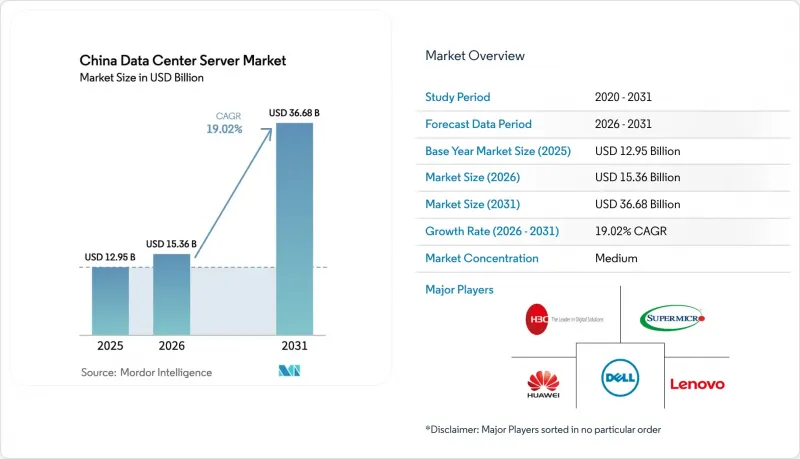
Mordor Intelligence에 의하면, 중국의 데이터센터 서버 시장 규모는 2025년에 129억 5,000만 달러로 평가되었고 2026년 153억 6,000만 달러에서 2031년까지 366억 8,000만 달러에 이를 것으로 예측되며, 예측 기간(2026-2031년)에서 CAGR은 19.02%를 나타낼 전망입니다.
본 보고서는 티어 유형(Tier 1, Tier 2, 기타), 데이터센터 규모(소규모, 중규모, 기타), 데이터센터 유형(코로케이션, 하이퍼스케일러/CSP, 기타), 폼 팩터(하프 하이트 블레이드, 풀 하이트 블레이드, 기타), 용도/워크로드(가상화 및 프라이빗 클라우드, HPC, 기타)별로 분류되어 있습니다. 시장 예측은 금액(달러) 기준으로 제시되어 있습니다.
중국 데이터센터 서버 시장 동향 및 인사이트
AI 및 GPU 가속 워크로드 수요 급증
알리바바의 ‘Tongyi Qianwen’이나 바이두의 ‘ERNIE’와 같은 대규모 언어 모델에는 400 GbE 또는 InfiniBand 패브릭으로 연결된 8-웨이 GPU 노드 클러스터가 필요하며, 이로 인해 일반적인 랙 밀도는 70 kW를 초과합니다. 사업자들은 2025년에 약 100만 개의 Nvidia H20 GPU를 구매할 예정이며, 피크 FLOPS는 감소했지만 처리량을 극대화하기 위해 맞춤형 콜드 플레이트 루프와 결합하고 있습니다. SMIC에서 제조된 화웨이의 ‘Ascend 910B’는 벤치마크 최고 기록보다 공급망 주권을 우선시하는 국영 기업들 사이에서 점유율을 확대되고 있습니다. 산업정보화부의 보고서에 따르면, 2025년 초 지능형 컴퓨팅 장비 도입량은 45% 증가하여 범용 서버 성장률의 3배에 달했습니다. 이러한 추세로 인해 평균 판매 가격이 상승하고 NVMe 스토리지 도입이 가속화되면서 중국 데이터센터 서버 시장 전체의 성장세가 더욱 강화되고 있습니다.
기업 내 클라우드 도입 확대 및 퍼블릭 클라우드 IaaS 지출
중국정보통신기술연구원(CAICT)의 추산에 따르면, 2025년 말까지 기업 워크로드의 38%가 퍼블릭 클라우드 또는 하이브리드 클라우드에서 운영될 것으로 예상되며, 이는 2023년의 29%에서 증가한 수치입니다. 텐센트 클라우드는 2030년까지 톈진, 충칭, 칭위안에 새로운 캠퍼스를 건설하기 위해 100억 달러를 투자하겠다고 약속했으며, 고밀도 섀시에 대한 수요가 급증하고 있습니다. 알리바바 클라우드의 ARM 기반 ‘Yitian 710’ 칩을 탑재한 5세대 ECS 인스턴스는 x86 기반의 이전 세대 모델에 비해 VM당 비용을 20% 절감했습니다. 바이두는 50만 대 이상의 서버를 운영 중이며, 2026년에는 10만 대를 추가로 도입할 계획이므로, 벤더의 성공은 하이퍼스케일 설계 수주 확보에 달려 있습니다. 이러한 집중화로 인해 구매력이 더욱 공고해지면서, 중국 데이터센터 서버 시장 전체에 걸쳐 맞춤형화 추세가 형성되고 있습니다.
Tier 1 허브에서의 고액 설비 투자(CapEx)와 전력·부지 부족
2025년, 베이징 이좡(Yizhuang)과 상하이 링강(Lingang)의 토지 가격은 에이커당 평균 1,500만 위안(210만 달러)에 달했으나, 시의 전력 상한선으로 인해 신규 할당량은 프로젝트당 50MW로 제한되고 있습니다. 선전에서는 PUE가 1.25를 초과하는 시설의 건설이 금지되어 있어, 사실상 액체 냉각이 의무화됨에 따라 초기 비용이 20% 증가하게 됩니다. 각 사업자들은 토지 가격이 3분의 1 수준인 청두나 우한에서 통신 교환국을 개조하거나, 용량을 확보한 후 GPU가 밀집된 클러스터용으로 Tier 1 랙을 확보하고 있습니다. 이러한 양극화된 전략은 물류 복잡성을 가중시키고, 도시 지역으로의 확장을 지연시키며, 중국 데이터센터 서버 시장의 단기 성장 속도를 억제하고 있습니다.
부문 분석
2025년 설치 건수의 71.24%를 Tier 3 시설이 차지하고 있으며, 비용과 99.982%의 가동률 사이의 균형이 높이 평가되고 있습니다. 한편, 금융 기관과 퍼블릭 클라우드 사업자가 AI 훈련 운영을 중단으로부터 보호하기 위해 Tier 4 용량은 연평균 성장률(CAGR) 20.31%로 증가하고 있습니다. 2025년, 중국건설은행은 예기치 않은 중단 없이 분산 원장 결제 워크로드를 호스팅하는 12곳의 Tier 4 사이트를 보고했습니다. 보험사와 병원도 이에 발맞추어 99.995%의 가용성 요건을 충족하고 있습니다. 각 벤더사는 듀얼 패스 패브릭과 모든 구성 요소의 핫스왑 기능을 갖춘 블레이드 플랫폼을 제공하고 있으며, 평균 판매 가격(ASP)은 상승하고 있지만 다운타임으로 인한 손실은 최소화되고 있습니다.
가격에 민감한 중소기업들은 Tier 4 캐비닛보다 약 30% 저렴한 Tier 3 코로케이션 랙을 계속 선호하고 있으며, 이는 단일 공급원의 공랭식 서버에 대한 견고한 업그레이드를 촉진하고 있습니다. 6개월 이내에 납품 가능한 조립식 Tier 3 포드는 중국 소프트웨어 기업의 신속한 반복 개발 문화에 적합합니다. 그 결과, 중국의 데이터센터 서버 시장은 양극화된 구도를 유지하고 있으며, 높은 수익률을 자랑하는 Tier 4 노드가 가장 빠르게 성장하고 있는 반면, 출하 대수의 기반은 여전히 Tier 3가 차지하고 있습니다.
1만 대 이상의 서버를 보유한 하이퍼스케일 캠퍼스는 2025년에 설치 대수의 40.54%를 차지할 것이며, 알리바바 클라우드, 텐센트 클라우드, 바이두 클라우드가 내륙 지역에 새로운 사이트를 추가함에 따라 연평균 성장률(CAGR) 20.14%로 확대되고 있습니다. 알리바바는 2025년에 7곳의 이러한 캠퍼스를 운영할 예정이며, 청두와 우한에 2곳을 추가로 신설할 것이라고 발표했습니다. 각 캠퍼스는 8만 대의 액체 냉각 랙을 수용할 수 있도록 설계되었습니다. 대량 구매를 통해 정가의 최대 30% 할인이 적용되며, 맞춤형 반도체의 공동 설계도 가능해집니다.
대규모(1,000-1만 대) 및 중규모(100-1,000대) 시설은 현지 관리를 중시하는 곳, 하이퍼스케일급 예산을 보유하지 않은 지역의 ISP, 성 정부, 산업 허브에 여전히 필수적입니다. ‘클라우드 퍼스트’ 정책이 정착됨에 따라 소규모 On-Premise 시설은 단계적으로 폐지되고 있으며, 이를 대체할 수요는 공유 시설로 이동하고 있습니다. 그 결과 발생하는 규모의 양극화는 협상력을 집중시키고, 중국 데이터센터 서버 시장의 로드맵을 결정짓고 있습니다.
기타 혜택:
- 엑셀 형식 시장 예측(ME) 시트
- 3개월간의 애널리스트 지원
자주 묻는 질문
목차
제1장 서론
제2장 조사 방법
제3장 개요
제4장 시장 구도
제5장 시장 규모와 성장 예측
제6장 경쟁 구도
제7장 시장 기회와 향후 전망
JHS 26.09.03According to Mordor Intelligence, the China data center server market size was valued at USD 12.95 billion in 2025 and is estimated to grow from USD 15.36 billion in 2026 to reach USD 36.68 billion by 2031, at a CAGR of 19.02% during the forecast period (2026-2031).
This report is Segmented by Tier Type (Tier 1 and 2, and More), Data Center Size (Small, Medium, and More), Data Center Type (Colocation, Hyperscalers/CSPs, and More), Form Factor (Half-Height Blades, Full-Height Blades, and More), Application/Workload (Virtualization and Private Cloud, HPC, and More). Market Forecasts are Provided in Terms of Value (USD).
China Data Center Server Market Trends and Insights
Surge in AI and GPU-Accelerated Workload Demand
Large language models such as Alibaba's Tongyi Qianwen and Baidu's ERNIE require clusters of eight-way GPU nodes linked by 400 GbE or InfiniBand fabrics, pushing typical rack densities above 70 kW. Operators purchased roughly 1 million Nvidia H20 GPUs in 2025, pairing them with custom cold-plate loops to maximize throughput despite lower peak flops. Huawei's Ascend 910B, fabricated at SMIC, is winning share among state-owned enterprises prioritizing supply-chain sovereignty over raw benchmark records. The Ministry of Industry and Information Technology reported a 45% jump in intelligent-computing power installations in early 2025, triple the growth of general-purpose servers. These dynamics lift average selling prices, accelerate adoption of NVMe storage, and magnify the overall momentum of the China data center server market.
Rising Enterprise Cloud Adoption and Public Cloud IaaS Spending
CAICT estimated that 38% of enterprise workloads ran on public or hybrid clouds by end-2025, up from 29% in 2023. Tencent Cloud pledged USD 10 billion through 2030 for new campuses in Tianjin, Chongqing, and Qingyuan, heightening bulk demand for high-density chassis. Alibaba Cloud's fifth-generation ECS instances, powered by ARM-based Yitian 710 chips, trimmed per-VM cost by 20% relative to x86 predecessors. With Baidu operating more than 500,000 servers and planning 100,000 more in 2026, vendor success hinges on securing hyperscale design wins. This concentration further solidifies purchasing power and shapes customization trends across the China data center server market.
High CapEx and Power-Land Scarcity in Tier 1 Hubs
Land in Beijing's Yizhuang and Shanghai's Lingang averaged CNY 15 million (USD 2.1 million) per acre in 2025, while municipal power caps hold new allocations to 50 MW per project. Shenzhen bans builds with PUE above 1.25, effectively mandating liquid cooling and adding 20% to upfront spend. Operators retrofit telecom exchanges or source capacity in Chengdu and Wuhan where land costs one-third as much, then reserve Tier 1 racks for GPU-dense clusters. The bifurcated strategy increases logistical complexity and slows urban expansion, curbing near-term velocity for the China data center server market.
Other drivers and restraints analyzed in the detailed report include:
- Rapid 5G Roll-Out Catalyzing Edge Data Center Expansion
- Government Digital-Infrastructure Incentives and Subsidies
- Export Controls Limiting Access to Cutting-Edge GPUs and CPUs
For complete list of drivers and restraints, kindly check the Table Of Contents.
Segment Analysis
Tier 3 facilities held 71.24% of 2025 installations, underscoring their balance of cost and 99.982% uptime, while Tier 4 capacity is rising at a 20.31% CAGR as finance and public-cloud operators safeguard AI training runs from interruption. In 2025, China Construction Bank reported 12 Tier 4 sites that hosted distributed-ledger settlement workloads without unscheduled outages. Insurance carriers and hospitals follow suit to comply with 99.995% availability mandates. Vendors cater with blade platforms featuring dual-path fabrics and hot-swap everything, elevating ASPs but minimizing downtime penalties.
Price-sensitive SMEs continue to favor Tier 3 colocation racks that cost roughly 30% less than Tier 4 cabinets, fueling resilient refresh for single-supply air-cooled servers. Prefabricated Tier 3 pods, deliverable in six months, suit the rapid iteration culture of Chinese software firms. Consequently, the China data center server market sustains a dual-track mix, where high-margin Tier 4 nodes grow fastest yet Tier 3 still anchors shipment volume.
Hyperscale campuses with more than 10,000 servers commanded 40.54% of installed units in 2025 and are progressing at a 20.14% CAGR as Alibaba Cloud, Tencent Cloud, and Baidu Cloud add greenfield sites inland. Alibaba operated seven such campuses in 2025 and announced two more in Chengdu and Wuhan, each designed for 80,000 liquid-cooled racks. Volume buys secure up to 30% list-price discounts and enable co-design of custom silicon.
Large (1,000-10,000 servers) and medium (100-1,000) facilities remain vital for regional ISPs, provincial governments, and industrial hubs that crave local control but lack hyperscale budgets. Small on-premise rooms are retiring as cloud-first mandates take hold, redirecting replacement demand into shared facilities. The resulting scale polarization concentrates bargaining power and defines roadmaps for the China data center server market.
Complete Report Scope:
- By Tier Type
- Tier 1 and 2
- Tier 3
- Tier 4
- By Data Center Size
- Small Data Center
- Medium Data Center
- Large Data Center
- Hyperscale Data Center
- By Data Center Type
- Colocation Data Center
- Hyperscalers Data Center/CSPs
- Enterprise and Edge Data Center
- By Form Factor
- Half-height Blades
- Full-height Blades
- Quarter-height / Micro-blades
- By Application / Workload
- Virtualisation and Private Cloud
- High-Performance Computing (HPC)
- Artificial Intelligence/Machine Learning and Data Analytics
- Storage-centric
- Edge / IoT Gateways
List of Companies Covered in this Report:
- Dell Technologies Inc.
- Huawei Technologies Co., Ltd.
- Lenovo Group Limited
- New H3C Technologies Co., Ltd.
- Inspur Group (IEIT Systems Co., Ltd.)
- Dawning Information Industry Co., Ltd. (Sugon)
- Super Micro Computer, Inc.
- Hewlett Packard Enterprise Company
- ZTE Corporation (Server Division)
- NVIDIA Corporation (Server Systems)
- Phytium Technology Co., Ltd.
- Hygon Information Technology Co., Ltd.
- Shanghai Zhaoxin Semiconductor Co., Ltd.
- Alibaba Cloud Computing Co., Ltd.
- Tencent Cloud Computing (Beijing) Co., Ltd.
- Baidu Cloud (Baidu Inc.)
- Cambricon Technologies Corporation Limited
- Foxconn Technology Group (Data Center ODM)
- HiSilicon Technologies Co., Ltd.
Additional Benefits:
- The market estimate (ME) sheet in Excel format
- 3 months of analyst support
TABLE OF CONTENTS
1 INTRODUCTION
- 1.1 Study Assumptions and Market Definition
- 1.2 Scope of the Study
2 RESEARCH METHODOLOGY
3 EXECUTIVE SUMMARY
4 MARKET LANDSCAPE
- 4.1 Market Overview
- 4.2 Market Drivers
- 4.2.1 Surge in AI and GPU-Accelerated Workload Demand
- 4.2.2 Rising Enterprise Cloud Adoption and Public Cloud IaaS Spending
- 4.2.3 Rapid 5G Roll-Out Catalyzing Edge Data Center Expansion
- 4.2.4 Government Digital-Infrastructure Incentives and Subsidies
- 4.2.5 Commercialization of Underwater Data Centers for Sustainable Cooling
- 4.2.6 Factory-Integrated Cabinet Delivery Shortening Deployment Lead Times
- 4.3 Market Restraints
- 4.3.1 High CapEx and Power-Land Scarcity in Tier-1 Hubs
- 4.3.2 Export Controls Limiting Access to Cutting-Edge GPUs and CPUs
- 4.3.3 Advanced Packaging Capacity Bottlenecks for AI Server Components
- 4.3.4 Water-Use Restrictions Challenging Liquid-Cooling Scale-Up
- 4.4 Industry Supply-Chain Analysis
- 4.5 Regulatory Landscape
- 4.6 Technological Outlook
- 4.7 Porter's Five Forces Analysis
- 4.7.1 Threat of New Entrants
- 4.7.2 Bargaining Power of Buyers
- 4.7.3 Bargaining Power of Suppliers
- 4.7.4 Threat of Substitutes
- 4.7.5 Intensity of Competitive Rivalry
- 4.8 Assesment of Macroeconomic Factors on the Market
5 MARKET SIZE AND GROWTH FORECASTS (VALUE)
- 5.1 By Tier Type
- 5.1.1 Tier 1 and 2
- 5.1.2 Tier 3
- 5.1.3 Tier 4
- 5.2 By Data Center Size
- 5.2.1 Small Data Center
- 5.2.2 Medium Data Center
- 5.2.3 Large Data Center
- 5.2.4 Hyperscale Data Center
- 5.3 By Data Center Type
- 5.3.1 Colocation Data Center
- 5.3.2 Hyperscalers Data Center/CSPs
- 5.3.3 Enterprise and Edge Data Center
- 5.4 By Form Factor
- 5.4.1 Half-height Blades
- 5.4.2 Full-height Blades
- 5.4.3 Quarter-height / Micro-blades
- 5.5 By Application / Workload
- 5.5.1 Virtualisation and Private Cloud
- 5.5.2 High-Performance Computing (HPC)
- 5.5.3 Artificial Intelligence/Machine Learning and Data Analytics
- 5.5.4 Storage-centric
- 5.5.5 Edge / IoT Gateways
6 COMPETITIVE LANDSCAPE
- 6.1 Market Concentration
- 6.2 Strategic Moves
- 6.3 Market Share Analysis
- 6.4 Company Profiles (Includes Global Level Overview, Market Level Overview, Core Segments, Financials as Available, Strategic Information, Market Rank/Share, Products and Services, and Recent Developments)
- 6.4.1 Dell Technologies Inc.
- 6.4.2 Huawei Technologies Co., Ltd.
- 6.4.3 Lenovo Group Limited
- 6.4.4 New H3C Technologies Co., Ltd.
- 6.4.5 Inspur Group (IEIT Systems Co., Ltd.)
- 6.4.6 Dawning Information Industry Co., Ltd. (Sugon)
- 6.4.7 Super Micro Computer, Inc.
- 6.4.8 Hewlett Packard Enterprise Company
- 6.4.9 ZTE Corporation (Server Division)
- 6.4.10 NVIDIA Corporation (Server Systems)
- 6.4.11 Phytium Technology Co., Ltd.
- 6.4.12 Hygon Information Technology Co., Ltd.
- 6.4.13 Shanghai Zhaoxin Semiconductor Co., Ltd.
- 6.4.14 Alibaba Cloud Computing Co., Ltd.
- 6.4.15 Tencent Cloud Computing (Beijing) Co., Ltd.
- 6.4.16 Baidu Cloud (Baidu Inc.)
- 6.4.17 Cambricon Technologies Corporation Limited
- 6.4.18 Foxconn Technology Group (Data Center ODM)
- 6.4.19 HiSilicon Technologies Co., Ltd.
7 MARKET OPPORTUNITIES AND FUTURE OUTLOOK
- 7.1 White-Space and Unmet-Need Assessment


