|
시장보고서
상품코드
2119837
중동의 사이버 보안 시장 : 점유율 분석, 업계 동향과 통계, 성장 예측(2026-2031년)Middle East Cybersecurity - Market Share Analysis, Industry Trends & Statistics, Growth Forecasts (2026 - 2031) |
||||||
 Mordor Intelligence
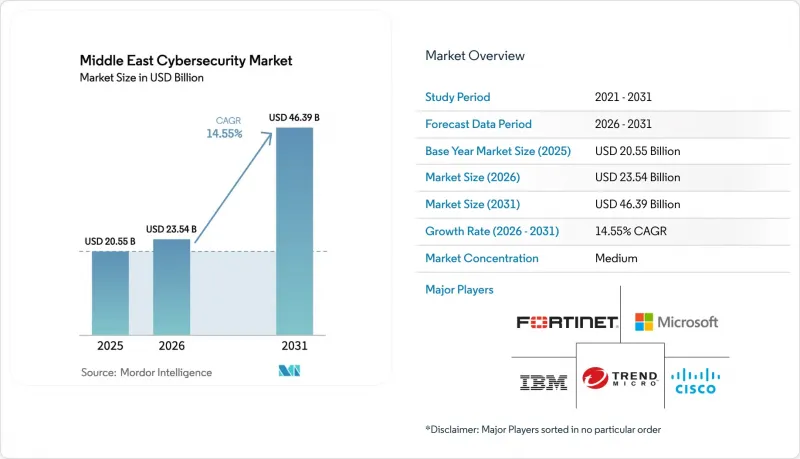
Mordor Intelligence에 의하면, 중동의 사이버 보안 시장 규모는 2025년에 205억 5,000만 달러로 평가되었고 2026년 235억 4,000만 달러에서 2031년까지 463억 9,000만 달러에 이를 것으로 예측되며, 예측 기간(2026-2031년)에서 CAGR은 14.55%를 나타낼 전망입니다.
본 보고서는 제공 형태(솔루션 및 서비스), 도입 형태(On-Premise 및 클라우드), 기업 규모(중소기업 및 대기업), 최종 사용자 산업(은행 및 금융 서비스·보험, 헬스케어 및 생명과학, IT 및 통신, 정부 기관 등) 및 국가별로 분류되어 있습니다. 시장 예측은 금액(달러)으로 표시되어 있습니다.
중동 사이버 보안 시장 동향 및 인사이트
국가 주도의 공격 및 중요 인프라에 대한 공격의 급증
국가 지원 그룹은 지역 전체의 공공 서비스 부문에서 VPN의 취약점을 악용한 ‘레몬 샌드스톰(Lemon Sandstorm)’ 캠페인이 보여주듯이, 일시적인 침입에서 운영 네트워크 내에서 수년에 걸쳐 끈질기게 거점을 확보하는 전략으로 전환하고 있습니다. 이란과 관련된 공격자들은 최대 24개월 동안 비밀리에 접근 권한을 유지해 왔으며, 이는 적대 세력이 시스템 방해 능력 및 장기적인 네트워크 모니터링에 전략적 가치를 두고 있음을 여실히 보여줍니다. 이에 대응하여 각국 정부는 실시간 위협 정보 공유를 강화하고 국경을 초월한 협력을 개선했습니다. 예를 들어, UAE 사이버 보안 위원회와 Group-IB 간의 협정을 통해 15개 관할 구역에 걸친 사고 대응 매뉴얼이 조정되어 사이버 위협의 조기 감지, 차단 및 시정이 촉진되었습니다. 그 결과, 지정학적 긴장이 고조됨에 따라 중동 사이버 보안 시장 전체에서 엔드포인트 강화, OT 가시화 도구 및 포렌식 서비스에 대한 고액 지출이 지속적으로 증가했습니다.
사이버 보안 예산을 의무화하는 정부의 ‘비전’ 프로그램
사우디아라비아, UAE, 카타르에서는 법적 구속력을 지닌 국가 변혁 로드맵을 통해 사이버 보안이 국가 안보의 핵심 우선순위로 자리매김하고 있습니다. 이러한 프로그램을 통해 사이버 보안에 대한 투자는 재량적인 기술 지출에서 공공 기관 및 민간 기업을 불문하고 의무화된 예산 배분으로 전환되고 있습니다. 그 결과, 각 조직은 규제 및 운영 요건을 충족하기 위해 기존에는 선택적이었던 라이선스, 규정 준수 도구,보안 서비스를 강제적인 예산 항목으로 전환하고 있습니다. 2024년 12월에 도입된 사우디아라비아의 규정에서는 규정 준수 위반 시 최대 2,500만 사우디아라비아 리얄(660만 달러)의 벌금이 부과되도록 규정되어 있어, 이로 인해 기업의 설명 책임이 실질적으로 강화되었으며, 수년에 걸친 사이버 보안 조달 파이프라인이 촉진되고 있습니다. UAE는 비석유 GDP의 20%를 AI가 차지하도록 하는 것을 목표로 하고 있으며, 이로 인해 정부 서비스, 기업, 중요 산업 전반에 걸쳐 안전한 디지털 인프라에 대한 수요가 높아졌습니다. 그 결과, 모든 디지털 서비스의 도입은 시작 전에 보안 인증을 받아야 합니다. 이러한 필수 사이버 보안 기준으로 인해 조직은 규정 준수, 모니터링, 위험 관리, 사이버 복원력에 지속적으로 투자해야 하므로, 중동의 사이버 보안 시장은 프로젝트 기반의 지출에서 지속적인 예산 모델로 전환되고 있습니다.
만성적인 인력 부족과 두 자릿수 임금 상승
급속한 디지털화가 숙련된 사이버 보안 전문가공급을 초과하면서, 중동 사이버 보안 시장의 성장을 저해하는 만성적인 인력 부족을 초래했습니다. 사우디아라비아의 전력 회사는 임금을 두 자릿수 비율로 인상했음에도 불구하고 핵심 직책 채용에 어려움을 겪었습니다. 이러한 임금 인상은 운영 비용 증가, 이익률 압박, 사이버 보안 프로젝트 일정 지연을 초래하여 전력 회사가 보안 프로그램을 효율적으로 확대하는 능력을 제한했습니다. 또한, 이 인력 부족은 특히 전문 지식이 필요한 분야에서 중요 인프라 전반에 대한 첨단 솔루션의 적시 도입에도 영향을 미쳤습니다. 대학에서 교육 과정을 확충했음에도 불구하고, AI, 클라우드 보안, 사고 대응에 관한 전문 지식은 여전히 부족하여, 조직이 탄탄한 사이버 보안 체계를 구축하고 시장 성장을 유지하기 어려운 상황입니다.
부문 분석
2025년 중동 사이버 보안 시장 규모에서 솔루션이 52.12%를 차지했으나, 서비스 부문은 2026년부터 2031년까지 연평균 성장률(CAGR) 18.45%를 나타낼 것으로 예측됩니다. 기업들이 사고 대응형 아웃소싱에서 벗어나 플랫폼 중심의 예방 모델을 점점 더 많이 채택함에 따라, 서비스 매출은 솔루션 매출보다 빠른 속도로 확대되고 있습니다. 이러한 변화는 예방적 사이버 보안 관리, 지속적인 모니터링 및 통합 방어 역량에 대한 광범위한 노력을 반영합니다. 클라우드 보안 태세 관리, 용도 보호 및 ID 오케스트레이션에 대한 수요는 여전히 집중되어 있으며, 이러한 기능들은 기업 환경 전반에 걸친 제로 트러스트 정책 도입을 뒷받침하고 있습니다. 또한, 주목을 끄는 인프라 침해 사건으로 인해 조직이 위협의 신속한 식별과 대응을 우선시함에 따라, 실시간 가시화 도구 및 이상 감지 엔진을 조달 계획에 포함시키는 움직임이 가속화되고 있습니다.
동시에, 전문 서비스 팀은 특히 보안 대책 및 규제 대응 준비 상태에 대한 외부 검증이 필요한 조직을 대상으로, 규정 준수 감사 및 레드팀 활동과 같은 전문적인 틈새 분야를 계속해서 다루고 있습니다. 그러나 대규모 고객들이 보안 프로세스, 데이터 가시성, 사고 대응에 대한 관리를 강화하기 위해 보안 운영 센터(SOC)의 사내화를 추진하는 경향이 강해짐에 따라, 매니지드 보안 계약은 가격 측면에서 압박을 받고 있습니다. Corgea와 같은 AI 네이티브 벤더는 아랍어 코드베이스에 적응한 자동화된 취약점 분류 엔진을 개발하기 위해 260만 달러를 조달했습니다. 이는 솔루션 파이프라인을 강화하고, 더욱 자동화되고 컨텍스트를 인식하는 사이버 보안 기능으로 시장 전환을 뒷받침하는 혁신을 부각시키고 있습니다.
2025년 중동 사이버 보안 시장에서 클라우드 워크로드는 73.06%를 차지하며, 2031년까지 연평균 성장률(CAGR) 18.32%로 성장할 것으로 전망됩니다. GCC(걸프협력회의) 회원국의 각 부처는 시민 서비스 현대화, 업무 효율성 향상, 디지털 서비스 제공 강화를 위해 ‘클라우드 퍼스트’ 정책을 채택하고 있습니다. 이러한 변화에 따라 공공 부문과 기업들이 안전한 액세스,데이터 보호, 확장 가능한 클라우드 운영을 우선시함에 따라 SASE 및 워크로드 암호화 게이트웨이의 도입이 확대되고 있습니다. 현재 기밀 컴퓨팅 솔루션은 조직이 규제 요건을 충족하면서도 클라우드 인프라의 비용 효율성과 확장성 이점을 유지할 수 있도록 지원하는 하드웨어 기반 제어 기능을 제공합니다.
On-Premise 배포는 조직이 엄격한 데이터 분류, 주권 및 보안 요건을 준수해야 하는 핵심 뱅킹 및 국방 네트워크 분야에서 여전히 선호되는 모델입니다. 또한, 금융 기관이 규제 준수 및 고급 디지털 기능에 대한 필요성 사이의 균형을 맞추는 과정에서 하이브리드 모델도 점차 보급되고 있습니다. 사우디아라비아의 한 은행은 현재 은행 간 블록체인 송금을 로컬 노드를 통해 처리하는 한편, 분석 워크로드를 소버린 클라우드에 저장하고 있습니다. 이러한 듀얼 스택 접근 방식을 통해 중요한 데이터 거주 요건을 보호하는 동시에, AI를 활용한 부정 행위 감시, 고속 분석, 그리고 탄력적인 클라우드 환경에서의 보다 유연한 운영이 가능해집니다.
기타 혜택:
- 엑셀 형식 시장 예측(ME) 시트
- 3개월간의 애널리스트 지원
자주 묻는 질문
목차
제1장 서론
제2장 조사 방법
제3장 개요
제4장 시장 구도
제5장 시장 규모와 성장 예측
제6장 경쟁 구도
제7장 시장 기회와 향후 전망
JHS 26.09.03According to Mordor Intelligence, the Middle East cybersecurity market size was valued at USD 20.55 billion in 2025 and estimated to grow from USD 23.54 billion in 2026 to reach USD 46.39 billion by 2031, at a CAGR of 14.55% during the forecast period (2026-2031).
This report is Segmented by Offerings (Solutions, and Services), Deployment (On-Premise, and Cloud), Organization Size (Small and Medium Enterprises, and Large Enterprises), End-User Industry (Banking, Financial Services, and Insurance, Healthcare and Life Sciences, IT and Telecommunication, Government, and More), and Country. The Market Forecasts are Provided in Terms of Value (USD).
Middle East Cybersecurity Market Trends and Insights
Surge in Nation-State and Critical-Infrastructure Attacks
State-sponsored groups have shifted from smash-and-grab intrusions to patient, multi-year footholds in operational networks, as illustrated by the Lemon Sandstorm campaign that exploited VPN flaws across regional utilities. Iranian-linked actors maintained covert access for up to 24 months, highlighting the strategic value that adversaries placed on disruption capabilities and long-term network surveillance. In response, governments strengthened real-time threat intelligence exchanges and improved cross-border coordination. For instance, the UAE Cyber Security Council's pact with Group-IB coordinated incident response playbooks across 15 jurisdictions, supporting faster detection, containment, and remediation of cyber threats. As a result, heightened geopolitical tensions continued to drive premium spending on endpoint hardening, OT visibility tools, and forensics services across the Middle East cybersecurity market.
Government "Vision" Programmes Mandating Cyber Budgets
Legally binding national transformation roadmaps in Saudi Arabia, the UAE, and Qatar have positioned cybersecurity as a core national security priority. These programs are moving cybersecurity investments from discretionary technology spending to mandated budget allocations across public and private entities. As a result, organizations are converting previously optional licenses, compliance tools, and security services into enforceable budget line items to meet regulatory and operational requirements. Saudi regulations introduced in December 2024 stipulated penalties of up to SAR 25 million (USD 6.60 million) for non-compliance, effectively strengthening enterprise accountability and supporting multi-year cybersecurity procurement pipelines. The UAE targeted AI to contribute 20% to non-oil GDP, which increased the need for secure digital infrastructure across government services, enterprises, and critical industries. Consequently, every digital service rollout must undergo security accreditation before launch. These mandatory cybersecurity baselines are shifting the Middle East cybersecurity market from project-based spending to a recurring budget model, as organizations must continuously invest in compliance, monitoring, risk management, and cyber resilience.
Persistent Talent Gap and Double-Digit Wage Inflation
Rapid digitalization outpaced the supply of skilled cybersecurity professionals, creating a persistent talent gap that challenged the growth of the Middle East cybersecurity market. Power utilities in Saudi Arabia struggled to fill key roles, even as they raised salaries at double-digit rates. This wage inflation increased operating costs, compressed margins, and delayed cybersecurity project timelines, limiting utilities' ability to scale security programs efficiently. The shortage also affected the timely deployment of advanced solutions across critical infrastructure, particularly in areas requiring specialized expertise. Although universities expanded their course offerings, expertise in AI, cloud security, and incident response remained scarce, making it difficult for organizations to build resilient cybersecurity capabilities and sustain market growth.
Other drivers and restraints analyzed in the detailed report include:
- Cloud-First and SaaS Adoption Across GCC Public Sector
- AI-Driven Security Analytics Lowering MTTR
- Fragmented Data-Sovereignty Laws Across GCC and Levant
For complete list of drivers and restraints, kindly check the Table Of Contents.
Segment Analysis
Solutions accounted for 52.12% of the Middle East cybersecurity market size in 2025, while services are forecast to register a CAGR of 18.45% during 2026-2031. Services revenue is expanding at a faster pace than solutions revenue as enterprises move away from incident-driven outsourcing and increasingly adopt platform-centric prevention models. This shift reflects a broader focus on proactive cybersecurity management, continuous monitoring, and integrated defense capabilities. Demand remains concentrated in cloud security posture management, application shielding, and identity orchestration, as these capabilities support the implementation of zero-trust policies across enterprise environments. High-profile infrastructure breaches have also accelerated the inclusion of real-time visibility tools and anomaly-detection engines in procurement plans, as organizations prioritize faster threat identification and response.
At the same time, professional services teams continue to address a specialized niche in compliance audits and red-teaming, particularly among organizations that require external validation of security controls and regulatory readiness. However, managed security contracts face pricing pressure as larger customers increasingly insource security operations centers to gain greater control over security processes, data visibility, and incident response. AI-native vendors, such as Corgea, secured USD 2.6 million to develop automated vulnerability-triage engines adapted to Arabic-language code bases, underscoring the innovation now strengthening the solutions pipeline and supporting the market's shift toward more automated and context-aware cybersecurity capabilities.
Cloud workloads accounted for 73.06% of the Middle East cybersecurity market in 2025 and are projected to grow at a 18.32% CAGR through 2031. GCC ministries have adopted "cloud-first" charters to modernize citizen services, improve operational efficiency, and strengthen digital service delivery. This shift has increased the adoption of SASE and workload-encryption gateways, as public-sector entities and enterprises prioritize secure access, data protection, and scalable cloud operations. Confidential computing options now offer hardware-based controls that help organizations meet regulatory requirements while retaining the cost and scalability benefits of cloud infrastructure.
On-premises deployments remain the preferred model for core banking and defense networks, where organizations must comply with stringent data classification, sovereignty, and security requirements. Hybrid models are also gaining traction as institutions balance regulatory compliance with the need for advanced digital capabilities. Saudi banks now route interbank blockchain transfers through local nodes while storing analytics workloads in sovereign clouds. This dual-stack approach protects critical data residency requirements while enabling AI-driven fraud monitoring, faster analytics, and more flexible operations in elastic cloud environments.
Complete Report Scope:
- By Offering
- Solutions
- Application Security
- Cloud Security
- Data Security
- Identity and Access Management
- Infrastructure Protection
- Integrated Risk Management
- Network Security Equipment
- Endpoint Security
- Services
- Professional Services
- Managed Services
- Solutions
- By Deployment Mode
- Cloud
- On-premise
- By Organization Size
- Small and Medium Enterprises (SMEs)
- Large Enterprises
- By End-User Industry
- Banking, Financial Services, and Insurance (BFSI)
- Healthcare and Life Sciences
- IT and Telecommunication
- Government and Public Administration
- Retail and E-Commerce
- Energy and Utilities
- Industrial Manufacturing
- Other End-User Industries
- By Country
- Saudi Arabia
- United Arab Emirates
- Qatar
- Kuwait
- Bahrain
- Rest of Middle East
List of Companies Covered in this Report:
- IBM Corporation
- Cisco Systems Inc.
- Fortinet Inc.
- Microsoft Corporation
- Trend Micro Incorporated
- Palo Alto Networks Inc.
- Check Point Software Technologies Ltd.
- Broadcom Ltd. (Symantec)
- Dell Technologies Inc.
- Intel Corporation
- McAfee LLC
- Huawei Technologies Co. Ltd.
- Zscaler Inc.
- DarkMatter Group
- Help AG (e&)
- CPX Holding (UAE)
- StarLink ME
- Cyway LLC
- BAE Systems AI
- Kaspersky Lab
Additional Benefits:
- The market estimate (ME) sheet in Excel format
- 3 months of analyst support
TABLE OF CONTENTS
1 INTRODUCTION
- 1.1 Study Assumptions and Market Definition
- 1.2 Scope of the Study
2 RESEARCH METHODOLOGY
3 EXECUTIVE SUMMARY
4 MARKET LANDSCAPE
- 4.1 Market Overview
- 4.2 Market Drivers
- 4.2.1 Surge in Nation-State and Critical-Infrastructure Attacks
- 4.2.2 Government Vision Programs Mandating Cyber Budgets
- 4.2.3 Cloud-First and SaaS Adoption Across GCC Public Sector
- 4.2.4 AI-driven Security Analytics Lowering MTTR
- 4.2.5 Merger and Acquisition (M&A) Wave Mmong Local MSSPs Creating Bundled Offerings
- 4.2.6 Oil-and-Gas OT Retrofit to Zero-Trust Architectures
- 4.3 Market Restraints
- 4.3.1 Persistent Talent Gap and Double-digit Wage Inflation
- 4.3.2 Fragmented Data-Sovereignty Laws Across GCC and Levant
- 4.3.3 Legacy Air-gapped SCADA Slowing OT Security Upgrades
- 4.3.4 Shadow-IT Growth in SME Supply Chains
- 4.4 Regulatory Landscape
- 4.5 Technological Outlook
- 4.6 Porter's Five Forces Analysis
- 4.6.1 Threat of New Entrants
- 4.6.2 Bargaining Power of Suppliers
- 4.6.3 Bargaining Power of Buyers
- 4.6.4 Threat of Substitutes
- 4.6.5 Intensity of Competitive Rivalry
- 4.7 Impact of Macroeconomic Factors on the Market
- 4.8 Industry Value-Chain Analysis
5 MARKET SIZE AND GROWTH FORECASTS (VALUE)
- 5.1 By Offering
- 5.1.1 Solutions
- 5.1.1.1 Application Security
- 5.1.1.2 Cloud Security
- 5.1.1.3 Data Security
- 5.1.1.4 Identity and Access Management
- 5.1.1.5 Infrastructure Protection
- 5.1.1.6 Integrated Risk Management
- 5.1.1.7 Network Security Equipment
- 5.1.1.8 Endpoint Security
- 5.1.2 Services
- 5.1.2.1 Professional Services
- 5.1.2.2 Managed Services
- 5.1.1 Solutions
- 5.2 By Deployment Mode
- 5.2.1 Cloud
- 5.2.2 On-premise
- 5.3 By Organization Size
- 5.3.1 Small and Medium Enterprises (SMEs)
- 5.3.2 Large Enterprises
- 5.4 By End-User Industry
- 5.4.1 Banking, Financial Services, and Insurance (BFSI)
- 5.4.2 Healthcare and Life Sciences
- 5.4.3 IT and Telecommunication
- 5.4.4 Government and Public Administration
- 5.4.5 Retail and E-Commerce
- 5.4.6 Energy and Utilities
- 5.4.7 Industrial Manufacturing
- 5.4.8 Other End-User Industries
- 5.5 By Country
- 5.5.1 Saudi Arabia
- 5.5.2 United Arab Emirates
- 5.5.3 Qatar
- 5.5.4 Kuwait
- 5.5.5 Bahrain
- 5.5.6 Rest of Middle East
6 COMPETITIVE LANDSCAPE
- 6.1 Market Concentration
- 6.2 Strategic Moves
- 6.3 Market Share Analysis
- 6.4 Company Profiles (includes Global-level Overview, Market-level Overview, Core Segments, Financials, Strategic Info, Market Rank/Share, Products and Services, Recent Developments)
- 6.4.1 IBM Corporation
- 6.4.2 Cisco Systems Inc.
- 6.4.3 Fortinet Inc.
- 6.4.4 Microsoft Corporation
- 6.4.5 Trend Micro Incorporated
- 6.4.6 Palo Alto Networks Inc.
- 6.4.7 Check Point Software Technologies Ltd.
- 6.4.8 Broadcom Ltd. (Symantec)
- 6.4.9 Dell Technologies Inc.
- 6.4.10 Intel Corporation
- 6.4.11 McAfee LLC
- 6.4.12 Huawei Technologies Co. Ltd.
- 6.4.13 Zscaler Inc.
- 6.4.14 DarkMatter Group
- 6.4.15 Help AG (e&)
- 6.4.16 CPX Holding (UAE)
- 6.4.17 StarLink ME
- 6.4.18 Cyway LLC
- 6.4.19 BAE Systems AI
- 6.4.20 Kaspersky Lab
7 MARKET OPPORTUNITIES AND FUTURE OUTLOOK
- 7.1 White-space and Unmet-need Assessment