

|
시장보고서
상품코드
2119900
결제 오케스트레이션 플랫폼 : 시장 점유율 분석, 업계 동향과 통계, 성장 예측(2026-2031년)Payment Orchestration Platform - Market Share Analysis, Industry Trends & Statistics, Growth Forecasts (2026 - 2031) |
||||||
 Mordor Intelligence
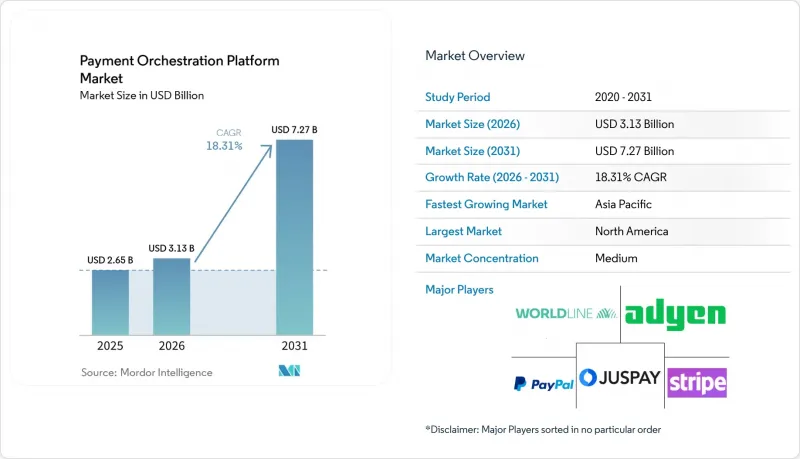
Mordor Intelligence에 따르면 결제 오케스트레이션 플랫폼 시장 규모는 2025년 26억 5,000만 달러에서 2026년에는 31억 3,000만 달러로 확대하며, 2026-2031년에 CAGR 18.31%로 추이하며, 2031년에는 72억 7,000만 달러에 달할 것으로 예측됩니다.
이 보고서는 유형별(B2B, B2C, C2C), 배포 방식별(클라우드형, 온프레미스/프라이빗 클라우드), 조직 규모별(대기업, 중소기업), 최종사용자 산업별(BFSI, 소매·E-Commerce 등) 및 지역별로 분류되어 있습니다. 시장 예측은 금액(달러)으로 표시되어 있습니다.
글로벌 결제 오케스트레이션 플랫폼 시장의 동향 및 인사이트
국경을 넘는 E-Commerce 송금에서 B2B의 우위
국경을 넘는 B2B 결제 거래액은 2028년까지 40% 증가할 것으로 예상되며, 이는 다중 통화 결제, 현지 규정 준수, 블록체인을 활용한 결제 경로를 동시에 처리할 수 있는 오케스트레이션 레이어의 채택을 촉진하고 있습니다. 스테이블코인은 2024년에 32조 달러의 거래액을 기록하여 전 세계 국경을 넘는 자금 흐름의 20%에 달할 것으로 예상되며, 토큰화된 유동성을 통합한 플랫폼을 위해 60조 달러 규모의 잠재적 시장 기회를 창출하고 있습니다. 마스터카드나 J.P. 모건 등 대형 금융기관들은 B2B 사용 사례를 목적으로 상호 운용 가능한 블록체인 코리도(corridor)에 대한 실증 실험을 진행 중이며, 이는 오케스트레이션 로직이 법정화폐와 온체인 결제 경로를 모두 고려해야 함을 시사합니다. 거래액이 증가함에 따라 기업은 일관된 KYC(신원 확인) 및 제재 심사를 실시하면서, 카드, 계좌 간, 암호화폐 채널에 걸친 라우팅을 최적화할 수 있는 통합 관리 지점을 모색하고 있습니다.
아시아의 급성장 중인 핀테크 가맹점에서 스마트 라우팅 수요 급증
아시아의 가맹점들은 AI 기반 라우팅 엔진을 도입한 후 승인률이 최소 20% 향상되었다고 보고하고 있으며, 이 지표는 수익 증가로 직결됩니다. 일본의 E-Commerce 시장만 해도 2032년까지 2,300억 달러에서 6,500억 달러로 성장할 것으로 예측되며, 이에 따라 현지 결제 방식, 글로벌 카드 및 대체 결제 수단 간을 밀리초 단위로 전환할 수 있는 오케스트레이션 파트너에 대한 수요가 높아지고 있습니다. Nuvei의 Paywiser Japan 인수는 주요 결제 네트워크에 대한 직접적인 아쿠아이어링 연결을 실현하는 것으로, 제공업체가 급증하는 아시아의 거래량을 확보하기 위해 연결 환경을 현지화하고 있는 실제 사례를 보여줍니다. 2026년까지 일본의 온라인 구매자 수가 1억 명을 넘어설 것으로 예상되는 가운데, 거래 수준 데이터를 학습하여 실시간으로 결제 경로를 재설정하는 능력은 전환율 향상을 목표로 하는 가맹점에게 경영진 차원의 최우선 과제가 되고 있습니다.
서차지 및 인터체인지 수수료 상한선이 오케스트레이터의 처리업체 마진을 압박
EU의 MIF 규제에 따라 신용카드 인터체인지 수수료는 0.3%, 직불카드는 0.2%로 상한이 설정되어, 발행사의 수익에서 매년 50억-60억 유로(55억-66억 달러)가 감소하고 있습니다. 프로세서가 경쟁을 지속하기 위해 수수료를 인하하는 가운데, 변동 베이스포인트 스프레드로 수익을 얻는 오케스트레이션 플랫폼은 이익률 압박에 직면하고 있습니다. 미국 의회가 ‘신용카드 경쟁법’ 제정을 위해 병행하여 움직이고 있는 만큼, 북미에서도 유사한 수수료 압박이 발생할 가능성이 있습니다. 수수료율 하락에 직면한 각 오케스트레이터 기업은 승인율 향상, 부정 사용으로 인한 손실 감소, 혹은 운전 자본 절감을 기반으로 한 성과 연동형 가격 책정으로 전환을 모색하고 있지만, 이러한 모델에는 고도화된 분석 기술에 대한 투자가 필요하며, 이는 고정비 증가로 이어집니다.
부문 분석
2025년, B2B 거래는 결제 오케스트레이션 플랫폼 시장 점유율의 54.40%를 차지하며, 이는 기업이 다중 통화 및 다중 아쿠이리어와의 거래 관계를 합리화해야 할 필요성을 반영합니다. B2B 비현금 결제가 전년 대비 14%라는 높은 성장률을 보이고 있는 것은 라이선스 갱신의 지속과 기능 도입의 확대로 이어지고 있으며, 결제 오케스트레이션 플랫폼 시장이 기업 분야에서 강력한 입지를 유지할 것임을 보장하고 있습니다. 마스터카드와 J.P. 모건이 진행한 블록체인 상호운용성 시범 프로젝트는 주요 금융 부문이 현재 오케스트레이터에게 기존 결제 인프라와 토큰화된 유동성의 조화를 기대하고 있음을 시사합니다.
대조적으로, B2C 분야의 도입은 디지털 E-Commerce 사업자들이 마찰 없는 결제 프로세스와 승인률 향상을 추구하는 가운데 연평균 성장률(CAGR) 21.63%로 가속화되고 있습니다. 소비자 단말기에서는 생체 인증, 원클릭 토큰 지갑, 장바구니내 할부 결제 옵션에 대한 수요가 증가하고 있으며, 이 모든 요소가 라우팅 로직을 복잡하게 만들고 있습니다. C2C 거래량은 여전히 틈새 영역에 머물러 있지만, 긱 경제에서의 결제 및 소셜 커머스의 단체 구매가 부상함에 따라 오케스트레이터들은 보다 범용적인 API 세트를 제공하기 위해 나아가고 있습니다. 비즈니스 흐름과 소비자 흐름을 모두 단일 분석 계층 아래에서 통합할 수 있는 제공업체는 추가 모듈의 교차 판매 및 고객 유지율 향상 측면에서 가장 유리한 입장에 있습니다.
클라우드 기반 서비스는 2025년에 결제 오케스트레이션 플랫폼 시장 규모의 77.20%를 차지하며, 연평균 성장률(CAGR) 19.68%로 더욱 확대될 전망입니다. 가맹점들은 Akurateco가 제공하는 450개 이상의 커넥터가 사내 IT 부담을 늘리지 않으면서 지속적으로 업데이트되는 ‘단일 통합 모델’을 높이 평가하고 있습니다. 모듈식 마이크로서비스를 통해 기능을 켜고 끌 수 있게 되어, 가맹점은 플랫폼 전체를 재구축하지 않고도 AI 라우팅이나 네트워크 토큰화를 테스트하고 그 효과를 검증할 수 있습니다.
정부 기관의 결제나 대형 은행 등 규제가 엄격한 업계에서는 온프레미스나 프라이빗 클라우드 배포이 여전히 이어지고 있지만, 동향으로는 중요한 암호화 모듈을 기업의 방화벽 내에 유지하면서 라우팅 인텔리전스를 클라우드 클러스터에 아웃소싱하는 하이브리드 아키텍처가 주류를 이루고 있습니다. 현재 주요 하이퍼스케일러 각사에서 이용 가능한 클라우드 기반 하드웨어 보안 모듈(HSM)은 감사인의 우려를 해소하고 전환을 가속화합니다. 그 결과, ‘클라우드 퍼스트’ 전략으로 시장에 진입한 신규 사업자는 시장 출시 기간을 단축할 수 있는 이점을 누리는 반면, 기존 결제 처리 업체들은 경쟁력을 유지하기 위해 컨테이너화된 구성 요소에 대응해야 하는 압박을 받고 있습니다.
지역별 분석
북미는 E-Commerce의 높은 성숙도, 토큰의 광범위한 채택, 그리고 적응형 라우팅 로직이 필요한 FedNow와 같은 실시간 결제 시스템에 힘입어 2025년에는 결제 오케스트레이션 플랫폼 시장 점유율의 37.70%를 차지하며 선두 자리를 유지할 전망입니다. ‘신용카드 경쟁법’과 같은 입법안은 인터체인지 수수료의 역학을 완전히 바꿀 가능성이 있으며, 가맹점은 네트워크 비용을 조정하기 위해 오케스트레이션에 대한 의존도를 더욱 높여야 할 것입니다. Stripe, PayPal 및 지역 신생 기업은 AI 기반 의사결정 엔진에 연구개발(R&D)을 집중하고 있습니다. 예를 들어 PayPal은 2024년에 총 결제 처리액 1조 6,800억 달러를 처리했으며, 이는 승인률이 소폭 상승하는 것만으로도 얼마나 큰 수익으로 이어지는지를 여실히 보여줍니다.
아시아태평양은 2026-2031년까지 19.95%라는 가장 높은 연평균 성장률(CAGR)을 기록할 것으로 예상되며, 향후 10년 말에는 북미의 거래량에 필적할 것으로 보입니다. 인도의 UPI는 실시간 소액 결제를 정착시켰으며, 2028년까지 국경 간 실시간 송금이 결제 흐름의 42%에 달할 것으로 전망됩니다. 이 지역 기업의 97% 이상이 MSME(중소·영세 기업)이며, 이 부문에서는 지역에 최적화된 결제 수용 기능과 내장형 대출을 패키지로 묶은 오케스트레이터에 의한 서비스 제공이 확대되고 있습니다. Nuvei 등 아세안 및 일본에서 사업을 확장하고 있는 제공업체들은 국내 구매 행태에 부합하는 다이렉트 어퀴어링 및 대체 결제 수단을 중시하고 있습니다.
유럽에서는 PSD3 및 결제 서비스 규제에 대한 대응이 과제로 대두되고 있습니다. 이 모든 것은 오픈 파이낸스를 추진하는 한편, 책임 범위를 확대하는 것입니다. 최근 어퀴어러 간의 합병에 따라 가맹점의 폴백 라우팅에 대한 수요가 급증하면서, 중견 소매업체를 대상으로 한 결제 오케스트레이션 플랫폼 시장의 침투가 더욱 가속화되고 있습니다. 오픈 뱅킹 주도의 계좌 간 결제는 카드 결제 점유율의 일부를 대체할 것으로 예상되며, 이에 따라 오케스트레이터는 카드 결제와 은행 결제 양측에서 리스크 모델링의 조화를 도모해야 할 필요성에 직면해 있습니다. 라틴아메리카에서는 브라질의 PIX 성공을 원동력으로, 실시간 지불 지시를 원활한 국경 간 결제로 전환할 수 있는 오케스트레이터에 대한 수요가 높아지고 있습니다. 마지막으로 중동 및 아프리카는 아직 발전 단계에 있지만, 규제 당국이 핀테크 샌드박스 및 국내 즉시 결제 체계를 구축하고 있으며, 두 자릿수 성장을 보이고 있습니다.
기타 혜택:
- 엑셀 형식의 시장 예측(ME) 시트
- 3개월간의 애널리스트 지원
자주 묻는 질문
목차
제1장 서론
제2장 조사 방법
제3장 개요
제4장 시장 구도
제5장 시장 규모와 성장 예측
제6장 경쟁 구도
제7장 시장 기회와 향후 전망
KSA 26.09.02According to Mordor Intelligence, the payment orchestration platform market size is expected to grow from USD 2.65 billion in 2025 to USD 3.13 billion in 2026, and is forecast to reach USD 7.27 billion by 2031, at an 18.31% CAGR over 2026-2031.
This report is Segmented by Type (B2B, B2C, C2C), Deployment Mode (Cloud-Based, On-Premise / Private Cloud), Organization Size (Large Enterprises, Smes), End-User Industry (BFSI, Retail and E-Commerce, and More), and Geography. The Market Forecasts are Provided in Terms of Value (USD).
Global Payment Orchestration Platform Market Trends and Insights
B2B Dominance in Cross-border E-commerce Remittances
Cross-border B2B payment value is set to climb 40% by 2028, fueling adoption of orchestration layers that can juggle multi-currency settlement, local compliance and blockchain-enabled rails. Stablecoins moved USD 32 trillion in 2024 and are on track to reach 20% of global cross-border flows, creating a USD 60 trillion addressable opportunity for platforms that embed tokenised liquidity. Major institutions such as Mastercard and J.P. Morgan are piloting interoperable blockchain corridors aimed at B2B use cases, signalling that orchestration logic must now account for both fiat and on-chain rails. As transaction values rise, enterprises seek centralised control points that can optimise routing across card, account-to-account and crypto channels while enforcing consistent KYC and sanction screening.
Surge in Smart-Routing Demand Among High-Growth Fin-Tech Merchants in Asia
Asian merchants report at least a 20% uplift in approval rates after deploying AI-driven routing engines, a metric that directly converts into revenue gains. Japan's e-commerce market alone is forecast to grow from USD 230 billion to USD 650 billion by 2032, driving demand for orchestration partners that can switch between local schemes, global cards and alternative payment methods in milliseconds. Nuvei's acquisition of Paywiser Japan delivers direct acquiring links to major schemes, illustrating how providers are localising connectivity to capture escalating Asian volumes. With online buyers in Japan set to surpass 100 million by 2026, the capacity to learn from transaction-level data and re-route payments in real time becomes a board-level priority for merchants targeting conversion gains.
Surcharging and Interchange-Fee Caps Diluting Processor Margins for Orchestrators
The EU's MIF Regulation caps credit-card interchange at 0.3% and debit at 0.2%, stripping EUR 5-6 billion (USD 5.5-6.6 billion) in issuer revenue each year. As processors compress fees to stay competitive, orchestration platforms that earn variable basis-point spreads face margin squeeze. Parallel moves by the US Congress to advance the Credit Card Competition Act could replicate fee pressure in North America. Faced with diminished take rates, orchestrators are pivoting to outcome-based pricing anchored on approval-rate improvement, fraud loss reduction or working-capital savings, yet such models demand sophisticated analytics investments that raise fixed costs.
Other drivers and restraints analyzed in the detailed report include:
- Consolidation of Acquirer Landscape in Europe Driving Need for Vendor-Neutral Orchestration
- Token-Based Network Expansion Boosting Multi-PSP Integration
- EU PSD3/PSR Draft Heightening Liability for Technical Service Providers
For complete list of drivers and restraints, kindly check the Table Of Contents.
Segment Analysis
B2B flows accounted for 54.40% of payment orchestration platform market share in 2025, reflecting enterprises' need to rationalise multi-currency, multi-acquirer relationships. Elevated B2B non-cash growth at 14% year-on-year is translating into sustained license renewals and broader feature uptake, ensuring the payment orchestration platform market retains a strong corporate footprint. Blockchain interoperability pilots by Mastercard and J.P. Morgan signal that large treasuries now expect orchestrators to harmonise traditional rails with tokenised liquidity.
B2C implementations, in contrast, accelerate at 21.63% CAGR as digital merchants chase frictionless checkout and higher authorisation rates. Consumer endpoints increasingly demand biometric authentication, one-click token wallets and split-payment options at cart, all of which intensify routing logic. While C2C volumes remain niche, the rise of gig-economy payouts and social-commerce group purchases nudges orchestrators toward more versatile API sets. Providers that can contextualise both business and consumer flows under one analytics layer are best positioned to cross-sell additional modules and cement client stickiness.
Cloud delivery secured 77.20% of the payment orchestration platform market size in 2025 and is forecast to rise further on a 19.68% CAGR. Merchants value the single-integration model where 450-plus connectors, as offered by Akurateco, are perpetually updated without internal IT lift. Modular microservices enable feature toggling, letting merchants test-and-learn AI routing or network tokenisation without full platform re-writes.
On-premise and private-cloud instances persist in regulated verticals such as government payments and top-tier banking, yet the trend line favours hybrid architectures that retain key encryption modules behind the corporate firewall while outsourcing routing intelligence to cloud clusters. Cloud-based Hardware Security Modules, now available across the major hyperscalers, soften auditor concerns and accelerate migration. Consequently, cloud-first newcomers enjoy time-to-market advantages, while legacy processors must retrofit containerised components to sustain relevance.
Complete Report Scope:
- By Type
- B2B
- B2C
- C2C
- By Deployment Mode
- Cloud-Based
- On-Premise / Private Cloud
- By Organization Size
- Large Enterprises
- SMEs
- By End-user Industry
- BFSI
- Retail and E-commerce
- Travel and Hospitality
- Healthcare
- Other End-user Industries
- By Geography
- North America
- United States
- Canada
- Mexico
- Europe
- United Kingdom
- Germany
- France
- Italy
- Rest of Europe
- Asia Pacific
- China
- Japan
- India
- South Korea
- Rest of Asia Pacific
- South America
- Brazil
- Argentina
- Rest of South America
- Middle East
- United Arab Emirates
- Saudi Arabia
- Rest of Middle East
- Africa
- South Africa
- Rest of Africa
- North America
Geography Analysis
North America leads with 37.70% of payment orchestration platform market share in 2025, driven by advanced e-commerce maturity, widespread token adoption and real-time rails such as FedNow that necessitate adaptive routing logic. Legislative proposals like the Credit Card Competition Act could reshape interchange dynamics, compelling merchants to lean harder on orchestration to arbitrate network costs. Stripe, PayPal and regional upstarts funnel R&D into AI-based decision engines; PayPal, for instance, processed USD 1.68 trillion in total payment volume during 2024, underscoring the scale on which incremental approval gains translate into sizeable revenue.
Asia-Pacific posts the fastest CAGR at 19.95% for 2026-2031 and is on track to rival North American volume by decade-end. India's UPI has normalised instant micro-payments, with cross-border instant transfers tipped to reach 42% of flows by 2028. Over 97% of enterprises in the region are MSMEs, a segment increasingly serviced by orchestrators that bundle localised acceptance and embedded financing. Providers expanding across ASEAN and Japan, such as Nuvei, emphasise direct acquiring and alternative payments that resonate with domestic buyer behaviour.
Europe wrestles with PSD3 and the Payment Services Regulation, both of which broaden liability while promoting open finance. Merchant appetite for fallback routing soared after recent acquirer mergers, furthering the payment orchestration platform market's penetration among mid-tier retailers. Open-banking-driven account-to-account checkouts are projected to displace a share of card volume, pushing orchestrators to harmonise risk modelling across card and bank rails. Latin America, powered by Brazil's PIX success, witnesses rising demand for orchestrators that can translate real-time mandates into frictionless cross-border settlement. Finally, the Middle East and Africa, although nascent, exhibit double-digit growth as regulators lay out fintech sandboxes and domestic instant-payment schemes.
- Adyen N.V.
- PayPal Holdings Inc.
- Stripe Inc.
- Worldline S.A.
- Juspay Technologies Private Limited
- Nuvei Corporation
- CellPoint Digital Ltd.
- IXOPAY GmbH (IXOLIT Group)
- Spreedly Inc.
- Checkout.com Group
- Rapyd Financial Network Ltd.
- Primer API Ltd.
- BlueSnap Inc.
- Corefy Limited
- Akurateco BV
- Modo Payments LLC
- Worldpay LLC (FIS)
- PayU Payments Pvt Ltd.
- PPRO Financial Ltd.
- AEVI International GmbH
- Payoneer Global Inc.
Additional Benefits:
- The market estimate (ME) sheet in Excel format
- 3 months of analyst support
TABLE OF CONTENTS
1 INTRODUCTION
- 1.1 Study Assumptions and Market Definition
- 1.2 Scope of the Study
2 RESEARCH METHODOLOGY
3 EXECUTIVE SUMMARY
4 MARKET LANDSCAPE
- 4.1 Market Overview
- 4.2 Market Drivers
- 4.2.1 B2B Dominance in Cross-border E-commerce Remittances
- 4.2.2 Surge in Smart-Routing Demand Among High-Growth Fin-Tech Merchants in Asia
- 4.2.3 Consolidation of Acquirer Landscape in Europe Driving Need for Vendor-Neutral Orchestration
- 4.2.4 Token-Based Network Expansion (Network Tokens, SRC) Boosting Multi-PSP Integration
- 4.2.5 Real-time-Payment Rails Adoption (FedNow, UPI, PIX) Requiring Dynamic Routing Logic
- 4.2.6 Marketplace Compliance (DAC-7, Inform Consumers Act) Accelerating Split-Payment Workflows
- 4.3 Market Restraints
- 4.3.1 Surcharging and Interchange-Fee Caps Diluting Processor Margins for Orchestrators
- 4.3.2 EU PSD3/PSR Draft Heightening Liability for Technical Service Providers
- 4.3.3 Limited 3-DS Exemptions Curbing Approval-Rate Uplift in High-Risk Sectors
- 4.3.4 Scarcity of Certified Cloud HSM Capacity in LATAM
- 4.4 Industry Value Chain Analysis
- 4.5 Regulatory Outlook
- 4.6 Porter's Five Forces Analysis
- 4.6.1 Bargaining Power of Suppliers
- 4.6.2 Bargaining Power of Buyers
- 4.6.3 Threat of New Entrants
- 4.6.4 Threat of Substitutes
- 4.6.5 Intensity of Competitive Rivalry
5 MARKET SIZE AND GROWTH FORECASTS (VALUES)
- 5.1 By Type
- 5.1.1 B2B
- 5.1.2 B2C
- 5.1.3 C2C
- 5.2 By Deployment Mode
- 5.2.1 Cloud-Based
- 5.2.2 On-Premise / Private Cloud
- 5.3 By Organization Size
- 5.3.1 Large Enterprises
- 5.3.2 SMEs
- 5.4 By End-user Industry
- 5.4.1 BFSI
- 5.4.2 Retail and E-commerce
- 5.4.3 Travel and Hospitality
- 5.4.4 Healthcare
- 5.4.5 Other End-user Industries
- 5.5 By Geography
- 5.5.1 North America
- 5.5.1.1 United States
- 5.5.1.2 Canada
- 5.5.1.3 Mexico
- 5.5.2 Europe
- 5.5.2.1 United Kingdom
- 5.5.2.2 Germany
- 5.5.2.3 France
- 5.5.2.4 Italy
- 5.5.2.5 Rest of Europe
- 5.5.3 Asia Pacific
- 5.5.3.1 China
- 5.5.3.2 Japan
- 5.5.3.3 India
- 5.5.3.4 South Korea
- 5.5.3.5 Rest of Asia Pacific
- 5.5.4 South America
- 5.5.4.1 Brazil
- 5.5.4.2 Argentina
- 5.5.4.3 Rest of South America
- 5.5.5 Middle East
- 5.5.5.1 United Arab Emirates
- 5.5.5.2 Saudi Arabia
- 5.5.5.3 Rest of Middle East
- 5.5.6 Africa
- 5.5.6.1 South Africa
- 5.5.6.2 Rest of Africa
- 5.5.1 North America
6 COMPETITIVE LANDSCAPE
- 6.1 Market Concentration
- 6.2 Strategic Moves
- 6.3 Market Share Analysis
- 6.4 Company Profiles (includes Global level Overview, Market level overview, Core Segments, Financials as available, Strategic Information, Market Rank/Share, Products and Services, Recent Developments)
- 6.4.1 Adyen N.V.
- 6.4.2 PayPal Holdings Inc.
- 6.4.3 Stripe Inc.
- 6.4.4 Worldline S.A.
- 6.4.5 Juspay Technologies Private Limited
- 6.4.6 Nuvei Corporation
- 6.4.7 CellPoint Digital Ltd.
- 6.4.8 IXOPAY GmbH (IXOLIT Group)
- 6.4.9 Spreedly Inc.
- 6.4.10 Checkout.com Group
- 6.4.11 Rapyd Financial Network Ltd.
- 6.4.12 Primer API Ltd.
- 6.4.13 BlueSnap Inc.
- 6.4.14 Corefy Limited
- 6.4.15 Akurateco BV
- 6.4.16 Modo Payments LLC
- 6.4.17 Worldpay LLC (FIS)
- 6.4.18 PayU Payments Pvt Ltd.
- 6.4.19 PPRO Financial Ltd.
- 6.4.20 AEVI International GmbH
- 6.4.21 Payoneer Global Inc.
7 MARKET OPPORTUNITIES AND FUTURE OUTLOOK
- 7.1 White-space and Unmet-Need Assessment


