

|
시장보고서
상품코드
2120669
그리스 : 시장 점유율 분석, 업계 동향과 통계, 성장 예측(2026-2031년)Grease - Market Share Analysis, Industry Trends & Statistics, Growth Forecasts (2026 - 2031) |
||||||
 Mordor Intelligence
Mordor Intelligence에 의하면, 그리스 시장 규모는 2025년에 26억 8,000만 리터로 평가되었고, 2026년 27억 7,000만 리터에서 2031년까지 32억 8,000만 리터에 이를 것으로 추정되며, 예측 기간(2026년-2031년) CAGR은 3.45%를 기록할 전망입니다.
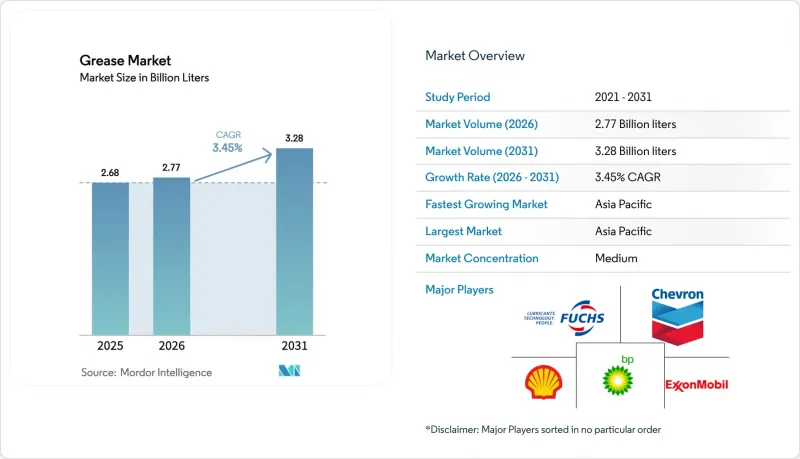
본 보고서는 증점제(리튬계, 칼슘계 등), 제품 유형(광물유, 합성유 등), 성능 등급(고온용 등), 최종 사용자 산업(발전, 중장비 등) 및 지역(아시아태평양, 북미, 유럽, 남미, 중동 및 아프리카)별로 분류되어 있습니다. 시장 전망은 판매량(리터) 기준으로 제시되어 있습니다.
세계 그리스 시장 동향 및 인사이트
가공 라인에서 위생적인 식품 등급 윤활유의 채택
규제 당국의 검사에서 윤활유 선정이 예방적 관리 조치로 취급되게 됨에 따라, NSF H1 인증을 취득한 알루미늄 복합계 및 칼슘설폰산계 그리스에 대한 수요가 증가하고 있습니다. 유제품, 양조, 즉석식품을 취급하는 가공 공장에서는 리콜 발생 시의 잠재적 비용을 총소유비용(TCO) 분석에 반영하고 있으며, 15-25%의 가격 프리미엄도 허용 범위 내에 있습니다. 이러한 등급의 그리스는 150°C 이상에서도 산화 안정성을 유지하고 스팀 세척으로 인한 유출을 견디기 때문에 금속 비누 유래의 맛이 식품으로 옮겨지는 것을 방지합니다. 유럽 및 북미의 ISO 21469 감사를 통해 다국적 브랜드들이 전 세계 위생 기준을 통일함에 따라 도입이 가속화되고 있습니다. 식품 등급 그리스, 기술 지원 및 관련 문서를 패키지로 제공하는 공급업체는 감사 대응을 서두르는 가공업체들로부터 우선 공급업체로서의 지위를 확보하고 있습니다.
EV(전기자동차) 파워트레인용 베어링에서 리튬 복합계 및 칼슘 설폰산염계 그리스로의 전환
전기자동차의 모터는 10,000-15,000 rpm으로 회전하며, 기존의 리튬 비누계 그리스로는 대응할 수 없는 전기 전도성 및 혼합 회전 조건을 요구합니다. 이온 액체 첨가제가 배합된 칼슘 설폰산염 및 리튬 복합계 그리스는 마찰 손실을 최대 45% 저감하고, 로터의 온도를 낮추며, 주행 거리를 연장합니다. 중국의 배터리 팩 조립 라인에서는 탄산리튬에 대한 추가적인 노출을 피하기 위해 칼슘계 그리스가 지정되어 있습니다. 이는 2022년부터 2024년에 걸쳐 해당 원자재의 가격이 급변함에 따라 표준화된 예방 조치입니다. 각 자동차 제조업체는 이러한 화학 성분의 그리스에 대해 다년 계약을 체결하여 원자재 가격 변동으로부터 부품 명세서(BOM)를 보호하고 있습니다. -40°C에서 +180°C 범위에서 안정적인 특성을 유지하는 폴리우레아 배합은 물로 인한 유출에 강하기 때문에 휠 베어링이나 CV 조인트 용도로 보급이 확대되고 있습니다.
배터리 업계 경쟁에 따른 탄산리튬 비용 변동
중국의 새로운 염수 프로젝트가 전기차 보급 속도를 앞지르면서 현물 가격은 2022년 8만 달러/t에서 2024년에는 1만-1만 2천 달러/t까지 하락했습니다. 고비용 계약을 체결했던 그리스 배합 제조업체들은 이익률이 200-300 베이시스 포인트 축소되었고, 조달 리드타임이 8주에서 16주로 연장되었습니다. 이러한 충격으로 인해 배터리 업계와의 연동성이 없는 칼슘설폰산 및 폴리우레아계 증점제로의 다각화가 진행되었습니다. 조달 팀은 현재 리스크를 억제하기 위해 여러 공급처를 확보하고 있지만, 이러한 경험은 리튬 비누의 경제 구조 내 취약성을 여실히 드러내고 있습니다. 2024년 말에는 가격이 안정화되었으나, 공급업체와의 계약에는 여전히 리스크 프리미엄이 반영되어 있습니다.
부문 분석
리튬계 그리스는 수십 년에 걸친 OEM의 승인으로 입지가 확고해졌기 때문에 2025년에도 그리스 시장 점유율의 66.89%를 유지했습니다. 그러나 칼슘 설폰산염계 그리스는 260°C를 넘는 드롭 포인트, 뛰어난 내수성, 그리고 우수한 4볼 마모 시험 결과를 제공하기 때문에 연평균 성장률(CAGR) 8.22%로 시장 점유율을 확대되고 있습니다. 선박, 광업, 제철소 운영 사업자들은 그리스의 유실이나 고부하 시의 고장을 방지하기 위해 이러한 그리스를 채택하고 있습니다. 2024년 셰브론이 출시한 ‘Rykon’은 리튬 복합 그리스를 능가하는 하중 저항력을 갖추고 이 분야를 겨냥하고 있어, 추가적인 대체를 촉진하고 있습니다. 알루미늄 복합 등급은 250°C에서의 안정성이 20-30%의 가격 프리미엄을 상쇄하는 가마 베어링 등 틈새 고온 용도를 차지하고 있습니다. 폴리우레아계 화학제품은 -40°C에서 +180°C의 온도 사이클에서 뛰어난 내산화성을 바탕으로, 전기차용 휠 베어링 및 터빈 요 구동 장치에 대한 최적의 솔루션으로 발전하고 있습니다. 벤토나이트 및 실리카겔과 같은 특수 증점제는 NSF H1 규격을 준수하는 클린룸 용도를 뒷받침하며, 공급업체의 제품 포트폴리오를 강화하고 있습니다.
칼슘 및 폴리우레아의 채택은 탄산리튬의 가격 변동 위험을 회피하기 위한 조달 전략의 다각화를 반영합니다. 구매자들은 리튬 복합체와 칼슘계 제품을 결합한 이중 조달 체제를 구축하고 있으며, 이는 2031년까지 시장 점유율 추이에 변화를 가져오고 있습니다. 풍력 터빈에 폴리우레아를 사용하는 것은 유지보수 주기 연장에도 기여하여, 가동 중단 시간 단축과 수명 주기 비용 절감을 실현하고 있습니다. 이러한 동향들이 맞물리면서, 그리스 시장에서 칼슘설폰산염 및 폴리우레아의 점유율이 확대되는 반면, 리튬계 제품의 우위는 꾸준히 낮아지고 있습니다.
2025년 판매량에서 광물유계 그리스는 여전히 75.19%를 차지하고 있지만, 성능 요구 사항이 기존의 한계를 뛰어넘음에 따라 합성계 그리스 시장은 연평균 성장률(CAGR) 4.51%로 확대되고 있습니다. 폴리알파올레핀 및 에스테르계 베이스는 점도 지수가 140을 초과하고 1,000시간 이상 산화에 견디기 때문에 풍력 터빈의 재윤활 주기를 12개월로 연장할 수 있습니다. 엑슨모빌이 2025년에 프랑스와 네덜란드에서 시행할 그룹 II 및 그룹 III 재정제 프로젝트를 통해 합성 윤활유의 원료 비용이 10-15% 절감되어, 광물유 제품과의 기존 가격 차이가 축소될 것입니다. 바이오 그리스는 틈새 시장이지만, ISO 12924에 따라 수생 독성이 낮아야 하는 임업 및 해양 분야에서는 사용이 의무화되어 있습니다. 이 부문의 성장세는 설비 가동 중단이 심각한 문제가 되는 경우, 총 소유 비용(TCO)의 관점에서 단가가 높다는 단점을 상쇄하고도 남을 만한 이점이 있음을 보여줍니다.
광물유 등급은 비용 민감도가 중요한 자동차 섀시 윤활 및 일반 산업용도에서 여전히 주류를 차지하고 있습니다. 그러나 합성유의 가격이 하락하고 OEM의 오일 교환 주기가 연장됨에 따라 합성유로의 대체가 진행되고 있습니다. 바이오 제품은 50-70%의 가격 프리미엄과 좁은 사용 온도 범위로 인해 도입 곡선이 가장 가파르지만, 규제에 따른 인센티브나 페널티로 인해 그 점유율은 확대되고 있습니다. 전반적으로, 합성유의 성장 분야가 그리스 시장 규모에서 합성유의 점유율을 해마다 끌어올리고 있습니다.
지역별 분석
아시아태평양은 2025년에 전 세계 총량의 49.75%를 차지하며, 연평균 성장률(CAGR) 4.39%를 나타낼 것으로 예측됩니다. 중국의 자동차 생산 대수는 연간 3,000만 대를 넘어섰으며, BYD의 조립 라인에서는 현재 리튬 변동으로 인한 영향을 줄이기 위해 냉각 모듈에 칼슘 설폰산계 그리스가 채택되고 있습니다. 인도의 국가 인프라 계획은 가동률이 80% 이상의 굴삭기 및 크레인 차량의 극압 그리스 소비를 견인하고 있습니다. 일본과 한국은 자동차 수출을 전기차(EV) 플랫폼으로 전환하고 있으며, 베어링 마찰을 45% 저감하는 폴리우레아 및 리튬 복합 솔루션을 채택하고 있습니다. 쉘(Shell)의 인도네시아에 위치한 1만 2,000톤 규모의 공장과 생산 능력이 3배로 확대된 태국 거점은 지역 공급 안정성을 강화하고 있으며, 이는 아세안(ASEAN)의 산업 성장에 대한 장기적인 신뢰를 반영하고 있습니다.
북미에서는 니어쇼어링의 혜택을 받아 2024년 멕시코의 자동차 생산 대수가 400만 대를 돌파하며, 현지에서 그리스 조달이 촉진되고 있습니다. 미국은 셰일 시추 및 식품 등급 제품의 채택을 주도하고 있는 반면, 텍사스주와 그레이트 플레인스 지역의 육상 풍력 발전 회랑에서는 합성 윤활유 수요가 확대되고 있습니다. 멕시코만에 위치한 셰브론(Chevron)사의 앵커(Anchor) 유전에서는 심해의 부하를 견딜 수 있도록 설계된 해양용 등급의 윤활유가 사용되고 있습니다. 캐나다의 광산 사업에서는 영하의 환경에 대응하는 북극용 그리스가 요구되고 있으며, 폴리우레아 및 합성 PAO 화학 물질이 활용되고 있습니다.
유럽의 상황은 제각각입니다. 2025년에는 독일의 자동차 생산이 둔화되었지만, 북해와 발트해에서의 해상 풍력 발전소 건설은 가속화되고 있습니다. 북유럽 국가들에서는 유동점 -50°C의 극지용 그리스가 요구되는 반면, 튀르키예에서는 재건 수요의 급증으로 인해 극압 그리스에 대한 수요가 높아지고 있습니다. PFAS 및 질화 붕소에 관한 EU의 REACH 규제는 제품 포트폴리오의 재편과 연구개발비 증가를 초래하고 있지만, 규제를 준수하는 공급업체에게는 경쟁상의 우위를 가져다주고 있습니다.
남미에서는 브라질이 핵심 시장으로 부상하고 있으며, 해당 국가에서는 페트로브라스의 프리솔트 프로젝트가 선박용 그리스 수요를 견인하고 있습니다. 아르헨티나의 리튬 광산 지역에서는 파쇄 설비 및 컨베이어 라인에서 극압 그리스의 소비량이 증가하고 있습니다. 중동 및 아프리카에서는 각각 ‘사우디 비전 2030’과 남아프리카공화국의 광업 투자를 배경으로 건설 기계 및 발전 설비의 보유 대수가 확대되고 있습니다. 후크스(Fuchs)사가 남아프리카공화국에서 생산 능력을 40% 증강한 것은 사하라 이남 지역의 성장에 대한 해당 기업의 확신을 보여주는 것입니다.
기타 혜택:
- 엑셀 형식 시장 예측(ME) 시트
- 3개월간의 애널리스트 지원
자주 묻는 질문
목차
제1장 서론
제2장 조사 방법
제3장 주요 요약
제4장 시장 구도
제5장 시장 규모와 성장 예측
제6장 경쟁 구도
제7장 시장 기회와 향후 전망
LSH 26.09.08According to Mordor Intelligence, the grease market size was valued at 2.68 Billion liters in 2025 and is estimated to grow from 2.77 Billion liters in 2026 to reach 3.28 Billion liters by 2031, at a CAGR of 3.45% during the forecast period (2026-2031).
This report is Segmented by Thickener (Lithium-Based, Calcium-Based, and More), Product Type (Mineral Oil, Synthetic Oil, and More), Performance Grade (High-Temperature, and More), End-User Industry (Power Generation, Heavy Equipment, and More), and Geography (Asia-Pacific, North America, Europe, South America, and the Middle East and Africa). The Market Forecasts are Provided in Terms of Volume (liters).
Global Grease Market Trends and Insights
Hygienic Food-Grade Lubrication Uptake in Processing Lines
Demand for NSF H1-certified aluminum-complex and calcium-sulfonate greases is climbing because regulatory inspections now treat lubricant selection as a preventive control. Processing plants that handle dairy, brewing, and ready-meal products factor potential recall costs into total-cost-of-ownership analysis, making the 15-25% price premium acceptable. These grades maintain oxidation stability above 150 °C and resist steam-cleaning washout, preventing metallic-soap taste migration. ISO 21469 audits in Europe and North America accelerate adoption as multinational brands unify global hygiene standards. Vendors that offer bundled food-grade grease, technical support, and documentation gain preferred-supplier status with processors seeking audit readiness.
EV E-Powertrain Bearing Shift to Lithium-Complex & Calcium-Sulfonate Greases
Electric-vehicle motors run at 10,000-15,000 rpm and impose electrical conductivity as well as mixed-rolling conditions that legacy lithium soaps cannot handle. Calcium-sulfonate and lithium-complex greases doped with ionic-liquid additives cut friction losses by up to 45%, reducing rotor temperature and extending driving range. Battery-pack assembly lines in China specify calcium systems to avoid additional lithium-carbonate exposure, a hedge that became standard after the commodity's 2022-2024 price whiplash. Automakers are locking multi-year contracts for these chemistries, insulating bills of materials from raw-material swings. Polyurea formulations, which remain consistent from -40°C to +180°C, are gaining ground in wheel-bearing and CV-joint applications because they resist water washout.
Lithium-Carbonate Cost Volatility Due to Battery-Sector Competition
Spot prices dropped from USD 80,000/t in 2022 to USD 10,000-12,000/t in 2024 when new Chinese brine projects outpaced EV uptake. Grease blenders locked into high-cost contracts saw margins shrink by 200-300 basis points and lengthened purchasing lead times from eight to sixteen weeks. The shock fueled diversification toward calcium-sulfonate and polyurea thickeners that lack battery-sector linkage. Procurement teams now dual-source to cap exposure, but the experience underscores structural fragility in lithium-soap economics. Although prices stabilized by late 2024, risk premiums remain embedded in supplier agreements.
Other drivers and restraints analyzed in the detailed report include:
- Offshore Deep-Water Drilling Boosting Water-Resistant Marine Greases
- Construction Equipment Boom Driving Extreme-Pressure Greases
- EU REACH Tightening on PFAS & Boron-Nitride Additives
For complete list of drivers and restraints, kindly check the Table Of Contents.
Segment Analysis
Lithium-based greases maintained a 66.89% grease market share in 2025 as decades of OEM approvals anchor their position. However, calcium-sulfonate greases are advancing at an 8.22% CAGR because they deliver dropping points beyond 260°C, superior water resistance, and excellent four-ball-wear results. Marine, mining, and steel-mill operators adopt them to avoid washout and heavy-load failures. Chevron's Rykon launch in 2024 targets this space with a load-carrying capacity that surpasses lithium complexes, catalyzing further substitution. Aluminum-complex grades occupy niche high-temperature services such as kiln bearings where 250°C stability offsets a 20-30% price premium. Polyurea chemistries progress as the preferred solution for EV wheel bearings and turbine yaw drives thanks to oxidation resistance over -40°C to +180°C cycles. Specialty thickeners like bentonite and silica gel underpin NSF H1 clean-room applications, reinforcing supplier portfolios.
Calcium and polyurea adoption mirrors procurement strategies that diversify away from lithium-carbonate volatility. Buyers draw dual-sourcing frameworks that blend lithium complexes with calcium equivalents, shifting market-share trajectories through 2031. Polyurea use in wind turbines also supports extended maintenance intervals, cutting downtime and lowering lifecycle cost. Together, these trends raise the calcium-sulfonate and polyurea slices of the grease market size while lithium-based dominance erodes steadily.
Mineral-oil greases still account for 75.19% of 2025 volume, yet synthetic formulations grow at 4.51% CAGR as performance needs outstrip conventional limits. Polyalphaolefin and ester bases carry viscosity indices above 140 and resist oxidation beyond 1,000 hours, enabling 12-month turbine relubrication cycles. ExxonMobil's 2025 re-refined Group II and Group III project in France and the Netherlands lowers synthetic input cost by 10-15%, narrowing historical price gaps with mineral products. Bio-based greases, while niche, secure mandates in forestry and marine zones that enforce low aquatic toxicity under ISO 12924. This segment's momentum demonstrates that total-cost-of-ownership considerations can outweigh higher unit prices when equipment downtime is critical.
Mineral oil grades continue to dominate automotive chassis lubrication and general industrial services where cost sensitivity prevails. However, as synthetic prices fall and OEM drain intervals lengthen, substitution edges upward. Bio-based products face the steepest adoption curve due to 50-70% price premiums and narrower temperature windows, yet regulatory carrots and sticks are expanding their footprint. Overall, synthetic expansion segments lift the synthetic share of the grease market size year over year.
Complete Report Scope:
- By Thickener
- Lithium-based
- Calcium-based
- Aluminum-based
- Polyurea
- Other Thickeners
- By Product type
- Mineral Oil
- Synthetic Oil
- Bio-based Oil
- By Performance Grade
- High-Temperature Greases
- Low-Temperature & Arctic-Grade Greases
- Extreme-Pressure & Heavy-Load Greases
- By End-user Industry
- Automotive & Other Transportation
- Power Generation (Wind, Hydro, Thermal)
- Heavy Equipment
- Food & Beverage
- Metallurgy & Metalworking
- Chemical Manufacturing
- Other Industries
- By Geography
- Asia-Pacific
- China
- India
- Japan
- South Korea
- Indonesia
- Malaysia
- Thailand
- Vietnam
- Rest of Asia-Pacific
- North America
- United States
- Canada
- Mexico
- Europe
- Germany
- United Kingdom
- France
- Italy
- Spain
- NORDIC Countries
- Turkey
- Russia
- Rest of Europe
- South America
- Brazil
- Argentina
- Colombia
- Rest of South America
- Middle East and Africa
- Saudi Arabia
- South Africa
- Nigeria
- Egypt
- Rest of Middle East and Africa
- Asia-Pacific
Geography Analysis
Asia-Pacific held 49.75% of global volume in 2025 and is forecast to post a 4.39% CAGR. Chinese manufacturing exceeds 30 million vehicles a year, with BYD assembly lines now using calcium-sulfonate greases in cooling modules to reduce exposure to lithium swings. India's National Infrastructure Pipeline drives extreme-pressure consumption in excavator and crane fleets operating above 80% utilization. Japan and South Korea transition automotive exports to EV platforms, embedding polyurea and lithium-complex solutions that lower bearing friction by 45%. Shell's 12,000 t Indonesian plant and triple-capacity Thailand site reinforce regional supply security, reflecting long-term confidence in ASEAN industrial growth.
North America benefits from near-shoring that boosts Mexican vehicle production past 4 million units in 2024, encouraging local grease sourcing. The United States leads shale drilling and food-grade adoption, while onshore wind corridors in Texas and the Great Plains absorb synthetic volumes. Chevron's Anchor field in the Gulf of Mexico consumes marine grades engineered for deep-water loads. Canadian mining operations require arctic-rated greases for sub-zero environments, leaning on polyurea and synthetic PAO chemistries.
Europe presents a mixed picture. German automotive output softened in 2025, yet offshore wind build-outs in the North Sea and Baltic accelerate. Nordic nations demand arctic-grade greases with -50°C pour points, while Turkey's reconstruction surge spurs extreme-pressure uptake. EU REACH rules on PFAS and boron nitride reshape product portfolios and inflate R&D costs, but offer competitive edge to compliant suppliers.
South America is anchored by Brazil, where Petrobras pre-salt projects fuel marine grease demand. Argentina's lithium-mining belt boosts extreme-pressure consumption in crushing and conveyor lines. The Middle East and Africa expand construction equipment and power-generation fleets under Saudi Vision 2030 and South African mining investments, respectively. FUCHS's 40% capacity addition in South Africa evidences confidence in sub-Saharan growth.
- Ampol Limited
- Axel Christiernsson AB
- BECHEM Lubrication Technology LLC
- BP p.l.c.
- Chevron Corporation
- China Petrochemical Corporation
- DuPont
- ENEOS Corporation
- ETS Oil & Gas Ltd.
- Exxon Mobil Corporation
- FUCHS
- Gazprom
- Gulf Oil International Ltd
- Idemitsu Kosan Co.,Ltd.
- Kluber Lubrication SE
- LUKOIL
- Morris Lubricants
- Orlen Oil
- Penrite Oi
- Petromin
- Petronas Lubricants International
- Shell Plc
- SKF
- TotalEnergies
- Valvoline Global Operations
Additional Benefits:
- The market estimate (ME) sheet in Excel format
- 3 months of analyst support
TABLE OF CONTENTS
1 Introduction
- 1.1 Study Assumptions & Market Definition
- 1.2 Scope of the Study
2 Research Methodology
3 Executive Summary
4 Market Landscape
- 4.1 Market Overview
- 4.2 Market Drivers
- 4.2.1 Hygienic food-grade lubrication uptake in processing lines
- 4.2.2 EV e-powertrain bearing shift to lithium-complex & calcium-sulfonate greases
- 4.2.3 Offshore deep-water drilling boosting water-resistant marine greases
- 4.2.4 Construction equipment boom driving extreme-pressure greases
- 4.2.5 Robust investments in the power-generation sector
- 4.3 Market Restraints
- 4.3.1 Lithium-carbonate cost volatility due to battery-sector competition
- 4.3.2 EU REACH tightening on PFAS & boron-nitride additives
- 4.3.3 Low penetration of auto-lubrication systems
- 4.4 Value Chain Analysis
- 4.5 Porter's Five Forces Analysis
- 4.5.1 Bargaining Power of Suppliers
- 4.5.2 Bargaining Power of Buyers
- 4.5.3 Threat of New Entrants
- 4.5.4 Threat of Substitutes
- 4.5.5 Degree of Competition
5 Market Size & Growth Forecasts (Volume)
- 5.1 By Thickener
- 5.1.1 Lithium-based
- 5.1.2 Calcium-based
- 5.1.3 Aluminum-based
- 5.1.4 Polyurea
- 5.1.5 Other Thickeners
- 5.2 By Product type
- 5.2.1 Mineral Oil
- 5.2.2 Synthetic Oil
- 5.2.3 Bio-based Oil
- 5.3 By Performance Grade
- 5.3.1 High-Temperature Greases
- 5.3.2 Low-Temperature & Arctic-Grade Greases
- 5.3.3 Extreme-Pressure & Heavy-Load Greases
- 5.4 By End-user Industry
- 5.4.1 Automotive & Other Transportation
- 5.4.2 Power Generation (Wind, Hydro, Thermal)
- 5.4.3 Heavy Equipment
- 5.4.4 Food & Beverage
- 5.4.5 Metallurgy & Metalworking
- 5.4.6 Chemical Manufacturing
- 5.4.7 Other Industries
- 5.5 By Geography
- 5.5.1 Asia-Pacific
- 5.5.1.1 China
- 5.5.1.2 India
- 5.5.1.3 Japan
- 5.5.1.4 South Korea
- 5.5.1.5 Indonesia
- 5.5.1.6 Malaysia
- 5.5.1.7 Thailand
- 5.5.1.8 Vietnam
- 5.5.1.9 Rest of Asia-Pacific
- 5.5.2 North America
- 5.5.2.1 United States
- 5.5.2.2 Canada
- 5.5.2.3 Mexico
- 5.5.3 Europe
- 5.5.3.1 Germany
- 5.5.3.2 United Kingdom
- 5.5.3.3 France
- 5.5.3.4 Italy
- 5.5.3.5 Spain
- 5.5.3.6 NORDIC Countries
- 5.5.3.7 Turkey
- 5.5.3.8 Russia
- 5.5.3.9 Rest of Europe
- 5.5.4 South America
- 5.5.4.1 Brazil
- 5.5.4.2 Argentina
- 5.5.4.3 Colombia
- 5.5.4.4 Rest of South America
- 5.5.5 Middle East and Africa
- 5.5.5.1 Saudi Arabia
- 5.5.5.2 South Africa
- 5.5.5.3 Nigeria
- 5.5.5.4 Egypt
- 5.5.5.5 Rest of Middle East and Africa
- 5.5.1 Asia-Pacific
6 Competitive Landscape
- 6.1 Market Concentration
- 6.2 Strategic Moves
- 6.3 Market Share(%)/Ranking Analysis
- 6.4 Company Profiles (includes Global-level Overview, Market-level Overview, Core Segments, Financials as available, Strategic Information, Market Rank/Share, Products & Services, Recent Developments)
- 6.4.1 Ampol Limited
- 6.4.2 Axel Christiernsson AB
- 6.4.3 BECHEM Lubrication Technology LLC
- 6.4.4 BP p.l.c.
- 6.4.5 Chevron Corporation
- 6.4.6 China Petrochemical Corporation
- 6.4.7 DuPont
- 6.4.8 ENEOS Corporation
- 6.4.9 ETS Oil & Gas Ltd.
- 6.4.10 Exxon Mobil Corporation
- 6.4.11 FUCHS
- 6.4.12 Gazprom
- 6.4.13 Gulf Oil International Ltd
- 6.4.14 Idemitsu Kosan Co.,Ltd.
- 6.4.15 Kluber Lubrication SE
- 6.4.16 LUKOIL
- 6.4.17 Morris Lubricants
- 6.4.18 Orlen Oil
- 6.4.19 Penrite Oi
- 6.4.20 Petromin
- 6.4.21 Petronas Lubricants International
- 6.4.22 Shell Plc
- 6.4.23 SKF
- 6.4.24 TotalEnergies
- 6.4.25 Valvoline Global Operations
7 Market Opportunities & Future Outlook
- 7.1 White-space & Unmet-Need Assessment
- 7.2 Growing usage of polyurea greases


