|
시장보고서
상품코드
2120768
체외진단 : 시장 점유율 분석, 업계 동향과 통계, 성장 예측(2026-2031년)In Vitro Diagnostic - Market Share Analysis, Industry Trends & Statistics, Growth Forecasts (2026 - 2031) |
||||||
 Mordor Intelligence
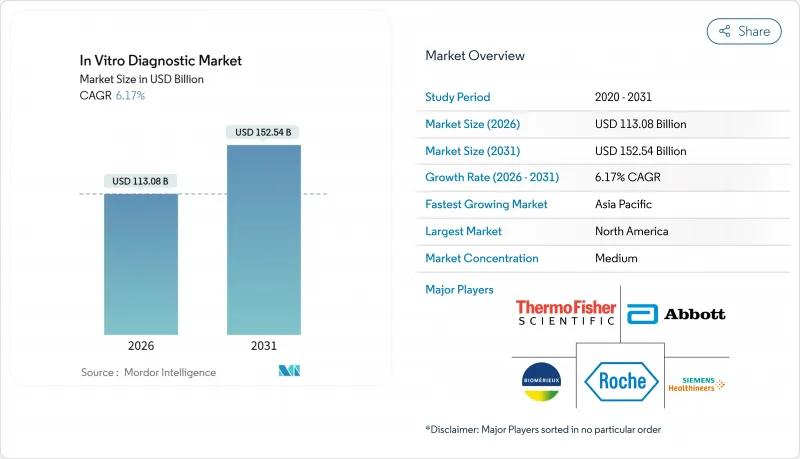
Mordor Intelligence에 따르면 체외진단 시장 규모는 2026년에 1,130억 8,000만 달러로 추정되며, 예측 기간(2026-2031년) 동안 CAGR 6.17%로 확대되어 2031년에는 1,525억 4,000만 달러에 달할 것으로 전망됩니다.
본 보고서는 제품 유형(기기, 시약·키트, 소프트웨어·서비스), 기술(면역측정법, 임상화학, 분자진단 등), 용도(감염증, 종양학, 당뇨병 등), 최종사용자(병원·학술 연구소 등), 지역(북미, 유럽, 아시아태평양 등)별로 분류되어 있습니다. 시장 전망은 금액(달러) 기준으로 제시되어 있습니다.
세계 체외진단 시장의 동향 및 인사이트
POC(Point-of-Care) 진단 보급 확대
규제 당국은 2024년 및 2025년에 CLIA 면제 대상 범주를 확대하여, 약국이나 기업 내 진료소가 검사실 직원 없이도 연쇄상구균, 인플루엔자, 지질 패널에 대한 신속 검사를 실시할 수 있도록 했습니다. CVS Health나 Walgreens와 같은 소매 체인은 과거에는 외부 검사 기관으로 흘러가던 일상적인 검사를 흡수하게 되었으며, 이로 인해 중앙 검사 시설은 특수한 염기서열 분석이나 자가면역 패널에 특화될 수밖에 없게 되었습니다. 2024년 Dexcom사의 시판용 연속 혈당 모니터가 FDA 승인을 획득한 것은 가전 제조업체가 기존의 인프라를 완전히 우회할 수 있음을 입증했습니다. 휴대용 면역측정 리더기나 스마트폰 연동형 측방유동 검사 장치는 병원 수준의 정확도를 충족하며, 중앙 검사실을 지켜왔던 성능 격차를 좁히고 있습니다. 이러한 분산화로 인해 검사에 대한 접근성은 향상되지만, 수익성이 높은 병원 환경에서의 시약 판매량은 압박을 받고 있습니다.
만성 질환의 높은 유병률
2025년에는 당뇨병, 심혈관질환, 만성 신장병으로 인해 13억 건의 진단 검사가 실시되어 전 세계 검사실의 처리 능력에 부담이 가중되었습니다. 2024년에는 당뇨병 유병자 수가 성인 5억 3,700만 명에 달했으며, 남아시아와 중동에서 가장 빠른 증가세를 보였습니다. 만성 질환 환자 한 명 한 명이 지질, 트로포닌, 신기능에 대한 정기적인 검사를 필요로 하기 때문에 보험 환급액이 정체되어 있더라도 소모품에 대한 수요는 증가하고 있습니다. 웨어러블 생체 센서를 통해 혈당 및 젖산 수치 데이터가 지속적으로 스트리밍됨에 따라, 모니터링의 일부가 정맥 천자에서 클라우드 분석으로 전환되고 있습니다. 따라서 각 벤더는 기존 소모품 판매가 정체되는 상황에서도 수익을 유지하기 위해 검사 보고서와 경과 시간별 분석 서비스 구독을 세트로 판매하고 있습니다.
여러 지역의 엄격한 규제 승인 일정
2024년 5월에 전면 시행된 유럽연합(EU)의 IVD 규정에 따라 수천 건의 저위험 검사가 자가 인증에서 인증 기관의 심사로 전환되었으며, 그 결과 승인까지 걸리는 기간의 중앙값은 22개월이 되었습니다. 일본과 중국도 유사한 데이터 요건을 부과하고 있어, 다국적 기업의 제품이 아시아 지역에서 출시되기까지 추가로 18-24개월이 소요됩니다. 소규모 혁신 기업들은 여러 지역에서 동시에 임상시험을 수행할 규제 대응 인력이 부족하기 때문에 우선 미국 시장을 공략하고 해외에서의 초기 시장 점유율은 양보하게 됩니다. 출시 시기의 차이는 세계 진출 규모 확대를 지연시키고, 후발 경쟁사가 선구자보다 먼저 보험 환급을 확보할 수 있게 하여 체외진단 시장의 연평균 성장률(CAGR)을 소폭 끌어내리고 있습니다.
부문 분석
시약 및 키트는 2025년 매출의 54.28%를 차지하고 있으며, 이는 대부분의 검사실을 지탱하는 소모품 기반의 경제 구조를 여실히 보여줍니다. 병원은 분석 기기 구입 비용을 면제받는 대신, 수년까지 소모품을 구매하기로 약속하는 시약 임대 계약을 선호하고 있으며, 이러한 모델은 공급업체의 수익을 안정적으로 유지시켜 줍니다. 소프트웨어 및 서비스는 AI 기반 의사결정 지원, 클라우드 호스팅 미들웨어, 원격 장비 진단에 힘입어 2031년까지 연평균 성장률(CAGR) 10.29%를 기록할 것으로 예측됩니다. 장비는 여전히 락인 플랫폼으로서 필수적이며, 지멘스 헬시니어스의 ‘Atellica Solution’은 시간당 440건의 검사를 처리하고 결과의 85%를 자동 검증함으로써, 건당 보고서 작성에 소요되는 시간을 몇 분 단축하고 있습니다. 체외진단용 소프트웨어의 시장 규모는 현재로서는 작지만, 두 자릿수의 성장 궤도는 검사실이 분석 업무 및 규정 준수 업무를 아웃소싱으로 전환하고 있음을 시사합니다.
현재 FDA의 ‘의료기기로서의 소프트웨어(Software-as-a-Medical-Device)’ 프레임워크 하에서 소프트웨어는 하드웨어와 분리되어 알고리즘을 독립적으로 업그레이드할 수 있게 되었습니다. 각 벤더는 클라우드 대시보드와 품질 관리용 시약을 결합하여 차별화를 꾀하고, 고객 유지율이 높은 생태계를 구축하고 있습니다. 자본 예산이 빠듯한 상황에서, 시약 대여 및 구독형 소프트웨어를 통한 수익은 하드웨어 도입 대수보다 빠르게 증가하여 체외진단 시장에서 벤더의 이익 구조를 재편하게 될 것입니다.
2025년, 면역분석법은 갑상선, 심장, 종양 마커에 힘입어 매출 점유율 26.63%를 유지했습니다. 한편, 분자진단은 액체 생검의 승인, CRISPR 분석법, 증후군별 감염증 패널에 힘입어 연평균 성장률(CAGR) 8.21%로 확대될 것으로 예측됩니다. 임상화학의 자동화로 인해 대사 패널의 상품화가 진행됨에 따라, 각 벤더들은 현재 시약의 화학적 특성보다는 처리 속도 향상 및 미들웨어 통합을 통해 차별화를 꾀하고 있습니다. 혈액학 플랫폼에는 AI 기반의 세포 분류 기능이 내장되어 있으며, 미생물학 분야에서는 배양에서 MALDI-TOF로 전환되어 15분 만에 신속한 동정이 가능해졌습니다.
기술의 융합으로 인해 기존의 부서 간 경계가 점차 희미해지고 있습니다. 차세대 플랫폼에서는 면역 측정법, 분자 기술, 질량 분석법이 단일 트랙 상에서 통합되어 있습니다. 검사실에서는 검체 처리량 감소, 오류 위험 최소화, 인건비 절감으로 이어지는 통합된 워크플로우가 환영받고 있습니다. 이러한 하이브리드 시스템의 보급에 따라 체외진단 시장은 AI를 활용한 검체 트라이어지를 통합한 다중 모드 분석 장치로 전환될 것이며, 이로 인해 전환 비용은 증가하는 한편 공급업체와의 관계는 더욱 공고해질 것입니다.
지역별 분석
북미는 분자진단의 조기 도입과 견실한 보험 환급에 힘입어 2025년 매출의 37.16%를 차지했습니다. CMS(미국 의료보험서비스센터)의 가치 기반 진료 모델에서는 검사실 이용이 포괄적 지급과 연동되어, 의료 제공자에게 가치가 낮은 검사를 제한하도록 압력이 가해지고 있습니다. FDA(미국 식품의약국)의 사이버 보안 규제로 인해 규정 준수 비용은 증가하지만, 데이터의 무결성은 향상됩니다. 캐나다와 멕시코에서는 규모의 경제 효과를 얻기 위해 검사를 지역 허브로 집약하고 있습니다.
아시아태평양은 2026년부터 2031년까지 연평균 성장률(CAGR) 7.19%를 기록할 것으로 예상되며, 이는 지역별로는 가장 빠른 성장 속도입니다. 중국의 수량 기반 조달로 인해 시약 가격은 최대 60%까지 인하되었지만, 검사량의 급증으로 인해 공급업체의 수익은 유지되고 있습니다. 인도의 ‘국가 보건 미션’은 2024-25 회계연도에 5,000곳의 지역 검사실에 자금을 지원하여 1인당 연간 검사 횟수를 0.08회에서 0.15회로 늘렸습니다. 고령화가 진행되고 있는 일본과 한국에서는 인력 부족을 보완하기 위해 적극적으로 자동화를 추진하고 있으며, 그 결과 검사실의 완전 자동화를 위한 설비 투자가 증가하고 있습니다.
유럽에서는 IVD 규제가 시행되어 승인까지의 기간이 연장되고 있는 반면, 경험이 풍부한 규제 대응 팀을 보유한 다국적 기업이 유리한 입장에 있습니다. GCC 국가들은 ‘비전 2030’에 따라 석유 수입을 검사실 인프라에 투자하고 있습니다. 사하라 이남 아프리카에서는 보급률이 여전히 낮은 편이지만, 기부 자금을 통한 HIV, 결핵, 말라리아 대책 프로그램의 혜택을 받고 있습니다. 남미의 검사실은 환율 변동과 수입 관세로 어려움을 겪고 있어, 비용 관리를 위해 가능한 한 현지에서 시약을 조달하고 있습니다.
기타 혜택:
- 엑셀 형식의 시장 예측(ME) 시트
- 3개월간의 애널리스트 지원
자주 묻는 질문
목차
제1장 소개
제2장 조사 방법
제3장 주요 요약
제4장 시장 구도
제5장 시장 규모와 성장 예측
제6장 경쟁 구도
제7장 시장 기회와 향후 전망
KSM 26.09.02According to Mordor Intelligence, the in vitro diagnostic market size is estimated at USD 113.08 billion in 2026, and is expected to reach USD 152.54 billion by 2031, at a CAGR of 6.17% during the forecast period (2026-2031).
This report is Segmented by Product Type (Instruments, Reagents & Kits, Software & Services), Technology (Immunoassay, Clinical Chemistry, Molecular Diagnostics, and More), Application (Infectious Diseases, Oncology, Diabetes, and More), End User (Hospitals & Academic Labs, and More), and Geography (North America, Europe, Asia-Pacific, and More). The Market Forecasts are Provided in Terms of Value (USD).
Global In Vitro Diagnostic Market Trends and Insights
Expanding Adoption of Point-of-Care (POC) Diagnostics
Regulators expanded CLIA-waived categories in 2024 and 2025, allowing pharmacies and employer clinics to perform rapid strep, influenza, and lipid panels without requiring laboratory staff. Retail chains such as CVS Health and Walgreens now capture routine tests that once flowed to reference labs, forcing central facilities to specialize in esoteric sequencing and autoimmune panels. FDA clearance of Dexcom's over-the-counter continuous glucose monitor in 2024 demonstrated that consumer electronics firms can bypass legacy infrastructure entirely. Handheld immunoassay readers and smartphone-linked lateral-flow devices meet hospital-grade precision, narrowing the performance gap that protected central labs. This decentralization boosts test access but squeezes reagent volumes in high-margin hospital settings.
High Prevalence of Chronic Diseases
Diabetes, cardiovascular disease, and chronic kidney disease drove 1.3 billion diagnostic procedures in 2025, straining global laboratory capacity. Diabetes prevalence climbed to 537 million adults in 2024, with the fastest growth in South Asia and the Middle East. Each chronic-care patient requires serial lipid, troponin, and kidney-function assays, raising consumable demand even as reimbursement remains flat. Wearable biosensors now continuously stream glucose and lactate data, shifting some monitoring from venipuncture to cloud analytics. Vendors, therefore, bundle laboratory reporting with longitudinal analytics subscriptions to preserve revenue even as traditional consumable sales plateau.
Stringent Multi-Region Regulatory Approval Timelines
The European Union's IVD Regulation, fully enforced in May 2024, transitioned thousands of low-risk assays from self-certification to notified-body review, resulting in a median approval time of 22 months. Japan and China impose parallel data requirements, adding 18 to 24 months before multinational launches reach the Asia region. Small innovators lack the regulatory manpower to run simultaneous trials, so they prioritize the United States first, ceding early share abroad. Staggered launches delay global scale and allow fast-follower rivals to secure reimbursement ahead of pioneers, marginally shaving the in vitro diagnostic market CAGR.
Other drivers and restraints analyzed in the detailed report include:
- Aging Population Boosting Chronic Disease Testing Volumes
- Growing Infectious-Disease Burden Fueling Rapid Diagnostics
- Reimbursement Uncertainty Across Emerging Test Classes
For complete list of drivers and restraints, kindly check the Table Of Contents.
Segment Analysis
Reagents and kits accounted for 54.28% of 2025 revenue, underscoring the consumable-based economics that sustain most laboratories. Hospitals favor reagent-rental agreements that waive analyzer acquisition costs in exchange for multi-year consumable purchases, a model that smooths vendor revenue. Software and services are forecast to post a 10.29% CAGR through 2031, powered by AI decision-support, cloud-hosted middleware, and remote instrument diagnostics. Instruments remain vital as lock-in platforms; Siemens Healthineers' Atellica Solution processes 440 tests per hour and auto-verifies 85% of results, saving labor minutes per report. The in vitro diagnostic market size for software is currently small, but its double-digit trajectory signals a shift by laboratories toward analytics and compliance outsourcing.
Software now decouples from hardware under the FDA's Software-as-a-Medical-Device framework, enabling independent algorithm upgrades. Vendors differentiate by pairing cloud dashboards with quality-control materials, creating sticky ecosystems. As capital budgets tighten, revenue from reagent rental and subscription-based software will rise faster than hardware placements, reshaping vendor profit pools within the in vitro diagnostic market.
Immunoassay retained a 26.63% revenue share in 2025, driven by thyroid, cardiac, and tumor markers. Yet, molecular diagnostics are projected to expand at an 8.21% CAGR, driven by liquid biopsy approvals, CRISPR assays, and syndromic infectious disease panels. Clinical chemistry automation has commoditized metabolic panels, so vendors now differentiate themselves through faster throughput and middleware integration rather than reagent chemistry. Hematology platforms incorporate AI-based cell classification, while microbiology shifts from culture to MALDI-TOF for rapid identification in 15 minutes.
Technology convergence is blurring legacy silos; next-generation platforms combine immunoassay, molecular techniques, and mass spectrometry on a single track. Laboratories welcome consolidated workflows that reduce sample handling, minimize error risk, and contain labor costs. As these hybrid systems scale, the in vitro diagnostic market will shift toward multi-modal analyzers that integrate AI-driven sample triage, increasing switching costs and solidifying vendor relationships.
Complete Report Scope:
- By Product Type
- Instruments
- Reagents & Kits
- Software & Services
- By Technology
- Immunoassay
- Clinical Chemistry
- Molecular Diagnostics
- Hematology
- Microbiology
- Coagulation
- Urinalysis
- Others
- By Application
- Infectious Diseases
- Oncology
- Diabetes
- Cardiology
- Autoimmune Diseases
- Nephrology
- Others
- By End User
- Hospitals & Academic Labs
- Reference Laboratories
- Point-of-Care Testing Sites
- Homecare/OTC Settings
- By Geography
- North America
- United States
- Canada
- Mexico
- Europe
- Germany
- United Kingdom
- France
- Italy
- Spain
- Rest of Europe
- Asia-Pacific
- China
- Japan
- India
- Australia
- South Korea
- Rest of Asia-Pacific
- Middle East & Africa
- GCC
- South Africa
- Rest of Middle East & Africa
- South America
- Brazil
- Argentina
- Rest of South America
- North America
Geography Analysis
North America accounted for 37.16% of the 2025 revenue, supported by early adoption of molecular diagnostics and robust reimbursement. CMS value-based-care models now tie laboratory utilization to bundled payments, pressuring providers to limit low-value testing. FDA cybersecurity mandates increase compliance costs but improve data integrity. Canada and Mexico consolidate testing into regional hubs to capture scale economies.
The Asia-Pacific region is forecast to post a 7.19% CAGR from 2026 to 2031, the fastest regional pace. China's volume-based procurement slashed reagent prices by up to 60%, yet soaring volumes protect vendor revenue. India's National Health Mission funded 5,000 district labs in 2024-25, increasing per-capita test penetration from 0.08 to 0.15 tests per capita annually. Aging Japan and South Korea are automating aggressively to offset labor shortages, resulting in increased capital expenditure on total laboratory automation.
Europe enforces the IVD Regulation, extending approval timelines and favoring multinationals with seasoned regulatory teams. GCC states channel oil revenue into laboratory infrastructure under Vision 2030. Sub-Saharan Africa remains under-penetrated but benefits from donor-funded HIV, tuberculosis, and malaria programs. South American laboratories struggle with currency fluctuations and import tariffs, sourcing reagents locally whenever possible to manage costs.
- Abbott Laboratories
- Agilent Technologies
- Beckton Dickinson
- Bio-Rad Laboratories
- bioMerieux
- Danaher
- DiaSorin
- Roche
- GE Healthcare
- Grifols
- Hologic
- Illumina
- Meril Diagnostics Pvt Ltd
- Ortho Clinical Diagnostics / QuidelOrtho
- PerkinElmer
- QIAGEN
- QuidelOrtho
- Randox Laboratories
- Siemens Healthineers
- Sysmex
- Thermo Fisher Scientific
Additional Benefits:
- The market estimate (ME) sheet in Excel format
- 3 months of analyst support
TABLE OF CONTENTS
1 Introduction
- 1.1 Study Assumptions & Market Definition
- 1.2 Scope of the Study
2 Research Methodology
3 Executive Summary
4 Market Landscape
- 4.1 Market Overview
- 4.2 Market Drivers
- 4.2.1 Expanding Adoption of Point-of-Care (POC) Diagnostics
- 4.2.2 High Prevalence of Chronic Diseases
- 4.2.3 Aging Population Boosting Chronic Disease Testing Volumes
- 4.2.4 Growing Infectious-Disease Burden Fueling Rapid Diagnostics
- 4.2.5 Surge in Decentralized Point-of-Care (POC) Testing
- 4.2.6 Lab Automation & Digital Pathology Convergence Drives Bundled IVD Procurement
- 4.3 Market Restraints
- 4.3.1 Stringent Multi-Region Regulatory Approval Timelines
- 4.3.2 Reimbursement Uncertainty Across Emerging Test Classes
- 4.3.3 Cyber-Security & Data-Interoperability Gaps in Connected IVD
- 4.3.4 Global Shortage of Skilled Lab Technologists
- 4.4 Regulatory Landscape
- 4.5 Technological Outlook
- 4.6 Porter's Five Forces Analysis
- 4.6.1 Threat of New Entrants
- 4.6.2 Bargaining Power of Buyers
- 4.6.3 Bargaining Power of Suppliers
- 4.6.4 Threat of Substitutes
- 4.6.5 Competitive Rivalry
5 Market Size & Growth Forecasts
- 5.1 By Product Type
- 5.1.1 Instruments
- 5.1.2 Reagents & Kits
- 5.1.3 Software & Services
- 5.2 By Technology
- 5.2.1 Immunoassay
- 5.2.2 Clinical Chemistry
- 5.2.3 Molecular Diagnostics
- 5.2.4 Hematology
- 5.2.5 Microbiology
- 5.2.6 Coagulation
- 5.2.7 Urinalysis
- 5.2.8 Others
- 5.3 By Application
- 5.3.1 Infectious Diseases
- 5.3.2 Oncology
- 5.3.3 Diabetes
- 5.3.4 Cardiology
- 5.3.5 Autoimmune Diseases
- 5.3.6 Nephrology
- 5.3.7 Others
- 5.4 By End User
- 5.4.1 Hospitals & Academic Labs
- 5.4.2 Reference Laboratories
- 5.4.3 Point-of-Care Testing Sites
- 5.4.4 Homecare/OTC Settings
- 5.5 By Geography
- 5.5.1 North America
- 5.5.1.1 United States
- 5.5.1.2 Canada
- 5.5.1.3 Mexico
- 5.5.2 Europe
- 5.5.2.1 Germany
- 5.5.2.2 United Kingdom
- 5.5.2.3 France
- 5.5.2.4 Italy
- 5.5.2.5 Spain
- 5.5.2.6 Rest of Europe
- 5.5.3 Asia-Pacific
- 5.5.3.1 China
- 5.5.3.2 Japan
- 5.5.3.3 India
- 5.5.3.4 Australia
- 5.5.3.5 South Korea
- 5.5.3.6 Rest of Asia-Pacific
- 5.5.4 Middle East & Africa
- 5.5.4.1 GCC
- 5.5.4.2 South Africa
- 5.5.4.3 Rest of Middle East & Africa
- 5.5.5 South America
- 5.5.5.1 Brazil
- 5.5.5.2 Argentina
- 5.5.5.3 Rest of South America
- 5.5.1 North America
6 Competitive Landscape
- 6.1 Market Concentration
- 6.2 Market Share Analysis
- 6.3 Company Profiles (includes Global level Overview, Market-level Overview, Core Segments, Financials, Strategic Information, Market Rank/Share, Products & Services, Recent Developments)
- 6.3.1 Abbott Laboratories
- 6.3.2 Agilent Technologies Inc.
- 6.3.3 Becton, Dickinson and Company
- 6.3.4 Bio-Rad Laboratories Inc.
- 6.3.5 bioMerieux SA
- 6.3.6 Danaher Corporation
- 6.3.7 DiaSorin SpA
- 6.3.8 F. Hoffmann-La Roche Ltd
- 6.3.9 GE Healthcare
- 6.3.10 Grifols SA
- 6.3.11 Hologic Inc.
- 6.3.12 Illumina Inc.
- 6.3.13 Meril Diagnostics Pvt Ltd
- 6.3.14 Ortho Clinical Diagnostics / QuidelOrtho
- 6.3.15 PerkinElmer Inc.
- 6.3.16 Qiagen NV
- 6.3.17 QuidelOrtho Corporation
- 6.3.18 Randox Laboratories Ltd
- 6.3.19 Siemens Healthineers AG
- 6.3.20 Sysmex Corporation
- 6.3.21 Thermo Fisher Scientific Inc.
7 Market Opportunities & Future Outlook
- 7.1 White-space & Unmet-need Assessment