

|
시장보고서
상품코드
2121299
스페인의 체외진단 시장 : 시장 점유율 분석, 업계 동향과 통계, 성장 예측(2026-2031년)Spain In-vitro Diagnostics - Market Share Analysis, Industry Trends & Statistics, Growth Forecasts (2026 - 2031) |
||||||
 Mordor Intelligence
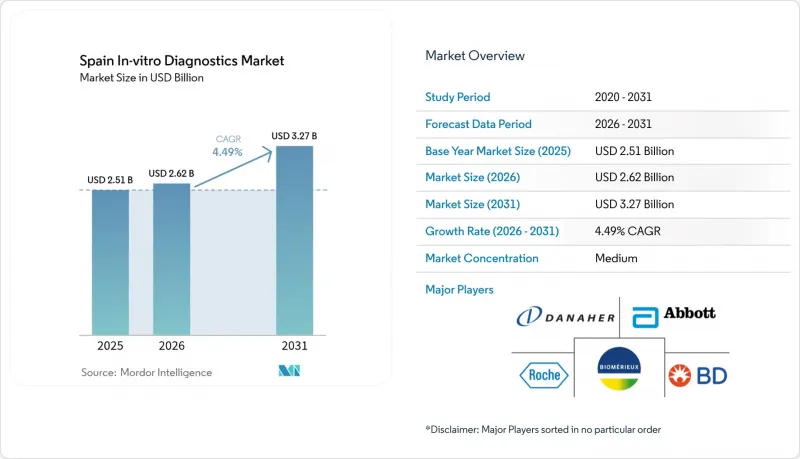
Mordor Intelligence에 따르면 2026년 스페인의 체외진단 시장 규모는 26억 2,000만 달러로 추정되며, 2025년 25억 1,000만 달러에서 확대되어 2031년에는 32억 7,000만 달러에 달할 것으로 예측됩니다.
2026년부터 2031년까지 연평균 성장률(CAGR) 4.49%로 성장할 것으로 전망됩니다.
본 보고서는 검사 유형(임상화학, 분자진단, 기타), 제품(계측기기·분석장치, 시약·소모품, 기타), 사용성(일회용 체외진단용 의료기기, 재사용형 체외진단용 의료기기), 용도(감염증, 종양학(암), 순환기과, 기타), 최종사용자(진단 실험실, 병원·클리닉, 기타)별로 분류되어 있습니다. 시장 전망은 금액(달러) 기준으로 제시되어 있습니다.
스페인 체외진단 시장의 동향 및 인사이트
만성 질환 및 생활습관병의 부담 증가
스페인 성인의 약 15.1%가 만성 신장질환을 앓고 있으며, 이 수치는 인구 고령화에 따라 지속적으로 증가하고 있습니다. 당뇨병, 암, 심혈관질환의 유병률 증가로 인해 1차 진료 클리닉에서 검사가 더 조기에, 더 빈번하게 이루어지고 있습니다. ‘CARABELA-CKD’ 프로그램은 신장질환 진료 경로를 표준화하여, 스페인 체외진단 시장 전체에서 크레아티닌, eGFR, 미세알부민 검사의 수요를 높이고 있습니다. 갈리시아주와 아스투리아스주의 검사실에서는 신기능 검사 패널의 연간 증가율이 두 자릿수에 달한다는 보고가 있어, 이에 따라 시약 판매업체들은 재고 수준을 높여야 하는 상황에 직면해 있습니다. 지역 보건 당국은 현재 선별 검사 항목을 병원의 자금 조달 계약에 포함시키고 있으며, 이러한 접근 방식 덕분에 구매량은 만성 질환 관리 지표와 연동되고 있습니다. 이러한 요인들이 복합적으로 작용하여 일상 검사와 전문 검사 분야에서 꾸준한 기준선 성장을 뒷받침하고 있습니다.
분자진단 및 면역진단 분야의 급속한 기술 혁신
유럽투자은행이 유니버설 DX에 제공한 2,000만 유로의 자금 지원으로, 대장암 조기 발견을 목표로 한 액체 생검 개발이 가속화되고 있습니다. 스페인의 한 스타트업은 차세대 시퀀싱과 기계 학습 알고리즘을 결합하여 한 번의 측정으로 여러 바이오마커를 분석함으로써 검사당 비용을 절감하고 있습니다. 발렌시아의 대학 병원에서는 90분 만에 결과를 얻을 수 있어 입원 환자의 격리 기간을 단축하는 다항목 호흡기 패널이 검증되고 있습니다. 면역진단 플랫폼에서는 화학발광 검출과 자동 보정이 통합되어 갑상선 및 심장 마커의 감도가 향상되고 있습니다. IVDR이 추적성과 성능 벤치마킹을 추진하는 가운데, 현지 기업들은 인증 기관의 감사에 직접 반영되는 클라우드 기반 품질 관리 대시보드를 도입하여 규정 준수를 강화하는 동시에 경쟁적 차별화를 꾀하고 있습니다.
엄격하고 끊임없이 변화하는 EU의 IVDR 규제 현황
스페인 검사실의 73%가 IVDR 적합성 파일을 작성하기 위한 적절한 지침이 부족하다고 응답했습니다. 고위험 검사법은 2025년 5월까지 새로운 성능 검사 및 시판 후 조사 규정을 충족해야 하지만, 인증 기관의 대응 능력은 여전히 한계에 부딪혀 있습니다. 2024/1860호 개정으로 일부 기한은 연장되었으나, 공급망 추적성 의무가 추가되면서 행정적 부담이 증가하고 있습니다. 중소 시약 제조업체들은 연구개발(R&D) 예산을 문서 작성에 할당해야 하는 상황에 처해 있어, 제품 파이프라인의 회전 속도가 느려지고 있습니다. 각 자치주가 독자적인 조달 기준을 통해 EU 법을 해석하기 때문에 공급업체는 지역별로 다른 체크리스트에 대응할 수밖에 없어, 국내 제품 출시가 복잡해지고 있습니다.
부문 분석
2025년, 임상화학 부문은 대사, 신장 기능, 간 기능 패널에서 중심적인 역할을 바탕으로 스페인 체외진단 시장 규모의 28.32%를 차지했습니다. 루틴용 분석 장비는 높은 처리 능력과 비용 효율성을 실현하고 있어, 이는 시약 수요를 안정적으로 유지하고 있습니다. 한편, 병원에서 암 및 감염증 유전자 검사를 확대함에 따라 분자진단 부문은 연평균 성장률(CAGR) 9.38%를 기록하고 있습니다. 스페인의 체외 진단 시장은 Seegene과 Werfen의 합작 사업의 혜택을 받고 있으며, 이 사업은 현지 항생제 내성 프로파일에 맞춘 증후군별 PCR 검사 메뉴를 제공할 것을 약속하고 있습니다. 차세대 염기서열 분석 비용이 하락하는 가운데, 지역 센터에서는 EU 혁신 기금을 통해 자금을 지원받은 암 위험 선별 프로그램의 검사 운영이 이루어지고 있으며, 이것이 성장을 공고히 하고 있습니다.
면역측정법과 PCR 마커를 결합한 하이브리드 패널로의 전환으로 인해, 기존 부문 간의 경계가 모호해지고 있습니다. 검사실에서는 임상화학 검사에서 이상치가 검출될 경우 확인용 분자 검사를 수행하는 리플렉스 검사 프로토콜을 도입하고 있으며, 이로 인해 부문 간 시약 소비량이 증가하고 있습니다. IVDR(체외진단 의료기기 규정)에서는 추적 가능성이 있는 로트 릴리스 데이터가 의무화되어 있어, 임상화학 검사와 분자 검사의 미들웨어 통합이 촉진되고 있습니다. 이러한 동향은 분자진단의 전략적 중요성을 높이는 한편, 스페인의 체외진단 시장에서 임상화학 검사가 수량 면에서 주도권을 유지할 것임을 보장하고 있습니다.
2025년, 시약 및 소모품은 스페인 체외진단 시장 점유율의 70.35%를 차지하며, 이는 검사 빈도와 보충 주기가 높음을 반영합니다. 검사 정보 시스템(LIS)과 연동된 자동 재고 관리 모듈 덕분에 유효기간 만료로 인한 폐기량은 감소하고 있지만, 치열한 입찰 경쟁으로 인해 이익률은 낮은 수준을 유지하고 있습니다. 소프트웨어 및 서비스(현재 매출에서 차지하는 비중은 10% 미만)는 디지털 병리학, 클라우드 미들웨어, AI 분석이 조달상의 우선순위로 부상함에 따라 연평균 성장률(CAGR) 8.01%로 다른 카테고리를 웃도는 성장이 예상됩니다. 병원에서는 장비 리스와 예측 유지보수 모듈을 결합한 구독 모델을 채택하여 자본 지출을 운영비로 전환하고 있습니다.
장비 공급업체들은 현재 오픈 API를 통합하여 타사 알고리즘이 분석 장비의 데이터를 분석할 수 있게 함으로써, 플랫폼을 임상 의사결정의 허브로 변모시키고 있습니다. 스페인의 디지털 헬스 전략에서는 HL7-FHIR 메시징을 권장하는 상호 운용성 기준이 정해져 있어, 공급업체들은 통합 인증을 획득해야 하는 상황에 놓여 있습니다. 이에 따라 시약 제조업체들은 소프트웨어 기업과 제휴하여 품질 관리 대시보드를 패키지화함으로써, 소모품 판매를 분석 성능의 보증과 연계하고 있습니다. 하드웨어, 시약, 분석 기술의 이러한 융합이 스페인 체외진단 시장 전반에 걸쳐 종합적인 구매 결정을 촉진하고 있습니다.
기타 혜택
- 엑셀 형식의 시장 예측(ME) 시트
- 3개월간의 애널리스트 지원
자주 묻는 질문
목차
제1장 소개
제2장 조사 방법
제3장 주요 요약
제4장 시장 구도
제5장 시장 규모와 성장 예측
제6장 경쟁 구도
제7장 시장 기회와 향후 전망
KSM 26.09.03According to Mordor Intelligence, Spain iVD market size in 2026 is estimated at USD 2.62 billion, growing from 2025 value of USD 2.51 billion with 2031 projections showing USD 3.27 billion, growing at 4.49% CAGR over 2026-2031.
This report is Segmented by Test Type (Clinical Chemistry, Molecular Diagnostics, and More), Product (Instruments & Analyzers, Reagents, and More), Usability (Disposable IVD Devices and Reusable IVD Devices), Application (Infectious Diseases, Oncology, Cardiology, and More), and End Users (Diagnostic Laboratories, Hospitals and More). The Market Forecasts are Provided in Terms of Value (USD).
Spain In-vitro Diagnostics Market Trends and Insights
Rising Burden of Chronic & Lifestyle Diseases
About 15.1% of Spanish adults live with chronic kidney disease, a figure that continues to climb with population aging. Higher prevalence of diabetes, cancer, and cardiovascular disorders is prompting earlier, more frequent testing in primary care clinics. The CARABELA-CKD program standardizes nephrology pathways and lifts demand for creatinine, eGFR, and micro-albumin tests across the Spain IVD market. Laboratories in Galicia and Asturias report double-digit yearly increases in renal panels, pushing reagent distributors to boost stock levels. Regional health authorities now bundle screening targets into hospital financing agreements, an approach that ties purchasing volumes to chronic-care metrics. Collectively, these factors underpin consistent baseline growth for routine and specialty assays.
Rapid Technological Innovation in Molecular & Immunodiagnostics
The European Investment Bank's EUR 20 million loan to Universal DX accelerates liquid-biopsy development for early colorectal-cancer detection. Spanish startups mix next-generation sequencing with machine-learning algorithms to profile multiple biomarkers in one run, lowering per-test costs. University hospitals in Valencia validate multiplex respiratory panels that deliver 90-minute results and reduce inpatient isolation days. Immunodiagnostic platforms now integrate chemiluminescent detection with automated calibration, raising sensitivity for thyroid and cardiac markers. As IVDR pushes traceability and performance benchmarking, local firms adopt cloud-based quality-control dashboards that feed directly into notified-body audits, strengthening compliance while sharpening competitive differentiation.
Stringent & Evolving EU IVDR Regulatory Landscape
Seventy-three percent of Spanish laboratories say they lack adequate guidance to complete IVDR conformity files. High-risk assays must meet new performance-study and post-market-surveillance rules by May 2025, yet notified-body capacity remains tight. The 2024/1860 amendment extends certain timelines but also adds supply-chain traceability duties, raising administrative workloads. Smaller reagent makers divert R&D budgets toward documentation, slowing product-pipeline turnover. Because each autonomous community interprets EU law through its own procurement filters, suppliers face variable local checklists that complicate national launches.
Other drivers and restraints analyzed in the detailed report include:
- Expansion of Point-of-Care Testing Across Primary & Home Settings
- Government & EU Investment Programs for Digital Lab Modernization
- Regional Reimbursement Delays & Budget Constraints
For complete list of drivers and restraints, kindly check the Table Of Contents.
Segment Analysis
Clinical chemistry generated 28.32% of the Spain IVD market size in 2025, supported by its central role in metabolic, renal, and hepatic panels. Routine analyzers achieve high throughput and cost efficiency, which stabilizes reagent demand. However, molecular diagnostics is posting a 9.38% CAGR as hospitals expand oncology and infectious-disease gene testing. The Spain IVD market benefits from Seegene and Werfen's joint venture, which promises syndromic PCR menus tailored to local antimicrobial-resistance profiles. As next-generation sequencing costs fall, regional centers pilot cancer-risk screening programs financed through EU innovation funds, cementing growth.
A shift toward hybrid panels that combine immunoassay and PCR markers blurs traditional segment boundaries. Laboratories deploy reflex-testing protocols that trigger confirmatory molecular runs after abnormal chemistry results, raising cross-segment reagent consumption. IVDR mandates traceable lot-release data, encouraging integration of chemistry and molecular middleware. These developments reinforce molecular diagnostics' strategic importance while ensuring clinical chemistry retains volume leadership in the Spain IVD market.
Reagents & consumables represented 70.35% of the Spain IVD market share in 2025, reflecting high test frequency and replenishment cycles. Automated inventory modules tied to laboratory-information systems trim expiry-related wastage, yet tight tender pricing keeps margins thin. Software & services-currently under 10% of revenues-will outpace other categories at an 8.01% CAGR as digital pathology, cloud middleware, and AI analytics become procurement priorities. Hospitals adopt subscription models that bundle instrument leasing with predictive-maintenance modules, converting capital outlays into operating expenses.
Instrument vendors now embed open APIs so third-party algorithms can interrogate analyzer data, turning platforms into clinical-decision hubs. Spain's Digital Health Strategy sets interoperability standards that favor HL7-FHIR messaging, nudging suppliers to certify integrations. In turn, reagent makers collaborate with software firms to package quality-control dashboards, tying consumable sales to analytical-performance guarantees. This convergence between hardware, reagents, and analytics drives holistic purchasing decisions across the Spain IVD market.
Complete Report Scope:
- By Test Type
- Clinical Chemistry
- Immunodiagnostics
- Molecular Diagnostics
- Hematology
- Microbiology
- Coagulation
- Point-of-Care (POC) Tests
- By Product
- Instruments & Analyzers
- Reagents & Consumables
- Software & Services
- By Usability
- Disposable IVD Devices
- Reusable IVD Devices
- By Application
- Infectious Disease
- Diabetes
- Oncology (Cancer)
- Cardiology
- Autoimmune Disorders
- Other Applications
- By End-User
- Hospitals & Clinics
- Diagnostic Laboratories
- Academic & Research Institutes
- Home-Care / Ambulatory POC Settings
- Other End-Users
List of Companies Covered in this Report:
- Abbott Laboratories
- Danaher Corporation (Beckman Coulter, Cepheid)
- Roche
- Siemens Healthineers
- Thermo Fisher Scientific
- bioMerieux
- Beckton Dickinson
- Bio-Rad Laboratories
- QIAGEN
- Sysmex
- Werfen Group (Instrumentation Laboratory)
- Grifols
- Diasorin S.p.A.
- Eurofins
- Illumina
- Hologic
- Nova Biomedical
- Sekisui Diagnostics
- Randox Laboratories
- Operon S.A.
- Fujifilm Wako
Additional Benefits:
- The market estimate (ME) sheet in Excel format
- 3 months of analyst support
TABLE OF CONTENTS
1 Introduction
- 1.1 Study Assumptions & Market Definition
- 1.2 Scope of the Study
2 Research Methodology
3 Executive Summary
4 Market Landscape
- 4.1 Market Overview
- 4.2 Market Drivers
- 4.2.1 Rising Burden of Chronic & Lifestyle Diseases (Diabetes, CVD, Cancer)
- 4.2.2 Rapid Technological Innovation in Molecular & Immunodiagnostics
- 4.2.3 Expansion of Point-of-Care Testing Across Primary & Home Settings
- 4.2.4 Government & EU Investment Programs for Digital Lab Modernization
- 4.2.5 Growth of Precision Medicine & Companion Diagnostics Adoption
- 4.3 Market Restraints
- 4.3.1 Stringent & Evolving EU IVDR Regulatory Landscape
- 4.3.2 Regional Reimbursement Delays & Budget Constraints
- 4.3.3 Shortage of Skilled Laboratory Personnel & Training Gaps
- 4.4 Regulatory Outlook
- 4.5 Porter's Five Forces Analysis
- 4.5.1 Threat of New Entrants
- 4.5.2 Bargaining Power of Buyers
- 4.5.3 Bargaining Power of Suppliers
- 4.5.4 Threat of Substitutes
- 4.5.5 Competitive Rivalry Intensity
5 Market Size & Growth Forecasts (Value, USD)
- 5.1 By Test Type
- 5.1.1 Clinical Chemistry
- 5.1.2 Immunodiagnostics
- 5.1.3 Molecular Diagnostics
- 5.1.4 Hematology
- 5.1.5 Microbiology
- 5.1.6 Coagulation
- 5.1.7 Point-of-Care (POC) Tests
- 5.2 By Product
- 5.2.1 Instruments & Analyzers
- 5.2.2 Reagents & Consumables
- 5.2.3 Software & Services
- 5.3 By Usability
- 5.3.1 Disposable IVD Devices
- 5.3.2 Reusable IVD Devices
- 5.4 By Application
- 5.4.1 Infectious Disease
- 5.4.2 Diabetes
- 5.4.3 Oncology (Cancer)
- 5.4.4 Cardiology
- 5.4.5 Autoimmune Disorders
- 5.4.6 Other Applications
- 5.5 By End-User
- 5.5.1 Hospitals & Clinics
- 5.5.2 Diagnostic Laboratories
- 5.5.3 Academic & Research Institutes
- 5.5.4 Home-Care / Ambulatory POC Settings
- 5.5.5 Other End-Users
6 Competitive Landscape
- 6.1 Market Concentration
- 6.2 Market Share Analysis
- 6.3 Company Profiles (includes Global-level Overview, Market-level Overview, Core Segments, Financials as available, Strategic Information, Market Rank/Share, Products & Services, Recent Developments)
- 6.3.1 Abbott Laboratories
- 6.3.2 Danaher Corporation (Beckman Coulter, Cepheid)
- 6.3.3 F. Hoffmann-La Roche AG
- 6.3.4 Siemens Healthineers AG
- 6.3.5 Thermo Fisher Scientific Inc.
- 6.3.6 bioMerieux SA
- 6.3.7 Becton, Dickinson and Company
- 6.3.8 Bio-Rad Laboratories Inc.
- 6.3.9 QIAGEN N.V.
- 6.3.10 Sysmex Corporation
- 6.3.11 Werfen Group (Instrumentation Laboratory)
- 6.3.12 Grifols S.A.
- 6.3.13 Diasorin S.p.A.
- 6.3.14 Eurofins Scientific SE
- 6.3.15 Illumina Inc.
- 6.3.16 Hologic Inc.
- 6.3.17 Nova Biomedical
- 6.3.18 Sekisui Diagnostics
- 6.3.19 Randox Laboratories
- 6.3.20 Operon S.A.
- 6.3.21 Fujifilm Wako
7 Market Opportunities & Future Outlook
- 7.1 White-Space & Unmet-Need Assessment


