

|
시장보고서
상품코드
2121359
자동차용 열교환기 : 시장 점유율 분석, 업계 동향과 통계, 성장 예측(2026-2031년)Automotive Heat Exchanger - Market Share Analysis, Industry Trends & Statistics, Growth Forecasts (2026 - 2031) |
||||||
 Mordor Intelligence
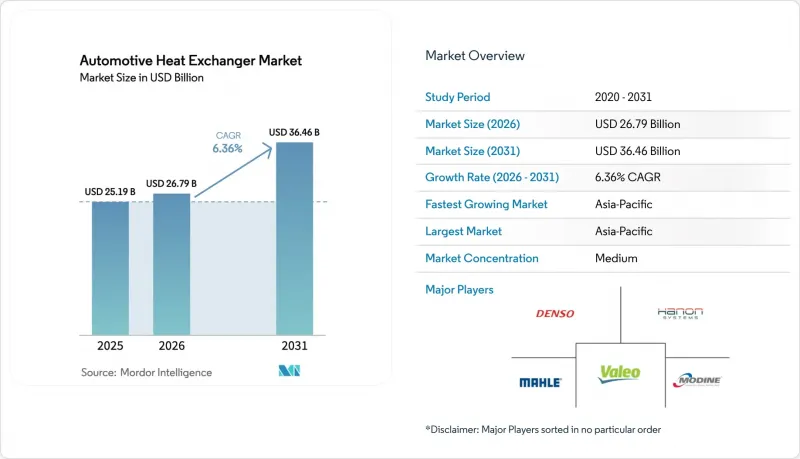
Mordor Intelligence에 의하면, 자동차용 열교환기 시장 규모는 2025년에 251억 9,000만 달러로 평가되었고, 2026년 267억 9,000만 달러에서 2031년까지 364억 6,000만 달러에 이를 것으로 예측되며, 예측 기간(2026년-2031년) CAGR은 6.36%를 기록할 전망입니다.
본 보고서는 용도별(라디에이터, 차저 에어 쿨러/인터쿨러 등), 설계 유형별(튜브 핀형, 플레이트 바형 등), 재질별(알루미늄, 구리/황동 등),차종별(승용차, 소형 상용차 등), 파워트레인 유형별(내연기관 차량 등), 지역별로 분류되어 있습니다. 시장 예측은 금액(달러) 기준으로 제시되어 있습니다.
전 세계 자동차용 열교환기 시장 동향 및 인사이트
EV 판매 확대가 견인하는 첨단 열 관리에 대한 수요
전기자동차는 내연기관 차량에 비해 약 30% 더 많은 알루미늄을 필요로 하기 때문에 라디에이터의 역할을 넘어선 열교환기의 재설계가 요구되고 있습니다. 배터리 루프는 런어웨이를 방지하기 위해 셀 온도를 2°C 범위 내로 유지해야 합니다. 한편, 실리콘 카바이드 인버터는 국부적인 열 급증을 유발하지만, 이는 마이크로채널 코어를 통해 처리됩니다. Prestone사의 GB29743-2 규격에 부합하는 냉각수용 형상 합금 및 코팅 제품, 그리고 직접 침지 냉각과 같은 저열전도율 유체를 통해 열전도 위험을 제거하는 유전체 유닛의 틈새 시장이 열리고 있습니다.
엄격한 세계 배기 가스 규제
2024년 5월에 공포된 유로 7 규제는 배기가스 제한을 통일하고, 브레이크 및 타이어에서 발생하는 입자상 물질의 상한치를 추가했습니다. 이로 인해 자동차 제조업체들이 효율 향상을 추구하는 과정에서 간접적으로 열 부하가 증가하고 있습니다. 요구되는 배터리의 내구성으로 인해 열교환기의 수명 목표는 10년 이상으로 설정되어 있으며, 내식성 브레이징 시트에 대한 수요가 증가하고 있습니다. 또한, 차량 진단 시스템을 통해 예측적인 유량 제어가 가능해졌습니다. 2026년 11월까지의 프로그램 일정에 따라 검증 기간이 단축됨에 따라, 사전 인증을 완료한 시험대를 보유한 공급업체가 유리한 입장에 있습니다.
알루미늄 및 구리 가격 변동
전기자동차에는 최대 80kg의 구리가 사용될 가능성이 있으며(내연기관 차량의 4배), 이로 인해 열교환기 비용은 현물 가격의 영향을 크게 받습니다. 자동차 제조업체는 다년 계약 및 폐쇄형 순환 재활용을 통해 리스크 헤지를 하고 있지만, 지역별 가격 차이는 여전히 조달 전략에 영향을 미치고 있습니다. 단위 중량당 전도율을 높이는 합금 혁신을 통해 1차 금속 수요를 억제하고, 환율이 급등할 때에도 비용을 안정화할 수 있습니다.
부문 분석
라디에이터는 자동차용 열교환기 시장 규모에서 가장 큰 점유율을 차지하며, 2025년에는 매출의 38.86%를 차지했습니다. 전동화의 우선 순위를 반영하여, 배터리 및 파워 일렉트로닉스용 쿨러가 2031년까지 연평균 성장률(CAGR) 12.74%를 기록함에 따라 라디에이터의 점유율은 하락하고 있습니다. 리튬 이온 배터리 팩은 급속 충전을 위해 ±2℃의 열 안정성이 요구되며, 이로 인해 자동차용 열교환기 시장에서는 일체형 칠 플레이트 및 유전체 침지 모듈의 채택이 진행되고 있습니다. 차지 에어 시스템은 터보차저의 보급에 발맞추고 있는 반면, 오일 쿨러는 e-액슬의 윤활로 용도가 전환되고 있습니다. 실내용 증발기 및 커패시터는 가역형 열펌프 열교환기로 진화하고 있으며, 수소 연료전지용 가습기는 새로운 틈새 시장으로 부상하고 있습니다.
자동차용 열교환기 시장에서는 여전히 라디에이터의 출하 대수가 중요시되고 있습니다. 그러나 연료전지 버스 및 트럭용 스택 가습 모듈에는 미개척 영역이 있으며, 이 분야에서 에버스파허(Everspacher)사의 배기 공기 유닛은 물 회수 기능과 방음 기능을 융합하고 있습니다. 하이브리드 방식의 배열 회수는 유로 7을 준수하는 파워트레인에서 여전히 중요하며, 순수 전기차의 채택이 진전되는 가운데 공급업체에게 있어 가교 역할을 하는 제품이 되고 있습니다.
플레이트·바 어셈블리는 각 OEM 업체들이 스케이트보드형 섀시에서 충돌 안전성 확보와 두께의 균형을 맞추는 과정에서 연평균 성장률(CAGR) 8.65%로 성장하고 있습니다. 마이크로채널 플랫 튜브 유닛을 활용한 자동차용 열교환기 시장 규모는 뛰어난 열전달 계수 덕분에 공간이 제한된 배터리 트레이 주변에서도 얇은 모듈을 구현할 수 있어 가장 빠르게 확대되고 있습니다. 히트파이프와 베퍼 챔버는 고급 배터리 팩에 채택되고 있으며, 이러한 추세는 고체 배터리가 열 부하를 줄이는 한편 온도 균일성 요구 사항이 엄격해짐에 따라 확산될 것으로 보입니다.
고압 루프에서는 쉘 앤 튜브식 열교환기가 여전히 확고한 입지를 유지하고 있으며, 주로 수소 연료전지나 폐열 회수 시스템 등에서 중량 증가라는 단점을 상쇄할 만한 견고성이 요구되고 있습니다. 한편, 플레이트-바형 열교환기는 내부 오프셋 핀을 채택하여 유속과 소음을 억제하고 있으며, 상용차의 충전 공기 냉각 분야에서 입지를 강화하고 있습니다.
지역별 분석
아시아태평양은 2025년에 46.88%의 점유율로 자동차용 열교환기 시장을 주도하며, 연평균 성장률(CAGR) 8.62%로 확대될 것으로 예측됩니다. 중국에서는 2025년에 자동차 생산 대수가 3,500만 대를 넘어설 전망이며, 전기차 판매 대수는 연간 50% 증가하고 있어, 마이크로채널 튜브를 대규모로 생산하는 수직 통합형 알루미늄 압출 제조업체들이 그 혜택을 보고 있습니다. 일본의 연료전지 로드맵과 한국의 복사 난방 기술의 획기적인 발전은 자동차용 열교환기 시장 전체의 기술적 수요를 더욱 다각화시키고 있습니다.
북미에서는 상반된 추세가 나타나고 있습니다. 전기차 소매 수요의 둔화로 포드는 F-150 라이트닝의 생산 대수를 줄였지만, 한편으로는 ‘인플레이션 억제법’이 현지화된 공급망을 뒷받침하고 있습니다. 젠섬(Gensam)은 4억 달러 규모의 신규 수주를 확보하는 한편, 2025년 1분기에 3억 5,400만 달러의 매출을 달성하며 기후 및 쾌적성 관련 틈새 시장에서 견조한 실적을 보이고 있습니다. 국내 압출 성형 및 브레이징에 대한 투자는 해외 원자재 공급 차질에 대한 완충 역할을 할 가능성이 있습니다.
유럽 시장 점유율은 2026년 11월로 설정된 유로 7 규격 준수 기한에 따라 좌우될 것입니다. 자동차 제조업체들은 76%의 회수율을 활용하여 재활용 알루미늄 사용을 확대되고 있습니다. 온세미(Onsemi)가 체코에 건설한 20억 달러 규모의 SiC 공장은 접합 온도 상승에 따라 해당 지역의 방열판 수요를 끌어올리고 있습니다. 또한, 국가 자금 지원은 수소 트럭 운송 회랑에도 투입되어, 자동차용 열교환기 시장에서 연료전지용 가습기 제품의 생산 라인 유지를 뒷받침하고 있습니다.
기타 혜택:
- 엑셀 형식 시장 예측(ME) 시트
- 3개월간의 애널리스트 지원
자주 묻는 질문
목차
제1장 서론
제2장 조사 방법
제3장 주요 요약
제4장 시장 구도
제5장 시장 규모와 성장 예측
제6장 경쟁 구도
제7장 시장 기회와 향후 전망
LSH 26.09.08According to Mordor Intelligence, the automotive heat exchanger market size was valued at USD 25.19 billion in 2025 and estimated to grow from USD 26.79 billion in 2026 to reach USD 36.46 billion by 2031, at a CAGR of 6.36% during the forecast period (2026-2031).
This report is Segmented by Application (Radiator, Charge-Air Coolers / Intercoolers, and More), Design Type (Tube-Fin, Plate-Bar, and More), Material (Aluminum, Copper / Brass, and More) Vehicle Type (Passenger Cars, Light Commercial Vehicles, and More), Powertrain Type (Internal Combustion Engine Vehicles, and More), and Geography. The Market Forecasts are Provided in Terms of Value (USD).
Global Automotive Heat Exchanger Market Trends and Insights
EV Sales-Driven Demand for Advanced Thermal Management
Electric vehicles require roughly 30% more aluminum than combustion cars, forcing the redesign of exchangers beyond radiator duty. Battery loops must keep cell temperatures within a 2 °C band to avoid runaway, while silicon-carbide inverters impose localized heat spikes handled by micro-channel cores. Low-conductivity fluids, such as Prestone's GB29743-2-compliant coolant shape alloy and coating choices, and direct-immersion cooling, open a niche for dielectric units that eliminate conductivity risk.
Stringent Global Emission Regulations
Euro 7 rules published in May 2024 unify tailpipe limits and add brake- and tire-particulate caps, indirectly raising thermal loads as automakers chase efficiency gains. Required battery durability pushes exchanger life targets beyond a decade, spurring corrosion-proof brazing sheets while onboard diagnostics enable predictive flow control. Program timelines to November 2026 tighten validation windows, favoring suppliers with pre-certified test benches.
Aluminum and Copper Price Volatility
Electric models can contain up to 80 kg copper-four times that of combustion cars-making exchanger cost highly sensitive to spot prices. Automakers hedge with multiyear contracts and closed-loop recycling, yet regional premiums still skew sourcing strategies. Alloy innovation that lifts conductivity per unit weight helps limit primary metal demand, stabilizing costs when exchange rates spike.
Other drivers and restraints analyzed in the detailed report include:
- Heat-pump System Integration in Electric Vehicles
- Rising HVAC Penetration in Emerging Markets
- Micro-channel Extrusion Supply Bottlenecks
For complete list of drivers and restraints, kindly check the Table Of Contents.
Segment Analysis
Radiators accounted for the largest slice of the automotive heat exchanger market size, holding 38.86% revenue in 2025. Their share slips as battery and power-electronics coolers record a 12.74% CAGR to 2031, reflecting electrification priorities. Lithium-ion packs demand +-2 °C thermal stability for fast charging, prompting integrated chill plates and dielectric immersion modules in the automotive heat exchanger market. Charge-air systems keep pace with turbocharging, while oil coolers pivot toward e-axle lubrication. Cabin evaporators and condensers evolve into reversible heat-pump exchangers, and hydrogen fuel-cell humidifiers surface as a nascent niche.
The automotive heat exchanger market continues to prize radiator volumes. Yet, white-space lies in stack humidification modules for fuel-cell buses and trucks, where Eberspacher's exhaust-air unit blends water recovery with acoustic damping. Hybrid exhaust-heat recovery remains relevant in Euro-7-compliant powertrains, giving suppliers a bridge product as pure battery adoption climbs.
Tube-fin cores represented 46.92% of automotive heat exchanger market share in 2025 owing to mature tooling and low cost. Plate-bar assemblies grow 8.65% CAGR as OEMs trade off thickness for crash packaging in skateboard chassis. The automotive heat exchanger market size for micro-channel flat tube units is scaling fastest because superior transfer coefficients enable slim modules around crowded battery trays. Heat pipes and vapor chambers appear in premium battery packs, a trend likely to cascade as solid-state cells lower heat loads but tighten temperature uniformity needs.
In high-pressure loops, shell-and-tube exchangers preserve a foothold, mainly in hydrogen fuel-cell and waste-heat recovery systems where robustness outweighs weight penalties. Concurrently, plate-bar variants adopt internal offset fins to temper flow velocity and noise, reinforcing their position in commercial-vehicle charge-air cooling.
Complete Report Scope:
- By Application
- Radiators
- Charge-Air Coolers / Intercoolers
- Oil Coolers
- EGR and Exhaust Gas Heat Recovery
- Cabin HVAC (Evaporator and Condenser)
- Battery / Power-electronics Coolers
- Fuel-cell Humidifiers
- Other Applications
- By Design Type
- Tube-Fin
- Plate-Bar
- Micro-channel Flat Tube
- Shell-and-Tube
- Others
- By Material
- Aluminum
- Copper / Brass
- Stainless Steel
- Composites and Polymers
- By Vehicle Type
- Passenger Cars
- Light Commercial Vehicles
- Heavy Commercial and Off-Highway Vehicles
- By Powertrain Type
- Internal Combustion Engine (ICE)
- Hybrid Electric Vehicles (HEV/PHEV)
- Battery Electric Vehicles (BEV)
- Fuel-Cell Electric Vehicles (FCEV)
- By Geography
- North America
- United States
- Canada
- Rest of North America
- South America
- Brazil
- Argentina
- Rest of South America
- Europe
- Germany
- United Kingdom
- France
- Italy
- Russia
- Rest of Europe
- Asia-Pacific
- China
- Japan
- India
- South Korea
- Rest of Asia-Pacific
- Middle East and Africa
- United Arab Emirates
- Saudi Arabia
- Turkey
- South Africa
- Rest of Middle East and Africa
- North America
Geography Analysis
Asia-Pacific dominated the automotive heat exchanger market with 46.88% share in 2025 and is forecast to expand 8.62% CAGR. China exceeded 35 million vehicle builds in 2025, with EV sales up 50% yearly, benefiting vertically integrated aluminum extruders that produce micro-channel tubes at scale. Japan's fuel-cell roadmap and South Korea's radiant heating breakthroughs further diversify technical demand across the automotive heat exchanger market.
North America confronts mixed signals: softer retail EV demand led Ford to trim F-150 Lightning volumes, yet the Inflation Reduction Act spurs localized supply chains. Gentherm booked USD 400 million in new awards while achieving USD 354 million Q1 2025 revenue, reflecting resilience in climate-comfort niches. Domestic extrusion and brazing investment could cushion against foreign material shocks.
Europe's share is shaped by Euro 7's November 2026 compliance deadline. Automakers are boosting recycled aluminum use, leveraging a 76% collection rate. Onsemi's USD 2 billion SiC facility in Czechia elevates regional heat-sink demand owing to higher junction temperatures. National funding also targets hydrogen truck corridors, keeping fuel-cell humidifier lines viable within the automotive heat exchanger market
- DENSO Corporation
- MAHLE GmbH
- Valeo SA
- Hanon Systems
- Modine Manufacturing Company
- Dana Incorporated
- Marelli (Calsonic Kansei)
- Sanden Holdings
- GEA Group
- Kelvion Holdings
- T.RAD Co. Ltd.
- Behr Hella Service
- AKG Thermal Systems
- American Industrial Heat Transfer
- Banco Products (India) Ltd.
- Climetal SL
- Constellium SE
- GandM Radiator
- Nippon Light Metal Holdings
- Valeo SA (Thermal Systems)
Additional Benefits:
- The market estimate (ME) sheet in Excel format
- 3 months of analyst support
TABLE OF CONTENTS
1 Introduction
- 1.1 Study Assumptions and Market Definition
- 1.2 Scope of the Study
2 Research Methodology
3 Executive Summary
4 Market Landscape
- 4.1 Market Overview
- 4.2 Market Drivers
- 4.2.1 EV Sales-Driven Demand For Advanced Thermal Management
- 4.2.2 Stringent Global Emission Regulations
- 4.2.3 Rising HVAC Penetration In Emerging Markets
- 4.2.4 Heat-Pump System Integration In Electric Vehicles
- 4.2.5 800-V High-Voltage XEV Architectures
- 4.2.6 Fuel-Cell Humidifier Exchanger Adoption
- 4.3 Market Restraints
- 4.3.1 Aluminum and Copper Price Volatility
- 4.3.2 Stringent Durability and Corrosion Validation Costs
- 4.3.3 Declining Heat-Load In Solid-State Battery Packs
- 4.3.4 Micro-Channel Extrusion Supply Bottlenecks
- 4.4 Value/Supply-Chain Analysis
- 4.5 Regulatory Landscape
- 4.6 Technological Outlook
- 4.7 Porter's Five Forces
- 4.7.1 Threat of New Entrants
- 4.7.2 Bargaining Power of Buyers
- 4.7.3 Bargaining Power of Suppliers
- 4.7.4 Threat of Substitutes
- 4.7.5 Competitive Rivalry
5 Market Size and Growth Forecasts (Value (USD))
- 5.1 By Application
- 5.1.1 Radiators
- 5.1.2 Charge-Air Coolers / Intercoolers
- 5.1.3 Oil Coolers
- 5.1.4 EGR and Exhaust Gas Heat Recovery
- 5.1.5 Cabin HVAC (Evaporator and Condenser)
- 5.1.6 Battery / Power-electronics Coolers
- 5.1.7 Fuel-cell Humidifiers
- 5.1.8 Other Applications
- 5.2 By Design Type
- 5.2.1 Tube-Fin
- 5.2.2 Plate-Bar
- 5.2.3 Micro-channel Flat Tube
- 5.2.4 Shell-and-Tube
- 5.2.5 Others
- 5.3 By Material
- 5.3.1 Aluminum
- 5.3.2 Copper / Brass
- 5.3.3 Stainless Steel
- 5.3.4 Composites and Polymers
- 5.4 By Vehicle Type
- 5.4.1 Passenger Cars
- 5.4.2 Light Commercial Vehicles
- 5.4.3 Heavy Commercial and Off-Highway Vehicles
- 5.5 By Powertrain Type
- 5.5.1 Internal Combustion Engine (ICE)
- 5.5.2 Hybrid Electric Vehicles (HEV/PHEV)
- 5.5.3 Battery Electric Vehicles (BEV)
- 5.5.4 Fuel-Cell Electric Vehicles (FCEV)
- 5.6 By Geography
- 5.6.1 North America
- 5.6.1.1 United States
- 5.6.1.2 Canada
- 5.6.1.3 Rest of North America
- 5.6.2 South America
- 5.6.2.1 Brazil
- 5.6.2.2 Argentina
- 5.6.2.3 Rest of South America
- 5.6.3 Europe
- 5.6.3.1 Germany
- 5.6.3.2 United Kingdom
- 5.6.3.3 France
- 5.6.3.4 Italy
- 5.6.3.5 Russia
- 5.6.3.6 Rest of Europe
- 5.6.4 Asia-Pacific
- 5.6.4.1 China
- 5.6.4.2 Japan
- 5.6.4.3 India
- 5.6.4.4 South Korea
- 5.6.4.5 Rest of Asia-Pacific
- 5.6.5 Middle East and Africa
- 5.6.5.1 United Arab Emirates
- 5.6.5.2 Saudi Arabia
- 5.6.5.3 Turkey
- 5.6.5.4 South Africa
- 5.6.5.5 Rest of Middle East and Africa
- 5.6.1 North America
6 Competitive Landscape
- 6.1 Market Concentration
- 6.2 Strategic Moves
- 6.3 Market Share Analysis
- 6.4 Company Profiles (Includes Global Level Overview, Market Level Overview, Core Segments, Financials as Available, Strategic Information, Market Rank/Share for Key Companies, Products and Services, and Recent Developments)
- 6.4.1 DENSO Corporation
- 6.4.2 MAHLE GmbH
- 6.4.3 Valeo SA
- 6.4.4 Hanon Systems
- 6.4.5 Modine Manufacturing Company
- 6.4.6 Dana Incorporated
- 6.4.7 Marelli (Calsonic Kansei)
- 6.4.8 Sanden Holdings
- 6.4.9 GEA Group
- 6.4.10 Kelvion Holdings
- 6.4.11 T.RAD Co. Ltd.
- 6.4.12 Behr Hella Service
- 6.4.13 AKG Thermal Systems
- 6.4.14 American Industrial Heat Transfer
- 6.4.15 Banco Products (India) Ltd.
- 6.4.16 Climetal SL
- 6.4.17 Constellium SE
- 6.4.18 GandM Radiator
- 6.4.19 Nippon Light Metal Holdings
- 6.4.20 Valeo SA (Thermal Systems)


