

|
시장보고서
상품코드
2121449
프리프레그 : 시장 점유율 분석, 업계 동향과 통계, 성장 예측(2026-2031년)Prepreg - Market Share Analysis, Industry Trends & Statistics, Growth Forecasts (2026 - 2031) |
||||||
 Mordor Intelligence
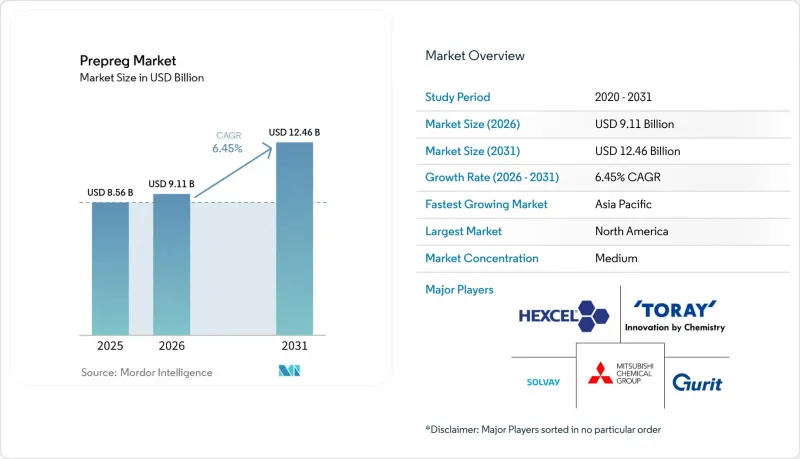
Mordor Intelligence에 의하면, 2026년 프리프레그 시장 규모는 91억 1,000만 달러로 추정되며, 2025년 85억 6,000만 달러에서 성장하여 2031년에는 124억 6,000만 달러에 달할 것으로 예측됩니다.
또한 2026-2031년 연평균 성장률(CAGR) 6.45%를 기록할 전망입니다.

본 보고서는 수지 유형(열경화성, 열가소성), 섬유 유형(탄소섬유, 유리 섬유, 아라미드 섬유), 형태(단방향 테이프, 토우 프리프레그,패 브릭/직물, 오가노 시트), 최종 사용자 산업(항공우주 및 방위, 풍력 터빈, 자동차 등), 지역(아시아태평양, 북미, 유럽, 남미, 중동 및 아프리카)별로 분류되어 있습니다. 시장 예측은 금액(달러) 기준으로 제시되어 있습니다.
전 세계 프리프레그 시장 동향 및 인사이트
급증하는 항공우주 및 방위 분야의 생산 대수
보잉사의 777X 및 에어버스사의 A350이 모두 중량 대비 50% 이상의 탄소섬유 강화 폴리머를 포함한 복합재를 다량 사용하는 제조 일정을 지속하고 있어, 민간 항공기 생산이 증가하고 있습니다. 고양력 구조 부품, 동체 배럴, 날개 외판에는 엄격한 피로 및 손상 허용 요건을 충족하는 인증된 에폭시계 프리프레그가 사용되고 있습니다. NATO 회원국의 국방력 현대화도 유사한 추세를 보이고 있으며, 구형 기체를 항속 거리와 적재량을 확대하는 경량 임무 시스템으로 개조하고 있습니다. 장기 계약을 통해 도레이 및 헥셀 코퍼레이션 등공급업체는 인증 취득 비용을 상각하면서 안정적인 납품을 보장할 수 있습니다. 항공기 1대당 복합재 사용량이 증가함에 따라, 프리프레그 시장은 독자적인 소재 데이터베이스에 힘입어 판매량 증가와 평균 판매 가격 상승이라는 두 가지 이점을 모두 누리고 있습니다.
풍력 터빈 블레이드 길이의 확대
현재 해상 풍력 발전기의 로터 직경 평균은 200m를 초과하고, 블레이드 길이도 100m 이상이어야 하므로 스퍼 캡의 강성에 대한 요구가 높아지고 있습니다. 탄소섬유 프리프레그로 제작된 스퍼 캡은 구조적 무결성을 유지하면서 블레이드 무게를 25% 줄여, 기존의 재킷 기초에 더 대형 터빈을 설치할 수 있게 해줍니다. 베스타스(Vestas) 등 유럽의 OEM 업체들은 유리섬유에서 탄소-유리 하이브리드 구조로 전환하고 있으며, 중국 제조업체들도 발전 용량 확대 목표를 달성하기 위해 이를 따르고 있습니다. 진공 보조 수지 전사 성형(VTM) 및 자동 섬유 배치(AFP)를 통해 사이클 시간이 단축되고 인건비가 절감됨에 따라 비용 경쟁력이 강화되고 있습니다. 북해와 남중국해에서의 해상 풍력 발전 사업이 가속화되는 가운데, 지속적인 탄소섬유 수요가 프리프레그 시장에 대한 견고한 장기 수주 전망을 확고히 하고 있습니다.
오토클레이브 경화 라인의 높은 설비 투자(Capex) 및 운영비(OpEx)
대형 항공우주용 오토클레이브는 설비 투자액이 200만 달러를 초과하고, 6-8시간의 열압 사이클로 가동되기 때문에 막대한 에너지를 소비합니다. 소규모 2차 공급업체는 자금 조달 장벽이 높아 세계 사업 확장에 제약을 받을 뿐만 아니라, 수요가 급증할 경우 공급 병목 현상의 위험이 발생합니다. 오토클레이브 외 공정(진공 백만을 이용한 경화, 수지 주입, 오븐을 이용한 경화 사이클)은 에너지 소비를 최대 50%까지 줄여주지만, 1차 구조물에서 오토클레이브를 통한 기공률 제어를 아직 재현할 수는 없습니다. 항공우주용 2차 부품에 대한 도입이 점차 진행되면서 비용은 낮아지고 있지만, 동체나 주익의 인증이 지연될 경우 오토클레이브의 우위가 유지되어 프리프레그 시장의 추가적인 보급이 계속해서 억제될 것입니다.
부문 분석
2025년에는 상업용 항공기 및 방탄 등급 방위 장비의 인증 진전에 힘입어 열경화성 수지 시스템이 매출의 72.80%를 차지했습니다. 에폭시 수지는 고온 경화를 통해 항공기의 수명 주기 전반에 걸쳐 일관된 기계적 특성을 발휘하기 때문에 주익 및 동체의 주요 부재에 여전히 필수적입니다. 대조적으로, 열가소성 수지 등급은 eVTOL, 자동차, 수소 저장 분야 수요 증가에 따라 연평균 성장률(CAGR) 8.43%로 확대될 것으로 예측됩니다. 이러한 성장에 힘입어 2026년부터 2031년 사이에 프리프레그 시장 규모에 12억 9,000만 달러가 기여할 것으로 보입니다. 폴리에테르에테르케톤(PEEK) 및 폴리페닐렌설파이드(PPS) 계열 수지는 최대 220°C의 내열성을 갖추고 있으며, 유도 용접이 가능하기 때문에 조립 시 체결 부품의 수를 줄이고, 유지보수로 인한 가동 중단 시간을 단축할 수 있습니다.
폐쇄형 소재 흐름에 대한 노력이 열가소성 수지의 매력을 높이고 있습니다. 이는 절단 부스러기를 성능을 저하시키지 않고 재용융하여 2차 성형품으로 재생할 수 있기 때문입니다. 고톤수의 압축 성형 프레스를 운영하는 자동차 OEM 각사는 기존의 180°C 에폭시 수지 성형 사이클에서 3분 미만의 열가소성 수지 성형 공정으로 전환했을 때, 사이클 타임이 40% 단축되었다고 보고하고 있습니다. 한편, 비스마레이미드나 페놀계 수지는 내화성·연기 독성 기준 준수가 요구되는 고온의 제트 엔진 덕트나 내장 패널 분야에서 여전히 틈새 시장 지위를 유지하고 있습니다. 전반적으로, 수지 화학 계열별 서로 다른 성장 궤적이 프리프레그 시장 내 경쟁의 다양성을 보장하고 있습니다.
2025년에는 탄소섬유가 금액 기준으로 80.70%를 차지할 것으로 예측됩니다. 이는 탄소섬유의 타의 추종을 불허하는 강성 대 중량 비율이 민간 항공기, 우주 로켓, F1의 요구 사항을 뒷받침하고 있기 때문입니다. 항공기의 운항 공차 중량을 1Kg 줄일 때마다, 그 수명 기간 동안 최대 75톤의 연료를 절약할 수 있습니다. 이는 경기 침체기에도 탄소 가격의 강세를 유지하는 직접적인 경제적 요인이 됩니다. 한편, 유리섬유는 5G 전자기기, LED 기판, 그리고 더 낮은 탄성률 값이라도 허용되는 비용 중심의 모빌리티 용도에 힘입어 2031년까지 연평균 성장률(CAGR) 7.62%를 나타낼 것으로 예측됩니다. 특수 유리 섬유 프리프레그를 사용하여 배합된 고주파 인쇄 회로 기판용 적층판은 24GHz 이상의 레이더용 유전율 기준을 충족합니다.
풍력 터빈의 스파 캡에서 카본 스킨과 유리 코어 패브릭을 결합한 하이브리드 적층판은 무게를 최적화하면서 원자재 비용을 절감하여 대상 시장 규모를 확대되고 있습니다. 아라미드 섬유는 방탄 보호 및 충격 에너지 흡수 분야에서 제한된 시장 점유율을 유지하고 있지만, 각 보강재가 수행하는 소재 고유의 역할을 부각시키고 있습니다. 중국 생산자들이 생산 규모를 확대함에 따라 저급 카본 파이버의 가격이 압박을 받고, 상대적인 비용 차이가 확대되면서 성능 차이가 크지 않은 분야에서는 대체 소재의 타당성에 대한 논의가 활발해지고 있습니다.
지역별 분석
북미는 2025년 프리프레그 시장에서 37.40%라는 최대 점유율을 유지했습니다. 이는 복합재를 다량으로 사용하는 보잉사의 787, 777X 및 독자적인 우주 발사 구조물이 뒷받침하고 있습니다. 미국 국방부의 현대화 프로그램에 따라 자재 수요는 회전익기, 무인 시스템, 초음속기로 확대되고 있으며, 향후 수년에 걸쳐 안정적인 수주 잔고가 확보되어 있습니다. 이 지역의 인증 생태계는 헥셀(Hexel)이나 도레이 어드밴스드 컴포지트(Toray Advanced Composites)와 같은 국내 공급업체에 유리하게 작용하고 있습니다. 두 회사 모두 탄화 공정부터 프리프레그 제조에 이르기까지 수직 통합형 생산 라인을 운영하고 있습니다. 그럼에도 불구하고, 2025년 민간 항공우주 분야의 매출액은 협폭기(narrow-body) 인도 계획의 대폭적인 조정에 따라 감소했습니다. 이는 방위 분야의 미결 주문량이 견조한 반면, 단기적인 변동이 발생하기 쉽다는 점을 여실히 보여주고 있습니다.
아시아태평양은 2031년까지 연평균 성장률(CAGR)이 7.78%로 예측되며, 가장 빠르게 성장하는 지역으로 부상하고 있습니다. 중국의 국영 탄소섬유 제조업체들은 2030년까지 전 세계 생산 능력의 50% 가까이를 차지할 전망이며, 가격을 인하하여 산업 전반에 걸친 채택 확대를 촉진하고 있습니다. COMAC의 C919 및 CR929와 같은 국산 항공우주 프로그램과 국내 eVTOL 프로토타입은 고품질 프리프레그에 대한 확실한 수요를 창출하고 있습니다. 일본의 도레이와 테이진은 고탄성률 섬유 및 자동차용 인증을 받은 열가소성 라미네이트를 통해 기술적 리더십을 유지하고 있는 반면, 한국의 수소 저장 탱크 관련 노력은 토우 프리프레그의 성장을 뒷받침하고 있습니다.
유럽에서는 에어버스의 주익 조립, 영국의 첨단 추진 시스템 연구 개발, 그리고 북해의 적극적인 해상 풍력 발전 목표에 힘입어 한 자릿수 중반의 성장률을 유지하고 있습니다. 정책 입안자들은 사용 후 복합재료 폐기물에 대한 감시를 강화하고 있으며, 고부가가치 섬유를 회수할 수 있는 열분해 및 용매 분해 파일럿 플랜트에 대한 투자가 가속화되고 있습니다. 그릿(Grit)사가 스위스의 생산 라인을 폐쇄하는 한편, 독일의 항공우주용 프리프레그 생산 능력을 확대하기로 결정한 것은 유럽의 에너지 가격 급등 속에서 비용 합리화를 여실히 보여주고 있습니다. 한편, 자동차 분야의 복합재 채택은 탄소섬유 사용 제한 가능성에 대한 규제 불확실성에 직면해 있지만, 재생 에너지 및 상업용 항공 분야에서는 경량 소재가 여전히 규제 대상에서 제외되고 있습니다.
기타 혜택:
- 엑셀 형식 시장 예측(ME) 시트
- 3개월간의 애널리스트 지원
자주 묻는 질문
목차
제1장 서론
제2장 조사 방법
제3장 주요 요약
제4장 시장 구도
제5장 시장 규모와 성장 예측
제6장 경쟁 구도
제7장 시장 기회와 향후 전망
LSH 26.09.09According to Mordor Intelligence, prepreg market size in 2026 is estimated at USD 9.11 billion, growing from 2025 value of USD 8.56 billion with 2031 projections showing USD 12.46 billion, growing at 6.45% CAGR over 2026-2031.
This report is Segmented by Resin Type (Thermoset, Thermoplastic), Fiber Type (Carbon, Glass, Aramid), Form (Unidirectional Tapes, Tow Prepreg, Fabric/Woven, Organosheets), End-User Industry (Aerospace and Defense, Wind Turbine, Automotive, and More), and Geography (Asia-Pacific, North America, Europe, South America, Middle East and Africa). The Market Forecasts are Provided in Terms of Value (USD).
Global Prepreg Market Trends and Insights
Surging Aerospace and Defense Build-Rates
Commercial aircraft production is rising as Boeing's 777X and Airbus's A350 continue composite-heavy build schedules, each incorporating more than 50% carbon-fiber-reinforced polymer by weight. High-lift structural components, fuselage barrels, and wing skins rely on certified epoxy-based prepreg that meets stringent fatigue and damage-tolerance requirements. Defense modernization across NATO members mirrors these trends, retrofitting legacy fleets with lighter mission systems that extend range and payload. Long-term contracts allow suppliers such as Toray Industries and Hexcel Corporation to amortize qualification costs while guaranteeing stable deliveries. As composite usage per aircraft climbs, the prepreg market benefits from both volume growth and higher average selling prices anchored by proprietary material databases.
Wind-Turbine Blade Length Escalation
Average offshore rotor diameters now exceed 200 m, forcing blade lengths above 100 m and increasing spar-cap stiffness demands. Carbon-fiber prepreg spar caps reduce blade weight by 25% while maintaining structural integrity, enabling larger turbines to be installed on existing jacket foundations. European OEMs such as Vestas have shifted from fiberglass to hybrid carbon-glass architectures, and Chinese manufacturers are following to meet capacity-addition targets. Vacuum-assisted resin transfer molding and automated fiber placement shorten cycle times and cut labor expenses, bolstering cost competitiveness. With offshore wind commitments accelerating in the North Sea and South China Sea, sustained carbon-fiber demand secures a robust long-term pipeline for the prepreg market.
High Cap-ex and OPEX of Autoclave Curing Lines
Large-format aerospace autoclaves exceed USD 2 million in capital cost and operate 6-8-hour heat-pressure cycles that consume substantial energy. Smaller Tier-2 suppliers face steep financing barriers, limiting global expansion and introducing supply-bottleneck risk when demand surges. Out-of-autoclave processes-vacuum-bag-only curing, resin-infusion, and oven-based cycles-reduce energy by up to 50% but cannot yet replicate autoclave-derived porosity control for primary structures. Incremental adoption in secondary aerospace parts lowers cost envelopes; however, any delay in fuselage or wing certification sustains the autoclave's dominance and continues to restrain wider prepreg market penetration.
Other drivers and restraints analyzed in the detailed report include:
- Carbon-Prepreg Penetration in Premium Autos and Sports
- eVTOL and Urban-Air-Mobility Demand for Thermoplastic Prepregs
- Carbon-Fiber Supply-Chain Volatility
For complete list of drivers and restraints, kindly check the Table Of Contents.
Segment Analysis
Thermoset systems retained 72.80% revenue in 2025, underpinned by certification depth in commercial aviation and ballistic-grade defense hardware. Epoxies remain indispensable for primary wings and fuselage sections where high-temperature cures translate to consistent mechanical properties over the aircraft life cycle. In contrast, thermoplastic grades are projected to advance at an 8.43% CAGR on rising eVTOL, automotive, and hydrogen-storage requirements. That expansion contributes USD 1.29 billion to the prepreg market size between 2026 and 2031. Polyetheretherketone and polyphenylene sulfide families deliver heat resistance up to 220 °C and allow induction welding, thereby reducing assembly fastener counts and maintenance downtime.
The push for closed-loop material flows strengthens thermoplastic appeal, as scrap off-cuts can be re-melted into secondary mouldings without degrading performance. Automotive OEMs running high-tonnage compression presses report cycle-time improvements of 40% when switching from classic 180 °C epoxy cycles to sub-3-minute thermoplastic campaigns. Meanwhile, bismaleimide and phenolic systems hold their niche in high-temperature jet-engine ducts and interior panels that demand flame-smoke-toxicity compliance. Overall, contrasting growth trajectories between resin chemistries ensure competitive diversity within the prepreg market.
Carbon fiber controlled 80.70% by value in 2025 as its unmatched stiffness-to-weight ratio underpins commercial airliner, space-launch, and Formula 1 requirements. Each additional kilogram trimmed from an aircraft's operating empty weight saves up to 75 t of fuel over its service life, a direct economic lever that keeps carbon pricing resilient even during downturns. Glass fiber, however, is projected for 7.62% CAGR growth through 2031, riding 5G electronics, LED substrates, and cost-sensitive mobility applications that tolerate lower modulus values. High-frequency printed-circuit-board laminates formulated with specialized glass-fiber prepreg meet dielectric benchmarks for 24 GHz radar and beyond.
Hybrid laminates combining carbon skins with glass core fabrics in wind-turbine spar caps optimize weight while lowering raw-material cost, widening addressable volume. Aramid fibers retain limited market presence in ballistic protection and impact-energy absorption but underscore the material-specific role each reinforcement plays. As Chinese producers scale output, lower-grade carbon fiber pricing compresses, widening the relative cost delta and spurring substitution debates where performance margins are narrower.
Complete Report Scope:
- By Resin Type
- Thermoset
- Thermoplastic
- By Fiber Type
- Carbon
- Glass
- Aramid
- By Form
- Unidirectional (UD) Tapes
- Tow Prepreg
- Fabric/Woven
- Organosheets
- By End-User Industry
- Aerospace and Defense
- Wind Turbine
- Automotive
- Electrical and Electronics
- Sporting and Leisure
- Other Industries
- By Geography
- Asia-Pacific
- China
- Japan
- India
- South Korea
- Australia
- Southeast Asia
- Rest of Asia-Pacific
- North America
- United States
- Canada
- Mexico
- Europe
- Germany
- United Kingdom
- France
- Italy
- Spain
- Russia
- Rest of Europe
- South America
- Brazil
- Argentina
- Rest of South America
- Middle East and Africa
- Saudi Arabia
- United Arab Emirates
- South Africa
- Nigeria
- Rest of Middle East and Africa
- Asia-Pacific
Geography Analysis
North America retained the largest 37.40% share of the prepreg market in 2025, buoyed by Boeing's composite-intensive 787, 777X, and proprietary space-launch structures. Pentagon modernization programs extend material demand into rotorcraft, unmanned systems, and hypersonic vehicles, ensuring stable multi-year order books. The region's certification ecosystem favors domestic suppliers such as Hexcel and Toray Advanced Composites, both of which operate vertically integrated lines from carbonization to prepregging. Nevertheless, 2025 commercial-aerospace revenues slipped after a major narrow-body delivery adjustment, highlighting short-cycle variability amid otherwise strong defense backlogs.
Asia-Pacific emerges as the quickest-growing geography with an 7.78% CAGR forecast to 2031. Chinese state-backed carbon fiber producers are on pace to command nearly 50% of global capacity by 2030, lowering price points and catalyzing broader industrial uptake. Indigenous aerospace programs such as COMAC's C919 and CR929, along with domestic eVTOL prototypes, provide captive demand for high-grade prepreg. Japan's Toray and Teijin maintain technology leadership through high-modulus fibers and automotive-qualified thermoplastic laminates, while South Korea's hydrogen-storage tank initiatives fuel tow-prepreg growth.
Europe sustains mid-single-digit growth anchored by Airbus wing-assembly, UK advanced-propulsion R&D, and aggressive offshore-wind targets in the North Sea. Policymakers intensify scrutiny of end-of-life composite waste, accelerating investment into pyrolysis and solvolysis pilot plants that can reclaim high-value fiber. Gurit's decision to expand German aerospace-prepreg capacity while shuttering a Swiss line illustrates cost-rationalization amid tight European energy pricing. Meanwhile, automotive composite adoption faces regulatory uncertainty over potential carbon-fiber usage limits, though lighter materials remain exempt in renewable-energy and commercial-aviation contexts.
- AGC INC.
- Axiom Materials
- DIC Corporation
- Gurit Services AG
- Hexcel Corporation
- Huntsman International LLC
- Isola Group
- Mitsubishi Chemical Group Corporation
- NTPT
- Park Aerospace Corp.
- Renegade Materials Corporation
- SGL Carbon
- Solvay
- Teijin Limited
- THE YOKOHAMA RUBBER CO., LTD.
- Toray Industries Inc.
- Ventec International Group
- Victrex plc
Additional Benefits:
- The market estimate (ME) sheet in Excel format
- 3 months of analyst support
TABLE OF CONTENTS
1 Introduction
- 1.1 Study Assumptions and Market Definition
- 1.2 Scope of the Study
2 Research Methodology
3 Executive Summary
4 Market Landscape
- 4.1 Market Overview
- 4.2 Market Drivers
- 4.2.1 Surging aerospace and defense build-rates
- 4.2.2 Wind-turbine blade length escalation
- 4.2.3 Carbon-prepreg penetration in premium autos and sports
- 4.2.4 eVTOL and urban-air-mobility demand for thermoplastic prepregs
- 4.2.5 Hydrogen pressure-vessel tow-prepreg boom
- 4.3 Market Restraints
- 4.3.1 High cap-ex and OPEX of autoclave curing lines
- 4.3.2 Carbon-fiber supply-chain volatility
- 4.3.3 Weak recycling and EoL infrastructure
- 4.4 Value Chain Analysis
- 4.5 Porter's Five Forces
- 4.5.1 Bargaining Power of Suppliers
- 4.5.2 Bargaining Power of Buyers
- 4.5.3 Threat of New Entrants
- 4.5.4 Threat of Substitutes
- 4.5.5 Degree of Competition
5 Market Size and Growth Forecasts (Value)
- 5.1 By Resin Type
- 5.1.1 Thermoset
- 5.1.2 Thermoplastic
- 5.2 By Fiber Type
- 5.2.1 Carbon
- 5.2.2 Glass
- 5.2.3 Aramid
- 5.3 By Form
- 5.3.1 Unidirectional (UD) Tapes
- 5.3.2 Tow Prepreg
- 5.3.3 Fabric/Woven
- 5.3.4 Organosheets
- 5.4 By End-User Industry
- 5.4.1 Aerospace and Defense
- 5.4.2 Wind Turbine
- 5.4.3 Automotive
- 5.4.4 Electrical and Electronics
- 5.4.5 Sporting and Leisure
- 5.4.6 Other Industries
- 5.5 By Geography
- 5.5.1 Asia-Pacific
- 5.5.1.1 China
- 5.5.1.2 Japan
- 5.5.1.3 India
- 5.5.1.4 South Korea
- 5.5.1.5 Australia
- 5.5.1.6 Southeast Asia
- 5.5.1.7 Rest of Asia-Pacific
- 5.5.2 North America
- 5.5.2.1 United States
- 5.5.2.2 Canada
- 5.5.2.3 Mexico
- 5.5.3 Europe
- 5.5.3.1 Germany
- 5.5.3.2 United Kingdom
- 5.5.3.3 France
- 5.5.3.4 Italy
- 5.5.3.5 Spain
- 5.5.3.6 Russia
- 5.5.3.7 Rest of Europe
- 5.5.4 South America
- 5.5.4.1 Brazil
- 5.5.4.2 Argentina
- 5.5.4.3 Rest of South America
- 5.5.5 Middle East and Africa
- 5.5.5.1 Saudi Arabia
- 5.5.5.2 United Arab Emirates
- 5.5.5.3 South Africa
- 5.5.5.4 Nigeria
- 5.5.5.5 Rest of Middle East and Africa
- 5.5.1 Asia-Pacific
6 Competitive Landscape
- 6.1 Market Concentration
- 6.2 Strategic Moves
- 6.3 Market Share Analysis
- 6.4 Company Profiles (includes Global level Overview, Market level overview, Core Segments, Financials, Strategic Info, Market Rank/Share, Products and Services, Recent Developments)
- 6.4.1 AGC INC.
- 6.4.2 Axiom Materials
- 6.4.3 DIC Corporation
- 6.4.4 Gurit Services AG
- 6.4.5 Hexcel Corporation
- 6.4.6 Huntsman International LLC
- 6.4.7 Isola Group
- 6.4.8 Mitsubishi Chemical Group Corporation
- 6.4.9 NTPT
- 6.4.10 Park Aerospace Corp.
- 6.4.11 Renegade Materials Corporation
- 6.4.12 SGL Carbon
- 6.4.13 Solvay
- 6.4.14 Teijin Limited
- 6.4.15 THE YOKOHAMA RUBBER CO., LTD.
- 6.4.16 Toray Industries Inc.
- 6.4.17 Ventec International Group
- 6.4.18 Victrex plc
7 Market Opportunities and Future Outlook
- 7.1 White-space and Unmet-Need Assessment


