

|
시장보고서
상품코드
2121722
유럽의 접착제 및 실란트 : 시장 점유율 분석, 업계 동향과 통계, 성장 예측(2026-2031년)Europe Adhesives And Sealants - Market Share Analysis, Industry Trends & Statistics, Growth Forecasts (2026 - 2031) |
||||||
 Mordor Intelligence
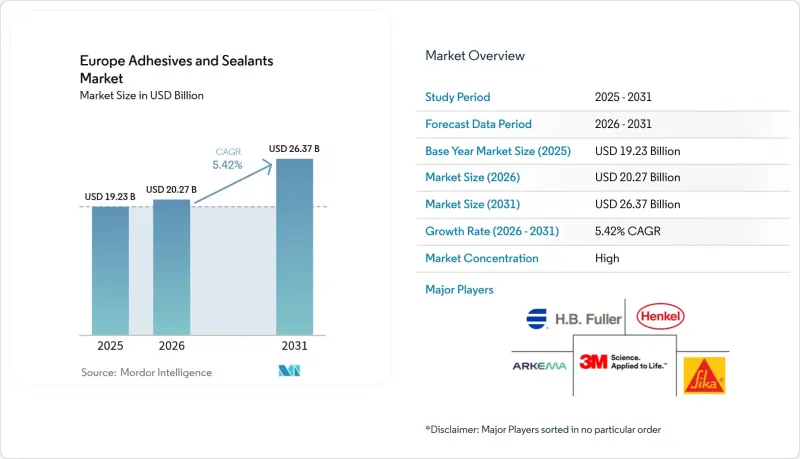
Mordor Intelligence에 의하면, 2026년 유럽의 접착제 및 실란트 시장 규모는 202억 7,000만 달러로 추정되고 있으며, 2025년 192억 3,000만 달러에서 2031년에는 263억 7,000만 달러에 달할 것으로 예측됩니다.
또한, 2026-2031년 연평균 성장률(CAGR)은 5.42%를 기록할 전망입니다.
본 보고서는 접착제 수지(아크릴, 시아노아크릴레이트, 에폭시, 기타), 접착제 기술(핫멜트, 반응형, 용제형, 기타), 실란트 수지(폴리우레탄, 에폭시,아크릴, 기타), 최종 사용자 산업(항공우주, 자동차, 건축 및 건설, 기타), 지역(독일, 영국, 프랑스, 이탈리아, 스페인, 러시아, 북유럽 국가, 기타 유럽)별로 분류되어 있습니다.
유럽의 접착제 및 실란트 시장 동향 및 인사이트
주택 리모델링 수요 증가
에너지 효율화 의무화 및 팬데믹 이후 라이프스타일 변화로 인해 단열재, 바닥재, 창문 개보수 지출이 증가함에 따라 유럽의 개보수 활동은 탄력을 받고 있습니다. ‘EU 리노베이션 웨이브(EU Renovation Wave)’는 2030년까지 건물 리노베이션 비율을 2배로 늘리는 것을 목표로 하고 있으며, 이는 열교를 제거하는 연속 접착 시스템에 대한 수요를 뒷받침하고 있습니다. 독일의 연간 500억 유로(약 584억 5,000만 달러) 규모의 리노베이션 시장에서는 화석 유래 제품에 비해 내재된 CO2를 60% 이상 감축하는 헨켈의 ‘LOCTITE HB S ECO’와 같은 바이오 유래 제품이 점점 더 많이 지정되고 있습니다. 북유럽공급업체들은 조립식 파사드 패널용 공장 도장형 접착제 개발을 선도하고 있으며, 이는 엄격한 실내 공기질 기준을 충족하면서도 현장에서의 신속한 조립을 가능하게 합니다. 이러한 리노베이션 수요 증가에 힘입어 2028년까지 유럽의 접착제 및 실란트 시장의 수량 성장이 지속될 전망입니다.
전자상거래 포장물량의 급증
소포 발송량 증가에 따라, 각 컨버터 기업들은 FEICA가 공표한 종이 재활용 가이드라인을 준수하는 고속이며 용제 무함유 접착 솔루션의 도입을 추진하고 있습니다. 연질 포장용 접착제는 접착 강도와 탈색성의 균형을 유지하면서, EU 플라스틱 전략 하에서 재활용을 단순화하는 단일 소재 설계를 지원해야 합니다. 독일과 네덜란드에서는 엄격한 점도 제어와 빠른 경화가 요구되는 자동 생산 라인의 업그레이드가 진행되고 있습니다. 이러한 동향은 특히 고속 처리를 위해 설계된 핫멜트형 및 수성형 접착제·실런트 분야에서 유럽 시장의 점진적인 성장을 뒷받침하는 요인이 되고 있습니다.
높아지는 환경 문제
2023년 8월에 발효되는 REACH의 디이소시아네이트 규제로 인해 폴리우레탄 시스템의 재조성 또는 근로자 교육이 의무화되는 한편, 2026년 8월에 발효되는 포름알데히드 배출 상한치로 인해 초저배출 등급으로의 전환이 진행되고 있습니다. 옥타메틸트리실록산을 포함한 247종의 SVHC가 추가됨에 따라 규제상의 불확실성이 더욱 커지고 있습니다. 지속가능성에 대한 투자로 인해 유럽 화학 산업 전체의 연간 자본 지출이 70% 증가해야 하며, 이로 인해 이익률은 압박을 받지만 바이오 원료 분야의 장기적인 혁신이 촉진되고 있습니다.
부문별 분석
아크릴계 수지는 그 범용성과 다양한 기질에 대한 접착력 덕분에 2025년 유럽의 접착제 및 실란트 시장에서 36.55%의 매출 점유율을 유지했습니다. 한편, 바이오 혁신 제품을 포함한 기타 수지는 탄소 배출 감축 규제가 강화됨에 따라 2031년까지 연평균 성장률(CAGR) 6.58%로 확대될 것으로 예측됩니다. BASF의 재생 가능 아크릴산 에틸 시장 출시와, 자일란계 핫멜트가 30MPa의 중첩 전단 강도를 발휘하면서도 재사용이 가능하다는 것이 입증됨에 따라, 유럽 접착제·실런트 시장에서 바이오 유래 등급 시장 규모는 확대될 것으로 예측됩니다. 시아노아크릴레이트계 접착제는 전자기기의 소형화에서 주목을 받고 있으며, 폴리우레탄 배합 제조업체들은 디이소시아네이트 취급 훈련이 필요 없는 습기 경화형 시스템 개발을 추진하고 있습니다. 실리콘계 제품은 고온 용도 부문에서 성장하고 있는 반면, VAE/EVA는 비용 면에서의 우위를 살려 틈새 시장을 유지하고 있습니다.
수성 플랫폼은 2025년 매출의 42.70%를 차지하고 있으며, 이는 확립된 생산 라인과 VOC 규제 준수를 반영한 것입니다. 한편, 조립 공장에서 순간 접착 가공을 요구함에 따라 UV 경화형 시스템은 2031년까지 연평균 성장률(CAGR) 6.21%를 기록할 전망입니다. 파나콜의 흑색 UV 에폭시는 더 두꺼운 층에서도 경화되어 그림자가 생기는 부분을 없애기 때문에 현재 EV 모터의 와이어 응력 완화 접합부에 지정되어 있습니다.
반응성 핫멜트는 빠른 경화성과 강력한 최종 접착력을 겸비하고 있어 고속 포장 라인에서 활용되고 있습니다. 용제계 제품에 대한 수요는 긴 오픈 타임이 필수적인 항공우주 부문에서 여전히 지속되고 있지만, 고고형분 제품이 배출 규제의 강화에 대응하는 데 도움이 되고 있습니다. LED-UV 램프로의 설비 교체로 에너지 소비가 감소함에 따라, 유럽의 접착제 및 실란트 시장에서 기술 전환이 더욱 가속화되고 있습니다.
기타 혜택
- 엑셀 형식 시장 예측(ME) 시트
- 3개월간의 애널리스트 지원
자주 묻는 질문
목차
제1장 서론
제2장 조사 방법
제3장 주요 요약
제4장 시장 구도
제5장 시장 규모와 성장 예측
제6장 경쟁 구도
제7장 시장 기회와 향후 전망
LSH 26.09.02According to Mordor Intelligence, the Europe adhesives and sealants market size in 2026 is estimated at USD 20.27 billion, growing from 2025 value of USD 19.23 billion with 2031 projections showing USD 26.37 billion, growing at 5.42% CAGR over 2026-2031.
This report is Segmented by Adhesive Resin (Acrylic, Cyanoacrylate, Epoxy, and More), Adhesive Technology (Hot-Melt, Reactive, Solvent-Borne, and More), Sealant Resin (Polyurethane, Epoxy, Acrylic, and More), End-User Industry (Aerospace, Automotive, Building and Construction, and More), and Geography (Germany, United Kingdom, France, Italy, Spain, Russia, NORDIC Countries, and Rest of Europe).
Europe Adhesives And Sealants Market Trends and Insights
Rising Demand from Residential Renovation
European renovation activity is gathering momentum as energy-efficiency mandates and post-pandemic lifestyle shifts lift spending on insulation, flooring, and window upgrades. The EU Renovation Wave aims to double building refurbishment rates by 2030, bolstering demand for continuous-bonding systems that eliminate thermal bridging. Germany's EUR 50 billion (~USD 58.45 billion) annual renovation market increasingly specifies bio-based products such as Henkel's LOCTITE HB S ECO, which cuts embodied CO2 by more than 60% compared with fossil-based counterparts. Nordic suppliers pioneer factory-applied adhesives for prefabricated facade panels, allowing rapid site assembly while meeting stringent indoor-air-quality norms. This renovation push is set to sustain volume growth for the European adhesives and sealants market through 2028.
Surge in E-Commerce Packaging Volumes
Rising parcel shipments prompt converters to adopt high-speed, solvent-free bonding solutions compatible with paper-recycling guidelines published by FEICA. Flexible-packaging adhesives must balance bond strength and de-inkability while supporting mono-material designs that simplify recycling under the EU Plastics Strategy. Germany and the Netherlands are upgrading automated lines that require tight viscosity control and quick setting. These trends underpin incremental gains for the European adhesives and sealants market, especially in hot-melt and waterborne grades engineered for rapid throughput.
Rising Environmental Concerns
REACH diisocyanate restrictions effective August 2023 force reformulation of polyurethane systems or mandatory worker training, while formaldehyde emission ceilings effective August 2026 drive shifts to ultra-low-emission grades. The addition of 247 SVHCs, including octamethyltrisiloxane, extends regulatory uncertainty. Sustainability investment needs 70% higher annual capital outlays across Europe's chemical sector, compressing margins yet spurring long-run innovation in bio-based feedstocks.
Other drivers and restraints analyzed in the detailed report include:
- Accelerating Lightweighting in European Auto Industry
- Fast-Growing Wind-Turbine Blade Bonding Market
- Volatile Feedstock Prices
For complete list of drivers and restraints, kindly check the Table Of Contents.
Segment Analysis
Acrylics retained 36.55% revenue share of the European adhesives and sealants market in 2025, thanks to versatility and adhesion to diverse substrates. Other resins, including bio-based innovations, are forecast to expand 6.58% CAGR to 2031 as carbon-reduction mandates intensify. Europe adhesives and sealants market size for bio-based grades is projected to widen as BASF's renewable ethyl acrylate rolls out and xylan hot-melts demonstrate 30 MPa lap-shear while remaining reusable. Cyanoacrylates gain traction in electronics miniaturization, and polyurethane formulators pursue moisture-curing systems that bypass diisocyanate training. Silicone chemistries grow in high-temperature segments, whereas VAE/EVA retains cost-driven niches.
Waterborne platforms accounted for 42.70% of the 2025 revenue base, reflecting entrenched production lines and alignment with VOC caps. UV-cured systems, however, will post a 6.21% CAGR through 2031 as assembly plants seek instant-bond processing. Panacol's black UV epoxies cure in thicker layers, eliminating shadow areas, and are now specified in EV motor wire stress-relief joints.
Reactive hot melts combine rapid set with strong final bonds, serving high-speed packaging lines. Solvent-borne demand persists in aerospace, where long open time is critical, but higher-solids versions help meet tightening emission norms. Equipment upgrades toward LED-UV lamps cut energy use and further incentivize technology switching in the European adhesives and sealants market.
Complete Report Scope:
- By Adhesive Resin
- Acrylic
- Cyanoacrylate
- Epoxy
- Polyurethane
- Silicone
- VAE / EVA
- Other Resins (Silane-Modified Polymer (SMP), Bio-based Resins, etc.)
- By Adhesive Technology
- Hot-Melt
- Reactive
- Solvent-Borne
- UV-Cured
- Water-Borne
- By Sealant Resin
- Polyurethane
- Epoxy
- Acrylic
- Silicone
- Other Resins (Polysulfide, SMP Hybrid, etc.)
- By End-User Industry
- Aerospace
- Automotive
- Building and Construction
- Footwear and Leather
- Healthcare
- Packaging
- Woodworking and Joinery
- Other End-User Industries (Renewable Energy,Electronics and Appliances, etc.)
- By Geography
- Germany
- United Kingdom
- France
- Italy
- Spain
- Russia
- NORDIC Countries
- Rest of Europe
List of Companies Covered in this Report:
- 3M
- Akzo Nobel N.V.
- Arkema
- Avery Dennison Corporation
- BASF
- Dow
- Dymax
- H.B. Fuller Company
- Henkel AG & Co. KGaA
- Huntsman International LLC.
- Jowat
- Mapei S.p.A
- Momentive
- Munzing
- PPG Industries, Inc.
- Sika AG
- Soudal Group
- Wacker Chemie AG
Additional Benefits:
- The market estimate (ME) sheet in Excel format
- 3 months of analyst support
TABLE OF CONTENTS
1 Introduction
- 1.1 Study Assumptions and Market Definition
- 1.2 Scope of the Study
2 Research Methodology
3 Executive Summary
4 Market Landscape
- 4.1 Market Overview
- 4.2 Market Drivers
- 4.2.1 Rising Demand from Residential-Renovation
- 4.2.2 Surge in E-Commerce Packaging Volumes
- 4.2.3 Accelerating Lightweighting in European Auto Industry
- 4.2.4 Fast-Growing Wind-Turbine Blade Bonding Market
- 4.2.5 Prefab Modular Construction Uptake
- 4.3 Market Restraints
- 4.3.1 Rising Environmental Concerns
- 4.3.2 Volatile Feedstock Prices
- 4.3.3 Skill Gap in Robotic Adhesive-Dispensing Workforce
- 4.4 Value Chain Analysis
- 4.5 Porter's Five Forces
- 4.5.1 Bargaining Power of Suppliers
- 4.5.2 Bargaining Power of Consumers
- 4.5.3 Threat of New Entrants
- 4.5.4 Threat of Substitute Products and Services
- 4.5.5 Degree of Competition
5 Market Size and Growth Forecasts (Value)
- 5.1 By Adhesive Resin
- 5.1.1 Acrylic
- 5.1.2 Cyanoacrylate
- 5.1.3 Epoxy
- 5.1.4 Polyurethane
- 5.1.5 Silicone
- 5.1.6 VAE / EVA
- 5.1.7 Other Resins (Silane-Modified Polymer (SMP), Bio-based Resins, etc.)
- 5.2 By Adhesive Technology
- 5.2.1 Hot-Melt
- 5.2.2 Reactive
- 5.2.3 Solvent-Borne
- 5.2.4 UV-Cured
- 5.2.5 Water-Borne
- 5.3 By Sealant Resin
- 5.3.1 Polyurethane
- 5.3.2 Epoxy
- 5.3.3 Acrylic
- 5.3.4 Silicone
- 5.3.5 Other Resins (Polysulfide, SMP Hybrid, etc.)
- 5.4 By End-User Industry
- 5.4.1 Aerospace
- 5.4.2 Automotive
- 5.4.3 Building and Construction
- 5.4.4 Footwear and Leather
- 5.4.5 Healthcare
- 5.4.6 Packaging
- 5.4.7 Woodworking and Joinery
- 5.4.8 Other End-User Industries (Renewable Energy,Electronics and Appliances, etc.)
- 5.5 By Geography
- 5.5.1 Germany
- 5.5.2 United Kingdom
- 5.5.3 France
- 5.5.4 Italy
- 5.5.5 Spain
- 5.5.6 Russia
- 5.5.7 NORDIC Countries
- 5.5.8 Rest of Europe
6 Competitive Landscape
- 6.1 Market Concentration
- 6.2 Strategic Moves
- 6.3 Market Share(%)/Ranking Analysis
- 6.4 Company Profiles (includes Global level Overview, Market level overview, Core Segments, Financials as available, Strategic Information, Market Rank/Share for key companies, Products and Services, and Recent Developments)
- 6.4.1 3M
- 6.4.2 Akzo Nobel N.V.
- 6.4.3 Arkema
- 6.4.4 Avery Dennison Corporation
- 6.4.5 BASF
- 6.4.6 Dow
- 6.4.7 Dymax
- 6.4.8 H.B. Fuller Company
- 6.4.9 Henkel AG & Co. KGaA
- 6.4.10 Huntsman International LLC.
- 6.4.11 Jowat
- 6.4.12 Mapei S.p.A
- 6.4.13 Momentive
- 6.4.14 Munzing
- 6.4.15 PPG Industries, Inc.
- 6.4.16 Sika AG
- 6.4.17 Soudal Group
- 6.4.18 Wacker Chemie AG
7 Market Opportunities and Future Outlook
- 7.1 White-space and Unmet-Need Assessment
- 7.2 EU Green Deal push for low-VOC and circular materials
- 7.3 Innovation and Development of Bio-based Adhesives


