

|
시장보고서
상품코드
2121797
생분해성 플라스틱 포장 시장 : 시장 점유율 분석, 업계 동향 및 통계, 성장 예측(2026-2031년)Biodegradable Plastic Packaging - Market Share Analysis, Industry Trends & Statistics, Growth Forecasts (2026 - 2031) |
||||||
 Mordor Intelligence
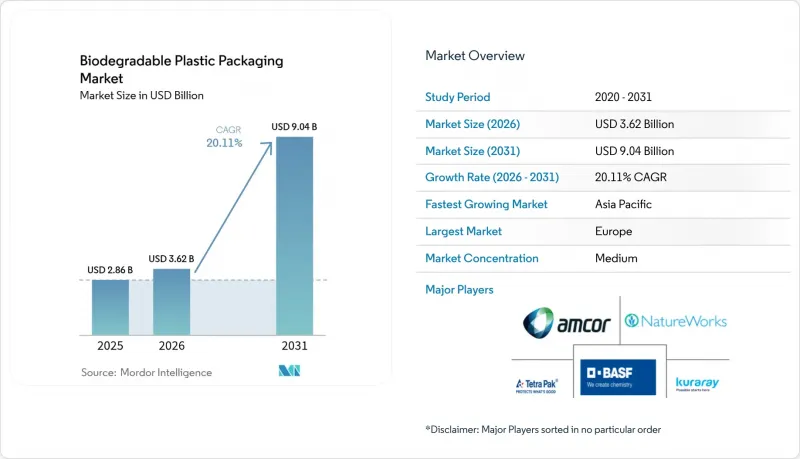
Mordor Intelligence에 의하면, 생분해성 플라스틱 포장 시장 규모는 2025년에 28억 6,000만 달러로 평가되었고, 2026년에 36억 2,000만 달러로 추정되고, 2031년까지 90억 4,000만 달러에 이를 것으로 예측되며, 2026-2031년 CAGR 20.11%로 성장할 전망입니다.
본 보고서는 소재 유형별(전분 블렌드, 폴리젖산(PLA) 등), 포장 유형별(연포장, 경질 포장), 최종 이용 산업별(식품, 음료, 외식 산업 등), 퇴비화 가능성별(가정용 퇴비화 가능, 산업용 퇴비화 가능), 지역별로 분류되어 있습니다. 시장 전망은 금액(달러) 기준으로 제시됩니다.
세계의 생분해성 플라스틱 포장 시장 동향 및 인사이트
EU 및 인도 전역에서 일회용 석유 유래 플라스틱 포장재 금지 조치가 가속화
현재 조달을 주도하고 있는 것은 자발적인 서약이 아니라 규제 집행입니다. 인도의 일회용 플라스틱 금지 조치로 인해 86만 1,740건의 검사가 실시되어 1,985톤의 불법 제품이 압수되었으며, 규정을 위반하는 수입을 억제하기 위한 벌금이 부과되었습니다. 유럽 규정 2025/40은 산업용 퇴비화 시설이 존재하는 지역에서 퇴비화 가능한 포장재를 티백, 커피 포드, 과일 라벨로 제한하고 있어, 이로 인해 인증 비용이 증가하고 적용 대상이 좁아지고 있습니다. 인도의 ‘2026년 고형 폐기물 관리 규정’에서는 발생 원천에서의 4가지 분리 수거가 의무화되어 있으며, 이 요건은 TUV AUSTRIA와 같은 기관에서 인증한 표준화된 생분해성 포맷에 유리하게 작용하고 있습니다. 이러한 조치들이 맞물리면서 브랜드들은 검증 가능한 바이오 수지 솔루션으로의 전환을 강요받고 있으며, 생분해성 플라스틱 포장의 잠재 시장이 확대되고 있습니다.
북미에서 음식 배달 앱의 보급이 퇴비화 가능한 포장을 필요로 하고 있습니다.
DoorDash, Uber Eats, Grubhub는 2024-2025년 수십억 끼니의 테이크아웃 음식을 배달하며, 포장재에 대한 책임을 음식점에서 지자체로 이전시켰습니다. 미국 환경보호청(EPA)의 추산에 따르면, 유기물 및 재활용 가능한 폐기물을 관리하기 위해 2030년까지 360억-430억 달러 규모의 인프라 구축이 필요할 것으로 예측됩니다. Closed Loop Partners는 2025년에 8건의 새로운 퇴비화 프로젝트에 자금을 지원했으나, 현재 미국에서 인증된 퇴비화 가능 포장을 수용하는 시설은 200곳 미만에 그치고 있습니다. 이러한 불일치로 인해, ASTM D6400 및 EN 13432 인증을 받은 가정용 퇴비화 가능 SKU를 공급하는 컨버터에게는 선점 우위가 생겨나며, 산업상의 병목 현상을 피할 수 있게 되었습니다.
서유럽 이외 지역의 산업용 퇴비화 인프라 부족
미국에서 인증된 퇴비화 가능 포장을 수용하는 시설은 200곳 미만에 불과하며, 많은 지자체에서는 오염 위험을 이유로 이를 완전히 배제하고 있습니다. 인도의 분리 수거 의무에는 이에 상응하는 퇴비화 능력이 뒷받침되지 않아, 도시 주변 지역은 매립 처리에 의존할 수밖에 없는 상황입니다. EU 규정 2025/40은 검증된 시설이 존재하는 경우에만 퇴비화를 승인함으로써 이러한 제약을 더욱 강화하고 있습니다. 그 결과, 가정용 퇴비화가 가능한 대체재가 주목받고 있지만, 많은 경우 수분이나 산소 차단성을 희생하고 있어 고성능 플렉서블 필름에의 사용은 제한되고 있습니다.
부문 분석
2025년, 생분해성 플라스틱 포장 시장에서 가장 큰 점유율을 차지한 것은 폴리젖산(PLA)이었습니다. 이는 NatureWorks의 미국 공장(연산 15만 톤) 및 TotalEnergies Corbion의 태국 공장(연산 7만 5,000톤)에서 확립된 생산 규모를 반영한 것입니다. 한편, 폴리하이드록시아카노에이트(PHA)는 뛰어난 차단성과 해양 환경에서의 분해 특성에 힘입어 21.43%라는 가장 높은 연평균 성장률(CAGR)을 나타낼 전망입니다. 2025년 Danimer Scientific이 파산 신청을 하고 Meredian Holdings가 해당 회사의 자산을 인수한 것은 PHA에 대한 투자자들의 관심이 여전히 높음을 보여줍니다. 전분 블렌드는 비용 효율성을 중시하는 쇼핑백에 활용되고 있으며, BASF의 ‘에코비오(EcoVio)’는 PBAT와 PLA를 조합하여 식품용 랩의 강인성을 높이고 있습니다. 폴리부틸렌 숙시네이트는 내열성이 중요한 멀티필름이나 경질 컵에 사용되고 있습니다. Balrampur Chini Mills가 인도에서 가동을 예정하고 있는 PLA 생산 라인은 지역적 공급의 여유를 높이고, 남아시아 가공업체들의 수입 의존도를 낮추게 될 것입니다. 소량 생산되는 셀룰로오스 및 폴리비닐알코올 필름은 수용성이나 높은 산소 차단성 등 틈새 시장을 충족시켜 생분해성 플라스틱 포장 업계의 다양성을 유지하고 있습니다.
중기 전망은 원료 동향에 달려 있습니다. 옥수수 가격의 횡보 추세로 인해 현재 PLA 현물 가격은 안정적이지만, 사탕수수와 연동되는 원가 구조로 인해 PBS 및 PHA 가격은 엘니뇨 현상의 영향을 받기 쉬운 상황입니다. TUV AUSTRIA 및 생분해성 제품 협회(BPI)의 인증 기준 명확화로 인해 성능 편차에 대한 인식이 줄어들고 있으며, PLA의 가공성과 PHA의 상온 퇴비화성을 결합한 다중 소재 블렌드가 촉진되고 있습니다. 이러한 시너지 효과로 인해 2031년까지 생분해성 플라스틱 포장 시장 전체에서 두 자릿수 성장이 지속될 것으로 예측됩니다.
2025년에는 스낵, 신선 식품, 제빵 제품 분야의 두께 감소에 따른 효율성 향상 덕분에 플렉서블 필름이 매출의 대부분을 차지했습니다. 그러나 발포 폴리스티렌(EPS) 사용 금지 조치와 테이크아웃 식품 증가에 힘입어, 현재는 리지드 트레이, 클램쉘, 커피 포드가 연평균 성장률(CAGR) 20.39%로 가장 빠르게 성장하는 하위 부문이 되었습니다. Sealed Air의 ‘CRYOVAC’ 생분해성 육류 트레이는 다층 코팅을 통해 생분해성을 저해하지 않으면서도 내습성 및 내산소성을 실현할 수 있음을 보여줍니다. 각 커피 브랜드는 2027년까지 알루미늄 및 다층 라미네이트 캡슐을 대체할 PHA 또는 성형 섬유로 만든 포드의 시범 도입을 추진하고 있습니다. 유연한 랩의 성장은 전자상거래 배송용 봉투와 청과물용 봉투 분야에서 지속될 전망이지만, 가치 향상의 핵심은 매장에서의 브랜드 차별화가 명확하고 폐기 방법이 명시된 가공된 경질 시스템에 있습니다. Amcor가 Metsa Group과 제휴하여 성형 섬유 트레이의 상용화를 추진하고 있는 것은 보다 광범위한 생분해성 플라스틱 포장 시장에서도 업계가 재활용 가능한 섬유로 무게중심을 옮기고 있음을 여실히 보여줍니다.
퇴비화 가능성에 관한 표시 규정 또한 이러한 움직임을 가속화하는 요인 중 하나입니다. EU의 새로운 픽토그램에서는 소비자에게 명확한 지침이 요구되며, 다양한 소재가 혼합된 유연한 소재보다 균일한 경질 소재가 선호되고 있습니다. 북미의 푸드서비스 체인에서는 ASTM D6400 준수를 지정하는 사례가 늘어나고 있으며, PLA-PBAT 혼합 소재로 만든 열성형 그릇 및 식기에 대한 수요가 증가하고 있습니다. 이러한 규제와 소비자의 압력이 시너지를 발휘함에 따라, 경질 포맷은 생분해성 플라스틱 포장 시장 규모 전망에서 중요한 성장 축으로서의 입지를 확고히 하고 있습니다.
지역별 분석
유럽은 통합된 퇴비화 네트워크와 엄격한 일회용 제품 금지 조치를 배경으로, 2025년에도 생분해성 플라스틱 포장 시장 규모에서 1위를 유지했습니다. 독일, 프랑스, 네덜란드에서는 EN 13432 인증을 획득한 포장을 수용하는 고밀도 유기물 회수 시스템이 운영되고 있어, 가공업체에 예측 가능한 사용 후 제품 처리 경로를 제공합니다. 그러나 EU의 새로운 법에 따라 퇴비화 가능성이 제한적인 이용 사례로 국한되고, 추가 투자가 재활용 가능한 섬유로 이동함에 따라 시장 성장은 둔화되고 있습니다.
아시아태평양은 연평균 성장률(CAGR) 21.18%라는 눈부신 성장을 이루고 있습니다. 중국의 5개년 계획에서는 바이오 수지의 확장에 보조금이 지급되고 있으며, 인도에서는 Balrampur Chini Mills가 조만간 가동할 PLA 생산 라인을 통해 수입 의존도를 낮추면서 국내 플라스틱 금지 할당량을 충족할 수 있게 될 것입니다. 호주 및 뉴질랜드는 지자체 주도의 가정용 퇴비화 프로그램을 선도하고 있으며, 광범위한 지역에서 뒷마당 퇴비화 기준의 모범 사례가 되고 있습니다. 태국, 인도네시아, 필리핀의 풍부한 원료 자원은 PLA 및 PBS의 비용 구조를 뒷받침하며, 생분해성 플라스틱 포장 시장에서 해당 지역의 경쟁력을 강화하고 있습니다.
북미는 절대적인 시장 점유율 면에서는 유럽에 뒤처져 있지만, 인프라 자금 조달 파이프라인은 견조합니다. Closed Loop Partners의 보조금과 주 차원의 확대 생산자 책임(EPR) 법안으로 인해 산업용 퇴비화 능력은 점진적으로 증가할 것으로 예상되지만, 실제 영향이 나타나기 시작하는 것은 2030년 이후가 될 것입니다. 캐나다의 ‘플라스틱 폐기물 제로’ 정책은 가정 쓰레기 수거에 대한 시범 도입을 뒷받침하고 있는 반면, 멕시코는 칠레의 법률을 모델로 한 전국적인 비닐봉지 금지 조치를 검토하고 있습니다. 남미는 여전히 발전 단계에 있습니다. 브라질 상파울루시에서는 퇴비화 가능한 쇼핑백 사용을 의무화하는 시범 사업이 진행 중이지만, 매립 처리에 대한 의존도가 확산을 저해하고 있습니다. 중동 및 아프리카에서는 주로 아랍에미리트, 사우디아라비아, 남아프리카공화국에서 호텔·관광 업계 및 고급 소매 업계에서 산발적인 도입 사례가 나타나고 있습니다. 이러한 지역에서는 지속가능성 인증이 관광지의 브랜딩의 일환으로 자리 잡고 있습니다. 다국적 기업들이 통일된 ESG 목표를 추진하는 가운데, 이들 지역은 생분해성 플라스틱 포장 산업에서 규모는 작지만 증가 추세를 보이는 시장 점유율을 차지하고 있습니다.
기타 혜택 :
- 엑셀 형식 시장 예측(ME) 시트
- 3개월간의 애널리스트 지원
자주 묻는 질문
목차
제1장 서론
제2장 조사 방법
제3장 주요 요약
제4장 시장 구도
제5장 시장 규모 및 성장 예측
제6장 경쟁 구도
제7장 시장 기회 및 향후 전망
AJY 26.09.09According to Mordor Intelligence, the biodegradable plastic packaging market size is projected to be USD 2.86 billion in 2025, USD 3.62 billion in 2026, and reach USD 9.04 billion by 2031, growing at a CAGR of 20.11% from 2026 to 2031.
This report is Segmented by Material Type (Starch Blends, Polylactic Acid (PLA), and More), Packaging Type (Flexible Packaging, and Rigid Packaging), End-Use Industry (Food, Beverage, Foodservice, and More), Compostability (Home-Compostable, and Industrial-Compostable), and Geography. The Market Forecasts are Provided in Value (USD).
Global Biodegradable Plastic Packaging Market Trends and Insights
Accelerated Bans On Single-Use Petro-Plastic Packaging Across EU And India
Regulatory enforcement rather than voluntary pledges is now steering procurement. India's single-use plastic ban prompted 861,740 inspections and the seizure of 1,985 t of contraband items, along with monetary penalties that deter non-compliant imports. The European Regulation 2025/40 restricts compostable packaging to tea bags, coffee pods, and fruit labels where industrial composting exists, increasing certification costs and narrowing eligible applications. India's Solid Waste Management Rules 2026 require four-stream segregation at source, a mandate that favors standardized biodegradable formats certified by bodies such as TUV Austria. Collectively, these measures push brands toward verifiable bio-resin solutions and expand the addressable market for biodegradable plastic packaging.
Food-Delivery App Proliferation Requiring Compost-Ready Formats In North America
DoorDash, Uber Eats, and Grubhub delivered billions of take-away meals during 2024-2025, transferring packaging responsibility from restaurants to municipalities. The United States Environmental Protection Agency estimates that USD 36-43 billion of infrastructure is required by 2030 to manage organics and recyclables. Closed Loop Partners funded eight new composting projects in 2025, yet fewer than 200 U.S. sites currently accept certified compostable packaging. This mismatch is driving first-mover advantage for converters supplying home-compostable SKUs certified to ASTM D6400 and EN 13432, enabling them to bypass industrial bottlenecks.
Tight Industrial-Composting Infrastructure Outside Western Europe
Fewer than 200 U.S. plants accept certified compostable packaging, and many municipalities outright exclude it due to contamination risks. India's segregation mandate lacks matching compost capacity, leaving peri-urban regions dependent on landfill. The EU's Regulation 2025/40 cements these constraints by authorizing compostability only where proven facilities exist. As a result, home-compostable alternatives gain traction, though they often sacrifice moisture and oxygen barriers, limiting use in high-performance flexible films.
Other drivers and restraints analyzed in the detailed report include:
- Retailer Plastic-Neutral Pledges Boosting Demand
- Re-Tooling Of Existing Film-Blowing Lines To Run Bio-Resins
- Feedstock Price Volatility For PLA (Corn, Sugarcane)
For complete list of drivers and restraints, kindly check the Table Of Contents.
Segment Analysis
Polylactic acid contributed the largest biodegradable plastic packaging market size in 2025, reflecting established scale at NatureWorks' 150,000 t y-1 U.S. plant and TotalEnergies Corbion's 75,000 t y-1 Thai facility. Polyhydroxyalkanoates, however, are projected to post the strongest CAGR at 21.43%, buoyed by superior barrier and marine degradation properties. Although Danimer Scientific filed for bankruptcy in 2025, Meredian Holdings acquired its assets, signaling continued investor interest in PHA. Starch blends sustain cost-sensitive shopping bags, while BASF's ecovio combines PBAT and PLA to boost toughness in food wraps. Polybutylene succinate serves mulch films and rigid cups where heat resistance is critical. Balrampur Chini Mills' upcoming Indian PLA line will add regional redundancy, softening import exposure for South Asian converters. Small-volume cellulose and polyvinyl alcohol films cater to water-soluble or high-oxygen-barrier niches, keeping the biodegradable plastic packaging industry diversified.
The medium-term outlook hinges on feedstock dynamics. Corn price plateaus hold current PLA spot rates, whereas sugarcane-linked costs leave PBS and PHA pricing vulnerable to El Nino events. Certification clarity from TUV Austria and the Biodegradable Products Institute is narrowing performance variability perceptions and fostering multi-material blends that pair PLA's processability with PHA's ambient compostability. This interplay is expected to sustain double-digit expansion for the entire biodegradable plastic packaging market through 2031.
Flexible films dominated revenue in 2025, thanks to thin-gauge efficiencies in snacks, fresh produce, and bakery segments. Yet rigid trays, clamshells, and coffee pods are now the fastest-growing sub-sector at a 20.39% CAGR, lifted by municipal bans on expanded polystyrene and rising carry-out meals. Sealed Air's CRYOVAC compostable meat tray illustrates how multi-layer coatings can deliver moisture and oxygen resistance without compromising compostability. Coffee brands are piloting PHA or molded-fiber pods to replace aluminum or multi-laminate capsules by 2027. Flexible wrap growth will persist in e-commerce mailers and produce bags, but the value upside lies in converted rigid systems where brand differentiation is visible on the shelf and disposal instructions are explicit. Amcor's alliance with Metsa Group to commercialize molded fiber trays underscores an industry pivot toward recyclable fiber even within the broader biodegradable plastic packaging market.
Compostability labeling rules are another accelerant. The EU's new pictograms require clear consumer instructions, favoring uniform rigid substrates over multi-material flexibles. North American foodservice chains increasingly specify ASTM D6400 conformity, boosting demand for thermoformed bowls and cutlery made from PLA-PBAT blends. This regulatory plus consumer pressure synergy positions rigid formats as a key growth pillar inside the biodegradable plastic packaging market size forecast.
Complete Report Scope:
- By Material Type
- Starch Blends
- Polylactic Acid (PLA)
- Poly(Butylene Adipate-co-Terephthalate) (PBAT)
- Polybutylene Succinate (PBS)
- Polyhydroxyalkanoates (PHA)
- Other Material Types
- By Packaging Type
- Flexible Packaging
- Bags and Pouches
- Films and Wraps
- Labels and Sleeves
- Rigid Packaging
- Tableware
- Trays and Bowls
- Food Containers
- Coffee Cups and Pods
- Other Rigid Packaging
- Flexible Packaging
- By End-use Industry
- Food
- Beverage
- Foodservice
- Personal Care and Home Care
- Pharmaceutical
- Other End - Use Industry
- By Compostability
- Home-Compostable
- Industrial-Compostable
- By Geography
- North America
- United States
- Canada
- Mexico
- Europe
- Germany
- United Kingdom
- France
- Italy
- Spain
- Russia
- Rest of Europe
- Asia-Pacific
- China
- India
- Japan
- South Korea
- Australia and New Zealand
- Rest of Asia-Pacific
- Middle East
- Middle East
- United Arab Emirates
- Saudi Arabia
- Turkey
- Rest of Middle East
- Africa
- South Africa
- Nigeria
- Egypt
- Rest of Africa
- South America
- Brazil
- Argentina
- Rest of South America
- North America
Geography Analysis
Europe maintained the largest biodegradable plastic packaging market size in 2025 on the back of integrated composting networks and stringent single-use bans. Germany, France, and the Netherlands operate dense organics collection systems that accept EN 13432-certified packs, giving converters a predictable end-of-life channel. Market growth, however, is moderating as the new EU law limits compostability to narrow use-cases, steering incremental investment toward recyclable fiber.
Asia-Pacific is the breakout growth region at a 21.18% CAGR. China's five-year plan subsidizes bio-resin expansion, and India's upcoming PLA line from Balrampur Chini Mills reduces import dependency while meeting domestic plastic-ban quotas. Australia and New Zealand lead municipal home-compost programs, offering proof-of-concept for backyard degradation standards across the wider area. Feedstock abundance in Thailand, Indonesia, and the Philippines supports PLA and PBS cost bases, reinforcing regional competitiveness within the biodegradable plastic packaging market.
North America trails Europe on absolute share but shows a strong pipeline of infrastructure funding. Closed Loop Partners' grants and state-level extended producer responsibility bills forecast a gradual uptick in industrial composting capacity, though real impact will materialize post-2030. Canada's zero-plastic-waste agenda encourages pilot curbside trials, while Mexico weighs nationwide bag bans modeled on Chilean law. South America remains nascent; Brazil experiments with mandated compostable shopping sacks in Sao Paulo, yet landfill reliance hampers scale. The Middle East and Africa record sporadic adoption in hospitality and luxury retail, chiefly in the United Arab Emirates, Saudi Arabia, and South Africa where sustainability certification is part of destination branding. These geographies together contribute a modest but rising slice of the biodegradable plastic packaging industry as multinationals push uniform ESG targets.
- Amcor plc
- BASF SE
- NatureWorks LLC
- Tetra Pak International S.A.
- Kuraray Co., Ltd.
- Sealed Air Corporation
- Taghleef Industries
- FKuR Kunststoff GmbH
- good natured Products Inc.
- Pactiv Evergreen Inc.
- ALPLA Werke Alwin Lehner GmbH
- Transcontinental Inc.
- Plascon Industries
- Futamura Group
- Cortec Corporation
- BioBag International AS
- Biome Bioplastics
- Bio Packaging Films
- Bio Futura
- Groupe Barbier
- VektoPack
- Singular Solutions Inc.
- Biogreen Biotech
- Plabottles.eu (Global Solutions BV)
Additional Benefits:
- The market estimate (ME) sheet in Excel format
- 3 months of analyst support
TABLE OF CONTENTS
1 INTRODUCTION
- 1.1 Study Assumptions and Market Definition
- 1.2 Scope of the Study
2 RESEARCH METHODOLOGY
3 EXECUTIVE SUMMARY
4 MARKET LANDSCAPE
- 4.1 Market Overview
- 4.2 Market Drivers
- 4.2.1 Accelerated Bans On Single-Use Petro-Plastic Packaging Across EU And India
- 4.2.2 Food-Delivery App Proliferation Requiring Compost-Ready Formats In North America
- 4.2.3 Retailer "Plastic-Neutral" Pledges (E.G., Walmart, Carrefour) Boosting Demand
- 4.2.4 Re-Tooling Of Existing Film-Blowing Lines To Run Bio-Resins (Capex Approximately 15%)
- 4.2.5 Brand Shift To Transparent Carbon-Labelling On Packs
- 4.2.6 Corporate-Level Internal Carbon-Price Adoption (More than USD 70/T) Favouring Bio-Options
- 4.3 Market Restraints
- 4.3.1 Tight industrial-composting infrastructure outside Western Europe
- 4.3.2 Feed-stock price volatility for PLA (corn, sugarcane)
- 4.3.3 Consumer confusion around "compostable" vs "biodegradable" claims
- 4.3.4 Mechanical-recycling stream contamination penalties in US and Japan
- 4.4 Supply-Chain Analysis
- 4.5 Regulatory and Technological Outlook
- 4.6 Porter's Five Forces Analysis
- 4.6.1 Threat of New Entrants
- 4.6.2 Bargaining Power of Suppliers
- 4.6.3 Bargaining Power of Buyers
- 4.6.4 Threat of Substitutes
- 4.6.5 Competitive Rivalry
- 4.6.6 Industry Ecosystem Analysis
- 4.7 Innovations in Biodegradable and Bio-based Plastic Packaging
- 4.8 Comparative Analysis - Petro-plastic vs Biodegradable Packaging
- 4.9 Bioplastics - Production Landscape
- 4.9.1 Production Statistics for Bioplastics
- 4.9.2 Production by Resin Type
- 4.9.3 Production by Region
- 4.9.4 Evolving Trends in the Foodservice/HoReCa Sector
- 4.9.5 Emerging Industry Trends
5 MARKET SIZE AND GROWTH FORECASTS (VALUE)
- 5.1 By Material Type
- 5.1.1 Starch Blends
- 5.1.2 Polylactic Acid (PLA)
- 5.1.3 Poly(Butylene Adipate-co-Terephthalate) (PBAT)
- 5.1.4 Polybutylene Succinate (PBS)
- 5.1.5 Polyhydroxyalkanoates (PHA)
- 5.1.6 Other Material Types
- 5.2 By Packaging Type
- 5.2.1 Flexible Packaging
- 5.2.1.1 Bags and Pouches
- 5.2.1.2 Films and Wraps
- 5.2.1.3 Labels and Sleeves
- 5.2.2 Rigid Packaging
- 5.2.2.1 Tableware
- 5.2.2.2 Trays and Bowls
- 5.2.2.3 Food Containers
- 5.2.2.4 Coffee Cups and Pods
- 5.2.2.5 Other Rigid Packaging
- 5.2.1 Flexible Packaging
- 5.3 By End-use Industry
- 5.3.1 Food
- 5.3.2 Beverage
- 5.3.3 Foodservice
- 5.3.4 Personal Care and Home Care
- 5.3.5 Pharmaceutical
- 5.3.6 Other End - Use Industry
- 5.4 By Compostability
- 5.4.1 Home-Compostable
- 5.4.2 Industrial-Compostable
- 5.5 By Geography
- 5.5.1 North America
- 5.5.1.1 United States
- 5.5.1.2 Canada
- 5.5.1.3 Mexico
- 5.5.2 Europe
- 5.5.2.1 Germany
- 5.5.2.2 United Kingdom
- 5.5.2.3 France
- 5.5.2.4 Italy
- 5.5.2.5 Spain
- 5.5.2.6 Russia
- 5.5.2.7 Rest of Europe
- 5.5.3 Asia-Pacific
- 5.5.3.1 China
- 5.5.3.2 India
- 5.5.3.3 Japan
- 5.5.3.4 South Korea
- 5.5.3.5 Australia and New Zealand
- 5.5.3.6 Rest of Asia-Pacific
- 5.5.4 Middle East
- 5.5.4.1 Middle East
- 5.5.4.2 United Arab Emirates
- 5.5.4.3 Saudi Arabia
- 5.5.4.4 Turkey
- 5.5.4.5 Rest of Middle East
- 5.5.5 Africa
- 5.5.5.1 South Africa
- 5.5.5.2 Nigeria
- 5.5.5.3 Egypt
- 5.5.5.4 Rest of Africa
- 5.5.6 South America
- 5.5.6.1 Brazil
- 5.5.6.2 Argentina
- 5.5.6.3 Rest of South America
- 5.5.1 North America
6 COMPETITIVE LANDSCAPE
- 6.1 Market Concentration
- 6.2 Strategic Moves
- 6.3 Market Share Analysis
- 6.4 Company Profiles {(includes Global level Overview, Market level overview, Core Segments, Financials as available, Strategic Information, Market Rank/Share for key companies, Products and Services, and Recent Developments)}
- 6.4.1 Amcor plc
- 6.4.2 BASF SE
- 6.4.3 NatureWorks LLC
- 6.4.4 Tetra Pak International S.A.
- 6.4.5 Kuraray Co., Ltd.
- 6.4.6 Sealed Air Corporation
- 6.4.8 Taghleef Industries
- 6.4.9 FKuR Kunststoff GmbH
- 6.4.10 good natured Products Inc.
- 6.4.11 Pactiv Evergreen Inc.
- 6.4.12 ALPLA Werke Alwin Lehner GmbH
- 6.4.13 Transcontinental Inc.
- 6.4.14 Plascon Industries
- 6.4.15 Futamura Group
- 6.4.16 Cortec Corporation
- 6.4.17 BioBag International AS
- 6.4.18 Biome Bioplastics
- 6.4.19 Bio Packaging Films
- 6.4.20 Bio Futura
- 6.4.21 Groupe Barbier
- 6.4.22 VektoPack
- 6.4.23 Singular Solutions Inc.
- 6.4.24 Biogreen Biotech
- 6.4.25 Plabottles.eu (Global Solutions BV)
7 MARKET OPPORTUNITIES AND FUTURE OUTLOOK
- 7.1 White-space and Unmet-need Assessment


