

|
시장보고서
상품코드
2122318
폴리머 마이크로스피어 : 시장 점유율 분석, 업계 동향과 통계, 성장 예측(2026-2031년)Polymer Microspheres - Market Share Analysis, Industry Trends & Statistics, Growth Forecasts (2026 - 2031) |
||||||
 Mordor Intelligence
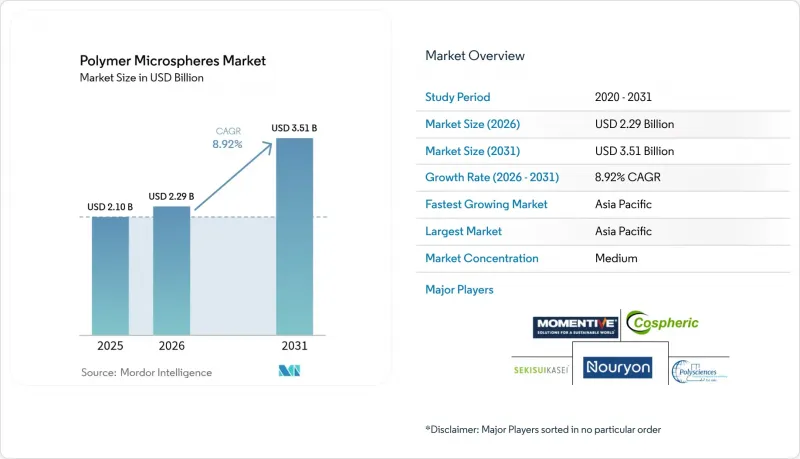
Mordor Intelligence에 의하면, 폴리머 마이크로스피어 시장 규모는 2025년 21억 달러에서 2026년에는 22억 9,000만 달러에 이르고, 2026-2031년 CAGR 8.92%로 성장을 지속하여 2031년까지 35억 1,000만 달러에 달할 것으로 예측됩니다.
본 보고서는 유형별(팽창성 마이크로스피어, 생분해성 마이크로스피어), 재료 구성별(폴리스티렌(PS), 폴리메틸메타크릴레이트(PMMA), 폴리에틸렌(PE), 기타),최종 사용자 산업별(생명과학·제약, 화장품 및 퍼스널케어, 페인트 및 코팅, 기타), 지역별(아시아태평양, 북미, 유럽, 남미, 중동 및 아프리카)로 분류되어 있습니다.
전 세계 폴리머 마이크로스피어 시장 동향 및 인사이트
표적 지향형 약물 전달 및 서방형 의약품에서의 채택 확대
PLGA 및 기타 생분해성 운반체를 통해 실현 가능한 정밀한 방출 프로파일 덕분에, 제제 개발자들은 기존 정제 형태에서 주사용 또는 이식형 마이크로스피어 시스템으로 전환하고 있습니다. 생물학적 제제를 캡슐화하는 능력은 안정성을 향상시켜 콜드체인에서의 손실을 줄이고 치료 성과를 높입니다. 마이크로플루이딕스 제조 기술을 통해 기존 배치 간 편차를 극복한, 입자 크기 분포가 좁은 제품이 현재 제공되고 있습니다. 미국 식품의약국(FDA)은 15종 이상의 PLGA 기반 제품을 승인하여 명확한 규제상의 선례를 마련했습니다. 맞춤형 의료 프로그램에서는 조절형 방출 동역학을 활용하여 개별 약동학 프로파일에 기반한 투여를 가능하게 하고 있습니다. 이미 무균 마이크로스피어 제조 능력을 갖춘 제약 기업들은 높은 전환 비용을 구축함으로써 경쟁 우위를 공고히 하고 있습니다.
자동차 및 운송 장비 부품 분야의 경량 충전재 수요
유럽 규제 당국은 CO₂ 배출 강도 목표 달성을 지원하기 위해 차량 전체의 경량화를 의무화하고 있으며, 이에 따라 인테리어 트림, 범퍼 빔, 보닛 하부 부품에 중공 구체를 통합한 폴리머의 채택이 촉진되고 있습니다. 기계적 강성을 저해하지 않으면서 밀도를 25% 낮출 수 있으며, 이러한 이점은 전기차의 주행 거리 연장으로 이어집니다. 마이크로스피어를 통해 가능한 저압 성형은 사이클 타임 단축으로도 이어져 공장의 생산성을 향상시킵니다. 컴파운더와 공동으로 등급을 개발하는 공급업체는 수년에 걸친 조달 계약을 확실하게 확보하고 있습니다. 배터리식 전기차의 생산 점유율이 높아짐에 따라, 화이트 바디에서 1Kg이 경량화될 때마다 자동차 제조업체에게는 구체적인 비용 절감과 주행 거리 향상이라는 이점이 주어집니다.
화장품·위생용품 분야의 미세플라스틱 규제
유럽연합(EU) 규정에 따라 씻어내는 유형의 화장품에 포함된 미세플라스틱 함량은 0.01%로 제한되어 있으며, 페이셜 스크럽이나 치약에 포함된 기존 폴리스티렌 미세 입자는 사실상 금지되어 있습니다. 세계 브랜드들은 규제를 준수하는 단일 기준에 맞추어 배합을 통일하고 있으며, 이로 인해 일회용 등급 제품의 중요한 판로가 사라지고 있습니다. 생분해성 대체재를 보유하지 않은 공급업체들은 즉각적인 매출 감소를 겪고 있습니다. 또한 신제품 개발 주기에서도 규제 대응을 위한 검사에 자원이 할당됨에 따라, 관련 카테고리에서의 신제품 출시가 지연되고 있습니다. 생분해성 대체품은 더 높은 이익률을 가져오지만, 이러한 단기적인 전환은 퍼스널케어 부문에 대한 의존도가 높은 기업의 현금 흐름에 어려움을 초래하고 있습니다.
부문별 분석
팽창성 등급은 2025년 매출의 52.05%를 차지했습니다. 이는 자동차 및 건설용 복합재료에서의 꾸준한 활용에 힘입은 것으로, 이러한 부문에서는 제어된 팽창을 통해 강도를 저해하지 않고 밀도를 낮출 수 있습니다. 생분해성 등급은 규모는 작지만, 규제 당국과 의약품 개발 기업들이 제어된 약물 방출을 위해 PLGA 및 폴리카프로락톤 매트릭스를 선호함에 따라 연평균 성장률(CAGR) 10.74%로 가장 빠르게 성장할 것으로 예측됩니다. 아시아태평양의 배합 제조업체들은 기존에는 경량 충전재용 팽창성 스피어에 주력해 왔으나, 현재는 미래 수요에 대비하기 위해 생분해성 제품의 생산 능력으로 사업을 다각화하고 있습니다.
의약품 수탁 제조 기업들은 후기 임상시험 프로그램을 위한 생산 능력을 확보하기 위해 장기 공급 계약을 체결하고 있으며, 이로 인해 수주 잔고가 안정적입니다. 대조적으로, 범용 팽창성 제품은 특히 저비용 기반을 활용하는 중국 및 인도의 국내 제조업체들로부터 가격 경쟁이 심화되고 있습니다. 그 결과, 2031년까지 폴리머 마이크로스피어 시장 전체의 매출 구성은 수익성이 높은 생분해성 부문으로 이동할 전망입니다.
지역별 분석
아시아태평양은 제약 제조, 반도체 조립, 자동차 생산 분야의 우위를 반영하여 2025년 세계 시장 규모의 36.88%를 차지하고 있습니다. 이 지역의 예상 연평균 성장률(CAGR) 10.31%는 원료 비용의 우위와 경량 충전재를 중시하는 전기차 조립 라인의 확대에 기인합니다. 인도에서는 국내 의약품 생산량 증가와 현지 화장품 브랜드들이 규제를 준수하는 생분해성 대체재를 채택함에 따라 성장이 더욱 가속화되고 있습니다. 수출 지향적인 공급업체들은 확립된 물류망을 활용하여 북미와 유럽으로 제품을 출하하고 있으며, 아시아태평양이 폴리머 마이크로스피어 시장의 주요 생산 거점으로서의 역할을 강화하고 있습니다.
이 지역의 예상 연평균 성장률(CAGR) 10.31%는 원자재 비용의 경쟁력과 경량 필러를 중시하는 전기차 조립 라인의 확장에 기인합니다. 인도에서는 국내 의약품 생산량 증가와 현지 화장품 브랜드들이 규제를 준수하는 생분해성 대체재를 채택하고 있어 성장이 더욱 가속화되고 있습니다. 수출 지향적인 공급업체들은 확립된 물류망을 활용하여 북미와 유럽으로 제품을 출하하고 있으며, 이는 폴리머 마이크로스피어 시장의 주요 생산 거점으로서 아시아태평양의 역할을 강화하고 있습니다.
북미에서는 약물 전달 기술의 혁신과 경량화 목표를 반영한 엄격한 기업 평균 연비 규제(CAFE)로 인해 견조한 소비가 유지되고 있습니다. 계약 연구 기관(CRO)과 OEM은 독자적인 성능 기준을 충족하는 전용 등급 개발에 있어 마이크로스피어 공급업체와 협력하고 있습니다. 유럽에서는 REACH에 따른 미세 플라스틱 규제가 시행되고 있어, 배합 제조업체들은 생분해성 스피어를 채택할 수밖에 없는 상황입니다. 이러한 법규의 추진으로 인해 퍼스널케어 제품 및 도료 부문에서 제품의 재배합이 급속히 진행되고 있습니다. 남미, 중동 및 아프리카에서는 산업의 다각화가 진행됨에 따라 적정한 수준의 보급이 이루어지고 있으나, 현지 생산 능력이 제한적이어서 공급은 수입에 의존하고 있습니다.
기타 혜택
- 엑셀 형식 시장 예측(ME) 시트
- 3개월간의 애널리스트 지원
자주 묻는 질문
목차
제1장 서론
제2장 조사 방법
제3장 주요 요약
제4장 시장 구도
제5장 시장 규모와 성장 예측
제6장 경쟁 구도
제7장 시장 기회와 향후 전망
LSH 26.09.04According to Mordor Intelligence, the polymer microspheres market size is expected to grow from USD 2.10 billion in 2025 to USD 2.29 billion in 2026 and is forecast to reach USD 3.51 billion by 2031 at 8.92% CAGR over 2026-2031.
This report is Segmented by Type (Expandable Microspheres, and Biodegradable Microspheres), Material Composition (Polystyrene (PS), Polymethyl-Methacrylate (PMMA), Polyethylene (PE), and More), End-User Industry (Life Sciences and Pharmaceuticals, Cosmetics and Personal Care, Paints and Coatings, and More), and Geography (Asia-Pacific, North America, Europe, South America, and Middle-East and Africa).
Global Polymer Microspheres Market Trends and Insights
Rising Adoption in Targeted Drug Delivery and Controlled-Release Pharmaceuticals
Precise release profiles achievable with PLGA and other biodegradable carriers have shifted formulators away from traditional tablets toward injectable or implantable microsphere systems. The capability to encapsulate biologics improves stability, which reduces cold-chain losses and enhances therapeutic outcomes. Microfluidic manufacturing now delivers narrow particle-size distributions that overcome historic batch variability. The United States Food and Drug Administration has cleared more than 15 PLGA-based products, providing clear regulatory precedents. Personalized-medicine programs exploit tunable release kinetics, enabling dosing designed around individual pharmacokinetic profiles. Pharmaceutical companies that already own sterile microsphere capacity build high switching costs that reinforce competitive moats.
Demand for Lightweight Fillers in Automotive and Transportation Components
Regulators in Europe require fleetwide weight reductions that support CO2 intensity targets, encouraging polymers that integrate hollow spheres into interior trim, bumper beams, and under-hood parts. Density can fall by 25% with no loss in mechanical stiffness, a gain that extends electric vehicle driving range. Lower-pressure molding made possible by microspheres also trims cycle times, which improves plant productivity. Suppliers that co-develop grades with compounders lock in multiyear sourcing agreements. As battery-electric models account for a larger share of production, every kilogram removed from the body in white delivers tangible cost and range advantages for original equipment manufacturers.
Restrictions on Micro-Plastics in Cosmetics and Toiletries
European Union regulation limits microplastic content in rinse-off cosmetics to 0.01%, effectively banning conventional polystyrene spheres in facial scrubs and toothpastes. Global brands harmonize formulations to a single compliant standard, which removes a significant volume outlet for disposable grades. Suppliers that lack biodegradable alternatives see immediate revenue declines. New product development cycles also divert resources toward regulatory testing, slowing launches in adjacent categories. While bio-degradable replacements offer higher margins, the short-term shift challenges cash flows for firms heavily exposed to personal care.
Other drivers and restraints analyzed in the detailed report include:
- Surge in Micro-Electronics Manufacturing
- Growth of 3-D Printing Feedstocks Using Polymer Microspheres
- Production-Scale Challenges in Ultra-Uniform Biodegradable Microspheres
For complete list of drivers and restraints, kindly check the Table Of Contents.
Segment Analysis
Expandable grades captured 52.05% of 2025 revenue, underpinned by steady use in automotive and construction composites, where controlled expansion lowers density without sacrificing strength. Biodegradable grades, while smaller, are forecast to grow fastest at 10.74% CAGR as regulators and drug developers favor PLGA and polycaprolactone matrices for controlled drug release. Asia-Pacific formulators historically focused on expandable spheres for lightweight fillers, now diversifying into bio-degradable capacity to hedge future demand.
Pharmaceutical contractors lock in long-term supply agreements that secure capacity for late-stage clinical programs, stabilizing order books. By contrast, generic expandable products face intensifying price competition, especially from domestic producers in China and India that leverage low-cost bases. As a result, revenue mix across the polymer microspheres market tilts toward higher-margin biodegradable segments through 2031.
Complete Report Scope:
- By Type
- Expandable Microspheres
- Biodegradable Microspheres
- By Material Composition
- Polystyrene (PS)
- Polymethyl-methacrylate (PMMA)
- Polyethylene (PE)
- Polyurethane (PU)
- Biodegradable Polymers (PLGA, PCL, etc.)
- Others (Nylon, PVDF, etc.)
- By End-User Industry
- Life Sciences and Pharmaceuticals
- Cosmetics and Personal Care
- Paints and Coatings
- Electronics
- Ceramics and Composites
- Plastics
- Other End-User Industries (3-D Printing, Agriculture, etc.)
- By Geography
- Asia-Pacific
- China
- India
- Japan
- South Korea
- Rest of Asia-Pacific
- North America
- United States
- Canada
- Mexico
- Europe
- Germany
- United Kingdom
- France
- Italy
- Rest of Europe
- South America
- Brazil
- Argentina
- Rest of South America
- Middle-East and Africa
- Saudi Arabia
- South Africa
- Rest of Middle-East and Africa
- Asia-Pacific
Geography Analysis
Asia-Pacific holds a 36.88% share of the 2025 global value, reflecting its dominance in pharmaceutical manufacturing, semiconductor assembly, and automotive production. The region's 10.31% forecast CAGR stems from cost advantages in feedstocks and expanding electric-vehicle assembly lines that value lightweight fillers. India amplifies growth as domestic pharmaceutical output rises, and local cosmetics brands adopt compliant, degradable alternatives. Export-oriented suppliers leverage established logistics to ship to North America and Europe, reinforcing Asia-Pacific's role as the primary production hub for the polymer microspheres market.
The region's 10.31% forecast CAGR stems from cost advantages in feedstocks and expanding electric-vehicle assembly lines that value lightweight fillers. India amplifies growth as domestic pharmaceutical output rises, and local cosmetics brands adopt compliant, degradable alternatives. Export-oriented suppliers leverage established logistics to ship to North America and Europe, reinforcing Asia-Pacific's role as the primary production hub for the polymer microspheres market.
North America maintains strong consumption through innovation in drug delivery and stringent corporate average fuel economy regulations that embed lightweighting targets. Contract research organizations and original equipment manufacturers collaborate with microsphere suppliers on proprietary grades that meet unique performance criteria. Europe enforces micro-plastic restrictions under REACH, compelling formulators to adopt biodegradable spheres. This legislative push drives rapid product reformulation across personal care and paints. South America and the Middle-East, and Africa experience moderate uptake as industrial diversification advances, but supply relies on imports due to limited local production capacity.
- Bangs Laboratories Inc.
- CD Bioparticles
- Cospheric LLC
- DiaSorin S.p.A
- Evonik Industries AG
- Matsumoto Yushi Seiyaku Co., Ltd.
- Merck KGaA
- Momentive
- Nouryon
- Phosphorex Inc.
- PolyMicrospheres
- Polysciences Inc.
- Sekisui Kasei Co., Ltd.
- Sphere Fluidics Ltd.
- Sunjin Chemical Co., Ltd.
- Thermo Fisher Scientific Inc.
Additional Benefits:
- The market estimate (ME) sheet in Excel format
- 3 months of analyst support
TABLE OF CONTENTS
1 Introduction
- 1.1 Study Assumptions and Market Definition
- 1.2 Scope of the Study
2 Research Methodology
3 Executive Summary
4 Market Landscape
- 4.1 Market Overview
- 4.2 Market Drivers
- 4.2.1 Rising Adoption in Targeted Drug Delivery and Controlled-Release Pharmaceuticals
- 4.2.2 Demand for Lightweight Fillers in Automotive and Transportation Components
- 4.2.3 Surge in Micro-Electronics Manufacturing
- 4.2.4 Growth of 3-D Printing Feedstocks Using Polymer Microspheres
- 4.2.5 Emergence of Bio-Based Expandable Microspheres for Low-Carbon Building Materials
- 4.3 Market Restraints
- 4.3.1 Restrictions on Micro-Plastics in Cosmetics and Toiletries
- 4.3.2 Volatile Petrochemical Feedstock Prices and Supply Disruption Risk
- 4.3.3 Production-Scale Challenges in Ultra-Uniform Biodegradable Microspheres
- 4.4 Value Chain Analysis
- 4.5 Porter's Five Forces
- 4.5.1 Bargaining Power of Suppliers
- 4.5.2 Bargaining Power of Buyers
- 4.5.3 Threat of New Entrants
- 4.5.4 Threat of Substitutes
- 4.5.5 Competitive Rivalry
5 Market Size and Growth Forecasts (Value)
- 5.1 By Type
- 5.1.1 Expandable Microspheres
- 5.1.2 Biodegradable Microspheres
- 5.2 By Material Composition
- 5.2.1 Polystyrene (PS)
- 5.2.2 Polymethyl-methacrylate (PMMA)
- 5.2.3 Polyethylene (PE)
- 5.2.4 Polyurethane (PU)
- 5.2.5 Biodegradable Polymers (PLGA, PCL, etc.)
- 5.2.6 Others (Nylon, PVDF, etc.)
- 5.3 By End-User Industry
- 5.3.1 Life Sciences and Pharmaceuticals
- 5.3.2 Cosmetics and Personal Care
- 5.3.3 Paints and Coatings
- 5.3.4 Electronics
- 5.3.5 Ceramics and Composites
- 5.3.6 Plastics
- 5.3.7 Other End-User Industries (3-D Printing, Agriculture, etc.)
- 5.4 By Geography
- 5.4.1 Asia-Pacific
- 5.4.1.1 China
- 5.4.1.2 India
- 5.4.1.3 Japan
- 5.4.1.4 South Korea
- 5.4.1.5 Rest of Asia-Pacific
- 5.4.2 North America
- 5.4.2.1 United States
- 5.4.2.2 Canada
- 5.4.2.3 Mexico
- 5.4.3 Europe
- 5.4.3.1 Germany
- 5.4.3.2 United Kingdom
- 5.4.3.3 France
- 5.4.3.4 Italy
- 5.4.3.5 Rest of Europe
- 5.4.4 South America
- 5.4.4.1 Brazil
- 5.4.4.2 Argentina
- 5.4.4.3 Rest of South America
- 5.4.5 Middle-East and Africa
- 5.4.5.1 Saudi Arabia
- 5.4.5.2 South Africa
- 5.4.5.3 Rest of Middle-East and Africa
- 5.4.1 Asia-Pacific
6 Competitive Landscape
- 6.1 Market Concentration Analysis
- 6.2 Strategic Moves (Mergers and Acquisitions, JVs, Collaborations)
- 6.3 Market Share (%)/Ranking Analysis
- 6.4 Company Profiles (includes Global level Overview, Market level overview, Core Segments, Financials as available, Strategic Information, Market Rank/Share for key companies, Products and Services, and Recent Developments)
- 6.4.1 Bangs Laboratories Inc.
- 6.4.2 CD Bioparticles
- 6.4.3 Cospheric LLC
- 6.4.4 DiaSorin S.p.A
- 6.4.5 Evonik Industries AG
- 6.4.6 Matsumoto Yushi Seiyaku Co., Ltd.
- 6.4.7 Merck KGaA
- 6.4.8 Momentive
- 6.4.9 Nouryon
- 6.4.10 Phosphorex Inc.
- 6.4.11 PolyMicrospheres
- 6.4.12 Polysciences Inc.
- 6.4.13 Sekisui Kasei Co., Ltd.
- 6.4.14 Sphere Fluidics Ltd.
- 6.4.15 Sunjin Chemical Co., Ltd.
- 6.4.16 Thermo Fisher Scientific Inc.
7 Market Opportunities and Future Outlook
- 7.1 White-space and Unmet-Need Assessment


