

|
시장보고서
상품코드
2122816
카메라 모듈 : 시장 점유율 분석, 업계 동향 및 통계, 성장 예측(2026-2031년)Camera Module - Market Share Analysis, Industry Trends & Statistics, Growth Forecasts (2026 - 2031) |
||||||
 Mordor Intelligence
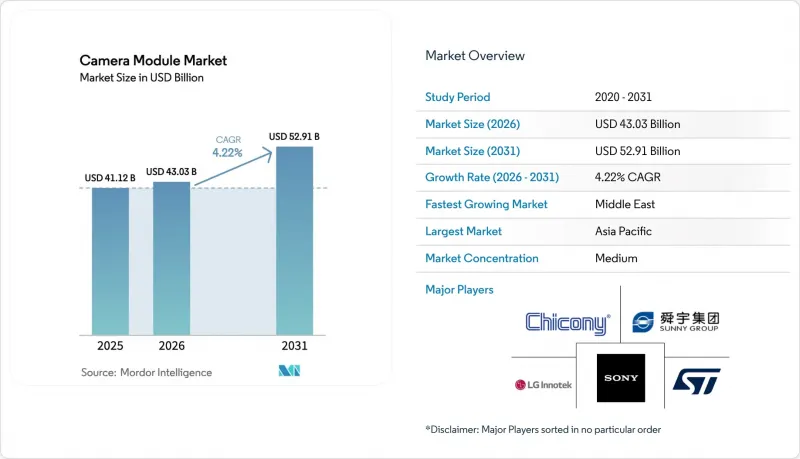
카메라 모듈 시장 규모는 2025년 411억 2,000만 달러로 평가되었습니다. 2026년에는 430억 3,000만 달러로 확대되어 2026년부터 2031년에 걸쳐 CAGR 4.22%로 성장을 지속하여, 2031년에는 529억 1,000만 달러에 이를 것으로 예측됩니다.
본 보고서는 구성 부품(이미지 센서, 렌즈 세트 등), 센서 유형(CMOS, CCD), 화소 수 또는 해상도(7 MP 이하, 8-13 MP, 기타),초점 방식(고정 초점, 자동 초점), 제조 공정(칩 온 보드 등), 모듈 폼 팩터(컴팩트, MIPI 인터페이스 모듈), 용도(자동차 등), 지역별로 분류되어 있습니다. 시장 예측은 금액(달러) 기준으로 제시되어 있습니다.
세계의 카메라 모듈 시장 동향 및 인사이트
3개 이상의 렌즈를 탑재한 멀티 카메라 스마트폰의 보급
현재 중국의 플래그십 단말기에는 4개 이상의 독립적인 카메라가 탑재되어 있으며, 단말기 1대당 약 1.3개의 모듈이 추가되고 있습니다. 샤오미의 ‘17 Ultra’는 초광각, 광각, 매크로 렌즈 외에도 각각 독자적인 자동 초점 기구를 갖춘 2억 화소 페리스코프 카메라를 최초로 탑재했습니다. OPPO와 vivo도 ‘Find X8’ 및 ‘X200 Pro’ 시리즈에서 유사한 접근 방식을 채택하여 출하 대수를 유지하면서 평균 판매 가격을 인상했습니다. 한때 플래그십 모델에만 한정되었던 심도 감지용 TOF(Time-of-Flight) 모듈은 현재 소매가 400달러 이상의 기종에 표준으로 장착되어, 새로운 증강현실(AR) 쇼핑 기능을 실현하고 있습니다. 그 결과, 전 세계 스마트폰 교체 수요가 정체되어 있음에도 불구하고 모듈 수요는 점차 증가하고 있습니다. 삼성의 ‘All Lenses on Prism’ 설계 덕분에 페리스코프 카메라의 Z축 방향 높이가 22% 감소하여, 경쟁사들도 배터리 용량을 희생하지 않고 접이식 광학 시스템을 탑재할 수 있게 되었습니다.
후방 시야 확보 및 ADAS 카메라 관련 규제
안전 규제로 인해 옵션이었던 카메라 시스템이 기본 사양으로 바뀌고 있습니다. 미국에서는 FMVSS-111에 따라 2026년형 이후의 모든 경차에 후방 카메라 장착이 의무화되었습니다. 유럽연합(EU)의 일반 안전 규정도 유사한 압력을 가하고 있으며, 2024년 7월 이후 신차 모델에 대해 차선 유지 보조 및 속도 제한 보조를 위한 전방 카메라의 탑재를 의무화하고 있습니다. Tier 1 공급업체들은 현재 레이더 및 라이더와 결합하여 차량당 3-4대의 카메라를 통합하고 있으며, 2030년까지 모듈 탑재 수는 3.8개에 달할 것으로 예측됩니다. 북미에서 판매되는 렉서스 모델은 2026년부터 최소 4대의 카메라를 탑재하게 되며, 자동차용 등급 부품의 인증 주기가 가속화되고 있습니다.
2024년 지진 이후 VCM 액추에이터 공급 제약
2024년 4월 화롄 지진으로 인해 대만의 주요 액추에이터 공급업체의 클린룸이 피해를 입어, 자동 초점 및 광학식 손떨림 보정용 보이스 코일 모터의 리드타임이 2배로 늘어났습니다. 삼성일렉트로메카닉스와 LG이노텍은 제한된 부품을 확보하기 위해 고액의 물류 비용을 지불한 결과, 모듈 출하량이 전 분기 대비 12% 감소했다고 보고했습니다. 2025년 말까지 복구율은 85%에 달했으나, OEM 각사는 그 이후 향후 공급 충격을 완화하기 위해 일본 공급업체로부터 이중 조달을 진행하고 있습니다.
부문별 분석
2025년 카메라 모듈 시장에서 이미지 센서 시장 규모는 매출의 47.17%를 차지했으나, 액추에이터는 점유율은 작았음에도 2031년까지의 연평균 성장률(CAGR)이 5.07%로 가장 높은 성장세를 보였습니다. 소니의 적층형 CMOS 부품은 고가대로 거래되고 있지만, 페리스코프 모듈용 2축 광학식 손떨림 보정용 액추에이터에 대한 수요가 그 격차를 좁히고 있습니다. 각 렌즈에 독자적인 자동 초점 구동 장치가 탑재되면서 보이스 코일 모터의 출하 대수가 증가하고 있으며, 자동차용 프로그램에서는 -40°C-105°C의 내환경 성능을 갖춘 견고한 액추에이터가 지정되어 있습니다. 렌즈 세트는 여전히 두 번째로 큰 구성 요소이며, 고온 환경에서는 플라스틱 제품 대신 유리 성형 비구면 렌즈가 채택되고 있습니다. 조립 서비스는 구성 요소 중 점유율이 가장 낮지만, 진동 감쇠 및 기밀성이 소비자용 수준의 요구 사항을 상회하는 장수명 자동차용 플랫폼에서 부가가치를 제공합니다.
용도에 관계없이 구성 비율의 변화가 관찰됩니다. 자동차용 카메라에서는 하이 다이내믹 레인지(HDR) 센서나 세계 셔터에 대해 30%의 프리미엄이 지불되는 반면, 소비자용 전자기기에서는 픽셀 비닝 처리된 후면 조사형 칩이 주류를 이루고 있습니다. ST마이크로일렉트로닉스와 ON세미컨덕터는 야간 주행 보조용 0.1럭스 대응 센서를 출시하여, 출하량이 적더라도 평균 판매 가격을 끌어올리고 있습니다. 한편, 주요 스마트폰 브랜드들이 설계를 자체 생산으로 전환함에 따라 전문 조립 제조업체들은 상품화(commoditization)에 직면해 있습니다.
CMOS 기술은 2025년 매출의 89.22%를 차지하고 연평균 성장률(CAGR) 4.73%를 나타낼 것으로 예측되며, 과학 분야의 틈새 시장에서 CCD(전하 결합 소자)를 몰아내고 있습니다. 딥 트렌치 절연, 핀이 부착된 포토다이오드, 온칩 A/D 변환을 통해 감도가 향상되는 동시에 전력 소비가 감소하여 CMOS의 우위가 확고해졌습니다. 삼성의 1억 800만 화소 ‘ISOCELL’ 센서와 옴니비전의 스태거드 HDR 지원 ‘OV50K’는 자동차 분야에서 상을 수상하며 기존의 CCD 유닛을 대체했습니다. 대조적으로, 텔라다인의 초저잡음 CCD는 프레임 속도보다 화소의 순도가 중시되는 천문학 및 실험용 기기 분야에서 살아남고 있습니다.
한때 CCD의 대명사였던 세계 셔터나 16비트 듀얼 게인 출력과 같은 기능을 갖춘 차세대 CMOS 디바이스는 카메라 모듈 분야에서 CCD 시장 점유율을 더욱 잠식할 태세입니다. OEM 업체들은 CCD보다 대체품을 점점 더 선호하고 있으며, CCD는 주로 특수한 영상 촬영 용도로 제한되고 있습니다. 이러한 변화는 효율과 성능을 모두 높이는 복합적인 비용 측면의 우위와 기술적 진보에 의해 추진되고 있습니다.
1,300만 화소를 초과하는 모듈은 페리스코프식 망원 렌즈와 4K 동영상 촬영의 보급에 힘입어 연평균 성장률(CAGR) 4.83%로 확대되고 있습니다. 샤오미의 2억 화소 센서는 저조도 촬영 시 1,250만 화소로 픽셀 비닝을 수행하지만, 디지털 줌 시에는 풀 해상도를 유지하여 마케팅상의 사양과 실용성을 모두 충족시키고 있습니다. 정착된 8-13메가픽셀급은 여전히 매출의 48.54%를 차지하고 있지만, 보급형 스마트폰이 고해상도로 급속히 전환됨에 따라 그 점유율은 축소되고 있습니다. 또한, 얼굴 인식과 관련된 지자체 조달 규정을 충족하기 위해 방범 카메라도 4K로 업그레이드가 진행되고 있어, 2메가픽셀 아날로그 기기는 점차 도태되고 있습니다.
광학의 물리 법칙에는 한계가 있습니다. 1.0µm의 픽셀 크기를 가진 f/1.8 렌즈의 경우, 108메가픽셀을 초과하면 회절 한계에 도달하기 때문에 화질을 손상시키지 않고 해상도를 더욱 높이는 것은 현실적으로 어렵습니다. 소니의 IMX989는 50메가픽셀에서 1.6µm의 픽셀 피치를 자랑하며, 단순한 픽셀 수보다 픽셀당 감도를 중시함으로써 저조도 환경에서 뛰어난 성능과 더욱 선명한 이미지를 구현하고 있습니다. 자동차 분야에서는 8메가픽셀 센서가 비용 효율성과 기능성의 균형을 맞추며, 50미터 떨어진 곳에서 번호판을 인식하기에 충분한 해상도를 제공합니다. 이러한 구성은 합리적인 가격과 성능의 양립이 요구되는 일반 차량의 실용적인 한계를 정의하고 있습니다.
지역별 분석
2025년, 아시아태평양은 카메라 모듈 시장 점유율의 42.37%를 차지했습니다. 이는 설계 주기를 단축하는 중국의 센서 제조 공장, 렌즈 연마 공장 및 조립 라인의 집적에 힘입은 결과입니다. Sunny Optical, O-Film, LuxVisions 각사는 최종 조립 현장으로부터 500킬로미터 반경 내의 공장에서 전 세계 스마트폰용 모듈의 60% 이상을 출하했습니다. 인도의 7만 3,000카롤 인디안 루피(87억 7,000만 달러)에 달하는 ‘생산 연계형 인센티브 제도’ 덕분에 생산 능력이 국내 기업인 Dixon Technologies와 Bhagwati Products로 전환되어, 지역 브랜드가 모듈을 더 신속하게 확보할 수 있게 되었습니다. 일본은 자동차용 등급 센서로 무게중심을 옮기고 있는 반면, 한국은 수직 통합을 활용하여 프리미엄 차량용 계약을 위해 센서와 렌즈를 묶어 공급하고 있습니다.
중동은 규모는 작지만 연평균 성장률(CAGR) 5.21%를 기록하며 가장 빠르게 성장하는 지역입니다. NEOM 및 두바이의 스마트시티 계획에 따른 AI 지원 감시 하드웨어 도입 요건이 높은 수익률을 기록하는 출하를 뒷받침하고 있습니다. 걸프 국가들이 경기장,교통 거점, 주요 공공시설에서의 감시 체계를 강화함에 따라, 4K·120fps 얼굴 인식 카메라 도입으로 입찰 건수가 급증할 전망입니다. 이러한 확대는 유동 인구가 많은 장소나 중요 지역에서의 보안 인프라 강화 및 공공 안전 확보를 위한 더 광범위한 노력의 일환입니다.
북미에서는 견조한 수요와 혁신에 힘입어 자동차 및 산업 분야에 대한 의존도가 높아지고 있지만, 스마트폰 생산은 다른 지역으로 해외 이전되고 있습니다. 유럽에서는 EN 303645 사이버 보안 규제로 인해 IoT 카메라 인증이 지연되면서 성장에 어려움이 발생하고 있으며, 일부 도입이 2027년까지 미뤄져 기술 도입 속도에 영향을 미치고 있습니다. 남미에서는 브라질과 아르헨티나의 자동차 생산 회복에 힘입어 경기 개선과 맞물려 시장이 회복 조짐을 보이고 있습니다. 한편, 여전히 틈새 시장인 아프리카에서는 주로 남아프리카공화국의 광업 분야 자동화에 주력하며, 기술 진보를 활용하여 효율성과 생산성 향상을 도모하고 있습니다.
기타 혜택 :
- 엑셀 형식 시장 예측(ME) 시트
- 3개월간의 애널리스트 지원
자주 묻는 질문
목차
제1장 서론
제2장 조사 방법
제3장 주요 요약
제4장 시장 구도
제5장 시장 규모 및 성장 예측
제6장 경쟁 구도
제7장 시장 기회 및 향후 전망
KTH 26.09.16According to Mordor Intelligence, the camera module market size is expected to grow from USD 41.12 billion in 2025 to USD 43.03 billion in 2026 and is forecast to reach USD 52.91 billion by 2031 at 4.22% CAGR over 2026-2031.
This report is Segmented by Component (Image Sensor, Lens Set, and More), Sensor Type (CMOS, and CCD), Pixel or Resolution (Up To 7 MP, 8-13 MP, and More), Focus Type (Fixed-Focus, and Autofocus), Manufacturing Process (Chip-On-Board, and More), Module Form-Factor (Compact, and MIPI-Interface Modules), Application (Automotive, and More), and Geography. The Market Forecasts are Provided in Terms of Value (USD).
Global Camera Module Market Trends and Insights
Multi-Camera Smartphone Adoption Exceeding Three Lenses
Chinese flagship devices now integrate four or more discrete cameras, adding roughly 1.3 modules per handset. Xiaomi's 17 Ultra debuted a 200-megapixel periscope alongside ultra-wide, wide, and macro units, each with its own autofocus chain. OPPO and vivo mirrored this approach in the Find X8 and X200 Pro series, raising average selling prices while maintaining shipment volumes. Depth-sensing time-of-flight modules, once confined to halo products, are now standard above USD 400 retail, unlocking new augmented-reality shopping features. The cumulative effect is incremental module demand despite a plateau in global smartphone replacements. Samsung's All Lenses on Prism design shaved 22% off periscope z-height, enabling competitors to embed folded optics without sacrificing battery capacity.
Rear-Visibility and ADAS Camera Mandates
Safety regulations are transforming optional camera systems into base-grade hardware. In the United States, FMVSS-111 requires rear-view cameras on all light vehicles from model year 2026. The European Union General Safety Regulation applies similar pressure, mandating forward-facing cameras for lane-keeping and speed-limit assistance on new vehicle types from July 2024. Tier-one suppliers now integrate three to four cameras per vehicle, bundled with radar and lidar, raising module content to a forecast 3.8 units by 2030. Lexus models sold in North America will feature at least four cameras from 2026, accelerating the qualification cycle for automotive-grade components.
VCM Actuator Supply Constraints Post-2024 Earthquake
The April 2024 Hualien earthquake damaged clean rooms at key Taiwanese actuator suppliers, doubling lead times for autofocus and optical image stabilization voice-coil motors. Samsung Electro-Mechanics and LG Innotek reported a 12% sequential decline in module shipments as they paid premium logistics costs to secure limited parts. Restoration reached 85% by late 2025, but OEMs have since dual-sourced from Japanese vendors to mitigate future shocks.
Other drivers and restraints analyzed in the detailed report include:
- AI-Enabled Edge-Analytics Surveillance Rollouts
- Periscope or Folded-Optics Boom
- Wafer-Level Optics Yield Loss in Under-Display Modules
For complete list of drivers and restraints, kindly check the Table Of Contents.
Segment Analysis
The camera module market size for image sensors accounted for 47.17% of revenue in 2025, while actuators captured a smaller share but posted the strongest 5.07% CAGR through 2031. Sony's stacked CMOS parts fetch premium pricing, but demand for dual-axis optical image stabilization actuators in periscope modules is narrowing the gap. Voice-coil motor volumes rose as every additional lens now ships with its own autofocus drive, and automotive programs specify ruggedized actuators rated for -40 °C to 105 °C. Lens sets remained the second-largest element, with glass-molded aspherics replacing plastic in high-temperature environments. Assembly services, though the smallest component share, deliver value in long-life automotive platforms where vibration damping and hermetic sealing outstrip consumer-grade requirements.
A shift in mix is visible across applications. Automotive cameras pay a 30% premium for high-dynamic-range sensors and global shutters, while consumer electronics gravitate toward pixel-binned back-side illuminated chips. STMicroelectronics and ON Semiconductor released 0.1 lux sensors for night-time driver assistance, raising average selling prices even when unit volumes stay modest. Meanwhile, pure-play assemblers face commoditization as flagship smartphone brands bring design in-house.
CMOS technology accounted for 89.22% of 2025 sales and is forecast to grow at a 4.73% CAGR, crowding out charge-coupled devices in scientific niches. Deep-trench isolation, pinned photodiodes, and on-chip analog-to-digital conversion lifted sensitivity while cutting power draw, sealing CMOS dominance. Samsung's 108-megapixel ISOCELL sensors and OmniVision's staggered-HDR OV50K captured automotive awards, displacing legacy CCD units. In contrast, Teledyne's ultra-low-noise CCDs survive in astronomy and lab instruments where pixel purity trumps frame rate.
Next-generation CMOS parts, now boasting global shutters and 16-bit dual-gain output-features that were once the hallmark of CCD-are poised to further erode the market share of CCD in the camera module arena. OEMs are increasingly favoring alternatives over CCDs, reserving the latter primarily for specialty imaging. This shift is driven by the compounded cost advantages and technological advancements that enhance both efficiency and performance.
Modules above 13 megapixels are expanding at a 4.83% CAGR, supported by periscope telephoto lenses and pervasive 4K video capture. Xiaomi's 200-megapixel sensor bins to 12.5 megapixels for low-light shots yet retains full resolution for digital zoom, bridging marketing specs with real-world usability. The entrenched 8-13-megapixel class still accounts for 48.54% of revenue but faces erosion as entry-level smartphones leapfrog to higher resolutions. Security cameras are also being upgraded to 4K to meet municipal procurement rules for facial recognition, retiring 2-megapixel analog inventory.
Optical physics sets boundaries: f/1.8 lenses with 1.0 µm pixels hit diffraction limits past 108 megapixels, making further increases in resolution less practical without compromising image quality. Sony's IMX989, boasting a 1.6 µm pixel pitch at 50 megapixels, emphasizes per-pixel sensitivity over sheer pixel count, ensuring better performance in low-light conditions and enhanced image clarity. In the automotive realm, 8-megapixel sensors strike a balance between cost efficiency and functionality, offering sufficient resolution to recognize license plates from 50 meters. This configuration establishes a practical limit for mainstream vehicles, where affordability and performance must align.
Complete Report Scope:
- By Component
- Image Sensor
- Lens Set
- Camera Module Assembly
- Voice-Coil Motor, AF and OIS
- By Sensor Type
- CMOS
- CCD
- By Pixel or Resolution
- Up to 7 MP
- 8 - 13 MP
- Above 13 MP
- By Focus Type
- Fixed-Focus
- Autofocus
- By Manufacturing Process
- Chip-on-Board
- Flip-Chip/Wafer-Level Packaging
- By Module Form-Factor
- Compact
- MIPI-Interface Modules
- By Application
- Mobile and Smartphones
- Consumer Electronics
- Automotive
- Healthcare and Medical Imaging
- Security and Surveillance
- Industrial and Robotics
- By Geography
- North America
- United States
- Canada
- Mexico
- Europe
- Germany
- United Kingdom
- France
- Russia
- Rest of Europe
- Asia-Pacific
- China
- Japan
- India
- South Korea
- Australia
- Rest of Asia-Pacific
- Middle East and Africa
- Middle East
- Saudi Arabia
- United Arab Emirates
- Rest of Middle East
- Africa
- South Africa
- Egypt
- Rest of Africa
- Middle East
- South America
- Brazil
- Argentina
- Rest of South America
- North America
Geography Analysis
Asia-Pacific commanded 42.37% of the camera module market share in 2025, powered by China's clustering of sensor fabs, lens grinders, and assembly lines that condense design cycles. Sunny Optical, O-Film, and LuxVisions shipped more than 60% of global smartphone modules from plants within 500 kilometers of final assembly sites. India's INR 73,000 crore Production-Linked Incentive scheme (USD 8.77 billion) is redirecting capacity to domestic players Dixon Technologies and Bhagwati Products, giving regional brands faster access to modules. Japan pivots toward automotive-grade sensors, while South Korea leverages vertical integration to bundle sensors and lenses for premium vehicle contracts.
The Middle East, though small, is the fastest-growing region, with a 5.21% CAGR. NEOM and Dubai smart-city mandates for AI-ready surveillance hardware propel high-margin shipments. As Gulf states enhance surveillance at stadiums, transport hubs, and major public venues, the adoption of 4K, 120-fps facial recognition cameras will drive a surge in tender volumes. This expansion is part of broader efforts to strengthen security infrastructure and ensure public safety in high-traffic and sensitive areas.
North America leans heavily towards automotive and industrial sectors, driven by robust demand and innovation, while smartphone production has been offshored to other regions. In Europe, growth faces challenges as EN 303645 cybersecurity regulations delay IoT camera certifications, pushing certain rollouts to 2027 and impacting the pace of technological adoption. South America witnesses a rebound, supported by the recovery of vehicle production in Brazil and Argentina, which is further bolstered by improving economic conditions. Meanwhile, Africa, still a niche market, focuses primarily on the automation of South African mining operations, leveraging advancements in technology to enhance efficiency and productivity.
- LG Innotek Co. Ltd
- Samsung Electro-Mechanics Co. Ltd
- Sunny Optical Technology Group Co. Ltd
- O-Film Group Co. Ltd
- Hon Hai Precision Industry Co., Ltd.
- Chicony Electronics Co. Ltd
- LuxVisions Innovation Ltd, Lite-On
- Cowell E Holdings Inc.
- Sony Group Corporation
- OmniVision Technologies Inc.
- STMicroelectronics N.V.
- AMS Osram AG
- ON Semiconductor Corp.
- Panasonic Corp.
- Largan Precision Co. Ltd
- MINEBEA MITSUMI Inc.
- Canon Inc.
- Robert Bosch GmbH
- Continental AG
- Magna International Inc.
- Valeo SA
- e-con Systems Pvt Ltd
Additional Benefits:
- The market estimate (ME) sheet in Excel format
- 3 months of analyst support
TABLE OF CONTENTS
1 INTRODUCTION
- 1.1 Study Assumptions and Market Definition
- 1.2 Scope of the Study
2 RESEARCH METHODOLOGY
3 EXECUTIVE SUMMARY
4 MARKET LANDSCAPE
- 4.1 Market Overview
- 4.2 Market Drivers
- 4.2.1 Multi-Camera Smartphone Adoption Exceeding Three Lenses in Chinese Flagships
- 4.2.2 Rear-Visibility and ADAS Camera Mandates, FMVSS-111 and EU-GSR
- 4.2.3 AI-Enabled Edge-Analytics Surveillance Roll-outs in Middle-East Smart-City Projects
- 4.2.4 Periscope or Folded-Optics Boom Elevating Lens Count per Module
- 4.2.5 PLI Scheme-Driven Local Assembly of Modules in India
- 4.2.6 3D or Depth-Sensing Demand for XR Headsets in United States and Korea
- 4.3 Market Restraints
- 4.3.1 VCM Actuator Supply Constraints Post-2024 Earthquake in Taiwan
- 4.3.2 Wafer-Level Optics Yield Loss in Under-Display Camera Modules
- 4.3.3 Escalating Patent Litigation on Stacked CIS Architectures
- 4.3.4 EN 303645 Cyber-Security Compliance Delays for Networked Modules in EU
- 4.4 Industry Value Chain Analysis
- 4.5 Impact of Macroeconomic Factors on the Market
- 4.6 Regulatory Landscape
- 4.7 Technological Outlook
- 4.8 Porter's Five Forces Analysis
- 4.8.1 Bargaining Power of Suppliers
- 4.8.2 Bargaining Power of Buyers
- 4.8.3 Threat of New Entrants
- 4.8.4 Threat of Substitutes
- 4.8.5 Intensity of Competitive Rivalry
- 4.9 Pricing Analysis
- 4.10 Ultra-Miniature Camera Module Dynamics
- 4.11 Investment Analysis, CapEx in Assembly and Test Lines
5 MARKET SIZE AND GROWTH FORECASTS (VALUE)
- 5.1 By Component
- 5.1.1 Image Sensor
- 5.1.2 Lens Set
- 5.1.3 Camera Module Assembly
- 5.1.4 Voice-Coil Motor, AF and OIS
- 5.2 By Sensor Type
- 5.2.1 CMOS
- 5.2.2 CCD
- 5.3 By Pixel or Resolution
- 5.3.1 Up to 7 MP
- 5.3.2 8 - 13 MP
- 5.3.3 Above 13 MP
- 5.4 By Focus Type
- 5.4.1 Fixed-Focus
- 5.4.2 Autofocus
- 5.5 By Manufacturing Process
- 5.5.1 Chip-on-Board
- 5.5.2 Flip-Chip/Wafer-Level Packaging
- 5.6 By Module Form-Factor
- 5.6.1 Compact
- 5.6.2 MIPI-Interface Modules
- 5.7 By Application
- 5.7.1 Mobile and Smartphones
- 5.7.2 Consumer Electronics
- 5.7.3 Automotive
- 5.7.4 Healthcare and Medical Imaging
- 5.7.5 Security and Surveillance
- 5.7.6 Industrial and Robotics
- 5.8 By Geography
- 5.8.1 North America
- 5.8.1.1 United States
- 5.8.1.2 Canada
- 5.8.1.3 Mexico
- 5.8.2 Europe
- 5.8.2.1 Germany
- 5.8.2.2 United Kingdom
- 5.8.2.3 France
- 5.8.2.4 Russia
- 5.8.2.5 Rest of Europe
- 5.8.3 Asia-Pacific
- 5.8.3.1 China
- 5.8.3.2 Japan
- 5.8.3.3 India
- 5.8.3.4 South Korea
- 5.8.3.5 Australia
- 5.8.3.6 Rest of Asia-Pacific
- 5.8.4 Middle East and Africa
- 5.8.4.1 Middle East
- 5.8.4.1.1 Saudi Arabia
- 5.8.4.1.2 United Arab Emirates
- 5.8.4.1.3 Rest of Middle East
- 5.8.4.2 Africa
- 5.8.4.2.1 South Africa
- 5.8.4.2.2 Egypt
- 5.8.4.2.3 Rest of Africa
- 5.8.4.1 Middle East
- 5.8.5 South America
- 5.8.5.1 Brazil
- 5.8.5.2 Argentina
- 5.8.5.3 Rest of South America
- 5.8.1 North America
6 COMPETITIVE LANDSCAPE
- 6.1 Market Concentration
- 6.2 Strategic Moves, M&A, JVs, CapEx
- 6.3 Market Share Analysis
- 6.4 Company Profiles (includes Global Level Overview, Market Level Overview, Core Segments, Financials as Available, Strategic Information, Market Rank or Share, Products and Services, and Recent Developments)
- 6.4.1 LG Innotek Co. Ltd
- 6.4.2 Samsung Electro-Mechanics Co. Ltd
- 6.4.3 Sunny Optical Technology Group Co. Ltd
- 6.4.4 O-Film Group Co. Ltd
- 6.4.5 Hon Hai Precision Industry Co., Ltd.
- 6.4.6 Chicony Electronics Co. Ltd
- 6.4.7 LuxVisions Innovation Ltd, Lite-On
- 6.4.8 Cowell E Holdings Inc.
- 6.4.9 Sony Group Corporation
- 6.4.10 OmniVision Technologies Inc.
- 6.4.11 STMicroelectronics N.V.
- 6.4.12 AMS Osram AG
- 6.4.13 ON Semiconductor Corp.
- 6.4.14 Panasonic Corp.
- 6.4.15 Largan Precision Co. Ltd
- 6.4.16 MINEBEA MITSUMI Inc.
- 6.4.17 Canon Inc.
- 6.4.18 Robert Bosch GmbH
- 6.4.19 Continental AG
- 6.4.20 Magna International Inc.
- 6.4.21 Valeo SA
- 6.4.22 e-con Systems Pvt Ltd
7 MARKET OPPORTUNITIES AND FUTURE OUTLOOK
- 7.1 White-Space and Unmet-Need Assessment


