

|
시장보고서
상품코드
2122828
동물 정형외과 보철학 : 시장 점유율 분석, 업계 동향 및 통계, 성장 예측(2026-2031년)Animal Ortho-Prosthetics - Market Share Analysis, Industry Trends & Statistics, Growth Forecasts (2026 - 2031) |
||||||
 Mordor Intelligence
동물 정형외과 보철학 시장 규모는 2025년 5,932만 달러로 평가되었습니다. 2026년에는 6,471만 달러로 확대되어 2026년부터 2031년에 걸쳐 CAGR 9.09%로 성장을 지속하여, 2031년에는 9,996만 달러에 이를 것으로 예측됩니다.

본 보고서는 제품 유형(보조기, 의지, 기타), 동물 종(개, 고양이, 기타), 최종 사용자(동물병원 및 진료소, 기타), 소재(열가소성 플라스틱, 기타), 지역(북미, 유럽, 아시아태평양, 중동 및 아프리카, 남미)별로 분류되어 있습니다. 시장 예측은 금액(달러) 기준으로 제시되어 있습니다.
세계의 동물 정형외과 보철학 시장 동향 및 인사이트
전 세계 반려동물 관련 지출 증가
밀레니얼 세대와 Z세대 반려인들이 반려동물을 가족의 일원으로 대하기 시작함에 따라, 반려동물 관련 지출은 계속해서 확대되고 있습니다. 조사에 따르면, 미국의 지출액은 2023년 1,210억 달러에서 2030년까지 2,790억 달러에 달할 가능성이 있습니다. 이러한 예산 배분의 변화로 인해 1,000-2,000달러에 달하는 의지 및 보조기 비용도 수용 가능한 범위로 여겨지며, 이러한 제품들은 사치품이 아닌 필수 의료용품으로 자리매김하고 있습니다. 경기 침체기에도 수요는 견조한 추세를 보이고 있습니다. 이는 반려인이 반려동물의 의료비를 가장 먼저 삭감하는 경우가 거의 없기 때문입니다. 따라서 프리미엄 브랜드는 가격보다 삶의 질(QOL) 향상에 중점을 두며, 가치에 대한 인식을 강화하고 있습니다. 보험사도 점차 보상 범위를 확대하고 있으며, 이는 가계 부담을 더욱 경감시켜 도입 확대로 이어지고 있습니다.
수의 정형외과 분야의 기술 혁신
고해상도 3D 프린터로 제조된 티타늄 및 탄소섬유 부품은 현재 사지의 형태를 정밀하게 재현하여 뼈와의 유합을 촉진하는 동시에 경량화를 실현하고 있습니다. VCA 등의 병원 네트워크는 2024년에 전용 적층 가공 연구소를 개설하여 제조 리드타임을 수 주에서 수일로 단축했습니다. 컴퓨터 지원 모델링을 통해 엔지니어는 강도와 유연성의 균형을 최적화할 수 있으며, 과거 재수술의 원인이 되었던 스트레스 실드 현상을 줄일 수 있습니다. 스캔, 소프트웨어, 프린팅이 단일 디지털 스레드 상에서 연동되어 작동하기 때문에 진료소에서는 설계를 신속하게 반복하며 뛰어난 착용감을 실현할 수 있습니다. 이는 수작업으로 석고 모형을 제작하는 것에 비해 뚜렷한 장점입니다.
맞춤형 의수·의족 솔루션의 높은 비용
시장을 선도하는 OrthoPets사의 사지용 의수·의족 세트 가격은 클리닉에서 수수료를 부과하여 청구액이 두 배로 늘어나기 전 단계에서 1,265달러에서 2,125달러 사이입니다. 생산 물량이 제한적이고 고급 소재가 사용되기 때문에 규모의 경제가 발휘되지 않아 가격 탄력성이 높은 수준을 유지하고 있습니다. 보험사는 지급액에 상한선을 두거나 이동 보조 기구를 보상 대상에서 제외하는 경우가 많아, 나머지 비용은 반려인이 부담하게 됩니다. 지속적인 조정, 패드 교체, 개조 비용을 고려하면 평생 비용은 더욱 불어나, 부유층이 아닌 가정에서는 수요가 억제되고 있습니다.
부문별 분석
2024년에는 보조기가 가장 높은 매출을 기록했으나, 카트나 휠체어가 가장 높은 성장률을 나타냈습니다. 보조기는 수술을 피할 수 있고 인대 손상에 대해 즉각적인 안정성을 제공할 수 있어 인기가 높습니다. 그러나 사지를 완전히 상실한 증례에 대해서는 현재 재활 시간을 최소화하면서 보행 기능을 회복시킬 수 있는 맞춤형 카트가 제공되고 있습니다. 동물용 정형외과 보조기 시장의 이동 보조기 부문 시장 규모는 경량 알루미늄 프레임과 퀵 릴리스식 하네스 시스템의 보급에 힘입어 2031년까지 2,733만 달러에 달할 것으로 예측됩니다. 보조기는 부분적인 체중 부하를 지탱하는 데 여전히 필수적이지만, 각 제조업체는 보조기에 바퀴나 경사로를 세트로 구성하여 단품이 아닌 통합된 이동 키트로 판매하고 있습니다. 이러한 번들 전략을 통해 교차 판매의 수익 기회가 창출되고, 진료소와의 관계도 강화되고 있습니다.
의족은 판매량 측면에서는 틈새 시장이지만, 티타늄 지지대, 실리콘 라이너, 정교한 마감 처리 덕분에 단가는 높은 임베디드니다. 교체용 스트랩, 발바닥 커버, 관절 잠금 장치 등의 액세서리 제품군은 지속적인 수익원으로 인식되고 있습니다. 진료소에서는 환자가 소모품을 적시에 받을 수 있도록 연간 공급 계약을 체결하는 경우가 많으며, 이것이 애프터마켓 판매를 안정화시키고 있습니다. 내구재와 소모품을 모두 잘 아는 공급업체는 위험을 분산시키고, 동물용 정형외과 보조기 시장에서 고객 충성도를 구축할 수 있습니다.
반려인이 반려동물의 복지를 최우선으로 여기는 가운데, 반려견의 시술 건수가 시장을 주도하고 있지만, 작업용 말에 대한 수요도 증가세를 보이고 있습니다. 2025년 동물용 정형외과 보조기 시장에서 반려견용 제품의 점유율은 67.63%였으나, 스포츠용 및 경찰용 말을 대상으로 한 프로그램은 연평균 성장률(CAGR) 12.06%를 나타낼 것으로 예측됩니다. 관성 센서 등의 보행 분석 도구를 통해 파행 지표가 객관화됨에 따라, 제화사나 수의사는 보조기 착용을 통해 안락사를 미룰 수 있는 시기를 판단할 수 있게 되었습니다. 고가치 종마가 조기에 번식 활동을 재개하면, 번식 사업자는 직접적인 경제적 이익을 얻을 수 있으며, 이는 고가대 가격 유지로 이어집니다.
고양이의 경우, 그루밍 행동이나 체격 때문에 기기 수용이 저해되고 있어 시장 점유율이 낮은 임베디드니다. 이국적인 포유류나 가축은 여전히 시장 규모는 작지만, 전략적으로 중요한 위치를 차지하고 있습니다. 동물원이나 낙농장에서는 동물에게 중요한 보전 가치나 경제적 가치가 있을 경우, 수익성이 높은 맞춤형 제품을 주문하기도 합니다. 이러한 사례는 언론의 주목을 끌며, 동물용 정형외과 보조기 시장에 대한 대중의 인식을 높이고, 간접적으로 일반 반려동물 주인들 사이에서 도입을 촉진하고 있습니다.
지역별 분석
북미는 반려인이 비교적 높은 예산을 할당하고, 보험사가 비용의 일부를 보상하며, 의료기기 제조업체들이 학술적인 수의학 거점 주변에 집적되어 있기 때문에 41.95%의 점유율로 동물용 정형외과 보조기 시장을 선도하고 있습니다. 이 지역에서는 판매 대수가 한 자릿수 대에서 꾸준히 증가하고 있으며, 제품 구성은 고가의 의수로 이동하고 있습니다. 콜로라도주, 텍사스주 및 온타리오주의 동물병원은 골유합형 고정법의 선구자 역할을 하고 있으며, 북미 대륙은 하중 지지형 임플란트 제품의 조기 도입을 위한 기반을 마련하고 있습니다. 미국 식품의약국(FDA)의 수의학 의료기기에 관한 규제 지침은 불확실성을 줄이고 규정 준수 비용을 관리 가능한 수준으로 유지하고 있습니다.
아시아태평양은 도시 가구가 순종 반려동물을 키우며 가족의 일원으로 대하는 경향이 확산됨에 따라, 예측 연평균 성장률(CAGR)이 10.18%로 가장 높습니다. 2025년 중국에서 3D 프린팅으로 제작된 무릎 관절이 승인된 것은 첨단 정형외과 의료에 대한 국가의 지지를 보여줍니다. 그러나 지역 간 격차는 여전히 존재합니다. 1선 도시에는 전문 병원이 위치한 반면, 지방의 진료소에는 영상 진단 및 제조를 위한 시설이 부족합니다. 정부의 투자와 보험사의 진출로 격차는 줄어들 전망이지만, 가격 책정은 중산층의 지불 능력에 맞추어 조정되어야 합니다. 현재도 기존 제조 방식이 주류를 이루고 있어, 저렴한 인건비를 활용한 지역 제조 거점 설립의 여지가 있습니다.
유럽은 시장 규모 면에서 3위를 차지하고 있으며, CE 마크에 기반한 통일된 제품 기준의 혜택을 받고 있습니다. 독일, 네덜란드, 영국의 대학에서는 설계 개선으로 이어지는 생체역학 연구가 진행되고 있는 반면, 중소기업들은 말 스포츠 의학을 위한 맞춤형 솔루션을 개발하고 있습니다. 중동 및 아프리카 및 남미는 롱테일 기회 곡선을 형성하고 있습니다. 걸프 지역의 부유층은 의료기기를 수입하고 있으나, 보다 광범위한 보급을 위해서는 수의학 보험 적용 범위의 확대가 기대됩니다. 브라질에서는 재활 시설 체인이 수처리 풀을 도입하고 있으며, 경제 변동에도 불구하고 시장에 활기가 보입니다. 이 지역 전반에 걸쳐 피팅, 사후 관리, 원격 지원을 패키지로 묶은 유통업체이 계약을 따내고 있습니다. 이는 동물 병원이 턴키 방식의 서비스를 원하기 때문입니다.
기타 혜택 :
- 엑셀 형식 시장 예측(ME) 시트
- 3개월간의 애널리스트 지원
자주 묻는 질문
목차
제1장 서론
제2장 조사 방법
제3장 주요 요약
제4장 시장 구도
제5장 시장 규모 및 성장 예측
제6장 경쟁 구도
제7장 시장 기회 및 향후 전망
KTH 26.09.08According to Mordor Intelligence, the animal ortho-prosthetics market size is expected to grow from USD 59.32 million in 2025 to USD 64.71 million in 2026 and is forecast to reach USD 99.96 million by 2031 at 9.09% CAGR over 2026-2031.
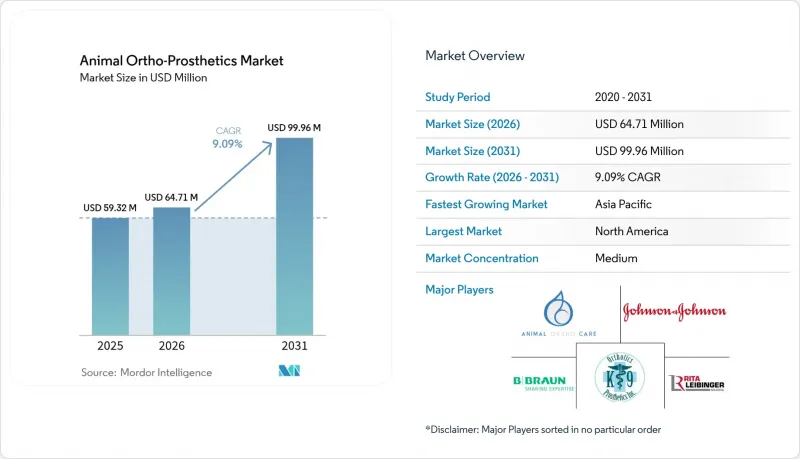
This report is Segmented by Product Type (Orthotic Devices, Prosthetic Devices, and More), Animal Type (Canine, Feline, and More), End-User (Veterinary Hospitals & Clinics, and More), Material (Thermoplastics, and More), and Geography (North America, Europe, Asia-Pacific, Middle East & Africa, South America). The Market Forecasts are Provided in Terms of Value (USD).
Global Animal Ortho-Prosthetics Market Trends and Insights
Rising Global Pet Expenditure
Pet spending continues to swell as millennial and Gen Z owners treat animals as family members; surveys show U.S. outlays could move from USD 121 billion in 2023 to USD 279 billion by 2030. The budget shift makes prosthetic costs between USD 1,000 and USD 2,000 tolerable, positioning devices as essential healthcare, not luxuries. Demand proves resilient during downturns because owners rarely cut pet health expenses first. Premium brands therefore focus on quality-of-life outcomes rather than price, reinforcing value perceptions. Insurers are slowly broadening coverage, which further cushions household budgets and widens adoption.
Technological Innovations in Veterinary Orthopedics
Titanium and carbon-fiber parts produced on high-resolution 3-D printers now replicate precise limb geometry, promoting bone integration and weight savings. Hospital networks such as VCA opened dedicated additive labs in 2024, trimming fabrication lead times from several weeks to a few days. Computer-aided modeling lets engineers balance strength and flexibility, reducing stress shielding that once triggered revision surgery. As scanning, software, and printing operate on one digital thread, clinics can iterate designs quickly and deliver superior fit, a clear edge over manual plaster casting.
High Cost of Custom Prosthetic Solutions
A full limb device from market leader OrthoPets ranges from USD 1,265 to USD 2,125 before clinic fees double the bill. Limited production batches and premium materials block economies of scale and keep price elasticities high. Insurers often cap payouts or exclude mobility aids, leaving owners to carry residual costs. When ongoing adjustments, padding replacements, and refurbishment are factored in, lifetime expenses climb further, dampening demand outside affluent households.
Other drivers and restraints analyzed in the detailed report include:
- Increasing Prevalence of Animal Musculoskeletal Disorders
- Expanding Veterinary Infrastructure and Insurance Penetration
- Limited Skilled Workforce in Veterinary Orthopedics
For complete list of drivers and restraints, kindly check the Table Of Contents.
Segment Analysis
Orthotic braces generated the largest revenue in 2024, yet carts and wheelchairs deliver the highest forecast growth. Orthotics appeal because they avoid surgery, offering immediate stability for ligament injuries. However, complete limb loss cases now receive custom carts that restore gait with minimal rehabilitation time. The animal ortho-prosthetics market size for mobility aids is projected to reach USD 27.33 million by 2031, a 6-year jump underpinned by lightweight aluminum frames and quick-release harness systems. Orthotics remain indispensable for partial weight bearing, but manufacturers are bundling braces with wheels and ramps, selling integrated mobility kits rather than single parts. This bundling strategy unlocks cross-sell revenue and strengthens clinic relationships.
Prosthetic limbs occupy a smaller volume niche yet command higher unit prices because of titanium pylons, silicone liners, and detailed finishing. Accessory lines-replacement straps, paw covers, and joint locks-are gaining recognition as recurring revenue streams. Clinics often sign annual supply contracts to ensure patients receive timely consumables, anchoring aftermarket sales. Providers that master both durable goods and consumables diversify risk and build loyalty in the animal ortho-prosthetics market.
Companion dogs dominate procedure counts as owners prioritize pets' welfare, but working horses generate rising traction. The animal ortho-prosthetics market share for canine applications was 67.63% in 2025, yet targeted programs for sport and police horses are forecast to post a 12.06% CAGR. Gait analysis tools such as inertial sensors now objectify lameness metrics, letting farriers and veterinarians decide when a brace can defer euthanasia. Breeding operations see direct financial returns when a high-value stallion resumes service sooner, supporting premium price points.
Cats index lower because device acceptance is hindered by grooming behavior and stature. Exotic mammals and livestock remain marginal but strategic; zoos and dairies commission high-margin one-off builds when an animal has significant conservation or economic value. These cases spark media coverage that lifts public perception of the animal ortho-prosthetics market and indirectly boosts adoption among mainstream pet owners.
Complete Report Scope:
- By Product Type
- Orthotic Devices
- Prosthetic Devices
- Mobility Aids (Carts, Wheel-chairs)
- Components & Accessories
- By Animal Type
- Canine
- Feline
- Equine
- Other Animal Types
- By End-User
- Veterinary Hospitals & Clinics
- Rehabilitation & Physiotherapy Centers
- Home-Care (Pet Owners)
- By Material
- Thermoplastics (PP, PE)
- Metals & Alloys (Ti, SS)
- Carbon-Fiber Composites
- Silicone & Others
- By Technology
- 3-D Printing / Additive Manufacturing
- Conventional Manufacturing
- Geography
- North America
- United States
- Canada
- Mexico
- Europe
- Germany
- United Kingdom
- France
- Italy
- Spain
- Rest of Europe
- Asia-Pacific
- China
- Japan
- India
- Australia
- South Korea
- Rest of Asia-Pacific
- Middle East & Africa
- GCC
- South Africa
- Rest of Middle East & Africa
- South America
- Brazil
- Argentina
- Rest of South America
- North America
Geography Analysis
North America leads the animal ortho-prosthetics market with a 41.95% share because owners allocate premium budgets, insurers reimburse partial costs, and device makers cluster around academic veterinary hubs. The region shows steady single-digit unit growth while mix shifts toward high ticket prosthetics. Clinics in Colorado, Texas, and Ontario pioneer osseointegrated fixation, positioning the continent for early adoption of load-bearing implant lines. Regulatory guidance from the U.S. Food and Drug Administration on veterinary devices reduces ambiguity and keeps compliance costs manageable.
Asia-Pacific records the highest forecast CAGR at 10.18% as urban households acquire pedigree pets and treat them as family. China's acceptance of a 3-D printed knee in 2025 demonstrates state endorsement of advanced orthopedics. However, inter-regional disparity persists: tier-one cities host specialist hospitals, while provincial clinics lack imaging and fabrication labs. Government investment and insurer entry should narrow gaps, though pricing must align with middle-income affordability. Conventional fabrication remains dominant today, creating scope for local manufacturing hubs that leverage lower labor costs.
Europe ranks third in value terms and enjoys harmonized product standards under CE marking. Universities in Germany, the Netherlands, and the United Kingdom perform biomechanics research that feeds into design enhancements, while small enterprises craft bespoke solutions for equine sports medicine. The Middle East and Africa plus South America form a long-tail opportunity curve. Affluent Gulf households import devices, but broader uptake waits for wider veterinary coverage. In Brazil, rehabilitation chains add hydrotherapy pools, indicating momentum despite economic volatility. Across these regions, distributors that bundle fitting, after-care, and remote support win contracts because clinics seek turnkey offerings.
- OrthoPets LLC
- Animal OrthoCare
- Bionic Pets
- Walkin' Pets By HandicappedPets
- My Pet's Brace
- Thera-Paw Inc.
- Eddie's Wheels
- KVP Orthotics
- Hero Braces
- L'Il Back Bracer
- Wheelchairs For Dogs (USA)
- Pawsthetics
- Motion 3-D (UK)
- Veterinary Inclusive 3-D Solutions
- Animal Bionics India
- CamMedica (EU)
- PawDynamics
- OrthoVet LLC
- Ottobock VetCare
- Ossur Veterinary
Additional Benefits:
- The market estimate (ME) sheet in Excel format
- 3 months of analyst support
TABLE OF CONTENTS
1 Introduction
- 1.1 Study Assumptions & Market Definition
- 1.2 Scope of the Study
2 Research Methodology
3 Executive Summary
4 Market Landscape
- 4.1 Market Overview
- 4.2 Market Drivers
- 4.2.1 Rising Global Pet Expenditure
- 4.2.2 Technological Innovations in Veterinary Orthopedics
- 4.2.3 Increasing Prevalence of Animal Musculoskeletal Disorders
- 4.2.4 Expanding Veterinary Care Infrastructure and Insurance Penetration
- 4.2.5 Growing Awareness of Animal Mobility Solutions
- 4.2.6 Adoption of Tele-Rehabilitation and Remote Fitting Platforms
- 4.3 Market Restraints
- 4.3.1 High Cost of Custom Prosthetic Solutions
- 4.3.2 Limited Skilled Workforce in Veterinary Orthopedics
- 4.3.3 Lack Of Standardized Regulatory Framework
- 4.3.4 Limited Market Penetration in Emerging Economies
- 4.4 Regulatory Landscape
- 4.5 Porter's Five Forces Analysis
- 4.5.1 Threat Of New Entrants
- 4.5.2 Bargaining Power Of Buyers
- 4.5.3 Bargaining Power Of Suppliers
- 4.5.4 Threat Of Substitutes
- 4.5.5 Intensity Of Competitive Rivalry
5 Market Size & Growth Forecasts (Value, USD)
- 5.1 By Product Type
- 5.1.1 Orthotic Devices
- 5.1.2 Prosthetic Devices
- 5.1.3 Mobility Aids (Carts, Wheel-chairs)
- 5.1.4 Components & Accessories
- 5.2 By Animal Type
- 5.2.1 Canine
- 5.2.2 Feline
- 5.2.3 Equine
- 5.2.4 Other Animal Types
- 5.3 By End-User
- 5.3.1 Veterinary Hospitals & Clinics
- 5.3.2 Rehabilitation & Physiotherapy Centers
- 5.3.3 Home-Care (Pet Owners)
- 5.4 By Material
- 5.4.1 Thermoplastics (PP, PE)
- 5.4.2 Metals & Alloys (Ti, SS)
- 5.4.3 Carbon-Fiber Composites
- 5.4.4 Silicone & Others
- 5.5 By Technology
- 5.5.1 3-D Printing / Additive Manufacturing
- 5.5.2 Conventional Manufacturing
- 5.6 Geography
- 5.6.1 North America
- 5.6.1.1 United States
- 5.6.1.2 Canada
- 5.6.1.3 Mexico
- 5.6.2 Europe
- 5.6.2.1 Germany
- 5.6.2.2 United Kingdom
- 5.6.2.3 France
- 5.6.2.4 Italy
- 5.6.2.5 Spain
- 5.6.2.6 Rest of Europe
- 5.6.3 Asia-Pacific
- 5.6.3.1 China
- 5.6.3.2 Japan
- 5.6.3.3 India
- 5.6.3.4 Australia
- 5.6.3.5 South Korea
- 5.6.3.6 Rest of Asia-Pacific
- 5.6.4 Middle East & Africa
- 5.6.4.1 GCC
- 5.6.4.2 South Africa
- 5.6.4.3 Rest of Middle East & Africa
- 5.6.5 South America
- 5.6.5.1 Brazil
- 5.6.5.2 Argentina
- 5.6.5.3 Rest of South America
- 5.6.1 North America
6 Competitive Landscape
- 6.1 Market Concentration
- 6.2 Market Share Analysis
- 6.3 Company Profiles (includes Global level Overview, Market level overview, Core Business Segments, Financials, Headcount, Key Information, Market Rank, Market Share, Products and Services, and analysis of Recent Developments)
- 6.3.1 OrthoPets LLC
- 6.3.2 Animal OrthoCare
- 6.3.3 Bionic Pets
- 6.3.4 Walkin' Pets By HandicappedPets
- 6.3.5 My Pet's Brace
- 6.3.6 Thera-Paw Inc.
- 6.3.7 Eddie's Wheels
- 6.3.8 KVP Orthotics
- 6.3.9 Hero Braces
- 6.3.10 L'Il Back Bracer
- 6.3.11 Wheelchairs For Dogs (USA)
- 6.3.12 Pawsthetics
- 6.3.13 Motion 3-D (UK)
- 6.3.14 Veterinary Inclusive 3-D Solutions
- 6.3.15 Animal Bionics India
- 6.3.16 CamMedica (EU)
- 6.3.17 PawDynamics
- 6.3.18 OrthoVet LLC
- 6.3.19 Ottobock VetCare
- 6.3.20 Ossur Veterinary
7 Market Opportunities & Future Outlook
- 7.1 White-Space & Unmet-Need Assessment


