

|
시장보고서
상품코드
2123492
변비 치료 시장 : 점유율 분석, 업계 동향과 통계, 성장 예측(2026-2031년)Constipation Treatment - Market Share Analysis, Industry Trends & Statistics, Growth Forecasts (2026 - 2031) |
||||||
 Mordor Intelligence
Mordor Intelligence에 의하면, 변비 치료 시장 규모는 2025년 132억 2,000만 달러, 2026년 139억 7,000만 달러에서 2031년까지 188억 4,000만 달러로 확대될 것으로 예측되고 있어 2026년부터 2031년까지 연평균 복합 성장률(CAGR)은 6.17%를 나타낼 전망입니다.
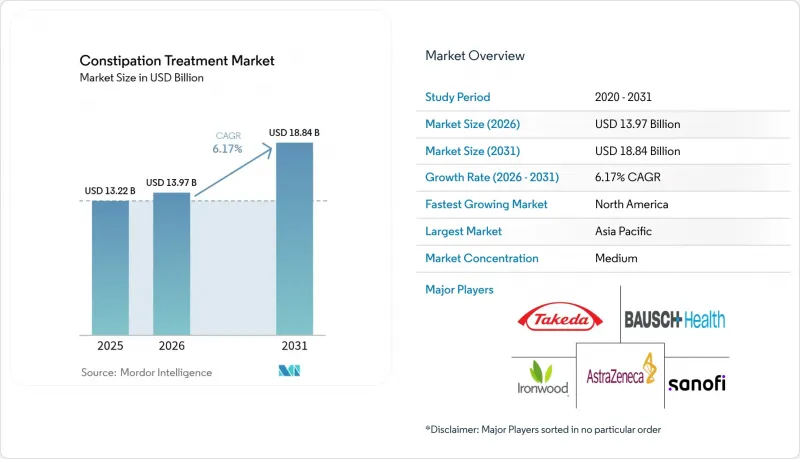
본 보고서는 약물 분류별(팽창성 완하제 등), 질환 유형별(만성 특발성 변비 등), 처방 형태별(처방약, 일반의약품 등), 투여 경로별(경구 투여 등), 환자 유형별(성인 등), 유통 채널별(병원 약국 등), 지역별(북미 등)로 분류되어 있습니다. 시장 예측은 금액(달러) 기준으로 제시되어 있습니다.
전 세계 변비 치료 시장 동향 및 인사이트
고령화로 인해 만성적인 사용 수요가 증가하고 있습니다.
2025년 65세 이상 인구는 7억 6,100만 명이었으나, 2030년까지 9억 9,400만 명에 달할 것으로 예측되며, 이러한 변화로 인해 변비의 기준 유병률은 26% 이상으로 상승할 것으로 전망됩니다. 장기 요양 시설에서는 예방적인 삼투압성 완하제나 팽창성 완하제의 사용이 의무화되어 있으며, 이러한 제품들은 정기적인 연금과 같은 처방전이 되고 있습니다. 인구의 29.1%가 65세 이상인 일본에서는 2025년에 75세 이상 연령층의 완하제 처방전이 14% 증가했다고 보고되었습니다. 파킨슨병 및 당뇨병 유병률의 상승으로 인해, 수년에 걸친 치료 계획이 더욱 정착되고 있습니다. 각 제약사는 2024년 ‘Beers Criteria’ 개정에 따라, 나트륨 함량이 낮고 복용하기 쉬운 제형으로 이에 대응하고 있습니다. 이번 개정에서는 고삼투압 제품이 처방 감축 대상으로 지목되었습니다.
오피오이드 처방 급증으로 OIC 치료 촉진
미국에서는 2024년에 1억 4,220만 건의 오피오이드 처방전이 조제되었으며, 이는 2023년 대비 불과 7% 감소에 그쳐, 오피오이드 유발성 변비(OIC) 위험을 안고 있는 대규모 환자 집단이 유지되고 있습니다. 만성 오피오이드 사용 환자의 최대 81%가 OIC를 경험하고 있음에도 불구하고, 말초 작용형 μ-오피오이드 수용체 길항제를 투여받고 있는 환자는 4분의 1 미만에 그치고 있어, 치료가 불충분한 환자 집단이 남아 있으며, 종종 변색전증을 이유로 응급실을 방문하는 사태가 발생하고 있습니다. 유럽 규제 당국은 2024년에 메틸나트렉손의 적응증을 확대하여 비암성 통증 분야를 넓혔습니다. 의사들은 사전 승인 장벽을 피하기 위해 리나크로티드와 같은 GC-C 작용제로의 오프라벨 전환을 늘리고 있으며, 이로 인해 치료의 공백을 최소화할 수 있는 고정 용량의 오피오이드-변비약 복합제에 대한 관심이 높아지고 있습니다.
부작용 및 의존성에 대한 우려가 장기 사용을 억제
2025년 FDA의 모니터링 검토에 따르면, 만성 자극성 완하제 사용자 중 입원이 필요할 정도로 심각한 저칼륨혈증이 발생한 비율이 19%에 달하는 것으로 나타났습니다. 지원 단체들은 자극성 완하제를 14일 이상 연속으로 사용하는 것에 대해 경고를 발령하고 있으며, 코호트 데이터에 따르면 18개월 이내에 34%의 환자에서 투여량 증가가 관찰되어 의존성에 대한 우려가 뒷받침되고 있습니다. 캐나다 보건부가 고용량 폴리에틸렌글리콜과 허약한 고령자의 흡인성 폐렴 간의 연관성을 지적한 권고에 따라, 작용 발현이 느림에도 불구하고 요양 시설에서는 식이섬유 기반 약물로 전환하는 추세가 진행되고 있습니다.
부문 분석
2025년에는 자극성 완하제가 부문 매출의 38.62%를 차지하여 저렴한 비용과 빠른 효과를 반영할 것으로 보이지만, 마이크로캡슐화 기술로 인해 고령자의 흡인 위험이 감소함에 따라 윤활제 제제는 연평균 성장률(CAGR) 7.06%를 나타낼 것으로 예측됩니다. 삼투압성 완하제는 병원 프로토콜에서 여전히 1차 선택 약물로 사용되고 있지만, 5.8%의 성장률은 변비 치료 시장의 기준치인 6.17%보다 낮습니다. 분비 촉진제는 이미 고가 시장을 점유하고 있지만, 2027년부터 2028년까지 특허가 만료됨에 따라 이익률을 압박할 바이오시밀러가 등장할 가능성이 있습니다.
팽창성 완하제는 ‘자연스러운’ 완화 효과로 정평이 나 있지만, 다량의 수분 섭취가 필요하기 때문에 허약한 환자에게는 장벽이 됩니다. 독사트를 주성분으로 하는 변연화제는 코크란 리뷰에서 명확한 유효성이 인정되지 않았다는 점을 감안하여 그 위상이 하락하고 있으며, 이에 따라 미국 소화기병 학회는 2025년 지침에서 이러한 약물의 권장 등급을 하향 조정했습니다. 말초 작용형 μ-오피오이드 수용체 길항제는 OIC(오피오이드 유발성 변비)라는 특수한 틈새 시장을 차지하고 있지만, 보험 적용과 관련된 장벽에 직면해 있어, 적응증 외 사용이 이루어지는 GC-C 계열 약물과 비교할 때 보급이 제한되고 있습니다.
2025년 시점에서 오피오이드 유발성 변비는 질환 유형별 시장 가치의 34.07%를 차지하고 있지만, IBS-C는 연평균 성장률(CAGR) 9.63%로 급성장하여 전체 적응증 중 가장 높은 성장률을 보일 것으로 예측됩니다. 만성 특발성 변비는 여전히 절대 환자 수가 가장 많지만, 환자들이 식이 요법, 식이섬유 보충제, 앱 기반 바이오피드백 등을 시도함에 따라 그 성장 속도는 둔화되고 있습니다.
2024년 로마 IV 진단 기준의 개정에 따라 증상 빈도에 대한 기준치가 하향 조정되면서 IBS-C 환자 수가 실질적으로 증가했고, GC-C 및 5-HT4 작용제의 환자층이 확대되었습니다. 2025년에는 유럽에서 소아 적응증 승인으로 브랜드 인지도가 높아짐에 따라, 풀카로프라이드의 처방량이 27% 급증했습니다. 신경성 변비는 신경과와 소화기내과 간에 진료 경로가 나뉘어 있는 점을 반영하여, 여전히 충분한 의료 서비스가 제공되지 못하고 있습니다.
지역별 분석
북미는 1인당 의료비가 높은 수준이며, OIC(오피오이드 유발성 변비) 부문을 주도하는 오피오이드 처방이 정착된 것을 배경으로 2025년 매출의 39.43%를 차지했습니다. 캐나다에서는 2024년, 2대 주에서 리나클로티드의 보험 적용 범위가 확대되면서 처방 건수가 23% 증가했습니다. 멕시코에서는 여전히 양극화가 나타나고 있습니다. 대도시권에서는 미국과 유사한 치료 패턴이 나타나는 반면, 농촌 지역에서는 허브인 센나에 의존하고 있어 처방 보급률은 진단 사례의 34%에 그치고 있습니다.
독일, 영국, 프랑스는 지역 매출의 62%를 차지하고 있지만, 단일 지불자 제도에 따른 비용 억제로 인해 임상의들은 제네릭 의약품으로의 전환을 강요받고 있습니다. 다케다 제약이 새로 승인을 받은 5-HT4 수용체 작용제는 이탈리아와 스페인에서 여전히 유리한 가격 합의를 얻지 못해 보급이 지연되고 있습니다. 또한, 식이섬유 및 생활 습관 개선을 중시하는 NICE(영국 국립의료기술평가원)의 지침 개정에 따라 영국에서의 처방량이 억제되고 있습니다.
아시아태평양은 11.27%라는 지역별 최고 수준의 연평균 성장률(CAGR)을 기록하고 있습니다. 중국이 2024년에 리나클로티드를 각 성의 보험 적용 목록에 추가하기로 결정한 점, 인도에서 저가 제네릭 GC-C가 출시된 점, 그리고 일본의 초고령화 사회가 맞물려 성장을 뒷받침하고 있습니다. 호주에서는 자극제의 포장 크기 상한선이 설정됨에 따라 의도치 않게 만성 사용자들이 처방약으로 전환하는 반면, 한국에서는 원격의료를 활용하여 전문의에 대한 접근성을 확대되고 있습니다.
중동 및 아프리카는 합계 7%로 점유율이 소폭에 그치지만, 걸프 국가들이 의료 인프라를 정비하고 있어 꾸준한 성장을 기록하고 있습니다. 남미는 6.9%의 성장률을 보이고 있으며, 2024년 브라질에서의 프레카나티드 승인 및 현지 제네릭 의약품 출시로 인해 가격 경쟁력이 유지되고 있습니다. 아르헨티나의 경제 변동은 계속해서 소비자들이 현지에서 제조된 자극제로 눈을 돌리게 하고 있습니다.
기타 혜택:
- 엑셀 형식 시장 예측(ME) 시트
- 3개월간의 애널리스트 지원
자주 묻는 질문
목차
제1장 서론
제2장 조사 방법
제3장 주요 요약
제4장 시장 구도
제5장 시장 규모와 성장 예측
제6장 경쟁 구도
제7장 시장 기회와 향후 전망
JHS 26.09.07According to Mordor Intelligence, the constipation treatment market size is projected to expand from USD 13.22 billion in 2025 and USD 13.97 billion in 2026 to USD 18.84 billion by 2031, registering a CAGR of 6.17% between 2026 to 2031.
This report is Segmented by Drug Class (Bulk-Forming Agents, and More), Disease Type (Chronic Idiopathic Constipation, and More), Prescription Type (Over-The-Counter, and More), Route of Administration (Oral, and More), Patient Type (Adult, and More), Distribution Channel (Hospital Pharmacies, and More), and Geography (North America, and More). Market Forecasts are Provided in Terms of Value (USD).
Global Constipation Treatment Market Trends and Insights
Aging Population Boosts Chronic-Use Demand
People aged 65 and above numbered 761 million in 2025 and are projected to reach 994 million by 2030, a shift that raises baseline constipation prevalence to more than 26%. Long-term care facilities mandate prophylactic osmotic or bulk-forming agents, turning these products into recurring, annuity-style prescriptions. Japan, where 29.1% of citizens are older than 65, reported a 14% rise in laxative scripts among those over 75 during 2025. Higher Parkinson's and diabetes incidence further entrenches multi-year regimens. Manufacturers answer with low-sodium, palatable formulas aligned with the 2024 Beers Criteria update, which flags high-osmolarity products for deprescribing.
Opioid Prescription Surge Driving OIC Therapies
The United States dispensed 142.2 million opioid prescriptions in 2024, only 7% below 2023, sustaining a large cohort at risk for opioid-induced constipation. Up to 81% of chronic-opioid patients experience OIC, yet fewer than one-quarter receive a peripherally acting mu-opioid receptor antagonist, leaving an undertreated pool that often presents in emergency care for fecal impaction. European regulators widened methylnaltrexone labeling in 2024, enlarging the non-cancer pain segment. Physicians increasingly redirect to GC-C agonists like linaclotide off-label to bypass prior-authorization barriers, spurring interest in fixed-dose opioid-laxative combinations that minimize therapeutic gaps.
Adverse-Effect & Dependency Fears Curb Long-Term Use
A 2025 FDA surveillance review showed that 19% of chronic stimulant users developed hypokalemia serious enough to require hospitalization. Advocacy groups caution against more than 14 straight days of stimulant use, and cohort data reveal a 34% dose-escalation rate within 18 months, validating dependency concerns. Health Canada's advisory linking high-dose polyethylene glycol to aspiration pneumonia in frail seniors has driven nursing homes toward fiber-based agents despite a slower onset.
Other drivers and restraints analyzed in the detailed report include:
- E-Commerce Accelerates OTC Laxative Penetration
- Pipeline Gut-Targeted Neuromodulators Enter Mid-Stage Trials
- Stricter OTC Stimulant / Sodium-Phosphate Regulations
For complete list of drivers and restraints, kindly check the Table Of Contents.
Segment Analysis
Stimulant agents accounted for 38.62% of segment revenue in 2025, reflecting their low cost and rapid onset, yet lubricant formulas are projected to grow at a 7.06% CAGR as microencapsulation reduces aspiration risk among elders. Osmotic agents remain first-line in hospital protocols, though their 5.8% growth lags the 6.17% baseline of the constipation treatment market. Secretagogues already command premium pricing, and their patents expiring in 2027-2028 could invite biosimilars that compress margins.
Bulk-forming products enjoy a reputation for "natural" relief but require high fluid intake that deters frail patients. Stool softeners, chiefly docusate, slide after a Cochrane review showed no clear efficacy, leading the American College of Gastroenterology to downgrade them in 2025 guidance. Peripherally acting mu-opioid receptor antagonists occupy a specialized OIC niche but endure payer hurdles that limit uptake compared with off-label GC-C alternatives.
Opioid-induced constipation retained 34.07% of disease-type value in 2025, yet IBS-C is forecast to sprint ahead at a 9.63% CAGR, the fastest among all indications. Chronic idiopathic constipation remains the largest absolute pool but grows more slowly as patients experiment with diet, fiber supplements, and app-based biofeedback.
Rome IV criteria revisions in 2024 effectively expanded the IBS-C population by lowering the symptom-frequency threshold, enlarging the patient pool for GC-C and 5-HT4 agonists. Prucalopride prescriptions surged 27% in 2025 after pediatric European approval stimulated brand visibility. Neurologic constipation continues to be underserved, reflecting split care pathways between neurology and gastroenterology practices.
Complete Report Scope:
- By Drug Class
- Bulk-Forming Agents
- Osmotic Agents
- Stimulant Agents
- Stool Softeners / Emollients
- Lubricant Agents
- Secretagogues (ClC-2, GC-C)
- Other Drug Classes
- By Disease Type
- Chronic Idiopathic Constipation (CIC)
- Irritable Bowel Syndrome-C (IBS-C)
- Opioid-Induced Constipation (OIC)
- Post-surgical & Neurologic Constipation
- By Prescription Type
- Over-the-Counter (OTC)
- Prescription Drugs
- By Route of Administration
- Oral
- Rectal
- Parenteral
- By Patient Type
- Adult
- Geriatric
- Pediatric
- By Distribution Channel
- Hospital Pharmacies
- Retail / Drug Stores
- Online Pharmacies & DTC Subscriptions
- By Geography
- North America
- United States
- Canada
- Mexico
- Europe
- Germany
- United Kingdom
- France
- Italy
- Spain
- Rest of Europe
- Asia-Pacific
- China
- Japan
- India
- Australia
- South Korea
- Rest of Asia-Pacific
- Middle East & Africa
- GCC
- South Africa
- Rest of Middle East & Africa
- South America
- Brazil
- Argentina
- Rest of South America
- North America
Geography Analysis
North America captured 39.43% of 2025 revenue on the back of high per-capita health spending and entrenched opioid prescribing that feeds the OIC segment. Canada expanded linaclotide coverage in its two largest provinces during 2024, prompting a 23% rise in prescriptions. Mexico remains bifurcated: metropolitan centers mirror U.S. treatment patterns, while rural areas lean on herbal senna, leaving prescription penetration at 34% of diagnosed cases.
Germany, the United Kingdom, and France supply 62% of regional turnover, but single-payer cost controls push clinicians toward generics. Takeda's newly approved 5-HT4 agent still awaits favorable price agreements in Italy and Spain, delaying uptake. NICE guidance updates that emphasize fiber and lifestyle adjustment dampen prescription volume in the United Kingdom.
Asia-Pacific posts the fastest regional CAGR at 11.27%. China's decision to add linaclotide to provincial reimbursement lists in 2024, India's low-priced generic GC-C launches, and Japan's super-aged demographic collectively propel growth. Australia's stimulant pack-size caps inadvertently shift chronic users to prescription items, while South Korea leverages telemedicine to broaden specialist access.
Middle East and Africa together represent a modest 7% share but record steady expansion as Gulf states upgrade health infrastructure. South America grows at 6.9%; Brazil's approval of plecanatide in 2024 and local generic launches keep prices accessible. Economic volatility in Argentina continues to push consumers toward locally made stimulants.
- Abbvie
- Abbott Laboratories
- Ardelyx Inc.
- AstraZeneca
- Bausch Health (Salix)
- Bayer
- Beutlich Pharmaceuticals
- Boehringer Ingelheim
- Dr. Reddy's Laboratories
- GlaxoSmithKline
- Ironwood Pharmaceuticals
- Johnson & Johnson
- Mallinckrodt Pharma
- Norgine B.V.
- Prestige Consumer Healthcare
- Procter & Gamble
- Sanofi
- Sun Pharmaceuticals Industries
- Takeda Pharmaceuticals
- Teva Pharmaceutical Industries
Additional Benefits:
- The market estimate (ME) sheet in Excel format
- 3 months of analyst support
TABLE OF CONTENTS
1 Introduction
- 1.1 Study Assumptions & Market Definition
- 1.2 Scope of the Study
2 Research Methodology
3 Executive Summary
4 Market Landscape
- 4.1 Market Overview
- 4.2 Market Drivers
- 4.2.1 Aging Population Boosts Chronic-Use Demand
- 4.2.2 Opioid Prescription Surge Driving OIC Therapies
- 4.2.3 E-Commerce Accelerates OTC Laxative Penetration
- 4.2.4 Pipeline Gut-Targeted Neuromodulators Enter Mid-Stage Trials
- 4.2.5 Personalized Microbiome Therapies & Digital Adherence Tools Emerge
- 4.2.6 Novel GC-C and 5-HT4 Agonists Gaining Approvals
- 4.3 Market Restraints
- 4.3.1 Adverse-Effect & Dependency Fears Curb Long-Term Use
- 4.3.2 Stricter OTC Stimulant / Sodium-Phosphate Regulations
- 4.3.3 Digital Biofeedback Platforms Cannibalise Drug Revenues
- 4.3.4 Consumer Shift to Herbal & Home Remedies Reducing Prescription Uptake
- 4.4 Regulatory Landscape
- 4.5 Technological Outlook
- 4.6 Porter's Five Forces Analysis
- 4.6.1 Threat of New Entrants
- 4.6.2 Bargaining Power of Buyers
- 4.6.3 Bargaining Power of Suppliers
- 4.6.4 Threat of Substitute Products
- 4.6.5 Intensity of Competitive Rivalry
5 Market Size & Growth Forecasts
- 5.1 By Drug Class
- 5.1.1 Bulk-Forming Agents
- 5.1.2 Osmotic Agents
- 5.1.3 Stimulant Agents
- 5.1.4 Stool Softeners / Emollients
- 5.1.5 Lubricant Agents
- 5.1.6 Secretagogues (ClC-2, GC-C)
- 5.1.7 Other Drug Classes
- 5.2 By Disease Type
- 5.2.1 Chronic Idiopathic Constipation (CIC)
- 5.2.2 Irritable Bowel Syndrome-C (IBS-C)
- 5.2.3 Opioid-Induced Constipation (OIC)
- 5.2.4 Post-surgical & Neurologic Constipation
- 5.3 By Prescription Type
- 5.3.1 Over-the-Counter (OTC)
- 5.3.2 Prescription Drugs
- 5.4 By Route of Administration
- 5.4.1 Oral
- 5.4.2 Rectal
- 5.4.3 Parenteral
- 5.5 By Patient Type
- 5.5.1 Adult
- 5.5.2 Geriatric
- 5.5.3 Pediatric
- 5.6 By Distribution Channel
- 5.6.1 Hospital Pharmacies
- 5.6.2 Retail / Drug Stores
- 5.6.3 Online Pharmacies & DTC Subscriptions
- 5.7 By Geography
- 5.7.1 North America
- 5.7.1.1 United States
- 5.7.1.2 Canada
- 5.7.1.3 Mexico
- 5.7.2 Europe
- 5.7.2.1 Germany
- 5.7.2.2 United Kingdom
- 5.7.2.3 France
- 5.7.2.4 Italy
- 5.7.2.5 Spain
- 5.7.2.6 Rest of Europe
- 5.7.3 Asia-Pacific
- 5.7.3.1 China
- 5.7.3.2 Japan
- 5.7.3.3 India
- 5.7.3.4 Australia
- 5.7.3.5 South Korea
- 5.7.3.6 Rest of Asia-Pacific
- 5.7.4 Middle East & Africa
- 5.7.4.1 GCC
- 5.7.4.2 South Africa
- 5.7.4.3 Rest of Middle East & Africa
- 5.7.5 South America
- 5.7.5.1 Brazil
- 5.7.5.2 Argentina
- 5.7.5.3 Rest of South America
- 5.7.1 North America
6 Competitive Landscape
- 6.1 Market Concentration
- 6.2 Market Share Analysis
- 6.3 Company Profiles (includes Global Level Overview, Market Level Overview, Core Segments, Financials as Available, Strategic Information, Market Rank/Share for Key Companies, Products & Services, and Recent Developments)
- 6.3.1 AbbVie Inc.
- 6.3.2 Abbott Laboratories
- 6.3.3 Ardelyx Inc.
- 6.3.4 AstraZeneca PLC
- 6.3.5 Bausch Health (Salix)
- 6.3.6 Bayer AG
- 6.3.7 Beutlich Pharmaceuticals
- 6.3.8 Boehringer Ingelheim
- 6.3.9 Dr. Reddy's Laboratories
- 6.3.10 GlaxoSmithKline PLC
- 6.3.11 Ironwood Pharmaceuticals
- 6.3.12 Johnson & Johnson
- 6.3.13 Mallinckrodt Pharma
- 6.3.14 Norgine B.V.
- 6.3.15 Prestige Consumer Healthcare
- 6.3.16 Procter & Gamble Co.
- 6.3.17 Sanofi S.A.
- 6.3.18 Sun Pharma
- 6.3.19 Takeda Pharmaceutical
- 6.3.20 Teva Pharmaceuticals
7 Market Opportunities & Future Outlook
- 7.1 White-space & Unmet-Need Assessment


