

|
시장보고서
상품코드
2124092
감정 분석 시장 : 시장 점유율 분석, 업계 동향 및 통계, 성장 예측(2026-2031년)Emotion Analytics - Market Share Analysis, Industry Trends & Statistics, Growth Forecasts (2026 - 2031) |
||||||
 Mordor Intelligence
Mordor Intelligence에 의하면, 감정 분석 시장 규모는 2026년에 50억 2,000만 달러로 추정되고, 예측 기간(2026-2031년) CAGR 8.93%로 성장을 지속할 것으로 예상되며, 2031년까지 77억 달러에 이를 전망입니다.
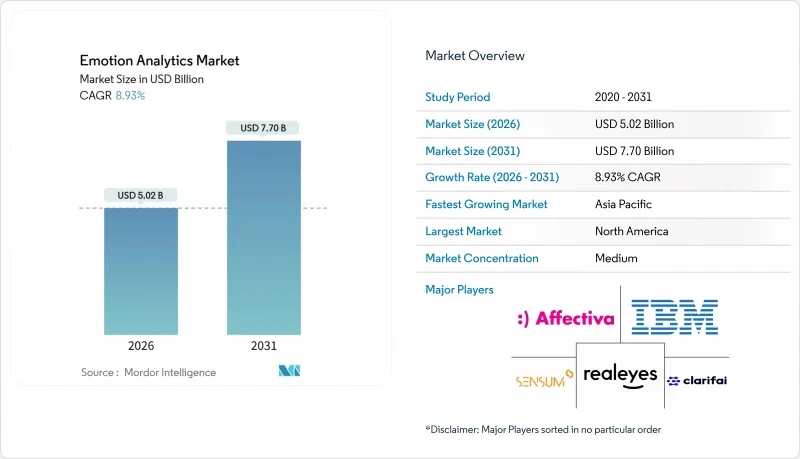
본 보고서는 배포 방식별(온프레미스, 클라우드 등), 구성 요소별(소프트웨어, 하드웨어, 서비스), 분석 기법별(얼굴 감정 인식, 동영상 기반 멀티모달 등), 용도별(고객 서비스 및 컨택 센터, 제품·시장 조사 등), 그리고 지역별로 분류되어 있습니다. 시장 전망은 금액(달러) 기준으로 제시되어 있습니다.
세계의 감정 분석 시장 동향 및 인사이트
IoT 웨어러블 및 스마트 기기의 보급
감정을 감지하는 웨어러블 하드웨어는 실험실의 프로토타입 단계에서 기업 도입 단계로 그 규모를 확대되고 있습니다. 그 대표적인 예가 14채널 뇌파 측정 헤드셋 ‘Emotiv EPOC X’입니다. 가격은 999달러이며, 현재 직장 내 스트레스 점검 및 사용자 경험 시범 운영을 위해 제공되고 있습니다. BIOPAC Research Ring은 피부 전기 반응, 광 플레치스모그래피, 심전도, 체온, 가속도계의 측정 데이터를 단일 폼 팩터에 통합하여, 가슴 스트랩이나 얼굴 카메라를 사용하지 않고도 지속적인 감정 추적을 실현하고 있습니다. 2025년 12월 『Nature Scientific Data』지에 게재된 논문에서는 Epoc-X 및 Empatica E4의 신호를 동기화된 영상·음성과 융합하여, 멀티모달 감정 모델을 학습시키기 위한 LLaMAC 데이터셋이 소개되었습니다. 심박 변이도나 피부 전도도 등의 생리 신호는 얼굴 단서보다 집단 간 일관성이 높기 때문에 인구통계학적 편향을 줄일 수 있습니다. 또한, 기기 상에서 추론을 수행함으로써 원시 생체 신호를 클라우드 서버로 스트리밍할 필요가 없어지므로, 지연이나 데이터 유출 위험을 더욱 줄일 수 있습니다.
딥러닝에 기반한 컴퓨터 비전 및 자연어 처리의 발전
트랜스포머 아키텍처와 자기 지도 학습을 통해 라벨링된 데이터의 필요성이 줄어들었으며, 벤더들은 기존의 컨볼루션 모델에 비해 훨씬 적은 양의 라벨링 데이터만으로 콜센터 음성, 임상 면담 또는 차량 내 운전자 영상을 활용해 기반 모델을 미세 조정할 수 있게 되었습니다. Google Cloud의 ‘Conversational Insights’는 실시간 음성에서 감정, 의도, 에스컬레이션 징후를 추출하고, Microsoft Azure AI는 텍스트, 음성, 동영상을 분석하는 기성 감정 분석 API를 제공함으로써, 머신러닝 전문 인력을 보유하지 않은 기업의 진입 장벽을 낮추고 있습니다. 실시간 감정에 기반한 라우팅은 컨택 센터의 대응 시간을 단축하고 처리 능력을 향상시키며, 잠재적인 고객 이탈을 충성도 향상으로 전환합니다. 또한, 텍스트 분석을 통해 소셜 미디어, 제품 리뷰, 설문조사에서 브랜드 인지도를 몇 분 이내에 추적하는 것도 가능합니다. 이러한 발전이 결합되어, 감성 컴퓨팅은 고립된 시범 프로젝트에서 일상적인 비즈니스 워크플로로 그 적용 범위를 넓히고 있습니다.
엄격한 데이터 개인정보 보호 규정(GDPR(EU 개인정보보호규정), CPRA 등)
일반 데이터 보호 규정(GDPR(EU 개인정보보호규정)) 제9조는 생체 인식에 의한 추론을 민감한 데이터로 취급하며, 명시적인 동의, 이용 목적의 제한, 그리고 엄격한 보존 기간을 의무화하고 있습니다. 캘리포니아주 개인정보 보호법(CPRA) 또한 생체 인식 식별자에 대해 유사한 규정을 적용하는 한편, 삭제권 및 알고리즘에 의한 의사 결정에 대한 설명 의무를 추가하고 있습니다. 향후 시행될 예정인 유럽연합(EU) 인공지능법에서는 학교나 직장에서의 감정 분석을 ‘고위험’으로 분류하여, 적합성 평가 및 시장 출시 후 모니터링을 의무화할 예정입니다. 규정 준수 대응에 따른 부담으로 인해 도입 비용이 증가하여, 중소기업의 도입이 지연될 것입니다. 연방 학습(Federated Learning)이나 동형 암호화(Homomorphic Encryption)와 같은 개인정보 보호 도구는 정보 유출 위험을 경감시키지만, 지연이나 계산 비용이 증가하기 때문에 전 세계적인 확산이 지연되고 있습니다.
부문 분석
기업들이 데이터 주권 요건과 밀리초 수준의 지연 목표를 충족하기 위해 추론 처리를 센서에 가까운 곳에 배치하도록 추진함에 따라, 엣지 및 온디바이스 도입은 2026-2031년 연평균 성장률(CAGR) 10.11%로 확대될 것으로 예측됩니다. 탄력적인 컴퓨팅 능력과 중앙 집중식 모델 업데이트 덕분에, 2025년 시점에서도 클라우드 아키텍처는 감정 분석 시장의 54.57% 점유율을 차지했습니다. 그러나 왕복 지연으로 인해 1초 미만의 피드백이 요구되는 안전상 중요한 운전자 모니터링이나 원격 정신 건강 세션의 경우, 클라우드 이용은 현실적이지 않습니다. 온프레미스형 스택은 생체 인증 데이터의 외부 유출을 금지하는 은행이나 병원에 매력적이지만, 로컬 가속기 및 숙련된 머신러닝 인력에 대한 설비 투자가 필요합니다.
기술의 발전으로 인해 엣지에서 모델을 실행하는 데 따르는 장벽은 점차 낮아지고 있습니다. 2025년에 공개된 오픈소스 ‘BioGAP-Ultra’ 플랫폼은 저전력 마이크로컨트롤러에서 뇌파, 근전도, 심전도, 광 플레치스모그래피 스트림을 처리하여, 클라우드 연결 없이도 정확한 감정 추론이 가능함을 입증했습니다. 페더레이티드 러닝 툴킷을 사용하면 원시 데이터를 로컬에 보관한 채 수천 대의 기기가 공유 모델을 공동으로 학습할 수 있어, 대역폭 비용을 절감하는 동시에 기업이 일반 데이터 보호 규정(GDPR(EU 개인정보보호규정)) 제9조를 준수하는 데 도움이 됩니다. 칩 제조업체들이 표준 시스템 온 칩(SoC) 설계에 신경 처리 장치(NPU)를 추가하고, 모델 압축 기술을 통해 실적가 축소됨에 따라 엣지와 클라우드 간의 경제적 격차는 계속해서 좁혀지고 있습니다.
카메라, 뇌파 측정용 헤드셋, 피부 전기 반응(GSR) 링, 심전도(ECG) 모듈 등의 하드웨어 센서는 2031년까지 연평균 성장률(CAGR) 9.43%를 나타낼 것으로 예측되며, 이는 모든 구성 요소 그룹 중 가장 높은 성장률입니다. 소프트웨어 계층(소프트웨어 개발 키트,애플리케이션 프로그래밍 인터페이스, 관리형 대시보드)는 2025년에 감정 분석 시장 규모의 45.72%를 차지할 것으로 예상되며, 이는 클라우드 API의 초기 도입 용이성을 반영합니다. 구매자들이 턴키(turnkey) 도입을 요구하는 가운데, 통합 및 맞춤형 모델 훈련을 묶은 서비스 제공도 병행하여 확대되고 있습니다.
하드웨어 시장의 성장세는 규제와 웨어러블 기기의 보급으로 설명할 수 있습니다. EU의 운전자 모니터링 규제로 인해 자동차 제조업체들은 모든 신차에 적외선 카메라를 탑재해야 합니다. 의료 및 기업 웰니스 분야에서는 Emotiv Epoc X의 14채널 뇌파 측정 헤드셋에 사전 학습된 스트레스 및 참여 지표가 탑재되어 있어, 전문가가 아닌 팀에게도 도입 장벽이 낮아졌습니다. BIOPAC Research Ring은 피부 전기 반응, 광맥파계, 심전도, 체온, 가속도계의 데이터 스트림을 손가락에 착용하는 폼 팩터에 통합하여, 개인정보 보호 정책으로 인해 동영상 촬영이 제한되는 경우에도 연구자에게 다중 모드 선택지를 제공합니다. 센서의 소형화가 진행되고 생산량이 증가함에 따라, 하드웨어는 연구실을 넘어 소비자용 웨어러블 기기 및 앰비언트 인텔리전스(Ambient Intelligence)를 지원하는 천장 설비로 확산될 전망입니다.
지역별 분석
2025년에는 초기 파일럿 프로젝트, 벤처 자금, 하이퍼스케일 제공업체의 클라우드 크레딧에 힘입어 북미가 매출의 36.64%를 차지했습니다. 아시아태평양은 2031년까지 연평균 성장률(CAGR) 11.61%를 나타낼 것으로 예측되어, 지역별로는 가장 급격한 성장 궤도를 보이고 있습니다. 중국은 스마트카 프로그램과 스마트시티 감시 카메라에서 감정 분석을 추진하고 있는 반면, 일본은 감정을 추적하여 참여도를 높이는 고령자 돌봄 로봇에 투자하고 있습니다. 인도의 비즈니스 프로세스 아웃소싱(BPO) 거점에서는 품질 보증 워크플로우에 감정 분석 대시보드가 통합되어 있으며, 한국의 전자기기 제조업체는 스마트폰과 TV에 기분 감지 기능을 통합하고 있습니다.
유럽에서는 공급업체가 일반 데이터 보호 규정(GDPR(EU 개인정보보호규정) 제9조)과 향후 시행될 인공지능법 모두를 준수하고 있음을 입증해야 하기 때문에 성장 속도가 완만합니다. 연방 학습(Federated Learning) 파이프라인이나 동형 암호화를 패키지로 제공하는 공급업체가 조달 과정에서 우선적으로 선정되고 있습니다.
남미, 중동 및 아프리카에서는 소매, 호텔·관광, 공공 안전 분야에서 초기 시범 프로젝트가 보고되고 있으나, 대역폭 및 인프라 격차로 인해 단기적인 기여도는 제한적입니다. 전반적으로, 예측 기간 동안 아시아태평양이 북미와의 격차를 좁혀감에 따라 지역별 매출 구성은 다양화될 전망입니다.
기타 혜택 :
- 엑셀 형식 시장 예측(ME) 시트
- 3개월간의 애널리스트 지원
자주 묻는 질문
목차
제1장 서론
제2장 조사 방법
제3장 주요 요약
제4장 시장 구도
제5장 시장 규모 및 성장 예측
제6장 경쟁 구도
제7장 시장 기회 및 향후 전망
AJY 26.09.11According to Mordor Intelligence, the emotion analytics market size is estimated at USD 5.02 billion in 2026, and is expected to reach USD 7.70 billion by 2031, at a CAGR of 8.93% during the forecast period (2026-2031).
This report is Segmented by Deployment (On-Premise, Cloud, and More), Component (Software, Hardware, and Services), Analytics Modality (Facial Emotion Recognition, Video-Based Multimodal, and More), Application (Customer Service and Contact Centers, Product and Market Research, and More), and Geography. The Market Forecasts are in Value (USD)
Global Emotion Analytics Market Trends and Insights
Proliferation of IoT Wearables and Smart Devices
Wearable emotion-sensing hardware has scaled from laboratory prototypes to enterprise rollouts, exemplified by the Emotiv EPOC X, a 14-channel electroencephalography headset priced at USD 999 that now ships for workplace stress audits and user experience trials. The BIOPAC Research Ring combines galvanic skin response, photoplethysmography, electrocardiogram, temperature, and accelerometer streams into a single form factor, delivering continuous affect tracking without chest straps or facial cameras. A December 2025 Nature Scientific Data paper introduced the LLaMAC dataset that fuses Epoc-X and Empatica E4 signals with synchronized video and audio to train multimodal emotion models. Physiological signals, such as heart rate variability and skin conductance, exhibit greater cross-population consistency than facial cues, thereby reducing demographic bias. On-device inference further limits latency and data-leak risk by removing the need to stream raw biosignals to cloud servers.
Advances in Deep-Learning-Based Computer Vision and Natural Language Processing
Transformer architectures and self-supervised pre-training have reduced the need for labeled data, allowing vendors to fine-tune foundation models on call-center audio, clinical interviews, or in-cabin driver videos with far fewer annotations than their convolutional predecessors. Google Cloud's Conversational Insights surfaces sentiment, intent, and escalation cues from live audio, while Microsoft Azure AI offers pre-built sentiment APIs that parse text, speech, and video, reducing barriers for firms lacking machine-learning staff. Real-time emotion routing lowers handle time and boosts throughput in contact centers, turning potential churn into loyalty gains. Text analysis also tracks brand perception across social media, product reviews, and surveys within minutes. Together, these advances extend affective computing from isolated pilots to routine business workflows.
Stringent Data-Privacy Regulations (GDPR, CPRA, etc.)
General Data Protection Regulation Article 9 treats biometric inference as sensitive data, demanding explicit consent, purpose limitation, and strict retention windows. The California Privacy Rights Act imposes similar rules on biometric identifiers, adding deletion rights and algorithmic-decision explanations. The forthcoming European Union Artificial Intelligence Act will categorize school and workplace emotion analytics as high risk, requiring conformity assessments and post-market monitoring. Compliance overhead raises deployment costs and delays procurement for small firms. Privacy-preserving tools such as federated learning and homomorphic encryption mitigate exposure but add latency and compute expense, slowing global rollouts.
Other drivers and restraints analyzed in the detailed report include:
- Demand for Hyper-Personalized Customer Engagement Tools
- Regulatory Mandate for Driver-Monitoring Systems (EU GSR 2024)
- Bias and Accuracy Issues in Facial-Emotion Data Sets
For complete list of drivers and restraints, kindly check the Table Of Contents.
Segment Analysis
Edge and on-device deployment is projected to advance at a 10.11% CAGR between 2026 and 2031 as enterprises push inference closer to sensors to satisfy data-sovereignty mandates and millisecond-level latency targets. Cloud architectures still held 54.57% of the emotion analytics market share in 2025 thanks to elastic compute and centralized model updates. However, round-trip delays make cloud impractical for safety-critical driver monitoring or tele-mental-health sessions that require sub-second feedback. On-premise stacks appeal to banks and hospitals that ban biometric data egress, yet they demand capital outlays for local accelerators and skilled machine-learning staff.
Technical progress is lowering the hurdles to run models at the edge. The open-source BioGAP-Ultra platform, published in 2025, processes electroencephalography, electromyography, electrocardiogram, and photoplethysmography streams on low-power microcontrollers, proving that accurate emotion inference can run without cloud connectivity. Federated-learning toolkits let thousands of devices co-train a shared model while keeping raw data local, cutting bandwidth cost and helping firms comply with General Data Protection Regulation Article 9. As chip makers add neural-processing units to standard system-on-chip designs and model-compression methods shrink footprints, the economic gap between edge and cloud continues to close.
Hardware sensors, including cameras, electroencephalography headsets, galvanic skin response rings, and electrocardiogram modules, are forecast to grow at a 9.43% CAGR through 2031, the fastest rate among all component groups. Software layers (software development kits, application programming interfaces, and managed dashboards) captured 45.72% of the emotion analytics market size in 2025, reflecting the early ease of spinning up cloud APIs. Service offerings that bundle integration and custom model training expand in parallel as buyers seek turnkey rollouts.
Regulation and wearable adoption explain hardware momentum. EU driver-monitoring rules push automakers to install infrared cameras in every new cabin. In healthcare and corporate wellness, the Emotiv Epoc X 14-channel electroencephalography headset ships with pre-trained stress and engagement metrics, lowering the entry bar for non-specialist teams. The BIOPAC Research Ring fuses galvanic skin response, photoplethysmography, electrocardiogram, temperature, and accelerometer streams in a finger-worn form factor, giving researchers a multimodal option when privacy policies restrict video capture. Ongoing sensor miniaturization and rising production volume are set to bring hardware from labs to consumer wearables and ambient-intelligence ceilings.
Complete Report Scope:
- By Deployment
- On-Premise
- Cloud-based
- Edge/On-Device
- By Component
- Software (SDK/API)
- Hardware (Sensors/Camera)
- Services (Integration and Managed)
- By Analytics Modality
- Facial Emotion Recognition
- Video-based Multimodal
- Speech and Voice Tone
- Text and Sentiment
- Bio-signal (EEG/ECG/GSR) Multimodal
- By Application
- Customer Service and Contact Centers
- Product and Market Research
- Healthcare and Well-being
- Automotive and Transportation
- Education and E-Learning
- Gaming and Entertainment
- Security and Public Safety
- By Geography
- North America
- United States
- Canada
- Mexico
- South America
- Brazil
- Argentina
- Rest of South America
- Europe
- Germany
- United Kingdom
- France
- Italy
- Spain
- Rest of Europe
- Asia-Pacific
- China
- Japan
- India
- South Korea
- ASEAN
- Rest of Asia-Pacific
- Middle East
- Saudi Arabia
- United Arab Emirates
- Rest of Middle East
- Africa
- South Africa
- Nigeria
- Rest of Africa
- North America
Geography Analysis
North America accounted for 36.64% of revenue in 2025, driven by early pilots, venture funding, and cloud credits from hyperscale providers. Asia-Pacific is projected to log an 11.61% CAGR through 2031, the steepest regional trajectory. China promotes emotion analytics within intelligent-vehicle programs and smart-city cameras, while Japan invests in eldercare robots that track affect to improve engagement. India's business-process-outsourcing hubs embed sentiment dashboards into quality-assurance workflows, and South Korean electronics firms integrate mood-sensing capabilities into smartphones and televisions.
Europe is growing more slowly because vendors must demonstrate compliance with both the General Data Protection Regulation (Article 9) and the forthcoming Artificial Intelligence Act. Suppliers that package federated-learning pipelines and homomorphic encryption gain procurement preference.
South America, the Middle East, and Africa report early pilots in retail, hospitality, and public safety, yet bandwidth and infrastructure gaps temper near-term contributions. Overall, the regional revenue mix is poised to diversify as the Asia-Pacific narrows the gap with North America over the forecast window.
- Affectiva Inc.
- Realeyes OU
- IBM Corporation
- Clarifai Inc.
- Sensum Ltd.
- Beyond Verbal Communication Ltd.
- Noldus Information Technology BV
- Sentiance NV
- Lexalytics Inc.
- Deloitte Touche Tohmatsu Ltd.
- Gorilla Technology Group Inc.
- Microsoft Corporation
- Google LLC
- Amazon Web Services Inc.
- Apple Inc.
- NEC Corporation
- Intel Corporation
- NVISO SA
- Sightcorp BV
- Kairos Inc.
- Entropik Technologies Pvt Ltd.
- iMotions A/S
- CrowdEmotion Ltd.
- Cogito Corporation
Additional Benefits:
- The market estimate (ME) sheet in Excel format
- 3 months of analyst support
TABLE OF CONTENTS
1 INTRODUCTION
- 1.1 Study Assumptions and Market Definition
- 1.2 Scope of the Study
2 RESEARCH METHODOLOGY
3 EXECUTIVE SUMMARY
4 MARKET LANDSCAPE
- 4.1 Market Overview
- 4.2 Market Drivers
- 4.2.1 Proliferation of IoT Wearables and Smart Devices
- 4.2.2 Advances in Deep-Learning-based Computer Vision and NLP
- 4.2.3 Demand for Hyper-personalised Customer Engagement Tools
- 4.2.4 Regulatory Mandate for Driver-monitoring Systems (EU GSR 2024)
- 4.2.5 Emergence of Empathetic AI in Tele-mental-health Platforms
- 4.2.6 Edge-compute Frameworks for Privacy-preserving Analytics
- 4.3 Market Restraints
- 4.3.1 Stringent Data-privacy Regulations (GDPR, CPRA, etc.)
- 4.3.2 Bias and Accuracy Issues in Facial-emotion Data Sets
- 4.3.3 High Latency/Bandwidth Cost in Real-time Video Analytics
- 4.3.4 Ethical Backlash Against Emotion Surveillance in Schools
- 4.4 Industry Value Chain Analysis
- 4.5 Regulatory Landscape
- 4.6 Technological Outlook
- 4.7 Porter's Five Forces Analysis
- 4.7.1 Bargaining Power of Suppliers
- 4.7.2 Bargaining Power of Buyers
- 4.7.3 Threat of New Entrants
- 4.7.4 Threat of Substitutes
- 4.7.5 Intensity of Competitive Rivalry
5 MARKET SIZE AND GROWTH FORECASTS (VALUE)
- 5.1 By Deployment
- 5.1.1 On-Premise
- 5.1.2 Cloud-based
- 5.1.3 Edge/On-Device
- 5.2 By Component
- 5.2.1 Software (SDK/API)
- 5.2.2 Hardware (Sensors/Camera)
- 5.2.3 Services (Integration and Managed)
- 5.3 By Analytics Modality
- 5.3.1 Facial Emotion Recognition
- 5.3.2 Video-based Multimodal
- 5.3.3 Speech and Voice Tone
- 5.3.4 Text and Sentiment
- 5.3.5 Bio-signal (EEG/ECG/GSR) Multimodal
- 5.4 By Application
- 5.4.1 Customer Service and Contact Centers
- 5.4.2 Product and Market Research
- 5.4.3 Healthcare and Well-being
- 5.4.4 Automotive and Transportation
- 5.4.5 Education and E-Learning
- 5.4.6 Gaming and Entertainment
- 5.4.7 Security and Public Safety
- 5.5 By Geography
- 5.5.1 North America
- 5.5.1.1 United States
- 5.5.1.2 Canada
- 5.5.1.3 Mexico
- 5.5.2 South America
- 5.5.2.1 Brazil
- 5.5.2.2 Argentina
- 5.5.2.3 Rest of South America
- 5.5.3 Europe
- 5.5.3.1 Germany
- 5.5.3.2 United Kingdom
- 5.5.3.3 France
- 5.5.3.4 Italy
- 5.5.3.5 Spain
- 5.5.3.6 Rest of Europe
- 5.5.4 Asia-Pacific
- 5.5.4.1 China
- 5.5.4.2 Japan
- 5.5.4.3 India
- 5.5.4.4 South Korea
- 5.5.4.5 ASEAN
- 5.5.4.6 Rest of Asia-Pacific
- 5.5.5 Middle East
- 5.5.5.1 Saudi Arabia
- 5.5.5.2 United Arab Emirates
- 5.5.5.3 Rest of Middle East
- 5.5.6 Africa
- 5.5.6.1 South Africa
- 5.5.6.2 Nigeria
- 5.5.6.3 Rest of Africa
- 5.5.1 North America
6 COMPETITIVE LANDSCAPE
- 6.1 Market Concentration
- 6.2 Strategic Moves
- 6.3 Market Share Analysis
- 6.4 Company Profiles (includes Global level Overview, Market Level Overview, Core Segments, Financials as Available, Strategic Information, Market Rank/Share for Key Companies, Products and Services, and Recent Developments)
- 6.4.1 Affectiva Inc.
- 6.4.2 Realeyes OU
- 6.4.3 IBM Corporation
- 6.4.4 Clarifai Inc.
- 6.4.5 Sensum Ltd.
- 6.4.6 Beyond Verbal Communication Ltd.
- 6.4.7 Noldus Information Technology BV
- 6.4.8 Sentiance NV
- 6.4.9 Lexalytics Inc.
- 6.4.10 Deloitte Touche Tohmatsu Ltd.
- 6.4.11 Gorilla Technology Group Inc.
- 6.4.12 Microsoft Corporation
- 6.4.13 Google LLC
- 6.4.14 Amazon Web Services Inc.
- 6.4.15 Apple Inc.
- 6.4.16 NEC Corporation
- 6.4.17 Intel Corporation
- 6.4.18 NVISO SA
- 6.4.19 Sightcorp BV
- 6.4.20 Kairos Inc.
- 6.4.21 Entropik Technologies Pvt Ltd.
- 6.4.22 iMotions A/S
- 6.4.23 CrowdEmotion Ltd.
- 6.4.24 Cogito Corporation
7 MARKET OPPORTUNITIES AND FUTURE OUTLOOK
- 7.1 White-space and Unmet-Need Assessment


