

|
시장보고서
상품코드
2124383
미국의 디지털 화물 운송 시장 : 점유율 분석, 업계 동향과 통계, 성장 예측(2026-2031년)United States Digital Freight Forwarding - Market Share Analysis, Industry Trends & Statistics, Growth Forecasts (2026 - 2031) |
||||||
 Mordor Intelligence
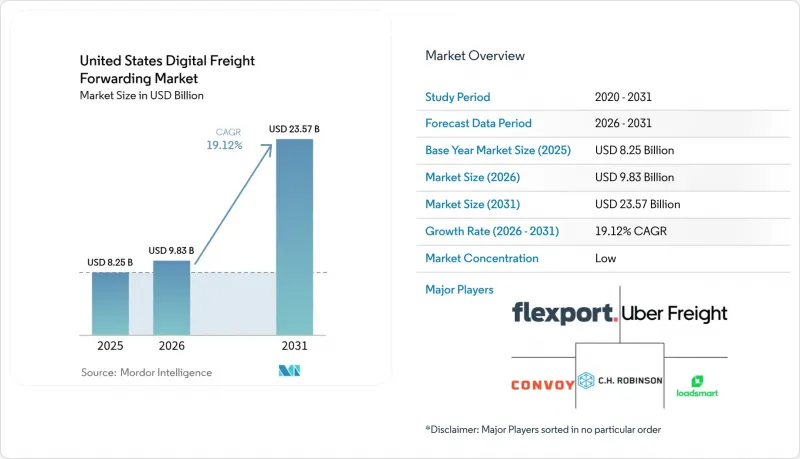
Mordor Intelligence에 의하면, 미국 디지털 화물 운송 시장 규모는 2025년에 82억 5,000만 달러로 평가되었고 2026년 98억 3,000만 달러에서 2031년까지 235억 7,000만 달러에 이를 것으로 예측되며, 예측 기간(2026-2031년) CAGR은 19.12%를 나타낼 전망입니다.
본 보고서는 기능별(운송 관리(육상, 해상, 항공), 창고 관리, 부가가치 서비스), 최종 사용자별(소매 및 전자상거래, 제조업, 헬스케어 및 제약, 자동차, 기타),배포 방식별(클라우드, On-Premise), 기업 규모별(중소기업, 대기업, 정부 기관), 지역별로 분류되어 있습니다. 시장 예측은 금액(달러) 기준으로 제시되어 있습니다.
미국 디지털 화물 운송 시장 동향 및 인사이트
전자상거래의 급속한 성장이 소량 화물 수입량을 견인
2024년, 미국 전자상거래 마켓플레이스 규모는 8,338억 달러에 달하고, 소매 총액의 15.5%를 차지하고 있으며, 그중 국경 간 소포가 이미 5%를 차지하고 있습니다. 소포 처리량은 연평균 성장률(CAGR) 5%를 기록하며 2029년까지 290억 개에 달할 것으로 예측되어, 라스트 마일 네트워크에 막대한 부하가 가해짐에 따라 고속 및 저가치 화물 배송 관리로의 전환이 시급해지고 있습니다. 각 디지털 포워더 기업들은 자동화된 통관 알고리즘과 AI를 활용한 경로 최적화를 도입하여, 엔트리 유형 86을 통해 하루 수천 건의 통관 절차를 관리하고 있습니다. 소매 업계의 실시간 대응에 대한 기대감으로 인해 운송업체에는 저비용으로 2일 이내 배송이 요구되고 있으며, 이로 인해 기존 포워더에 대한 디지털화 압력이 강해지고 있습니다. 이러한 역량이 부족한 기업들은 소량 소포 데이터를 대규모로 처리할 수 있는 기술 중심의 경쟁사들에게 미국 디지털 화물 운송 시장 점유율을 빼앗길 위험에 직면해 있습니다.
종단간 화물 가시성 및 실시간 분석에 대한 수요
2024년 현재 종합적인 가시성 체계를 갖춘 포워더는 고작 20%에 불과하지만, 화주들은 순수한 속도보다 신뢰성을 더 중요시하는 경향이 강해지고 있습니다. IoT 센서, 클라우드 대시보드, 예측 분석이 수동으로 작성된 상황 보고 이메일을 대체하며, 선제적인 예외 관리를 가능하게 하고 있습니다. 맥킨지에 따르면, 미국 소비자의 90%는 여전히 비용을 우선시하지만, 정시 배송은 필수 조건으로 남아 있습니다. Uber Freight의 생성형 AI 플랫폼은 그 성과를 여실히 보여주고 있습니다. 연간 2,400만 건의 화물을 처리하며, 동적인 도착 예정 시간(ETA) 예측 및 대체 경로 제안을 제공합니다. 화주들이 데이터 기반의 풍부한 서비스를 요구하는 가운데, 이러한 기능은 공급업체 간의 차별화 요인으로 점점 더 중요해지고 있습니다.
운송업체의 분산화가 API 도입을 지연시키고 있다.
미국에는 8만 개 이상의 트럭 운송업체가 존재하지만, 그 중 다수가 최신 IT 인프라를 갖추지 못해 플랫폼과의 통합을 복잡하게 만들고 있습니다. 디지털 포워더는 수작업과 디지털을 병행하는 하이브리드 워크플로우에 과도한 자원을 소모하고 있어 네트워크 확장이 지연되고 있습니다. 간소화된 온보딩 키트나 로우코드 API 브리지가 도움이 되지만, 지역 간 격차는 여전히 존재하고 온보딩 소요 기간도 길어지고 있어, 미국 디지털 화물 운송 시장에서 달성 가능한 성장률은 낮아지고 있습니다.
부문 분석
2025년, 운송 관리는 미국 디지털 화물 운송 시장 점유율의 45.72%를 차지했으며, 화주들이 운송 경로 선정, 운송업체의 성과, 경로 계획 최적화를 최우선 과제로 삼고 있음이 부각되었습니다. 현재 AI 알고리즘이 육상, 해상, 항공 화물 구성의 균형을 조정하여 공차 거리 감소와 체류 시간 단축을 도모하고 있습니다. 실시간 API는 운전기사, 창고, 통관업자를 연계하여 플랫폼이 40만 명 이상의 미국 트럭 운전기사를 대상으로 운송 의뢰를 자동화할 수 있게 합니다. 이러한 효율화를 통해 포워더는 서비스 품질을 유지하면서 신속하게 처리되는 소매 수입 화물을 처리할 수 있게 됩니다.
화주들이 통관 업무, 보험, 무역 규정 준수 분석을 통합한 대시보드를 요구하는 가운데, 부가가치 서비스는 10.94%라는 가장 높은 연평균 성장률(CAGR)을 기록하고 있습니다. 머신러닝 모델은 상업 송장을 분석하여 관세 절감 기회를 파악하고, 대체 인코텀즈를 제안합니다. 이러한 기능의 융합으로 화주들은 통합 플랫폼을 선호하게 되었으며, 계정당 수익이 증가하고 미국 디지털 화물 운송 시장 규모가 확대되고 있습니다.
소매 및 전자상거래 부문은 온라인 소매 보급률 15.5%와 소액 소포 수입의 급증에 힘입어 2025년에는 미국 디지털 화물 운송 시장 규모의 36.48%를 차지했습니다. 옴니채널 소매업체들은 주문 관리 시스템을 디지털 포워더의 API와 통합하여, 단일 인터페이스를 통해 매장 재고 보충과 소비자 배송을 조정하고 있습니다. 의류 산업의 반품률이 평균 16%에 달함에 따라 역물류 워크플로우도 점차 확산되고 있습니다.
헬스케어 및 제약 부문은 엄격한 온도 관리 및 추적성 요구를 반영하여 2031년까지 연평균 성장률(CAGR) 11.86%라는 가장 높은 성장률을 보이고 있습니다. 페덱스의 지속 가능한 항공 연료 도입과 AI를 활용한 콜드체인 분석은 전문적인 운송 경로에 대한 수요를 여실히 보여주고 있습니다. 디지털 포워더는 센서가 장착된 포장재와 규정을 준수하는 데이터 저장소를 활용하여, 정시성이 요구되는 생물학적 제제의 운송 계약을 수주하고 있습니다.
기타 혜택
- 엑셀 형식 시장 예측(ME) 시트
- 3개월간의 애널리스트 지원
자주 묻는 질문
목차
제1장 서론
제2장 조사 방법
제3장 주요 요약
제4장 시장 구도
제5장 시장 규모와 성장 예측
제6장 경쟁 구도
제7장 시장 기회와 향후 전망
JHS 26.09.11According to Mordor Intelligence, the United States digital freight forwarding market size was valued at USD 8.25 billion in 2025 and estimated to grow from USD 9.83 billion in 2026 to reach USD 23.57 billion by 2031, at a CAGR of 19.12% during the forecast period (2026-2031).
This report is Segmented by Function (Transportation Management (Land, Sea, Air), Warehouse Management, Value-Added Services), End-Users (Retail & E-Commerce, Manufacturing, Healthcare & Pharma, Automotive, Others), Deployment Mode (Cloud, On-Premise), Firm Type (SMEs, Large Enterprises and Government Entities), and Geography. The Market Forecasts are Provided in Terms of Value (USD).
United States Digital Freight Forwarding Market Trends and Insights
E-commerce Boom Driving Small-Parcel Import Volumes
U.S. e-commerce reached USD 833.8 billion in 2024, representing 15.5% of total retail, and cross-border parcels already account for 5% of that value. Parcel volumes are projected to hit 29 billion by 2029 at a 5% CAGR, flooding last-mile networks and forcing a shift toward high-velocity, low-value shipment orchestration. Digital freight forwarders are embedding automated customs algorithms and AI route optimization to manage thousands of daily entries under Entry Type 86. Real-time retail expectations compel carriers to deliver low-cost two-day shipping, intensifying pressure on traditional forwarders to digitize. Companies lacking these capabilities risk losing share in the United States digital freight forwarding market to technology-native rivals capable of processing small-parcel data at scale.
Demand for End-to-End Shipment Visibility and Real-Time Analytics
Only 20% of forwarders had comprehensive visibility in place by 2024, yet shippers increasingly rank reliability above pure speed. IoT sensors, cloud dashboards, and predictive analytics are replacing manual status emails, enabling proactive exception management. McKinsey notes 90% of U.S. consumers still prioritize cost, but on-time delivery remains mandatory. Uber Freight's generative-AI platform illustrates the payoff: 24 million loads processed annually with dynamic ETA predictions and alternative routing suggestions. This capability increasingly differentiates providers as shippers demand data-rich service.
Fragmented Carrier Base Slows API Onboarding
The United States hosts more than 80,000 trucking carriers, many of which lack modern IT stacks, complicating platform integrations. Digital forwarders spend disproportionate resources on hybrid manual-digital workflows, delaying network scale-up. Although simplified onboarding kits and low-code API bridges help, regional disparities persist, and onboarding timelines lengthen, reducing the attainable growth rate for the United States digital freight forwarding market.
Other drivers and restraints analyzed in the detailed report include:
- Digitized Customs Clearance via ACE and USMCA Reduces Dwell Time
- Near-shoring to Mexico Spurs Cross-Border Digital Corridors
- Volatile Ocean Spot Rates Hamper Instant Quoting Accuracy
For complete list of drivers and restraints, kindly check the Table Of Contents.
Segment Analysis
Transportation Management accounted for a 45.72% United States digital freight forwarding market share in 2025, underscoring shippers' priority to optimize lane selection, carrier performance, and route planning. AI algorithms now balance freight mix across land, sea, and air to reduce empty miles and cut dwell time. Real-time APIs align drivers, warehouses, and customs brokers, enabling platforms to automate tendering across more than 400,000 U.S. truck drivers. This efficiency lets forwarders process high-velocity retail imports while sustaining service quality.
Value-added Services record the fastest 10.94% CAGR as shippers demand consolidated dashboards that blend customs brokerage, insurance, and trade-compliance analytics. Machine-learning models read commercial invoices, identify duty-savings opportunities, and suggest alternative Incoterms. The converging feature set encourages shippers to favor unified platforms, deepening revenue per account and amplifying scale within the United States digital freight forwarding market.
Retail & E-commerce captured 36.48% of the United States digital freight forwarding market size in 2025, fueled by 15.5% online retail penetration and the surge of low-value parcel imports. Omnichannel retailers integrate order-management systems with digital forwarder APIs to orchestrate store replenishment and consumer deliveries through a single interface. Reverse-logistics workflows also gain traction as return rates average 16% in apparel.
Healthcare & Pharma exhibit the highest 11.86% CAGR through 2031, reflecting strict temperature-control and traceability needs. FedEx's sustainable aviation-fuel rollout and AI-enabled cold-chain insights illustrate demand for specialized lanes. Digital forwarders leverage sensor-laden packaging and regulatory-compliant data vaults to win contracts for time-sensitive biologics shipments.
Complete Report Scope:
- By Function
- Transportation Management
- Land
- Sea
- Air
- Warehouse Management
- Value-added Services
- Transportation Management
- By End-users
- Retail and E-commerce
- Manufacturing
- Healthcare and Pharma
- Automotive
- Others
- By Deployment Mode
- Cloud
- On-premise
- By Firm Type
- SMEs
- Large Enterprises and Government Entities
- By US Region
- Northeast
- Midwest
- South
- West
List of Companies Covered in this Report:
- Flexport
- Uber Freight
- Convoy
- C.H. Robinson (Navisphere)
- Loadsmart
- Expeditors International
- Kuehne + Nagel (KN Freight Net)
- Twill
- Forto
- InstaFreight
- Transporteca
- Kontainers
- Turvo
- iContainers
- DHL Group (myDHLi)
- uShip
- Nuvocargo
- Zencargo
- Shipthis
- Transfix
Additional Benefits:
- The market estimate (ME) sheet in Excel format
- 3 months of analyst support
TABLE OF CONTENTS
1 Introduction
- 1.1 Study Assumptions and Market Definition
- 1.2 Scope of the Study
2 Research Methodology
3 Executive Summary
4 Market Landscape
- 4.1 Market Overview
- 4.2 Market Drivers
- 4.2.1 E-commerce boom driving small-parcel import volumes
- 4.2.2 Demand for end-to-end shipment visibility and real-time analytics
- 4.2.3 Digitized customs clearance via ACE and USMCA reduces dwell time
- 4.2.4 SEC cyber-incident rules push SOC-2-compliant platforms
- 4.2.5 Near-shoring to Mexico spurs cross-border digital corridors
- 4.2.6 Softening cyber-insurance rates unlock mid-market adoption
- 4.3 Market Restraints
- 4.3.1 Fragmented carrier base slows API onboarding
- 4.3.2 Volatile ocean spot rates hamper instant quoting accuracy
- 4.3.3 Ransomware incidents disrupt logistics tech platforms
- 4.3.4 Rising trucking insurance premiums inflate brokerage costs
- 4.4 Value / Supply-Chain Analysis
- 4.5 Regulatory Landscape
- 4.6 Technological Outlook
- 4.7 Porter's Five Forces
- 4.7.1 Bargaining Power of Suppliers
- 4.7.2 Bargaining Power of Buyers
- 4.7.3 Threat of New Entrants
- 4.7.4 Threat of Substitutes
- 4.7.5 Intensity of Competitive Rivalry
- 4.8 Overview of United States E-commerce Logistics
- 4.9 Impact of COVID-19 and Geo-Political Events
5 Market Size and Growth Forecasts (Value)
- 5.1 By Function
- 5.1.1 Transportation Management
- 5.1.1.1 Land
- 5.1.1.2 Sea
- 5.1.1.3 Air
- 5.1.2 Warehouse Management
- 5.1.3 Value-added Services
- 5.1.1 Transportation Management
- 5.2 By End-users
- 5.2.1 Retail and E-commerce
- 5.2.2 Manufacturing
- 5.2.3 Healthcare and Pharma
- 5.2.4 Automotive
- 5.2.5 Others
- 5.3 By Deployment Mode
- 5.3.1 Cloud
- 5.3.2 On-premise
- 5.4 By Firm Type
- 5.4.1 SMEs
- 5.4.2 Large Enterprises and Government Entities
- 5.5 By US Region
- 5.5.1 Northeast
- 5.5.2 Midwest
- 5.5.3 South
- 5.5.4 West
6 Competitive Landscape
- 6.1 Market Concentration
- 6.2 Strategic Moves
- 6.3 Market Share Analysis
- 6.4 Company Profiles (includes Global level Overview, Market level overview, Core Segments, Financials as available, Strategic Information, Market Rank/Share for key companies, Products and Services, Recent Developments)
- 6.4.1 Flexport
- 6.4.2 Uber Freight
- 6.4.3 Convoy
- 6.4.4 C.H. Robinson (Navisphere)
- 6.4.5 Loadsmart
- 6.4.6 Expeditors International
- 6.4.7 Kuehne + Nagel (KN Freight Net)
- 6.4.8 Twill
- 6.4.9 Forto
- 6.4.10 InstaFreight
- 6.4.11 Transporteca
- 6.4.12 Kontainers
- 6.4.13 Turvo
- 6.4.14 iContainers
- 6.4.15 DHL Group (myDHLi)
- 6.4.16 uShip
- 6.4.17 Nuvocargo
- 6.4.18 Zencargo
- 6.4.19 Shipthis
- 6.4.20 Transfix
7 Market Opportunities and Future Outlook
- 7.1 White-space and Unmet-Need Assessment


