

|
시장보고서
상품코드
2124970
양극성 파워 트랜지스터 : 시장 점유율 분석, 업계 동향 및 통계, 성장 예측(2026-2031년)Bipolar Power Transistor - Market Share Analysis, Industry Trends & Statistics, Growth Forecasts (2026 - 2031) |
||||||
 Mordor Intelligence
Mordor Intelligence에 의하면, 2026년 양극성 파워 트랜지스터 시장 규모는 23억 달러로 추정되고 2025년 22억 3,000만 달러에서 확대해, 2031년에는 27억 1,000만 달러에 이를 것으로 예측됩니다.
2026-2031년 동안 연평균 성장률(CAGR) 3.31%로 성장할 것으로 전망됩니다.

본 보고서는 유형(NPN 트랜지스터, PNP 트랜지스터), 소재(실리콘, 실리콘-게르마늄, 기타), 정격 출력(저, 중, 고),주파수 대역(저주파, 기타), 패키지 유형(스루홀, 기타), 최종 사용자 산업(가전제품, ICT 및 5G 인프라, 기타), 그리고 지역별로 분류되어 있습니다. 시장 전망은 금액(달러) 기준으로 제시되어 있습니다.
세계의 양극성 파워 트랜지스터 시장 동향 및 인사이트
유럽 자동차 시장의 48V 마일드 하이브리드 파워트레인 전동화
유럽의 자동차 제조업체들은 배기가스 규제에 대응하고 전동화 비용을 절감하기 위해 48V 시스템 도입을 확대되고 있습니다. 벨트식 스타터 제너레이터, 통합형 스타터 제너레이터, 전동 터보차저는 12V 아키텍처와의 호환성을 유지하면서 10-20kW의 버스트 전력을 처리하기 위해 효율적인 바이폴라 스위칭에 의존하고 있습니다. Molex에 따르면, 커넥터 재설계를 통해 고전압 환경에서의 전자기 간섭(EMI) 대책이 마련되고 있습니다. 온세미(Onsemi)의 APM21 모듈은 여러 스위치와 열 설계 개선을 결합하여 콤팩트한 레이아웃을 실현하고 있습니다. 신뢰성과 낮은 BOM 비용 덕분에 바이폴라 소자는 이러한 서브시스템에서 여전히 핵심적인 역할을 수행하고 있으며, 이는 2030년까지 바이폴라 전력 트랜지스터 시장의 연평균 성장률(CAGR)을 +0.8% 끌어올리는 요인이 되고 있습니다.
아시아 전역의 태양광 발전용 마이크로 인버터에서 실리콘 카바이드(SiC) BJT의 보급
아시아태평양의 상업용 및 지붕형 태양광 발전의 신규 도입이 마이크로 인버터의 보급을 뒷받침하고 있으며, SiC BJT는 실리콘에 비해 스위칭 손실을 최대 50%까지 줄여줍니다. ROHM과 Semikron Danfoss는 1,500V DC 링크용 SMA 시스템에 2kV SiC MOSFET을 통합하여 수율을 향상시켰습니다. 중국의 규모의 경제와 일본의 품질 중시 태도가 비용 절감과 신뢰성 향상을 뒷받침하고 있어, SiC에는 장기적인 호재가 이어지고 있으며, 이는 양극성 파워 트랜지스터 시장의 성장 전망에 +0.6%의 긍정적 요인으로 작용하고 있습니다.
고주파 DC-DC 컨버터 시장에서 파워 MOSFET의 점유율 하락
고효율 MOSFET의 게이트 제어를 통해 300kHz를 초과하는 스위칭 성능이 향상되어, 데이터센터 및 통신용 컨버터에서 MOSFET이 선호되고 있습니다. Infineon의 ‘CoolGaN’은 쇼트키 다이오드를 통합하여 데드타임 손실을 줄이고 설계 소형화를 실현하고 있습니다. 바이폴라 반도체 공급업체들은 비용 절감이나 저주파수 시장에 주력하고 있어, 시장 연평균 성장률(CAGR)에 -0.7%의 부정적 요인으로 작용하고 있습니다.
부문별 분석
2025년에는 NPN 트랜지스터가 매출의 67.12%를 차지했으며, 이 카테고리의 양극성 파워 트랜지스터 시장 규모는 2031년까지 연평균 성장률(CAGR) 3.33%로 확대될 것으로 전망됩니다. 자동차용 ECU, 산업용 드라이브, 소비자용 전원 공급 장치의 플러스 레일 시스템 설계에서는 NPN 극성이 선호되므로, 신소재가 등장하더라도 수요는 견조하게 유지될 것으로 전망됩니다. PNP형 트랜지스터는 푸시-풀 단이나 음전압 레일 회로에서 보완적인 역할을 유지하고 있지만, 규모의 경제로 인해 NPN형의 비용 우위는 확고합니다. 라이브러리의 지속적인 재사용을 통해 설계 주기가 단축되므로, 엔지니어가 부품 조달 및 검증 일정을 검토할 때 NPN형이 기본 선택지로 자리 잡고 있습니다.
실리콘 카바이드(SiC)로의 전환에서도 NPN의 관행은 유지되고 있습니다. STMicroelectronics는 SiC 구조에 익숙한 핀 배치를 매핑함으로써 인증 절차를 간소화하고, EV 충전, 재생에너지용 인버터, 5G용 전원 기판 분야의 양극성 파워 트랜지스터 시장 점유율을 확대되고 있습니다. 이러한 일관성 덕분에 개별 부품의 전체 판매량이 둔화되더라도 지속적인 수익을 확보할 수 있습니다.
2025년에는 높은 웨이퍼 처리량과 수십 년에 걸친 팹 라인 운영 덕분에 실리콘이 매출의 80.76%를 차지했습니다. 그러나 실리콘 카바이드(SiC) 소자는 연평균 성장률(CAGR) 4.71%를 기록하며, 고전압 소켓에서의 채택이 확대됨에 따라 양극성 파워 트랜지스터 시장 점유율 증가분을 확보하고 있습니다. SiC의 넓은 밴드갭은 전도 손실을 줄이고 175°C의 접합 온도를 가능하게 하므로, EV 및 스트링 인버터에서 방열판의 질량을 줄일 수 있습니다. 인피니언이 쿨림(Kulim)에서 추진 중인 200mm 웨이퍼 양산 확대는 향후 공급을 보장하는 동시에 비용 격차를 줄여줄 것입니다.
실리콘의 확립된 생태계는 대량 생산되는 소비자용 및 IoT 부문을 보호하고 있지만, 수 kW급 설계에서는 주행 거리 및 효율 향상을 위해 SiC로의 전환이 진행되고 있습니다. 두 재료를 결합한 하이브리드 기판이 보급되면서, 설계자가 각 응력 영역에 가장 적합한 다이를 선택할 수 있게 됨에 따라 양극성 파워 트랜지스터 시장 전체의 유연성이 높아지고 있습니다.
지역별 분석
아시아태평양은 2025년 매출의 50.65%를 차지했으며, 중국이 재생에너지 및 전기차(EV)에 대한 보조금을 투입하고, 일본이 정밀 IC 패키징을 추진하며, 한국이 5G 매크로 기지국을 확대함에 따라 이 지역의 양극성 파워 트랜지스터 시장 규모는 확대될 것으로 예측됩니다. 중국의 갈륨 및 게르마늄 수출 규제를 포함한 국내 소재 정책은 원자재 가격의 변동성을 높이고 현지 조달 프로젝트를 촉진하여 조달 및 가격 전략에 영향을 미치고 있습니다.
유럽의 각 OEM 기업들은 48V 마일드 하이브리드의 보급을 추진하고, 대기 시 손실을 제재 대상으로 하는 EU의 에코디자인 규정을 준수하며, 효율 향상을 위한 연구 개발에 주력하고 있습니다. 50억 유로(58억 8,000만 달러)의 보조금으로 지원되는 STMicroelectronics의 시칠리아 섬 SiC 팹 건설 계획은 리쇼어링의 기세를 상징하는 사례입니다. 청정 모빌리티와 산업의 탈탄소화를 둘러싼 지역적 협력이 첨단 양극성 파워 디바이스에 대한 수요를 뒷받침하고 있습니다.
북미는 항공, 방위, 산업용 자동화에 의존하고 있으며, 이러한 부문에서는 출하량이 적음에도 불구하고 제품 수명 전반에 걸친 신뢰성 덕분에 수요가 뒷받침되고 있습니다. 긴 인증 주기는 수익원을 안정화시켜 확고한 입지를 가진 공급업체에 유리하게 작용합니다. 중동 및 아프리카는 유틸리티 규모의 태양광 발전소 및 송전망 확장 프로젝트가 설비 투자의 대부분을 차지함에 따라 3.63%라는 가장 높은 연평균 성장률(CAGR)을 기록하고 있습니다. 남미의 광산에서는 모터 구동 장치의 개조가 진행되고 있어, 상품 수출에 의한 현금 흐름에 힘입은 틈새 수요가 발생하고 있습니다.
기타 혜택
- 엑셀 형식 시장 예측(ME) 시트
- 3개월간의 애널리스트 지원
자주 묻는 질문
목차
제1장 서론
제2장 조사 방법
제3장 주요 요약
제4장 시장 구도
제5장 시장 규모 및 성장 예측
제6장 경쟁 구도
제7장 시장 기회 및 향후 전망
KTH 26.09.14According to Mordor Intelligence, the bipolar power transistor market size in 2026 is estimated at USD 2.3 billion, growing from 2025 value of USD 2.23 billion with 2031 projections showing USD 2.71 billion, growing at 3.31% CAGR over 2026-2031.
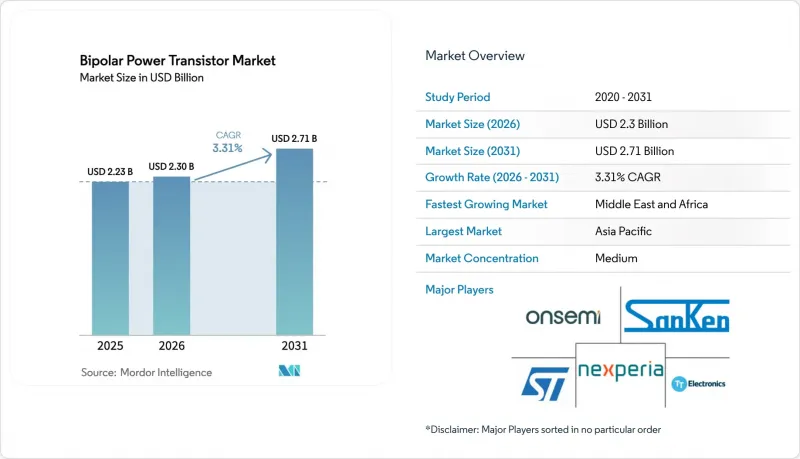
This report is Segmented by Type (NPN Transistors, and PNP Transistors), Material (Silicon, Silicon-Germanium, and More), Power Rating (Low, Medium, and High), Frequency Range (Low-Frequency, and More), Package Type (Through-Hole, and More), End-User Industry (Consumer Electronics, ICT and 5G Infrastructure, and More), and Geography. The Market Forecasts are Provided in Terms of Value (USD).
Global Bipolar Power Transistor Market Trends and Insights
Electrification of 48 V Mild-Hybrid Powertrains in European Vehicles
European OEMs are scaling 48 V systems to meet emissions rules and lower electrification bills. Belt starter generators, integrated starter generators, and electric turbochargers rely on efficient bipolar switching to handle 10-20 kW bursts while maintaining compatibility with 12 V architectures. Molex indicates connector redesign tackles electromagnetic interference at elevated voltages. Onsemi's APM21 module combines multiple switches and thermal enhancements for compact layouts.Reliability and low BOM cost keep bipolar devices central to these subsystems, supporting a +0.8% uplift in the bipolar power transistor market CAGR through 2030.
Proliferation of Silicon Carbide BJTs in Solar Micro-Inverters across Asia
Asia-Pacific utility-scale and rooftop solar additions drive micro-inverter uptake, and SiC BJTs cut switching losses up to 50% versus silicon. ROHM and Semikron Danfoss integrated 2 kV SiC MOSFETs into SMA systems for 1500 V DC links that raise yield. China's economies of scale and Japan's quality focus underpin cost and reliability improvements, giving SiC a long-term tailwind and adding +0.6% to growth prospects for the bipolar power transistor market.
Share Loss to Power MOSFETs in High-Frequency DC-DC Converters
Efficient MOSFET gate control enhances switching above 300 kHz, making them preferred within data centre and telecom converters. Infineon's CoolGaN integrates Schottky diodes, trimming deadtime losses and shrinking designs.Bipolar suppliers focus on cost-sensitive or lower frequency grids, facing a -0.7% drag on market CAGR.
Other drivers and restraints analyzed in the detailed report include:
- Demand for Cost-Optimised Discrete Switches in Low-Power IoT Wearables
- High-Reliability Requirements for Avionics Power Control Units in North America
- Thermal Runaway Risk above 150°C Limits Adoption in EV Traction Inverters
For complete list of drivers and restraints, kindly check the Table Of Contents.
Segment Analysis
NPN transistors controlled 67.12% revenue in 2025, and the bipolar power transistor market size for this category is forecast to expand at 3.33% CAGR to 2031. Positive-rail system designs in automotive ECUs, industrial drives, and consumer power supplies favour NPN polarity, anchoring demand even as new materials emerge. PNP units retain complementary roles in push-pull stages and negative-rail circuits, yet economies of scale keep NPN cost leadership intact. Continuous library reuse shortens design cycles, making NPN the default choice when engineers weigh part sourcing and validation schedules.
Migration to silicon carbide preserves NPN conventions. STMicroelectronics maps familiar pin-outs onto SiC structures, easing qualification and widening the bipolar power transistor market footprint in EV charging, renewable inverters, and 5 G power boards. This coherence ensures sustained revenue even if overall discrete volumes moderate.
Silicon delivered 80.76% revenue in 2025 due to high wafer throughput and decades-old fab lines. Yet, silicon carbide devices book a 4.71% CAGR and increasingly crowd high-voltage sockets, capturing a rising slice of the bipolar power transistor market share. SiC's wider bandgap shrinks conduction losses and allows 175 °C junctions, cutting heat-sink mass in EVs and string inverters. Infineon's 200 mm wafer ramp at Kulim underwrites future supply and narrows cost gaps.
Silicon's entrenched ecosystem shields high-volume consumer and IoT segments, but multi-kilowatt designs pivot toward SiC for range and efficiency gains. Hybrid boards blending both materials blossom, allowing designers to match the right die to each stress zone, which lifts overall bipolar power transistor market flexibility.
Complete Report Scope:
- By Type
- NPN Transistors
- PNP Transistors
- By Material
- Silicon (Si)
- Silicon-Germanium (SiGe)
- Silicon Carbide (SiC)
- Gallium Arsenide (GaAs)
- By Power Rating
- Low (Less than 1 A)
- Medium (1 - 10 A)
- High (Above 10 A)
- By Frequency Range
- Low-Frequency (Less than 300 kHz)
- Radio-Frequency and Microwave (300 kHz - 6 GHz)
- By Package Type
- Through-Hole (TO-220, TO-3)
- Surface-Mount (SOT-223, DPAK)
- Power Modules and Hybrid ICs
- By End-User Industry
- Consumer Electronics
- ICT and 5G Infrastructure
- Automotive and EV Powertrain
- Industrial Motor Drives and Automation
- Renewable Energy and Power (Solar, Wind)
- Aerospace and Defense
- By Geography
- North America
- United States
- Canada
- Mexico
- Europe
- Germany
- United Kingdom
- France
- Italy
- Spain
- Nordics (Denmark, Sweden, Norway, Finland)
- Rest of Europe
- Asia-Pacific
- China
- Japan
- South Korea
- India
- Southeast Asia
- Australia
- Rest of Asia-Pacific
- South America
- Brazil
- Argentina
- Rest of South America
- Middle East
- Gulf Cooperation Council Countries
- Turkey
- Rest of Middle East
- Africa
- South Africa
- Nigeria
- Rest of Africa
- North America
Geography Analysis
Asia-Pacific generated 50.65% of 2025 revenue, and the bipolar power transistor market size in the region is forecast to widen as China channels subsidies into renewables and EVs, Japan pushes precision IC packaging, and South Korea scales 5G macro sites. Domestic material policies, including China's gallium and germanium export controls, raise input volatility and spur localization projects, influencing sourcing and pricing strategies.
Europe's OEMs enforce 48 V mild-hybrid penetration and adhere to EU eco-design rules that penalize standby losses, directing R&D toward efficiency upgrades. STMicroelectronics' planned Sicily SiC fab, backed by EUR 5 billion (USD 5.88 billion) in aid, exemplifies reshoring momentum. Regional alignment around clean mobility and industrial decarbonization sustains demand for advanced bipolar power devices.
North America relies on aviation, defense, and industrial automation, where lifetime reliability offsets low shipment counts. Long qualification cycles stabilize revenue streams and favor entrenched suppliers. Middle East and Africa post the swiftest 3.63% CAGR as utility-scale solar farms and grid-expansion projects dominate capex. South America's mines refit motor drives, creating niche demand pockets underpinned by commodity export cashflows.
- STMicroelectronics
- Infineon Technologies AG
- ON Semiconductor (onsemi)
- Nexperia
- Renesas Electronics Corporation
- Toshiba Electronic Devices and Storage
- ROHM Co., Ltd.
- Vishay Intertechnology
- Texas Instruments Incorporated
- Microchip Technology Inc.
- Fuji Electric Co., Ltd.
- Semikron Danfoss
- Hitachi Power Semiconductor Device, Ltd.
- TT Electronics plc
- Diodes Incorporated
- Sanken Electric Co., Ltd.
- Solitron Devices, Inc.
- Littelfuse, Inc.
- Advanced Semiconductor, Inc.
- Alpha and Omega Semiconductor
Additional Benefits:
- The market estimate (ME) sheet in Excel format
- 3 months of analyst support
TABLE OF CONTENTS
1 INTRODUCTION
- 1.1 Study Assumptions and Market Definition
- 1.2 Scope of the Study
2 RESEARCH METHODOLOGY
3 EXECUTIVE SUMMARY
4 MARKET LANDSCAPE
- 4.1 Market Overview
- 4.2 Market Drivers
- 4.2.1 Electrification of 48-V Mild-Hybrid Powertrains in European Vehicles
- 4.2.2 Proliferation of Silicon Carbide (SiC) BJTs in Solar Micro-Inverters across Asia
- 4.2.3 Demand for Cost-Optimised Discrete Switches in Low-Power IoT Wearables
- 4.2.4 High-Reliability Requirements for Avionics Power Control Units in North America
- 4.2.5 Roll-out of mmWave 5G Macro Base-Stations Using RF BJTs in South Korea and Japan
- 4.2.6 Retrofit of Legacy Industrial Motor Drives in South America's Mining Sector
- 4.3 Market Restraints
- 4.3.1 Share-Loss to Power MOSFETs in High-Frequency DC-DC Converters
- 4.3.2 Thermal Run-away Risk above 150°C Limits Adoption in EV Traction Inverters
- 4.3.3 Tightened EU Ecodesign Regulations on Stand-by Losses
- 4.3.4 Supply Instability of High-Purity Germanium for SiGe BJTs
- 4.4 Industry Ecosystem Analysis
- 4.5 Technological Outlook
- 4.6 Porter's Five Forces Analysis
- 4.6.1 Threat of New Entrants
- 4.6.2 Bargaining Power of Consumers
- 4.6.3 Bargaining Power of Suppliers
- 4.6.4 Threat of Substitute Products
- 4.6.5 Intensity of Competitive Rivalry
5 MARKET SIZE AND GROWTH FORECASTS (VALUE)
- 5.1 By Type
- 5.1.1 NPN Transistors
- 5.1.2 PNP Transistors
- 5.2 By Material
- 5.2.1 Silicon (Si)
- 5.2.2 Silicon-Germanium (SiGe)
- 5.2.3 Silicon Carbide (SiC)
- 5.2.4 Gallium Arsenide (GaAs)
- 5.3 By Power Rating
- 5.3.1 Low (Less than 1 A)
- 5.3.2 Medium (1 - 10 A)
- 5.3.3 High (Above 10 A)
- 5.4 By Frequency Range
- 5.4.1 Low-Frequency (Less than 300 kHz)
- 5.4.2 Radio-Frequency and Microwave (300 kHz - 6 GHz)
- 5.5 By Package Type
- 5.5.1 Through-Hole (TO-220, TO-3)
- 5.5.2 Surface-Mount (SOT-223, DPAK)
- 5.5.3 Power Modules and Hybrid ICs
- 5.6 By End-User Industry
- 5.6.1 Consumer Electronics
- 5.6.2 ICT and 5G Infrastructure
- 5.6.3 Automotive and EV Powertrain
- 5.6.4 Industrial Motor Drives and Automation
- 5.6.5 Renewable Energy and Power (Solar, Wind)
- 5.6.6 Aerospace and Defense
- 5.7 By Geography
- 5.7.1 North America
- 5.7.1.1 United States
- 5.7.1.2 Canada
- 5.7.1.3 Mexico
- 5.7.2 Europe
- 5.7.2.1 Germany
- 5.7.2.2 United Kingdom
- 5.7.2.3 France
- 5.7.2.4 Italy
- 5.7.2.5 Spain
- 5.7.2.6 Nordics (Denmark, Sweden, Norway, Finland)
- 5.7.2.7 Rest of Europe
- 5.7.3 Asia-Pacific
- 5.7.3.1 China
- 5.7.3.2 Japan
- 5.7.3.3 South Korea
- 5.7.3.4 India
- 5.7.3.5 Southeast Asia
- 5.7.3.6 Australia
- 5.7.3.7 Rest of Asia-Pacific
- 5.7.4 South America
- 5.7.4.1 Brazil
- 5.7.4.2 Argentina
- 5.7.4.3 Rest of South America
- 5.7.5 Middle East
- 5.7.5.1 Gulf Cooperation Council Countries
- 5.7.5.2 Turkey
- 5.7.5.3 Rest of Middle East
- 5.7.6 Africa
- 5.7.6.1 South Africa
- 5.7.6.2 Nigeria
- 5.7.6.3 Rest of Africa
- 5.7.1 North America
6 COMPETITIVE LANDSCAPE
- 6.1 Market Concentration
- 6.2 Strategic Moves
- 6.3 Market Share Analysis
- 6.4 Company Profiles (includes Global level Overview, Market level overview, Core Segments, Financials as available, Strategic Information, Market Rank/Share, Products and Services, Recent Developments)
- 6.4.1 STMicroelectronics
- 6.4.2 Infineon Technologies AG
- 6.4.3 ON Semiconductor (onsemi)
- 6.4.4 Nexperia
- 6.4.5 Renesas Electronics Corporation
- 6.4.6 Toshiba Electronic Devices and Storage
- 6.4.7 ROHM Co., Ltd.
- 6.4.8 Vishay Intertechnology
- 6.4.9 Texas Instruments Incorporated
- 6.4.10 Microchip Technology Inc.
- 6.4.11 Fuji Electric Co., Ltd.
- 6.4.12 Semikron Danfoss
- 6.4.13 Hitachi Power Semiconductor Device, Ltd.
- 6.4.14 TT Electronics plc
- 6.4.15 Diodes Incorporated
- 6.4.16 Sanken Electric Co., Ltd.
- 6.4.17 Solitron Devices, Inc.
- 6.4.18 Littelfuse, Inc.
- 6.4.19 Advanced Semiconductor, Inc.
- 6.4.20 Alpha and Omega Semiconductor
7 MARKET OPPORTUNITIES AND FUTURE OUTLOOK
- 7.1 White-space and Unmet-Need Assessment


