

|
시장보고서
상품코드
2124973
RF 및 마이크로파 트랜지스터 : 시장 점유율 분석, 업계 동향 및 통계, 성장 예측(2026-2031년)RF And Microwave Transistors - Market Share Analysis, Industry Trends & Statistics, Growth Forecasts (2026 - 2031) |
||||||
 Mordor Intelligence
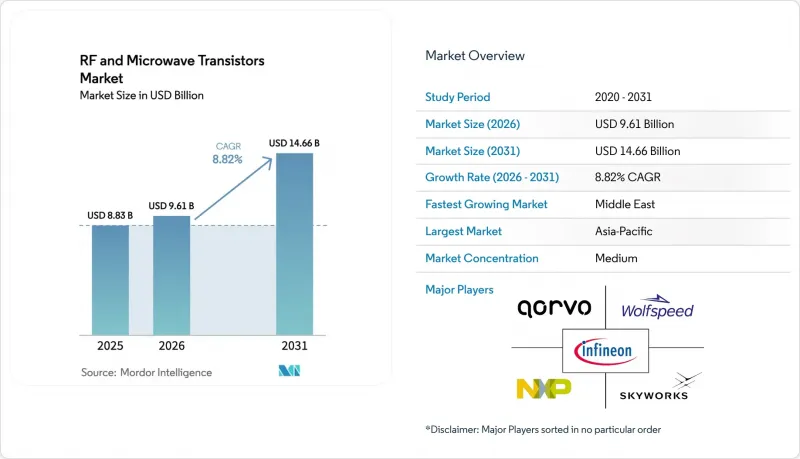
Mordor Intelligence에 의하면, RF 및 마이크로파 트랜지스터 시장 규모는 2025년 88억 3,000만 달러로 평가되었습니다. 2026년에는 96억 1,000만 달러로 확대되어 2026-2031년에 걸쳐 CAGR 8.82%로 성장을 지속하여, 2031년에는 146억 6,000만 달러에 이를 것으로 예측됩니다.

본 보고서는 주파수 대역(LF, L대역, S대역, C대역, 기타), 소재 유형(실리콘 LDMOS, GaN, GaAs, 기타), 출력(10W 미만, 10-50W, 50-150W, 150W 이상),최종 사용자 산업(통신 인프라, 가정용 전자기기, 기타), 용도(4G/5G 매크로 기지국, 기타), 지역별로 분류되어 있습니다. 시장 예측은 금액(달러) 기준으로 제시되어 있습니다.
세계의 RF 및 마이크로파 트랜지스터 시장 동향 및 인사이트
5G 인프라 도입 급증
2024년에는 약 120만 기의 새로운 5G 기지국이 가동을 시작했는데, 그중 3분의 2는 2025년까지 전국 커버리지 달성 의무를 규정한 지침에 따라 중국에 설치되었습니다. 통신 사업자들은 기존 매크로 사이트 내에서는 L-밴드 및 S-밴드 LDMOS 트랜지스터를, mm파 스몰 셀 내에서는 GaN 기반 모듈을 조합함으로써 커버리지와 용량에 대한 요구를 모두 지속적으로 충족하고 있습니다. AT&T가 미국 서비스 지역의 70%에서 실증한 오픈 무선 액세스 네트워크(Open RAN) 청사진은 멀티밴드 무선 장비의 설계 주기를 단축하고 공급업체 선택의 폭을 넓히고 있습니다. 인도에서는 Reliance Jio와 Bharti Airtel이 2024년에 30만 곳의 5G 기지국을 증설하며, 주파수 효율과 지방 지역 보급 간의 균형을 맞추기 위해 서브 6GHz 대역에 중점을 두었습니다. 3GPP 릴리스 18에서는 고급 안테나 구성과 더 광범위한 캐리어 어그리게이션이 도입되어, 이에 따라 전력 증폭기는 더 넓은 순간 대역폭에서 작동해야 합니다. GaN이 가진 고출력 시의 뛰어난 선형성은 엔지니어가 ETSI EN 301 908의 인접 채널 누설 기준을 준수하는 데 도움이 됩니다.
고출력 응용 분야에서 GaN 기술의 채택 확대
2024년 ‘CHIPS and Science Act’에 따라 Wolfspeed에 65억 달러가 지원되었으며, 이 자금은 100W를 초과하는 소자가 필요한 인프라 및 방위 부문 고객을 대상으로 한 200mm GaN-on-SiC 웨이퍼의 대량 생산 능력 확대에 사용될 예정입니다. GaN 트랜지스터는 X-밴드에서 70%를 초과하는 전력 부가 효율을 실현하여 냉각 부하를 줄이는 동시에 위상 배열(phased array)의 섀시를 소형화합니다. Qorvo의 2025 회계연도 2분기 인프라 관련 매출은 전년 동기 대비 12% 증가했으며, 이는 대규모 MIMO 무선 기기에서 GaN 파워 앰프에 대한 수요를 반영한 것입니다. 미국 국방부의 ‘Trusted Foundry’ 지침에 따라 레이더 공급업체는 GaN을 국내에서 조달해야 할 의무가 있으며, 이로 인해 수직 통합형 기업의 경쟁 우위가 확고해지고 있습니다. GaN의 기반이 되는 실리콘 카바이드(SiC) 기판은 열전도율이 490 W m-1K-1에 달하여, 항공기 탑재 레이더 플랫폼에서 200°C를 초과하는 접합 온도를 지원합니다.
GaN 웨이퍼 공급망의 혼란
Wolfspeed, II-VI Coherent, 스미토모 전기공업 등 3개사가 GaN-on-SiC 웨이퍼 생산을 독점하고 있으며, 2024년 하반기에는 150mm 기판의 리드 타임이 26주를 초과했습니다. Wolfspeed의 모호크 밸리에 위치한 200mm 생산 라인은 시운전 지연으로 인해 고정 가격 계약을 체결한 방위 관련 고객에 대한 할당량이 압박을 받았습니다. ‘CHIPS and Science Act’에서는 반도체 인센티브로 390억 달러가 책정되었으나, 그중 극히 일부만이 화합물 반도체에 배정되어 GaN 생산 능력은 여전히 민간 자본에 의존하고 있습니다. Qorvo는 인프라 관련 수익을 압박하는 요인으로 기판 부족을 꼽으며, 장기적인 웨이퍼 공급 계약을 체결했습니다. 2024년 중국이 시행한 갈륨 및 게르마늄 수출 규제로 인해 에피택셜 웨이퍼 비용이 8-12% 상승하여 팹리스 기업의 매출 총이익률을 압박했습니다. MACOM이 1억 8,000만 달러를 투자해 6인치 GaN 생산 라인을 인수한 것은 이러한 현물 시장공급 부족으로부터 회사를 보호하는 데 일조하고 있습니다.
부문별 분석
1-2GHz 대역을 커버하는 L-밴드용 트랜지스터는 통신 사업자들이 음성 폴백 및 지방 지역 서비스 제공을 위해 LTE 매크로 계층을 지속적으로 유지하고 있기 때문에 2025년 매출의 35.96%를 차지하며, RF 및 마이크로파 트랜지스터 시장에서 그 우위를 공고히 했습니다. 이 부문은 확고한 도입 실적과 여전히 와트당 비용이 가장 낮은 성숙한 LDMOS 공급망의 혜택을 받고 있습니다. 중대역 5G 및 방위용 레이더 개조에 따라 C-밴드와 X-밴드의 출하량이 증가하고 있어, 시장의 모멘텀은 더 높은 주파수 대역으로 이동하고 있습니다. 연방통신위원회(FCC)의 주파수 대역 재편에 따라 2024년에는 미국 통신 사업자에게 280MHz의 연속적인 C-밴드 대역폭이 할당됨에 따라, 3.7-3.98GHz 대역에서 40W 출력을 가진 전력 증폭기에 대한 수요가 증가하고 있습니다.
X-밴드, Ku-밴드, Ka-밴드 디바이스는 2031년까지 연평균 성장률(CAGR) 9.79%를 나타낼 것으로 예측되며, RF 및 마이크로파 트랜지스터 시장 전체를 상회하는 성장이 예상됩니다. 록히드 마틴사의 AN/TPY-4 레이더와 같은 방위 프로그램에서는 장거리 추적을 위해 GaN의 효율성이 활용되고 있습니다. C-밴드 지상국을 Ka-밴드 단말기로 교체하는 위성 사업자들은 콤팩트하고 경량화된 설계로 설치 비용을 절감할 수 있기 때문에 GaN을 선호하고 있습니다. 국제전기통신연합(ITU)이 고정 무선 접속용으로 71-76GHz를 할당함에 따라 E-밴드는 미래 성장 부문으로 자리매김하고 있지만, 패키징과 관련된 과제는 여전히 남아 있습니다.
실리콘 LDMOS는 6GHz 미만의 매크로 무선 기기에서 비용 면에서의 우위와 수십 년에 걸친 생산 노하우에 힘입어 2025년에도 54.57%의 점유율을 유지했으며, RF 및 마이크로파 트랜지스터 시장에서 LDMOS 시장 규모는 경쟁사를 크게 앞지르고 있습니다. 그러나 밀리파 스몰 셀, AESA 레이더, Ka 대역 지상 단말기에서는 더 높은 전력 밀도와 열적 여유가 요구되기 때문에 GaN의 출하량은 연평균 10.31% 성장할 전망입니다. Wolfspeed가 ‘CHIPS 법’의 지원을 받아 추진하는 200mm 공정 확대로 인해 다이 비용이 약 30% 절감되어 LDMOS와의 가격 차이는 줄어들고 있습니다.
20GHz 미만의 대역에서는 갈륨 비소가 여전히 저잡음 증폭기의 강자로 자리 잡고 있는 반면,인듐 인화물이나 다이아몬드 기판은 틈새 시장인 테라헤르츠 이미징 및 양자 컴퓨팅 분야에 대응하고 있으며, 이들을 합쳐도 매출의 2% 미만을 차지할 뿐입니다. 실리콘 카바이드의 열전도율 490 W m?¹K?¹은 GaN의 고온 내성이라는 장점을 뒷받침하며, 이는 항공기 탑재 레이더나 해군용 어레이에 있어 매우 중요한 특성입니다. 미국의 ‘Trusted Foundry’ 요건에 따라 기밀로 분류되는 레이더 프로그램에서는 국내산 GaN 소자 구매가 의무화되어 있어, 미국 이외공급업체에게는 구조적인 진입 장벽이 되고 있습니다.
지역별 분석
아시아태평양은 중국의 5G 기지국 415만 개와 인도의 신규 사이트 30만 곳을 원동력으로 2025년 매출의 43.92%를 차지하며, RF 및 마이크로파 트랜지스터 시장에서 주도적인 입지를 공고히 했습니다. 중국 공업정보화부는 2025년까지 5G 전면 커버리지 달성을 의무화 해 휴대전화 시장의 역풍에도 불구하고 수요를 뒷받침했습니다. 인도 통신부는 3.3-3.6GHz 대역의 주파수 대역을 할당하여, 릴라이언스 지오와 바티 에어텔이 서브 6GHz 및 mm파 부품을 필요로 하는 독립형(SA) 네트워크를 구축할 수 있도록 했습니다. 일본의 NTT 도코모와 한국의 SK 텔레콤은 도쿄와 서울에서 mm파 스몰셀 시범 운영을 진행 중이며, 도시 지역의 열적 제약을 충족하기 위해 GaN 소자를 최대한 활용하고 있습니다.
2031년까지 11.53%의 성장이 예상되는 중동은 사우디아라비아의 ‘비전 2030’과 아랍에미리트(UAE)의 조기 독립형 5G 코어 네트워크 업그레이드를 원동력으로 삼고 있습니다. 사우디아라비아 공공투자기금(PIF)은 매크로 사이트 및 고정 무선 사이트용 고출력 RF 증폭기를 포함한 디지털 인프라 구축에 200억 달러를 배정했습니다. 아랍에미리트(UAE)는 2024년에 26GHz 대역 주파수를 경매에 부쳐, 스마트 시티 시범 사업을 위한 mm파 활용의 기반을 마련했습니다. 튀르키예의 통신 사업자들은 서브 6GHz 대역에 중점을 두고, 2024년 말까지 1만 5,000곳의 5G 기지국을 가동했습니다. 북미는 2025년에 27.84%의 점유율을 차지했으며, AT&T의 Open RAN 추진과 국내 GaN 조달을 확보하는 견고한 방위 공급망에 힘입었습니다. 유럽은 17.62%를 차지했으며, 독일의 자동차용 레이더 도입과 영국의 주파수 대역 경매가 주도적인 역할을 했습니다. 브라질에서는 2024년 3.5GHz 대역 주파수 경매를 통해 2026년까지 모든 주 도시에 5G를 구축하도록 규정되어 있어, 이것이 남미 지역의 LDMOS 수요를 활성화시키고 있습니다. 아프리카는 보급률이 낮아 수익은 소폭에 그치고 있지만, 남아프리카공화국의 최근 주파수 할당으로 인해 저대역 트랜지스터를 활용한 농촌 지역의 LTE 커버리지가 가능해졌습니다. 아르헨티나에서는 거시경제적 압박으로 인해 통신 사업자의 설비 투자가 억제되고 있어 진전이 더딘 상황입니다.
기타 혜택
- 엑셀 형식 시장 예측(ME) 시트
- 3개월간의 애널리스트 지원
자주 묻는 질문
목차
제1장 서론
제2장 조사 방법
제3장 주요 요약
제4장 시장 구도
제5장 시장 규모 및 성장 예측
제6장 경쟁 구도
제7장 시장 기회 및 향후 전망
KTH 26.09.14According to Mordor Intelligence, the RF and microwave transistors market size is expected to grow from USD 8.83 billion in 2025 to USD 9.61 billion in 2026 and is forecast to reach USD 14.66 billion by 2031 at 8.82% CAGR over 2026-2031.
This report is Segmented by Frequency Band (LF, L-Band, S-Band, C-Band, and More), Material Type (Silicon LDMOS, Gan, Gaas, and More), Power Output (Below 10W, 10-50W, 50-150W, and Above 150W), End-User Vertical (Communication Infrastructure, Consumer Electronics, and More), Application (4G/5G Macro Base Stations, and More), and Geography. The Market Forecasts are Provided in Terms of Value (USD).
Global RF And Microwave Transistors Market Trends and Insights
Surge in 5G Infrastructure Deployment
About 1.2 million new 5G base stations went live in 2024, two-thirds of which were installed in China following a nationwide coverage mandate for 2025. Operators continue to pair L-Band and S-Band LDMOS transistors inside legacy macro sites with GaN-based modules inside millimeter-wave small cells, meeting both coverage and capacity needs. Open radio-access-network blueprints, demonstrated by AT&T across 70% of its United States footprint, shorten design cycles for multiband radios and broaden the vendor pool. In India, Reliance Jio and Bharti Airtel added 300,000 5G sites during 2024, focusing on sub-6 GHz spectrum to balance spectral efficiency and rural penetration. Release 18 of 3GPP introduces advanced antenna configurations and wider carrier aggregation, which force power amplifiers to operate over broader instantaneous bandwidths. GaN's superior linearity at high output power helps engineers comply with ETSI EN 301 908 adjacent-channel leakage standards.
Rising Adoption of GaN Technology for High-Power Applications
The 2024 CHIPS and Science Act award of USD 6.5 billion to Wolfspeed finances 200 mm GaN-on-SiC wafer capacity that targets infrastructure and defense customers needing devices beyond 100 W. GaN transistors deliver power-added efficiency above 70% at X-Band, lowering cooling overhead and shrinking phased-array enclosures. Qorvo's infrastructure revenue climbed 12% year over year in fiscal 2Q 2025, reflecting demand for GaN power amplifiers in massive MIMO radios. U.S. Department of Defense Trusted Foundry guidelines oblige radar suppliers to source GaN domestically, cementing a competitive edge for vertically integrated firms. The silicon-carbide substrates that underpin GaN boast thermal conductivity near 490 W m-1 K-1, supporting junction temperatures above 200 °C for airborne radar platforms.
Supply Chain Disruptions for GaN Wafers
Three suppliers Wolfspeed, II-VI Coherent, and Sumitomo Electric dominate GaN-on-SiC wafer output, and lead times for 150 mm substrates stretched past 26 weeks in late 2024. Wolfspeed's Mohawk Valley 200 mm line faced commissioning delays, compressing allocations for defense customers on fixed-price contracts. Although the CHIPS and Science Act set aside USD 39 billion for semiconductor incentives, only a minority funds compound semiconductors, leaving GaN capacity tied to private capital. Qorvo locked long-term wafer supply pacts after citing substrate scarcity as a drag on infrastructure revenue. China's 2024 export curbs on gallium and germanium inflated epitaxial wafer cost by 8-12%, squeezing fabless gross margins. MACOM's USD 180 million purchase of a 6-inch GaN line helps shield it from these spot shortages.
Other drivers and restraints analyzed in the detailed report include:
- Growth of Satellite Broadband Constellations
- Defense Modernization Programs Prioritizing AESA Radars
- Thermal Management Challenges at mmWave Frequencies
For complete list of drivers and restraints, kindly check the Table Of Contents.
Segment Analysis
L-Band transistors covering 1-2 GHz commanded 35.96% of 2025 revenue as operators keep LTE macro layers alive for voice fallback and rural reach, cementing their primacy in the RF and microwave transistors market share. The segment benefits from entrenched deployment footprints and mature LDMOS supply chains that still offer the lowest cost per watt. Momentum is nevertheless tilting toward higher bands as C-Band and X-Band shipments rise in concert with mid-band 5G and defense radar retrofits. Federal Communications Commission spectrum clearing delivered 280 MHz of contiguous C-Band bandwidth to United States carriers in 2024, pushing demand for power amplifiers with 40 W output across 3.7-3.98 GHz.
X-Band, Ku-Band, and Ka-Band devices are projected to clock a 9.79% CAGR through 2031, outpacing the broader RF and microwave transistors market. Defense programs such as Lockheed Martin's AN/TPY-4 radar rely on GaN's efficiency for long-range tracking. Satellite operators replacing C-Band earth stations with Ka-Band terminals favour GaN for compact, low-weight builds, improving installation economics. The International Telecommunication Union allocation of 71-76 GHz for fixed wireless access positions E-Band as a future growth vector, although packaging hurdles persist.
Silicon LDMOS retained 54.57% share in 2025, bolstered by its cost edge in sub-6 GHz macro radios and decades-deep production learning curves, leaving the RF and microwave transistors market size for LDMOS comfortably ahead of rivals. Yet GaN shipments will grow 10.31% annually as millimeter-wave small cells, AESA radars, and Ka-Band ground terminals demand better power density and thermal headroom. Wolfspeed's CHIPS Act-backed 200 mm expansion trims die cost roughly 30%, narrowing the price gap with LDMOS.
Gallium arsenide remains the low-noise amplifier king under 20 GHz, while indium phosphide and diamond substrates address niche terahertz imaging and quantum computing plays, together accounting for under 2% of revenue. Silicon carbide's thermal conductivity of 490 W m-1 K-1 underpins GaN's high-temperature advantage, a critical trait for airborne radars and naval arrays. The U.S. Trusted Foundry mandate obliges classified radar programs to buy domestic GaN devices, creating structural barriers for non-United States suppliers.
Complete Report Scope:
- By Frequency Band
- LF (More than 1 GHz)
- L-Band (1-2 GHz)
- S-Band (2-4 GHz)
- C-Band (4-8 GHz)
- X-Band and Above (Less than 8 GHz)
- By Material Type
- Silicon LDMOS
- Gallium Nitride (GaN)
- Gallium Arsenide (GaAs)
- Silicon Carbide (SiC)
- Other Material Types
- By Power Output
- Below 10 W
- 10-50 W
- 50-150 W
- Above 150 W
- By End-User Vertical
- Communication Infrastructure
- Consumer Electronics
- Automotive
- Industrial and IoT
- Aerospace and Defense
- Other End-User Verticals
- By Application
- 4G/5G Macro Base Stations
- Small Cells and DAS
- Radar Systems
- Satellite Communications
- IoT Devices
- Other Applications
- By Geography
- North America
- United States
- Canada
- Mexico
- Europe
- United Kingdom
- Germany
- France
- Italy
- Rest of Europe
- Asia-Pacific
- China
- Japan
- India
- South Korea
- Rest of Asia
- Middle East
- Israel
- Saudi Arabia
- United Arab Emirates
- Turkey
- Rest of Middle East
- Africa
- South Africa
- Egypt
- Rest of Africa
- South America
- Brazil
- Argentina
- Rest of South America
- North America
Geography Analysis
Asia Pacific generated 43.92% of 2025 revenue, propelled by China's 4.15 million 5G base stations and India's 300,000 new sites, solidifying its leadership in the RF and microwave transistors market. China's Ministry of Industry and Information Technology compels full 5G coverage by 2025, sustaining demand despite handset headwinds. India's Department of Telecommunications issued spectrum in the 3.3-3.6 GHz band, enabling Reliance Jio and Bharti Airtel to launch standalone architectures that require sub-6 GHz and millimeter-wave components. Japan's NTT Docomo and South Korea's SK Telecom experiment with millimeter-wave small cells in Tokyo and Seoul, working GaN devices hard to satisfy urban thermal constraints.
The Middle East, forecast to grow 11.53% through 2031, rides Saudi Arabia's Vision 2030 and the United Arab Emirates' early standalone 5G core upgrades. Saudi Arabia's Public Investment Fund earmarked USD 20 billion for digital infrastructure, including high-power RF amplifiers for macro and fixed-wireless sites. The United Arab Emirates auctioned 26 GHz spectrum in 2024 to seed millimeter-wave applications for smart-city pilots. Turkey's operators commissioned 15,000 5G sites by 2024 year-end, focusing on sub-6 GHz bands. North America held 27.84% share in 2025, buoyed by AT&T's Open RAN push and a robust defense supply chain that secures domestic GaN sourcing. Europe accounted for 17.62%, led by Germany's automotive radar rollouts and United Kingdom spectrum auctions. Brazil's 2024 3.5 GHz auction stipulates 5G deployment across all capitals by 2026, invigorating LDMOS demand in South America. Africa's low penetration keeps revenue modest, though South Africa's recent spectrum awards enable rural LTE coverage that leans on low-band transistors. Argentina lags as macroeconomic strains curtail operator capital expenditure.
- Toshiba Electronic Devices and Storage Corporation
- STMicroelectronics N.V.
- ON Semiconductor Corporation
- NXP Semiconductors N.V.
- Infineon Technologies AG
- Microchip Technology Inc.
- Nexperia B.V.
- Wolfspeed Inc.
- Qorvo Inc.
- Skyworks Solutions Inc.
- MACOM Technology Solutions Holdings Inc.
- Broadcom Inc.
- Tagore Technology Inc.
- Ampleon Netherlands B.V.
- Mitsubishi Electric Corporation
- Analog Devices Inc.
- Renesas Electronics Corporation
Additional Benefits:
- The market estimate (ME) sheet in Excel format
- 3 months of analyst support
TABLE OF CONTENTS
1 INTRODUCTION
- 1.1 Study Assumptions and Market Definition
- 1.2 Scope of the Study
2 RESEARCH METHODOLOGY
3 EXECUTIVE SUMMARY
4 MARKET LANDSCAPE
- 4.1 Market Overview
- 4.2 Market Drivers
- 4.2.1 Surge in 5G Infrastructure Deployment
- 4.2.2 Rising Adoption of GaN Technology for High-Power Applications
- 4.2.3 Growth of Satellite Broadband Constellations
- 4.2.4 Proliferation of Connected Consumer Electronics
- 4.2.5 Emergence of LEO-Based IoT Networks
- 4.2.6 Defense Modernization Programs Prioritizing AESA Radars
- 4.3 Market Restraints
- 4.3.1 Supply Chain Disruptions for GaN Wafers
- 4.3.2 Thermal Management Challenges at mmWave Frequencies
- 4.3.3 Export Control Tightening on Advanced RF Devices
- 4.3.4 Growing Viability of Photonic Integrated Circuits as Substitutes
- 4.4 Value-Chain Analysis
- 4.5 Regulatory Landscape
- 4.6 Technological Outlook
- 4.7 Impact of Macroeconomic Factors on the Market
- 4.8 Porter's Five Forces Analysis
- 4.8.1 Threat of New Entrants
- 4.8.2 Bargaining Power of Buyers
- 4.8.3 Bargaining Power of Suppliers
- 4.8.4 Threat of Substitutes
- 4.8.5 Intensity of Competitive Rivalry
5 MARKET SIZE AND GROWTH FORECASTS (VALUE)
- 5.1 By Frequency Band
- 5.1.1 LF (More than 1 GHz)
- 5.1.2 L-Band (1-2 GHz)
- 5.1.3 S-Band (2-4 GHz)
- 5.1.4 C-Band (4-8 GHz)
- 5.1.5 X-Band and Above (Less than 8 GHz)
- 5.2 By Material Type
- 5.2.1 Silicon LDMOS
- 5.2.2 Gallium Nitride (GaN)
- 5.2.3 Gallium Arsenide (GaAs)
- 5.2.4 Silicon Carbide (SiC)
- 5.2.5 Other Material Types
- 5.3 By Power Output
- 5.3.1 Below 10 W
- 5.3.2 10-50 W
- 5.3.3 50-150 W
- 5.3.4 Above 150 W
- 5.4 By End-User Vertical
- 5.4.1 Communication Infrastructure
- 5.4.2 Consumer Electronics
- 5.4.3 Automotive
- 5.4.4 Industrial and IoT
- 5.4.5 Aerospace and Defense
- 5.4.6 Other End-User Verticals
- 5.5 By Application
- 5.5.1 4G/5G Macro Base Stations
- 5.5.2 Small Cells and DAS
- 5.5.3 Radar Systems
- 5.5.4 Satellite Communications
- 5.5.5 IoT Devices
- 5.5.6 Other Applications
- 5.6 By Geography
- 5.6.1 North America
- 5.6.1.1 United States
- 5.6.1.2 Canada
- 5.6.1.3 Mexico
- 5.6.2 Europe
- 5.6.2.1 United Kingdom
- 5.6.2.2 Germany
- 5.6.2.3 France
- 5.6.2.4 Italy
- 5.6.2.5 Rest of Europe
- 5.6.3 Asia-Pacific
- 5.6.3.1 China
- 5.6.3.2 Japan
- 5.6.3.3 India
- 5.6.3.4 South Korea
- 5.6.3.5 Rest of Asia
- 5.6.4 Middle East
- 5.6.4.1 Israel
- 5.6.4.2 Saudi Arabia
- 5.6.4.3 United Arab Emirates
- 5.6.4.4 Turkey
- 5.6.4.5 Rest of Middle East
- 5.6.5 Africa
- 5.6.5.1 South Africa
- 5.6.5.2 Egypt
- 5.6.5.3 Rest of Africa
- 5.6.6 South America
- 5.6.6.1 Brazil
- 5.6.6.2 Argentina
- 5.6.6.3 Rest of South America
- 5.6.1 North America
6 COMPETITIVE LANDSCAPE
- 6.1 Market Concentration
- 6.2 Strategic Moves
- 6.3 Market Share Analysis
- 6.4 Company Profiles (includes Global level Overview, Market level overview, Core Segments, Financials as available, Strategic Information, Market Rank/Share for key companies, Products and Services, and Recent Developments)
- 6.4.1 Toshiba Electronic Devices and Storage Corporation
- 6.4.2 STMicroelectronics N.V.
- 6.4.3 ON Semiconductor Corporation
- 6.4.4 NXP Semiconductors N.V.
- 6.4.5 Infineon Technologies AG
- 6.4.6 Microchip Technology Inc.
- 6.4.7 Nexperia B.V.
- 6.4.8 Wolfspeed Inc.
- 6.4.9 Qorvo Inc.
- 6.4.10 Skyworks Solutions Inc.
- 6.4.11 MACOM Technology Solutions Holdings Inc.
- 6.4.12 Broadcom Inc.
- 6.4.13 Tagore Technology Inc.
- 6.4.14 Ampleon Netherlands B.V.
- 6.4.15 Mitsubishi Electric Corporation
- 6.4.16 Analog Devices Inc.
- 6.4.17 Renesas Electronics Corporation
7 MARKET OPPORTUNITIES AND FUTURE OUTLOOK
- 7.1 White-Space and Unmet-Need Assessment


