

|
시장보고서
상품코드
2125381
미국의 IT 서비스 : 시장 점유율 분석, 업계 동향 및 통계, 성장 예측(2026-2031년)United States IT Services - Market Share Analysis, Industry Trends & Statistics, Growth Forecasts (2026 - 2031) |
||||||
 Mordor Intelligence
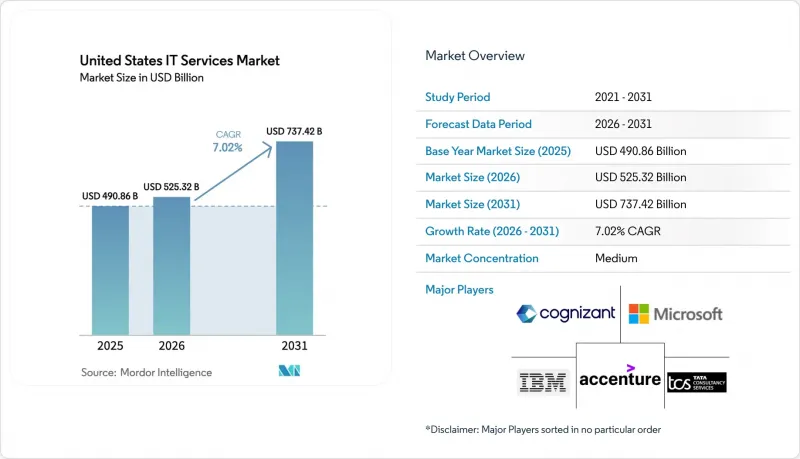
Mordor Intelligence에 의하면, 미국의 IT 서비스 시장 규모는 2025년에 4,908억 6,000만 달러로 평가되었습니다. 2026년 5,253억 2,000만 달러에서 2031년까지 7,374억 2,000만 달러에 이를 것으로 예상되며, 예측 기간(2026-2031년) CAGR은 7.02%를 나타낼 전망입니다.

본 보고서는 서비스 유형(IT 컨설팅 및 도입, 기타), 도입 모델(온쇼어, 니어쇼어, 오프쇼어), 계약 모델(프로젝트 기반, 인력 보강, 매니지드 서비스), 조직 규모(대기업, 중소기업), 그리고 최종 사용자 산업(은행, 금융서비스 및 보험(BFSI), 제조업, 정부 기관, 기타)별로 분류되어 있습니다. 시장 예측은 금액(달러) 기준으로 제시되어 있습니다.
미국의 IT 서비스 시장 동향 및 인사이트
미국 공공 부문의 클라우드 전환을 가속화하는 연방 정부의 인센티브
연방 정부 기관은 2026년에 기술 현대화 기금에서 10억 5,000만 달러를 조달했습니다. 이러한 급격한 증가로 인해 레거시 시스템의 폐지 및 FedRAMP 준수 클라우드 도입을 위한 자금이 투입됨에 따라, 메인프레임 워크로드를 대규모로 재플랫폼화할 수 있는 Tier 1 통합 업체에 대한 수요가 증가하고 있습니다. 각 기관은 대상 시스템의 67%를 이미 마이그레이션했으나, 나머지 시스템에는 데이터 주권을 확보하기 위한 래퍼 및 맞춤형 미들웨어가 포함되어 있어 보안 승인 자격을 갖춘 인력을 보유한 벤더에게 실행상의 우위가 더욱 확대되고 있습니다. 90억 달러 규모의 ‘합동 전투 클라우드 역량(Joint Warfighting Cloud Capability)’ 계약에서는 중소기업에 대한 하도급 발주 비율을 35%로 의무화하고 있어, 이로 인해 납품 체제가 세분화되고 프로그램 관리의 복잡성이 증가하고 있습니다. 주 및 지방 자치 단체는 2027년 기한 만료 전에 ‘인프라 투자 및 고용법(IIJA)’ 보조금을 신속히 집행하기 위해 서두르고 있으며, 2025년에는 조달 주기가 단축되어 카탈로그 기반 솔루션을 제공하는 공급업체가 유리한 입장에 있었습니다. 심각한 인력 부족(사이버 보안 및 클라우드 분야에서 2만 3,000개의 미충원 직위)으로 인해, 내셔널 캐피털 리전(NCR)에서는 보안 승인을 받은 인력의 시간당 임금이 185달러를 넘어 프로젝트 예산이 부풀어 오르고 있습니다.
포춘 1000대 기업의 생성형 AI 대규모 도입
생성형 AI 이용 사례의 실제 도입 건수는 2025년 1월부터 2026년 1월 사이에 412건에서 1,847건으로 증가했으나, 그중 3분의 2 가까이는 수익 창출이 아닌 사내 생산성 향상 워크플로우에 활용되었습니다. 데이터 품질 부족이 여전히 가장 큰 장벽으로 작용하고 있으며, 최고 데이터 책임자(CDO)의 71%가 통합된 고객 마스터 레코드가 부족함을 인정하고 있어, 이로 인해 전처리 비용이 증가하고 있습니다. JPMorgan Chase의 계약 인텔리전스 어시스턴트가 연간 36만 시간의 검토 시간을 절감하고 있는 사례에서 볼 수 있듯이, 금융 서비스 분야의 선도 기업들은 빠르게 수익화를 추진하고 있습니다. 규제 측면의 우려는 여전히 남아 있으며, 연방거래위원회(FTC)가 2025년에 18개의 AI 기반 가격 책정 알고리즘을 조사함에 따라 소비자 부문에서의 도입이 정체되었습니다. 통합 전문가들은 현재 검색 기능이 강화된 생성 파이프라인, 편향 감지, 감사 추적을 패키지화하고 있으며, 실험적인 파일럿 프로젝트를 규정 준수를 준수하는 확장 가능한 솔루션으로 전환함으로써 높은 보수를 받고 있습니다.
클라우드 및 보안 분야의 고위 인재 부족
2025년, 미국 고용주들은 정보 보안 분야에서 37만 7,500건의 인력 부족에 직면했으며, 이는 22% 증가한 수치로, 클라우드 아키텍트의 중간 연봉을 16만 8,000달러까지 끌어올렸습니다. 엘리트 인증 자격에 대한 수요는 공급을 훨씬 초과하고 있으며, AWS 솔루션 아키텍트 프로페셔널 자격을 보유한 전문가는 불과 4만 7,000명에 불과함에도 불구하고 구인 건수는 11만 2,000건에 달했습니다. 제로 트러스트 환경 도입에는 아이덴티티 패브릭 전문가가 필요하지만, 이들은 28%의 급여 프리미엄을 받고 있어 인재 유출이 심화되고 있습니다. 각 벤더사는 교육 프로그램을 확충하고 있으며, 코그니전트만 해도 16주간의 부트캠프에 8,200명의 신입 사원을 등록시켰지만, 하이퍼스케일러 기업들이 훈련을 받은 인재를 스카우트해 가면서 34%가 18개월 이내에 이직했습니다. 오프쇼어 차익 거래의 폭은 축소되고 있으며, 벵갈루루의 시니어 자바 엔지니어 연봉은 현재 5만 2,000달러에 달하고, 과거 기존 지원 모델을 지탱하던 비용 차이가 줄어들고 있습니다.
부문별 분석
매니지드 서비스는 2025년 매출의 27.46%를 차지했으며, 이는 기업들이 예측 가능한 운영 비용을 중시하고 있음을 반영합니다. 한편, 사이버 보안 서비스는 2031년까지 연평균 성장률(CAGR) 8.42%를 달성할 것으로 예측됩니다. 미국의 IT 서비스 시장 점유율은 대개 500만 달러를 상한으로 하는 침해 보장을 매니지드 감지 및 대응(MDR) 서비스에 통합하고 있는 제공업체를 중심으로 통합이 진행되고 있어, 경제적 인센티브와 위험 감소가 일치하고 있습니다. 애플리케이션 개발 및 유지보수는 여전히 절대액 기준으로 가장 큰 지출 비중을 차지하고 있지만, 로우코드 플랫폼을 통해 비즈니스 사용자가 부서용 용도를 신속하게 구축할 수 있게 됨에 따라 맞춤형 Java 및 .NET 개발에 대한 수요가 감소하면서 성장세가 둔화되고 있습니다. 클라우드 및 플랫폼 서비스는 2025년에 11.3% 성장했습니다. 이는 평균적인 기업이 4.7개의 클라우드 플랫폼을 병행 운영하는 가운데, FinOps 거버넌스 및 멀티클라우드 오케스트레이션에 대한 수요가 증가했기 때문입니다. 인프라 서비스는 상품화(commoditization)에 직면해 있으며, 벤더들은 자문, 마이그레이션, 관리형 운영(Managed Operations) 각 계층을 묶어 제공하는 것을 피할 수 없게 되었습니다. IT 아웃소싱과 비즈니스 프로세스 아웃소싱은 점점 더 융합되고 있으며, 그 예로 Genpact가 2025년에 RPA 벤더를 인수하여 IT와 재무 워크스트림을 아우르는 ‘청구부터 입금까지의 자동화’를 실현한 것을 들 수 있습니다. 디지털 전환(DX) 컨설팅에 대한 수요는 여전히 높지만, 신기술 파일럿 프로젝트의 57%가 개념 증명(PoC) 단계에서 정체되어 있어 데이터 거버넌스의 미비함이 두드러지고 있습니다.
고객이 성과 보장을 요구하는 움직임이 확산됨에 따라 이러한 추세는 더욱 가속화되고 있습니다. 매니지드 보안 제공업체는 현재 전문 SOC 분석가 이용 및 독자적인 AI 기반 위협 인텔리전스 피드 이용권을 다년 계약의 구독 요금에 포함시켜, 자본 지출(CAPEX)을 운영 비용(OPEX)으로 전환하고 있습니다. 한편, 레거시 인프라 계약에서는 클라우드의 ‘성장에 따른 과금(pay-as-you-grow)’ 모델이 채택되어, 벤더에 대한 보상이 워크로드 이전 속도나 이전 후의 비용 절감액에 연동되도록 되어 있습니다. 애플리케이션 현대화는 워터폴 방식에서 도입 초기부터 DevSecOps를 통합한 애자일 포드로 전환되고 있으며, 비즈니스 이해관계자와 전달 팀 간의 피드백 루프가 더욱 긴밀해지고 있습니다. 미국의 IT 서비스 시장에서는 수직 분야 전문 지식과 테스트 주기를 단축하고 기술적 부채를 줄이는 자동화 플랫폼을 융합한 벤더가 계속해서 높은 평가를 받고 있습니다.
2025년, 온쇼어 제공은 규정 준수 및 협업을 위해 코로케이션을 중시하는 규제 산업을 기반으로 54.63%의 점유율을 유지한 반면, 니어쇼어 제공은 연평균 성장률(CAGR) 8.87%로 확대될 것으로 예측됩니다. 멕시코의 수출액은 USMCA(미국·멕시코·캐나다 협정)에 따른 보호 조치와 41%의 인건비 우위에 힘입어 92억 달러에 달했으며, 이에 따라 187개의 미국 기업이 몬테레이와 과달라하라에 캡티브 센터를 설립했습니다. 캐나다의 문화적 친화성과 견고한 지적재산권법은 금융 서비스 고객을 끌어들이고 있으며, 토론토 엔지니어의 보수는 베이 에어리어의 동종 업계 종사자보다 22% 낮습니다. 고객이 동일한 시간대의 중첩을 활용하여 스프린트 주기를 단축함에 따라, 니어쇼어 센터와 관련된 미국의 IT 서비스 시장 규모는 확대되고 있습니다.
오프쇼어 서비스는 여전히 큰 규모를 유지하고 있지만, 인도와 필리핀의 임금 상승과 이직률이 20%에 가까워짐에 따라 수익성에 대한 역풍이 거세지고 있습니다. 마닐라와 세부는 2만 3,000명의 SOC 분석가를 보유한 사이버 보안 센터를 홍보하고 있지만, 지정학적 긴장으로 인해 리스크 회피 성향의 고객들은 북미와 남미 대륙으로 눈을 돌리고 있습니다. 동유럽은 GDPR(EU 개인정보보호규정)에 따라 규정 준수를 중시하는 업무를 수주하고 있지만, 2025년 임금 상승률 8.2%와 지역적 불안정성이 비용 측면에서의 매력을 상쇄하고 있습니다. 현재 각 서비스 제공업체들은 비용, 속도, 인력 규모의 균형을 맞추기 위해 온쇼어 제품 소유자, 니어쇼어 스크럼 마스터, 오프쇼어 개발자를 조합한 전 세계적으로 분산된 애자일 포드를 구축함으로써 서비스 제공의 위험을 헤지하고 있습니다.
기타 혜택 :
- 엑셀 형식 시장 예측(ME) 시트
- 3개월간의 애널리스트 지원
자주 묻는 질문
목차
제1장 서론
제2장 조사 방법
제3장 주요 요약
제4장 시장 구도
제5장 시장 규모 및 성장 예측
제6장 경쟁 구도
제7장 시장 기회 및 향후 전망
KTH 26.09.14According to Mordor Intelligence, the United States IT services market size was valued at USD 490.86 billion in 2025 and is estimated to grow from USD 525.32 billion in 2026 to reach USD 737.42 billion by 2031, at a CAGR of 7.02% during the forecast period (2026-2031).
This report is Segmented by Service Type (IT Consulting and Implementation, and More), Deployment Model (Onshore, Nearshore, and Offshore), Engagement Model (Project-Based, Staff Augmentation, and Managed Services), Organization Size (Large Enterprises, and SMEs), and End-User Industry (BFSI, Manufacturing, Government, and More). The Market Forecasts are Provided in Terms of Value (USD).
United States IT Services Market Trends and Insights
Federal Incentives Accelerating Cloud Migration in United States Public Sector
Federal agencies drew USD 1.05 billion from the Technology Modernization Fund in 2026, a steep rise that channels capital toward legacy-system retirement and FedRAMP cloud deployments, lifting demand for tier-1 integrators that can re-platform mainframe workloads at scale. Agencies have already migrated 67% of eligible systems, but the remaining estate involves data-sovereignty wrappers and custom middleware, widening the execution moat for vendors with cleared talent. The USD 9 billion Joint Warfighting Cloud Capability contract imposes a 35% small-business subcontracting quota, fragmenting delivery and raising program-management complexity. State and local governments, racing to obligate Infrastructure Investment and Jobs Act grants before 2027 expiry, compressed sourcing cycles in 2025, advantaging suppliers with catalog-based solutions. An acute talent deficit23,000 unfilled cyber and cloud positionshas pushed cleared hourly rates above USD 185 in the National Capital Region, inflating project budgets.
Large-Scale Adoption of Generative AI among Fortune 1000
Production deployments of generative-AI use cases climbed from 412 to 1,847 between January 2025 and January 2026, yet nearly two-thirds serve internal productivity workflows, not revenue generation. Data-quality shortcomings remain the chief barrier; 71% of chief data officers confess to lacking unified customer-master records, inflating preprocessing costs. Financial-services leaders are monetizing first, as illustrated by JPMorgan Chase's contract-intelligence assistant that trims 360,000 review hours a year. Regulatory clouds persist, with the Federal Trade Commission probing 18 AI-driven pricing algorithms in 2025, stalling consumer-sector rollouts. Integration specialists now package retrieval-augmented generation pipelines, bias detection, and audit trails, earning premium fees as they translate experimental pilots into compliant, scalable solutions.
Scarcity of Senior Cloud and Security Talent
United States employers faced 377,500 open information-security roles in 2025, a 22% uptick that pushed median cloud-architect salaries to USD 168,000. Demand for elite certifications far outstrips supply; only 47,000 professionals hold AWS Solutions Architect-Professional credentials, yet job postings climbed to 112,000. Zero-trust deployments require identity-fabric specialists who draw 28% wage premiums, intensifying churn. Vendors ramped apprenticeship programsCognizant alone enrolled 8,200 graduates in a 16-week bootcampbut 34% quit within 18 months as hyperscalers poached trained talent. Offshore arbitrage is narrowing, senior Java engineers in Bengaluru now draw USD 52,000, eroding the cost delta that once underpinned traditional support models.
Other drivers and restraints analyzed in the detailed report include:
- 5G and Edge Roll-out Driving Network Integration Demand
- Zero-Trust Cybersecurity Mandates Boosting Security Services
- Margin Pressure from Outcome-Based Pricing Models
For complete list of drivers and restraints, kindly check the Table Of Contents.
Segment Analysis
Managed Services secured 27.46% of 2025 revenue, reflecting enterprise appetite for predictable operating expenses, while Cybersecurity Services is expected to deliver an 8.42% CAGR through 2031. The United States IT Services market share is consolidating around providers that layer breach warranties often capped at USD 5 million to managed detection and response offerings, aligning economic incentives with risk reduction. Application Development and Maintenance still drives the largest absolute spend, although growth slackens as low-code platforms let business users spin up departmental apps, trimming demand for bespoke Java and.NET builds. Cloud and Platform Services expanded 11.3% in 2025 as the average enterprise juggled 4.7 cloud platforms, intensifying demand for FinOps governance and multi-cloud orchestration. Infrastructure Services face commoditization, compelling vendors to bundle advisory, migration, and managed-ops layers. IT Outsourcing and Business Process Outsourcing increasingly converge, illustrated by Genpact's 2025 acquisition of an RPA vendor that now stitches invoice-to-cash automation across IT and finance workstreams. Digital-transformation consulting remains in high demand, yet 57% of emerging-tech pilots stall at proof-of-concept, underscoring data-governance gaps.
Tailwinds extend as clients pursue outcome guarantees. Managed-security providers now price access to specialized SOC analysts and proprietary AI-driven threat-intel feeds within multiyear subscriptions, converting capital spend into OPEX. Conversely, legacy infrastructure deals replicate cloud's pay-as-you-grow model, tying vendor remuneration to workload migration velocity and post-move cost savings. Application modernization is shifting from waterfall to agile pods that integrate DevSecOps from day zero, further tightening feedback loops between business stakeholders and delivery teams. The United States IT Services market continues to reward vendors that meld vertical-domain expertise with automation platforms that shrink test cycles and cut technical debt.
Onshore Delivery retained 54.63% share in 2025, anchored in regulated industries that prize co-location for compliance and collaboration, yet Nearshore Delivery is forecast to expand at an 8.87% CAGR. Mexico's exports hit USD 9.2 billion, aided by USMCA protections and 41% labor discounts, prompting 187 United States enterprises to establish captive centers in Monterrey and Guadalajara. Canada's cultural fit and robust IP laws lure financial-services clients, with Toronto engineers charging 22% less than Bay Area peers. The United States IT Services market size linked to nearshore centers is widening as clients compress sprint cycles by exploiting the same-time-zone overlap.
Offshore Delivery remains large but margin headwinds rise as Indian and Philippine wages climb and attrition nears 20%. Manila and Cebu pitch cybersecurity centers staffed by 23,000 SOC analysts, yet geopolitical tension nudges risk-averse clients toward the Americas. Eastern Europe wins compliance-sensitive work under GDPR, but 8.2% 2025 wage inflation and regional instability moderate its cost appeal. Providers now hedge delivery by architecting globally distributed agile pods, blending onshore product owners, nearshore scrum masters, and offshore developers to balance cost, speed, and talent depth.
Complete Report Scope:
- By Service Type
- IT Consulting and Implementation
- Application Development and Maintenance (ADM)
- Infrastructure Services
- Managed Services
- IT Outsourcing (ITO)
- Business Process Outsourcing (BPO)
- Cloud and Platform Services
- Cybersecurity Services
- Digital Transformation and Emerging Tech (AI, IoT, Blockchain)
- By Deployment Model
- Onshore Delivery
- Nearshore Delivery
- Offshore Delivery
- By Engagement Model
- Project-based / Fixed Price
- Staff Augmentation / Time-and-Material
- Managed Services / Outcome-based
- By Organization Size
- Large Enterprises
- Small and Medium Enterprises (SMEs)
- By End-User Industry
- Banking, Financial Services and Insurance (BFSI)
- Manufacturing
- Government and Public Sector
- Healthcare and Life Sciences
- Retail and Consumer Goods
- Telecom and Media
- Transportation and Logistics
- Energy and Utilities
- Other End-User Industries
List of Companies Covered in this Report:
- Accenture plc
- IBM Corporation
- Cognizant Technology Solutions Corp.
- Tata Consultancy Services Ltd.
- Microsoft Corporation
- Infosys Ltd.
- Wipro Ltd.
- Deloitte Consulting LLP
- Capgemini SE
- HCL Technologies Ltd.
- CGI Inc.
- DXC Technology Co.
- Booz Allen Hamilton Inc.
- Leidos Holdings Inc.
- Slalom LLC
- EPAM Systems Inc.
- NTT DATA Services
- Kyndryl Holdings Inc.
- LTI Mindtree Ltd.
- Tech Mahindra Ltd.
- Perficient Inc.
- ThoughtWorks Inc.
- Persistent Systems Ltd.
Additional Benefits:
- The market estimate (ME) sheet in Excel format
- 3 months of analyst support
TABLE OF CONTENTS
1 INTRODUCTION
- 1.1 Study Assumptions and Market Definition
- 1.2 Scope of the Study
2 RESEARCH METHODOLOGY
3 EXECUTIVE SUMMARY
4 MARKET LANDSCAPE
- 4.1 Market Overview
- 4.2 Market Drivers
- 4.2.1 Federal Incentives Accelerating Cloud Migration in US Public Sector
- 4.2.2 Large-Scale Adoption of Generative AI among Fortune 1000
- 4.2.3 5G and Edge Roll-out Driving Network Integration Demand
- 4.2.4 Zero-Trust Cybersecurity Mandates Boosting Security Services
- 4.2.5 Healthcare Interoperability Rules Fueling EHR Integration Services
- 4.2.6 PE-Backed ERP Modernization Wave in Mid-Market Firms
- 4.3 Market Restraints
- 4.3.1 Scarcity of Senior Cloud and Security Talent
- 4.3.2 Margin Pressure from Outcome-Based Pricing Models
- 4.3.3 Compliance Complexity under CCPA/CPRA Litigation
- 4.3.4 Offshore Wage Inflation Eroding Cost Advantages
- 4.4 Industry Value Chain Analysis
- 4.5 Regulatory Outlook
- 4.6 Impact of Macroeconomic Factors on the Market
- 4.7 Technological Outlook
- 4.8 Porter's Five Forces Analysis
- 4.8.1 Bargaining Power of Suppliers
- 4.8.2 Bargaining Power of Buyers
- 4.8.3 Threat of New Entrants
- 4.8.4 Degree of Competition
- 4.8.5 Threat of Substitutes
- 4.9 Comparative Insights - Tier 1 vs Tier 2 Vendors
- 4.10 In-housing vs Outsourcing Analysis
- 4.11 Investment Analysis
5 MARKET SIZE AND GROWTH FORECASTS (VALUE)
- 5.1 By Service Type
- 5.1.1 IT Consulting and Implementation
- 5.1.2 Application Development and Maintenance (ADM)
- 5.1.3 Infrastructure Services
- 5.1.4 Managed Services
- 5.1.5 IT Outsourcing (ITO)
- 5.1.6 Business Process Outsourcing (BPO)
- 5.1.7 Cloud and Platform Services
- 5.1.8 Cybersecurity Services
- 5.1.9 Digital Transformation and Emerging Tech (AI, IoT, Blockchain)
- 5.2 By Deployment Model
- 5.2.1 Onshore Delivery
- 5.2.2 Nearshore Delivery
- 5.2.3 Offshore Delivery
- 5.3 By Engagement Model
- 5.3.1 Project-based / Fixed Price
- 5.3.2 Staff Augmentation / Time-and-Material
- 5.3.3 Managed Services / Outcome-based
- 5.4 By Organization Size
- 5.4.1 Large Enterprises
- 5.4.2 Small and Medium Enterprises (SMEs)
- 5.5 By End-User Industry
- 5.5.1 Banking, Financial Services and Insurance (BFSI)
- 5.5.2 Manufacturing
- 5.5.3 Government and Public Sector
- 5.5.4 Healthcare and Life Sciences
- 5.5.5 Retail and Consumer Goods
- 5.5.6 Telecom and Media
- 5.5.7 Transportation and Logistics
- 5.5.8 Energy and Utilities
- 5.5.9 Other End-User Industries
6 COMPETITIVE LANDSCAPE
- 6.1 Market Concentration
- 6.2 Strategic Moves
- 6.3 Market Share Analysis
- 6.4 Company Profiles (includes Global level Overview, Market level overview, Core Segments, Financials as available, Strategic Information, Market Rank/Share for key companies, Products and Services, and Recent Developments)
- 6.4.1 Accenture plc
- 6.4.2 IBM Corporation
- 6.4.3 Cognizant Technology Solutions Corp.
- 6.4.4 Tata Consultancy Services Ltd.
- 6.4.5 Microsoft Corporation
- 6.4.6 Infosys Ltd.
- 6.4.7 Wipro Ltd.
- 6.4.8 Deloitte Consulting LLP
- 6.4.9 Capgemini SE
- 6.4.10 HCL Technologies Ltd.
- 6.4.11 CGI Inc.
- 6.4.12 DXC Technology Co.
- 6.4.13 Booz Allen Hamilton Inc.
- 6.4.14 Leidos Holdings Inc.
- 6.4.15 Slalom LLC
- 6.4.16 EPAM Systems Inc.
- 6.4.17 NTT DATA Services
- 6.4.18 Kyndryl Holdings Inc.
- 6.4.19 LTI Mindtree Ltd.
- 6.4.20 Tech Mahindra Ltd.
- 6.4.21 Perficient Inc.
- 6.4.22 ThoughtWorks Inc.
- 6.4.23 Persistent Systems Ltd.
7 MARKET OPPORTUNITIES AND FUTURE OUTLOOK
- 7.1 White-space and Unmet-Need Assessment


