

|
시장보고서
상품코드
2125392
인도네시아의 렌터카 : 시장 점유율 분석, 업계 동향 및 통계, 성장 예측(2026-2031년)Indonesia Car Rental - Market Share Analysis, Industry Trends & Statistics, Growth Forecasts (2026 - 2031) |
||||||
 Mordor Intelligence
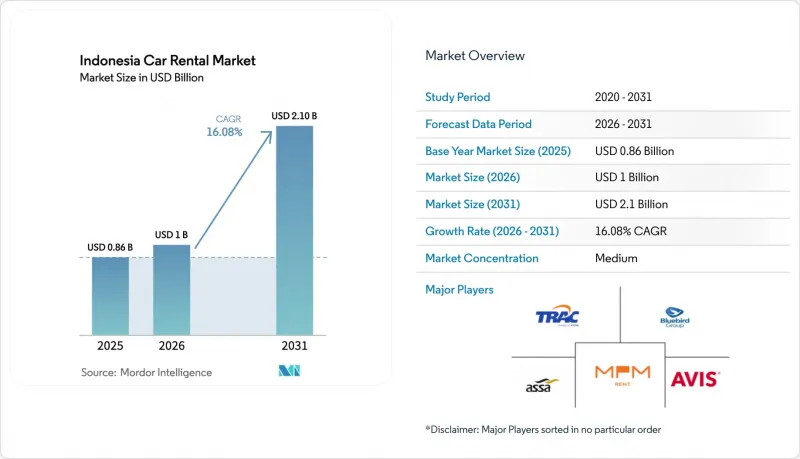
Mordor Intelligence에 의하면, 2026년 인도네시아의 렌터카 시장 규모는 10억 달러로 추정되고 2025년 8억 6,000만 달러에서 확대해, 2031년에는 21억 달러에 이를 것으로 예측됩니다.
2026년부터 2031년까지 연평균 성장률(CAGR) 16.08%로 성장할 것으로 전망됩니다.
본 보고서는 예약 유형(온라인 및 오프라인), 렌탈 기간(단기, 중기, 장기), 용도(관광·레저, 일상 통근, 기타), 차량 유형(이코노미/해치백, 기타), 연료 유형(내연기관·가솔린,내연기관·디젤, 기타), 최종 사용자(법인 및 개인), 렌탈 채널, 그리고 지역별로 분류되어 있습니다. 시장 전망은 금액(달러) 기준으로 제시되어 있습니다.
인도네시아의 렌터카 시장 동향 및 인사이트
증가하는 해외 및 국내 관광객 수
2024년, 인도네시아는 약 1,390만 명의 해외 방문객을 맞이했으며, 국내 여행자 수는 10억 회를 넘어섰고, 국경 규제 완화에 힘입어 관광 부문이 급속히 회복되었습니다. 관광부는 도착 시 비자 발급 확대와 ‘10개의 새로운 발리’로 불리는 관광지 홍보에 힘입어 2025년 해외 방문객 수가 1,460만 명에서 1,600만 명으로 증가했습니다. 코모도, 롬복 및 기타 지방 공항에 대한 대규모 자본 투자를 통해 좌석 수가 확대됨에 따라 여행객의 흐름이 자바 섬 이외의 지역으로 분산되고 있습니다. 세계여행관광협의회(WTTC)는 2025년에 관광 부문이 GDP의 4.6%를 차지했습니다. 관광객층의 확대는 특히 대중교통이 제한적인 섬들에서 렌터카 및 운전기사 포함 패키지 투어에 대한 수요를 직접적으로 끌어올리고 있습니다.
디지털 우선 예약 플랫폼의 급증
2024년, 인도네시아의 디지털 경제는 전자상거래 거래의 급증에 힘입어 900억 달러를 돌파했으며, 앞으로도 추가 성장이 예상됩니다. 2024년에는 온라인 렌터카 예약이 전체 거래에서 상당한 비중을 차지하며, 소비자들이 실시간 가격 비교, 무현금 결제, 로열티 혜택을 제공하는 슈퍼 앱으로 몰리면서 연간 상당한 성장을 기록했습니다. 블루버드 택시와 고젝(Gojek)의 제휴와 같은 협력을 통해 기존 차량 사업자는 고객 확보 비용을 절감하면서 전국 규모의 고객 기반을 개척할 수 있게 됩니다. 어그리게이터는 풍부한 데이터를 활용하여 동적 가격 책정을 미세 조정하고, 차량 가동률을 최적화하며, 보험 및 부가 서비스의 업셀링을 실시간으로 수행하고 있습니다.
라이드셰어 슈퍼앱이 단기 렌탈 시장을 잠식하고 있다.
2024년, 그랩(Grab)과 고젝(Gojek)은 인도네시아 내에서 방대한 수의 온디맨드 차량 호출 서비스를 처리했습니다. 제안된 그랩과 고투(GoTo)의 제휴가 실현된다면, 배송, 결제, 라이드셰어를 단일 지갑으로 통합함으로써 네트워크 효과가 더욱 강화될 가능성이 있습니다. 도시 지역 소비자들은 교통 체증 요금이나 주차 공간 부족을 피하기 위해 자가 운전식 렌터카보다 도어 투 도어 차량 호출 서비스를 선호합니다. 또한, 출장객들도 기존의 공항 픽업 카운터를 거치지 않고 경비 관리 대시보드를 통해 차량 공유 서비스를 예약하고 있습니다. 경쟁력을 유지하기 위해 각 렌터카 업체들은 앱을 통한 상품화(commoditization)의 영향을 덜 받는 틈새 시장에 대응하기 위해 시간 단위 요금제, 항공사와의 로열티 제휴, 프리미엄 SUV 도입 등을 모색하고 있습니다.
부문별 분석
2025년, 인도네시아의 렌터카 시장 매출의 68.84%를 온라인 채널이 차지했으며, 연평균 성장률(CAGR) 16.85%로 성장하고 있습니다. 이러한 우위는 높은 스마트폰 보급률, 무현금 결제 붐, 그리고 여행 계획, 지도, 디지털 지갑을 통합한 슈퍼 앱에 대한 소비자의 선호도를 반영합니다. 오프라인 여행사 카운터에 기인한 인도네시아의 렌터카 시장 규모는 2025년에도 여전히 상당한 매출을 유지했으나, 가격에 민감한 관광객을 확보하기 위해 소규모 사업자들이 애그리게이터 포털에 차량을 등록하기 시작하면서 시장 점유율이 하락하고 있습니다.
슈퍼앱 생태계는 차량 호출 서비스, 음식 배달, 디지털 뱅킹을 통합하여 1일 단위 렌터카 패키지의 교차 판매를 촉진하고 있습니다. 기존 브랜드들은 클라우드 기반 예약 엔진, 푸시 알림을 통한 할인, AI 기반 고객 서비스 챗봇을 도입하여 기술 플랫폼과 동등한 사용자 경험을 제공합니다. 온라인에서 수집된 데이터를 통해 국적, 여행 목적, 지출액에 따른 세분화가 가능해졌으며, 사업자는 주행 거리 상한에 대한 A/B 테스트나 Wi-Fi 라우터 번들 판매를 통해 추가 수익을 창출할 수 있게 되었습니다.
1일에서 30일간의 렌탈을 의미하는 단기 예약은 계절적 관광 수요의 정점에 힘입어 2025년 인도네시아의 렌터카 시장에서 57.88%의 점유율을 차지했습니다. 장기 계약은 2025년 인도네시아의 렌터카 시장에서 주목할 만한 수익 규모를 넘어, 연평균 성장률(CAGR) 17.12%로 확대될 것으로 예측됩니다. 기업들은 자본을 보존하고 유지보수 책임을 서비스 제공업체로 이관하기 위해 운영 리스를 채택하고 있습니다.
장기 패키지에는 일반적으로 운전기사 급여, 정기 점검 및 종합 보험이 포함되어 있어, 고객은 잔존 가치 변동의 영향을 받지 않습니다. 차량 관리자는 텔레매틱스를 활용하여 연료 소비량과 예방 정비를 모니터링함으로써 가동 중단 시간을 줄이고 있습니다. 이러한 추세는 중고차 처분 경로에도 영향을 미치고 있으며, 3-5년이 경과한 차량은 경매에 출품되거나 라이드셰어 운전자에게 판매됨으로써 개인에 의한 재판매보다 신속하게 자본을 회수할 수 있게 되었습니다.
2025년에는 관광 부문이 매출의 63.74%를 차지했으나, 비즈니스 모빌리티는 연평균 성장률(CAGR) 17.62%로 확대되어 차기 성장 동력이 될 전망입니다. 인도네시아의 투자 적격 등급과 신속한 라이선스 승인은 다국적 기업의 이전을 촉진하고, 임원 직원 픽업, 프로젝트 현장 셔틀, 주재원 가족 픽업에 대한 수요를 높이고 있습니다. 공장 근로자를 위한 일상 통근 패키지와 BPO(비즈니스 프로세스 아웃소싱) 종사자를 위한 카풀 밴도 해당 수요를 확대되고 있습니다.
관광 관련 예약은 발리, 족자카르타, 롬복에 집중되어 있으며, 이들 지역에서는 여정 기획 및 다국어 지원 GPS 내비게이션이 포함된 자가 운전 패키지가 제공되고 있습니다. 각 렌터카 업체는 인도네시아가 군도라는 지역적 특성과 도시 간 철도망이 미비한 점을 활용하여, 공항 마중 서비스, SIM 카드 신속 발급 키트, 연중무휴 24시간 로드사이드 어시스턴스 등을 맞춤형으로 제공합니다. 동시에, 법인 계약을 통한 수익 다각화가 진행되어 계절적 변동을 완화하는 동시에 예측 가능한 차량 가동률을 실현하고 있습니다.
기타 혜택 :
- 엑셀 형식 시장 예측(ME) 시트
- 3개월간의 애널리스트 지원
자주 묻는 질문
목차
제1장 서론
제2장 조사 방법
제3장 주요 요약
제4장 시장 구도
제5장 시장 규모 및 성장 예측
제6장 경쟁 구도
제7장 시장 기회 및 향후 전망
KTH 26.09.14According to Mordor Intelligence, the indonesian car rental market size in 2026 is estimated at USD 1.0 billion, growing from 2025 value of USD 0.86 billion with 2031 projections showing USD 2.1 billion, growing at 16.08% CAGR over 2026-2031.
This report is Segmented by Booking Type (Online and Offline), Rental Duration (Short-Term, Medium-Term and Long-Term), Application (Tourism and Leisure, Daily Commuting, and More), Vehicle Type (Economy/Hatchback and More), Fuel Type (ICE-Petrol, ICE-Diesel, and More), End-User (Corporate and Individual), Rental Channel, and Region. The Market Forecasts are Provided in Terms of Value (USD).
Indonesia Car Rental Market Trends and Insights
Rising International and Domestic Tourist Arrivals
In 2024, Indonesia welcomed around 13.9 million international visitors and recorded over 1 billion domestic journeys, marking a swift rebound in its tourism sector following the easing of border restrictions. The Ministry of Tourism projects inbound visitors will rise to between 14.6 and 16 million in 2025, supported by visa-on-arrival expansion and marketing of the "10 New Balis" destinations. Significant capital investment in Komodo, Lombok, and other regional airports increases seat capacity and disperses travel flows beyond Java. The World Travel & Tourism Council projects the sector will contribute 4.6% to GDP in 2025. A larger tourist base directly lifts self-drive rentals and chauffeured packages, particularly in islands where public transport is limited.
Surge in Digital-First Booking Platforms
In 2024, Indonesia's digital economy hit the USD 90 billion mark, buoyed by a surge in e-commerce transactions, with projections indicating further growth. Online rental bookings accounted for a substantial share of the overall transactions in 2024 and are growing significantly annually as consumers gravitate to super-apps offering instant price comparison, cashless payments, and loyalty rewards. Partnerships like Blue Bird taxis integrating with Gojek allow legacy fleets to unlock a nationwide customer base while cutting acquisition costs. Aggregators use rich data to fine-tune dynamic pricing, optimize fleet utilization, and upsell insurance or ancillary services in real time.
Ride-Hailing Super-Apps Cannibalizing Short-Term Rentals
Grab and Gojek processed a significant number of on-demand rides in Indonesia during 2024. A proposed Grab-GoTo tie-up could deepen network effects, bundling deliveries, payments, and ride-sharing into a single wallet. Urban consumers prefer door-to-door rides over self-drive rentals to avoid congestion fees and parking scarcity. Corporate travelers also book ride-hailing through expense-management dashboards, bypassing traditional airport pickup counters. To stay relevant, rental firms are exploring hourly packages, loyalty linkage with airlines, and premium SUVs to serve niches less exposed to app-based commoditization.
Other drivers and restraints analyzed in the detailed report include:
- Growing Corporate Demand for Long-Term Operational Leasing
- Government EV Roadmap Accelerating Fleet Electrification
- Intensifying Price-Led Competition Among Incumbents
For complete list of drivers and restraints, kindly check the Table Of Contents.
Segment Analysis
Online channels generated 68.84% of the Indonesian car rental market revenue in 2025, climbing at a 16.85% CAGR. The dominance reflects deep smartphone penetration, a cashless payment boom, and consumer comfort with super-apps integrating trip planning, mapping, and digital wallets. Indonesia's car rental market size, attributed to offline travel-agency counters, remained at significant revenue in 2025 but is losing share as small operators list fleets on aggregator portals to reach price-sensitive tourists.
Super-app ecosystems combine ride-hailing, food delivery, and digital banking, encouraging cross-selling day-long rental packages. Legacy brands adopt cloud-based reservation engines, push-notification discounts, and AI-enabled customer-service chatbots to match the user experience of tech platforms. Data captured online allows segmentation by nationality, trip purpose, and spend, enabling operators to A/B test mileage caps or bundle Wi-Fi routers for incremental revenue.
Short-term bookings, defined as rentals lasting 1-30 days, held a 57.88% share in the Indonesian car rental market in 2025 due to seasonal tourism peaks. Long-term contracts surpassed the noteworthy revenue i the Indonesian car rental market in 2025 and are projected to expand at a 17.12% CAGR. Corporations adopt operating leases to preserve capital and shift maintenance responsibilities to service providers.
Long-term packages typically include driver salaries, periodic servicing, and full insurance, insulating clients from residual-value swings. Fleet managers deploy telematics to monitor fuel consumption and preventive maintenance, reducing downtime. The trend also anchors used-vehicle disposal channels, where cars aged three to five years are auctioned or sold to ride-hailing drivers, recouping capital faster than private resales.
Tourism accounted for 63.74% of revenue in 2025; however, business mobility is on course to become the next growth engine, expanding at an 17.62% CAGR. Indonesia's investment-grade rating and quick licensing approvals spur multinational relocations, raising demand for executive transfers, project-site shuttles, and expatriate family transport. Daily commuting packages for factory staff and shared vans for BPO workers also widen addressable volumes.
Tourism bookings concentrate in Bali, Yogyakarta, and Lombok, where self-drive packages include itinerary curation and GPS navigation in multiple languages. Car rental firms tailor airport meet-and-greet services, fast-track SIM card kits, and 24/7 roadside assistance, leveraging Indonesia's archipelagic geography and limited inter-city rail. In parallel, corporate contracts diversify income, cushioning seasonality and yielding predictable fleet-utilization ratios.
Complete Report Scope:
- By Booking Type
- Online
- Offline
- By Rental Duration
- Short-term (Less than/Equals 30 days)
- Medium-term (1 to 12 months)
- Long-term (Above 12 months)
- By Application
- Tourism and Leisure
- Daily Commuting
- Corporate Fleet / Business Mobility
- Airport Transfer
- By Vehicle Type
- Economy / Hatchback
- Multi-Purpose Vehicle (MPV)
- Sports Utility Vehicle (SUV)
- Luxury / Executive
- By Fuel Type
- ICE - Petrol
- ICE - Diesel
- Hybrid-Electric
- Battery-Electric (BEV)
- By End-user
- Corporate
- Individual
- By Rental Channel
- Aggregator Platforms
- Direct-to-Consumer (Rental Co.)
- Super-App-Based Bundles
- By Region
- Java
- Greater Jakarta (Jabodetabek)
- West Java (ex-Jakarta)
- Central and East Java
- Bali and Nusa Tenggara
- Sumatra
- Kalimantan
- Sulawesi
- Papua and Maluku
- Java
List of Companies Covered in this Report:
- Blue Bird Group
- TRAC Astra Rent A Car
- Adi Sarana Armada (ASSA Rent)
- Mitra Pinasthika Mustika Rent
- The Hertz Corporation
- Avis Budget Group
- Europcar Indonesia
- Indorent (PT Indomobil Multi Jasa)
- Globe Rent a Car
- Otomo
- Grab Rentals
- GoCar Rental (Gojek)
- DOcar
- Movic
- Easyrent
- Tiket.com Car Rental
- Traveloka Car Rental
Additional Benefits:
- The market estimate (ME) sheet in Excel format
- 3 months of analyst support
TABLE OF CONTENTS
1 Introduction
- 1.1 Study Assumptions & Market Definition
- 1.2 Scope of the Study
2 Research Methodology
3 Executive Summary
4 Market Landscape
- 4.1 Market Overview
- 4.2 Market Drivers
- 4.2.1 Rising International and Domestic Tourist Arrivals
- 4.2.2 Surge in Digital-First Booking Platforms
- 4.2.3 Growing Corporate Demand for Long-Term Operational Leasing
- 4.2.4 Government EV Roadmap Accelerating Fleet Electrification
- 4.2.5 Halal-Friendly Tourism Packages Boosting Niche Rentals
- 4.2.6 Rapid Expansion of Secondary-Airport Connectivity
- 4.3 Market Restraints
- 4.3.1 Ride-Hailing Super-Apps Cannibalizing Short-Term Rentals
- 4.3.2 Intensifying Price-Led Competition Among Incumbents
- 4.3.3 Urban Congestion and Parking Scarcity Deterring Self-Drive
- 4.3.4 Fragmented Regional Licensing and Tax Compliance Burden
- 4.4 Value / Supply-Chain Analysis
- 4.5 Regulatory Landscape
- 4.6 Technological Outlook
- 4.7 Porter's Five Forces
- 4.7.1 Bargaining Power of Suppliers
- 4.7.2 Bargaining Power of Buyers/Consumers
- 4.7.3 Threat of New Entrants
- 4.7.4 Threat of Substitute Products
- 4.7.5 Intensity of Competitive Rivalry
5 Market Size & Growth Forecasts (Value, USD)
- 5.1 By Booking Type
- 5.1.1 Online
- 5.1.2 Offline
- 5.2 By Rental Duration
- 5.2.1 Short-term (Less than/Equals 30 days)
- 5.2.2 Medium-term (1 to 12 months)
- 5.2.3 Long-term (Above 12 months)
- 5.3 By Application
- 5.3.1 Tourism and Leisure
- 5.3.2 Daily Commuting
- 5.3.3 Corporate Fleet / Business Mobility
- 5.3.4 Airport Transfer
- 5.4 By Vehicle Type
- 5.4.1 Economy / Hatchback
- 5.4.2 Multi-Purpose Vehicle (MPV)
- 5.4.3 Sports Utility Vehicle (SUV)
- 5.4.4 Luxury / Executive
- 5.5 By Fuel Type
- 5.5.1 ICE - Petrol
- 5.5.2 ICE - Diesel
- 5.5.3 Hybrid-Electric
- 5.5.4 Battery-Electric (BEV)
- 5.6 By End-user
- 5.6.1 Corporate
- 5.6.2 Individual
- 5.7 By Rental Channel
- 5.7.1 Aggregator Platforms
- 5.7.2 Direct-to-Consumer (Rental Co.)
- 5.7.3 Super-App-Based Bundles
- 5.8 By Region
- 5.8.1 Java
- 5.8.1.1 Greater Jakarta (Jabodetabek)
- 5.8.1.2 West Java (ex-Jakarta)
- 5.8.1.3 Central and East Java
- 5.8.2 Bali and Nusa Tenggara
- 5.8.3 Sumatra
- 5.8.4 Kalimantan
- 5.8.5 Sulawesi
- 5.8.6 Papua and Maluku
- 5.8.1 Java
6 Competitive Landscape
- 6.1 Market Concentration
- 6.2 Strategic Moves
- 6.3 Market Share Analysis
- 6.4 Company Profiles (includes Global Level Overview, Market Level Overview, Core Segments, Financials as Available, Strategic Information, Market Rank/Share for Key Companies, Products and Services, SWOT Analysis, and Recent Developments)
- 6.4.1 Blue Bird Group
- 6.4.2 TRAC Astra Rent A Car
- 6.4.3 Adi Sarana Armada (ASSA Rent)
- 6.4.4 Mitra Pinasthika Mustika Rent
- 6.4.5 The Hertz Corporation
- 6.4.6 Avis Budget Group
- 6.4.7 Europcar Indonesia
- 6.4.8 Indorent (PT Indomobil Multi Jasa)
- 6.4.9 Globe Rent a Car
- 6.4.10 Otomo
- 6.4.11 Grab Rentals
- 6.4.12 GoCar Rental (Gojek)
- 6.4.13 DOcar
- 6.4.14 Movic
- 6.4.15 Easyrent
- 6.4.16 Tiket.com Car Rental
- 6.4.17 Traveloka Car Rental
7 Market Opportunities & Future Outlook
- 7.1 White-space & Unmet-Need Assessment


