

|
시장보고서
상품코드
2125605
중국의 배터리 제조 장비 시장 : 점유율 분석, 업계 동향과 통계, 성장 예측(2026-2031년)China Battery Manufacturing Equipment - Market Share Analysis, Industry Trends & Statistics, Growth Forecasts (2026 - 2031) |
||||||
 Mordor Intelligence
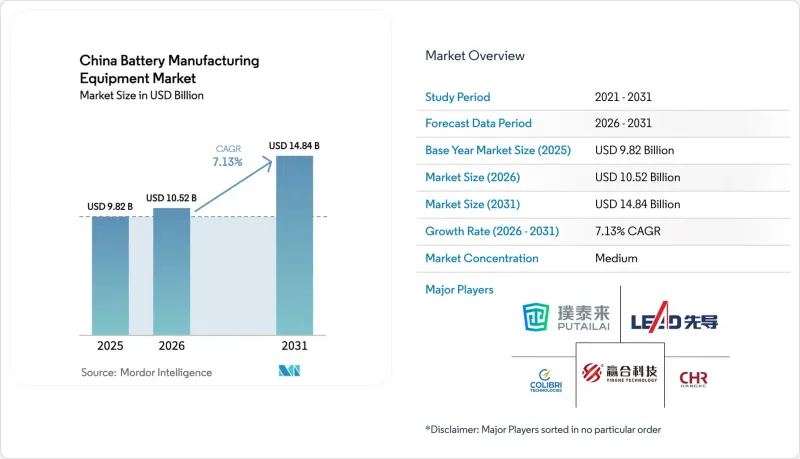
Mordor Intelligence에 의하면, 중국 배터리 제조 장비 시장 규모는 2025년 98억 2,000만 달러에서 2026년에는 105억 2,000만 달러로 확대되어 2026년부터 2031년까지 CAGR 7.13%로 성장을 지속하여, 2031년에는 148억 4,000만 달러에 이를 것으로 예측됩니다.
본 보고서는 배터리의 화학적 구성(리튬 이온, 전고체, 플로우 배터리 등), 기계의 유형(코팅·건조 시스템, 성형·시험 라인,조립·핸들링 로봇 등), 자동화 수준(완전 자동, AI 감시형 ‘라이트아웃’ 라인 등), 그리고 최종 사용자(자동차 OEM 및 Tier 1 공급업체, 에너지 저장 시스템 통합사업자 등)에 따라 분류되어 있습니다.
중국 배터리 제조 장비 시장 동향 및 인사이트
EV 주도 하의 기가팩토리 급속한 확대
2024년, 중국에서는 950만 대의 전기차가 생산될 전망이며, 이에 따라 CATL은 2026년까지 연간 생산 능력을 200GWh 증설하고, BYD도 같은 기간 내에 150GWh 증설을 계획하고 있습니다. 기가팩토리의 각 확장 단계에는 30억-40억 달러의 신규 설비 투자가 필요하며, 12-18개월 이내에 턴키 방식의 생산 라인을 납품할 수 있는 공급업체가 유리합니다. 장쑤성, 광둥성, 쓰촨성에는 긴밀한 공급망이 구축되어 있어 적시 설치가 가능하기 때문에 현지 공급업체의 입지가 확고해졌습니다. 각 성의 우대 조치에 따라 대상 설비 비용의 최대 30%가 보조금으로 지원됨에 따라 도입이 더욱 가속화되고 있습니다. 그 결과, 전국의 설비 가동률이 50% 미만에 그치고 있음에도 불구하고, 중국의 배터리 제조 장비 시장에서는 단기적인 수주 전망이 밝은 상황입니다.
AI를 활용한 수율 향상 소프트웨어 번들
하드웨어에 머신 비전 분석 기능을 번들로 제공함으로써 평균 판매 가격이 15-20% 상승하고, 고객을 수년에 걸친 서비스 계약에 묶어둘 수 있습니다. 우시 리드(Wuxi Lead)사의 보고에 따르면, AI 모니터링 라인의 초기 수율은 96-97%인 반면, 기존 시스템에서는 92-93%에 그치고 있어, 10GWh 규모의 공장에서는 연간 800만-1,000만 달러의 비용 절감으로 이어집니다. 실시간 결함 감지로 가동 중단 시간이 단축되는 한편, 데이터 피드백 루프를 통해 셀의 화학적 조성을 미세 조정할 수 있게 되어 공급업체와 고객 간의 유대 관계가 더욱 공고해집니다. 독자적인 소프트웨어 개발 역량을 갖추지 못한 공급업체는 신생 기업을 인수하거나 알고리즘 라이선스를 취득해야 하며, 어느 경우든 이익률을 압박하여 풀스택 통합업체의 경쟁 우위를 더욱 공고히 하게 됩니다.
2023-24년 설비 투자 붐 이후의 설비 과잉
2년간의 설치 붐을 거친 후, 2023년에는 전국적인 가동률이 47%까지 떨어졌고, 공급업체는 유휴 재고를 떠안게 되어 할인 판매를 할 수밖에 없었으며, 운전자금의 완충 여력이 줄어들었습니다. 특히, 일반 상품용 믹서, 슬리터, 코터는 가장 심각한 공급 과잉에 직면해 있는 반면, 중국 공업정보화부(MIIT)의 지침에서는 품질 향상으로 이어지지 않는 한 신규 건설을 자제할 것을 촉구하고 있습니다. 지방 당국은 여전히 고용을 우선시하고 있어 각 성별 규제 집행 상황에 편차가 발생하고 있으며, 이로 인해 공급 과잉이 장기화되면서 중국 배터리 제조 장비 시장의 경쟁이 격화되고 있습니다.
부문 분석
전고체 배터리 설비의 매출액은 연평균 성장률(CAGR) 30.24%로 증가할 것으로 예측됩니다. 이는 2026년까지 3-5GWh에 달할 가능성이 있는 시범 공장 건설에 대해 중국 정부가 60억 위안을 지원하기로 한 것을 반영한 것입니다. 대조적으로, 리튬 이온 배터리는 전기차 및 가전제품에 대한 꾸준한 수요 덕분에 2025년 중국 배터리 제조 장비 시장 점유율 84.62%를 유지했습니다. 나트륨 이온 배터리 수요는 예산을 중시하는 제조업체들에게 개조가 용이한 설비가 매력적이기 때문에 가속화되고 있습니다. 한편, 플로우 배터리는 계통 규모의 에너지 저장 분야에서 성장세를 보이고 있습니다. 납산 배터리와 니켈계 배터리는 산업용 및 항공우주 분야에서 활용되고 있으며, 틈새 시장이지만 안정적인 시장을 유지하고 있습니다.
강력한 정책 지원과 우시 납업, 푸타이라이, 그리고 1차 셀 제조업체 간의 공동 개발 제휴가 고체 전지의 급속한 보급을 뒷받침하고 있습니다. 설비 설계에는 현재 이를 숙지하고 있는 공급업체가 거의 없는 무용제 코팅, 진공 증착, 고압 캘린더 가공이 채택되어 있으며, 선도 기업들은 중국 배터리 제조 장비 시장의 다음 확장 물결을 포착하는 데 유리한 입장에 있습니다.
코팅 및 건조 시스템은 2025년 매출의 20.12%를 차지하고 있으며, 이는 높은 자본 집약도와 정밀도 요구 사항을 반영합니다. 한편, 조립 및 이송 로봇은 제조업체들이 인건비 급등을 상쇄하기 위해 노동 집약적인 적층 및 포장 공정을 자동화함에 따라 16.15%라는 가장 높은 연평균 성장률(CAGR)을 기록하고 있습니다. 따라서 중국 배터리 제조 장비 시장에서 로봇 시장 규모는 셀 형태의 다양화에 따라 급속히 확대되고 있습니다.
레이저 노칭 및 고정밀 절단은 더 엄격한 치수 관리가 요구되는 대형 셀 구조의 혜택을 받고 있습니다. 성형 및 시험 라인에는 AI 진단 기능이 통합되어 초기 단계의 결함을 조기에 감지함으로써 전기차 제조업체의 보증 충당금을 절감하고 있습니다. 한편, 재활용 및 블랙매스 처리 장비는 2028년에 시행될 ‘재질 회수율 95%’ 의무화라는 정책적 호재를 타고 있으며, 1차 전지 생산 이외의 분야에서도 수익 기회를 확대되고 있습니다.
기타 혜택:
- 엑셀 형식 시장 예측(ME) 시트
- 3개월간의 애널리스트 지원
자주 묻는 질문
목차
제1장 서론
제2장 조사 방법
제3장 주요 요약
제4장 시장 구도
제5장 시장 규모와 성장 예측
제6장 경쟁 구도
제7장 시장 기회와 향후 전망
JHS 26.09.11According to Mordor Intelligence, the China battery manufacturing equipment market size is expected to grow from USD 9.82 billion in 2025 to USD 10.52 billion in 2026 and is forecast to reach USD 14.84 billion by 2031 at 7.13% CAGR over 2026-2031.
This report is Segmented by Battery Chemistry (Lithium-Ion, Solid-State, Flow Batteries, and More), Machine Type (Coating and Drying Systems, Formation and Testing Lines, Assembly and Handling Robots, and More), Automation Level (Fully-Automatic, AI-Supervised "lights-Out" Lines, and More), and End-User (Automotive OEMs and Tier-1s, Energy Storage System Integrators, and More).
China Battery Manufacturing Equipment Market Trends and Insights
Rapid EV-Led Gigafactory Expansion
China produced 9.5 million electric vehicles in 2024, spurring CATL to add 200 GWh of annual capacity by 2026 and BYD to plan 150 GWh over the same horizon. Each gigafactory wave requires USD 3-4 billion of fresh machinery, favoring suppliers able to deliver turnkey lines within 12-18 months. Jiangsu, Guangdong, and Sichuan host dense supply chains, enabling just-in-time installation that entrenches local vendors. Provincial incentives further accelerate deployments by offsetting up to 30% of qualifying equipment costs. As a result, the Chinese battery manufacturing equipment market enjoys near-term order visibility despite nationwide capacity utilization below 50%.
AI-Driven Yield-Improvement Software Bundling
Bundling machine-vision analytics with hardware lifts average selling prices 15-20% and locks customers into multi-year service contracts. Wuxi Lead reports first-pass yields of 96-97% on AI-supervised lines versus 92-93% on conventional systems, translating into USD 8-10 million in annual savings for a 10 GWh plant. Real-time defect detection shrinks downtime, while data feedback loops inform cell chemistry tweaks, deepening vendor-client ties. Suppliers lacking native software capabilities must acquire startups or license algorithms, both of which dilute margins and reinforce the competitive moat of full-stack integrators.
Equipment Over-Capacity After 2023-24 Capex Spree
Nationwide utilization fell to 47% in 2023 after a two-year installation boom, leaving vendors with idle inventory and forcing discounts that sliced working-capital buffers. Commodity mixers, slitters, and coaters face the deepest glut, while MIIT guidelines now discourage fresh builds unless tied to quality upgrades. Provincial enforcement remains uneven because local authorities still prioritize employment, prolonging oversupply and intensifying competition within the Chinese battery manufacturing equipment market.
Other drivers and restraints analyzed in the detailed report include:
- Surging Demand for Sodium-Ion Pilot Equipment
- Solid-State Pilot-Line Investments
- Intensifying Price-Cut Wars Among Chinese OEMs
For complete list of drivers and restraints, kindly check the Table Of Contents.
Segment Analysis
Solid-state equipment revenues are projected to climb at a 30.24% CAGR, reflecting China's CNY 6 billion commitment to pilot builds that could reach 3-5 GWh by 2026. In contrast, lithium-ion retained 84.62% of the Chinese battery manufacturing equipment market share in 2025 due to entrenched EV and consumer electronics demand. Sodium-ion demand is accelerating as retrofit-friendly tooling appeals to budget-conscious producers, while flow batteries gain traction in grid-scale storage. Lead-acid and nickel-based chemistries remain niche but stable, serving industrial and aerospace use cases.
Strong policy backing and co-development alliances between Wuxi Lead, Putailai, and Tier-1 cell makers underpin rapid solid-state adoption. Equipment designs feature solvent-free coating, vacuum deposition, and high-pressure calendaring that few vendors presently master, making early movers well-positioned to capture the next wave of China battery manufacturing equipment market expansion.
Coating and drying systems generated 20.12% of 2025 revenue, reflecting their capital intensity and precision requirements. Assembly and handling robots, however, post the quickest 16.15% CAGR as producers automate labor-heavy stacking and packaging to offset wage inflation. The Chinese battery manufacturing equipment market size for robots, therefore, expands rapidly alongside cell format diversification.
Laser notching and high-precision cutting benefit from large-format cell architectures that demand tighter dimensional control. Formation and testing lines integrate AI diagnostics to catch early-life defects, reducing warranty provisions for EV makers. Meanwhile, recycling and black-mass processing equipment gains policy tailwinds from the 95% material-recovery mandate effective 2028, broadening revenue opportunities beyond primary battery production.
Complete Report Scope:
- By Battery Chemistry
- Lithium-ion
- Solid-state
- Sodium-ion
- Lead-acid
- Nickel-based
- Flow Batteries (Zn-Br, Vanadium etc.)
- By Machine Type
- Coating and Drying Systems
- Calendaring Presses
- Mixing and Homogenizers
- Slitting Machines
- Laser Notching and Cutting
- Electrode Stacking
- Vacuum Drying and Degassing
- Electro-lyte Filling
- Assembly and Handling Robots
- Formation and Testing Lines
- Packaging and Sealing
- Recycling and Black-mass Processing Equipment
- By Automation Level
- Manual/Lab-scale
- Semi-automatic
- Fully-automatic
- AI-supervised "lights-out" lines
- By End-User
- Automotive OEMs and Tier-1s
- Energy Storage System Integrators
- Consumer Electronics
- Industrial and Power Tools
- Aerospace and Defense
- Other End Users
List of Companies Covered in this Report:
- Wuxi Lead Intelligent Equipment Co., Ltd.
- Shenzhen Yinghe Technology Co., Ltd.
- HangKe Technology Co., Ltd.
- Durr AG
- Xiamen Tmax Battery Equipments Ltd.
- Xiamen TOB New Energy Technology Co., Ltd.
- Xiamen ACEY New Energy Technology
- Schuler AG
- Hitachi Ltd.
- Andritz AG
- Shenzhen Colibri Technologies
- Putailai (PTL) Intelligent Equipment
- Manz AG
- NAURA Technology Group
Additional Benefits:
- The market estimate (ME) sheet in Excel format
- 3 months of analyst support
TABLE OF CONTENTS
1 Introduction
- 1.1 Study Assumptions & Market Definition
- 1.2 Scope of the Study
2 Research Methodology
3 Executive Summary
4 Market Landscape
- 4.1 Market Overview
- 4.2 Market Drivers
- 4.2.1 Rapid EV?led gigafactory expansion
- 4.2.2 Government "Made-in-China 2025" automation subsidies
- 4.2.3 Vertical integration by Tier-1 cell makers
- 4.2.4 Solid-state pilot-line investments
- 4.2.5 AI-driven yield-improvement software bundling
- 4.2.6 Surging demand for sodium-ion pilot equipment
- 4.3 Market Restraints
- 4.3.1 Equipment over-capacity after 2023-24 capex spree
- 4.3.2 Intensifying price-cut wars among Chinese OEMs
- 4.3.3 Scarcity of senior automation engineers
- 4.3.4 Export-control risks on US/?EU process IP
- 4.4 Supply-Chain Analysis
- 4.5 Regulatory Landscape
- 4.6 Technological Outlook
- 4.7 Porter's Five Forces
- 4.7.1 Threat of New Entrants
- 4.7.2 Bargaining Power of Suppliers
- 4.7.3 Bargaining Power of Buyers
- 4.7.4 Threat of Substitutes
- 4.7.5 Competitive Rivalry
- 4.8 PESTLE Analysis
5 Market Size & Growth Forecasts
- 5.1 By Battery Chemistry
- 5.1.1 Lithium-ion
- 5.1.2 Solid-state
- 5.1.3 Sodium-ion
- 5.1.4 Lead-acid
- 5.1.5 Nickel-based
- 5.1.6 Flow Batteries (Zn-Br, Vanadium etc.)
- 5.2 By Machine Type
- 5.2.1 Coating and Drying Systems
- 5.2.2 Calendaring Presses
- 5.2.3 Mixing and Homogenizers
- 5.2.4 Slitting Machines
- 5.2.5 Laser Notching and Cutting
- 5.2.6 Electrode Stacking
- 5.2.7 Vacuum Drying and Degassing
- 5.2.8 Electro-lyte Filling
- 5.2.9 Assembly and Handling Robots
- 5.2.10 Formation and Testing Lines
- 5.2.11 Packaging and Sealing
- 5.2.12 Recycling and Black-mass Processing Equipment
- 5.3 By Automation Level
- 5.3.1 Manual/Lab-scale
- 5.3.2 Semi-automatic
- 5.3.3 Fully-automatic
- 5.3.4 AI-supervised "lights-out" lines
- 5.4 By End-User
- 5.4.1 Automotive OEMs and Tier-1s
- 5.4.2 Energy Storage System Integrators
- 5.4.3 Consumer Electronics
- 5.4.4 Industrial and Power Tools
- 5.4.5 Aerospace and Defense
- 5.4.6 Other End Users
6 Competitive Landscape
- 6.1 Market Concentration
- 6.2 Strategic Moves (M&A, Partnerships, PPAs)
- 6.3 Market Share Analysis (Market Rank/Share for key companies)
- 6.4 Company Profiles (includes Global level Overview, Market level overview, Core Segments, Financials as available, Strategic Information, Products & Services, and Recent Developments)
- 6.4.1 Wuxi Lead Intelligent Equipment Co., Ltd.
- 6.4.2 Shenzhen Yinghe Technology Co., Ltd.
- 6.4.3 HangKe Technology Co., Ltd.
- 6.4.4 Durr AG
- 6.4.5 Xiamen Tmax Battery Equipments Ltd.
- 6.4.6 Xiamen TOB New Energy Technology Co., Ltd.
- 6.4.7 Xiamen ACEY New Energy Technology
- 6.4.8 Schuler AG
- 6.4.9 Hitachi Ltd.
- 6.4.10 Andritz AG
- 6.4.11 Shenzhen Colibri Technologies
- 6.4.12 Putailai (PTL) Intelligent Equipment
- 6.4.13 Manz AG
- 6.4.14 NAURA Technology Group
7 Market Opportunities & Future Outlook
- 7.1 White-space & Unmet-Need Assessment


