

|
시장보고서
상품코드
2154269
미국의 크롤러 토공 기계 : 시장 점유율 분석, 업계 동향과 통계, 성장 예측(2026-2031년)US Crawler Earthmoving Machines - Market Share Analysis, Industry Trends & Statistics, Growth Forecasts (2026 - 2031) |
||||||
 Mordor Intelligence
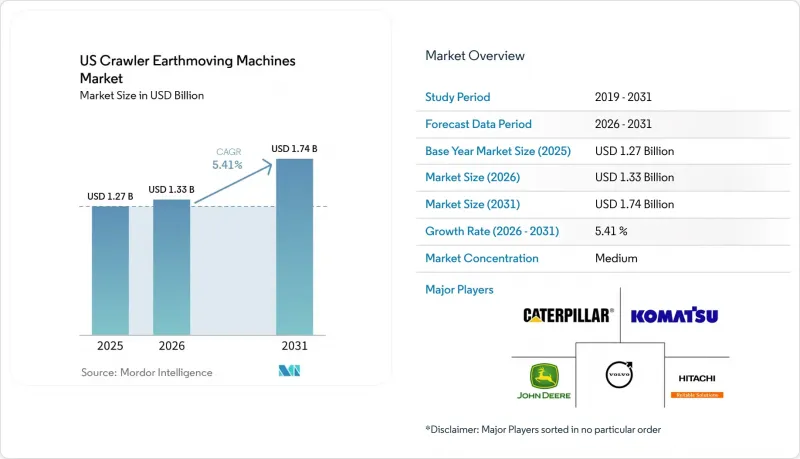
에 따르면 미국의 크롤러식 토목 기계 시장 규모는 2025년에 12억 7,000만 달러로 평가되며, 2026년에는 13억 3,000만 달러로 추정되고 있으며, 예측 기간(2026-2031년)에 CAGR 5.41%로 추이하며, 2031년까지 17억 4,000만 달러에 달할 것으로 전망되고 있습니다.
미국 크롤러식 토목 기계 시장의 동향 및 인사이트
연방 정부의 인프라 자금 급증(IIJA, IRA)
연방 정부의 배분 방식에 따라 고속도로 건설비에 매년 막대한 투자가 이루어지고 있습니다. 그러나 2026년 초 현재, 이 총 승인액의 상당 부분이 미사용 상태로 남아 있습니다. 이러한 상황은 주요 시공사들에게 수년에 걸친 사업 전망을 확고히 해줄 뿐만 아니라, 미국의 크롤러식 토목 기계 시장에 대한 관심도 높이는 요인이 되고 있습니다. 이러한 재정적 기반을 보완하는 형태로, ‘BUILD’ 및 ‘RAISE’ 보조금 제도를 통해 지방 도시에 위치한 복합 운송 허브에 자금이 투입되고 있습니다. 이러한 노력은 콤팩트 굴착기 및 로더 시장을 확대시키고 있습니다. 한편, 지출 의무화 주기의 지연으로 인해 기계 발주가 제한된 기간에 집중되고 있습니다. 이러한 동향은 분기별 출하량 변동을 심화시킬 뿐만 아니라 수요의 급증도 지속시키고 있으며, 렌탈 사업자들은 이에 대응할 태세를 갖추고 있습니다. 변화 중 하나로, 공공 부문의 구매 담당자들은 일괄 구매보다 리스를 선호하는 경향을 보이고 있습니다. 이러한 전략을 통해 지자체 대차대조표상의 자산 감가상각 부담을 피할 수 있으며, 결과적으로 렌탈 이용이 확산되고 있습니다. 이에 대응하여 각 OEM 업체들은 주요 교통부(DOT) 관할 구역 근처에 재고를 전략적으로 배치하고, 막바지 주문에도 확실하게 대응할 수 있도록 준비를 진행하고 있습니다.
인력 부족이 건설기계 렌탈의 보급을 지원
향후 10년이 끝날 무렵에는 건설 인력의 상당 부분이 정년퇴직할 것으로 예상되어, 건설업체들은 숙련된 운전기사를 확보하는 데 어려움을 겪게 될 것입니다(BLS.GOV). 이러한 기술 격차를 해소하기 위해 렌탈 업체들은 현재 조작자 교육과 텔레매틱스 대시보드를 결합한 패키지형 서비스를 제공하여, 기계 조작 및 규정 준수를 보다 용이하게 하고 있습니다. 금리 상승에 따라 신용도가 중간 수준인 신청자들에게는 리스 견적 비용이 점점 더 높아지고 있으며, 구매보다 렌탈을 선택하는 경향이 강해지고 있습니다. 이러한 변화는 자사 금융 프로그램을 이용할 수 없는 중소규모 기업에서 특히 두드러집니다. 이러한 동향을 바탕으로, 전미 렌탈 협회(ARA)는 향후 수년간 렌탈 이용률이 사상 최고치를 기록할 것으로 예측하고 있으며, 이는 예측 기간 중 해당 채널의 꾸준한 성장 추세와 일치합니다.
2023년 이후 설비 금융 금리의 급등
2023년 중반까지 연방준비제도이사회(FRB)는 정책 금리를 대폭 인상했으며, 그 결과 몇 년 전과 비교하여 차입 비용은 실질적으로 2배로 증가했습니다. 이러한 인상으로 인해 크롤러식 굴착기 등 고가 장비의 월 임대료에 막대한 비용이 추가되었습니다. 투자 적격 등급의 신용도를 갖추지 못한 중소규모 도급업체들은 현재 더 높은 리스 견적을 마주하고 있으며, 단기 대여가 더 현실적인 선택지가 되거나 장비 교체를 연기할 수밖에 없는 상황에 내몰리고 있습니다. 이러한 추세는 2025년 상반기에 미국 장비 리스·금융 협회(ELFA)가 보고한 신규 계약 건수의 현저한 감소에 반영되어 있습니다. 한편, 각 OEM 업체들은 소형 모델을 대상으로 2025년 하반기까지 이어지는 0% 금리 프로모션을 도입했습니다. 이러한 조치는 판매 대수를 지원하는 한편, 딜러의 이익률에 압박을 가하고 있으며, 금리 지원이 중단된 후의 장기적인 지속가능성에 대한 우려도 제기되고 있습니다.
부문 분석
크롤러식 굴착기는 도랑 파기, 대규모 굴착, 철거 작업에서의 다용도성을 바탕으로 2025년 미국 크롤러식 토목 기계 시장 매출의 67.73%를 차지했습니다. 한편, 소형 트랙 로더는 2026-2031년까지 연평균 성장률(CAGR) 6.43%를 기록할 전망입니다. 이는 설치 면적이 작고 잔디를 손상시키지 않는 하부 구조가 선호되는 기존 주택 밀집 지역 개발 및 도시 재생으로의 구조적 전환을 반영한 것입니다.
대형 불도저 분야의 차량 교체에 따른 수요 공백은 굴착기 탑재형 지반 정리 제어 부착물의 매출 증가로 이어지고 있으며, 각 OEM 업체들은 독자적인 3D 기계 제어 소프트웨어를 통해 이러한 업셀링 기회를 수익화하고 있습니다. 또한 BEAD 프로그램과 관련된 통신용 도랑 굴착 공사도 ‘기타’ 부문을 견인하고 있으며, 424억 5,000만 달러 규모의 농촌 지역 광대역망 구축에 따라 특수 기계 및 부착 장치에 대한 수요가 증가하고 있습니다.
2025년에는 내연기관이 83.31%의 점유율을 유지했으나, 전기 및 하이브리드 모델은 2031년까지 연평균 성장률(CAGR) 6.45%를 기록할 것으로 예상되어, 미국 크롤러식 토공 기계 시장에서의 점유율을 꾸준히 확대하고 있습니다. 볼보 CE의 5개 모델로 구성된 하이브리드 라인업은 20%의 연료 절감을 실현하는 한편, 코마츠의 회생식 스윙 하네스는 생산성을 15% 향상시켜, 초기 비용이 높음에도 불구하고 운영 비용 측면에서 하이브리드 기계가 유리한 상황입니다. 2024년에 시행되는 캘리포니아주의 제로 배출 조달 규정에 따라 해안 지역에서의 도입이 가속화되는 반면, 내륙 주에서는 차량 전체의 전동화를 단행하기 전에 보다 광범위한 충전 네트워크 구축을 기다리고 있는 상황입니다.
채석장이나 장거리 토공 현장에서는 뛰어난 에너지 밀도와 급유 편의성 덕분에 여전히 디젤 기계가 주류를 차지하고 있으며, Tier 4 대응 기종은 Tier 3에 비해 연비를 3%-6% 향상시켰습니다. 하지만 배터리 팩의 모듈화와 셀 비용 하락으로 인해 경제성 격차는 기존 예측보다 빠르게 줄어들고 있습니다. 특히 하루 가동 시간이 8시간을 넘는 경우가 드문 6톤 미만의 미니 굴착기급에서 이러한 경향이 두드러집니다. 하이브리드차량의 보급이 확대됨에 따라 각 OEM 업체들은 동력 배분 알고리즘 및 배터리 상태 모니터링을 최적화하는 소프트웨어의 잠금 해제 기능을 통해 지속적인 수입원을 확보할 수 있게 되었으며, 이로 인해 미국 크롤러식 토공 기계 시장 전체에서 애프터서비스 고객 유지율이 강화되고 있습니다.
기타 혜택:
- 엑셀 형식의 시장 예측(ME) 시트
- 3개월간의 애널리스트 지원
자주 묻는 질문
목차
제1장 서론
- 조사 전제조건과 시장 정의
- 조사 범위
제2장 조사 방법
제3장 개요
제4장 시장 구도
- 시장 개요
- 시장 성장 촉진요인
- 시장 성장 억제요인
- 밸류·공급망 분석
- 규제 상황
- 기술 전망
- Porter's Five Forces 분석
제5장 시장 규모와 성장 예측
- 기기 유형별
- 추진력별
- 엔진 출력별
- 용도별
- 유통 채널별
제6장 경쟁 구도
- 시장 집중도
- 전략적 동향
- 시장 점유율 분석
- 기업 개요
- Caterpillar Inc.
- Komatsu Ltd.
- John Deere
- Volvo CE
- Hitachi Construction Machinery
- Doosan Bobcat Inc.
- SANY America
- Kobelco USA
- CASE Construction Equipment(CNH Industrial)
- Takeuchi US
- Kubota Tractor Corp.
- JCB North America
- LiuGong North America
- Hyundai CE Americas
- Yanmar CE
- Liebherr Corporation
- Wacker Neuson
- XCMG North America
- Sunward USA
- Mecalac North America
제7장 시장 기회와 향후 전망
KSA 26.10.23According to Mordor Intelligence, the US crawler earthmoving machines market size was valued at USD 1.27 billion in 2025, is estimated at USD 1.33 billion in 2026, and is projected to reach USD 1.74 billion by 2031, at a CAGR of 5.41% during the forecast period (2026-2031).
US Crawler Earthmoving Machines Market Trends and Insights
Boom in Federal Infrastructure Funding (IIJA, IRA)
Federal formula allocations are channeling significant annual investments into highway spending. However, as of early 2026, a substantial portion of this total authorization remains untouched. This scenario not only locks in multi-year visibility for prime contractors but also casts a spotlight on the US crawler earthmoving machine market. Complementing this financial foundation, the BUILD and RAISE grant schemes are directing funds into multimodal hubs situated in secondary cities. This initiative broadens the market for compact excavators and loaders. Meanwhile, delayed obligation cycles are squeezing machine orders into tight timeframes. This trend not only heightens quarterly shipment volatility but also maintains surges in demand, which rental fleets are poised to meet. In a shift, public-sector buyers are leaning towards leasing rather than outright purchases. This strategy helps them sidestep the burden of depreciating assets on municipal balance sheets, consequently boosting rental penetration. In response, OEMs are strategically positioning their inventory close to major DOT districts, ensuring they're ready for last-minute orders.
Labor Scarcity Driving Equipment-Rental Penetration
By the end of the decade, a significant portion of the construction workforce is expected to retire, leaving contractors in search of skilled operators. BLS.GOV. To address this skills gap, rental companies are now offering bundled services that combine operator training with telematics dashboards, making machine control and compliance more straightforward. With rising interest rates, mid-tier credit applicants are seeing lease quotes becoming increasingly expensive-the balance is tipping towards renting rather than buying. This shift is particularly pronounced among smaller firms that don't have access to captive finance programs. In light of these trends, the American Rental Association is predicting record-high rental penetration in the coming years, aligning with the channel's steady growth trajectory over the forecast period .
Steep Increases in Equipment-Financing Rates Post-2023
By mid-2023, the Federal Reserve raised its benchmark rate significantly, effectively doubling borrowing costs compared to a couple of years prior. This increase added substantial costs to the monthly lease of high-value equipment like crawler excavators. Small contractors, lacking investment-grade credit, now face higher lease quotes, making short-term rentals a more viable option or forcing delays in fleet upgrades. This trend is reflected in a notable decline in new-business volume reported by the Equipment Leasing and Finance Association during the first half of 2025. Meanwhile, OEMs introduced zero-percent promotions on compact models, extending through late 2025. While this approach supports sales volumes, it puts pressure on dealer margins and raises concerns about its long-term viability once rate subsidies are removed.
Other drivers and restraints analyzed in the detailed report include:
- Rise of Electrified and Hybrid Excavator Models
- Accelerated Urban-Renewal Projects in Tier-2 US Cities
- Volatile Steel Prices Impacting OEM Margins
For complete list of drivers and restraints, kindly check the Table Of Contents.
Segment Analysis
Crawler excavators generated 67.73% of 2025 revenue in the US crawler earthmoving machine market, supported by their utility in trenching, mass excavation, and demolition. Compact tracked loaders, however, are on course for a 6.43% CAGR between 2026 and 2031, reflecting a structural pivot toward infill housing and urban renewal that favors smaller footprints and turf-friendly undercarriages.
Vacuum from fleet turnover in the heavy-duty bulldozer arena funnels incremental sales to excavator-mounted grade-control attachments, an upsell path that OEMs monetize through proprietary 3D machine-control software. Telecommunications trenching tied to the BEAD program also buttresses the "Others" category, where specialty machines and attachments see a demand uptick amid the USD 42.45 billion rural broadband rollout.
Internal combustion engines retained 83.31% share in 2025, yet electric and hybrid models are forecast to post a 6.45% CAGR through 2031, steadily enlarging their slice of the US crawler earthmoving machine market. Volvo CE's five-model hybrid line delivers 20% fuel savings, while Komatsu's regenerative swing harness lifts productivity 15%, tilting operating-expense math in favor of hybrids despite upfront price premiums. California's zero-emission procurement rule, effective 2024, fast-tracks coastal adoption, whereas heartland states await broader charging networks before committing to fleet-wide electrification.
Diesel machines still dominate quarrying and long-haul earthmoving due to superior energy density and refueling convenience, and Tier-4 hardware bumps fuel efficiency 3%-6% compared with Tier 3. Nevertheless, battery-pack modularity and falling cell costs are closing the economics gap faster than previously modeled, especially in the sub-6-ton mini-excavator class, where daily duty cycles rarely exceed eight hours. As hybrid penetration rises, OEMs gain a recurring revenue stream from software unlocks that optimize power-split algorithms and battery health monitoring, reinforcing after-sales stickiness across the US crawler earthmoving machine market.
Complete Report Scope:
- By Equipment Type
- Crawler Excavators
- Crawler Bulldozers
- Crawler Loaders
- Crawler Cranes and Pipe-layers
- Compact Tracked Loaders and Skid-steers
- Others (Trencher, Drill Rig, etc.)
- By Propulsion
- Internal Combustion Engine (ICE)
- Electric and Hybrid
- By Engine Power Output
- Below 100 HP
- 100-200 HP
- 201-400 HP
- Above 400 HP
- By Application
- Construction
- Mining and Quarrying
- Agriculture and Forestry
- Others
- By Distribution Channel
- Direct OEM Sales
- Authorized Dealers
- Rental and Leasing Firms
List of Companies Covered in this Report:
- Caterpillar Inc.
- Komatsu Ltd.
- John Deere
- Volvo CE
- Hitachi Construction Machinery
- Doosan Bobcat Inc.
- SANY America
- Kobelco USA
- CASE Construction Equipment (CNH Industrial)
- Takeuchi US
- Kubota Tractor Corp.
- JCB North America
- LiuGong North America
- Hyundai CE Americas
- Yanmar CE
- Liebherr Corporation
- Wacker Neuson
- XCMG North America
- Sunward USA
- Mecalac North America
Additional Benefits:
- The market estimate (ME) sheet in Excel format
- 3 months of analyst support
TABLE OF CONTENTS
1 Introduction
- 1.1 Study Assumptions and Market Definition
- 1.2 Scope of the Study
2 Research Methodology
3 Executive Summary
4 Market Landscape
- 4.1 Market Overview
- 4.2 Market Drivers
- 4.2.1 Boom in federal infrastructure funding (IIJA, IRA)
- 4.2.2 Labor scarcity driving equipment-rental penetration
- 4.2.3 Rise of electrified and hybrid excavator models
- 4.2.4 Accelerated urban-renewal projects in Tier-2 US cities
- 4.2.5 Digitized job-site management and telematics integration
- 4.2.6 Forestry wildfire-mitigation incentives (USFS)
- 4.3 Market Restraints
- 4.3.1 Steep increases in equipment-financing rates post-2023
- 4.3.2 Volatile steel prices impacting OEM margins
- 4.3.3 Tight Tier-4 emission-compliance costs for OEMs
- 4.3.4 Supply-chain fragility for hydraulic components
- 4.4 Value / Supply-Chain Analysis
- 4.5 Regulatory Landscape
- 4.6 Technological Outlook
- 4.7 Porter's Five Forces Analysis
- 4.7.1 Threat of New Entrants
- 4.7.2 Bargaining Power of Suppliers
- 4.7.3 Bargaining Power of Buyers
- 4.7.4 Threat of Substitutes
- 4.7.5 Competitive Rivalry
5 Market Size and Growth Forecasts (Value (USD) and Volume (Units))
- 5.1 By Equipment Type
- 5.1.1 Crawler Excavators
- 5.1.2 Crawler Bulldozers
- 5.1.3 Crawler Loaders
- 5.1.4 Crawler Cranes and Pipe-layers
- 5.1.5 Compact Tracked Loaders and Skid-steers
- 5.1.6 Others (Trencher, Drill Rig, etc.)
- 5.2 By Propulsion
- 5.2.1 Internal Combustion Engine (ICE)
- 5.2.2 Electric and Hybrid
- 5.3 By Engine Power Output
- 5.3.1 Below 100 HP
- 5.3.2 100-200 HP
- 5.3.3 201-400 HP
- 5.3.4 Above 400 HP
- 5.4 By Application
- 5.4.1 Construction
- 5.4.2 Mining and Quarrying
- 5.4.3 Agriculture and Forestry
- 5.4.4 Others
- 5.5 By Distribution Channel
- 5.5.1 Direct OEM Sales
- 5.5.2 Authorized Dealers
- 5.5.3 Rental and Leasing Firms
6 Competitive Landscape
- 6.1 Market Concentration
- 6.2 Strategic Moves
- 6.3 Market Share Analysis
- 6.4 Company Profiles (Includes Global Level Overview, Market Level Overview, Core Segments, Financials as Available, Strategic Information, Market Rank/Share for Key Companies, Products and Services, SWOT Analysis, and Recent Developments)
- 6.4.1 Caterpillar Inc.
- 6.4.2 Komatsu Ltd.
- 6.4.3 John Deere
- 6.4.4 Volvo CE
- 6.4.5 Hitachi Construction Machinery
- 6.4.6 Doosan Bobcat Inc.
- 6.4.7 SANY America
- 6.4.8 Kobelco USA
- 6.4.9 CASE Construction Equipment (CNH Industrial)
- 6.4.10 Takeuchi US
- 6.4.11 Kubota Tractor Corp.
- 6.4.12 JCB North America
- 6.4.13 LiuGong North America
- 6.4.14 Hyundai CE Americas
- 6.4.15 Yanmar CE
- 6.4.16 Liebherr Corporation
- 6.4.17 Wacker Neuson
- 6.4.18 XCMG North America
- 6.4.19 Sunward USA
- 6.4.20 Mecalac North America
7 Market Opportunities and Future Outlook
- 7.1 White-space and Unmet-Need Assessment


