

|
시장보고서
상품코드
2154353
아밀로이드증 치료제 : 시장 점유율 분석, 업계 동향과 통계, 성장 예측(2026-2031년)Amyloidosis Therapeutics - Market Share Analysis, Industry Trends & Statistics, Growth Forecasts (2026 - 2031) |
||||||
 Mordor Intelligence
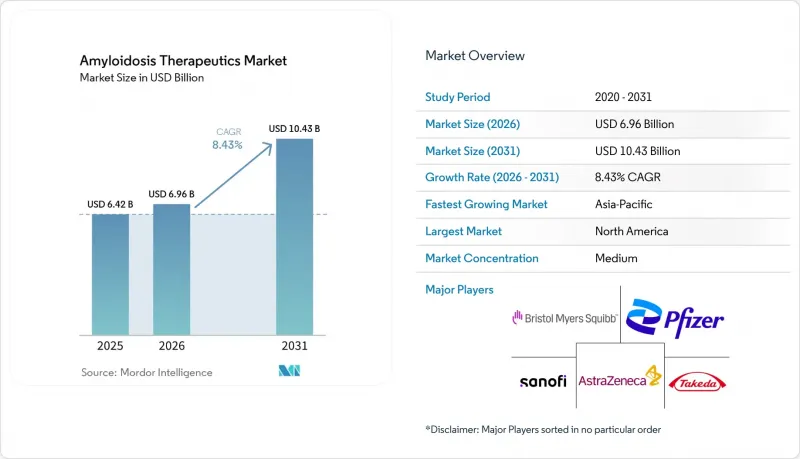
에 따르면 아밀로이드증 치료제 시장은 2025년에 64억 2,000만 달러 규모에 달하며, 2026년에는 69억 6,000만 달러에 달할 것으로 추정되고 있습니다.
전 세계 아밀로이드증 치료제 시장의 동향 및 인사이트
질환 수정 요법의 승인 동향
2024-2026년에 걸친 규제 당국의 조치로 인해 아밀로이드증 치료제 시장의 치료 선택지에 변화가 생겼습니다. ATTRibute-CM 임상시험에서 632명의 참가자를 대상으로 30개월에 걸친 모든 원인에 의한 사망률 및 심혈관 질환으로 인한 재입원 복합 평가변수가 42% 감소한 것으로 보고됨에 따라 FDA는 2024년 11월 ATTR-CM에 대한 아콜라미디스의 승인을 내렸습니다. 그 후, FDA는 2025년 3월 ATTR-CM에 대한 부토리실란을 승인하여, RNA 간섭 요법의 적용 범위를 심근증 및 다발성 신경병증으로 확대했습니다. 미국, 브라질, 유럽연합, 캐나다에서의 승인으로 인해 지급 기관이 각 시장 간의 결정을 비교할 수 있게 되므로, 각 지역에서 보험 적용 결정까지 걸리는 기간이 단축될 가능성이 있습니다. 2025년 11월, 새로 진단된 AL 아밀로이드증에 대한 달라줌맙·히알루로니다제-fihj와 VCd의 병용 요법이 FDA로부터 기존 방식대로 승인을 받음에 따라 ANDROMEDA 임상시험의 장기 추적 조사를 통해 확립된 치료법이 더욱 확고해졌습니다. 이러한 결정에 따라 제약 기업은 임상적 이점 외에도 실용적 가치를 입증해야 할 필요성이 더욱 커지고 있습니다.
고령화 사회와 ATTR-CM의 규명
ATTR 심근증은 주로 65세 이상의 성인에게 발병하며, 미국내 발생률은 2023년까지 증가했습니다. 보험 청구 데이터를 기반으로 한 증거에 따르면 미국 고령층의 ATTR-CM 유병률은 100만 명당 54.9명이었습니다. 또한 부검 소견을 통해 임상적으로 인지되지 않았던 환자들에서도 심장 아밀로이드 침착이 확인되었으며, 이는 진단된 유병률만으로는 임상적 부담의 전모를 완전히 파악할 수 없음을 시사합니다. 조기 인식을 통해 환자가 치료법을 변경할 필요 없이 치료 대상 집단에 새로운 환자를 포함시킬 수 있게 됩니다. 일본에서는 ATTR-CM의 유병률이 연간 100명/100만 명으로 보고되고 있으며, 진단 체계가 정비됨에 따라 수요가 증가할 것으로 예상됩니다. 또한 FDA나 EMA 등 규제 당국이 운영하는 희귀질환 의약품 제도도 희귀질환의 임상 개발에서 여전히 중요한 역할을 수행하고 있습니다.
고액의 치료비와 평생에 걸친 질환 관리비
장기 치료 비용은 규제 당국의 승인을 받았더라도 치료 접근성을 제한하는 요인이 될 수 있습니다. AL 아밀로이드증 치료에는 자원을 대량으로 소모하는 항형질세포 요법도 필요하며, 이로 인해 의료 서비스 이용 총량이 증가할 가능성이 있습니다. 빈도 조정된 달라줌맙 요법은 유효성을 유지하면서 치료 강도를 완화하는 것을 목적 중 하나로 삼아 연구되어 왔습니다. 보험 적용을 받는 환자라 하더라도 사전 승인 절차가 반복되거나 치료 지속이 지연될 위험에 직면할 수 있습니다. 브라질, 남아프리카공화국 및 걸프협력회의(GCC) 회원국에서는 희귀질환을 위한 자금 조달 체계가 마련되어 있지 않아, 승인 후에도 보험 적용을 통한 접근이 지연될 우려가 있습니다. 이러한 제약으로 인해 의학적 필요성이 명백하더라도 아밀로이드증 치료제 시장에서 수익 실현이 지연될 가능성이 있습니다.
부문 분석
2025년, AL 아밀로이드증은 아밀로이드증 치료제 시장 점유율의 42.57%를 차지했습니다. 이러한 매출 상황은 형질세포를 표적으로 한 치료를 위한 오랜 기간 축적된 임상 인프라와 환자 1인당 치료비가 높다는 점을 반영하고 있습니다. 2025년 11월, 달라줌맙·히알루로니다제-fihj와 VCd의 병용 요법이 기존 승인 절차를 거쳐 승인됨에 따라 새로 진단된 AL 아밀로이드증에 대한 확고한 표준 치료법이 확립되었습니다. ANDROMEDA 임상시험의 장기 추적 조사에서는 전체 생존 기간의 위험비(HR)가 0.62로 보고되었습니다. 이러한 치료 경로는 다제 병용 항형질세포 요법에 대한 지속적인 수요를 지원하고 있습니다.
ATTR 아밀로이도시는 2031년까지 연평균 성장률(CAGR) 8.89%로 가장 빠른 성장세를 기록할 것으로 예측됩니다. 승인된 치료법의 증가와 원인 불명의 심부전을 보이는 고령자의 진단 정확도 향상 등이 이러한 성장을 지원하고 있습니다. AA 아밀로이도시는 여전히 매출 규모가 가장 작은 범주이며, 그 치료는 주로 기저 염증성 질환의 조절을 통해 이루어지고 있습니다. IL-6를 표적으로 하는 생물제제는 이 환자군의 치료에 간접적인 영향을 미칠 가능성이 있습니다. ATTR의 경우 환자 수 증가 속도가 빨라지는 반면, AL은 다층적인 약물 요법을 통한 치료가 가능하므로 환자 1인당 매출은 계속해서 높은 수준을 유지할 전망입니다. 희귀질환 의약품에 관한 규제 요건은 질환 유형에 관계없이 임상시험 설계 및 시판 후 모니터링에 계속해서 영향을 미치고 있습니다.
2025년 시점에 TTR 안정화제는 아밀로이드증 치료제 시장 점유율의 38.93%를 차지했습니다. 경구용 약물인 타파미디스와 아콜라미디스는 ATTR-CM 환자 집단에서 이러한 입지를 지원하고 있습니다. 안정화제는 처방 의사들에게 친숙하며, 일상적인 외래 진료에 적합합니다. 유전자 사일런서는 2031년까지 연평균 성장률(CAGR) 9.23%로 확대될 것으로 예측됩니다. 부트리실란의 ATTR-CM에 대한 승인 및 에프론텔센의 유전성 ATTR 다발성 신경병증에 대한 확립된 사용으로 인해 이 치료제군의 임상적 역할은 확대되었습니다.
아밀로이드 제거제의 경우, AL 아밀로이드증에서 승인된 역할이 아직 확립되지 않았습니다. 프로테나(Protena)는 메이요 분류 4기 AL 아밀로이드증을 대상으로 한 3상 AFFIRM-AL 임상시험에서 주요 평가 변수를 달성하지 못함에 따라 2025년 5월 빌타미맙의 개발을 중단했습니다. 그 결과, ALXN2220이나 콜라미투그 등 ATTR에 초점을 맞춘 항체에 대한 관심이 높아지고 있습니다. 항형질세포 항체 및 화학요법 요법은 여전히 AL 치료에서 중요한 위치를 차지하고 있습니다. ‘안정제 우선’ 치료 방침에 따른 약물 채택 결정은, 사일렌서의 심혈관계 결과에 대한 증거가 축적됨에 따라 재평가될 가능성이 높다고 여겨집니다. 따라서 아밀로이드증 치료제 업계는 확립된 경구 치료법과 TTR 생성을 억제하는 새로운 접근법 간의 균형을 모색하고 있습니다.
지역별 분석
2025년, 북미는 아밀로이드증 치료제 시장 점유율의 39.55%를 차지했습니다. 미국에서는 FDA의 적극적인 승인 결정, 확립된 전문 약국 네트워크, 그리고 부토리실란에 대한 광범위한 보험 적용이 맞물려 시장을 주도하고 있습니다. 메디케어 수혜자 중 2021년 ATTR-CM의 발생률은 10만 인년당 44.3건이었으며, 시간이 지남에 따라 증가하는 추세를 보였습니다. 이는 확인된 질환의 유병률이 여전히 잠재적 수준보다 낮음을 시사합니다. 캐나다 보건부는 2025년 12월 ATTR-CM에 대한 부토리실란을 승인하여, 2026년 캐나다내 보급을 촉진했습니다.
유럽에서는 2025년 중 몇 가지 중요한 승인이 추가로 이루어졌습니다. 유럽집행위원회는 2025년 6월, ATTR-CM에 대한 부토리실란의 사용을 승인했습니다. 독일에서 아콜라미디스와 부토리실란에 대한 급여 평가는 보험 급여 협상시 참고 기준으로 활용되고 있습니다. 잉글랜드 국민보건서비스(NHS)의 미들랜즈 아밀로이드증 서비스는 런던의 국립 아밀로이드증 센터 외에도 접근성을 확대했습니다.
아시아태평양은 2031년까지 연평균 성장률(CAGR) 12.29%를 기록할 것으로 예상되며, 이는 각 지역 중 가장 높은 성장률입니다. 일본의 ATTR-CM 유병률은 연간 100명/100만 명이며, 진단 기술의 발전에 따라 대규모 환자 기반이 형성될 전망입니다. 아콜라미디스는 2025년 3월 일본에서 승인되어, 이를 통해 일본은 두 가지 주요 TTR 안정화제 계열에 대한 접근이 가능해졌습니다. 중국에서는 타파미디스를 이용한 ATTR 치료의 선례가 확립되어 있으며, 아스트라제네카는 중국의 ATTR-CM 환자를 대상으로 에프론텔센의 임상 시험을 진행하고 있습니다. 브라질에서는 2025년 3월에 ATTR-CM에 대한 부토리실란이 승인되었으나, 기타 지역에서는 전문의 확보나 환자의 비용 부담 등의 요인으로 인해 접근성은 여전히 제한적입니다.
기타 혜택:
- 엑셀 형식의 시장 예측(ME) 시트
- 3개월간의 애널리스트 지원
자주 묻는 질문
목차
제1장 서론
- 조사 전제조건과 시장 정의
- 조사 범위
제2장 조사 방법
제3장 개요
제4장 시장 구도
- 시장 개요
- 시장 성장 촉진요인
- 시장 성장 억제요인
- 밸류·공급망 분석
- 규제 상황
- 기술 전망
- Porter's Five Forces
제5장 시장 규모와 성장 예측
- 아밀로이드증 유형별
- 치료 분류별
- 약제 모달리티별
- 제제별
- 투여 경로별
- 최종사용자별
- 지역별
- 북미
- 미국
- 캐나다
- 멕시코
- 유럽
- 독일
- 영국
- 프랑스
- 이탈리아
- 스페인
- 기타 유럽 국가
- 아시아태평양
- 중국
- 인도
- 일본
- 호주
- 한국
- 기타 아시아태평양 국가
- 중동 및 아프리카
- GCC
- 남아프리카공화국
- 기타 중동 및 아프리카 국가
- 남미
- 브라질
- 아르헨티나
- 기타 남미 국가
- 북미
제6장 경쟁 구도
- 시장 집중도
- 시장 점유율 분석
- 기업 개요
- Alexion Pharmaceuticals, Inc.
- Alnylam Pharmaceuticals, Inc.
- Amgen Inc.
- Arcturus Therapeutics Holdings Inc.
- AstraZeneca PLC
- Attralus, Inc.
- BridgeBio Pharma, Inc.
- Bristol Myers Squibb Company
- Corino Therapeutics, Inc.
- CRISPR Therapeutics AG
- CSL Limited
- F. Hoffmann-La Roche Ltd
- GSK plc
- Intellia Therapeutics, Inc.
- Ionis Pharmaceuticals, Inc.
- Johnson & Johnson Services, Inc.
- Neurimmune AG
- Novartis AG
- Oncopeptides AB
- Pfizer Inc.
- Prothena Corporation plc
- Regeneron Pharmaceuticals, Inc.
- Sanofi
- SOM Biotech, S.L.
- Takeda Pharmaceutical Company Limited
제7장 시장 기회와 향후 전망
KSA 26.10.23According to Mordor Intelligence, the amyloidosis therapeutics market was valued at USD 6.42 billion in 2025 and is estimated to reach USD 6.96 billion in 2026.
Global Amyloidosis Therapeutics Market Trends and Insights
Regulatory Approvals of Disease-Modifying Therapies
Regulatory activity between 2024 and 2026 has changed treatment choices in the amyloidosis therapeutics market. The FDA approved acoramidis for ATTR-CM in November 2024 after the ATTRibute-CM study reported a 42% reduction in the composite of all-cause mortality and recurrent cardiovascular hospitalizations over 30 months among 632 participants. The FDA then approved vutrisiran for ATTR-CM in March 2025, extending an RNA interference option across cardiomyopathy and polyneuropathy manifestations htm. Its approvals in the United States, Brazil, the European Union, and Canada may shorten the period before local coverage decisions because payers can compare decisions across markets. The traditional FDA approval of daratumumab-hyaluronidase-fihj plus VCd for newly diagnosed AL amyloidosis in November 2025 reinforced an established regimen after extended ANDROMEDA follow-up. These decisions increase the need for manufacturers to show practical value in addition to clinical benefit.
Aging Population and ATTR-CM Identification
ATTR cardiomyopathy mainly affects adults older than 65 years, and the incidence in the United States increased through 2023. Claims-based evidence reported ATTR-CM prevalence of 54.9 per million among older adults in the United States. Autopsy findings have also identified cardiac amyloid deposits in people who were not recognized clinically, indicating that diagnosed prevalence does not capture the full clinical burden. Earlier recognition can add new patients to the treated population without requiring patients to switch therapies. Japan has a reported ATTR-CM prevalence of 100 per million per year, which supports demand as its diagnosis pathway develops. Orphan-drug pathways administered by regulators such as the FDA and EMA also remain important for clinical development in rare diseases.
High Treatment and Lifetime Disease-Management Costs
The cost of long-term treatment can restrict access despite regulatory approval. AL amyloidosis care also requires resource-intensive anti-plasma-cell regimens, which can raise total healthcare use. Frequency-adjusted daratumumab regimens have been studied partly to reduce treatment intensity while maintaining efficacy. Patients with coverage can still face repeated prior authorization and the risk of delayed continuation. In Brazil, South Africa, and Gulf Cooperation Council states, the lack of rare-disease funding structures may delay reimbursed access after authorization. These limits can slow revenue realization in the amyloidosis therapeutics market even when the medical need is clear.
Other drivers and restraints analyzed in the detailed report include:
- AI-Enabled Echocardiography and PYP Referral Pathways
- Rising Disease Awareness and Earlier Diagnosis
- Payer Prior Authorization and Site-of-Care Fragmentation
For complete list of drivers and restraints, kindly check the Table Of Contents.
Segment Analysis
AL amyloidosis accounted for 42.57% of the amyloidosis therapeutics market share in 2025. Its revenue position reflects long-standing clinical infrastructure for plasma-cell-directed treatment and high therapy cost per patient. The November 2025 traditional approval of daratumumab-hyaluronidase-fihj plus VCd established a durable standard for newly diagnosed AL amyloidosis. The extended ANDROMEDA follow-up reported a hazard ratio of 0.62 for overall survival. This treatment pathway supports continued demand for multi-agent anti-plasma-cell regimens.
ATTR amyloidosis is projected to record the fastest growth at 8.89% CAGR through 2031. More approved therapies and improved detection of older adults with unexplained heart failure support this expansion. AA amyloidosis remains the smallest revenue category and is primarily addressed by controlling its underlying inflammatory disease. IL-6 targeted biologics may indirectly affect care in this group. ATTR is likely to add patients faster, while AL retains higher revenue per patient because its treatment can include layered drug regimens. Regulatory requirements for orphan therapies continue to influence trial design and post-marketing monitoring across types.
TTR stabilizers held 38.93% of the amyloidosis therapeutics market share in 2025. Oral tafamidis and acoramidis support this position in the ATTR-CM population. Stabilizers remain familiar to prescribers and fit routine outpatient use. Gene silencers are forecast to expand at 9.23% CAGR through 2031. Vutrisiran’s ATTR-CM approval and eplontersen’s established use in hereditary ATTR polyneuropathy have broadened the clinical role of this therapy class.
Amyloid depleters have yet to establish an approved role in AL amyloidosis. Prothena discontinued birtamimab in May 2025 after the Phase 3 AFFIRM-AL trial did not meet its primary endpoint in Mayo Stage IV AL amyloidosis. Attention has consequently shifted toward ATTR-focused antibodies, including ALXN2220 and coramitug. Anti-plasma-cell and chemotherapy regimens remain important in AL treatment. Formulary decisions made around stabilizer-first care are likely to be reassessed as cardiovascular outcome evidence for silencers accumulates. The amyloidosis therapeutics industry is thus balancing established oral treatment with newer approaches that reduce TTR production.
Complete Report Scope:
- By Amyloidosis Type
- ATTR Amyloidosis
- AL Amyloidosis
- AA Amyloidosis
- Others
- By Therapy Class
- TTR Stabilizers
- Gene Silencers
- Amyloid Depleters
- Anti-Plasma-Cell and Chemotherapy Regimens
- Organ Transplantation
- Others
- By Drug Modality
- Small-Molecule Therapies
- RNA Interference Therapies
- Plasma-Derived and Recombinant Therapies
- Monoclonal Antibodies
- Others
- By Formulation
- Tablets
- Capsules
- Prefilled Syringes
- Vials and Infusion Products
- By Route of Administration
- Oral
- Intravenous
- Subcutaneous
- Others
- By End User
- Hospitals
- Specialty Clinics
- Ambulatory Surgical Centers (ASCs)
- Others
- By Geography
- North America
- United States
- Canada
- Mexico
- Europe
- Germany
- United Kingdom
- France
- Italy
- Spain
- Rest of Europe
- Asia-Pacific
- China
- India
- Japan
- Australia
- South Korea
- Rest of Asia-Pacific
- Middle East and Africa
- GCC
- South Africa
- Rest of Middle East and Africa
- South America
- Brazil
- Argentina
- Rest of South America
- North America
Geography Analysis
North America held 39.55% of the amyloidosis therapeutics market share in 2025. The United States combines active FDA decisions, established specialty pharmacy networks, and broad commercial coverage for vutrisiran. Among Medicare-eligible people, ATTR-CM incidence was 44.3 per 100,000 person-years in 2021 and had increased over time. This suggests that the identified disease remains below the potential prevalence level. Health Canada approved vutrisiran for ATTR-CM in December 2025, supporting Canadian uptake in 2026.
Europe added several important approvals during 2025. The European Commission authorized vutrisiran for ATTR-CM in June 2025. Germany's benefit evaluations for acoramidis and vutrisiran provide reference points for reimbursement negotiations. NHS England's Midlands Amyloidosis Service extended access beyond London's National Amyloidosis Center.
Asia-Pacific is expected to record a 12.29% CAGR through 2031, the fastest rate among regions. Japan's ATTR-CM prevalence of 100 per million per year offers a large patient base as identification improves. Acoramidis received Japanese approval in March 2025, giving Japan access to both major TTR stabilizer classes. China has established a precedent for ATTR treatment through tafamidis, while AstraZeneca is studying eplontersen in Chinese ATTR-CM patients. Brazil approved vutrisiran for ATTR-CM in March 2025, but access elsewhere remains limited by specialist capacity and patient costs.
- Alexion Pharmaceuticals, Inc.
- Alnylam Pharmaceuticals
- Amgen
- Arcturus Therapeutics Holdings Inc.
- AstraZeneca
- Attralus, Inc.
- BridgeBio Pharma, Inc.
- Bristol-Myers Squibb
- Corino Therapeutics, Inc.
- CRISPR Therapeutics AG
- CSL Behring
- Roche
- GlaxoSmithKline
- Intellia Therapeutics, Inc.
- Ionis Pharmaceuticals
- Johnson & Johnson
- Neurimmune AG
- Novartis
- Oncopeptides AB
- Pfizer
- Prothena Corporation plc
- Regeneron Pharmaceuticals
- Sanofi
- SOM Biotech, S.L.
- Takeda Pharmaceuticals
Additional Benefits:
- The market estimate (ME) sheet in Excel format
- 3 months of analyst support
TABLE OF CONTENTS
1 Introduction
- 1.1 Study Assumptions & Market Definition
- 1.2 Scope of the Study
2 Research Methodology
3 Executive Summary
4 Market Landscape
- 4.1 Market Overview
- 4.2 Market Drivers
- 4.2.1 Rising Disease Awareness and Earlier Diagnosis
- 4.2.2 Aging Population and ATTR-CM Identification
- 4.2.3 Regulatory Approvals of Disease-Modifying Therapies
- 4.2.4 Expansion of Specialized Amyloidosis Care Centers
- 4.2.5 AI-Enabled Echocardiography and PYP Referral Pathways
- 4.2.6 Genotype-Guided Therapy and Companion Diagnostics
- 4.3 Market Restraints
- 4.3.1 High Treatment and Lifetime Disease-Management Costs
- 4.3.2 Limited Patient Pools for Clinical-Trial Recruitment
- 4.3.3 Payer Prior Authorization and Site-of-Care Fragmentation
- 4.3.4 Limited RNAi Manufacturing and Cold-Chain Capacity
- 4.4 Value/Supply-Chain Analysis
- 4.5 Regulatory Landscape
- 4.6 Technological Outlook
- 4.7 Porter's Five Forces
- 4.7.1 Threat of New Entrants
- 4.7.2 Bargaining Power of Buyers
- 4.7.3 Bargaining Power of Suppliers
- 4.7.4 Threat of Substitutes
- 4.7.5 Intensity of Rivalry
5 Market Size & Growth Forecasts (Value, USD)
- 5.1 By Amyloidosis Type
- 5.1.1 ATTR Amyloidosis
- 5.1.2 AL Amyloidosis
- 5.1.3 AA Amyloidosis
- 5.1.4 Others
- 5.2 By Therapy Class
- 5.2.1 TTR Stabilizers
- 5.2.2 Gene Silencers
- 5.2.3 Amyloid Depleters
- 5.2.4 Anti-Plasma-Cell and Chemotherapy Regimens
- 5.2.5 Organ Transplantation
- 5.2.6 Others
- 5.3 By Drug Modality
- 5.3.1 Small-Molecule Therapies
- 5.3.2 RNA Interference Therapies
- 5.3.3 Plasma-Derived and Recombinant Therapies
- 5.3.4 Monoclonal Antibodies
- 5.3.5 Others
- 5.4 By Formulation
- 5.4.1 Tablets
- 5.4.2 Capsules
- 5.4.3 Prefilled Syringes
- 5.4.4 Vials and Infusion Products
- 5.5 By Route of Administration
- 5.5.1 Oral
- 5.5.2 Intravenous
- 5.5.3 Subcutaneous
- 5.5.4 Others
- 5.6 By End User
- 5.6.1 Hospitals
- 5.6.2 Specialty Clinics
- 5.6.3 Ambulatory Surgical Centers (ASCs)
- 5.6.4 Others
- 5.7 By Geography
- 5.7.1 North America
- 5.7.1.1 United States
- 5.7.1.2 Canada
- 5.7.1.3 Mexico
- 5.7.2 Europe
- 5.7.2.1 Germany
- 5.7.2.2 United Kingdom
- 5.7.2.3 France
- 5.7.2.4 Italy
- 5.7.2.5 Spain
- 5.7.2.6 Rest of Europe
- 5.7.3 Asia-Pacific
- 5.7.3.1 China
- 5.7.3.2 India
- 5.7.3.3 Japan
- 5.7.3.4 Australia
- 5.7.3.5 South Korea
- 5.7.3.6 Rest of Asia-Pacific
- 5.7.4 Middle East and Africa
- 5.7.4.1 GCC
- 5.7.4.2 South Africa
- 5.7.4.3 Rest of Middle East and Africa
- 5.7.5 South America
- 5.7.5.1 Brazil
- 5.7.5.2 Argentina
- 5.7.5.3 Rest of South America
- 5.7.1 North America
6 Competitive Landscape
- 6.1 Market Concentration
- 6.2 Market Share Analysis
- 6.3 Company Profiles (includes Global Level Overview, Market Level Overview, Core Segments, Financials as Available, Strategic Information, Market Rank/Share for Key Companies, Products & Services, and Recent Developments)
- 6.3.1 Alexion Pharmaceuticals, Inc.
- 6.3.2 Alnylam Pharmaceuticals, Inc.
- 6.3.3 Amgen Inc.
- 6.3.4 Arcturus Therapeutics Holdings Inc.
- 6.3.5 AstraZeneca PLC
- 6.3.6 Attralus, Inc.
- 6.3.7 BridgeBio Pharma, Inc.
- 6.3.8 Bristol Myers Squibb Company
- 6.3.9 Corino Therapeutics, Inc.
- 6.3.10 CRISPR Therapeutics AG
- 6.3.11 CSL Limited
- 6.3.12 F. Hoffmann-La Roche Ltd
- 6.3.13 GSK plc
- 6.3.14 Intellia Therapeutics, Inc.
- 6.3.15 Ionis Pharmaceuticals, Inc.
- 6.3.16 Johnson & Johnson Services, Inc.
- 6.3.17 Neurimmune AG
- 6.3.18 Novartis AG
- 6.3.19 Oncopeptides AB
- 6.3.20 Pfizer Inc.
- 6.3.21 Prothena Corporation plc
- 6.3.22 Regeneron Pharmaceuticals, Inc.
- 6.3.23 Sanofi
- 6.3.24 SOM Biotech, S.L.
- 6.3.25 Takeda Pharmaceutical Company Limited
7 Market Opportunities & Future Outlook
- 7.1 White-Space & Unmet-Need Assessment


