

|
시장보고서
상품코드
2154372
프라이빗 5G 시스템 통합사업자 : 시장 점유율 분석, 업계 동향과 통계, 성장 예측(2026-2031년)Private 5G System Integrator - Market Share Analysis, Industry Trends & Statistics, Growth Forecasts (2026 - 2031) |
||||||
 Mordor Intelligence
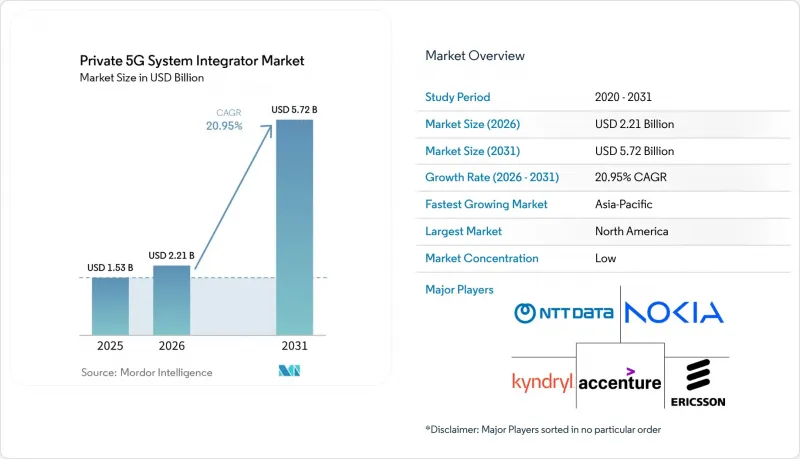
에 따르면 프라이빗 5G 시스템 통합사업자 시장 규모는 2025년에 15억 3,000만 달러로 평가되며, 2026년 22억 1,000만 달러에서 2031년까지 57억 2,000만 달러에 달할 것으로 예측되고 있으며, 2026-2031년 예측 기간의 CAGR은 20.95%에 달할 전망입니다.
전 세계 프라이빗 5G 시스템 통합사업자 시장의 동향 및 인사이트
산업 자동화 및 스마트 팩토리 도입
제조업체들은 이동식 기기, 센서, 생산 시스템을 위해 신뢰할 수 있는 무선 연결을 필요로 하므로 산업 자동화는 수요의 주요 촉진요인이 되고 있습니다. 기업이 단일 거점에서의 시범 운영을 여러 거점에 걸친 프로그램으로 확대할 때, 프라이빗 5G 시스템 통합사업자 시장은 그 혜택을 누리게 됩니다. NTT DATA는 2026년 2월, 자사의 프라이빗 5G 서비스가 미국 및 유럽에 위치한 카길(Cargill)사의 제조·가공 거점 50곳을 커버했다고 발표했습니다. 이러한 프로그램에서는 각 거점의 사이트 설계, 디바이스 연결, 애플리케이션 통합 및 운영 지원이 필요합니다. 또한 구형 공장 설비나 Modbus, OPC UA, Profinet 등의 산업용 프로토콜과의 신중한 연동도 요구됩니다. 이에 따라 산업 및 네트워크 분야의 전문 지식을 갖춘 시스템 통합사업자는 도입 수명주기 전반에 걸쳐 중요한 역할을 담당하게 됩니다.
안전하고 지연 시간이 짧은 미션 크리티컬 연결에 대한 기업의 수요
철도 시설, 광산, 공공 사업, 생산 플랜트를 운영하는 기업은 시간적 제약이 있는 업무를 위해 신뢰성 높은 로컬 연결을 필요로 합니다. ‘프라이빗 5G 시스템 통합사업자 시장’은 무선 시스템을 보안, 디바이스 관리, 로컬 컴퓨팅과 연계함으로써 이러한 요구에 대응하고 있습니다. GlobalLogic과 에릭슨은 2025년 9월, 메릴랜드주에 위치한 히타치 레일의 307,000제곱피트 규모의 디지털 공장에 프라이빗 5G 네트워크를 구축했습니다. 이 프로젝트에는 기술 컨설팅, 구축, OT(운영 기술)와 IT의 통합, 그리고 수명주기관리가 포함되었습니다. 버라이즌은 네트워크 서비스가 사업 운영과 연계됨으로써 프라이빗 무선 기술이 업무 효율 향상에 기여할 수 있다고 보고했습니다. 포괄적인 통합 업체라면 네트워크를 유지 관리하고, 운영 요구 사항의 변화에 따라 네트워크를 유연하게 조정할 수 있습니다.
초기 도입 및 통합 비용의 높음
초기 비용은 특히 고객이 이미 가동중인 Wi-Fi 시스템을 보유하고 있는 경우, 프라이빗 5G 도입 결정을 지연시키는 요인이 될 수 있습니다. 레거시 제어 시스템이 존재하고 맞춤형 통합이나 장기간에 걸친 테스트가 필요한 오래된 산업 시설에서는 이 문제가 더욱 커집니다. 기업은 프로그램을 승인하기 전에 주파수 대역, 장비, 디바이스, 보안, 지원 및 통합에 드는 비용을 평가해야 합니다. 중소기업의 경우 초기 투자 부담이 특히 크게 다가올 수 있습니다. 관리형 서비스나 ‘as-a-service’형 계약을 활용하면, 지출을 운영 요구에 맞춰 조정함으로써 초기 지불 부담을 줄일 수 있습니다. 공급자는 도입 후 지원 비용이 급증하는 설계는 피해야 합니다.
부문 분석
2025년 프라이빗 5G 시스템 통합사업자 시장 규모 중 47.21%를 설치 및 통합 서비스가 차지했습니다. 이 비율은 기업이 프라이빗 네트워크를 구축할 때 필요한 막대한 설계 및 도입 작업을 반영한 것입니다. 이 서비스에는 일반적으로 현장 평가, 무선 설계, 코어 설정, 기기 연결, 테스트 및 검수가 포함됩니다. 또한 도입 시작 전에 고객이 계획이나 아키텍처에 대한 지원을 필요로 하므로 전문 서비스도 여전히 중요합니다. 이러한 서비스는 기업이 레거시 생산 설비를 연결해야 하는 경우에 특히 중요해집니다. 또한 이러한 서비스는 고객이 통신사, 장비 공급업체, 시스템 통합사업자 각각의 책임 범위를 명확히 하는 데에도 도움이 됩니다.
매니지드 서비스는 2031년까지 연평균 성장률(CAGR) 21.87%로 성장할 것으로 예측됩니다. 이러한 변화는 고객이 일회성 납품 모델이 아닌 지속적인 성과 관리에 관심을 두고 있음을 반영합니다. NTT DATA가 카길(Cargill)을 위해 구축한 프라이빗 5G는 2026년 2월까지 50곳의 제조 및 가공 거점을 커버했습니다. 이 회사는 이 프로그램을 여러 업무 시스템 및 운영 시스템을 지원하는 완전한 매니지드 서비스라고 설명하고 있습니다. 서비스 제공업체 입장에서는 재현 가능한 서비스 방식을 통해 거점 간 일관성을 높일 수 있습니다. 고객 입장에서는 매니지드 서비스를 통해 네트워크 가용성 및 지속적인 변경 사항에 대응할 수 있는 단일 창구가 제공됩니다.
2025년 프라이빗 5G 시스템 통합 시장에서는 온프레미스 구축이 시장 점유율의 45.04%를 차지하고 있으며, 운영 데이터 및 네트워크 성능을 엄격하게 관리해야 하는 사용자들로부터 지지를 받고 있습니다. 국방, 공공사업, 석유화학 시설에서는 많은 경우 로컬 시스템을 우선시하는 요구 사항이 있습니다. 또한 로컬 구축은 원격지의 컴퓨팅 리소스로 인한 지연을 허용할 수 없는 애플리케이션에도 대응할 수 있습니다. 이러한 도입 방식에서는 고객이나 통합업체가 스택의 대부분을 현장에서 관리해야 합니다. 이러한 요구 사항으로 인해 숙련된 엔지니어링 및 운영 팀에 대한 필요성이 높아질 수 있습니다.
하이브리드 배포는 2031년까지 연평균 성장률(CAGR) 22.76%로 성장할 것으로 예측됩니다. 이를 통해 기밀성이 높은 기능이나 시간적 제약이 엄격한 기능을 온사이트에서 유지하면서, 분석이나 광범위한 조정에는 클라우드 리소스를 활용할 수 있습니다. 2025년 Mavenir사의 보고서에 따르면 응답자의 48%가 프라이빗 5G를 네트워크 엣지 클라우드 워크로드 중 가장 인기 있는 것으로 꼽았습니다. 이 접근 방식을 통해 기업은 모든 애플리케이션을 원격 클라우드에 배포하지 않고도 여러 거점을 관리할 수 있게 됩니다. 호스팅 서비스는 사내 인프라 보유 수준을 낮게 유지하고자 하는 고객에게 여전히 중요한 선택지입니다. 어느 모델을 선택하든 데이터 경로, 보안 책임 및 서비스 수준을 신중하게 정의해야 합니다.
2025년, 프라이빗 5G 시스템 통합 시장내 라이선스 주파수 대역의 점유율은 48.12%를 차지할 것으로 예상되며, 2031년까지 연평균 성장률(CAGR) 21.87%로 성장할 것으로 전망됩니다. 기업은 예측 가능한 성능과 간섭에 대한 더 강력한 제어가 필요한 경우 라이선스 주파수를 활용합니다. 이는 안전성, 생산 및 실시간 통신이 요구되는 애플리케이션에 중요합니다. 라이선싱 방식의 도입에는 일반적으로 시스템 가동 전에 공식적인 계획과 조정이 필요합니다. 이러한 작업은 시스템 통합사업자에게 프로젝트의 복잡성을 가중시킬 수 있습니다. 또한 규정 준수 및 네트워크 운영을 유지해야 하므로 고객과의 장기적인 관계가 형성될 수도 있습니다.
공유 스펙트럼은 전용 주파수를 확보할 수 없거나 필요로 하지 않는 고객을 위한 대안입니다. 라이선싱에 따른 접속 비용을 부담하지 않으면서도 전용 통신 영역이 필요한 산업 및 의료 현장에서 유용합니다. 비면허 5G는 여전히 이용 범위가 제한적이며, 관리된 실내 환경에 가장 적합합니다. 독일의 지역 주파수 프로그램에서는 2025년 11월까지 484건의 할당이 이루어졌습니다. 이러한 유형의 프레임워크는 기업에 전용 주파수를 확보할 수 있는 보다 명확한 경로를 제공합니다. 또한 지역 규제에 대한 전문 지식이 통합 및 도입 과정에서 중요한 요소가 됩니다.
지역별 분석
2025년, 북미는 프라이빗 5G 시스템 통합사업자 시장의 74.23% 점유율을 차지했습니다. 이 지역은 발달된 CBRS 생태계, 산업 투자, 그리고 공공 부문 사용자의 수요라는 이점을 누리고 있습니다. 미국에는 사설 무선 시스템을 활용할 수 있는 제조, 운송, 국방, 공공사업 거점이 널리 분포되어 있습니다. 캐나다에서도 산업용 사설 5G 도입 사례가 확대되고 있습니다. TERAGO와 에릭슨은 2026년 5월 캐나다 맥마스터 제조 연구소에서 관리형 프라이빗 5G 네트워크를 구축했습니다. 이 도입을 통해 AI를 활용한 자동화, 로봇 공학, 실시간 처리 및 스마트 제조 애플리케이션이 지원되고 있습니다.
아시아태평양은 2031년까지 연평균 성장률(CAGR) 22.67%로 확대될 것으로 예측됩니다. 일본, 한국, 중국, 인도, 호주는 각각 다른 산업 환경과 정책 상황을 통해 수요를 창출하고 있습니다. 한국에서는 4.7 GHz 및 28 GHz 프라이빗 5G 주파수 대역이 통신사업자 이외의 기업에도 개방되어 있습니다. 일본은 국내 5G 생태계를 통해 상호 운용성 향상을 도모하고 있습니다. NTT 이스트는 2026년 3월, 26개사가 참여한 265건의 벤더 간 상호연동 테스트 결과를 발표했습니다. 이러한 노력을 통해 서로 다른 공급업체의 장비를 연결해야 하는 기업의 통합 난이도를 낮출 수 있습니다. 이 지역의 다양성으로 인해 통합 업체는 각국의 상황에 맞춰 제공 모델을 조정해야 합니다.
유럽은 독일의 지역 주파수 체계와 산업 고객 기반을 바탕으로 중요한 위치를 차지하고 있습니다. 2025년 11월까지 독일에서 할당된 484건의 지역 5G 주파수 대역은 캠퍼스 구축을 위한 명확한 기반을 제공하고 있습니다. 영국, 프랑스, 이탈리아, 스페인 역시 여러 국가에 걸친 비즈니스 기회를 제공하지만, 각국의 규제로 인해 현지에서 계획을 수립해야 합니다. 남미, 중동 및 아프리카는 여전히 초기 단계의 비즈니스 기회입니다. 이 지역들의 수요는 광업, 공공사업, 석유 및 가스, 항만 및 스마트 시티 프로그램과 밀접하게 연관되어 있습니다. 주파수 접근성, 전문 기술 및 기업용 사용 사례가 더욱 정착됨에 따라 이 지역들의 사설 5G 시스템 통합사업자 시장에는 추가적인 발전 여지가 있습니다.
기타 혜택:
- 엑셀 형식의 시장 예측(ME) 시트
- 3개월간의 애널리스트 지원
자주 묻는 질문
목차
제1장 서론
- 조사 전제조건과 시장 정의
- 조사 범위
제2장 조사 방법
제3장 개요
제4장 시장 구도
- 시장 개요
- 시장 성장 촉진요인
- 시장 성장 억제요인
- 거시경제 요인이 시장에 미치는 영향
- 업계 밸류체인 분석
- 기술 동향
- 규제 상황
- Porter's Five Forces 분석
제5장 시장 규모와 성장 예측
- 제공별
- 배포 모델별
- 주파수대 할당별
- 주파수대별
- 네트워크 아키텍처별
- 클라우드 모델별
- 기업 규모별
- 산업 분야별
- 지역별
- 북미
- 미국
- 캐나다
- 멕시코
- 남미
- 브라질
- 아르헨티나
- 칠레
- 기타 남미 국가
- 유럽
- 독일
- 영국
- 프랑스
- 이탈리아
- 스페인
- 기타 유럽 국가
- 아시아태평양
- 중국
- 일본
- 인도
- 한국
- 호주
- 기타 아시아태평양 국가
- 중동
- 아랍에미리트
- 사우디아라비아
- 카타르
- 기타 중동 국가
- 아프리카
- 남아프리카공화국
- 이집트
- 나이지리아
- 기타 아프리카 국가
- 북미
제6장 경쟁 구도
- 시장 집중도
- 전략적 동향
- 시장 점유율 분석
- 기업 개요
- Accenture plc
- Cisco Systems, Inc.
- Hewlett Packard Enterprise Company
- International Business Machines Corporation
- Kyndryl Holdings, Inc.
- Nokia Corporation
- Telefonaktiebolaget LM Ericsson
- Huawei Technologies Co., Ltd.
- Samsung Electronics Co., Ltd.
- ZTE Corporation
- NEC Corporation
- Fujitsu Limited
- Siemens AG
- Deutsche Telekom AG
- Orange S.A.
- Vodafone Group Plc
- AT&T Inc.
- Verizon Communications Inc.
- NTT DATA Corporation
- Amazon Web Services, Inc.
- Microsoft Corporation
- Mavenir Systems, Inc.
- Rakuten Symphony Singapore Pte. Ltd.
- Celona, Inc.
- Federated Wireless, Inc.
- Betacom Incorporated
- Boingo Wireless, Inc.
- JMA Wireless, Inc.
- Tech Mahindra Limited
- Capgemini SE
제7장 시장 기회와 향후 전망
KSA 26.10.23According to Mordor Intelligence, the private 5G system integrator market size was valued at USD 1.53 billion in 2025 and is estimated to grow from USD 2.21 billion in 2026 to reach USD 5.72 billion by 2031, at a CAGR of 20.95% during the forecast period 2026-2031.
Global Private 5G System Integrator Market Trends and Insights
Industrial Automation and Smart Factory Rollouts
Industrial automation is a major driver of demand because manufacturers need reliable wireless connectivity for mobile equipment, sensors, and production systems. The Private 5G System Integrator Market benefits when enterprises expand a site pilot into a multi-location program. NTT DATA announced in February 2026 that its private 5G service covered 50 Cargill manufacturing and processing sites in the United States and Europe. Such programs require site design, device connection, application integration, and operational support at every location. They also require careful work with older factory equipment and industrial protocols such as Modbus, OPC UA, and Profinet. This gives integrators with industrial and network expertise a role throughout the deployment lifecycle.
Enterprise Demand for Secure, Low-Latency Mission-Critical Connectivity
Enterprises operating rail facilities, mines, utilities, and production plants need dependable local connectivity for time-sensitive activities. The Private 5G System Integrator Market addresses this need by connecting radio systems with security, device management, and local computing. GlobalLogic and Ericsson deployed a private 5G network at Hitachi Rail's 307,000-square-foot digital factory in Maryland in September 2025. The work included technical consulting, deployment, OT and IT integration, and lifecycle management. Verizon reported that private wireless can support operational efficiency when network services are connected with business operations. Full-scope integrators can maintain the network and adapt it as operational needs change.
High Upfront Deployment and Integration Costs
Upfront costs can delay private 5G decisions, especially when a customer already has a working Wi-Fi system. The challenge is greater at older industrial sites, where legacy controls can require custom integration and extended testing. Enterprises must assess the costs of spectrum, equipment, devices, security, support, and integration before approving a program. Smaller businesses can find the initial commitment particularly difficult. Managed service and as-a-service contracts can reduce the initial payment burden by aligning spending with operating needs. Providers must still avoid designs that become expensive to support after deployment.
Other drivers and restraints analyzed in the detailed report include:
- Cloud-Native 5G Standalone Cores and Edge Platforms
- Local and Shared Spectrum Liberalization
- Fragmented Spectrum Rules and Cross-Border Interoperability
For complete list of drivers and restraints, kindly check the Table Of Contents.
Segment Analysis
Installation and integration services accounted for 47.21% of the Private 5G System Integrator Market size in 2025. This position reflects the substantial design and deployment work required as enterprises build private networks. The service typically includes site assessment, radio design, core setup, device connection, testing, and acceptance. Professional services also remain important because customers need planning and architecture support before deployment begins. These services are particularly relevant where an enterprise must connect legacy production equipment. They also help customers define the responsibilities of the operator, equipment supplier, and systems integrator.
Managed services are projected to grow at a 21.87% CAGR through 2031. The shift reflects customer interest in continuous performance management rather than a one-time delivery model. NTT DATA's private 5G deployment for Cargill covered 50 manufacturing and processing sites by February 2026. The company described the program as a fully managed service supporting several business and operational systems. For providers, repeatable service methods can improve consistency across locations. For customers, managed delivery can provide a single point of contact responsible for network availability and ongoing changes.
On-premises deployment accounted for 45.04% of the Private 5G System Integrator Market share in 2025, and it is favored by users who need close control over operational data and network performance. Defense, utilities, and petrochemical facilities often have requirements that favor local systems. Local deployment can also support applications that cannot accept delays from distant computing resources. These installations require the customer or integrator to manage a larger portion of the stack on-site. That requirement can increase the need for experienced engineering and operations teams.
Hybrid deployment is projected to grow at a 22.76% CAGR through 2031. It can keep sensitive and time-critical functions on-site while using cloud resources for analytics and broader coordination. In 2025, Mavenir reported that 48% of respondents identified private 5G as the most popular network edge cloud workload. This approach can help enterprises manage multiple sites without deploying every application to a remote cloud. Hosted services remain relevant for customers who prefer lower levels of internal infrastructure ownership. Each model requires careful definition of data paths, security responsibilities, and service levels.
Licensed spectrum accounted for 48.12% of the Private 5G System Integrator Market share in 2025, and it is expected to grow at a CAGR of 21.87% by 2031. Enterprises use licensed frequencies when they need predictable performance and stronger control over interference, which is important for applications with safety, production, and real-time communication requirements. Licensed deployments usually involve formal planning and coordination before the system becomes operational. That work can increase project complexity for the integrator. It can also support longer customer engagements because compliance and network operations must be maintained.
Shared spectrum provides an alternative for customers who cannot obtain dedicated frequencies or do not need them. It can be useful in industrial and healthcare settings that need private coverage without the cost of licensed access. Unlicensed 5G remains more limited and is best suited to controlled indoor environments. Germany's local spectrum program had issued 484 allocations by November 2025. This type of framework provides enterprises with a clearer path to dedicated spectrum. It also makes local regulatory expertise an important part of integration and delivery.
Complete Report Scope:
- By Offering
- Professional Services
- Installation and Integration Services
- Managed Services
- By Deployment Model
- On-Premise
- Hybrid
- Hosted
- By Spectrum Allocation
- Licensed Spectrum
- Shared Spectrum
- Unlicensed Spectrum
- By Frequency Band
- Low Band
- Mid Band
- mmWave
- By Network Architecture
- Standalone
- Non-Standalone
- By Cloud Model
- Private or Dedicated Cloud
- Public Cloud
- Hybrid Cloud
- By Enterprise Size
- Large Enterprises
- Small and Medium Enterprises
- By Industry Vertical
- Manufacturing and Factories
- Automotive
- Energy and Utilities
- Transportation and Logistics
- Mining and Oil and Gas
- Agriculture
- Media and Entertainment
- IT and Telecommunications
- Other Industry Verticals
- By Geography
- North America
- United States
- Canada
- Mexico
- South America
- Brazil
- Argentina
- Chile
- Rest of South America
- Europe
- Germany
- United Kingdom
- France
- Italy
- Spain
- Rest of Europe
- Asia-Pacific
- China
- Japan
- India
- South Korea
- Australia
- Rest of Asia-Pacific
- Middle East
- United Arab Emirates
- Saudi Arabia
- Qatar
- Rest of Middle East
- Africa
- South Africa
- Egypt
- Nigeria
- Rest of Africa
- North America
Geography Analysis
North America held 74.23% of the Private 5G System Integrator Market share in 2025. The region benefits from a developed CBRS ecosystem, industrial investment, and demand from public-sector users. The United States has a broad base of manufacturing, transport, defense, and utility sites that can use private wireless systems. Canada is also developing industrial private 5G references. TERAGO and Ericsson launched a managed private 5G network at McMaster Manufacturing Research Institute in Canada in May 2026. The deployment supports AI-driven automation, robotics, real-time processing, and smart manufacturing applications.
Asia-Pacific is projected to expand at a 22.67% CAGR through 2031. Japan, South Korea, China, India, and Australia each provide demand through different industrial and policy conditions. South Korea has opened the 4.7 GHz and 28 GHz private 5G frequency bands to non-operator enterprises. Japan is building greater interoperability through its local 5G ecosystem. NTT EAST published results from 265 cross-vendor interconnection tests involving 26 participating companies in March 2026. This work can reduce integration difficulty for enterprises that need to connect equipment from different suppliers. The region's diversity means integrators must adjust their delivery model to each country.
Europe holds a significant position due to Germany's local spectrum framework and its industrial customer base. Germany's 484 local 5G spectrum allocations by November 2025 provide a clear foundation for campus deployments. The United Kingdom, France, Italy, and Spain also offer multi-country opportunities, but their national rules require local planning. South America, the Middle East, and Africa remain earlier-stage opportunities. Their demand is tied to mining, utilities, oil and gas, ports, and smart city programs. The Private 5G System Integrator Market has room to develop in these regions as spectrum access, skills, and enterprise use cases become more established.
- Accenture plc
- Cisco Systems, Inc.
- Hewlett Packard Enterprise Company
- International Business Machines Corporation
- Kyndryl Holdings, Inc.
- Nokia Corporation
- Telefonaktiebolaget LM Ericsson
- Huawei Technologies Co., Ltd.
- Samsung Electronics Co., Ltd.
- ZTE Corporation
- NEC Corporation
- Fujitsu Limited
- Siemens AG
- Deutsche Telekom AG
- Orange S.A.
- Vodafone Group Plc
- AT&T Inc.
- Verizon Communications Inc.
- NTT DATA Corporation
- Amazon Web Services, Inc.
- Microsoft Corporation
- Mavenir Systems, Inc.
- Rakuten Symphony Singapore Pte. Ltd.
- Celona, Inc.
- Federated Wireless, Inc.
- Betacom Incorporated
- Boingo Wireless, Inc.
- JMA Wireless, Inc.
- Tech Mahindra Limited
- Capgemini SE
Additional Benefits:
- The market estimate (ME) sheet in Excel format
- 3 months of analyst support
TABLE OF CONTENTS
1 INTRODUCTION
- 1.1 Study Assumptions and Market Definition
- 1.2 Scope of the Study
2 RESEARCH METHODOLOGY
3 EXECUTIVE SUMMARY
4 MARKET LANDSCAPE
- 4.1 Market Overview
- 4.2 Market Drivers
- 4.2.1 Industrial Automation and Smart Factory Rollouts
- 4.2.2 Enterprise Demand for Secure, Low-Latency Mission-Critical Connectivity
- 4.2.3 Liberalization of Local and Shared Spectrum
- 4.2.4 Falling Prices of Industrial 5G Modules and Small Cells
- 4.2.5 Cloud-Native 5G Standalone Cores and Edge Platforms
- 4.2.6 Multi-Site Brownfield Integration Requirements
- 4.3 Market Restraints
- 4.3.1 Fragmented Spectrum Rules and Cross-Border Interoperability
- 4.3.2 High Upfront Deployment and Integration Costs
- 4.3.3 Shortage of Spectrum Engineering and Core Orchestration Skills
- 4.3.4 Unclear Return on Investment for Brownfield Retrofits
- 4.4 Impact of Macroeconomic Factors on the Market
- 4.5 Industry Value-Chain Analysis
- 4.6 Technology Outlook
- 4.7 Regulatory Landscape
- 4.8 Porter's Five Forces Analysis
- 4.8.1 Threat of New Entrants
- 4.8.2 Bargaining Power of Suppliers
- 4.8.3 Bargaining Power of Buyers
- 4.8.4 Threat of Substitutes
- 4.8.5 Intensity of Competitive Rivalry
5 MARKET SIZE AND GROWTH FORECASTS (VALUE)
- 5.1 By Offering
- 5.1.1 Professional Services
- 5.1.2 Installation and Integration Services
- 5.1.3 Managed Services
- 5.2 By Deployment Model
- 5.2.1 On-Premise
- 5.2.2 Hybrid
- 5.2.3 Hosted
- 5.3 By Spectrum Allocation
- 5.3.1 Licensed Spectrum
- 5.3.2 Shared Spectrum
- 5.3.3 Unlicensed Spectrum
- 5.4 By Frequency Band
- 5.4.1 Low Band
- 5.4.2 Mid Band
- 5.4.3 mmWave
- 5.5 By Network Architecture
- 5.5.1 Standalone
- 5.5.2 Non-Standalone
- 5.6 By Cloud Model
- 5.6.1 Private or Dedicated Cloud
- 5.6.2 Public Cloud
- 5.6.3 Hybrid Cloud
- 5.7 By Enterprise Size
- 5.7.1 Large Enterprises
- 5.7.2 Small and Medium Enterprises
- 5.8 By Industry Vertical
- 5.8.1 Manufacturing and Factories
- 5.8.2 Automotive
- 5.8.3 Energy and Utilities
- 5.8.4 Transportation and Logistics
- 5.8.5 Mining and Oil and Gas
- 5.8.6 Agriculture
- 5.8.7 Media and Entertainment
- 5.8.8 IT and Telecommunications
- 5.8.9 Other Industry Verticals
- 5.9 By Geography
- 5.9.1 North America
- 5.9.1.1 United States
- 5.9.1.2 Canada
- 5.9.1.3 Mexico
- 5.9.2 South America
- 5.9.2.1 Brazil
- 5.9.2.2 Argentina
- 5.9.2.3 Chile
- 5.9.2.4 Rest of South America
- 5.9.3 Europe
- 5.9.3.1 Germany
- 5.9.3.2 United Kingdom
- 5.9.3.3 France
- 5.9.3.4 Italy
- 5.9.3.5 Spain
- 5.9.3.6 Rest of Europe
- 5.9.4 Asia-Pacific
- 5.9.4.1 China
- 5.9.4.2 Japan
- 5.9.4.3 India
- 5.9.4.4 South Korea
- 5.9.4.5 Australia
- 5.9.4.6 Rest of Asia-Pacific
- 5.9.5 Middle East
- 5.9.5.1 United Arab Emirates
- 5.9.5.2 Saudi Arabia
- 5.9.5.3 Qatar
- 5.9.5.4 Rest of Middle East
- 5.9.6 Africa
- 5.9.6.1 South Africa
- 5.9.6.2 Egypt
- 5.9.6.3 Nigeria
- 5.9.6.4 Rest of Africa
- 5.9.1 North America
6 COMPETITIVE LANDSCAPE
- 6.1 Market Concentration
- 6.2 Strategic Moves
- 6.3 Market Share Analysis
- 6.4 Company Profiles (includes Global Level Overview, Market Level Overview, Core Segments, Financials as available, Strategic Information, Market Rank/Share, Products and Services, Recent Developments)
- 6.4.1 Accenture plc
- 6.4.2 Cisco Systems, Inc.
- 6.4.3 Hewlett Packard Enterprise Company
- 6.4.4 International Business Machines Corporation
- 6.4.5 Kyndryl Holdings, Inc.
- 6.4.6 Nokia Corporation
- 6.4.7 Telefonaktiebolaget LM Ericsson
- 6.4.8 Huawei Technologies Co., Ltd.
- 6.4.9 Samsung Electronics Co., Ltd.
- 6.4.10 ZTE Corporation
- 6.4.11 NEC Corporation
- 6.4.12 Fujitsu Limited
- 6.4.13 Siemens AG
- 6.4.14 Deutsche Telekom AG
- 6.4.15 Orange S.A.
- 6.4.16 Vodafone Group Plc
- 6.4.17 AT&T Inc.
- 6.4.18 Verizon Communications Inc.
- 6.4.19 NTT DATA Corporation
- 6.4.20 Amazon Web Services, Inc.
- 6.4.21 Microsoft Corporation
- 6.4.22 Mavenir Systems, Inc.
- 6.4.23 Rakuten Symphony Singapore Pte. Ltd.
- 6.4.24 Celona, Inc.
- 6.4.25 Federated Wireless, Inc.
- 6.4.26 Betacom Incorporated
- 6.4.27 Boingo Wireless, Inc.
- 6.4.28 JMA Wireless, Inc.
- 6.4.29 Tech Mahindra Limited
- 6.4.30 Capgemini SE
7 MARKET OPPORTUNITIES AND FUTURE OUTLOOK
- 7.1 White-Space and Unmet-Need Assessment


