

|
시장보고서
상품코드
2155666
오픈 RAN 시스템 통합사업자 : 시장 점유율 분석, 업계 동향과 통계, 성장 예측(2026-2031년)Open RAN System Integrator - Market Share Analysis, Industry Trends & Statistics, Growth Forecasts (2026 - 2031) |
||||||
 Mordor Intelligence
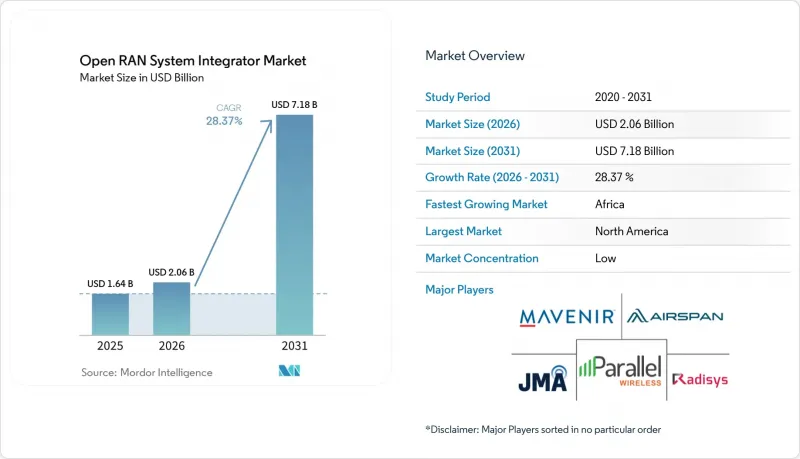
에 따르면 오픈 RAN 시스템 통합사업자 시장 규모는 2025년에 16억 4,000만 달러, 2026년에 20억 6,000만 달러에 달하고, 2031년까지 71억 8,000만 달러에 달할 것으로 예측되며, 2026년부터 2031년까지 CAGR 28.37%로 성장할 것으로 전망됩니다.
세계 오픈 RAN 시스템 통합업체 시장의 동향 및 인사이트
5G 독립형(SA) 및 클라우드 네이티브 RAN 도입
5G 독립형 아키텍처는 오픈 RAN 시스템 통합업체 시장의 주요 상업적 기반을 형성하고 있습니다. 이를 통해 통신 사업자는 클라우드 네이티브 오케스트레이션을 활용하여 중앙 집중형 유닛, 분산형 유닛 및 무선 유닛을 분리할 수 있게 됩니다. 따라서 통합의 범위는 무선 시운전에 그치지 않고, 프론트홀 타이밍 조정, O-Cloud 라이프사이클 관리, 네트워크 슬라이스 자동 구성까지 미칩니다. 이러한 작업은 폐쇄적인 단일 벤더의 도구로는 관리하기 어렵습니다. 5G 부문은 2025년 매출의 78.26%를 차지하며, 2031년까지 연평균 31.63%의 성장률을 보일 것으로 예측됩니다. 라쿠텐 모바일은 일본에서 완전히 가상화된 클라우드 네이티브 Open RAN 네트워크를 운영하고 있으며, 이러한 접근 방식이 전국 규모의 확장을 지원할 수 있음을 보여주고 있습니다.
다중 벤더 간 상호 운용성 요구 사항
현재 통신 사업자가 Open RAN 시스템 통합업체 시장에서 상용 구매 결정을 내리기 전에, 다중 벤더 간 상호 운용성은 실질적인 필수 요건이 되었습니다. O-RAN 얼라이언스는 2025년 3월부터 8월까지 신규 또는 갱신된 기술 문서 60건을 공개하여, 현행 버전의 문서 수는 134건으로 증가했습니다. 이 문서들은 O-RU, O-DU 및 Near-RT RIC의 적합성 평가 영역을 포괄하고 있습니다. ATIS는 2025년 2월, Open RAN Minimum Viable Profile을 확장하여 프론트홀 제어, 사용자, 동기화 및 관리 플레인 인터페이스 요구 사항을 추가했습니다. 사전에 검증된 조합을 제공할 수 있는 통합업체는 통신 사업자의 테스트 작업을 경감시키고, 납품에 대한 책임을 더 많이 떠안아 줄 수 있습니다. Open Testing and Integration Centre(OTIC) 프레임워크는 구성요소 및 상호 운용성 검증을 위한 공식 절차를 제공하므로 조달 과정에서 그 중요성이 커지고 있습니다.
통합의 복잡성과 도입 기간의 장기화
통합의 복잡성은 Open RAN 시스템 통합업체 시장에서 중대한 제약요인으로 작용하고 있습니다. 멀티 벤더 시스템에서는 O-RU와 O-DU 간의 오픈 프론트홀 링크, F1 및 E1 인터페이스, 그리고 O2 클라우드 인프라 인터페이스를 조정해야 합니다. 각 인터페이스는 단일 벤더 RAN에는 존재하지 않는 장애 모드를 유발할 가능성이 있습니다. NTIA의 통신과학연구소(TRI)는 2025년에 3개의 상용 Open RAN 시스템을 CRAIN 연구소에 통합하여, 타이머 설정, 메시지 처리 및 표준 버전 불일치와 관련된 상호 운용성 문제를 보고했습니다. 자료에 따르면, 통합 및 지원에 소요되는 오버헤드로 인해 프로젝트의 5년간 비용이 10%에서 20%까지 증가할 가능성이 있다고 합니다. 통신 사업자가 사내에 강력한 기술 팀을 보유하고 있는 경우, 통합 작업의 상당 부분을 자체적으로 수행할 수도 있지만, 공급업체의 책임 범위가 불분명한 경우 도입이 더욱 지연될 가능성이 있습니다.
부문 분석
2025년 매출 중 서비스가 68.91%를 차지하며, Open RAN 시스템 통합업체 시장에서 가장 큰 점유율을 기록했습니다. 멀티벤더 네트워크에서는 프로젝트의 전체 수명주기에 걸쳐 통합, 테스트, 최적화 및 운영 관리가 필요합니다. Digital Catapult의 보고서에 따르면, 2026년 봄 Plugfest에서 진행된 활동의 70%에서 80%는 공식 테스트 시작 전의 멀티벤더 통합 및 검증과 관련된 것이었습니다. 이러한 업무량은 단기적인 시운전 단계라기보다는 장기적인 서비스 계약을 뒷받침하는 것입니다. 클라우드 네이티브 설계로 인해 상용 기성(COTS) 서버 인프라에 RAN 워크로드가 더 많이 할당됨에 따라 하드웨어 부문은 압박을 받고 있습니다. 따라서 통합업체들은 하드웨어에 의존하지 않는 자동화 및 라이프사이클 서비스에 더욱 중점을 두게 될 것입니다.
소프트웨어 시장은 2031년까지 연평균 성장률(CAGR) 30.46%로 성장할 것으로 예상되며, 이는 구성요소 중 가장 높은 성장률입니다. AI 네이티브 SMO 플랫폼, 준실시간(Near-RT) RIC xApps 및 rApp 라이브러리는 상용 네트워크에서 가동하기 전에 전문적인 통합이 필요합니다. 소프트웨어의 현재 수익 기반은 서비스 부문보다 작지만, 플랫폼이 대규모로 배포되면 지속적인 라이선스 수익을 뒷받침할 수 있습니다. 이 때문에 각 통합업체들은 타사 도구의 도입에만 의존하지 않고, 독자적인 자동화 라이브러리 개발을 추진하고 있습니다. O-RAN 소프트웨어 커뮤니티는 2025년 7월, 비실시간 RIC 및 SMO 배포를 위한 통합 청사진을 포함한 ‘L’ 버전을 출시했습니다. 이번 출시로 인해 Open RAN 시스템 통합업체 업계에서 소프트웨어 계층의 기능을 구축하는 기업들의 진입 장벽이 낮아졌습니다.
2025년 매출 중 5G가 78.26%를 차지하며, Open RAN 시스템 통합업체 시장에서 주도적인 위치를 차지했습니다. 스탠드얼론형 5G에는 O-RU, O-DU, O-CU, 준실시간 RIC, SMO 및 O-Cloud에 걸친 협업이 필요합니다. 각 계층마다 테스트, 인증 및 라이프사이클 관리가 필요합니다. 라쿠텐 모바일은 최근 일본 국내에 다수의 첨단 매시브 MIMO O-RAN 무선 장비를 구축할 계획을 발표했습니다. 이 구축은 고밀도 도시 지역의 처리량 향상을 목적으로 합니다. 이러한 멀티 노드 구축에는 도입의 각 단계에서 시스템 통합이 요구됩니다.
LTE 부문은 특히 LTE 가입자 기반이 큰 신흥 시장에서 브라운필드 오버레이 프로젝트에 여전히 중요한 역할을 하고 있습니다. 그 외의 네트워크 세대는 점유율이 작으며, 사하라 이남 아프리카나 남미 일부 지역의 레거시 오버레이 사용 사례와 관련이 있습니다. LTE와 차세대 독립형 시스템을 결합한 프로젝트는 단일 세대 프로젝트보다 계약 범위가 더 넓어질 가능성이 있습니다. Mavenir사와 Parallel Wireless사는 최근 Mavenir사의 Converged Packet Core를 활용한 다세대 지원 GreenRAN 스택에 대한 상호 운용성 테스트를 완료했습니다.
지역별 분석
2025년, 북미는 전 세계 매출의 41.03%를 차지하며 Open RAN 시스템 통합업체 중 가장 큰 점유율을 기록했습니다. 이 지역에는 미국의 ‘공공 무선 공급망 혁신 기금(Public Wireless Supply Chain Innovation Fund)’과 ATIS의 ‘최소 실행 가능 프로파일(MVP)’ 요건에 의해 형성된 활발한 정책 및 표준화 환경이 조성되어 있습니다. ATIS는 2025년에 프로파일을 확장하여 북미 이동통신 사업자(MNO)를 위한 프론트홀 인터페이스 요구 사항을 정의했습니다. ATIS에 의한 브라운필드 환경에서의 비실시간 RIC 도입과 TELUS에 의한 전국 규모의 무선 시스템 전환은 소프트웨어 기반 자동화 및 네트워크 교체를 위한 좋은 기회가 되고 있습니다. NTIA는 2026년, AI 네이티브 RAN 아키텍처를 위한 최대 5,300만 달러의 자금 배분 방침에 대해 의견을 수렴하고 있습니다. 멕시코의 5G 주파수 대역 전개와 캐나다의 5G 전환 또한 이 지역에 더 많은 비즈니스 기회를 가져다주고 있습니다.
유럽에는 실적이 검증된 공급업체들이 구축한 상용 생태계가 존재하는 반면, 아시아태평양은 Open RAN 시스템 통합업체 시장에서 여전히 중심적인 위치를 차지하고 있으며, 일본이 그 대표적인 사례입니다. SONIC Labs 프로그램은 2026년 4월에 종료되었으며, 참여한 27개 벤더 중 72%가 상용 파트너십을 체결했고, 85%가 신제품 개발에 착수했습니다. 독일, 영국, 프랑스는 유럽 내에서 통신 사업자들의 시범 운영이 활발히 진행되고 있는 지역입니다. 라쿠텐 모바일은 가상화된 클라우드 네이티브 Open RAN 네트워크 운영을 지속하고 있으며, 2026년에는 일본 국내에서 용량을 확대했습니다. 라쿠텐 심포니는 2026년 5월부터 2029년 3월까지 경제산업성(METI)의 지원을 받아 세계 사우스 7개국을 대상으로 80억 엔(5,020만 달러) 규모의 시험을 실시하고 있습니다. 인도에는 대규모 Open RAN 도입에 전념하고 있는 통신 사업자 그룹이 없기 때문에 계속해서 장기적인 기회가 되고 있습니다.
아프리카는 2031년까지 연평균 성장률(CAGR) 31.28%로 성장할 것으로 예측되며, 이는 지역별로는 가장 높은 성장률입니다. 인프라 비용 부담, RAN 공유 계약, 그리고 국제적인 자금 지원이 이 지역의 Open RAN 시스템 통합업체 시장을 뒷받침하고 있습니다. MTN 그룹과 에어텔 아프리카는 2025년 3월 우간다와 나이지리아에서 RAN 및 광섬유 공유에 관한 협정을 공식적으로 체결했으며, 콩고(브라자빌), 르완다, 잠비아로의 확대도 검토되고 있습니다. Telkom Kenya, Rakuten Symphony, Airspan Networks 등 3개사는 2025년 1월, 미국 및 일본 정부로부터 440만 달러의 보조금을 지원받아 Open RAN 실증 실험 시설 및 현장 시험에 관한 양해각서에 서명했습니다. 남미에서는 브라질의 5G 독립형(SA) 구축과 볼리비아 및 파라과이에서의 시험 실시가 시장을 견인하고 있습니다. 중동에서는 Zain Kuwait와 Rakuten Symphony가 진행하는 시범 사업을 통해 초기 단계의 노력이 추진되고 있습니다.
기타 혜택:
- 엑셀 형식의 시장 예측(ME) 시트
- 3개월간의 애널리스트 지원
자주 묻는 질문
목차
제1장 소개
- 조사 가정과 시장 정의
- 조사 범위
제2장 조사 방법
제3장 주요 요약
제4장 시장 구도
- 시장 개요
- 시장 성장 촉진요인
- 시장 성장 억제요인
- 거시경제 요인이 시장에 미치는 영향
- 업계 밸류체인 분석
- 규제 상황
- 기술 전망
- Porter's Five Forces 분석
제5장 시장 규모와 성장 예측
- 구성요소별
- 네트워크 제너레이션별
- 전개별
- 최종사용자별
- 지역별
- 북미
- 미국
- 캐나다
- 멕시코
- 남미
- 브라질
- 아르헨티나
- 기타 남미 국가
- 유럽
- 독일
- 영국
- 프랑스
- 이탈리아
- 스페인
- 러시아
- 기타 유럽 국가
- 아시아태평양
- 중국
- 일본
- 인도
- 한국
- 기타 아시아태평양 국가
- 중동
- 사우디아라비아
- 아랍에미리트
- 튀르키예
- 기타 중동 국가
- 아프리카
- 남아프리카공화국
- 나이지리아
- 이집트
- 기타 아프리카 국가
- 북미
제6장 경쟁 구도
- 시장 집중도
- 전략적 동향
- 시장 점유율 분석
- 기업 개요
- Mavenir Systems, Inc.
- Parallel Wireless, Inc.
- Airspan Networks Holdings Inc.
- Radisys Corporation
- JMA Wireless, Inc.
- Baicells Technologies Co., Ltd.
- ASOCS Ltd.
- Amarisoft SA
- Cisco Systems, Inc.
- Cohere Technologies, Inc.
- DeepSig, Inc.
- Dell Technologies Inc.
- Rimedo Labs Sp. z o.o.
- IS-Wireless Sp. z o.o.
- Druid Software Limited
- Qualcomm Incorporated
- Intel Corporation
제7장 시장 기회와 향후 전망
KSM 26.10.30According to Mordor Intelligence, the open RAN system integrator market size is projected to be USD 1.64 billion in 2025, USD 2.06 billion in 2026, and reach USD 7.18 billion by 2031, growing at a CAGR of 28.37% from 2026 to 2031.
Global Open RAN System Integrator Market Trends and Insights
5G Standalone and Cloud-Native RAN Rollouts
5G standalone architecture is creating the main commercial setting for the Open RAN system integrator market. It allows operators to separate the centralized, distributed, and radio units using cloud-native orchestration. Integration, therefore, extends beyond radio commissioning to fronthaul timing, O-Cloud lifecycle management, and automated network slice configuration. These tasks are harder to manage through closed, single-vendor tools. The 5G segment held 78.26% of 2025 revenue and is projected to grow at 31.63% through 2031. Rakuten Mobile operates a fully virtualized, cloud-native Open RAN network in Japan, showing that the approach can support national-scale deployment.
Multi-Vendor Interoperability Requirements
Multi-vendor interoperability is now a practical requirement before operators make commercial purchasing decisions in the Open RAN system integrator market. The O-RAN Alliance released 60 new or updated technical documents between March and August 2025, increasing the number of current-version titles to 134. These documents cover conformance areas for the O-RU, O-DU, and Near-RT RIC. ATIS expanded its Open RAN Minimum Viable Profile in February 2025 to include fronthaul control, user, synchronization, and management-plane interface requirements. Integrators that can provide pre-validated combinations can reduce operator testing work and take on more delivery responsibility. The Open Testing and Integration Centre framework is becoming relevant in procurement because it provides a formal route for component and interoperability validation.
Integration Complexity and Extended Deployment Timelines
Integration complexity is a material constraint on the Open RAN system integrator market. Multi-vendor systems must coordinate the open fronthaul link between the O-RU and O-DU, the F1 and E1 interfaces, and the O2 cloud infrastructure interface. Each interface can introduce a failure mode that is not present in a single-vendor RAN. NTIA's Institute for Telecommunication Sciences integrated 3 commercial Open RAN systems into its CRAIN Laboratory in 2025 and reported interoperability issues involving timer configuration, message handling, and standards-version mismatches. The source material noted that projects can face 10% to 20% higher 5-year costs after integration and support overhead. When operators have strong internal technical teams, they may retain more integration work, while unclear supplier accountability can further delay deployment.
Other drivers and restraints analyzed in the detailed report include:
- Government Funding for Open and Secure Telecom Supply Chains
- Operator Demand for Vendor-Independent SMO and Automation
- Shortage of Carrier-Grade Open RAN Integration Skills
For complete list of drivers and restraints, kindly check the Table Of Contents.
Segment Analysis
Services accounted for 68.91% of 2025 revenue, giving them the largest position in the Open RAN system integrator market. Multi-vendor networks require integration, testing, optimization, and managed operations across the full project lifecycle. Digital Catapult reported that 70% to 80% of activity at its Spring 2026 Plugfest related to multi-vendor integration and validation before formal testing began. This workload supports extended service engagements rather than a short commissioning phase. Hardware is under pressure as cloud-native designs place more RAN workloads on commercial off-the-shelf server infrastructure. Integrators are therefore likely to place more emphasis on hardware-agnostic automation and lifecycle services.
Software is projected to grow at a CAGR of 30.46% through 2031, the fastest rate within the component structure. AI-native SMO platforms, Near-RT RIC xApps, and rApp libraries require specialized integration before they can operate in commercial networks. Software has a smaller current revenue base than services, but it can support recurring license revenue when platforms are deployed at scale. This is encouraging integrators to develop proprietary automation libraries rather than solely deploying third-party tools. The O-RAN Software Community released its L version in July 2025 with an integrated blueprint for non-real-time RIC and SMO deployment. The release lowered entry barriers for firms building software-layer capabilities in the Open RAN system integrator industry.
5G represented 78.26% of 2025 revenue and accounted for the leading position in the Open RAN system integrator market. Standalone 5G requires coordinated work across the O-RU, O-DU, O-CU, Near-RT RIC, SMO, and O-Cloud. Each layer needs testing, certification, and lifecycle management. Rakuten Mobile recently announced plans to deploy a large number of advanced massive MIMO O-RAN radios in Japan. The deployment aims to improve throughput in high-density urban areas. Such multi-node deployments require systems integration at each stage of rollout.
The LTE segment remains relevant for brownfield overlay projects, especially in emerging markets with large LTE subscriber bases. Other network generations account for a smaller share and are associated with legacy overlay use cases in sub-Saharan Africa and parts of South America. Work that combines LTE and next-generation standalone systems can have a greater contract scope than a single-generation project. Mavenir and Parallel Wireless recently completed interoperability testing for a multi-generation GreenRAN stack with Mavenir's Converged Packet Core.
Complete Report Scope:
- By Component
- Hardware
- Software
- Services
- By Network Generation
- 4G/LTE
- 5G
- Other Network Generations
- By Deployment
- Public Macrocell
- Private and Enterprise Network
- Indoor Small Cell and DAS
- By End User
- Mobile Network Operators
- Neutral-Host Providers
- Enterprises and Industry Verticals
- Government and Defense
- By Geography
- North America
- United States
- Canada
- Mexico
- South America
- Brazil
- Argentina
- Rest of South America
- Europe
- Germany
- United Kingdom
- France
- Italy
- Spain
- Russia
- Rest of Europe
- Asia-Pacific
- China
- Japan
- India
- South Korea
- Rest of Asia-Pacific
- Middle East
- Saudi Arabia
- United Arab Emirates
- Turkey
- Rest of Middle East
- Africa
- South Africa
- Nigeria
- Egypt
- Rest of Africa
- North America
Geography Analysis
North America accounted for 41.03% of global revenue in 2025, the largest share among Open RAN system integrators. The region has an active policy and standards environment shaped by the U.S. Public Wireless Supply Chain Innovation Fund and ATIS Minimum Viable Profile requirements. ATIS expanded its profile in 2025 to define fronthaul interface requirements for North American MNOs. AT&T's brownfield, non-real-time RIC deployment and TELUS's national radio transition represent opportunities for software automation and network replacement. NTIA is seeking feedback in 2026 on a direction of up to USD 53 million for AI-native RAN architecture. Mexico's 5G spectrum rollout and Canada's transition to 5G provide additional regional pipeline opportunities.
Europe has a commercial ecosystem of validated suppliers, while Asia-Pacific remains central to the Open RAN system integrator market, with Japan as a leading example. The SONIC Labs program ended in April 2026, with 72% of 27 participating vendors securing commercial partnerships and 85% initiating new product development. Germany, the UK, and France are active European locations for operator trials. Rakuten Mobile continues to operate a virtualized cloud-native Open RAN network and expanded capacity in Japan during 2026. Rakuten Symphony is running a JPY 8 billion (USD 50.2 million), METI-backed trial across 7 Global South countries from May 2026 to March 2029. India remains a long-term opportunity because no operator circle has committed to Open RAN at scale.
Africa is projected to grow at a CAGR of 31.28% through 2031, the fastest rate among geographic areas. Infrastructure cost pressure, RAN-sharing agreements, and international funding support the Open RAN system integrator market in the region. MTN Group and Airtel Africa formalized RAN and fiber-sharing agreements in Uganda and Nigeria in March 2025, with expansion considered for Congo-Brazzaville, Rwanda, and Zambia. Telkom Kenya, Rakuten Symphony, and Airspan Networks signed a January 2025 memorandum for an Open RAN laboratory and field trials, backed by a USD 4.4 million U.S. and Japanese government grant. South America is supported by Brazil's 5G standalone activity and trial locations in Bolivia and Paraguay. The Middle East has early activity through Zain Kuwait's pilot with Rakuten Symphony.
- Mavenir Systems, Inc.
- Parallel Wireless, Inc.
- Airspan Networks Holdings Inc.
- Radisys Corporation
- JMA Wireless, Inc.
- Baicells Technologies Co., Ltd.
- ASOCS Ltd.
- Amarisoft SA
- Cisco Systems, Inc.
- Cohere Technologies, Inc.
- DeepSig, Inc.
- Dell Technologies Inc.
- Rimedo Labs Sp. z o.o.
- IS-Wireless Sp. z o.o.
- Druid Software Limited
- Qualcomm Incorporated
- Intel Corporation
Additional Benefits:
- The market estimate (ME) sheet in Excel format
- 3 months of analyst support
TABLE OF CONTENTS
1 INTRODUCTION
- 1.1 Study Assumptions and Market Definition
- 1.2 Scope of the Study
2 RESEARCH METHODOLOGY
3 EXECUTIVE SUMMARY
4 MARKET LANDSCAPE
- 4.1 Market Overview
- 4.2 Market Drivers
- 4.2.1 5G Standalone and Cloud-Native RAN Rollouts
- 4.2.2 Multi-Vendor Interoperability Requirements
- 4.2.3 Government Funding for Open and Secure Telecom Supply Chains
- 4.2.4 Private 5G and Neutral-Host Network Expansion
- 4.2.5 Open RAN Lab-to-Field Validation Becoming a Procurement Gate
- 4.2.6 Operator Demand for Vendor-Independent SMO and Automation
- 4.3 Market Restraints
- 4.3.1 Integration Complexity and Extended Deployment Timelines
- 4.3.2 Shortage of Carrier-Grade Open RAN Integration Skills
- 4.3.3 Uneven Multi-Vendor Performance and Accountability Boundaries
- 4.3.4 Fragmented Commercial Support and Certification Responsibilities
- 4.4 Impact of Macroeconomic Factors on the Market
- 4.5 Industry Value Chain Analysis
- 4.6 Regulatory Landscape
- 4.7 Technological Outlook
- 4.8 Porter's Five Forces Analysis
- 4.8.1 Bargaining Power of Suppliers
- 4.8.2 Bargaining Power of Buyers
- 4.8.3 Threat of New Entrants
- 4.8.4 Threat of Substitutes
- 4.8.5 Competitive Rivalry
5 MARKET SIZE AND GROWTH FORECASTS (VALUE)
- 5.1 By Component
- 5.1.1 Hardware
- 5.1.2 Software
- 5.1.3 Services
- 5.2 By Network Generation
- 5.2.1 4G/LTE
- 5.2.2 5G
- 5.2.3 Other Network Generations
- 5.3 By Deployment
- 5.3.1 Public Macrocell
- 5.3.2 Private and Enterprise Network
- 5.3.3 Indoor Small Cell and DAS
- 5.4 By End User
- 5.4.1 Mobile Network Operators
- 5.4.2 Neutral-Host Providers
- 5.4.3 Enterprises and Industry Verticals
- 5.4.4 Government and Defense
- 5.5 By Geography
- 5.5.1 North America
- 5.5.1.1 United States
- 5.5.1.2 Canada
- 5.5.1.3 Mexico
- 5.5.2 South America
- 5.5.2.1 Brazil
- 5.5.2.2 Argentina
- 5.5.2.3 Rest of South America
- 5.5.3 Europe
- 5.5.3.1 Germany
- 5.5.3.2 United Kingdom
- 5.5.3.3 France
- 5.5.3.4 Italy
- 5.5.3.5 Spain
- 5.5.3.6 Russia
- 5.5.3.7 Rest of Europe
- 5.5.4 Asia-Pacific
- 5.5.4.1 China
- 5.5.4.2 Japan
- 5.5.4.3 India
- 5.5.4.4 South Korea
- 5.5.4.5 Rest of Asia-Pacific
- 5.5.5 Middle East
- 5.5.5.1 Saudi Arabia
- 5.5.5.2 United Arab Emirates
- 5.5.5.3 Turkey
- 5.5.5.4 Rest of Middle East
- 5.5.6 Africa
- 5.5.6.1 South Africa
- 5.5.6.2 Nigeria
- 5.5.6.3 Egypt
- 5.5.6.4 Rest of Africa
- 5.5.1 North America
6 COMPETITIVE LANDSCAPE
- 6.1 Market Concentration
- 6.2 Strategic Moves
- 6.3 Market Share Analysis
- 6.4 Company Profiles (includes Global Level Overview, Market Level Overview, Core Segments, Financials as available, Strategic Information, Market Rank/Share, Products and Services, Recent Developments)
- 6.4.1 Mavenir Systems, Inc.
- 6.4.2 Parallel Wireless, Inc.
- 6.4.3 Airspan Networks Holdings Inc.
- 6.4.4 Radisys Corporation
- 6.4.5 JMA Wireless, Inc.
- 6.4.6 Baicells Technologies Co., Ltd.
- 6.4.7 ASOCS Ltd.
- 6.4.8 Amarisoft SA
- 6.4.9 Cisco Systems, Inc.
- 6.4.10 Cohere Technologies, Inc.
- 6.4.11 DeepSig, Inc.
- 6.4.12 Dell Technologies Inc.
- 6.4.13 Rimedo Labs Sp. z o.o.
- 6.4.14 IS-Wireless Sp. z o.o.
- 6.4.15 Druid Software Limited
- 6.4.16 Qualcomm Incorporated
- 6.4.17 Intel Corporation
7 MARKET OPPORTUNITIES AND FUTURE OUTLOOK
- 7.1 White-Space and Unmet-Need Assessment


