

|
시장보고서
상품코드
2154734
가상화 RAN 소프트웨어 : 시장 점유율 분석, 업계 동향과 통계, 성장 예측(2026-2031년)Virtualized RAN Software - Market Share Analysis, Industry Trends & Statistics, Growth Forecasts (2026 - 2031) |
||||||
 Mordor Intelligence
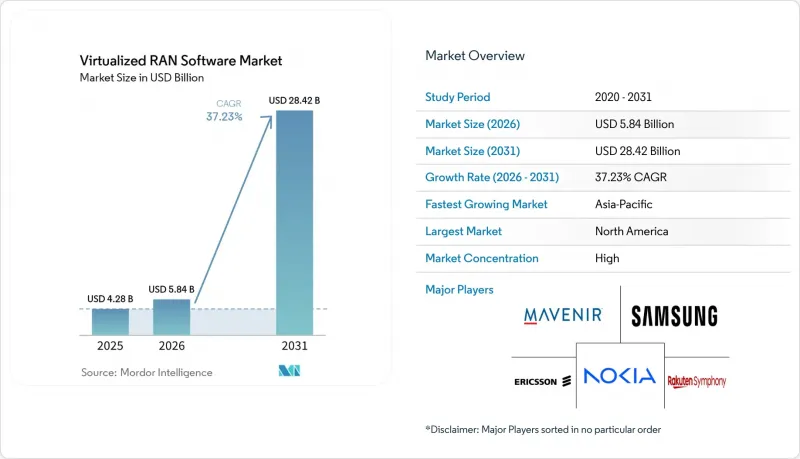
에 따르면 가상화 RAN 소프트웨어 시장 규모는 2025년 42억 8,000만 달러에서 2026년에는 58억 4,000만 달러로 확대되어, 2031년까지 284억 2,000만 달러에 달할 것으로 예상되며, 2026년부터 2031년까지 CAGR 37.23%로 확대될 전망입니다.
전 세계 가상화 RAN 소프트웨어 시장의 동향 및 인사이트
5G 독립형(SA) 및 클라우드 네이티브 RAN의 현대화 가속화
비독립형 5G에서 독립형 5G로의 전환은 가상화 RAN 소프트웨어 시장의 수요를 견인하는 주요 단기적 요인입니다. 2026년 3월 기준, 전 세계 약 1,400개의 통신 사업자 중 95곳이 5G 독립형 서비스를 상용화했습니다. 독립형 도입에는 완전한 5G 코어가 필요하며, 4G 코어를 앵커로 유지하는 네트워크보다 더 광범위한 소프트웨어 요구 사항이 수반됩니다. 또한 지원 기간이 단축되고 마이크로서비스 기반 소프트웨어가 주류를 이루면서, 통신 사업자들은 가상 네트워크 기능(VNF)에서 벗어나고 있습니다. 이로 인해 구형 네트워크 소프트웨어를 유지하는 데 드는 비용이 증가하여, 현대화가 더욱 시급한 운영 과제로 대두되고 있습니다. 에릭슨은 2026년 3월, 버진 미디어 O2와의 파트너십을 연장하여 5년 계약을 바탕으로 해당 회사의 전국적인 RAN 대부분을 지원하게 되었습니다. 이는 수년에 걸친 소프트웨어 주도형 네트워크에 대한 노력이 주요 통신 사업자들의 계획에 점차 반영되고 있음을 보여줍니다.
O-RAN 인터페이스의 표준화와 공급업체의 유연성
O-RAN ALLIANCE는 2025년 11월에 릴리스 5를 완성하여 2026년 6월에 발표했습니다. 이를 통해 통신 사업자들에게 상호 운용 가능한 구축을 위한 보다 명확하게 정의된 기술적 기반이 제공되었습니다. 이 릴리스에서는 O-RAN 인터페이스 전반에 걸쳐 TLS 1.3 사용이 의무화되었으며, 서비스 관리, O-Cloud, 무선 유닛 및 RAN 인텔리전트 컨트롤러를 위한 제로 트러스트 프레임워크가 추가되었습니다. 또한, 3GPP 릴리스 18을 준수하는 에너지 절약 기능도 공식적으로 규정되었습니다. 이러한 요구 사항 덕분에 조달 팀은 다중 벤더의 제안을 평가할 때 보다 명확한 기준을 확보할 수 있습니다. 이 표준화를 통해 특히 중소 규모 통신 사업자의 경우, 사업자 계약에서 맞춤형 인터페이스 조항의 필요성이 줄어들게 됩니다. 그 결과, 규격을 준수하는 구성요소의 사양 수립, 테스트 및 공급업체 간 통합이 용이해짐에 따라 가상화 RAN 소프트웨어 시장이 혜택을 받게 될 것입니다.
다중 벤더 통합 및 라이프사이클의 복잡성
다중 벤더에 의한 분리는 가상화 RAN 소프트웨어 시장에서 여전히 주요한 운영상의 장벽으로 남아 있습니다. F1, E1, E2, Open Fronthaul 등의 인터페이스는 호환되지 않는 소프트웨어 버전으로 인해 도입이 지연될 수 있는 통합 지점을 추가합니다. 또한 중앙 유닛, 분산 유닛, 무선 유닛의 각 애플리케이션은 각각 서로 다른 릴리스 주기를 따를 수 있습니다. 이로 인해 통신 사업자가 공급업체를 추가할수록 유지보수 부담이 더욱 커집니다. 릴리스 5에서는 O-RAN 인터페이스 전반에 걸쳐 TLS 1.3 및 제로 트러스트 조치가 필수화되어, 전체 스택에 걸친 조율된 업데이트가 필요할 수 있습니다. 시스템 통합업체나 오케스트레이션 플랫폼이 이러한 부담을 완화할 수는 있지만, 통신 사업자는 디스애그리게이션 아키텍처를 선택하기 전에 추가적인 테스트, 비용 및 납품 위험을 충분히 고려해야 합니다.
부문 분석
2025년, 가상화 RAN 소프트웨어 시장에서 중앙 유닛(Central Unit) 소프트웨어는 31.83%의 점유율을 차지했습니다. 이러한 위상은 멀티 벤더 Open RAN 구축에서 베이스밴드 연동을 지원하는 무선 자원 제어(RRC), 패킷 데이터 수렴 프로토콜(PDCP) 및 서비스 데이터 적응 프로토콜(SDAP) 각 기능에서 중앙 유닛 소프트웨어가 수행하는 역할을 반영한 것입니다. 분산 유닛 소프트웨어, 무선 유닛 및 저 PHY 소프트웨어는 지연 및 스펙트럼 효율에 영향을 미치는 처리 작업을 담당합니다. 하드웨어 분야에 강점을 가진 벤더들은 이러한 무선에 가까운 기능에서 여전히 우위를 유지하고 있습니다. 통신 사업자가 RAN 애플리케이션과 기존 운영 지원 시스템 전반에 걸친 라이프사이클 관리의 연동을 필요로함에 따라, 운영·관리·오케스트레이션 소프트웨어의 중요성이 높아지고 있습니다.
RAN 지능형 컨트롤러 및 자동화 소프트웨어는 2031년까지 연평균 성장률(CAGR) 38.43%로 확대될 것으로 예측됩니다. 라쿠텐 모바일과 라쿠텐 심포니는 2026년 2월 일본 국내에서 RIC의 전국적 확장을 완료하고, 예측 유지보수, 이동성 향상, 트래픽 최적화를 목적으로 AirHop Communications 및 Future Connections의 타사 rApp을 통합했습니다. 이러한 전개는 RIC 플랫폼이 시험 운영에 그치지 않고 상용 네트워크에서도 활용되기 시작했음을 보여줍니다. rApp 생태계의 발전에 따라 RIC 플랫폼은 RAN 내의 AI 추론 계층으로 기능하게 될 것입니다. 그 밖의 소프트웨어 범주에는 AI 모델 서빙 및 인텐트 기반 정책 엔진과 같은 신흥 기능이 포함됩니다. 이러한 기능들은 아직 표준 보고 범주로 분류되지는 않았지만, 상업적인 관심을 끌기 시작하고 있습니다.
2025년, 가상화 RAN 소프트웨어 시장 규모 중 오픈 vRAN이 34.42%를 차지했습니다. 이러한 위상은 더욱 성숙해진 O-RAN 사양과, 현재 준수 여부를 조달 요건으로 채택하고 있는 통신 사업자들에 의해 뒷받침되고 있습니다. 라쿠텐 모바일은 최대 규모의 오픈 vRAN 네트워크를 운영하고 있으며, 멀티 벤더 및 클라우드 네이티브 운영의 중요한 사례로 자리매김하고 있습니다. 삼성은 테스트와 검증을 거쳐 2026년 3월, 라쿠텐 모바일의 전국 규모 5G 오픈 RAN 무선 장비 공급업체가 되었습니다. 또한 삼성은 KDDI와 제휴하여 4G 및 5G vRAN 확장에 주력하고 있으며, 오픈 RAN 시스템의 상용 검증에서 일본의 역할을 강화하고 있습니다. 한편, 기존 벤더와의 관계를 중시하며 무선 기능을 상용 서버로 이전하고자 하는 통신 사업자들 사이에서는 여전히 독점형 및 하이브리드 vRAN 아키텍처에 대한 수요가 존재하고 있습니다.
클라우드 네이티브 vRAN은 2031년까지 연평균 성장률(CAGR) 38.03%로 확대될 것으로 예측됩니다. 이는 고정형 어플라이언스에서 쿠버네티스(Kubernetes)나 O-Cloud 프레임워크 상에서 실행 가능한 컨테이너화된 소프트웨어로의 전환을 반영한 것입니다. 삼성전자는 2026년 1월, 미국 Tier 1 통신 사업자의 네트워크에서 최대 72코어를 탑재한 인텔 제온 6700P-B 프로세서를 기반으로 자사의 vRAN 솔루션을 활용한 상용 통화를 성공적으로 수행했습니다. 이 시험은 고밀도 사이트에서 클라우드 네이티브 vRAN 워크로드를 단일 상용 서버로 처리할 수 있음을 입증한 것으로, 중앙 유닛, 분산 유닛 및 관련 AI 기능을 단일 서버에 통합함으로써 사이트의 경제성을 향상시킬 수 있습니다. 또한, Release 5의 보안 요구 사항도 클라우드 호스팅형 RAN의 조달 사양에 점차 반영되고 있습니다.
지역별 분석
2025년, 북미는 가상화 RAN 소프트웨어 시장 점유율의 38.26%를 차지했습니다. 이 지역은 AT&T의 Open RAN 프로그램, Dish Network의 그린필드 vRAN 설계, 그리고 주요 통신 사업자들의 멀티 벤더 5G 독립형 인프라에 대한 대규모 투자의 혜택을 받고 있으며, 미국에서는 국내 Open RAN 개발에 대한 정부 지원이 추가적인 수요를 뒷받침하고 있습니다. Airspan은 2025년 12월, 미국 국가통신정보국(NTIA)의 보조금을 일부 자금원으로 활용하여 라쿠텐 모바일을 위한 상용 Open RAN 도입을 실현했습니다. 캐나다에서는 기업용 프라이빗 5G 활용 사례가 개발되고 있으며, TERAGO사와 에릭슨은 2026년 5월 맥마스터 제조 연구소에서 프라이빗 5G 네트워크를 구축했습니다.
아시아태평양은 2031년까지 연평균 성장률(CAGR) 38.22%로 확대될 것으로 예측됩니다. 일본에서는 라쿠텐 모바일의 오픈 vRAN 네트워크에 더해, NTT 도코모와 KDDI의 상용 vRAN 구축을 통해 이 지역을 선도하고 있습니다. 2026년 삼성이 라쿠텐 모바일의 전국 규모 5G 오픈 RAN 무선 장비 공급업체로 선정된 것은 일본이 레퍼런스 시장으로서의 역할을 수행하는 데 박차를 가하고 있습니다. 라쿠텐 심포니는 2026년 4월, 기업용 오픈 RAN 프라이빗 5G 분야에서 세로나(Serona)와의 제휴를 발표하며, 지역 수요에 프라이빗 네트워크라는 새로운 경로를 추가했습니다. 이 지역의 활동에는 인도, 한국, 동남아시아 및 기타 신흥 시장에서의 시범 운영 및 도입이 포함되어 있으며, 일본의 수출 활동이 이들 국가에서의 보다 광범위한 보급을 뒷받침하고 있습니다.
유럽에서는 독일과 영국의 통신 사업자 프로그램을 통해 중요한 입지를 확립하고 있으며, 여기에는 보다폰이 에릭슨, 노키아, 삼성과 공동으로 추진하는 멀티벤더 프로그램도 포함됩니다. 보더폰의 독일 내 Open RAN 도입에서 삼성은 5년까지 수천 곳의 기지국을 담당하고 있습니다. 오렌지 그룹과 삼성은 사전 시험을 거쳐 2026년 2월 유럽 내 vRAN 및 Open RAN 제휴를 확대했습니다. 중동에서는 자인 쿠웨이트를 통해 클라우드 네이티브 O-RAN에 대한 초기 노력이 진행되고 있습니다. 아프리카와 남미에서는 프론트홀 및 주파수 대역 제약이 더 엄격한 상황이지만, 소프트웨어 정의형 시스템을 채택함으로써 기존 RAN에 비해 물리적 하드웨어 요구 사항을 줄일 수 있습니다.
기타 혜택:
- 엑셀 형식의 시장 예측(ME) 시트
- 3개월간의 애널리스트 지원
자주 묻는 질문
목차
제1장 소개
- 조사 가정과 시장 정의
- 조사 범위
제2장 조사 방법
제3장 주요 요약
제4장 시장 구도
- 시장 개요
- 거시경제 요인이 시장에 미치는 영향
- 시장 성장 촉진요인
- 시장 성장 억제요인
- 업계 밸류체인 분석
- 규제 상황
- 기술 전망
- Porter's Five Forces 분석
제5장 시장 규모와 성장 예측
- 소프트웨어 층별
- 아키텍처별
- 전개 모델별
- 네트워크 세대별
- 최종사용자별
- 지역별
- 북미
- 미국
- 캐나다
- 멕시코
- 남미
- 브라질
- 아르헨티나
- 기타 남미 국가
- 유럽
- 독일
- 영국
- 프랑스
- 이탈리아
- 스페인
- 러시아
- 기타 유럽 국가
- 아시아태평양
- 중국
- 일본
- 인도
- 한국
- 호주
- 기타 아시아태평양 국가
- 중동
- 사우디아라비아
- 아랍에미리트
- 튀르키예
- 기타 중동 국가
- 아프리카
- 남아프리카공화국
- 나이지리아
- 케냐
- 기타 아프리카 국가
- 북미
제6장 경쟁 구도
- 시장 집중도
- 전략적 동향
- 시장 점유율 분석
- 기업 개요
- Mavenir Systems, Inc.
- Parallel Wireless, Inc.
- Rakuten Symphony, Inc.
- Samsung Electronics Co., Ltd.
- Nokia Corporation
- Telefonaktiebolaget LM Ericsson
- NEC Corporation
- Fujitsu Limited
- Airspan Networks Inc.
- JMA Wireless, Inc.
- Radisys Corporation
- Celona Inc.
- Red Hat(IBM Corporation)
- NVIDIA Corporation
- Qualcomm Technologies, Inc.
- Druid Software Limited
- Software Radio Systems(SRS) Limited
- Amarisoft SAS
- Picocom Technology Limited
- Phluido, Inc.
- Wind River Systems, Inc.
제7장 시장 기회와 향후 전망
KSM 26.10.29According to Mordor Intelligence, the virtualized RAN software market size is expected to increase from USD 4.28 billion in 2025 to USD 5.84 billion in 2026 and reach USD 28.42 billion by 2031, expanding at a CAGR of 37.23% over 2026-2031.
Global Virtualized RAN Software Market Trends and Insights
Accelerating 5G Standalone and Cloud-Native RAN Modernization
The shift from non-standalone 5G to standalone 5G is a major near-term driver of demand for the virtualized RAN software market. By March 2026, 95 operators had commercially launched 5G standalone services, out of an estimated 1,400 operators worldwide. Standalone deployments require a complete 5G core and entail broader software requirements than networks that retain a 4G core anchor. Operators are also moving away from virtual network functions as support horizons narrow and microservices-based software becomes the preferred model. This raises the cost of retaining older network software and makes modernization a nearer operational decision. Ericsson extended its partnership with Virgin Media O2 in March 2026 to power most of the operator's nationwide RAN under a five-year agreement, showing that multi-year software-led network commitments are entering major operator plans.
O-RAN Interface Standardization and Supplier Flexibility
The O-RAN ALLIANCE completed Release 5 in November 2025 and announced it in June 2026, providing operators with a more clearly defined technical baseline for interoperable deployments. The release requires TLS 1.3 across O-RAN interfaces and adds a Zero Trust framework for service management, O-Cloud, radio units, and RAN intelligent controllers. It also formalizes energy-saving capabilities aligned with 3GPP Release 18. These requirements give procurement teams clearer reference points when they assess multi-vendor offers. The standards can reduce the need for customized interface terms in operator contracts, especially for smaller carriers. The virtualized RAN software market can therefore benefit as compliant components become easier to specify, test, and integrate across suppliers.
Multi-Vendor Integration and Lifecycle Complexity
Multi-vendor disaggregation remains a central operational barrier in the virtualized RAN software market. Interfaces such as F1, E1, E2, and Open Fronthaul add integration points where incompatible software versions can delay deployment. Central unit, distributed unit, and radio unit applications may also follow separate release cycles. This creates a larger maintenance burden as operators add suppliers. Release 5 requires TLS 1.3 and Zero Trust measures across O-RAN interfaces, which can require coordinated updates throughout the stack. Systems integrators and orchestration platforms can reduce this burden, but operators still need to account for added testing, cost, and delivery risk before selecting a disaggregated architecture.
Other drivers and restraints analyzed in the detailed report include:
- RAN Energy Efficiency and Emissions Reduction Targets
- Private 5G and Industrial Edge Deployment
- Fronthaul Fiber, Timing, and Deterministic-Latency Constraints
For complete list of drivers and restraints, kindly check the Table Of Contents.
Segment Analysis
Central unit software held 31.83% of the virtualized RAN software market share in 2025. Its position reflects its role in radio resource control, packet data convergence protocol, and service data adaptation protocol functions, which support baseband coordination across multi-vendor Open RAN deployments. Distributed unit software, radio unit, and low-PHY software handle processing tasks that affect latency and spectrum efficiency. Vendors with a strong hardware background retain an advantage in these near-radio functions. Operations, administration, and orchestration software is becoming more important as operators need coordinated lifecycle management across RAN applications and existing operational support systems.
RAN intelligent controller and automation software is projected to expand at a 38.43% CAGR through 2031. Rakuten Mobile and Rakuten Symphony completed a nationwide RIC deployment in Japan in February 2026, incorporating third-party rApps from AirHop Communications and Future Connections for predictive maintenance, mobility improvement, and traffic optimization. The deployment shows that RIC platforms are being used in commercial networks rather than remaining limited to trials. As rApp ecosystems develop, RIC platforms can function as an AI inference layer within the RAN. The remaining software category includes emerging functions such as AI model serving and intent-based policy engines that have not yet become standard reporting categories but are beginning to attract commercial interest.
Open vRAN accounted for 34.42% of the virtualized RAN software market size in 2025. Its position is supported by more mature O-RAN specifications and by operators that now use compliance as a procurement requirement. Rakuten Mobile operates the largest open vRAN network and remains an important example of multi-vendor, cloud-native operations. Samsung became Rakuten Mobile's nationwide 5G Open RAN radio provider in March 2026 after testing and validation. Samsung also partnered with KDDI on 4G and 5G vRAN expansion, reinforcing Japan's role in the commercial validation of open RAN systems, while proprietary and hybrid vRAN architectures retain demand among operators that prefer established vendor relationships and move radio functions to commercial servers.
Cloud-native vRAN is projected to expand at a 38.03% CAGR through 2031. This reflects a shift from fixed appliances to containerized software that can run on Kubernetes and O-Cloud frameworks. Samsung completed a commercial call with its vRAN solution on an Intel Xeon 6700P-B processor with up to 72 cores on a Tier 1 US operator network in January 2026. The test supports using a single commercial server for cloud-native vRAN workloads in dense sites, and consolidating the central unit, the distributed unit, and related AI functions on a single server can improve site economics. Security requirements in Release 5 are also being incorporated into cloud-hosted RAN procurement specifications.
Complete Report Scope:
- By Software Layer
- Central Unit Software
- Distributed Unit Software
- Radio Unit and Low-PHY Software
- RAN Intelligent Controller and Automation Software
- Operations, Administration, and Orchestration Software
- Rest of Virtualized RAN Software
- By Architecture
- Open vRAN
- Cloud-Native vRAN
- Proprietary vRAN
- Hybrid vRAN
- By Deployment Model
- Cloud-Native vRAN
- On Premise
- By Network Generation
- 5G New Radio
- 4G/LTE
- 3G and Legacy Modernization
- By End User
- Mobile Network Operators
- Enterprises and Industrial Organizations
- Neutral Hosts and Tower Companies
- Government and Defense Organizations
- By Geography
- North America
- United States
- Canada
- Mexico
- South America
- Brazil
- Argentina
- Rest of South America
- Europe
- Germany
- United Kingdom
- France
- Italy
- Spain
- Russia
- Rest of Europe
- Asia-Pacific
- China
- Japan
- India
- South Korea
- Australia
- Rest of Asia-Pacific
- Middle East
- Saudi Arabia
- United Arab Emirates
- Turkey
- Rest of Middle East
- Africa
- South Africa
- Nigeria
- Kenya
- Rest of Africa
- North America
Geography Analysis
North America accounted for 38.26% of the virtualized RAN software market share in 2025. The region benefits from AT&T's Open RAN program, Dish Network's greenfield vRAN design, and large operator investment in multi-vendor 5G standalone infrastructure, while public support for domestic Open RAN development provides additional demand support in the United States. Airspan delivered a commercial Open RAN deployment for Rakuten Mobile in December 2025, funded in part by a National Telecommunications and Information Administration grant. Canada is developing enterprise private 5G use cases, and TERAGO and Ericsson launched a private 5G network at the McMaster Manufacturing Research Institute in May 2026.
Asia-Pacific is projected to expand at a 38.22% CAGR through 2031. Japan leads the region through Rakuten Mobile's open vRAN network, as well as commercial vRAN activity at NTT Docomo and KDDI. Samsung's 2026 appointment as Rakuten Mobile's nationwide 5G Open RAN radio provider supports the country's role as a reference market. Rakuten Symphony announced a collaboration with Celona for enterprise Open RAN private 5G in April 2026, adding a private-network route to regional demand. Regional activity includes trials and deployments in India, South Korea, Southeast Asia, and other emerging markets, while Japan's export activity supports wider adoption across these countries.
Europe holds a substantial position through operator programs in Germany and the United Kingdom, including Vodafone's multi-vendor program with Ericsson, Nokia, and Samsung. Samsung's role in Vodafone's German Open RAN deployment covers thousands of sites over 5 years. Orange Group and Samsung expanded their vRAN and Open RAN partnership in Europe in February 2026 after earlier testing. The Middle East has early cloud-native O-RAN activity through Zain Kuwait. Africa and South America face greater fronthaul and spectrum constraints, although software-defined systems can reduce physical hardware requirements compared with traditional RANs.
- Mavenir Systems, Inc.
- Parallel Wireless, Inc.
- Rakuten Symphony, Inc.
- Samsung Electronics Co., Ltd.
- Nokia Corporation
- Telefonaktiebolaget LM Ericsson
- NEC Corporation
- Fujitsu Limited
- Airspan Networks Inc.
- JMA Wireless, Inc.
- Radisys Corporation
- Celona Inc.
- Red Hat (IBM Corporation)
- NVIDIA Corporation
- Qualcomm Technologies, Inc.
- Druid Software Limited
- Software Radio Systems (SRS) Limited
- Amarisoft SAS
- Picocom Technology Limited
- Phluido, Inc.
- Wind River Systems, Inc.
Additional Benefits:
- The market estimate (ME) sheet in Excel format
- 3 months of analyst support
TABLE OF CONTENTS
1 INTRODUCTION
- 1.1 Study Assumptions and Market Definition
- 1.2 Scope of the Study
2 RESEARCH METHODOLOGY
3 EXECUTIVE SUMMARY
4 MARKET LANDSCAPE
- 4.1 Market Overview
- 4.2 Impact of Macroeconomic Factors on the Market
- 4.3 Market Drivers
- 4.3.1 Accelerating 5G Standalone and Cloud-Native RAN Modernization
- 4.3.2 O-RAN Interface Standardization and Supplier Flexibility
- 4.3.3 RAN Energy-Efficiency and Emissions-Reduction Targets
- 4.3.4 Private 5G and Industrial Edge Deployment
- 4.3.5 GPU-Accelerated AI-RAN Commercialization
- 4.3.6 Telecom Software Reuse Across Terrestrial and Non-Terrestrial Networks
- 4.4 Market Restraints
- 4.4.1 Multi-Vendor Integration and Lifecycle Complexity
- 4.4.2 Fronthaul Fiber, Timing, and Deterministic-Latency Constraints
- 4.4.3 Merchant-Compute Power and Performance Parity Risk
- 4.4.4 RAN Software Supply-Chain and Cybersecurity Exposure
- 4.5 Industry Value Chain Analysis
- 4.6 Regulatory Landscape
- 4.7 Technological Outlook
- 4.8 Porter's Five Forces Analysis
- 4.8.1 Threat of New Entrants
- 4.8.2 Bargaining Power of Suppliers
- 4.8.3 Bargaining Power of Buyers
- 4.8.4 Threat of Substitutes
- 4.8.5 Intensity of Competitive Rivalry
5 MARKET SIZE AND GROWTH FORECASTS (VALUE)
- 5.1 By Software Layer
- 5.1.1 Central Unit Software
- 5.1.2 Distributed Unit Software
- 5.1.3 Radio Unit and Low-PHY Software
- 5.1.4 RAN Intelligent Controller and Automation Software
- 5.1.5 Operations, Administration, and Orchestration Software
- 5.1.6 Rest of Virtualized RAN Software
- 5.2 By Architecture
- 5.2.1 Open vRAN
- 5.2.2 Cloud-Native vRAN
- 5.2.3 Proprietary vRAN
- 5.2.4 Hybrid vRAN
- 5.3 By Deployment Model
- 5.3.1 Cloud-Native vRAN
- 5.3.2 On Premise
- 5.4 By Network Generation
- 5.4.1 5G New Radio
- 5.4.2 4G/LTE
- 5.4.3 3G and Legacy Modernization
- 5.5 By End User
- 5.5.1 Mobile Network Operators
- 5.5.2 Enterprises and Industrial Organizations
- 5.5.3 Neutral Hosts and Tower Companies
- 5.5.4 Government and Defense Organizations
- 5.6 By Geography
- 5.6.1 North America
- 5.6.1.1 United States
- 5.6.1.2 Canada
- 5.6.1.3 Mexico
- 5.6.2 South America
- 5.6.2.1 Brazil
- 5.6.2.2 Argentina
- 5.6.2.3 Rest of South America
- 5.6.3 Europe
- 5.6.3.1 Germany
- 5.6.3.2 United Kingdom
- 5.6.3.3 France
- 5.6.3.4 Italy
- 5.6.3.5 Spain
- 5.6.3.6 Russia
- 5.6.3.7 Rest of Europe
- 5.6.4 Asia-Pacific
- 5.6.4.1 China
- 5.6.4.2 Japan
- 5.6.4.3 India
- 5.6.4.4 South Korea
- 5.6.4.5 Australia
- 5.6.4.6 Rest of Asia-Pacific
- 5.6.5 Middle East
- 5.6.5.1 Saudi Arabia
- 5.6.5.2 United Arab Emirates
- 5.6.5.3 Turkey
- 5.6.5.4 Rest of Middle East
- 5.6.6 Africa
- 5.6.6.1 South Africa
- 5.6.6.2 Nigeria
- 5.6.6.3 Kenya
- 5.6.6.4 Rest of Africa
- 5.6.1 North America
6 COMPETITIVE LANDSCAPE
- 6.1 Market Concentration
- 6.2 Strategic Moves
- 6.3 Market Share Analysis
- 6.4 Company Profiles (includes Global Level Overview, Market Level Overview, Core Segments, Financials as available, Strategic Information, Market Rank/Share, Products and Services, Recent Developments)
- 6.4.1 Mavenir Systems, Inc.
- 6.4.2 Parallel Wireless, Inc.
- 6.4.3 Rakuten Symphony, Inc.
- 6.4.4 Samsung Electronics Co., Ltd.
- 6.4.5 Nokia Corporation
- 6.4.6 Telefonaktiebolaget LM Ericsson
- 6.4.7 NEC Corporation
- 6.4.8 Fujitsu Limited
- 6.4.9 Airspan Networks Inc.
- 6.4.10 JMA Wireless, Inc.
- 6.4.11 Radisys Corporation
- 6.4.12 Celona Inc.
- 6.4.13 Red Hat (IBM Corporation)
- 6.4.14 NVIDIA Corporation
- 6.4.15 Qualcomm Technologies, Inc.
- 6.4.16 Druid Software Limited
- 6.4.17 Software Radio Systems (SRS) Limited
- 6.4.18 Amarisoft SAS
- 6.4.19 Picocom Technology Limited
- 6.4.20 Phluido, Inc.
- 6.4.21 Wind River Systems, Inc.
7 MARKET OPPORTUNITIES AND FUTURE OUTLOOK
- 7.1 White-Space and Unmet-Need Assessment


