

|
시장보고서
상품코드
2154520
사지용 제품 : 시장 점유율 분석, 업계 동향과 통계, 성장 예측(2026-2031년)Extremity Products - Market Share Analysis, Industry Trends & Statistics, Growth Forecasts (2026 - 2031) |
||||||
 Mordor Intelligence
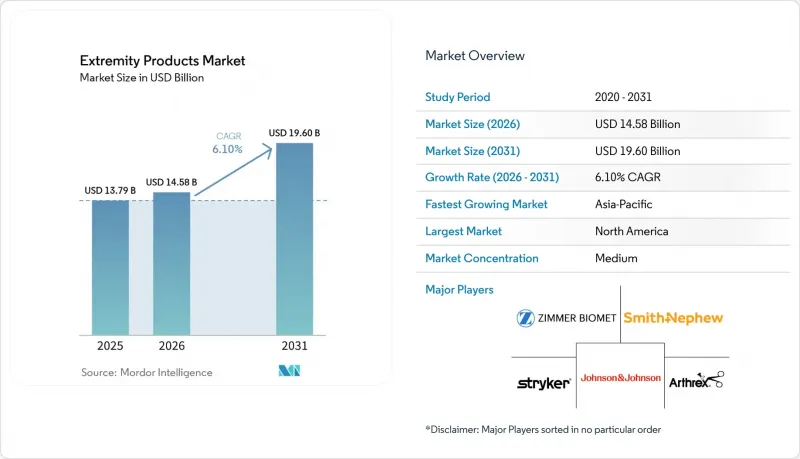
에 따르면 사지용 제품 시장은 2025년 137억 9,000만 달러에서 2026년에는 145억 8,000만 달러로 확대되어, 2031년까지 196억 달러에 달할 것으로 예상되며, 2026년부터 2031년까지 CAGR 6.10%로 성장할 것으로 전망됩니다.
전 세계 사지용 제품 시장의 동향 및 인사이트
고령화와 증가하는 취약성 골절의 부담
사지용 제품 시장은 인구 고령화 및 이에 따른 취약성 골절의 증가로 인해 장기적인 수요를 뒷받침받고 있습니다. 2025년 연구에 따르면, 폐경 후 여성의 골밀도 감소로 인한 골절 관련 사망자 수는 2021년 18만 9,025명에서 2050년까지 39만 7,537명으로 증가할 것으로 예측됩니다. 같은 조사에서 관련 장애 부담은 2050년까지 1,435만 장애 조정 생명년(DALY)에 달할 것으로 예측됩니다. 이러한 추세로 인해 고관절 골절 치료 시스템, 발목 고정 제품 및 재건 수술에 대한 지속적인 수요가 발생하고 있습니다.
또한, 하지 및 골반 골절은 사지용 제품 시장에 폭넓은 수술 기반을 제공하고 있습니다. 2025년 연구에 따르면, 2021년 전 세계 하지 및 골반 골절 신규 사례 수는 7,805만 건을 기록했으며, 이는 1990년에 비해 32% 증가한 수치입니다. 이러한 많은 사례 수는 고정, 나사 고정 및 인공관절 치환술 시스템의 지속적인 사용을 뒷받침하고 있습니다. 또한, 이는 의료 서비스 제공자들에게 주요 병원 센터 이외의 곳에서도 골절 치료 체계를 확충해야 할 이유가 되고 있습니다.
증가하는 정형외과 질환 및 스포츠 부상 발생률
근골격계 질환은 사지용 제품 시장의 수요를 이끄는 핵심 요인으로 계속 자리 잡고 있습니다. 세계보건기구(WHO) 보고서에 따르면, 이러한 질환은 전 세계 17억 1,000만 명에게 영향을 미치고 있으며, 전 세계 장애의 주요 원인이 되고 있습니다. 이러한 부담에는 이동 능력, 관절 기능 및 근로 능력을 제한하는 질환이 포함됩니다. 영향을 받는 인구의 규모가 크다는 점도 수술 후 기능 유지의 중요성을 더욱 높이고 있습니다.
스포츠 부상은 사지용 제품 업계에 또 다른 수요층을 형성하고 있습니다. 2026년 연구에 따르면, 20-40세 성인에서 스포츠로 인한 무릎 탈구는 1990년부터 2021년 사이 16.8% 증가했습니다. 이러한 환자들은 회복에 대한 강한 기대를 품고 직장 복귀나 신체 활동 재개를 모색하는 경우가 많습니다. 이에 따라 관절 기능 회복을 목적으로 하는 인대 보강, 어깨 관절 안정화, 발목 관절 치환 솔루션에 대한 수요가 증가하고 있습니다. 또한 생체역학적 근거의 중요성과 새로운 제품에 대한 외과의사의 신뢰도도 높아지고 있습니다. 명확한 임상 교육과 집중적인 제품 설계를 수행하는 기업은 가격 경쟁에만 그치지 않고 경쟁력을 발휘할 수 있습니다.
고액의 수술 비용과 첨단 임플란트 비용
비용 측면의 압박은 사지용 제품 시장, 특히 환자 맞춤형 및 로봇 관련 시스템의 도입을 제약할 가능성이 있습니다. CMS는 2026년에 정형외과 관절 치환술을 시행하는 외과의사에 대한 메디케어 환급액에 8% 삭감을 적용했습니다. 또한, 2027년 의사 보수 일정에 관한 규정안에서는 인공 고관절 및 인공 슬관절 치환술 코드에 대해 추가로 20%의 삭감이 적용될 것으로 예상됩니다. 이로 인해 시장에서의 채택은 기술적 혁신뿐만 아니라 입증된 가치에 더 크게 의존하게 되었습니다.
또한, 가격에 민감한 시장에서는 비용 장벽이 구조적인 문제이기도 합니다. 인도의 국내 제조업체들은 스테인리스강으로 만든 사지용 임플란트를 수입된 티타늄 시스템보다 40-60% 저렴한 가격에 판매하고 있습니다. 공급업체는 제품 포트폴리오의 폭과 현지 예산에 맞는 제품 구성 간의 균형을 맞춰야 합니다. 따라서 사지용 제품 시장에서는 지역별로 다른 가격 책정 및 판매 채널 접근 방식이 요구됩니다.
부문 분석
2025년, 사지용 임플란트 및 관절 재건 시스템은 사지용 제품 시장 점유율의 39.61%를 차지했습니다. 이 부문은 고령 환자나 더 복잡한 관절 질환을 앓고 있는 환자들 사이에서 증가하는 재건 수술 수요의 혜택을 받고 있습니다. 높은 매출 기여도로 인해, 폭넓은 정형외과 제품 포트폴리오를 구축하는 기업들에게 핵심적인 관심사가 되고 있습니다.
외상 및 고정 제품은 2031년까지 연평균 성장률(CAGR) 7.14%로 성장할 것으로 예측됩니다. 이 사지용 제품 시장 부문은 취약성 골절, 스포츠 부상, 그리고 보다 효율적인 외상 치료 워크플로우에 대한 지속적인 수요에 힘입어 성장하고 있습니다. Arthrex사는 2026년 2월, 전방십자인대(ACL) 고정용 ‘TightRope SB All-Suture Implant’를 출시했습니다. 오르토바이오로직스, 보조기 및 지지 제품은 치유, 재활 및 급성기 후 관리를 지원할 수 있기 때문에 계속해서 중요한 제품 분야로 남아 있습니다.
2025년, 하지 부문은 사지용 제품 시장 점유율의 46.25%를 차지했습니다. 이러한 위상을 뒷받침하는 요인은 고관절 및 슬관절 치환술 건수뿐만 아니라 경골, 비골, 발목 및 고관절 골절입니다. 하지 관련 사례에는 계획된 재건 수술과 응급 외상 치료가 모두 포함됩니다. 의료 서비스 제공자는 또한 일상적인 골절, 재수술 및 복잡한 재건 수술에 대응하기 위한 광범위한 시스템을 필요로 합니다.
상지 분야는 2031년까지 연평균 성장률(CAGR) 8.25%로 확대될 것으로 예상됩니다. 어깨 관절 치환술이 주요 요인인 반면, 팔꿈치 및 손목 재건술도 점점 더 널리 이용되고 있습니다. 외래 수술 센터에서 시행되는 상지 수술은 높은 비용 대비 효과를 가져올 가능성이 있습니다. 이로 인해 외래 상지 치료를 위한 장비 및 재고에 대한 투자가 촉진되고 있습니다. 또한, 최첨단 어깨 관절 기술도 이 부문의 발전을 뒷받침하고 있습니다.
지역별 분석
2025년, 북미는 사지용 제품 시장의 46.42%를 차지했습니다. 이러한 위상은 높은 수술 보수, 확립된 병원 인프라, 그리고 선진적인 외래 수술 센터 환경에 의해 뒷받침되고 있습니다. 미국에서는 2026년에도 특정 근골격계 수술이 계속해서 외래 진료 환경으로 전환되고 있습니다. 캐나다는 국민건강보험제도 덕분에 여전히 병원 중심의 체제를 유지하고 있습니다. 멕시코의 민간 병원 부문은 특히 디지털 기능을 갖춘 시스템 등 수입 시스템에 대한 새로운 판로가 되고 있습니다. 이러한 시장들은 고급 재건용 제품과 효율적인 외래 진료 체제를 모두 뒷받침하고 있습니다.
유럽 또한 중요한 수익 기반을 형성하고 있으며, 독일, 영국, 프랑스가 수술 건수와 혁신 도입을 뒷받침하고 있습니다. 독일의 ‘Endoprothesenregister Deutschland’는 전국 규모로 임플란트 치료 성과를 추적하여, 조달 결정에 활용되는 임상적 근거를 강화하고 있습니다. 유럽연합(EU)의 MDR 요건으로 인해, 근거 제시 의무를 충족하기 어려운 시장에서 일부 소규모 공급업체나 틈새 제품 라인이 철수하는 움직임이 나타나고 있습니다. 이탈리아와 스페인에서는 인구 고령화와 스포츠 참여 증가에 따라 어깨 및 발목 재건에 대한 수요가 높아지고 있습니다. 지역별 보험 급여 제도의 차이로 인해 접근성 및 도입 현황에 계속해서 편차가 발생하고 있습니다. 이러한 요인으로 인해, 탄탄한 제품 포트폴리오와 강력한 규제 대응 능력을 갖춘 공급업체가 유리한 입지를 점하고 있습니다.
아시아태평양은 2031년까지 연평균 성장률(CAGR) 9.13%로 성장할 것으로 예측되며, 이는 사지용 제품 시장에서 가장 높은 성장률입니다. 중국에서는 외상 치료 인프라가 확충되고 있으며, 선정된 의료기기에 대해서는 우선 심사 절차가 활용되고 있습니다. 한편, 인도에서는 대도시권 이외의 지역에서도 정형외과 치료에 대한 보험 적용 범위가 확대되고 있습니다. 일본에서는 고령화가 진행됨에 따라 고관절 골절 치료 및 당일 수술 프로토콜에 대한 수요가 증가하고 있습니다. 한국과 호주에서는 유럽 및 북미 시장과 마찬가지로 로봇 보조 정형외과 플랫폼에 대한 관심이 높아지고 있습니다. 남미, 중동 및 아프리카에는 브라질의 사립 병원 수요, 사우디아라비아의 정형외과 센터에 대한 투자, 아프리카 일부 지역의 저비용 모듈식 고정 시스템 등 각 지역마다 고유한 수요가 존재합니다.
기타 혜택:
- 엑셀 형식의 시장 예측(ME) 시트
- 3개월간의 애널리스트 지원
자주 묻는 질문
목차
제1장 소개
- 조사 가정과 시장 정의
- 조사 범위
제2장 조사 방법
제3장 주요 요약
제4장 시장 구도
- 시장 개요
- 시장 성장 촉진요인
- 시장 성장 억제요인
- 공급/밸류체인 분석
- 규제 상황
- 기술 전망
- Porter's Five Forces 분석
제5장 시장 규모와 성장 예측
- 제품 유형별
- 생체 구조별
- 용도별
- 최종사용자별
- 지역별
- 북미
- 미국
- 캐나다
- 멕시코
- 유럽
- 독일
- 영국
- 프랑스
- 이탈리아
- 스페인
- 기타 유럽 국가
- 아시아태평양
- 중국
- 일본
- 인도
- 호주
- 한국
- 기타 아시아태평양 국가
- 중동 및 아프리카
- GCC
- 남아프리카공화국
- 기타 중동 및 아프리카 국가
- 남미
- 브라질
- 아르헨티나
- 기타 남미 국가
- 북미
제6장 경쟁 구도
- 시장 집중도
- 시장 점유율 분석
- 기업 개요
- Acumed LLC
- Arthrex, Inc.
- B. Braun Melsungen AG
- Bioventus LLC
- CONMED Corporation
- Enovis Corporation
- Exactech, Inc.
- Extremity Medical LLC
- Globus Medical, Inc.
- Integra LifeSciences Holdings Corporation
- Johnson & Johnson MedTech
- Medartis AG
- Orthofix Medical Inc.
- Paragon 28, Inc.
- Skeletal Dynamics LLC
- Smith+Nephew plc
- Stryker Corporation
- TriMed, Inc.
- Wright Medical Group N.V.
- Zimmer Biomet Holdings, Inc.
제7장 시장 기회와 향후 전망
KSM 26.10.29According to Mordor Intelligence, the extremity products market is expected to increase from USD 13.79 billion in 2025 to USD 14.58 billion in 2026 and reach USD 19.60 billion by 2031, growing at a CAGR of 6.10% over 2026-2031.
Global Extremity Products Market Trends and Insights
Aging Population and the Compounding Fragility Fracture Burden
The extremity products market draws long-term support from population aging and the associated rise in fragility fractures. A 2025 study projected that deaths linked to low bone mineral density fractures among post-menopausal women will increase from 189,025 in 2021 to 397,537 by 2050.The same study projected that the related disability burden will rise to 14.35 million disability-adjusted life years by 2050. These patterns create a sustained need for hip fracture systems, ankle fixation products, and reconstruction procedures.
Lower-extremity and pelvic fractures also give the extremity products market a broad procedure base. A 2025 study recorded 78.05 million new lower-extremity and pelvic fracture cases globally in 2021, representing a 32% increase from 1990. The volume of these cases supports continued use of fixation, nailing, and arthroplasty systems. It also gives providers a reason to expand pathways for fracture care outside major hospital centers.
Rising Orthopedic Disease and Sports Injury Incidence
Musculoskeletal disease remains a central source of demand for the extremity products market. The World Health Organization reported that these conditions affect 1.71 billion people globally and are the leading contributors to disability worldwide. The burden includes conditions that limit mobility, joint function, and the ability to work. The scale of the affected population also increases the importance of preserving function after surgery.
Sports injuries add a separate demand layer for the extremity products industry. A 2026 study found that athletic knee dislocations among adults aged 20-40 increased 16.8% between 1990 and 2021. These patients often return to work and physical activity with high expectations for recovery. This raises demand for ligament augmentation, shoulder stabilization, and ankle replacement solutions that seek to restore joint function. It also raises the importance of biomechanical evidence and the surgeon's confidence in newer products. Companies with clear clinical education and focused product design can compete beyond price alone.
High Procedure and Advanced Implant Costs
Cost pressure can constrain adoption in the extremity products market, particularly for patient-specific and robotic-adjacent systems. CMS applied an 8% reduction to Medicare reimbursement for orthopedic joint replacement surgeons in 2026. It also states that a proposed 2027 Physician Fee Schedule rule would apply a further 20% reduction to total hip and knee replacement codes. This makes commercial adoption more dependent on demonstrated value rather than technical novelty alone.
The cost barrier is also structural in price-sensitive markets. Domestic manufacturers in India price stainless-steel extremity implants 40-60% below imported titanium systems. Suppliers must balance portfolio breadth with product configurations that fit local budgets. The extremity products market, therefore, requires different pricing and channel approaches across regions.
Other drivers and restraints analyzed in the detailed report include:
- Expansion of Outpatient and Ambulatory Extremity Surgery
- Adoption of Minimally Invasive, Robotic, and Digitally Planned Procedures
- Stringent and Regionally Variable Regulatory Requirements
For complete list of drivers and restraints, kindly check the Table Of Contents.
Segment Analysis
Extremity implants and joint-reconstruction systems held 39.61% of the extremity products market share in 2025. The segment benefits from demand for reconstruction in older patients and people with more complex joint disease. Its large revenue contribution makes it a core focus for companies building broad orthopedic portfolios.
Trauma and fixation products are forecasted to grow at a 7.14% CAGR through 2031. This extremity products market segment is supported by fragility fractures, sports injuries, and continued demand for more efficient trauma workflows. Arthrex released the TightRope SB All-Suture Implant for ACL fixation in February 2026. Orthobiologics, bracing, and support products remain related product areas because they can support healing, rehabilitation, and post-acute care.
Lower extremity held 46.25% of the extremity products market share in 2025. Hip and knee arthroplasty volume, along with fractures of the tibia, fibula, ankle, and hip, underpin this position. Lower-extremity cases include both planned reconstruction and urgent trauma treatment. Providers also need a range of systems for routine fractures, revisions, and complex reconstruction.
The upper extremity is expected to expand at a 8.25% CAGR through 2031. Shoulder arthroplasty is a major contributor, while elbow and wrist reconstruction are becoming more widely available. The upper-extremity procedures in ambulatory surgery centers can offer strong reimbursement efficiency. This supports investment in equipment and inventory for outpatient upper-limb care. Advanced shoulder technologies also support the segment's development.
Complete Report Scope:
- By Product Type
- Extremity Implants and Joint-Reconstruction Systems
- Trauma and Fixation Products
- Orthobiologics and Bone-Growth Products
- Prosthetics
- Bracing and Supports
- By Anatomy
- Upper Extremity
- Lower Extremity
- Pelvic and Acetabular Extremity Applications
- By Application
- Trauma Fracture Repair
- Joint Reconstruction and Arthroplasty
- Deformity Correction and Fusion
- Soft-Tissue Repair and Stabilization
- Limb Salvage and Revision Surgery
- Rehabilitation and Mobility Restoration
- By End-User
- Hospitals and Surgical Centers
- Ambulatory Surgical Centers
- Specialty and Orthopedic Clinics
- Prosthetic and Rehabilitation Clinics
- Homecare and Sports Centers
- By Geography
- North America
- United States
- Canada
- Mexico
- Europe
- Germany
- United Kingdom
- France
- Italy
- Spain
- Rest of Europe
- Asia-Pacific
- China
- Japan
- India
- Australia
- South Korea
- Rest of Asia-Pacific
- Middle East and Africa
- GCC
- South Africa
- Rest of Middle East and Africa
- South America
- Brazil
- Argentina
- Rest of South America
- North America
Geography Analysis
North America held 46.42% of the extremity products market in 2025. Its position is supported by high procedure reimbursement, established hospital infrastructure, and an advanced ambulatory surgery center landscape. The United States continues to move selected musculoskeletal procedures into outpatient settings in 2026. Canada remains more hospital-centered because of its universal healthcare structure. Mexico's private hospital sector is an additional route for imported systems, particularly those with digital capabilities. Together, these markets support both premium reconstruction products and efficient outpatient configurations.
Europe forms another important revenue base, with Germany, the United Kingdom, and France supporting procedure volume and innovation adoption. Germany's Endoprothesenregister Deutschland tracks implant outcomes at the population scale, strengthening the clinical evidence used in procurement decisions. The European Union MDR requirements are leading some smaller suppliers and niche product lines to leave markets where evidence obligations are difficult to support. Italy and Spain are seeing demand for shoulder and ankle reconstruction as populations age and sports participation rises. Reimbursement differences between regions continue to create uneven access and adoption. These factors favor suppliers with well-supported product portfolios and strong regulatory capabilities.
Asia-Pacific is projected to grow at a 9.13% CAGR through 2031, the fastest rate in the extremity products market. China is expanding trauma infrastructure and uses priority review channels for selected devices, while India is extending insurance coverage for orthopedic care beyond major cities. Japan's older population supports demand for hip fracture care and day-surgery protocols. South Korea and Australia show interest in robotic orthopedic platforms alongside European and North American markets. South America, the Middle East, and Africa have distinct needs, including private-hospital demand in Brazil, orthopedic center investment in Saudi Arabia, and lower-cost modular fixation systems in parts of Africa.
- Acumed
- Arthrex
- B. Braun
- Bioventus
- Conmed
- Enovis Corporation
- Exactech
- Extremity Medical LLC
- Globus Medical
- Integra LifeSciences
- Johnson & Johnson MedTech
- Medartis
- Orthofix
- Paragon 28, Inc.
- Skeletal Dynamics LLC
- Smith+Nephew plc
- Stryker
- TriMed, Inc.
- Wright Medical Group
- Zimmer Biomet
Additional Benefits:
- The market estimate (ME) sheet in Excel format
- 3 months of analyst support
TABLE OF CONTENTS
1 Introduction
- 1.1 Study Assumptions and Market Definition
- 1.2 Scope of the Study
2 Research Methodology
3 Executive Summary
4 Market Landscape
- 4.1 Market Overview
- 4.2 Market Drivers
- 4.2.1 Aging Population and Fragility Fracture Burden
- 4.2.2 Rising Orthopedic Disease and Sports Injury Incidence
- 4.2.3 Expansion of Outpatient and Ambulatory Extremity Surgery
- 4.2.4 Adoption of Minimally Invasive, Robotic, and Digitally Planned Procedures
- 4.2.5 Patient-Specific and Additively Manufactured Extremity Implants
- 4.2.6 Sensor-Enabled Constructs and Data-Linked Postoperative Care
- 4.3 Market Restraints
- 4.3.1 High Procedure and Advanced Implant Costs
- 4.3.2 Stringent and Regionally Variable Regulatory Requirements
- 4.3.3 Surgeon Training Gaps for Complex Extremity Reconstruction
- 4.3.4 Sustainability and Reprocessing Pressure on Single-Use Instrumentation
- 4.4 Supply/Value Chain Analysis
- 4.5 Regulatory Landscape
- 4.6 Technological Outlook
- 4.7 Porter's Five Forces Analysis
- 4.7.1 Threat of New Entrants
- 4.7.2 Bargaining Power of Suppliers
- 4.7.3 Bargaining Power of Buyers
- 4.7.4 Threat of Substitutes
- 4.7.5 Competitive Rivalry
5 Market Size & Growth Forecasts (Value, USD)
- 5.1 By Product Type
- 5.1.1 Extremity Implants and Joint-Reconstruction Systems
- 5.1.2 Trauma and Fixation Products
- 5.1.3 Orthobiologics and Bone-Growth Products
- 5.1.4 Prosthetics
- 5.1.5 Bracing and Supports
- 5.2 By Anatomy
- 5.2.1 Upper Extremity
- 5.2.2 Lower Extremity
- 5.2.3 Pelvic and Acetabular Extremity Applications
- 5.3 By Application
- 5.3.1 Trauma Fracture Repair
- 5.3.2 Joint Reconstruction and Arthroplasty
- 5.3.3 Deformity Correction and Fusion
- 5.3.4 Soft-Tissue Repair and Stabilization
- 5.3.5 Limb Salvage and Revision Surgery
- 5.3.6 Rehabilitation and Mobility Restoration
- 5.4 By End-User
- 5.4.1 Hospitals and Surgical Centers
- 5.4.2 Ambulatory Surgical Centers
- 5.4.3 Specialty and Orthopedic Clinics
- 5.4.4 Prosthetic and Rehabilitation Clinics
- 5.4.5 Homecare and Sports Centers
- 5.5 By Geography
- 5.5.1 North America
- 5.5.1.1 United States
- 5.5.1.2 Canada
- 5.5.1.3 Mexico
- 5.5.2 Europe
- 5.5.2.1 Germany
- 5.5.2.2 United Kingdom
- 5.5.2.3 France
- 5.5.2.4 Italy
- 5.5.2.5 Spain
- 5.5.2.6 Rest of Europe
- 5.5.3 Asia-Pacific
- 5.5.3.1 China
- 5.5.3.2 Japan
- 5.5.3.3 India
- 5.5.3.4 Australia
- 5.5.3.5 South Korea
- 5.5.3.6 Rest of Asia-Pacific
- 5.5.4 Middle East and Africa
- 5.5.4.1 GCC
- 5.5.4.2 South Africa
- 5.5.4.3 Rest of Middle East and Africa
- 5.5.5 South America
- 5.5.5.1 Brazil
- 5.5.5.2 Argentina
- 5.5.5.3 Rest of South America
- 5.5.1 North America
6 Competitive Landscape
- 6.1 Market Concentration
- 6.2 Market Share Analysis
- 6.3 Company Profiles (includes Global level Overview, Market level overview, Core Segments, Financials as available, Strategic Information, Market Rank/Share for key companies, Products & Services, Recent Developments)
- 6.3.1 Acumed LLC
- 6.3.2 Arthrex, Inc.
- 6.3.3 B. Braun Melsungen AG
- 6.3.4 Bioventus LLC
- 6.3.5 CONMED Corporation
- 6.3.6 Enovis Corporation
- 6.3.7 Exactech, Inc.
- 6.3.8 Extremity Medical LLC
- 6.3.9 Globus Medical, Inc.
- 6.3.10 Integra LifeSciences Holdings Corporation
- 6.3.11 Johnson & Johnson MedTech
- 6.3.12 Medartis AG
- 6.3.13 Orthofix Medical Inc.
- 6.3.14 Paragon 28, Inc.
- 6.3.15 Skeletal Dynamics LLC
- 6.3.16 Smith+Nephew plc
- 6.3.17 Stryker Corporation
- 6.3.18 TriMed, Inc.
- 6.3.19 Wright Medical Group N.V.
- 6.3.20 Zimmer Biomet Holdings, Inc.
7 Market Opportunities & Future Outlook
- 7.1 White-space & Unmet-need Assessment


