
|
시장보고서
상품코드
2091234
사지용 기기 시장 규모, 점유율, 성장 분석 : 제품 유형별, 소재별, 용도별, 최종사용자별, 지역별 - 업계 예측(2026-2033년)Extremities Market Size, Share, and Growth Analysis, By Product Type (Upper Extremity Implants, Lower Extremity Implants), By Material (Metallic Biomaterials, Polymeric Biomaterials), By Application, By End User, By Region - Industry Forecast 2026-2033 |
||||||

세계의 사지용 기기 시장 규모는 2024년에 144억 3,000만 달러로 평가되었으며, 2025년 152억 1,000만 달러에서 2033년까지 231억 6,000만 달러로 확대되어 예측 기간(2026-2033년) 동안 CAGR 5.4%로 성장할 것으로 전망됩니다.
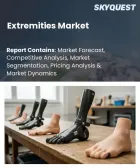
의지, 보조기, 외과용 임플란트를 포함한 전 세계 사지 보철·보조기 시장은 외상, 선천성 질환 또는 노화에 따른 질환으로 고통받는 분들이 이동 능력과 자립성을 되찾는 데 있어 매우 중요한 역할을 하고 있으며, 궁극적으로는 의료비 절감으로도 이어집니다. 이 시장의 성장은 고령화와 교통사고 증가를 배경으로 한 사지 상실 및 근골격계 질환 발생률의 상승에 힘입어 이루어지고 있습니다. 이 시장은 기본적인 목재 의족에서 시작해, 첨단 마이크로프로세서 제어 방식의 생체공학 장치 및 3D 프린팅 제품으로 발전해 왔습니다. 디지털 제조 및 재활 분야의 주요 발전으로 인해 납기 기간이 단축되고 환자의 치료 성과가 향상되었습니다. 제품 개발에 AI 기반 자동화를 도입함으로써 신속한 프로토타이핑과 맞춤형 솔루션을 가능하게 하고, 끊임없이 변화하는 환경에서 제조업체가 시장 수요에 민첩하게 대응할 수 있도록 지원함으로써 이 분야에 새로운 변화를 가져왔습니다.
세계 사지용 기기 시장의 성장요인
세계 사지용 기기 시장에서는 편의성 추구와 의료 현장에서의 노출을 피하고자 하는 환자들의 요구를 배경으로, 재택 재활 서비스로의 뚜렷한 전환이 진행되고 있습니다. 이러한 추세를 반영하여 각 제조사들은 사용자 친화적인 인터페이스와 무선 연결 기능을 갖춘, 모듈식이며 경량인 사지용 기기 장치 개발에 주력하고 있습니다. 재택 치료에 대한 수요를 충족시키는 제품을 설계함으로써, 기업은 더 폭넓은 고객층을 개척하고, 고령자나 이동에 어려움을 겪는 분들의 도입률을 높이며, 지속적인 이용을 촉진할 수 있으며, 이 모든 것이 시장의 눈부신 성장에 기여하고 있습니다. 또한, 이러한 편의성 덕분에 환자는 지속적인 치료에 대해 더 큰 자신감을 가질 수 있습니다.
세계 사지용 기기 시장의 제약요인
첨단 사지용 기기에 수반되는 높은 비용은, 특히 비용에 민감한 환경에서 의료 제공자와 환자 모두에게 큰 장벽이 되고 있습니다. 이러한 고액의 도입 비용은 병원이나 진료소가 신기술을 도입하는 데 걸림돌이 되어, 결과적으로 현재의 임상 요건을 충족하지 못할 가능성이 있는 구형 장비에 의존할 수밖에 없는 상황을 초래하고 있습니다. 그 결과, 재정적 제약이 혁신적인 솔루션의 광범위한 도입을 방해하고 업계 전반의 성장 잠재력을 제한함에 따라 시장 침투율은 하락하고 있습니다. 이러한 경제적 문제는 상환 제도가 미비한 개발도상국 시장에서 특히 두드러지게 나타나며, 수요를 더욱 제한하고 이 분야의 발전을 저해하고 있습니다.
세계 사지용 기기 시장의 동향
세계 사지용 기기 시장의 동향은 3D 프린팅, 생체적합성 소재, AI를 활용한 설계의 발전에 힘입어 점점 더 맞춤형 의수·의족의 통합 방향으로 나아가고 있습니다. 이러한 혁신을 통해 개별적인 해부학적 구조와 기능적 요구 사항에 맞춘 사지용 기기을 제작할 수 있게 되었으며, 이로 인해 적응에 소요되는 시간을 대폭 단축하는 동시에 환자의 편안함과 장기적인 치료 성과를 향상시키고 있습니다. 각 제조사는 의료기관과 전략적으로 협력하여 모듈식 플랫폼을 구축하고 있습니다. 이를 통해 환자의 회복 상태나 활동 수준의 변화에 따라 보조기를 신속하게 재구성할 수 있게 됩니다. 이러한 전환은 기존의 '일률적인' 솔루션에서 보다 맞춤형 제품 포트폴리오로의 명확한 전환을 보여주며, 환자 중심의 치료와 만족도 향상을 촉진하고 있습니다.
자주 묻는 질문
목차
소개
조사 방법
주요 요약
시장 역학과 전망
주요 시장 인사이트
세계의 사지용 기기 시장 규모 : 제품 유형별
세계의 사지용 기기 시장 규모 : 소재별
세계의 사지용 기기 시장 규모 : 용도별
세계의 사지용 기기 시장 규모 : 최종사용자별
세계의 사지용 기기 시장 규모 : 지역별
경쟁 정보
주요 기업 개요
결론과 제안
KSM 26.07.22Global Extremities Market size was valued at USD 14.43 Billion in 2024 and is poised to grow from USD 15.21 Billion in 2025 to USD 23.16 Billion by 2033, growing at a CAGR of 5.4% during the forecast period (2026-2033).
The global extremities market, which includes prosthetic limbs, orthotic supports, and surgical implants, plays a vital role in restoring mobility and independence to individuals affected by trauma, congenital issues, or age-related conditions, ultimately lowering healthcare costs. Growth is being fueled by increasing rates of limb loss and musculoskeletal disorders, driven by an aging demographic and rising traffic accidents. The market has transitioned from basic wooden prosthetics to advanced microprocessor-controlled bionic devices and 3D-printed options. Key advancements in digital manufacturing and rehabilitation have streamlined delivery times and enhanced patient outcomes. The incorporation of AI-driven automation in product development has further revolutionized the sector by facilitating rapid prototyping and personalized solutions, enabling manufacturers to remain agile and responsive to market demands in an evolving landscape.
Top-down and bottom-up approaches were used to estimate and validate the size of the Global Extremities market and to estimate the size of various other dependent submarkets. The research methodology used to estimate the market size includes the following details: The key players in the market were identified through secondary research, and their market shares in the respective regions were determined through primary and secondary research. This entire procedure includes the study of the annual and financial reports of the top market players and extensive interviews for key insights from industry leaders such as CEOs, VPs, directors, and marketing executives. All percentage shares split, and breakdowns were determined using secondary sources and verified through Primary sources. All possible parameters that affect the markets covered in this research study have been accounted for, viewed in extensive detail, verified through primary research, and analyzed to get the final quantitative and qualitative data.
Global Extremities Market Segments Analysis
Global extremities market is segmented by product type, material, application, end user and region. Based on product type, the market is segmented into Upper Extremity Implants, Lower Extremity Implants, Fixation Devices and Others. Based on material, the market is segmented into Metallic Biomaterials, Polymeric Biomaterials, Bioabsorbable Polymers and Others. Based on application, the market is segmented into Joint Reconstruction, Trauma Fracture Repair, Osteoarthritis Management and Others. Based on end user, the market is segmented into Hospitals, Ambulatory Surgical Centers, Orthopedic Specialty Clinics and Others. Based on region, the market is segmented into North America, Europe, Asia Pacific, Latin America and Middle East & Africa.
Driver of the Global Extremities Market
The Global Extremities market is experiencing a notable shift towards home-based rehabilitation services, driven by patient demand for convenience and reduced exposure to clinical environments. This trend has prompted manufacturers to innovate and create modular, lightweight extremities devices that feature user-friendly interfaces and wireless connectivity. By designing products that cater to the preferences of home therapy, companies can tap into a broader customer base, enhance adoption rates among older adults and those with mobility challenges, and encourage sustained usage, all of which contribute to significant market growth. Additionally, this convenience instills greater confidence in patients regarding their ongoing therapy.
Restraints in the Global Extremities Market
The elevated costs associated with advanced extremities devices pose a significant obstacle for both healthcare providers and patients, especially in cost-conscious settings. These high acquisition expenses deter hospitals and clinics from adopting new technologies, leading them to depend on outdated equipment that may fail to meet current clinical requirements. As a result, the rate of market penetration diminishes, as financial limitations hinder the broad adoption of innovative solutions and restrict the overall growth potential of the industry. This economic issue is particularly pronounced in developing markets with inadequate reimbursement systems, further limiting demand and stalling progress in the sector.
Market Trends of the Global Extremities Market
The Global Extremities market is increasingly trending towards personalized prosthetic integration, driven by advancements in 3D printing, bio-compatible materials, and AI-driven design. These innovations facilitate the production of extremity devices that are tailored to individual anatomy and functional requirements, significantly reducing adaptation times and enhancing patient comfort and long-term outcomes. Manufacturers are strategically collaborating with medical institutions to create modular platforms, allowing for rapid reconfiguration of devices as patients recover or their activity levels shift. This transition marks a clear movement away from traditional one-size-fits-all solutions towards a more customized product portfolio, fostering improved patient-centric care and satisfaction.
Table of Contents
Introduction
- Objectives of the Study
- Market Definition & Scope
Research Methodology
- Research Process
- Secondary & Primary Data Methods
- Market Size Estimation Methods
Executive Summary
- Global Market Outlook
- Key Market Highlights
- Segmental Overview
- Competition Overview
Market Dynamics & Outlook
- Macro-Economic Indicators
- Drivers & Opportunities
- Restraints & Challenges
- Supply Side Trends
- Demand Side Trends
- Porters Analysis & Impact
- Competitive Rivalry
- Threat of Substitute
- Bargaining Power of Buyers
- Threat of New Entrants
- Bargaining Power of Suppliers
Key Market Insights
- Key Success Factors
- Market Impacting Factors
- Top Investment Pockets
- Ecosystem Mapping
- Market Attractiveness Index 2025
- PESTEL Analysis
- Regulatory Landscape
Global Extremities Market Size by Product Type & CAGR (2026-2033)
- Market Overview
- Upper Extremity Implants
- Shoulder Implants
- Elbow Implants
- Hand and Wrist Implants
- Lower Extremity Implants
- Ankle Implants
- Foot and Toe Implants
- Fixation Devices
- Internal Fixation Devices
- External Fixation Devices
- Others
Global Extremities Market Size by Material & CAGR (2026-2033)
- Market Overview
- Metallic Biomaterials
- Titanium Alloys
- Stainless Steel
- Cobalt-Chromium Alloys
- Polymeric Biomaterials
- Bioabsorbable Polymers
- Others
Global Extremities Market Size by Application & CAGR (2026-2033)
- Market Overview
- Joint Reconstruction
- Trauma Fracture Repair
- Osteoarthritis Management
- Others
Global Extremities Market Size by End User & CAGR (2026-2033)
- Market Overview
- Hospitals
- Ambulatory Surgical Centers
- Orthopedic Specialty Clinics
- Others
Global Extremities Market Size & CAGR (2026-2033)
- North America (Product Type, Material, Application, End User)
- US
- Canada
- Europe (Product Type, Material, Application, End User)
- Germany
- Spain
- France
- UK
- Italy
- Rest of Europe
- Asia Pacific (Product Type, Material, Application, End User)
- China
- India
- Japan
- South Korea
- Rest of Asia-Pacific
- Latin America (Product Type, Material, Application, End User)
- Mexico
- Brazil
- Rest of Latin America
- Middle East & Africa (Product Type, Material, Application, End User)
- GCC Countries
- South Africa
- Rest of Middle East & Africa
Competitive Intelligence
- Top 5 Player Comparison
- Market Positioning of Key Players, 2025
- Strategies Adopted by Key Market Players
- Recent Developments in the Market
- Company Market Share Analysis, 2025
- Company Profiles of All Key Players
- Company Details
- Product Portfolio Analysis
- Company's Segmental Share Analysis
- Revenue Y-O-Y Comparison (2023-2025)
Key Company Profiles
- Stryker Corporation
- Company Overview
- Business Segment Overview
- Financial Updates
- Key Developments
- Zimmer Biomet Holdings, Inc.
- Company Overview
- Business Segment Overview
- Financial Updates
- Key Developments
- Johnson & Johnson Services, Inc.
- Company Overview
- Business Segment Overview
- Financial Updates
- Key Developments
- Smith & Nephew plc
- Company Overview
- Business Segment Overview
- Financial Updates
- Key Developments
- Enovis Corporation
- Company Overview
- Business Segment Overview
- Financial Updates
- Key Developments
- Medartis Holding AG
- Company Overview
- Business Segment Overview
- Financial Updates
- Key Developments
- Acumed LLC
- Company Overview
- Business Segment Overview
- Financial Updates
- Key Developments
- Arthrex, Inc.
- Company Overview
- Business Segment Overview
- Financial Updates
- Key Developments
- Conmed Corporation
- Company Overview
- Business Segment Overview
- Financial Updates
- Key Developments
- Ossur hf.
- Company Overview
- Business Segment Overview
- Financial Updates
- Key Developments
- Paragon 28, Inc.
- Company Overview
- Business Segment Overview
- Financial Updates
- Key Developments
- MicroPort Scientific Corporation
- Company Overview
- Business Segment Overview
- Financial Updates
- Key Developments
- Skeletal Dynamics, Inc.
- Company Overview
- Business Segment Overview
- Financial Updates
- Key Developments
- Integra LifeSciences Holdings Corporation
- Company Overview
- Business Segment Overview
- Financial Updates
- Key Developments
- Corin Group
- Company Overview
- Business Segment Overview
- Financial Updates
- Key Developments
- TriMed, Inc.
- Company Overview
- Business Segment Overview
- Financial Updates
- Key Developments
- Exactech, Inc.
- Company Overview
- Business Segment Overview
- Financial Updates
- Key Developments
- Orthofix Medical Inc.
- Company Overview
- Business Segment Overview
- Financial Updates
- Key Developments
- OsteoMed LLC
- Company Overview
- Business Segment Overview
- Financial Updates
- Key Developments
- Grupo Industrial Saltillo
- Company Overview
- Business Segment Overview
- Financial Updates
- Key Developments


