

|
시장보고서
상품코드
2154813
발전소용 머플러 : 시장 점유율 분석, 업계 동향과 통계, 성장 예측(2026-2031년)Power Plant Muffler - Market Share Analysis, Industry Trends & Statistics, Growth Forecasts (2026 - 2031) |
||||||
 Mordor Intelligence
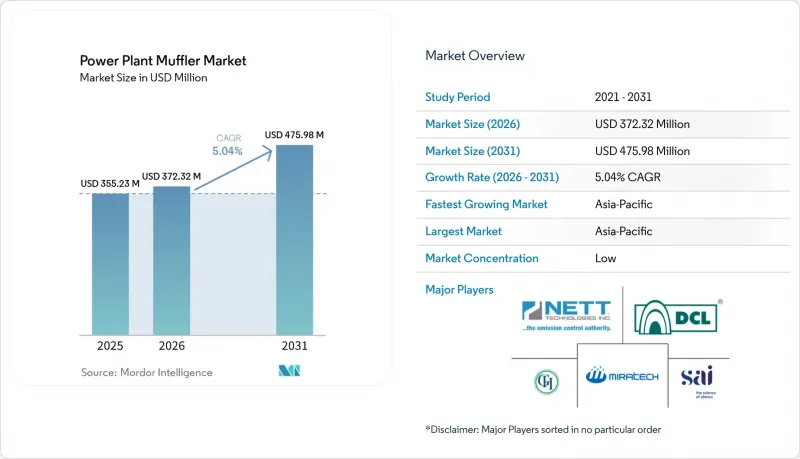
에 따르면 발전소용 머플러 시장 규모는 2025년 3억 5,523만 달러, 2026년 3억 7,232만 달러에서 2031년까지 4억 7,598만 달러로 확대될 것으로 예측되며, 2026년부터 2031년까지 연평균 성장률(CAGR)은 5.04%가 될 전망입니다.
전 세계 발전소용 머플러 시장의 동향 및 인사이트
분산형 및 백업 전력 인프라의 확대
분산형 에너지 네트워크와 백업 시스템은 산업용 배기 소음기의 수요를 뒷받침하고 있습니다. 컨테이너형 가스 발전기나 계량기 후방의 왕복 엔진에는 각각 설치 장소에 적합한 배기 시스템이 필요합니다. 지역의 소음 규제 및 허가 조건에 따라, 규정을 준수하는 소음 저감 장치는 초기 설비 패키지의 일부로 포함되고 있습니다. 주거지와 가까운 밀집된 도시 지역이나 산업 단지에서는 대부분의 경우 크리티컬 등급 또는 병원 등급의 소음 저감 성능이 요구됩니다. 이러한 용도는 음향 전문가에게 더 높은 부가가치를 지닌 설계를 제공할 수 있는 기회가 됩니다. 입지 제한이 엄격한 장소에 분산형 발전 설비가 도입될 경우, 발전소용 머플러 시장은 그 혜택을 누리게 됩니다.
이러한 요건은 신규 설비에만 국한되지 않습니다. 용도 변경, 확장 또는 허가 조건 개정에 따라 새로운 소음 조건이 발생할 경우, 기존 시설에서도 업그레이드가 필요할 수 있습니다. 따라서 공급업체에게는 신규 설비 수주뿐만 아니라 교체 공사에서도 비즈니스 기회가 있습니다. 설치 장소의 상황에 따라 필요한 소음 저감 수준과 설치 구성이 결정됩니다. 따라서 엔진의 크기, 배기 온도, 이용 가능한 공간에 맞춰 설계를 조정할 수 있는 기업이 유리합니다. 발전소용 머플러 시장은 이러한 설치 장소에 따른 엔지니어링에 대한 지속적인 수요에 의해 뒷받침되고 있습니다.
소음 및 배기가스 배출 규제의 강화
근로 환경 및 환경 관련 규제로 인해 문서화된 음향 성능의 중요성이 높아지고 있습니다. OSHA(미국 직업안전보건청)의 직업 소음 기준에 따르면, 근로자가 규정된 한계치를 초과하는 소음에 노출될 경우, 고용주는 실행 가능한 공학적 대책 또는 관리적 대책을 시행해야 합니다. 유럽의 환경 소음 지침 및 플랜트 수준의 배출 규제도 고정형 발생원에서 발생하는 소음에 더욱 주목하고 있습니다. ISO는 2026년 4월에 ISO 14001:2026을 공표하여 환경 경영 시스템의 요구 사항을 업데이트했습니다. 인증을 받은 사업자는 자사의 경영 시스템 하에서 측정 가능한 환경 성과를 입증해야 합니다. 이러한 상황은 명확한 시험 결과와 재료에 관한 문서가 갖춰진 머플러에 대한 수요를 뒷받침하고 있습니다.
표준적인 감쇠 설계로는 더욱 엄격한 심사를 받고 있는 시설의 요구 사항을 충족하지 못할 가능성이 있습니다. 복합형이나 다실식 흡음 제품은 단일 메커니즘 제품보다 더 넓은 주파수 범위를 대응할 수 있습니다. 조달 팀은 검증된 삽입 손실 데이터를 바탕으로 설계를 비교할 수도 있습니다. 따라서 발전소용 머플러 시장에서는 시험 기록과 일관된 제조 관리가 더욱 중요시되고 있습니다. 평판이 좋은 공급업체는 입찰 자격 심사 과정에서 인증 및 제품 문서를 활용할 수 있습니다. 소규모 기업은 규제 대상 프로젝트를 수주하기 위해 이러한 역량을 강화해야 할 수도 있습니다.
스테인리스강, 니켈 합금 및 음향 충전재의 가격 변동
자재비 변동은 고정 가격 프로젝트 계약 하에서 사업을 수행하는 제조업체의 이익률을 압박할 가능성이 있습니다. 스테인리스강과 니켈 합금은 고온 배기가스에 노출되는 장비에 있어 중요한 소재입니다. 흡음 패킹재 또한 제품의 원가와 조달 가능성에 영향을 미칩니다. 프로젝트 수주 잔고가 많은 공급업체는 계약 체결 후 원자재 가격이 상승할 경우 더 큰 위험에 직면할 가능성이 있습니다. 따라서 발전소용 머플러 시장에서는 대규모 조달 능력과 엄격한 계약 관리를 수행하는 기업이 유리할 수 있습니다. 소규모 지역 제조업체는 급격한 비용 변동을 흡수할 여력이 제한적일 수 있습니다.
대형 공급업체는 계약에서 허용되는 경우, 원자재 헤지, 이중 조달 및 가격 조정 조항을 활용할 수 있습니다. 또한, 미네랄울이나 세라믹 파이버를 여러 공급업체로부터 조달하는 것도 가능합니다. 이러한 조치들이 비용 리스크를 완전히 제거하는 것은 아니지만, 단일 원자재나 공급업체에 대한 의존도를 낮출 수는 있습니다. 자재는 성능 및 온도 요건을 충족해야 하기 때문에 프로젝트 일정도 더욱 복잡해지고 있습니다. 발전소용 머플러 시장은 여전히 인증된 자재의 확보 가능성에 민감합니다. 이 문제는 고온용이나 특별 주문에서 가장 두드러지게 나타납니다.
부문 분석
2025년 기준, 흡수형 머플러는 발전소용 머플러 시장 규모의 45.9%를 차지했습니다. 이는 천연가스 왕복 엔진 및 디젤 발전기 세트에서의 오랜 도입 실적을 반영한 것입니다. 미네랄울이나 세라믹 파이버 충전재는 500 Hz 이상의 주파수를 감쇠시킬 수 있습니다. 이 설계는 반응형 시스템에서 사용되는 공진 공동의 조정 작업이 필요하지 않습니다. 익숙한 재료를 사용하여 광대역 제어가 필요한 경우, 여전히 실용적인 선택지입니다. 발전소용 머플러 업계에서는 확립된 엔진 용도에서 계속해서 흡음형 제품이 사용되고 있습니다.
반응형 머플러는 공진기나 팽창실을 이용하여 저주파음을 음원 방향으로 반사시킵니다. 이들은 명확한 음조 주파수를 가진 대형 가스 터빈 배기 시스템에서 여전히 중요한 역할을 하고 있습니다. 복합형 머플러는 2031년까지 연평균 성장률(CAGR) 5.9%로 성장할 것으로 예측되며, 이는 머플러 유형 중 가장 높은 성장률입니다. 이 제품은 반응형 챔버를 통한 저주파 제어와 흡음재를 통한 광대역 감쇠를 결합하고 있습니다. 이로 인해 복잡한 음향 특성을 보이는 가스 터빈에 적합합니다. 발전소용 머플러 시장에서는 하나의 설계로 여러 음향 요구 사항을 충족할 수 있는 제품에 대한 수요가 증가하고 있습니다.
지역별 분석
아시아태평양은 2025년 발전소용 머플러 시장 규모의 39.6%를 차지하고 있으며, 2031년까지 연평균 성장률(CAGR) 6.2%로 성장할 것으로 예측됩니다. 이 지역에서는 새로운 가스 발전 용량의 증가, 도시 지역의 소음 규제 강화, 데이터센터에 대한 투자 확대가 맞물려 수요를 견인하고 있습니다. 중국과 인도는 산업 및 인프라 활동에서 백업 전원과 분산형 발전이 요구되기 때문에 중요한 대량 판매 시장이 되고 있습니다. 베트남, 인도네시아, 태국, 한국 역시 제조업의 성장과 송전망 신뢰성 확보에 대한 필요성을 통해 수요를 끌어올리고 있습니다. 이들 국가에서는 발전기 패키지에 규정을 준수하는 배기 시스템이 포함되어 있기 때문에 발전소용 머플러 시장이 혜택을 볼 가능성이 있습니다. 규제 요건이 강화됨에 따라 기존 설비 전반에 걸친 향후 업그레이드 수요도 발생할 가능성이 있습니다.
북미는 2025년 지역별 점유율에서 2위를 차지했습니다. 이 지역은 발전기 투자, 규제된 노동 환경, 그리고 중요도가 높은 방음 장비에 대한 수요로 인해 혜택을 보고 있습니다. OSHA(미국 직업안전보건청)는 관련 직업적 소음 상황에 대해 고용주가 공학적 대책을 검토할 것을 의무화하고 있습니다. 데이터센터의 발전기 군은 성능에 대한 문서화가 중요한 프리미엄 주문을 뒷받침하고 있습니다. 윌리엄스사는 2026년 7월, 미국 내 5건의 ‘비하인드 더 미터(Behind the Meter)’형 가스 화력 ‘파워 이노베이션(Power Innovation)’ 프로젝트에 대해 53억 달러의 자본 투자를 결정했다고 발표했습니다. 이러한 프로젝트들은 설계된 배기 설비에 대한 미래의 수요 기반을 뒷받침할 것입니다.
유럽의 수요는 환경 소음 규제, 산업 배출 요건, 그리고 독일의 ‘TA Larm’과 같은 각국 고유의 요건에 의해 형성되고 있습니다. 가스 발전 설비의 현대화 및 재가동 작업은 교체 및 개보수 수주를 촉진할 가능성이 있습니다. 남미는 시장 규모는 작지만, 외딴 지역의 산업 시설이나 석유·가스 시설에 디젤 및 가스 발전기를 설치함으로써 수요가 발생하고 있습니다. 중동 및 아프리카에서는 각국의 에너지 다각화 프로그램에 따라 가스 화력 발전 용량이 확대되고 있습니다. 모로코의 재생에너지 개발에 따라, 간헐적인 발전량을 보완하기 위한 가스 화력 피크 발전 용량이 필요할 가능성이 있습니다. 발전소용 머플러 시장에서는 열대, 사막 또는 변동하는 운전 요건에 대응할 수 있는 공급업체에게 이러한 지역에서 비즈니스 기회가 있습니다.
기타 혜택:
- 엑셀 형식의 시장 예측(ME) 시트
- 3개월간의 애널리스트 지원
자주 묻는 질문
목차
제1장 소개
- 조사 가정과 시장 정의
- 조사 범위
제2장 조사 방법
제3장 주요 요약
제4장 시장 구도
- 시장 개요
- 시장 성장 촉진요인
- 시장 성장 억제요인
- 공급망 분석
- Porter's Five Forces 분석
- 기술 동향
- 규제 상황
- 투자 분석
제5장 시장 규모와 성장 예측
- 머플러 종류별
- 연료 유형별
- 지역별
- 북미
- 미국
- 캐나다
- 멕시코
- 유럽
- 독일
- 프랑스
- 이탈리아
- 스페인
- 영국
- 폴란드
- 러시아
- 기타 유럽 국가
- 아시아태평양
- 중국
- 인도
- 일본
- 한국
- 호주
- 인도네시아
- 베트남
- 태국
- 기타 아시아태평양 국가
- 남미
- 브라질
- 아르헨티나
- 칠레
- 기타 남미 국가
- 중동 및 아프리카
- 사우디아라비아
- 아랍에미리트
- 이집트
- 남아프리카공화국
- 모로코
- 기타 중동 및 아프리카 국가
- 북미
제6장 경쟁 구도
- 시장 집중도
- 전략적 동향
- 시장 점유율 분석
- 기업 개요
- Catalyst Products International
- Caterpillar Inc.
- Cummins Inc.
- DCL International Inc.
- Donaldson Company, Inc.
- Durr Universal, Inc.
- ECI-Exhaust & Emissions Control
- Ergil Group
- Fischer Abgastechnik GmbH & Co. KG
- G+H Group
- IAC Acoustics
- Jeremias Abgastechnik GmbH
- MIRATECH Corporation
- Nelson Global Products
- Nett Technologies Inc.
- SAI-Societe d'Acoustique Industrielle
- Schiedel GmbH & Co. KG
- STOPSON Italiana S.R.L.
- Universal Silencer
- Wartsila Corporation
제7장 시장 기회와 향후 전망
KSM 26.10.29According to Mordor Intelligence, the power plant muffler market size is projected to expand from USD 355.23 million in 2025 and USD 372.32 million in 2026 to USD 475.98 million by 2031, at a CAGR of 5.04% between 2026 and 2031.
Global Power Plant Muffler Market Trends and Insights
Expansion of Distributed and Backup Power Infrastructure
Distributed energy networks and backup systems support demand for industrial exhaust silencers. Each containerized gas generator or behind-the-meter reciprocating engine requires an exhaust system suited to its site. Local noise limits and permit conditions make compliant attenuation equipment part of the initial equipment package. Dense urban districts and industrial parks near residential areas often require critical or hospital-grade attenuation. These applications give acoustic specialists opportunities to supply higher-value designs. The Power plant muffler market benefits when distributed generation is installed in locations with tighter siting limits.
The requirement is not limited to new capacity. Existing facilities can need upgrades when a change in use, an expansion, or a revised permit brings new noise conditions. Suppliers therefore have opportunities in replacement work as well as original equipment orders. The site setting determines the required attenuation level and installation configuration. This favors companies that can adapt designs to engine size, exhaust temperature, and available space. The Power plant muffler market is supported by this recurring need for site-specific engineering.
Tightening Noise and Exhaust-Emission Compliance Requirements
Occupational and environmental requirements are increasing the importance of documented acoustic performance. OSHA's occupational noise standard requires employers to use feasible engineering or administrative controls when workers are exposed above specified limits. The European Environmental Noise Directive and plant-level emissions rules also place more attention on stationary-source noise. ISO published ISO 14001:2026 in April 2026, which updates environmental management system requirements. Certified operators must be able to show measurable environmental performance under their management systems. These conditions support demand for mufflers with clear testing and material documentation.
Standard attenuation designs may not meet the needs of facilities facing stricter review. Combination and multichamber absorptive products can address a broader range of frequencies than single-mechanism products. Procurement teams can also compare designs based on verified insertion-loss data. The Power plant muffler market, therefore, places greater value on test records and consistent manufacturing controls. Established suppliers can use certification and product documentation during tender qualification. Smaller firms may need to strengthen those capabilities to compete for regulated projects.
Volatility in Stainless Steel, Nickel Alloys, and Acoustic Packing Materials
Material-cost changes can reduce margins for manufacturers working under fixed-price project contracts. Stainless steel and nickel alloys are important for equipment exposed to high exhaust temperatures. Acoustic packing materials also affect product cost and availability. Suppliers with long project backlogs may face greater risk when input prices rise after a contract is signed. The Power plant muffler market can therefore favor companies with purchasing scale and disciplined contract management. Smaller regional fabricators may have less room to absorb sudden cost changes.
Larger suppliers can use material hedging, dual sourcing, and escalation clauses where their contracts permit them. They can also source mineral wool or ceramic fiber from more than 1 supplier. These measures do not remove cost risk, but they can reduce exposure to a single input or supplier. Project schedules add another complication because material must meet performance and temperature requirements. The Power plant muffler market remains sensitive to the availability of qualified materials. The issue is most visible on high-temperature and custom-engineered orders.
Other drivers and restraints analyzed in the detailed report include:
- Growth of Data Centers and Mission-Critical Generator Fleets
- Expansion of Gas-Fired and Combined Heat and Power Generation
- Thermal and Pressure-Drop Trade-Offs in High-Attenuation Designs
For complete list of drivers and restraints, kindly check the Table Of Contents.
Segment Analysis
Absorptive mufflers held 45.9% of the Power plant muffler market size in 2025. Their long deployment history reflects their use on natural gas reciprocating engines and diesel generator sets. Mineral wool and ceramic fiber packing can attenuate frequencies above 500 Hz. This design does not require the tuned cavity work used in reactive systems. It remains a practical option where broadband control is needed with familiar materials. The Power plant muffler industry continues to use absorptive products across established engine applications.
Reactive mufflers use resonators and expansion chambers to reflect low-frequency sound toward its source. They remain relevant for large gas turbine exhaust systems with discrete tonal frequencies. Combination mufflers are forecast to grow at a 5.9% CAGR through 2031, the fastest rate among muffler types. They combine low-frequency control from reactive chambers with broadband attenuation from absorptive packing. This makes them suited to gas turbines that create complex acoustic profiles. The Power plant muffler market has a growing need for products that can meet several acoustic requirements in one design.
Complete Report Scope:
- By Muffler Type
- Reactive
- Absorptive
- Combination
- By Fuel Type
- Diesel
- Gas
- Others
- By Geography
- North America
- United States
- Canada
- Mexico
- Europe
- Germany
- France
- Italy
- Spain
- United Kingdom
- Poland
- Russia
- Rest of Europe
- Asia-Pacific
- China
- India
- Japan
- South Korea
- Australia
- Indonesia
- Vietnam
- Thailand
- Rest of Asia-Pacific
- South America
- Brazil
- Argentina
- Chile
- Rest of South America
- Middle East and Africa
- Saudi Arabia
- United Arab Emirates
- Egypt
- South Africa
- Morocco
- Rest of Middle East and Africa
- North America
Geography Analysis
Asia-Pacific held 39.6% of the Power plant muffler market size in 2025 and is forecast to grow at a 6.2% CAGR through 2031. The region combines new gas capacity, tighter urban noise controls, and expanding data center investment. China and India are important volume markets because industrial and infrastructure activity requires backup and distributed generation. Vietnam, Indonesia, Thailand, and South Korea also add demand through manufacturing growth and grid reliability needs. The Power plant muffler market can benefit as generator packages in these countries include compliant exhaust systems. Higher regulatory requirements can also create future upgrade demand across the installed base.
North America held the second-largest regional share in 2025. The region benefits from generator investment, regulated work environments, and demand for critical-grade acoustic equipment. OSHA requires employers to consider engineering controls in relevant occupational-noise situations. Data center generator fleets support premium orders where performance documentation is important. Williams announced USD 5.3 billion in committed capital for 5 behind-the-meter gas-fired Power Innovation projects in the United States in July 2026. These projects support a future demand base for engineered exhaust equipment.
Europe's demand is shaped by environmental noise rules, industrial emissions requirements, and national requirements such as Germany's TA Larm. Modernization and recommissioning work in gas capacity can support replacement and retrofit orders. South America is smaller but draws demand from diesel and gas generator installations at remote industrial and oil and gas facilities. The Middle East and Africa are adding gas-fired capacity under national diversification programs. Morocco's renewable development can require gas peaking capacity to support intermittent generation. The Power plant muffler market has opportunities in these locations where suppliers can meet tropical, desert, or variable operating requirements.
- Catalyst Products International
- Caterpillar Inc.
- Cummins Inc.
- DCL International Inc.
- Donaldson Company, Inc.
- Durr Universal, Inc.
- ECI - Exhaust & Emissions Control
- Ergil Group
- Fischer Abgastechnik GmbH & Co. KG
- G+H Group
- IAC Acoustics
- Jeremias Abgastechnik GmbH
- MIRATECH Corporation
- Nelson Global Products
- Nett Technologies Inc.
- SAI - Societe d'Acoustique Industrielle
- Schiedel GmbH & Co. KG
- STOPSON Italiana S.R.L.
- Universal Silencer
- Wartsila Corporation
Additional Benefits:
- The market estimate (ME) sheet in Excel format
- 3 months of analyst support
TABLE OF CONTENTS
1 INTRODUCTION
- 1.1 Study Assumptions and Market Definition
- 1.2 Scope of the Study
2 RESEARCH METHODOLOGY
3 EXECUTIVE SUMMARY
4 MARKET LANDSCAPE
- 4.1 Market Overview
- 4.2 Market Drivers
- 4.2.1 Expansion of Distributed and Backup Power Infrastructure
- 4.2.2 Tightening Noise and Exhaust-Emission Compliance Requirements
- 4.2.3 Growth of Data Centers and Mission-Critical Generator Fleets
- 4.2.4 Expansion of Gas-Fired and Combined Heat and Power Generation
- 4.2.5 Retrofit Demand from Integrated Muffler-Emission Control Systems
- 4.2.6 Site-Specific Acoustic Design for Renewable-Heavy Grids
- 4.3 Market Restraints
- 4.3.1 Thermal and Pressure-Drop Trade-Offs in High-Attenuation Designs
- 4.3.2 High Retrofit Complexity in Space-Constrained Existing Plants
- 4.3.3 Electrification and Renewable Generation Displacing Stationary Internal-Combustion Capacity
- 4.3.4 Volatility in Stainless Steel, Nickel Alloys, and Acoustic Packing Materials
- 4.4 Supply-Chain Analysis
- 4.5 Porter's Five Forces Analysis
- 4.5.1 Bargaining Power of Suppliers
- 4.5.2 Bargaining Power of Buyers
- 4.5.3 Threat of New Entrants
- 4.5.4 Threat of Substitutes
- 4.5.5 Competitive Rivalry
- 4.6 Technology Outlook
- 4.7 Regulatory Landscape
- 4.8 Investment Analysis
5 MARKET SIZE AND GROWTH FORECASTS
- 5.1 By Muffler Type
- 5.1.1 Reactive
- 5.1.2 Absorptive
- 5.1.3 Combination
- 5.2 By Fuel Type
- 5.2.1 Diesel
- 5.2.2 Gas
- 5.2.3 Others
- 5.3 By Geography
- 5.3.1 North America
- 5.3.1.1 United States
- 5.3.1.2 Canada
- 5.3.1.3 Mexico
- 5.3.2 Europe
- 5.3.2.1 Germany
- 5.3.2.2 France
- 5.3.2.3 Italy
- 5.3.2.4 Spain
- 5.3.2.5 United Kingdom
- 5.3.2.6 Poland
- 5.3.2.7 Russia
- 5.3.2.8 Rest of Europe
- 5.3.3 Asia-Pacific
- 5.3.3.1 China
- 5.3.3.2 India
- 5.3.3.3 Japan
- 5.3.3.4 South Korea
- 5.3.3.5 Australia
- 5.3.3.6 Indonesia
- 5.3.3.7 Vietnam
- 5.3.3.8 Thailand
- 5.3.3.9 Rest of Asia-Pacific
- 5.3.4 South America
- 5.3.4.1 Brazil
- 5.3.4.2 Argentina
- 5.3.4.3 Chile
- 5.3.4.4 Rest of South America
- 5.3.5 Middle East and Africa
- 5.3.5.1 Saudi Arabia
- 5.3.5.2 United Arab Emirates
- 5.3.5.3 Egypt
- 5.3.5.4 South Africa
- 5.3.5.5 Morocco
- 5.3.5.6 Rest of Middle East and Africa
- 5.3.1 North America
6 COMPETITIVE LANDSCAPE
- 6.1 Market Concentration
- 6.2 Strategic Moves
- 6.3 Market Share Analysis
- 6.4 Company Profiles (includes Global Level Overview, Market Level Overview, Core Segments, Financials as available, Strategic Information, Products and Services, Recent Developments)
- 6.4.1 Catalyst Products International
- 6.4.2 Caterpillar Inc.
- 6.4.3 Cummins Inc.
- 6.4.4 DCL International Inc.
- 6.4.5 Donaldson Company, Inc.
- 6.4.6 Durr Universal, Inc.
- 6.4.7 ECI - Exhaust & Emissions Control
- 6.4.8 Ergil Group
- 6.4.9 Fischer Abgastechnik GmbH & Co. KG
- 6.4.10 G+H Group
- 6.4.11 IAC Acoustics
- 6.4.12 Jeremias Abgastechnik GmbH
- 6.4.13 MIRATECH Corporation
- 6.4.14 Nelson Global Products
- 6.4.15 Nett Technologies Inc.
- 6.4.16 SAI - Societe d'Acoustique Industrielle
- 6.4.17 Schiedel GmbH & Co. KG
- 6.4.18 STOPSON Italiana S.R.L.
- 6.4.19 Universal Silencer
- 6.4.20 Wartsila Corporation
7 MARKET OPPORTUNITIES AND FUTURE OUTLOOK
- 7.1 White-Space and Unmet-Need Assessment


