

|
시장보고서
상품코드
2154947
소화기계 암 치료제 : 시장 점유율 분석, 업계 동향과 통계, 성장 예측(2026-2031년)Gastrointestinal Cancer Drugs - Market Share Analysis, Industry Trends & Statistics, Growth Forecasts (2026 - 2031) |
||||||
 Mordor Intelligence
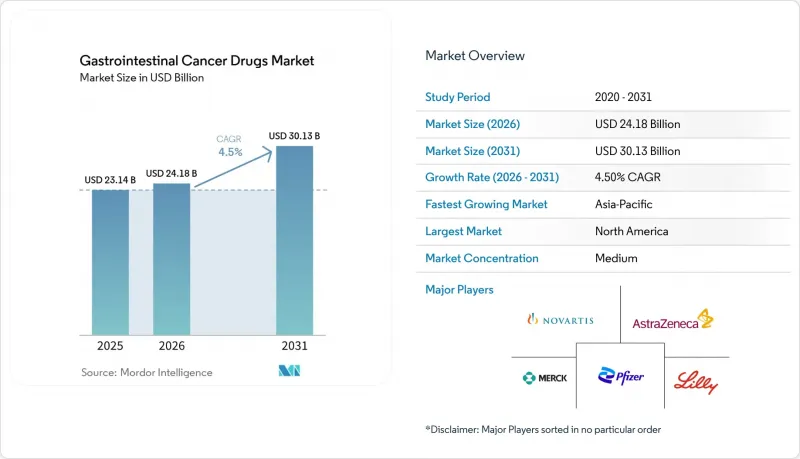
에 따르면 소화기암 치료제 시장 규모는 2025년에 231억 4,000만 달러로 평가되며, 2026년 241억 8,000만 달러에서 2031년까지 301억 3,000만 달러에 달할 것으로 예측되고 있으며, 예측 기간(2026-2031년)에 CAGR은 4.5%에 달할 전망입니다.
세계 소화기암 치료제 시장의 동향 및 인사이트
정밀 종양학 및 바이오마커 기반 치료법의 도입
소화기암 치료제 시장은 종양의 부위뿐만 아니라 바이오마커에 기반한 치료 결정에 의해 점점 더 주도되고 있습니다. 대장암, 위암, 췌장암 치료에서는 KRAS G12C, BRAF V600E, HER2, CLDN18.2, MSI-H/dMMR, MET 증폭 및 NRG1 융합이 활용되고 있습니다. 상업적으로 중요한 표적은 2020년 이후 거의 3배로 증가했습니다. 환자는 질병이 진행된 후 다른 바이오마커 적응 요법으로 전환할 수 있으며, 이를 통해 여러 치료 라인에 걸쳐 치료를 지속할 수 있습니다. 2026년, FDA는 BRAF V600E 변이를 가진 전이성 대장암 환자에서 BRAFTOVI 병용 요법의 동반 진단으로 Guardant360 CDx를 승인했으며, 이를 통해 지역 암 진료 현장에서 체액 생검의 도입과 검사 접근성이 촉진되었습니다.
1차 면역요법의 병용 확대
일차 체크포인트 억제제 병용 요법은 일부 소화기암에서 화학요법 단독 요법을 대체하고 있습니다. 2025년 3월, FDA는 PD-L1 CPS가 1 이상인 HER2 양성 위암 또는 위식도 접합부 선암에 대해 펨브롤리주맙과 트라스투주맙, 그리고 백금 제제 기반 화학요법의 병용 요법을 승인했습니다. 2025년 4월에는 니볼루맙과 이필리무맙의 병용 요법이 MSI-H/dMMR 절제 불가능 또는 전이성 대장암에 대한 1차 치료법으로 일반 승인을 받았습니다. 이러한 치료 요법에서는 치료 시작시 바이오마커 검사가 필요하며, 유지 요법을 24개월 이상 연장할 수 있습니다. 또한 dMMR 대장암의 니볼루맙 치료를 위한 ‘Idylla CDx MSI Test’가 FDA의 승인을 받음에 따라 3시간 이내에 결과를 얻을 수 있는 자동화된 워크플로우도 지지받게 되었습니다.
바이오마커 기반 치료법에서의 비용 및 보험 급여 관련 과제
바이오마커 선별에 기반한 병용 요법은 소화기암 치료에서 가장 비용이 많이 드는 치료 옵션 중 하나입니다. HER2 양성 위선암의 1차 치료에서는 HER2 표적 치료, PD-1 또는 PD-L1 억제제, 그리고 화학요법을 병용하는 경우가 있습니다. 의료기술평가기관은 이러한 병용요법에 대해 생존 기간의 점진적 증가 효과를 바탕으로 평가를 수행하지만, 그 효과는 몇 달 단위가 아닌 몇 주 단위로 측정되는 경우가 있습니다. 유럽의 일부 국가에서는 의약품 보험 급여가 동반 진단을 반드시 포함하지 않기 때문에 검사 실시에 차질이 생기고, 바이오마커 적격 환자에 대한 처방에도 제한이 발생하고 있습니다. 중국의 ‘2025년 국가 보험 급여 의약품 리스트’ 선정 과정에서는 몇 가지 소화기암용 바이오의약품이 대상에 포함되었으며, 리스트에 등재되기 위해서는 40%에서 60%의 가격 인하가 요구되었습니다. 보험 적용 범위의 확대는 접근성 향상으로 이어지지만, 가격 인하는 제조사의 이익률을 떨어뜨리고, 초기 가격이 낮은 국산 제품을 우대하는 결과를 초래할 수도 있습니다.
부문 분석
2025년, 대장암은 소화기암 치료제 시장 점유율의 34.22%를 차지했습니다. 이는 MSI-H/dMMR, BRAF V600E, KRAS G12C, HER2 증폭형 질환 등 바이오마커에 의해 정의된 각 그룹의 확립된 치료 경로에 힘입은 결과입니다. 위암, 위식도 접합부암 및 식도암은 그 다음으로 큰 그룹을 형성하고 있으며, 2025년과 2026년에 HER2 표적 치료제 및 PD-1 억제제가 승인됨에 따라 치료에 대한 사용이 증가하고 있습니다. 췌장암은 가장 빠르게 성장하는 부문으로, 이 부문은 2031년까지 연평균 성장률(CAGR) 5.36%로 성장할 것으로 예측됩니다. 2026년 8월에는 FDA가 선행 전신 요법을 받은 후 전이성 췌장 선암 환자 또는 다제 병용 화학요법을 받을 수 없는 환자를 대상으로 다락손라시브를 승인할 전망입니다. 제3상 RASolute 302 임상시험에서는 화학요법에 비해 사망 위험이 60% 감소하는 것으로 나타났습니다.
달라크손라시브는 췌장암에 대해 승인된 최초의 RAS 표적 억제제가 될 전망이며, 지금까지 화학요법이 주류를 이루던 적응증에서 표적 치료의 적용 범위를 확대하게 될 것입니다. 멜라스(Melas)사는 2024년 12월, NRG1 융합 양성 췌장 선암에 대한 제녹츠주맙의 FDA 신속 승인을 획득했습니다. 2026년 5월, FDA는 제녹츠주맙의 적응증을 선행 전신 요법을 받은 후의 NRG1 융합 양성 담관암으로 확대했습니다. 간암, 항문암 및 기타 소화기암은 점유율이 낮지만, 승인된 전신 치료 옵션이 존재합니다.
2025년 소화기암 치료제 지출 중 68.76%를 종양학과가 차지하고 있으며, 이는 확립된 종양학과 진료 현장에서 정맥 주사 기반 면역요법 및 화학요법의 사용을 반영한 것입니다. 방사선과 및 핵의학 분야는 2031년까지 연평균 성장률(CAGR) 6.33%로 성장할 것으로 예측되며, 이는 전체 적용 분야 중 가장 높은 성장률입니다. 방사성 리간드 요법에는 표준 정맥 주사 서비스를 넘어서는 전문적인 투여 환경이 필요합니다. 이러한 치료법에는 방사선 안전 인증, 차폐된 조제 구역, 그리고 원자력 규제의 대상이 되는 폐기물 처리 절차가 요구됩니다. 이러한 요건으로 인해 초기 단계의 확장은 확립된 인프라를 갖춘 시설로 제한될 것입니다. 지지요법제, 용량 제한 약물, 방사선 감작제 등을 포함하는 기타 적용 범주는 비교적 안정적인 시장 점유율을 유지하고 있습니다.
방사성 리간드 프로그램의 발전에 따라 소화기암 치료제 시장에서는 유통, 교육 및 접근성과 관련된 요건이 추가되고 있습니다. 제조사에게는 단순한 정맥 주사 센터뿐만 아니라, 핵의학 현장에 맞춘 프로그램이 요구되고 있습니다. 신경내분비종양에서 승인된 방사성 리간드 요법은 향후 다른 소화기 계통 악성 종양으로의 확대를 위한 기반이 될 것입니다. 추가 적응증이 규제 당국의 승인을 받음에 따라 임상시험 프로그램을 통해 방사선과 진료 활동이 증가할 가능성이 있습니다. FDA로부터 ‘획기적 치료법(Breakthrough)’ 지정을 받은 방사성 리간드 요법에 대한 신속 심사 절차는 임상 결과부터 의료 현장에 도입되기까지의 기간을 단축할 수 있습니다. 그러나 전문적인 인프라 구축은 단기적인 환자 수 측면에서 여전히 현실적인 제약 요인으로 남아 있습니다.
지역별 분석
2025년, 북미는 소화기암 치료제 시장에서 39.44%의 점유율을 차지했습니다. 이 지역은 2025년 1월부터 2026년 8월까지 소화기암 치료제로서 10건 이상의 FDA 승인을 획득한 혜택을 누렸습니다. 미국은 높은 약가, 높은 바이오마커 검사율, 그리고 신규 승인 약물을 신속하게 보험 적용 대상으로 포함시키는 처방약 리스트 제도를 통해 해당 지역을 주도했습니다. 캐나다와 멕시코는 점유율은 작지만 성장을 지속하고 있으나, 인플레이션 억제법(Inflation Reduction Act)에 따른 가격 협상 체계로 인해 해당 항암제가 승인 후 9년이 경과함에 따라 미국의 가격 우위가 압박받을 가능성이 있습니다.
유럽은 독일, 프랑스, 영국, 이탈리아, 스페인이 주도하며 큰 시장 점유율을 차지했습니다. EU의 IVDR(체외진단용 의료기기 규정) 체계에 따라 규정 준수 요건이 강화되면서, 동반 진단 관련 활동은 대규모 인증 공급업체에 집중되었습니다. 로슈(Roche)사의 ‘VENTANA MMR RxDx Panel’은 2026년 6월, 여러 소화기암 적응증에 대해 IVDR 승인을 획득했습니다. 듀르발맙과 FLOT 병용 요법이 유럽에서 승인됨에 따라 절제 가능한 위암 및 위식도 접합부암에 대한 수술 전후 치료 옵션이 추가되었으나, 의료 기술 평가 결정에 따라 독일과 프랑스에서는 치료 접근이 지연될 가능성이 있습니다.
아시아태평양은 2031년까지 연평균 성장률(CAGR) 6.98%로 확대될 것으로 예측되며, 가장 빠르게 성장하는 지역 부문이 될 전망입니다. 암 발병률 증가, 국내 바이오의약품 생산에 대한 투자, 그리고 규제 심사 신속화가 이러한 성장을 지원하고 있습니다. 중국에서는 2025년 1월 CLDN18.2 양성 위암에 대한 VYLOY가, 2026년 1월에는 HER2 양성 위암의 2차 치료에 대한 엔헤르투가 승인되었습니다. 일본은 2025년 9월에 소트라시브와 파니툼맙의 병용 요법을 승인했으며, 2026년 3월에는 엔헬츠의 첨부 문서를 개정했습니다. 중동 및 아프리카 및 남미는 여전히 시장 기여도가 낮은 편이지만, 아프리카의 암 발병률이 157% 증가할 것이라는 예측은 장기적인 잠재력을 시사하고 있습니다.
기타 혜택:
- 엑셀 형식의 시장 예측(ME) 시트
- 3개월간의 애널리스트 지원
자주 묻는 질문
목차
제1장 서론
- 조사 전제조건과 시장 정의
- 조사 범위
제2장 조사 방법
제3장 개요
제4장 시장 구도
- 시장 개요
- 시장 성장 촉진요인
- 시장 성장 억제요인
- 밸류·공급망 분석
- 규제 상황
- 기술 전망
- Porter's Five Forces 분석
제5장 시장 규모와 성장 예측
- 암 유형별
- 용도별
- 테라피별
- 최종사용자별
- 지역별
- 북미
- 미국
- 캐나다
- 멕시코
- 유럽
- 독일
- 영국
- 프랑스
- 이탈리아
- 스페인
- 기타 유럽 국가
- 아시아태평양
- 중국
- 인도
- 일본
- 호주
- 한국
- 기타 아시아태평양 국가
- 중동 및 아프리카
- GCC
- 남아프리카공화국
- 기타 중동 및 아프리카 국가
- 남미
- 브라질
- 아르헨티나
- 기타 남미 국가
- 북미
제6장 경쟁 구도
- 시장 집중도
- 시장 점유율 분석
- 기업 개요
- Amgen Inc.
- Astellas Pharma Inc.
- AstraZeneca PLC
- Bayer AG
- BeiGene, Ltd.
- BeOne Medicines Ltd.
- Bristol-Myers Squibb Company
- Eli Lilly and Company
- Exelixis, Inc.
- F. Hoffmann-La Roche Ltd
- Incyte Corporation
- Ipsen Biopharmaceuticals, Inc.
- Jazz Pharmaceuticals plc
- Merck & Co., Inc.
- Merus N.V.
- Novartis AG
- Pfizer Inc.
- Regeneron Pharmaceuticals, Inc.
- Revolution Medicines, Inc.
- Sanofi
- Taiho Pharmaceutical Co., Ltd.
- Takeda Pharmaceutical Company Limited
제7장 시장 기회와 향후 전망
KSA 26.10.28According to Mordor Intelligence, the gastrointestinal cancer drugs market size was valued at USD 23.14 billion in 2025 and is estimated to grow from USD 24.18 billion in 2026 to reach USD 30.13 billion by 2031, at a CAGR of 4.5% during the forecast period (2026-2031).
Global Gastrointestinal Cancer Drugs Market Trends and Insights
Precision Oncology and Biomarker Defined Treatment Adoption
The gastrointestinal cancer drugs market is increasingly driven by biomarker-based treatment decisions rather than tumor location alone. Colorectal, gastric, and pancreatic cancer care uses KRAS G12C, BRAF V600E, HER2, CLDN18.2, MSI-H/dMMR, MET amplification, and NRG1 fusions. Commercially relevant targets have nearly tripled since 2020. Patients can transition to another biomarker-eligible regimen after disease progression, extending treatment across multiple lines of care. In 2026, the FDA approved Guardant360 CDx as a companion diagnostic for the BRAFTOVI combination in BRAF V600E-mutant metastatic colorectal cancer, supporting liquid biopsy adoption and testing access in community oncology settings.
First Line Immunotherapy Combination Expansion
First-line checkpoint inhibitor combinations are replacing chemotherapy alone across several gastrointestinal cancers. In March 2025, the FDA approved pembrolizumab with trastuzumab and platinum-based chemotherapy for HER2-positive gastric or gastroesophageal junction adenocarcinoma with PD-L1 CPS of 1 or higher. In April 2025, nivolumab plus ipilimumab received regular approval for first-line MSI-H/dMMR unresectable or metastatic colorectal cancer. These regimens require biomarker testing at the start of care and can extend maintenance treatment for 24 months or longer. The FDA approval of the Idylla CDx MSI Test for nivolumab in dMMR colorectal cancer also supported an automated workflow with results in under three hours.
Cost and Reimbursement Friction for Biomarker Selected Regimens
Biomarker-selected combinations are among the highest-cost treatment options in gastrointestinal oncology. First-line treatment for HER2-positive gastric adenocarcinoma can combine HER2-targeted therapy, PD-1 or PD-L1 inhibition, and chemotherapy. Health technology assessment bodies assess these combinations against incremental survival gains, which may be measured in weeks rather than months. In several European countries, reimbursement for medicines does not always cover companion diagnostics, discouraging testing and limiting biomarker-eligible prescribing. China's 2025 National Reimbursement Drug List process included several gastrointestinal cancer biologics and required price cuts of 40% to 60% for inclusion. Wider coverage can improve access, but lower prices can reduce manufacturer margins and favor domestic products with lower starting prices.
Other drivers and restraints analyzed in the detailed report include:
- Rising Gastrointestinal Cancer Burden and Earlier Diagnosis
- Perioperative and Adjuvant Drug Treatment
- Biosimilar, Generic, and Mandatory Price Reduction Pressure
For complete list of drivers and restraints, kindly check the Table Of Contents.
Segment Analysis
Colorectal cancer held 34.22% of the gastrointestinal cancer drugs market share in 2025, supported by established treatment pathways across biomarker-defined groups, including MSI-H/dMMR, BRAF V600E, KRAS G12C, and HER2-amplified disease. Gastric, gastroesophageal junction, and esophageal cancers formed the next-largest group, with treatment use increasing following HER2-directed and PD-1 inhibitor approvals in 2025 and 2026. Pancreatic cancer is the fastest-growing category, with the segment projected to grow at a 5.36% CAGR through 2031. In August 2026, the FDA is expected to approve daraxonrasib for metastatic pancreatic adenocarcinoma after prior systemic therapy or for patients unable to receive multi-agent chemotherapy. The Phase III RASolute 302 trial showed a 60% reduction in the risk of death versus chemotherapy.
Daraxonrasib is expected to become the first targeted RAS inhibitor approved for pancreatic cancer, expanding targeted therapy in an indication previously dominated by chemotherapy. Merus received FDA accelerated approval for zenocutuzumab in NRG1 fusion-positive pancreatic adenocarcinoma in December 2024. In May 2026, the FDA expanded the use of zenocutuzumab to NRG1 fusion-positive cholangiocarcinoma following prior systemic therapy. Liver, anal, and other gastrointestinal cancers retain smaller shares but have approved systemic treatment options.
Oncology departments accounted for 68.76% of gastrointestinal cancer drug spending in 2025, reflecting the use of infusion-based immunotherapy and chemotherapy in established oncology settings. Radiology and nuclear medicine are projected to grow at a 6.33% CAGR through 2031, the fastest rate across the application segment. Radioligand therapies require specialized administration environments beyond standard infusion services. These therapies require radiation safety certification, shielded preparation areas, and waste-disposal procedures subject to nuclear regulations. Such requirements limit early expansion to centers with established infrastructure. The other application category, including supportive care drugs, dose-limiting agents, and radiation-sensitizing compounds, retains a comparatively stable share.
The gastrointestinal cancer drugs market is adding distribution, training, and access requirements as radioligand programs advance. Manufacturers need programs tailored to nuclear medicine settings rather than only infusion centers. Approved radioligand approaches in neuroendocrine tumors provide a foundation for future expansion across other gastrointestinal malignancies. Investigational programs could increase radiology activity as additional indications receive regulatory clearance. The FDA's accelerated review pathways for breakthrough-designated radioligand therapies can reduce the time from clinical results to adoption in care settings. However, specialized infrastructure remains a practical constraint on near-term patient volumes.
Complete Report Scope:
- By Cancer Type
- Colorectal Cancer
- Gastric and Gastroesophageal Junction Cancer
- Esophageal Cancer
- Pancreatic Cancer
- Liver Cancer
- Biliary Tract Cancer
- Anal Cancer
- Other Cancers
- By Application
- Oncology
- Radiology
- Others
- By Therapy
- Chemotherapy
- Immunotherapy
- Targeted Therapy
- Hormone Therapy
- Radioligand Therapy
- Cellular and TIL Therapy
- Others
- By End User
- Hospitals
- Oncology Clinics
- Ambulatory Surgical Centers
- Cancer Research Institutes
- Others
- By Geography
- North America
- United States
- Canada
- Mexico
- Europe
- Germany
- United Kingdom
- France
- Italy
- Spain
- Rest of Europe
- Asia-Pacific
- China
- India
- Japan
- Australia
- South Korea
- Rest of Asia-Pacific
- Middle East and Africa
- GCC
- South Africa
- Rest of Middle East and Africa
- South America
- Brazil
- Argentina
- Rest of South America
- North America
Geography Analysis
North America held a 39.44% share of the gastrointestinal cancer drugs market in 2025. The region benefited from more than 10 FDA clearances for gastrointestinal cancer therapies between January 2025 and August 2026. The United States led the region due to higher drug prices, stronger biomarker testing rates, and formulary systems that rapidly cover new approvals. Canada and Mexico held smaller but growing positions, while the Inflation Reduction Act price negotiation framework may pressure U.S. pricing advantages as eligible oncology medicines reach nine years after approval.
Europe held a significant market share, led by Germany, France, the United Kingdom, Italy, and Spain. The EU IVDR framework increased compliance requirements and concentrated companion diagnostic activity among larger certified suppliers. Roche's VENTANA MMR RxDx Panel received IVDR approval in June 2026 for several gastrointestinal cancer indications. The European approval of durvalumab with FLOT added a perioperative treatment option for resectable gastric and gastroesophageal junction cancer, although health technology assessment decisions may delay access in Germany and France.
Asia-Pacific is projected to expand at a CAGR of 6.98% through 2031, making it the fastest-growing geographic segment. Rising cancer incidence, investments in domestic biologics production, and faster regulatory reviews support growth. China approved VYLOY for CLDN18.2-positive gastric cancer in January 2025 and Enhertu for second-line HER2-positive gastric cancer in January 2026. Japan approved sotorasib with panitumumab in September 2025 and updated the Enhertu label in March 2026. The Middle East and Africa and South America remain smaller contributors, although Africa's projected 157% increase in cancer incidence indicates long-term potential.
- Amgen
- Astellas Pharma
- AstraZeneca
- Bayer
- BeiGene, Ltd.
- BeOne Medicines Ltd.
- Bristol-Myers Squibb
- Eli Lilly and Company
- Exelixis, Inc.
- Roche
- Incyte
- Ipsen
- Jazz Pharmaceuticals plc
- Merck
- Merus N.V.
- Novartis
- Pfizer
- Regeneron Pharmaceuticals
- Revolution Medicines, Inc.
- Sanofi
- Taiho Pharmaceutical Co., Ltd.
- Takeda Pharmaceuticals
Additional Benefits:
- The market estimate (ME) sheet in Excel format
- 3 months of analyst support
TABLE OF CONTENTS
1 INTRODUCTION
- 1.1 Study Assumptions and Market Definition
- 1.2 Scope of the Study
2 RESEARCH METHODOLOGY
3 EXECUTIVE SUMMARY
4 MARKET LANDSCAPE
- 4.1 Market Overview
- 4.2 Market Drivers
- 4.2.1 Precision-Oncology and Biomarker-Defined Treatment Adoption
- 4.2.2 Expansion of First-Line Immunotherapy Combinations
- 4.2.3 Rising Gastrointestinal Cancer Burden and Earlier Diagnosis
- 4.2.4 Wider Use of Companion Diagnostics
- 4.2.5 Shift Toward Perioperative and Adjuvant Drug Treatment
- 4.2.6 Regionalization of Oncology Biologics Manufacturing
- 4.3 Market Restraints
- 4.3.1 High Cost and Reimbursement Friction for Biomarker-Selected Regimens
- 4.3.2 Biosimilar, Generic, and Mandatory-Price-Reduction Pressure
- 4.3.3 Limited Molecular-Testing, Infusion, and Cell-Therapy Capacity
- 4.3.4 Manufacturing, Cold-Chain, and Injectable Supply Vulnerability
- 4.4 Value/Supply-Chain Analysis
- 4.5 Regulatory Landscape
- 4.6 Technological Outlook
- 4.7 Porter's Five Forces Analysis
- 4.7.1 Bargaining Power of Suppliers
- 4.7.2 Bargaining Power of Buyers
- 4.7.3 Threat of New Entrants
- 4.7.4 Threat of Substitutes
- 4.7.5 Competitive Rivalry
5 MARKET SIZE AND GROWTH FORECASTS (VALUE, USD)
- 5.1 By Cancer Type
- 5.1.1 Colorectal Cancer
- 5.1.2 Gastric and Gastroesophageal Junction Cancer
- 5.1.3 Esophageal Cancer
- 5.1.4 Pancreatic Cancer
- 5.1.5 Liver Cancer
- 5.1.6 Biliary Tract Cancer
- 5.1.7 Anal Cancer
- 5.1.8 Other Cancers
- 5.2 By Application
- 5.2.1 Oncology
- 5.2.2 Radiology
- 5.2.3 Others
- 5.3 By Therapy
- 5.3.1 Chemotherapy
- 5.3.2 Immunotherapy
- 5.3.3 Targeted Therapy
- 5.3.4 Hormone Therapy
- 5.3.5 Radioligand Therapy
- 5.3.6 Cellular and TIL Therapy
- 5.3.7 Others
- 5.4 By End User
- 5.4.1 Hospitals
- 5.4.2 Oncology Clinics
- 5.4.3 Ambulatory Surgical Centers
- 5.4.4 Cancer Research Institutes
- 5.4.5 Others
- 5.5 By Geography
- 5.5.1 North America
- 5.5.1.1 United States
- 5.5.1.2 Canada
- 5.5.1.3 Mexico
- 5.5.2 Europe
- 5.5.2.1 Germany
- 5.5.2.2 United Kingdom
- 5.5.2.3 France
- 5.5.2.4 Italy
- 5.5.2.5 Spain
- 5.5.2.6 Rest of Europe
- 5.5.3 Asia-Pacific
- 5.5.3.1 China
- 5.5.3.2 India
- 5.5.3.3 Japan
- 5.5.3.4 Australia
- 5.5.3.5 South Korea
- 5.5.3.6 Rest of Asia-Pacific
- 5.5.4 Middle East and Africa
- 5.5.4.1 GCC
- 5.5.4.2 South Africa
- 5.5.4.3 Rest of Middle East and Africa
- 5.5.5 South America
- 5.5.5.1 Brazil
- 5.5.5.2 Argentina
- 5.5.5.3 Rest of South America
- 5.5.1 North America
6 COMPETITIVE LANDSCAPE
- 6.1 Market Concentration
- 6.2 Market Share Analysis
- 6.3 Company Profiles (includes Global Level Overview, Market Level Overview, Core Segments, Financials as available, Strategic Information, Market Rank/Share, Products and Services, Recent Developments)
- 6.3.1 Amgen Inc.
- 6.3.2 Astellas Pharma Inc.
- 6.3.3 AstraZeneca PLC
- 6.3.4 Bayer AG
- 6.3.5 BeiGene, Ltd.
- 6.3.6 BeOne Medicines Ltd.
- 6.3.7 Bristol-Myers Squibb Company
- 6.3.8 Eli Lilly and Company
- 6.3.9 Exelixis, Inc.
- 6.3.10 F. Hoffmann-La Roche Ltd
- 6.3.11 Incyte Corporation
- 6.3.12 Ipsen Biopharmaceuticals, Inc.
- 6.3.13 Jazz Pharmaceuticals plc
- 6.3.14 Merck & Co., Inc.
- 6.3.15 Merus N.V.
- 6.3.16 Novartis AG
- 6.3.17 Pfizer Inc.
- 6.3.18 Regeneron Pharmaceuticals, Inc.
- 6.3.19 Revolution Medicines, Inc.
- 6.3.20 Sanofi
- 6.3.21 Taiho Pharmaceutical Co., Ltd.
- 6.3.22 Takeda Pharmaceutical Company Limited
7 MARKET OPPORTUNITIES AND FUTURE OUTLOOK
- 7.1 White-Space and Unmet-Need Assessment


