

|
시장보고서
상품코드
2154995
남미의 의료 영상 소프트웨어 : 시장 점유율 분석, 업계 동향과 통계, 성장 예측(2026-2031년)South America Medical Imaging Software - Market Share Analysis, Industry Trends & Statistics, Growth Forecasts (2026 - 2031) |
||||||
 Mordor Intelligence
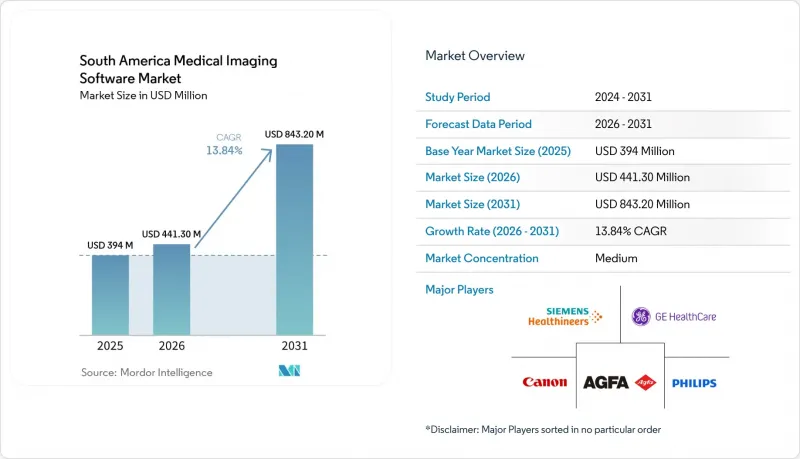
에 따르면 남미의 의료 영상 소프트웨어 시장 규모는 2025년 3억 9,400만 달러, 2026년 4억 4,130만 달러에서 2031년까지 8억 4,320만 달러로 확대될 것으로 예측되고 있으며, 2026-2031년까지 연평균 성장률(CAGR)은 13.84%에 달할 전망입니다.
남미 의료 영상 진단 소프트웨어 시장의 동향 및 인사이트
만성질환 부담 증가와 영상 진단 건수 증가
만성질환 관리로 인해 남미 전역에서 영상 진단 서비스에 대한 수요가 증가하고 있습니다. 북미와 남미에서 사망 원인의 77%를 비감염성 질환이 차지하고 있으며, 이는 영상 진단을 도입한 진단 프로세스에 대한 지속적인 수요를 지원하고 있습니다. 심장 MRI, 유방촬영술, 폐 CT에는 전문적인 뷰어와 후처리 툴이 필요하지만, 이러한 툴들은 과거 많은 의료 기관에서 선택 사항으로 간주되었습니다. 이러한 기능이 일상적인 진료 과정에 필수적인 요소로 자리 잡음에 따라 남미의 의료 영상 정보학 시장이 그 혜택을 누릴 것으로 기대됩니다. 또한 그동안 영상 진단에 대한 접근이 제한적이었던 도시 주변 지역의 중규모 진단 센터에서도 수요가 확대되고 있습니다. 브라질 보건부는 2026년 6월 ‘Portaria GM/MS 11.694/2026’을 공포하여 SUS(브라질 국민보건제도)의 의료기기 포트폴리오를 현대화하는 동시에, 진단 역량과 연계된 워크플로우를 지원할 전망입니다. 아르헨티나와 칠레의 고령화는 영상 검사 건수를 유지하고, 정기적인 소프트웨어 및 서비스 계약의 가치를 높이는 요인이 될 것입니다. 이러한 의료 패턴은 연계형 영상 저장·보고서 작성 시스템에 더 안정적인 기반을 마련해 줄 것입니다. 또한 남미의 의료 영상 정보학 시장에서는 전문의가 여러 거점에 걸쳐 업무를 수행할 수 있도록 하는 솔루션에 대한 수요도 증가하고 있습니다.
의료의 디지털화와 PACS·RIS의 현대화
공공 디지털 헬스 구상을 통해 PACS, RIS 및 기업 영상 플랫폼의 조달 기회가 더욱 명확해지고 있습니다. 브라질에서는 2025년에 ‘국가 의료 데이터 네트워크’가 의료 시설의 44%를 연결하여 공공 부문 도입률이 64%에 달했습니다. 이러한 커버리지 덕분에 의료 제공자는 다양한 의료 현장 간에 영상 데이터를 공유할 수 있는 더욱 견고한 기반을 확보할 수 있게 되었습니다. 칠레에서는 ‘호스피탈 디지털(Hospital Digital)’ 프로그램의 일환으로, 60개 이상의 공립 병원(이용자 수 1,600만 명)을 대상으로 SaaS 기반의 RIS, PACS 및 VNA 플랫폼이 선정되었습니다. 이 플랫폼은 연간 13만 건 이상의 검사 데이터를 처리할 수 있도록 설계되었으며, 99.98%의 가동률을 달성한 것으로 보고되었습니다. DICOM, HL7 및 HL7 FHIR 표준을 채택하고 있으며, 상호 운용성은 공공 입찰의 핵심 요건이 되었습니다. 남미의 의료 영상 정보학 시장에서는 이러한 표준을 충족하면서 예측 가능한 가격 정책과 신뢰할 수 있는 현지 지원을 제공하는 벤더가 우위를 점할 것으로 전망됩니다. 또한 공통된 데이터 표준이 있다면 병원 네트워크가 새로운 시설이나 소프트웨어 기능을 추가할 때 발생하는 도입상의 마찰을 완화할 수도 있습니다. 그 결과, 남미의 의료 영상 정보학 시장은 실용적인 시스템 호환성에 대한 의존도를 점점 더 높이고 있습니다.
높은 도입 비용과 총 소유 비용
기업급 영상 진단 시스템의 도입은 많은 중규모 의료기관의 재정적·기술적 역량을 초과하는 경우가 있습니다. 아르헨티나에서 IDB의 지원을 받아 시행된 AI 유방촬영술 프로그램의 경우, 검사별 운영 모델을 채택한 결과, 기존 조달 방식에 비해 초기 인프라 비용이 90% 절감되고, 대용량 스토리지 비용이 40% 절감되며, 총 소유 비용(TCO)이 43% 절감된 것으로 보고되었습니다. 이러한 결과는 자금 조달 구조가 기술 자체만큼이나 중요함을 보여줍니다. 대규모 병원 네트워크를 온프레미스형 시스템에서 관리형 서비스로 전환하려면 통합에 관한 전문 지식, 교육 및 지속적인 기술 지원도 필요합니다. 조정된 도입에 필요한 자금을 조달할 수 없는 의료 기관은 대신 각 부서별로 개별 툴을 도입하게 될 수도 있습니다. 이러한 접근 방식은 장기적인 비용을 증가시키고, 지점 간 영상 검사 데이터 공유를 제한할 가능성이 있습니다. 남미 의료 영상 정보학 시장의 공급업체들은 단계적 가격 책정, 현지 언어 지원, 소규모 의료 기관에 맞춘 도입 모델을 통해 이러한 장벽을 해소하는 데 도움을 줄 수 있습니다. 계약에는 도입, 교육, 저장 공간 및 지속적인 운영 지원도 포함되어야 합니다. 이해관계자들이 이러한 요건을 별도의 비용으로 취급할 경우, 남미 의료 영상 정보학 시장은 성장 동력을 잃을 가능성이 있습니다.
부문 분석
2025년, 남미 의료 영상 정보학 시장에서 소프트웨어는 68.00%의 점유율을 차지했습니다. 이는 기존의 필름 기반 및 1세대 디지털 아카이브가 통합형 PACS, RIS 및 기업 영상 플랫폼으로 광범위하게 대체되었음을 반영합니다. 소프트웨어 부문 내에서는 AI 및 의사결정 지원 모듈이 가장 빠르게 성장하는 하위 카테고리가 되었습니다. 각 벤더들은 이러한 기능을 독립형 제품으로 판매하기보다는 기존 임상용 뷰어의 라이선스에 통합하는 사례가 늘고 있습니다. 이러한 번들 방식 덕분에 별도의 예산 승인이 필요 없어져 도입이 가속화되었습니다. 워크스테이션 및 스토리지 인프라를 포함한 하드웨어는 클라우드 아키텍처로의 전환에 따라 자본 집약적인 스토리지 지출이 병원의 대차대조표에서 제외됨에 따라 시장 점유율은 안정세를 보이면서도 감소 추세를 유지했습니다. 도입·통합, 지원·유지보수, 관리형 원격방사선진단을 포함한 서비스는 사내 IT 역량이 제한적인 의료기관이 수명주기관리의 완전한 아웃소싱을 요구함에 따라 그 중요성이 커졌습니다. 2026년 4월, Koninklijke Philips N.V.는 남미에서 자사의 Vue PACS 웹 버전을 출시했습니다. 이로 인해 여러 거점에 걸친 진단 네트워크의 인프라 장벽이 낮아지고, 보다 가벼운 도입이 가능해졌으며, 일시적인 라이선스 수익보다 구독형 서비스의 수익이 우선시되게 되었습니다. 사내에 방사선과 IT 팀을 유지할 수 없는 소규모 의료 기관이 완전 관리형 솔루션을 요구함에 따라 서비스 및 관리형 원격 방사선학이 해당 부문에서 차지하는 비중은 확대될 것으로 예상됩니다. 이러한 변화로 인해 수익은 하드웨어 중심의 계약에서 장기적인 고객 유지율이 높은 정기 서비스 계약으로 점차 전환되고 있습니다. 브라질에서 3,000개 이상의 의료기관을 고객으로 보유하고 있으며, 아르헨티나, 우루과이, 페루에서도 입지를 강화하고 있는 Pixeon Medical Systems S.A.는 장비 중심의 기존 기업으로부터 시장 점유율을 빼앗고 있는 서비스 주도형 확장 모델의 대표적인 사례입니다.
3차원(3D) 영상 진단은 체적 재구성이 표준적인 임상 요건이된 종양학의 병기 분류, 순환기학 및 정형외과 분야의 수요에 힘입어 2025년에는 시장 점유율의 45.00%를 차지할 것으로 예측됩니다. 보다 빠르게 성장하고 있는 4D 영상 분야는 산과 진단 업체들이 태아 평가를 위한 실시간 체적 시각화에 투자하고, 심장 센터들이 혈행동태 평가를 위해 4D 플로우 MRI를 도입함에 따라 연평균 성장률(CAGR) 18.50%로 확대될 것으로 예측됩니다. 3D/4D 기술 부문은 2025년에 남미 초음파 진단 기기 시장의 46.88%를 차지할 것으로 예상됩니다. AI 탑재 플랫폼을 통해 임신 중기 검사에 소요되는 시간을 약 40% 단축할 수 있습니다. 2D(2D) 영상 진단은 환자 수가 많은 공공 의료 기관에서 비용 대비 효과가 높은 일선 선별 검사 솔루션으로 여전히 널리 활용되고 있습니다. 특히 의료 기관이 기존 2D 인프라의 진단 기능을 확장하기 위해 AI 강화 모듈을 추가 도입하는 경우 이러한 경향이 두드러집니다. 2026년 2월에는 아르헨티나 보건부가 시범 프로그램을 통해 외딴 지역의 진료소에 AI 강화형 휴대용 초음파 진단 장비를 도입할 전망입니다. 이러한 움직임은 4D 플랫폼을 경제적으로 이용할 수 없는 의료 서비스가 부족한 지역에서 2D 및 엔트리 레벨 3D 영상 진단이 지속적으로 확대되고 있음을 보여줍니다. 산부인과 및 종양학 분야에서 3D 영상 진단에서 4D 및 AI 강화형 체적 영상 진단으로의 전환에 따라 정기적인 업데이트가 필요한 후처리 및 시각화 소프트웨어에 대한 수요가 더욱 높아지고 있습니다. 이러한 추세는 시각화 라이선스를 다년간의 지원 계약과 함께 판매할 수 있는 인포매틱스 벤더에게 지속적인 수익 기회를 제공합니다.
기타 혜택:
- 엑셀 형식의 시장 예측(ME) 시트
- 3개월간의 애널리스트 지원
자주 묻는 질문
목차
제1장 서론
- 조사 전제조건과 시장 정의
- 조사 범위
- 기준연도, 예측 기간 및 통화
- 남미 시장의 범위 및 대상국
제2장 조사 방법
제3장 개요
제4장 시장 구도
- 시장 개요
- 거시경제 요인이 시장에 미치는 영향
- 시장 성장 촉진요인
- 시장 성장 억제요인
- 업계 밸류체인 분석
- 규제 상황
- 기술 전망
- Porter's Five Forces 분석
- 특허 및 혁신 활동
- 사이버 보안 및 사업 지속 성의 평가
제5장 시장 규모와 성장 예측(금액 기반)
- 컴포넌트별
- 이미징 유형별
- 모달리티별
- 배포 모드별
- 용도별
- 최종사용자별
- 지역별
- 브라질
- 아르헨티나
- 칠레
- 기타 남미 국가
제6장 경쟁 구도
- 시장 집중도
- 전략적 동향
- 시장 점유율 분석
- 기업 개요
- GE HealthCare Technologies Inc.
- Siemens Healthineers AG
- Koninklijke Philips N.V.
- Agfa-Gevaert N.V.
- Canon Medical Systems Corporation
- FUJIFILM Holdings Corporation
- Carestream Health, Inc.
- Sectra AB
- Esaote S.p.A.
- MIM Software Inc.
- INFINITT Healthcare Co., Ltd.
- Pro Medicus Limited
- Novarad Corporation
- RamSoft, Inc.
- Merge Healthcare Incorporated
- Pixeon Medical Systems S.A.
- NUBIX S.A. de C.V.
- Mobilemed Solucoes em Tecnologia Ltda.
- Genesis Tecnologia Ltda.
- Medilab Sistemas Ltda.
- RIACS Health SpA
- Mediarte Tecnologia Medica Ltda.
- Dr. Tis Tecnologia em Saude Ltda.
제7장 시장 기회와 향후 전망
KSA 26.10.28According to Mordor Intelligence, the South America medical imaging software market size is projected to expand from USD 394 million in 2025 and USD 441.30 million in 2026 to USD 843.20 million by 2031, registering a CAGR of 13.84% between 2026 and 2031.
South America Medical Imaging Software Market Trends and Insights
Rising Chronic Disease Burden and Imaging Volumes
Chronic disease care is increasing the need for imaging services across South America. Noncommunicable diseases account for 77% of deaths in the Americas, supporting sustained demand for diagnostic pathways that incorporate imaging. Cardiac MRI, mammography, and lung CT require specialized viewers and post-processing tools that many facilities previously considered optional. As these capabilities become integral to routine care pathways, the South American medical imaging informatics market can benefit. Demand is also expanding toward mid-tier diagnostic centers in peri-urban areas, where access to imaging has historically been limited. Brazil's Ministry of Health is expected to issue Portaria GM/MS 11.694/2026 in June 2026 to modernize the SUS equipment portfolio and support diagnostic capacity and connected workflows. Aging populations in Argentina and Chile can sustain imaging study volumes and strengthen the value of recurring software and service agreements. This care pattern creates a more stable foundation for connected image storage and reporting systems. The South American medical imaging informatics market also requires solutions that enable specialists to work across multiple sites.
Healthcare Digitalization and PACS-RIS Modernization
Public digital health initiatives are creating clearer procurement opportunities for PACS, RIS, and enterprise imaging platforms. In Brazil, the National Health Data Network connected 44% of health care facilities in 2025, while adoption in the public sector reached 64%. This coverage provides health care providers with a stronger foundation for sharing imaging data across care settings. In Chile, the Hospital Digital program selected a SaaS-based RIS, PACS, and VNA platform for more than 60 public hospitals, serving 16 million users. The platform was designed to process more than 130,000 studies annually and reported 99.98% operational availability. Its use of DICOM, HL7, and HL7 FHIR standards makes interoperability a core requirement in public tenders. The South America medical imaging informatics market is likely to favor vendors that meet these standards while offering predictable pricing and reliable local support. Shared data standards can also reduce implementation friction as hospital networks add new facilities or software functionalities. As a result, the South America medical imaging informatics market is becoming increasingly dependent on practical system compatibility.
High Implementation and Total Cost of Ownership
Enterprise imaging deployments can exceed the financial and technical capacity of many mid-tier facilities. Argentina's IDB-supported AI mammography program adopted a per-study operating model and reported 90% lower initial infrastructure costs, 40% lower mass-storage costs, and 43% lower total cost of ownership than conventional procurement. These results demonstrate that financing structures are as important as the technology itself. Transitioning a large hospital network from on-premise systems to managed services also requires integration expertise, training, and ongoing technical support. Facilities that cannot finance a coordinated deployment may instead adopt separate departmental tools. This approach can increase long-term costs and limit the exchange of imaging studies across sites. Vendors in the South America medical imaging informatics market can help address this barrier through tiered pricing, local-language support, and deployment models tailored to smaller providers. Contracts should also cover implementation, training, storage, and ongoing operational support. The South America medical imaging informatics market may lose momentum when stakeholders treat these requirements as separate costs.
Other drivers and restraints analyzed in the detailed report include:
- Expansion of Computer-Aided Diagnosis and Radiology AI
- Radiologist Shortages Increasing Demand for Workflow Automation
- Uneven Healthcare Infrastructure Outside Major Urban Centers
For complete list of drivers and restraints, kindly check the Table Of Contents.
Segment Analysis
Software held a 68.00% share of the South America medical imaging informatics market in 2025, reflecting the widespread replacement of legacy film-based and first-generation digital archives with integrated PACS, RIS, and enterprise imaging platforms. Within the software segment, AI and decision-support modules represented the fastest-growing subcategory. Vendors increasingly embedded these capabilities into existing clinical viewer licenses rather than selling them as standalone products. This bundling approach accelerated adoption by eliminating the need for separate budget approvals. Hardware, including workstations and storage infrastructure, maintained a stable but declining share as transitions to cloud architectures shifted capital-intensive storage expenditures off hospital balance sheets. Services, including implementation and integration, support and maintenance, and managed teleradiology, gained relevance as facilities with limited internal IT capacity sought fully outsourced lifecycle management. In April 2026, Koninklijke Philips N.V. launched the web-based version of its Vue PACS in South America, reducing infrastructure barriers for multi-site diagnostic networks and enabling lighter deployments that favor subscription-based service revenue over one-time licensing income Services and managed teleradiology are expected to account for a growing share of the segment as smaller centers that cannot maintain internal radiology IT teams seek fully managed solutions. This shift is gradually redistributing revenue from hardware-intensive contracts toward recurring service agreements, which offer higher long-term client retention. Pixeon Medical Systems S.A., with more than 3,000 client institutions in Brazil and a growing presence in Argentina, Uruguay, and Peru, exemplifies the services-led expansion model gaining share from equipment-centric incumbents.
Three-dimensional (3D) imaging is projected to hold a 45.00% share of the market in 2025, driven by oncology staging, cardiology, and orthopedic applications, where volumetric reconstruction is a standard clinical requirement. The faster-growing 4D imaging segment is projected to expand at a CAGR of 18.50%, as obstetric diagnostic providers invest in real-time volumetric visualization for fetal assessment and cardiac centers adopt 4D flow MRI for hemodynamic evaluation. The 3D/4D technology segment is expected to account for 46.88% of South America's ultrasound devices market in 2025. AI-enabled platforms can reduce second-trimester examination times by approximately 40%. Two-dimensional (2D) imaging remains widely relevant as a cost-effective first-line screening solution in high-volume public healthcare facilities, particularly where providers retrofit AI enhancement modules to extend the diagnostic capabilities of existing 2D infrastructure. In February 2026, Argentina's Ministry of Health is expected to deploy AI-enhanced portable ultrasound systems in remote clinics through a pilot program. This initiative illustrates the continued expansion of 2D and entry-level 3D imaging in underserved geographies, where 4D platforms remain financially inaccessible The transition from 3D imaging to 4D and AI-enhanced volumetric imaging in obstetrics and oncology is creating additional demand for post-processing and visualization software that requires regular updates. This trend presents a recurring revenue opportunity for informatics vendors that can bundle visualization licenses with multi-year support contracts.
Complete Report Scope:
- By Component
- Software
- PACS Software
- RIS Software
- Image-Analysis Software
- Enterprise Imaging Platforms
- Clinical Viewer and Visualization Software
- Artificial Intelligence and Decision-Support Software
- Hardware
- Services
- Implementation and Integration Services
- Support and Maintenance Services
- Managed Imaging and Teleradiology Services
- Software
- By Imaging Type
- 2D Imaging
- 3D Imaging
- 4D Imaging
- By Modality
- Computed Tomography
- Magnetic Resonance Imaging
- X-Ray and Digital Radiography
- Ultrasound
- Mammography
- Positron Emission Tomography
- Single-Photon Emission Computed Tomography
- Other Modalities
- By Deployment Mode
- Cloud-Based
- On-Premise
- Hybrid
- By Application
- Diagnostic Review and Reporting
- Image Storage, Archiving, and Distribution
- Workflow Management and Orchestration
- Image Enhancement and Reconstruction
- Computer-Aided Detection and Diagnosis
- Research and Clinical Development
- Other Applications
- By End User
- Hospitals and Clinics
- Diagnostic Imaging Centers
- Specialty Centers
- Research and Academic Institutions
- Teleradiology Providers
- Other End Users
- By Geography
- Brazil
- Argentina
- Chile
- Rest of South America
List of Companies Covered in this Report:
- GE HealthCare Technologies Inc.
- Siemens Healthineers AG
- Koninklijke Philips N.V.
- Agfa-Gevaert N.V.
- Canon Medical Systems Corporation
- FUJIFILM Holdings Corporation
- Carestream Health, Inc.
- Sectra AB
- Esaote S.p.A.
- MIM Software Inc.
- INFINITT Healthcare Co., Ltd.
- Pro Medicus Limited
- Novarad Corporation
- RamSoft, Inc.
- Merge Healthcare Incorporated
- Pixeon Medical Systems S.A.
- NUBIX S.A. de C.V.
- Mobilemed Solucoes em Tecnologia Ltda.
- Genesis Tecnologia Ltda.
- Medilab Sistemas Ltda.
- RIACS Health SpA
- Mediarte Tecnologia Medica Ltda.
- Dr. Tis Tecnologia em Saude Ltda.
Additional Benefits:
- The market estimate (ME) sheet in Excel format
- 3 months of analyst support
TABLE OF CONTENTS
1 INTRODUCTION
- 1.1 Study Assumptions and Market Definition
- 1.2 Scope of the Study
- 1.3 Base Year, Forecast Period, and Currency
- 1.4 South America Market Boundary and Country Coverage
2 RESEARCH METHODOLOGY
3 EXECUTIVE SUMMARY
4 MARKET LANDSCAPE
- 4.1 Market Overview
- 4.2 Impact of Macroeconomic Factors on the Market
- 4.3 Market Drivers
- 4.3.1 Rising Chronic Disease Burden and Imaging Volumes
- 4.3.2 Expansion of Computer-Aided Diagnosis and Radiology AI
- 4.3.3 Healthcare Digitalization and PACS-RIS Modernization
- 4.3.4 Radiologist Shortages Increasing Demand for Workflow Automation
- 4.3.5 Cloud-Native Imaging Platforms Extending Access Beyond Tertiary Hospitals
- 4.3.6 Cross-Border Teleradiology and Remote Reporting Networks
- 4.4 Market Restraints
- 4.4.1 High Implementation and Total Cost of Ownership
- 4.4.2 Uneven Healthcare Infrastructure Outside Major Urban Centers
- 4.4.3 Data-Localization, Privacy, and Interoperability Complexity
- 4.4.4 Limited Local Validation Data for AI-Based Imaging Software
- 4.5 Industry Value Chain Analysis
- 4.6 Regulatory Landscape
- 4.7 Technological Outlook
- 4.8 Porter's Five Forces Analysis
- 4.8.1 Bargaining Power of Suppliers
- 4.8.2 Bargaining Power of Buyers
- 4.8.3 Threat of New Entrants
- 4.8.4 Threat of Substitutes
- 4.8.5 Intensity of Competitive Rivalry
- 4.9 Patent and Innovation Activity
- 4.10 Cybersecurity and Business-Continuity Assessment
5 MARKET SIZE AND GROWTH FORECASTS, VALUE
- 5.1 By Component
- 5.1.1 Software
- 5.1.1.1 PACS Software
- 5.1.1.2 RIS Software
- 5.1.1.3 Image-Analysis Software
- 5.1.1.4 Enterprise Imaging Platforms
- 5.1.1.5 Clinical Viewer and Visualization Software
- 5.1.1.6 Artificial Intelligence and Decision-Support Software
- 5.1.2 Hardware
- 5.1.3 Services
- 5.1.3.1 Implementation and Integration Services
- 5.1.3.2 Support and Maintenance Services
- 5.1.3.3 Managed Imaging and Teleradiology Services
- 5.1.1 Software
- 5.2 By Imaging Type
- 5.2.1 2D Imaging
- 5.2.2 3D Imaging
- 5.2.3 4D Imaging
- 5.3 By Modality
- 5.3.1 Computed Tomography
- 5.3.2 Magnetic Resonance Imaging
- 5.3.3 X-Ray and Digital Radiography
- 5.3.4 Ultrasound
- 5.3.5 Mammography
- 5.3.6 Positron Emission Tomography
- 5.3.7 Single-Photon Emission Computed Tomography
- 5.3.8 Other Modalities
- 5.4 By Deployment Mode
- 5.4.1 Cloud-Based
- 5.4.2 On-Premise
- 5.4.3 Hybrid
- 5.5 By Application
- 5.5.1 Diagnostic Review and Reporting
- 5.5.2 Image Storage, Archiving, and Distribution
- 5.5.3 Workflow Management and Orchestration
- 5.5.4 Image Enhancement and Reconstruction
- 5.5.5 Computer-Aided Detection and Diagnosis
- 5.5.6 Research and Clinical Development
- 5.5.7 Other Applications
- 5.6 By End User
- 5.6.1 Hospitals and Clinics
- 5.6.2 Diagnostic Imaging Centers
- 5.6.3 Specialty Centers
- 5.6.4 Research and Academic Institutions
- 5.6.5 Teleradiology Providers
- 5.6.6 Other End Users
- 5.7 By Geography
- 5.7.1 Brazil
- 5.7.2 Argentina
- 5.7.3 Chile
- 5.7.4 Rest of South America
6 COMPETITIVE LANDSCAPE
- 6.1 Market Concentration
- 6.2 Strategic Moves
- 6.3 Market Share Analysis
- 6.4 Company Profiles (includes Global Level Overview, Market Level Overview, Core Segments, Financials as available, Strategic Information, Market Rank/Share, Products and Services, Recent Developments)
- 6.4.1 GE HealthCare Technologies Inc.
- 6.4.2 Siemens Healthineers AG
- 6.4.3 Koninklijke Philips N.V.
- 6.4.4 Agfa-Gevaert N.V.
- 6.4.5 Canon Medical Systems Corporation
- 6.4.6 FUJIFILM Holdings Corporation
- 6.4.7 Carestream Health, Inc.
- 6.4.8 Sectra AB
- 6.4.9 Esaote S.p.A.
- 6.4.10 MIM Software Inc.
- 6.4.11 INFINITT Healthcare Co., Ltd.
- 6.4.12 Pro Medicus Limited
- 6.4.13 Novarad Corporation
- 6.4.14 RamSoft, Inc.
- 6.4.15 Merge Healthcare Incorporated
- 6.4.16 Pixeon Medical Systems S.A.
- 6.4.17 NUBIX S.A. de C.V.
- 6.4.18 Mobilemed Solucoes em Tecnologia Ltda.
- 6.4.19 Genesis Tecnologia Ltda.
- 6.4.20 Medilab Sistemas Ltda.
- 6.4.21 RIACS Health SpA
- 6.4.22 Mediarte Tecnologia Medica Ltda.
- 6.4.23 Dr. Tis Tecnologia em Saude Ltda.
7 MARKET OPPORTUNITIES AND FUTURE OUTLOOK
- 7.1 White-Space and Unmet-Need Assessment


