

|
시장보고서
상품코드
2155281
중동의 5G 서비스 : 시장 점유율 분석, 업계 동향과 통계, 성장 예측(2026-2031년)Middle East 5G Services - Market Share Analysis, Industry Trends & Statistics, Growth Forecasts (2026 - 2031) |
||||||
 Mordor Intelligence
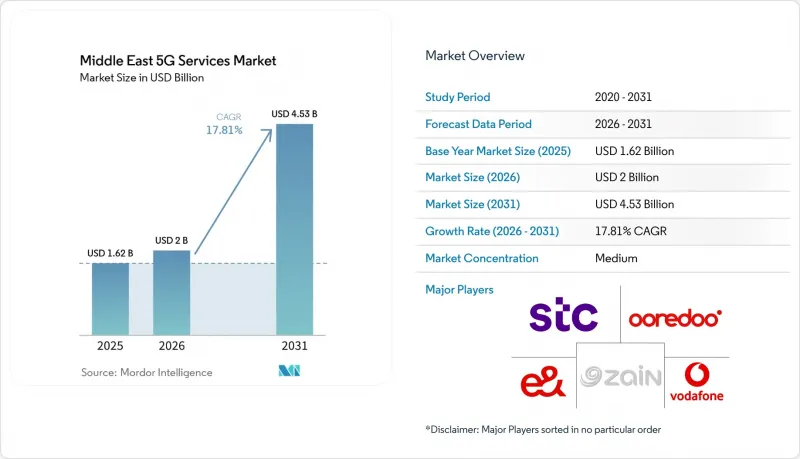
에 따르면 중동의 5G 서비스 시장 규모는 2025년에 16억 2,000만 달러, 2026년에 20억 달러에 달하며, 2031년까지 45억 3,000만 달러에 달할 것으로 예측되고 있으며, 2026-2031년에 CAGR 17.81%로 성장할 것으로 전망되고 있습니다.
중동 5G 서비스 시장의 동향 및 인사이트
5G 가입자 수 및 모바일 데이터 수요 증가
중동 5G 서비스 시장에서 가입자 수의 증가세는 해당 지역의 현재 보급률이 시사하는 수준보다 여전히 견고한 양상을 보이고 있습니다. GCC(걸프협력회의) 국가들의 5G 보급률은 2025년 말 기준 53%에 달할 것으로 예상되며, 2031년까지 모바일 연결의 88%, 즉 8,400만 건을 차지할 것으로 전망됩니다. MENA(중동·북아프리카) 지역의 5G 가입자 수는 2025년 6,000만 건에서 2026년에는 8,000만 건에 달할 것이며, 에릭슨은 2031년까지 3억 7,000만 건을 넘어설 것으로 전망하고 있습니다. MENA 지역의 모바일 데이터 트래픽은 스마트폰의 월간 사용량이 47GB에 가까워짐에 따라 월간 11 엑사바이트에서 30 엑사바이트로 증가할 것으로 예상됩니다. 쿠웨트에서는 2025년 3G 서비스 종료로 주파수 대역이 확보되면서 기존 네트워크에서 5G 서비스로의 전환이 가속화되었습니다. 터키의 경우, 8,500만 명의 모바일 가입자 중 5G 지원 단말기 보유율이 제한적이기 때문에 단말기 교체 속도가 빨라지기 전까지는 수익 창출이 지연될 가능성이 있습니다.
기업의 디지털 전환 활용 사례
중동의 5G 서비스 시장에서 기업의 지출은 소비자 대상 연결 서비스 단독보다 더 중요한 서비스 수입원으로 자리 잡고 있습니다. GSMA가 MENA 지역의 기업 851곳을 대상으로 실시한 조사에 따르면 2025-2030년에 디지털 전환에 대한 지출은 매출의 평균 9.8%를 차지할 것으로 예상됩니다. 사우디아라비아는 조사 대상 국가 중 가장 짧은 3.3년의 투자 회수 기간을 기록했습니다. 2030년까지 AI, 모바일 연결 및 관련 기기가 해당 지역의 기술 투자의 45% 가까이를 차지할 것으로 예상됩니다. 자동차, 공공사업, 물류 업계의 응답자들은 5G IoT 애플리케이션이 가장 큰 효과를 가져올 것으로 전망하고 있습니다. 통신사업자는 기본적인 대역폭 제공 대신 관리형 연결 및 성과 기반 서비스를 제공함으로써 연결 건당 수익을 향상시킬 수 있습니다.
높은 도입 비용과 기업의 긴 투자 회수 기간
중동의 5G 서비스 시장에서 산업용 사설 네트워크는 사이트별로 막대한 투자가 필요하며, 투자 회수 기간이 수 년이 걸리는 경우가 많습니다. 유전이나 항만에서의 도입에는 내환경성이 뛰어난 무선 장비, 분산형 안테나 시스템, 그리고 견고한 코어 인프라가 필요할 수 있습니다. 이러한 요건으로 인해 중소기업의 경우 프로젝트 자금 조달이 어려워집니다. 또한 통신사업자는 기업용 수익이 완전히 자리 잡기 전에 주파수 대역이나 사이트에 막대한 투자를 해야 하는 상황에 처해 있습니다. 인프라 공유 및 중립 호스트 계약은 고객의 총 소유 비용(TCO)을 절감할 수 있습니다. 이러한 방안이 더 널리 활용될 수 있을지는 주파수 대역 공유 및 백홀 공유를 지원하는 규제 방향에 달려 있습니다.
부문 분석
2025년, 강화형 모바일 브로드밴드는 지역 전체 5G 서비스 수익의 41.89%를 차지했습니다. 이는 2019년 해당 지역에서 서비스가 시작된 이래 확립되어 온 소비자용 브로드밴드 기반을 반영한 것입니다. 스마트폰 이용이 확대됨에 따라 신뢰성이 높은 대용량 연결에 대한 수요가 증가하고 있으며, 이 분야는 중동 5G 서비스 시장에서 여전히 중심적인 위치를 차지하고 있습니다. 초고신뢰성·저지연 통신(URLC)은 응답 시간과 신뢰성 높은 연결이 중요한 산업 자동화, 항만 물류, 자율주행 차량의 주행 경로를 지원하고 있습니다. 대규모 기계형 통신(MMC)은 통신망이 충분히 구축되지 않은 지역의 스마트 계량, 자산 추적, 농업 모니터링을 지원하고 있습니다. 이러한 서비스를 종합해 보면, 중동의 5G 서비스 시장이 소비자용 광대역 제공에서 다양한 연결 요구를 충족하는 플랫폼으로 발전하고 있음을 알 수 있습니다.
고정 무선 접속(FWA)은 2031년까지 연평균 성장률(CAGR) 18.47%로 확대될 것으로 예측되며, 중동 5G 서비스 시장에서 가장 빠르게 성장하는 서비스 유형이 될 것입니다. 사우디아라비아와 UAE의 통신사업자들은 광섬유 설치가 여전히 어렵거나 경제적으로 타당하지 않은 주거 지역 및 산업 단지에 서비스를 제공하기 위해 독립형(SA) 네트워크를 활용하고 있습니다. 이용 가능한 독립형 용량을 통해 통신사업자는 기존의 유선 회선 구축을 기다릴 필요 없이 가정과 기업을 연결할 수 있게 됩니다. 그 이용이 확대됨에 따라 기업과 가정이 더욱 맞춤화된 서비스 패키지를 채택하게 되면, eMBB가 수익에서 차지하는 상대적 비중은 점차 낮아질 가능성이 있습니다. 네트워크 슬라이싱을 통해 제공업체는 단순히 표준 데이터 요금제를 판매하는 것뿐만 아니라, 필요한 성능, 고객 유형 및 위치에 따라 연결을 구성할 수 있게 됩니다.
2025년에는 비독립형(Non-Standalone) 5G가 수익의 66.45%를 차지하며, 중동 전체 5G 서비스 시장에서 여전히 주류 아키텍처로 남아 있었습니다. 통신사업자들은 시그널링 및 모빌리티 관리에 4G 앵커를 계속 활용하고 있습니다. 이는 이 접근 방식을 통해 코어 네트워크를 즉시 전면적으로 교체하지 않고도 커버리지를 확대할 수 있기 때문입니다. 이 전략은 당초 특수한 성능보다 광범위한 가용성이 중시되었던 모바일 브로드밴드 분야에서 실용적이었습니다. 또한 독립형 코어 네트워크 도입에 따른 단기적인 비용 및 운영상의 혼란을 완화할 수도 있습니다. 그러나 비독립형 네트워크에서는 통신사업자들이 점점 더 많이 요구하는 차별화된 기업용 서비스에 대한 선택지가 제한될 수밖에 없습니다.
고객들이 저지연, 네트워크 슬라이싱, 네트워크 애플리케이션 프로그래밍 인터페이스(API)를 요구함에 따라 독립형 5G는 2031년까지 연평균 성장률(CAGR) 19.88%로 확대될 것으로 예상됩니다. 독립형 방식의 수익 전망은 지연, 지터, 처리량 등의 보장을 포함한 정의된 서비스 품질을 판매할 수 있다는 점에 의해 지원되고 있습니다. 보다폰 카타르는 2025년 11월, 노키아와 제휴하여 항만, 천연가스 사업, 데이터센터에서의 기업용 활용을 목적으로 한 상용 독립형 네트워크를 구축했습니다. 이러한 전환은 데이터 트래픽량만을 기준으로 한 가격 책정이 아닌, 성능에 기반한 가격 책정을 가능하게 함으로써 중동 5G 서비스 시장의 상업적 논리를 완전히 바꿔놓을 것입니다. 또한 통신사업자들은 기업 대상 영업, 서비스 보장 및 네트워크 운영 역량을 강화해야 할 것입니다.
기타 혜택:
- 엑셀 형식의 시장 예측(ME) 시트
- 3개월간의 애널리스트 지원
자주 묻는 질문
목차
제1장 서론
- 조사 전제조건과 시장 정의
- 조사 범위
제2장 조사 방법
제3장 개요
제4장 시장 구도
- 시장 개요
- 거시경제 요인이 시장에 미치는 영향
- 시장 성장 촉진요인
- 시장 성장 억제요인
- 업계 밸류체인 분석
- 규제 상황
- 기술 전망
- Porter's Five Forces 분석
제5장 시장 규모와 성장 예측
- 서비스 유형별
- 네트워크 아키텍처별
- 주파수대별
- 최종사용자 산업별
- 용도별
- 지역별
- 사우디아라비아
- 아랍에미리트
- 쿠웨이트
- 카타르
- 튀르키예
- 기타 중동 국가
제6장 경쟁 구도
- 시장 집중도
- 전략적 동향
- 시장 점유율 분석
- 기업 개요
- stc Group
- e&
- Emirates Integrated Telecommunications Company PJSC
- Mobily
- Mobile Telecommunications Company Saudi Arabia
- Ooredoo Q.P.S.C.
- Vodafone Qatar P.Q.S.C.
- Zain Group
- Zain Kuwait
- Omantel
- Vodafone Oman
- Batelco
- Orange Jordan
- Turkcell Iletisim Hizmetleri Anonim Sirketi
- Turk Telekomunikasyon Anonim Sirketi
- Huawei Technologies Co., Ltd.
- Telefonaktiebolaget LM Ericsson(publ)
- Nokia Corporation
- ZTE Corporation
- Samsung Electronics Co., Ltd.
- Qualcomm Technologies, Inc.
- Cisco Systems, Inc.
- Mavenir Systems, Inc.
- Rakuten Symphony, Inc.
- Amdocs Limited
제7장 시장 기회와 향후 전망
KSA 26.10.28According to Mordor Intelligence, the Middle East 5G services market size is projected to be USD 1.62 billion in 2025, USD 2 billion in 2026, and reach USD 4.53 billion by 2031, growing at a CAGR of 17.81% from 2026 to 2031.
Middle East 5G Services Market Trends and Insights
Rising 5G Subscriber and Mobile-Data Demand
Subscriber momentum remains stronger than the region's current penetration level suggests in the Middle East 5G services market. GCC 5G penetration reached 53% at the end of 2025 and is forecast to represent 88% of mobile connections, or 84 million subscriptions, by 2031. MENA 5G subscriptions reached 80 million in 2026, compared with 60 million in 2025, and Ericsson expects them to exceed 370 million by 2031. MENA mobile data traffic is expected to rise from 11 exabytes per month to 30 exabytes per month as smartphone use approaches 47 GB per month. Kuwait's 3G retirement in 2025 released spectrum and reinforced the migration from older networks to 5G services. In Turkey, limited 5G handset ownership among the country's 85 million mobile subscribers could delay revenue conversion until device replacement accelerates.
Enterprise Digital Transformation Use Cases
Enterprise spending is becoming a more important source of service revenue than consumer connectivity alone in the Middle East 5G services market. A GSMA survey of 851 MENA enterprises found that digital transformation spending is expected to average 9.8% of revenue during 2025-2030 Saudi Arabia recorded the fastest return-on-investment period in the survey at 3.3 years. AI, mobile connectivity, and related devices are expected to represent nearly 45% of regional technology investment through 2030. Automotive, utilities, and logistics respondents reported the strongest expected effect from 5G IoT applications. Operators can improve revenue per connection when they provide managed connectivity and performance-based services instead of basic bandwidth.
High Deployment Cost and Long Enterprise Payback
Industrial private networks require substantial site-specific investment and often have multi-year payback periods in the Middle East 5G services market. Oilfield and port deployments can need ruggedized radio equipment, distributed antenna systems, and hardened core infrastructure. These requirements make projects harder to fund for small and medium-sized enterprises. Operators also face major spectrum and site investment needs before enterprise revenue is fully established. Infrastructure sharing and neutral-host arrangements can lower the total cost of ownership for customers. Their wider use depends on regulatory rules that support shared spectrum and shared backhaul.
Other drivers and restraints analyzed in the detailed report include:
- Government Digital Economy and Smart City Programs
- Fixed Wireless Access for Underserved Premises
- Fragmented Spectrum Policy and Uneven Coverage Economics
For complete list of drivers and restraints, kindly check the Table Of Contents.
Segment Analysis
Enhanced mobile broadband held 41.89% of regional 5G service revenue in 2025, reflecting the consumer broadband foundation established after regional rollouts began in 2019. It remains central to the Middle East 5G services market because rising smartphone use is increasing demand for reliable high-capacity connections. Ultra-reliable low-latency communications support industrial automation, port logistics, and autonomous vehicle corridors where response times and dependable connectivity are important. Massive machine-type communications support smart metering, asset tracking, and agricultural monitoring in areas that are less densely served. Together, these services show that the Middle East 5G services market is developing from a consumer broadband offering into a platform for several connectivity needs.
Fixed wireless access is projected to expand at an 18.47% CAGR through 2031, making it the fastest-moving service type in the Middle East 5G services market. Operators in Saudi Arabia and the UAE use standalone networks to serve residential districts and industrial parks where extending fiber remains difficult or economically unattractive. Available standalone capacity allows operators to connect homes and businesses without waiting for conventional fixed-line construction. Its wider use could gradually reduce the relative revenue weight of eMBB as enterprises and households adopt more tailored service packages. Network slicing gives providers a way to organize connectivity around required performance, customer type, and location, rather than selling only standard data allowances.
Non-standalone 5G held 66.45% of revenue in 2025 and remained the prevailing architecture across the Middle East 5G services market. Operators have continued to use 4G anchors for signaling and mobility management because the approach supports coverage expansion without an immediate full core-network replacement. This strategy has been practical for mobile broadband, where broad availability was initially more important than specialized performance. It also reduces the near-term cost and operational disruption associated with a standalone core deployment. However, non-standalone networks provide fewer options for the differentiated enterprise services that operators increasingly seek to provide.
Standalone 5G is expected to expand at a 19.88% CAGR through 2031 as customers seek lower latency, network slicing, and network application programming interfaces. The standalone revenue outlook is supported by its ability to sell defined service quality, including latency, jitter, and throughput commitments. Vodafone Qatar launched a commercial standalone network with Nokia in November 2025 for enterprise uses in ports, natural gas operations, and data centers. This transition changes the commercial logic of the Middle East 5G services market because it permits performance-based pricing instead of pricing centered only on data volume. It also requires operators to strengthen their enterprise sales, service assurance, and network operations capabilities.
Complete Report Scope:
- By Service Type
- Enhanced Mobile Broadband
- Ultra-Reliable Low-Latency Communications
- Massive Machine-Type Communications
- Fixed Wireless Access
- By Network Architecture
- Non-Standalone 5G
- Standalone 5G
- By Frequency Band
- Low Band
- Mid Band
- Millimeter-Wave
- By End-User Industry
- IT and Telecom
- Automotive, Mobility and Transportation
- Manufacturing, Energy and Utilities
- Healthcare and Life Sciences
- Banking, Financial Services, Insurance and RegTech
- Retail, Media and E-Commerce
- Government, Defense, Education and Public Sector
- Other End-User Industries
- By Application
- Communication and Collaboration
- Asset Tracking
- Smart Cities
- Smart Buildings
- Autonomous Vehicles and Vehicle-to-Everything
- Smart Healthcare
- Industry 4.0
- Smart Utilities
- Immersive Media and Gaming
- Public Safety and Mission-Critical Communications
- By Geography
- Saudi Arabia
- United Arab Emirates
- Kuwait
- Qatar
- Turkey
- Rest of Middle East
List of Companies Covered in this Report:
- stc Group
- e&
- Emirates Integrated Telecommunications Company PJSC
- Mobily
- Mobile Telecommunications Company Saudi Arabia
- Ooredoo Q.P.S.C.
- Vodafone Qatar P.Q.S.C.
- Zain Group
- Zain Kuwait
- Omantel
- Vodafone Oman
- Batelco
- Orange Jordan
- Turkcell Iletisim Hizmetleri Anonim Sirketi
- Turk Telekomunikasyon Anonim Sirketi
- Huawei Technologies Co., Ltd.
- Telefonaktiebolaget LM Ericsson (publ)
- Nokia Corporation
- ZTE Corporation
- Samsung Electronics Co., Ltd.
- Qualcomm Technologies, Inc.
- Cisco Systems, Inc.
- Mavenir Systems, Inc.
- Rakuten Symphony, Inc.
- Amdocs Limited
Additional Benefits:
- The market estimate (ME) sheet in Excel format
- 3 months of analyst support
TABLE OF CONTENTS
1 INTRODUCTION
- 1.1 Study Assumptions and Market Definition
- 1.2 Scope of the Study
2 RESEARCH METHODOLOGY
3 EXECUTIVE SUMMARY
4 MARKET LANDSCAPE
- 4.1 Market Overview
- 4.2 Impact of Macroeconomic Factors on the Market
- 4.3 Market Drivers
- 4.3.1 Rising 5G Subscriber and Mobile-Data Demand
- 4.3.2 Enterprise Digital-Transformation Use Cases
- 4.3.3 Government-Led Digital-Economy and Smart-City Programs
- 4.3.4 Fixed Wireless Access for Underserved Premises
- 4.3.5 Industrial Private 5G in Energy, Ports, and Giga-Projects
- 4.3.6 5G-Advanced and Network-Slicing Monetization
- 4.4 Market Restraints
- 4.4.1 High Deployment Cost and Long Enterprise Payback
- 4.4.2 Fragmented Spectrum Policy and Uneven Coverage Economics
- 4.4.3 Limited 5G Device Affordability and Readiness Outside GCC
- 4.4.4 Site Access, Fiber Backhaul, and Specialized Skills Bottlenecks
- 4.5 Industry Value Chain Analysis
- 4.6 Regulatory Landscape
- 4.7 Technological Outlook
- 4.8 Porter's Five Forces Analysis
- 4.8.1 Threat of New Entrants
- 4.8.2 Bargaining Power of Buyers
- 4.8.3 Bargaining Power of Suppliers
- 4.8.4 Threat of Substitutes
- 4.8.5 Intensity of Competitive Rivalry
5 MARKET SIZE AND GROWTH FORECASTS (VALUE)
- 5.1 By Service Type
- 5.1.1 Enhanced Mobile Broadband
- 5.1.2 Ultra-Reliable Low-Latency Communications
- 5.1.3 Massive Machine-Type Communications
- 5.1.4 Fixed Wireless Access
- 5.2 By Network Architecture
- 5.2.1 Non-Standalone 5G
- 5.2.2 Standalone 5G
- 5.3 By Frequency Band
- 5.3.1 Low Band
- 5.3.2 Mid Band
- 5.3.3 Millimeter-Wave
- 5.4 By End-User Industry
- 5.4.1 IT and Telecom
- 5.4.2 Automotive, Mobility and Transportation
- 5.4.3 Manufacturing, Energy and Utilities
- 5.4.4 Healthcare and Life Sciences
- 5.4.5 Banking, Financial Services, Insurance and RegTech
- 5.4.6 Retail, Media and E-Commerce
- 5.4.7 Government, Defense, Education and Public Sector
- 5.4.8 Other End-User Industries
- 5.5 By Application
- 5.5.1 Communication and Collaboration
- 5.5.2 Asset Tracking
- 5.5.3 Smart Cities
- 5.5.4 Smart Buildings
- 5.5.5 Autonomous Vehicles and Vehicle-to-Everything
- 5.5.6 Smart Healthcare
- 5.5.7 Industry 4.0
- 5.5.8 Smart Utilities
- 5.5.9 Immersive Media and Gaming
- 5.5.10 Public Safety and Mission-Critical Communications
- 5.6 By Geography
- 5.6.1 Saudi Arabia
- 5.6.2 United Arab Emirates
- 5.6.3 Kuwait
- 5.6.4 Qatar
- 5.6.5 Turkey
- 5.6.6 Rest of Middle East
6 COMPETITIVE LANDSCAPE
- 6.1 Market Concentration
- 6.2 Strategic Moves
- 6.3 Market Share Analysis
- 6.4 Company Profiles (includes Global Level Overview, Market Level Overview, Core Segments, Financials as available, Strategic Information, Market Rank/Share, Products and Services, Recent Developments)
- 6.4.1 stc Group
- 6.4.2 e&
- 6.4.3 Emirates Integrated Telecommunications Company PJSC
- 6.4.4 Mobily
- 6.4.5 Mobile Telecommunications Company Saudi Arabia
- 6.4.6 Ooredoo Q.P.S.C.
- 6.4.7 Vodafone Qatar P.Q.S.C.
- 6.4.8 Zain Group
- 6.4.9 Zain Kuwait
- 6.4.10 Omantel
- 6.4.11 Vodafone Oman
- 6.4.12 Batelco
- 6.4.13 Orange Jordan
- 6.4.14 Turkcell Iletisim Hizmetleri Anonim Sirketi
- 6.4.15 Turk Telekomunikasyon Anonim Sirketi
- 6.4.16 Huawei Technologies Co., Ltd.
- 6.4.17 Telefonaktiebolaget LM Ericsson (publ)
- 6.4.18 Nokia Corporation
- 6.4.19 ZTE Corporation
- 6.4.20 Samsung Electronics Co., Ltd.
- 6.4.21 Qualcomm Technologies, Inc.
- 6.4.22 Cisco Systems, Inc.
- 6.4.23 Mavenir Systems, Inc.
- 6.4.24 Rakuten Symphony, Inc.
- 6.4.25 Amdocs Limited
7 MARKET OPPORTUNITIES AND FUTURE OUTLOOK
- 7.1 White-Space and Unmet-Need Assessment


