

|
시장보고서
상품코드
2155287
아시아태평양의 5G 서비스 : 시장 점유율 분석, 업계 동향과 통계, 성장 예측(2026-2031년)Asia-Pacific 5G Services - Market Share Analysis, Industry Trends & Statistics, Growth Forecasts (2026 - 2031) |
||||||
 Mordor Intelligence
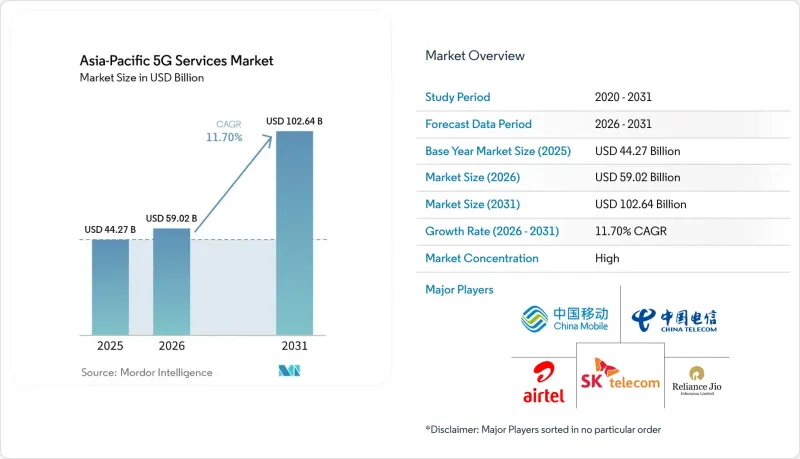
에 따르면 아시아태평양의 5G 서비스 시장 규모는 2025년 442억 7,000만 달러에서 2026년에는 590억 2,000만 달러로 확대하며, 2026-2031년에 CAGR 11.70%로 추이하며, 2031년에는 1,026억 4,000만 달러에 달할 것으로 예측됩니다.
아시아태평양 5G 서비스 시장의 동향 및 인사이트
폭발적으로 증가하는 모바일 데이터 트래픽이 네트워크 용량의 경제성을 재편
2025년 말 기준, 5G가 차지하는 전 세계 모바일 데이터 트래픽 비중은 48%로, 2024년 말의 34%에서 증가했습니다. 이 비중은 2031년까지 85%에 달할 것으로 예측됩니다. 동북아시아에서는 2025년에 활성 스마트폰 1대당 월평균 트래픽이 23GB를 기록할 것으로 예상되며, 2031년까지 45GB에 달할 것으로 전망됩니다. 동남아시아 및 오세아니아에서는 2025년에 활성 스마트폰 1대당 트래픽이 21GB를 기록할 것으로 예상되며, 2031년까지 40GB에 도달할 것으로 전망됩니다. 고정 무선 접속을 포함한 네트워크 트래픽은 인도와 동북아시아를 주축으로 2026년 1분기에 전년 동기 대비 22% 증가했습니다. 수요가 특정 시간대나 장소에 집중되어 있으므로 통신사업자들은 일률적인 네트워크 확장보다는 더 높은 밀도의 용량과 우수한 트래픽 관리가 필요합니다. 따라서 통신사업자들이 피크 시간대의 수요에 대응할 수 있는 저비용 방안을 모색하는 한편, 아시아태평양의 5G 서비스 시장은 지속적인 인프라 투자의 혜택을 받고 있습니다.
AI-RAN과 엣지 클라우드 워크로드는 통신사업자에게 새로운 수입원을 가져다줄 것입니다.
AI-RAN은 기지국의 컴퓨팅 자원을 AI 워크로드에 활용할 수 있으며, 통신사업자에게 기존의 데이터 과금 이외의 수입원을 제공할 가능성이 있습니다. KT 코퍼레이션과 삼성전자는 2025년 12월 KT의 상용 5G 네트워크에서 AI-RAN 최적화를 실증하여, 사용자 수준의 AI 설정을 활용하여 서비스 중단을 줄였습니다. 소프트뱅크는 2026년에 ‘AITRAS’ 플랫폼을 상용화하여, 기지국의 GPU 리소스에서 타사의 산업용 엣지 워크로드를 실행할 수 있게 했습니다. 2026년 7월, 한국 과학기술정보통신부는 160억 원(1,140만 달러) 규모의 ‘Hyper AI Network’ 시범 사업과 관련해 SK통신 및 KT가 주도하는 컨소시엄을 선정했습니다. 노키아와 인도샛 오오리드 허치슨은 2026년 6월, 인도네시아의 5G 무선 네트워크 현대화 및 AI-RAN 서비스 개발을 위한 다년 계약을 체결했으며, 2026년 말까지 현장 시험을 실시할 예정입니다. 이러한 프로젝트들은 아시아태평양의 5G 서비스 시장이 기업 컴퓨팅 및 산업용 애플리케이션과 점점 더 밀접하게 연계되고 있음을 보여줍니다.
높은 도입 비용과 긴 회수 기간이 네트워크 고밀도화를 제약
고밀도 5G 구축에는 안테나 일체형 무선기, 베이스밴드 장비, 광 프론트홀 및 소프트웨어가 필요하며, 이러한 요소들은 7년에 걸친 수명 주기 동안 소유 비용을 증가시킬 가능성이 있습니다. 안테나 일체형 무선기는 고밀도 사이트의 부품 원가의 45-55%를 차지하고 있습니다. 차이나모바일은 2025 회계연도에 1,509억 위안(208억 달러)의 설비 투자를 단행하고, 2026년에는 1,366억 위안(188억 달러)을 계획하고 있습니다. 이는 컴퓨팅 및 AI 인프라에 대한 지출을 확대하고 있기 때문입니다. 논스탠드얼론(NSA) 코어에서 스탠드얼론(SA) 코어로의 전환은 모든 기업 기능이 상용화되기 전에 통신사업자가 투자를 진행해야 하므로 투자 회수 시기를 더욱 늦출 가능성이 있습니다. 한국에서는 2026년까지 5G 기지국을 독립형(SA) 코어 장비로 연결하도록 의무화하고, 조건을 충족하는 실내 5G 구축에 대해서는 LTE 주파수 대역 재할당 수수료를 감면하는 조치를 취했습니다. 아시아태평양의 5G 서비스 시장은 통신사업자가 신뢰성이 높고 지연 시간이 짧은 서비스의 가치를 인정하는 계약과 투자를 적절히 연계할 수 있느냐에 달려 있습니다.
부문 분석
2025년, 아시아태평양의 5G 서비스 시장 점유율 중 62.97%를 강화형 모바일 브로드밴드가 차지했습니다. 이러한 위상은 중국과 인도의 대규모 소비자 가입자 기반을 반영한 것으로, 이들 국가에서는 5G가 동영상, 게임, 통신 및 일반적인 모바일 데이터 이용에 활용되고 있습니다. 차이나모바일(China Mobile)은 2025년 6억 4,200만 명의 5G 네트워크 가입자를 보고했습니다. 고정 무선 액세스(FWA)는 이러한 소비자 주도 모델을 가정 및 중소기업으로 확대하고 있습니다. 2025년 12월 기준, 중국 및 기타 아시아태평양의 고정 무선 접속(FWA) 고객 단말 장비(CPE) 출하 대수의 50% 이상이 5G 지원 단말기였습니다. Jio AirFiber는 2026 회계연도에 1,300만 가구에 보급되어, 5G 통신 용량을 활용한 실용적인 광대역 사용 사례를 새롭게 제시했습니다. 초고신뢰성·저지연 통신(URLC)의 규모는 여전히 작지만, 산업용 제어 및 안전성이 극히 중요한 용도에서 중요한 역할을 하고 있습니다. 인도샛(Indosat)이 인도네시아의 한 공장에 도입한 사례에서는 30밀리초 미만의 운영 제어 루프가 확인되었습니다.
대규모 머신 유형 통신(MMC)은 2031년까지 연평균 성장률(CAGR) 12.18%로 확대될 것으로 예측됩니다. 이 서비스는 공장, 물류 거점, 농업 현장에서 다수의 연결 기기를 지원합니다. 기능 제한형 기기(Reduced Capability devices)는 스마트폰급의 모든 기능을 갖춘 5G 기기와 같은 비용이나 전력 소비 없이도 복잡도가 낮은 IoT 연결을 지원할 수 있습니다. 이를 통해 기존의 저전력 네트워크가 기본적인 센서를 지원해 온 분야에서 활용이 가능해집니다. 아시아태평양의 mMTC용 5G 서비스 시장 규모는 프라이빗 네트워크 및 기기 생태계의 보급 확대에 달려 있습니다. 네트워크 슬라이싱 또한 특정 기업 애플리케이션을 위해 서비스 특성을 확보할 수 있다는 점에서 중요합니다. 스탠드얼론(SA) 코어를 채택한 통신사업자는 여전히 기존 코어 시스템에 의존하는 사업자보다 이러한 기능을 제공하기가 더 용이한 입장에 있습니다. 3GPP 릴리스 17 및 릴리스 18에서는 디바이스 및 네트워크 인증 지침이 되는 RedCap 및 5G Advanced의 주요 요구 사항이 정의되어 있습니다. 이러한 표준을 통해 산업 분야에서의 도입이 확대됨에 따라 상호 운용성의 장벽을 낮출 수 있습니다.
2025년, 아시아태평양의 5G 서비스 시장 점유율 중 비스탠드얼론(NSA) 5G가 66.31%를 차지했습니다. 이 아키텍처를 통해 통신사업자는 5G 무선 네트워크를 구축하면서 기존 4G 코어에 대한 투자를 활용할 수 있습니다. 이를 통해 초기 비용이 절감되었고, 해당 지역 전체에서 소비자 대상 서비스의 조기 제공이 가속화되었습니다. 그러나 전용 네트워크 슬라이스나 일부 저지연 기업 서비스에 필요한 모든 기능을 제공할 수는 없습니다. 2025년 4분기, 중국의 5G 독립형(SA) 방식 샘플 점유율은 80.9%를 기록한 반면, 인도는 49.2%였습니다. 릴라이언스 지오(Reliance Jio)의 전국적 아키텍처는 완전한 독립형 방식이며, 이것이 인도의 높은 수치를 지원하고 있습니다. 싱가포르는 2026년에 전국적인 독립형 방식 전환을 완료했습니다. 이러한 시장들은 아키텍처가 단순한 기술적 선택지가 아니라 상업적 차별화 요소로 자리 잡고 있음을 보여줍니다.
스탠드얼론형 5G는 2026-2031년에 연평균 성장률(CAGR) 12.52%로 확대될 것으로 예측됩니다. 2025년 기준, 5G 스탠드얼론형 보급률에서 세계 상위 10위권에 든 국가 중 6개국이 아시아태평양에 위치해 있었습니다. NTT 도코모와 NEC는 2026년 3월 AWS 상에서 일본 최초의 상용 5G 코어 네트워크를 가동했습니다. 이번 도입에서는 AI를 활용하여 코어 네트워크의 설계 및 구축을 자동화함으로써 구축 기간을 80% 단축했습니다. SK통신, KT, LG유플러스는 2026년 12월까지 전국 규모의 독립형 서비스 제공 개시를 목표로 하고 있습니다. 이러한 전환을 통해 기업용 서비스 수준 계약(SLA)의 가용성과 차별화된 네트워크 계층 제공이 향상될 가능성이 있습니다. 아시아태평양의 5G 서비스 시장에서는 보다 명확한 서비스 패키지 제공이 가능해지기 때문에 독립형 시스템으로의 전환을 위한 강력한 동기가 존재합니다. 특히 추가 기능이 아직 소비자 가격에 반영되지 않은 지역에서는 투자 부담이 여전히 큰 상태입니다.
기타 혜택:
- 엑셀 형식의 시장 예측(ME) 시트
- 3개월간의 애널리스트 지원
자주 묻는 질문
목차
제1장 서론
- 조사 전제조건과 시장 정의
- 조사 범위
제2장 조사 방법
제3장 개요
제4장 시장 구도
- 시장 개요
- 시장 성장 촉진요인
- 시장 성장 억제요인
- 거시경제 요인이 시장에 미치는 영향
- 업계 밸류체인 분석
- 규제 상황
- 기술 전망
- Porter's Five Forces 분석
제5장 시장 규모와 성장 예측
- 서비스 유형별
- 네트워크 아키텍처별
- 주파수대별
- 최종사용자 산업별
- 용도별
- 지역별
- 중국
- 인도
- 일본
- 한국
- 호주·뉴질랜드
- 인도네시아
- 싱가포르
- 기타 아시아태평양 국가
제6장 경쟁 구도
- 시장 집중도
- 전략적 동향
- 시장 점유율 분석
- 기업 개요
- China Mobile Limited
- China Telecom Corporation Limited
- China Unicom(Hong Kong) Limited
- Reliance Jio Infocomm Limited
- Bharti Airtel Limited
- NTT DOCOMO, INC.
- KDDI Corporation
- SoftBank Corp.
- Rakuten Mobile, Inc.
- SK Telecom Co., Ltd.
- KT Corporation
- LG Uplus Corp.
- Telstra Group Limited
- Singtel Group
- Huawei Technologies Co., Ltd.
- ZTE Corporation
- Telefonaktiebolaget LM Ericsson
- Nokia Corporation
- Samsung Electronics Co., Ltd.
- Qualcomm Incorporated
- Cisco Systems, Inc.
- NEC Corporation
- Fujitsu Limited
제7장 시장 기회와 향후 전망
KSA 26.10.28According to Mordor Intelligence, the Asia-Pacific 5G services market size is expected to grow from USD 44.27 billion in 2025 to USD 59.02 billion in 2026 and is forecast to reach USD 102.64 billion by 2031 at 11.70% CAGR over 2026-2031.
Asia-Pacific 5G Services Market Trends and Insights
Exploding Mobile Data Traffic Reshapes Network Capacity Economics
5G carried 48% of global mobile data traffic at the end of 2025, compared with 34% at the end of 2024, and its share is forecast to reach 85% by 2031. Northeast Asia recorded average monthly traffic of 23 GB per active smartphone in 2025, and usage is forecast to reach 45 GB by 2031. Southeast Asia and Oceania recorded 21 GB per active smartphone in 2025, and usage is forecast to reach 40 GB by 2031. Network traffic, including fixed wireless access, increased 22% year over year in Q1 2026, led by India and Northeast Asia. Demand is concentrated at certain hours and locations, so operators need denser capacity and better traffic management rather than uniform network expansion. The Asia-Pacific 5G services market therefore benefits from sustained infrastructure spending, even as operators seek lower-cost ways to handle peak demand.
AI-RAN and Edge-Cloud Workloads Drive a New Revenue Layer for Operators
AI-RAN can use base-station computing resources for AI workloads and may give operators a revenue source beyond traditional data pricing. KT Corporation and Samsung Electronics validated AI-RAN optimization on KT's commercial 5G network in December 2025, using user-level AI configurations to reduce service disruption. SoftBank made its AITRAS platform commercially available in 2026, enabling third-party industrial edge workloads on GPU resources at base stations. South Korea's Ministry of Science and ICT selected SK Telecom and KT-led consortia for a KRW 16 billion, USD 11.4 million, Hyper AI Network pilot in July 2026. Nokia and Indosat Ooredoo Hutchison signed a multiyear agreement in June 2026 to modernize Indonesia's 5G radio network and develop AI-RAN services, with field trials planned by the end of 2026. These projects show that the Asia-Pacific 5G services market is increasingly linked to enterprise computing and industrial applications.
High Deployment Costs and Long Return Horizons Constrain Network Densification
Dense 5G deployments require antenna-integrated radios, baseband equipment, optical fronthaul, and software, which can extend ownership costs across a 7-year life cycle. Antenna-integrated radios account for 45-55% of a dense site's bill of materials. China Mobile spent RMB 150.9 billion, USD 20.8 billion, on capital expenditure in FY2025 and plans RMB 136.6 billion, USD 18.8 billion, in 2026 as it directs more spending toward computing and AI infrastructure. The transition from Non-Standalone to Standalone cores can further delay returns because operators must invest before all enterprise features become commercially available. South Korea required 5G base stations to connect to Standalone core equipment by 2026 and offered lower LTE spectrum reallocation fees for qualifying indoor 5G deployments. The Asia-Pacific 5G services market will depend on operators matching investments with contracts that recognize the value of reliable, low-latency service.
Other drivers and restraints analyzed in the detailed report include:
- High Consumer Demand for Enhanced Mobile Broadband Strains Legacy ARPU Models
- Enterprise Digital Transformation Use Cases Accelerate B2B Revenue Diversification
- Limited 5G Device Readiness Delays Revenue Ramp in Emerging Markets
For complete list of drivers and restraints, kindly check the Table Of Contents.
Segment Analysis
Enhanced mobile broadband held 62.97% of the Asia-Pacific 5G services market share in 2025. Its position reflects a large consumer subscriber base in China and India, where 5G is used for video, gaming, communications, and general mobile data. China Mobile reported 642 million 5G network customers in 2025. Fixed wireless access is extending this consumer-led model into homes and small businesses. More than 50% of fixed wireless access customer-premises equipment shipments in China and the rest of Asia-Pacific were 5G devices in December 2025. Jio AirFiber reached 13 million homes in FY26, adding a practical broadband use case for 5G capacity. Ultra-reliable low-latency communications remain smaller but are relevant for industrial control and safety-critical uses. Indosat's Indonesian factory deployments documented operational control loops below 30 milliseconds.
Massive machine-type communications is projected to expand at a 12.18% CAGR through 2031. The service supports large numbers of connected devices in factories, logistics sites, and agricultural operations. Reduced Capability devices can support lower-complexity IoT connections without the cost or power needs of full smartphone-class 5G devices. This makes them relevant where legacy low-power networks have served basic sensors. The Asia-Pacific 5G services market size for mMTC will depend on wider adoption of private networks and device ecosystems. Network slicing is also important because it can reserve service characteristics for a specific enterprise application. Operators using Standalone cores are better placed to offer these features than operators still dependent on legacy core systems. 3GPP Release 17 and Release 18 define key RedCap and 5G Advanced requirements that guide device and network certification. These standards can reduce interoperability barriers as industrial deployments scale.
Non-Standalone 5G held 66.31% of the Asia-Pacific 5G services market share in 2025. The architecture lets operators use existing 4G core investments while deploying 5G radio coverage. This reduced the initial cost and sped early consumer launches across the region. However, it does not provide all the capabilities needed for dedicated network slices and some low-latency enterprise services. China recorded an 80.9% 5G Standalone sample share in Q4 2025, while India recorded a 49.2% share. Reliance Jio's nationwide architecture is fully Standalone, supporting India's higher result. Singapore completed its nationwide Standalone transition in 2026. These markets show how architecture is becoming a commercial differentiator rather than only a technical choice.
Standalone 5G is projected to expand at a 12.52% CAGR from 2026 to 2031. Six of the world's top 10 countries by 5G Standalone reach were in Asia-Pacific in 2025. NTT DOCOMO and NEC launched Japan's first commercial 5G core network on AWS in March 2026. The deployment used AI to automate core-network design and construction, reducing construction time by 80%. SK Telecom, KT Corporation, and LG Uplus aim to launch nationwide Standalone services by December 2026. Their migration may improve the availability of enterprise service-level agreements and differentiated network tiers. The Asia-Pacific 5G services market has a strong incentive to move toward Standalone systems because they enable more distinct service packages. The investment burden remains significant, particularly where consumer pricing has not yet reflected the added capability.
Complete Report Scope:
- By Service Type
- Enhanced Mobile Broadband
- Ultra-Reliable Low-Latency Communications
- Massive Machine-Type Communications
- Fixed Wireless Access
- By Network Architecture
- Non-Standalone 5G
- Standalone 5G
- By Frequency Band
- Low Band
- Mid Band
- Millimeter-Wave
- By End-User Industry
- IT and Telecom
- Automotive, Mobility and Transportation
- Manufacturing, Energy and Utilities
- Healthcare and Life Sciences
- Banking, Financial Services, Insurance and RegTech
- Retail, Media and E-Commerce
- Government, Defense, Education and Public Sector
- Other End-User Industries
- By Application
- Communication and Collaboration
- Asset Tracking
- Smart Cities
- Smart Buildings
- Autonomous Vehicles and Vehicle-to-Everything
- Smart Healthcare
- Industry 4.0
- Smart Utilities
- Immersive Media and Gaming
- Public Safety and Mission-Critical Communications
- By Geography
- China
- India
- Japan
- South Korea
- Australia and New Zealand
- Indonesia
- Singapore
- Rest of Asia-Pacific
List of Companies Covered in this Report:
- China Mobile Limited
- China Telecom Corporation Limited
- China Unicom (Hong Kong) Limited
- Reliance Jio Infocomm Limited
- Bharti Airtel Limited
- NTT DOCOMO, INC.
- KDDI Corporation
- SoftBank Corp.
- Rakuten Mobile, Inc.
- SK Telecom Co., Ltd.
- KT Corporation
- LG Uplus Corp.
- Telstra Group Limited
- Singtel Group
- Huawei Technologies Co., Ltd.
- ZTE Corporation
- Telefonaktiebolaget LM Ericsson
- Nokia Corporation
- Samsung Electronics Co., Ltd.
- Qualcomm Incorporated
- Cisco Systems, Inc.
- NEC Corporation
- Fujitsu Limited
Additional Benefits:
- The market estimate (ME) sheet in Excel format
- 3 months of analyst support
TABLE OF CONTENTS
1 INTRODUCTION
- 1.1 Study Assumptions and Market Definition
- 1.2 Scope of the Study
2 RESEARCH METHODOLOGY
3 EXECUTIVE SUMMARY
4 MARKET LANDSCAPE
- 4.1 Market Overview
- 4.2 Market Drivers
- 4.2.1 Exploding Mobile Data Traffic
- 4.2.2 High Consumer Demand for Enhanced Mobile Broadband
- 4.2.3 Enterprise Digital-Transformation Use Cases
- 4.2.4 Government Spectrum-Release Initiatives
- 4.2.5 Cross-Border 3.5 GHz Harmonization and Roaming Gaps Creating Localization Demand
- 4.2.6 AI-RAN and Edge-Cloud Workloads Increasing Premium Connectivity Demand
- 4.3 Market Restraints
- 4.3.1 High Deployment Costs and Long ROI Horizons
- 4.3.2 Limited 5G Device Readiness in Emerging Markets
- 4.3.3 Fragmented Spectrum Policy Across Southeast Asian Markets
- 4.3.4 Power-Grid Constraints and Energy Costs for Dense 5G Sites
- 4.4 Impact of Macroeconomic Factors on the Market
- 4.5 Industry Value Chain Analysis
- 4.6 Regulatory Landscape
- 4.7 Technological Outlook
- 4.8 Porter's Five Forces Analysis
- 4.8.1 Threat of New Entrants
- 4.8.2 Bargaining Power of Buyers
- 4.8.3 Bargaining Power of Suppliers
- 4.8.4 Threat of Substitutes
- 4.8.5 Intensity of Competitive Rivalry
5 MARKET SIZE AND GROWTH FORECASTS (VALUE)
- 5.1 By Service Type
- 5.1.1 Enhanced Mobile Broadband
- 5.1.2 Ultra-Reliable Low-Latency Communications
- 5.1.3 Massive Machine-Type Communications
- 5.1.4 Fixed Wireless Access
- 5.2 By Network Architecture
- 5.2.1 Non-Standalone 5G
- 5.2.2 Standalone 5G
- 5.3 By Frequency Band
- 5.3.1 Low Band
- 5.3.2 Mid Band
- 5.3.3 Millimeter-Wave
- 5.4 By End-User Industry
- 5.4.1 IT and Telecom
- 5.4.2 Automotive, Mobility and Transportation
- 5.4.3 Manufacturing, Energy and Utilities
- 5.4.4 Healthcare and Life Sciences
- 5.4.5 Banking, Financial Services, Insurance and RegTech
- 5.4.6 Retail, Media and E-Commerce
- 5.4.7 Government, Defense, Education and Public Sector
- 5.4.8 Other End-User Industries
- 5.5 By Application
- 5.5.1 Communication and Collaboration
- 5.5.2 Asset Tracking
- 5.5.3 Smart Cities
- 5.5.4 Smart Buildings
- 5.5.5 Autonomous Vehicles and Vehicle-to-Everything
- 5.5.6 Smart Healthcare
- 5.5.7 Industry 4.0
- 5.5.8 Smart Utilities
- 5.5.9 Immersive Media and Gaming
- 5.5.10 Public Safety and Mission-Critical Communications
- 5.6 By Geography
- 5.6.1 China
- 5.6.2 India
- 5.6.3 Japan
- 5.6.4 South Korea
- 5.6.5 Australia and New Zealand
- 5.6.6 Indonesia
- 5.6.7 Singapore
- 5.6.8 Rest of Asia-Pacific
6 COMPETITIVE LANDSCAPE
- 6.1 Market Concentration
- 6.2 Strategic Moves
- 6.3 Market Share Analysis
- 6.4 Company Profiles (includes Global Level Overview, Market Level Overview, Core Segments, Financials as available, Strategic Information, Market Rank/Share, Products and Services, Recent Developments)
- 6.4.1 China Mobile Limited
- 6.4.2 China Telecom Corporation Limited
- 6.4.3 China Unicom (Hong Kong) Limited
- 6.4.4 Reliance Jio Infocomm Limited
- 6.4.5 Bharti Airtel Limited
- 6.4.6 NTT DOCOMO, INC.
- 6.4.7 KDDI Corporation
- 6.4.8 SoftBank Corp.
- 6.4.9 Rakuten Mobile, Inc.
- 6.4.10 SK Telecom Co., Ltd.
- 6.4.11 KT Corporation
- 6.4.12 LG Uplus Corp.
- 6.4.13 Telstra Group Limited
- 6.4.14 Singtel Group
- 6.4.15 Huawei Technologies Co., Ltd.
- 6.4.16 ZTE Corporation
- 6.4.17 Telefonaktiebolaget LM Ericsson
- 6.4.18 Nokia Corporation
- 6.4.19 Samsung Electronics Co., Ltd.
- 6.4.20 Qualcomm Incorporated
- 6.4.21 Cisco Systems, Inc.
- 6.4.22 NEC Corporation
- 6.4.23 Fujitsu Limited
7 MARKET OPPORTUNITIES AND FUTURE OUTLOOK
- 7.1 White-Space and Unmet-Need Assessment


