

|
시장보고서
상품코드
2155654
플래시 LiDAR 시스템 : 시장 점유율 분석, 업계 동향과 통계, 성장 예측(2026-2031년)Flash LiDAR Systems - Market Share Analysis, Industry Trends & Statistics, Growth Forecasts (2026 - 2031) |
||||||
 Mordor Intelligence
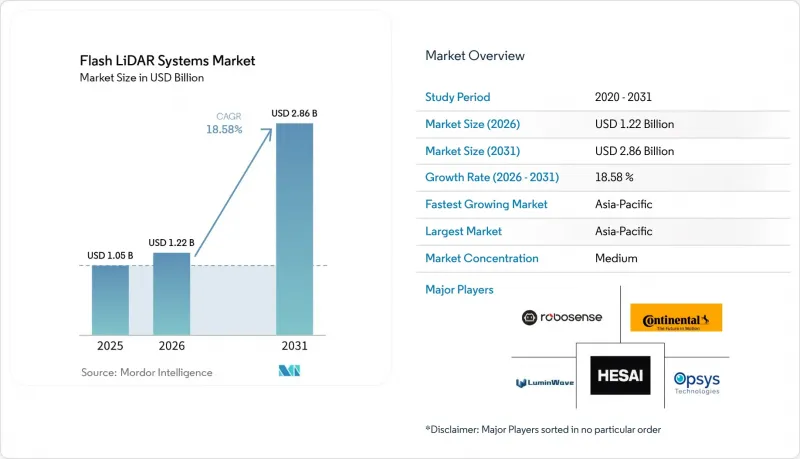
에 따르면 플래시 LiDAR 시스템 시장 규모는 2025년에 10억 5,000만 달러로 평가되며, 2026년 12억 2,000만 달러에서 확대되어 2031년까지 28억 6,000만 달러에 달할 것으로 예측됩니다.
예측 기간(2026-2031년) 동안 연평균 성장률(CAGR)은 18.58%가 될 것으로 전망됩니다.
세계 플래시 라이더(Flash LiDAR) 시스템 시장의 동향 및 인사이트
자율주행 로봇 및 창고 자동화의 확대
물류 자동화는 플래시 LiDAR 시스템 시장의 수요를 견인하는 주요 단기 요인입니다. 자율주행 로봇은 혼잡한 창고 통로나 공동 작업 구역에서 지속적인 3차원 인식이 필요합니다. 전체 장면을 포착함으로써, 스캔 센서가 변화하는 영역에서 멀어졌을 때 발생하는 인식의 공백을 최소화할 수 있습니다. Hesai사의 보고에 따르면, 2026년 2분기 로봇용 LiDAR 출하대수는 전년 동기 대비 193.4% 증가한 14만 2,371대에 달했습니다. 또한, 이 회사는 전 세계 50개 이상의 ‘엔보디드 AI(구현된 인공지능)’ 관련 기업과 제휴하고 있다고 보고했습니다. 솔리드 스테이트 센서는 설계가 가동 부품에 의존하지 않기 때문에 여러 교대조가 운영되는 물류 업무에도 적합합니다.
인더스트리 4.0 도입과 유연한 제조
유연한 제조는 생산 셀이나 제품 구성의 변화에 대응할 수 있는 3차원 센싱을 필요로 하기 때문에 플래시 LiDAR 시스템 시장을 뒷받침하고 있습니다. 재구성 가능한 셀, 협업 로봇, 그리고 실시간 품질 검사를 통해 고정된 장면 맵의 유용성은 떨어지고 있습니다. 플래시 LiDAR는 1프레임 만에 장면의 형상 정보를 획득할 수 있으므로, 셀 변경 후 조정을 신속하게 수행할 수 있습니다. 식품·음료 생산 라인, 의약품 포장 스테이션, 전자기기 조립 현장 등에서는 이러한 상황에 직면할 수 있습니다. 따라서 제조업체가 안정적인 레이아웃에 의존하지 않는 센싱을 필요로 하는 상황에서 플래시 LiDAR 시스템 시장은 혜택을 볼 수 있습니다. 공장이 더욱 적응력 높은 운영을 추구하는 가운데, 자동화 하드웨어 및 센서에 대한 투자는 계속해서 중요해질 것입니다.
카메라 및 4D 레이더 인식 시스템과의 경쟁
4D 이미징 레이더는 안개, 분진, 비 속에서도 감지 성능을 유지할 수 있기 때문에 플래시 LiDAR 시스템 시장의 성장을 제약할 가능성이 있습니다. 이러한 기상 조건은 항만, 광산 및 기타 야외 작업 현장에서 플래시 LiDAR의 유효 측정 거리를 단축시킬 우려가 있습니다. 2026년 CVPR 워크숍 논문에 따르면, 4D 레이더는 악천후 속에서도 기준 감지 범위의 95%를 유지할 수 있었다고 보고되었습니다. 같은 논문에서는 동일한 조건에서 라이다의 감지 범위가 60-80% 감소한 사실도 보고되었습니다. 또한, 스테레오 카메라나 이벤트 카메라 시스템도 조명 조건이 제어된 환경에서는 더 낮은 단가로 3차원 추정을 제공할 수 있습니다. 따라서 기존 머신비전 인프라로 인해 실내 제조 현장에서 센서 스택의 변경이 더디게 진행될 가능성이 있습니다.
부문 분석
2025년에는 최대 25미터까지의 단거리 대역이 플래시 LiDAR 시스템 시장 점유율의 43.81%를 차지했습니다. 창고 내 피킹 작업은 무인운반차(AGV)의 근접 감지를 통해 플래시 LiDAR 시스템 시장을 뒷받침하고 있으며, 로봇을 이용한 빈 피킹이 이 수요의 대부분을 차지하고 있습니다. 전경 조명은 이러한 콤팩트한 작업 영역에 최적입니다. 조명이 일정한 실내에서는 신호 품질과 주변광 제거를 최적화하기 쉽다는 장점이 있습니다. 실내 물류 분야에서의 도입 실적이 단거리 제품에 대한 지속적인 수요를 뒷받침하고 있습니다. 또한 구매자들은 저지연 근거리 장애물 감지가 필요한 용도에서도 이러한 센서를 활용하고 있습니다.
100미터를 초과하는 장거리 분야는 2031년까지 연평균 성장률(CAGR) 19.18%로 확대될 것으로 예측됩니다. 항만, 공항 및 중공업 분야의 주변 감시가 주요 발전 분야로 부상하고 있습니다. 이러한 환경에서는 더 긴 작동 거리와 장시간 가동 주기에 걸친 신뢰성 높은 감지가 요구됩니다. 장비가 연속적으로 가동되는 상황에서는 기계적 마모가 없는 것이 중요한 요소가 됩니다. 중거리(25-100미터)는 창고 통로 간 감시나 대형 분류 라인에 활용되고 있습니다. Optica사는 강한 주변광 아래에서도 2%의 정확도로 100미터의 실외 심도 이미징을 실현한 플래시 LiDAR 시스템을 발표했습니다.
2025년 기준, 플래시 LiDAR 모듈은 플래시 LiDAR 시스템 시장의 46.73%를 차지했습니다. 플래시 LiDAR 시스템 시장의 도입 기반은 자동차 업계의 Tier 1 공급업체와 물류 자동화 통합업체에 의해 뒷받침되고 있습니다. 모듈을 사용함으로써 통합업체는 센싱 하드웨어를 자사의 소프트웨어 스택과 결합할 수 있습니다. 이러한 유연성은 기존 산업용 자동화 구매자에게 여전히 중요한 요소로 남아 있습니다. 독립형 플래시 LiDAR 센서는 여전히 조사, 프로토타이핑 및 기존 설비에 대한 사후 도입에 활용되고 있습니다. 이러한 구매자들은 개별 프로젝트에서 미리 통합된 시스템을 필요로 하지 않는 경우가 있습니다.
통합형 플래시 LiDAR 인식 시스템은 2031년까지 연평균 성장률(CAGR) 19.21%로 확대될 것으로 예측됩니다. 이러한 제품은 센싱, 엣지 처리 및 인식 소프트웨어를 인증된 단일 유닛으로 통합한 것입니다. 이를 통해 통합 자원이 제한적인 사용자의 경우, 도입 작업 부담을 줄일 수 있습니다. 2026년 6월, MicroVision사는 로봇 공학 및 공간 AI 평가를 목적으로 한 AI 기업 및 하이퍼스케일러에 MOVIA 센서를 납품했습니다. 또한, RoboSense는 2026년 7월, EOCENE SPAD-SoC 아키텍처를 탑재한 E2 센서를 발표했습니다. 이러한 제품 발표는 지각 기능을 지원하는 제품으로의 전환을 나타내는 것입니다.
지역별 분석
2025년, 아시아태평양은 플래시 LiDAR 시스템 시장의 39.71%를 차지하고 있으며, 2031년까지 연평균 성장률(CAGR) 19.54%로 확대될 것으로 예측됩니다. 중국은 L2+ 및 L3 첨단 운전자 보조 시스템(ADAS)의 도입과 로봇 공학 활용 확대에 힘입어 지역 수요에서 가장 큰 점유율을 차지하고 있습니다. Hesai사는 2026년 2분기 중국 장거리 ADAS 라이다 분야에서 44%의 점유율을 기록했다고 보고했습니다. 또한, 해당 기업의 제출 자료에 따르면, 중국의 휴머노이드 및 사족 보행 로봇용 라이다 부문에서도 1위를 차지했습니다. 일본은 정밀 제조의 자동화를 통해 기여하고 있으며, 한국은 로봇 플랫폼 및 첨단 운전자 보조 시스템의 통합을 지원하고 있습니다.
북미는 2025년에 세계 2위의 점유율을 차지했습니다. 이 지역의 플래시 라이다 시스템 시장은 미국의 주요 풀필먼트 센터에서 물류 자동화를 정착시키고 있습니다. 또한, 자동차 업계의 Tier 1 공급업체들의 활동과 성숙한 로봇 통합 기반도 존재합니다. 산업용 이동 로봇의 안전 요건이 인증된 센서의 조달을 촉진하고 있습니다. 캐나다는 광업 자동화 및 정밀 농업 분야의 응용 사례를 제공하고 있습니다. 멕시코는 자동차 공급업체 시설에 대한 니어쇼어링 관련 투자를 통해 수요를 확대하고 있습니다.
유럽에서는 독일의 자동차 제조 및 내부 물류 분야에서 플래시 LiDAR 통합을 위한 기반이 성숙해 있습니다. 프랑스, 이탈리아, 스페인에서는 식품·음료 및 제약 분야의 자동화 도입이 진행되고 있습니다. 유럽연합(EU)의 기계 규정 2023/1230은 2027년에 발효되어, 사람과 기계가 공존하는 작업 환경에서 지각 센서에 대한 안전 요건을 강화할 것입니다. 중동 및 아프리카, 남미는 여전히 소규모 시장이지만 수요는 확대되고 있습니다. 중동의 항만 현대화 및 브라질의 식품 가공 자동화는 단기적인 활용 사례가 될 것입니다. 이러한 분야에서는 도입 및 검증 요건을 경감시켜 주는 통합 솔루션의 혜택을 누릴 수 있습니다.
기타 혜택:
- 엑셀 형식의 시장 예측(ME) 시트
- 3개월간의 애널리스트 지원
자주 묻는 질문
목차
제1장 소개
- 조사 가정과 시장 정의
- 조사 범위
제2장 조사 방법
제3장 주요 요약
제4장 시장 구도
- 시장 개요
- 시장 성장 촉진요인
- 시장 성장 억제요인
- 거시경제 요인이 시장에 미치는 영향
- 업계 공급망 분석
- 기술 동향
- 규제 상황
- Porter's Five Forces 분석
제5장 시장 규모와 성장 예측
- 범위별
- 제품 형태별
- 용도별
- 최종 이용 산업별
- 지역별
- 북미
- 미국
- 캐나다
- 멕시코
- 남미
- 브라질
- 아르헨티나
- 기타 남미 국가
- 유럽
- 독일
- 영국
- 프랑스
- 이탈리아
- 스페인
- 기타 유럽 국가
- 아시아태평양
- 중국
- 일본
- 인도
- 한국
- ASEAN
- 기타 아시아태평양 국가
- 중동 및 아프리카
- 중동
- 사우디아라비아
- 아랍에미리트
- 튀르키예
- 기타 중동 국가
- 아프리카
- 남아프리카공화국
- 나이지리아
- 기타 아프리카 국가
- 중동
- 북미
제6장 경쟁 구도
- 시장 집중도
- 전략적 동향
- 시장 점유율 분석
- 기업 개요
- Opsys Technologies Ltd.
- SiLC Technologies, Inc.
- LuminWave Technology Co., Ltd.
- Fastree3D SA
- PreAct Technologies, Inc.
- Leddartech Inc.
- Xenics NV
- Ouster, Inc.
- Velodyne Lidar
- Insight LiDAR, Inc.
- Pointcloud, Inc.
- Baraja Pty Ltd
- INFOWORKS, Inc.
- Photonx Ltd.
- Hangzhou Ailaida Technology Co., Ltd.
- Zhejiang Guangpo Intelligent Technology Co., Ltd.
- Beijing Guangshao Technology Co., Ltd.
- Hesai Technology Co., Ltd.
- MicroVision, Inc.
- AEye, Inc.
- TetraVue, Inc.
- Hybrid Lidar Systems
제7장 시장 기회와 향후 전망
KSM 26.10.30According to Mordor Intelligence, the flash LiDAR systems market size was valued at USD 1.05 billion in 2025 and estimated to expand from USD 1.22 billion in 2026 to reach USD 2.86 billion by 2031, at an CAGR of 18.58% during the forecast period (2026-2031).
Global Flash LiDAR Systems Market Trends and Insights
Expansion of Autonomous Mobile Robots and Warehouse Automation
Logistics automation is a major near-term driver of demand for the Flash LiDAR systems market. Autonomous mobile robots need continuous three-dimensional awareness in crowded warehouse aisles and shared work zones. Full-scene capture can limit the gaps that occur when a scanning sensor moves away from a changing area. Hesai reported that robotics LiDAR shipments increased 193.4% year over year to 142,371 units in the second quarter of 2026. It also reported engagement with more than 50 companies in embodied artificial intelligence worldwide. Solid-state sensors can also suit multi-shift logistics operations because their design does not rely on rotating parts.
Industry 4.0 Adoption and Flexible Manufacturing
Flexible manufacturing supports the Flash LiDAR systems market because it requires three-dimensional sensing that can respond to changes in production cells or product mixes. Reconfigurable cells, collaborative robots, and real-time quality checks reduce the usefulness of fixed scene maps. Flash LiDAR can acquire scene geometry in a single frame, enabling faster adjustment after a cell change. Food and beverage lines, pharmaceutical packaging stations, and electronics assembly floors can face these conditions. The Flash LiDAR systems market can therefore benefit where manufacturers need sensing that does not depend on a stable layout. Automation hardware and sensor investments remain relevant as factories pursue more adaptable operations.
Competition From Camera and 4D Radar Perception Systems
4D imaging radar can constrain the Flash LiDAR systems market by preserving detection performance in fog, dust, and rain. These conditions can reduce the useful range of flash LiDAR in ports, mining, and other outdoor operations. A 2026 CVPR Workshop paper reported that 4D radar maintained 95% of baseline detection range in adverse weather. The paper reported a 60-80% LiDAR range reduction under the same conditions. Stereo and event-camera systems can also provide three-dimensional estimates at lower per-unit costs under controlled lighting conditions. Existing machine-vision infrastructure may therefore slow sensor-stack changes in indoor manufacturing.
Other drivers and restraints analyzed in the detailed report include:
- Declining Photonic Component Costs and Semiconductor Integration
- Functional-Safety Requirements for Human-Robot Collaboration
- High Integration and Validation Costs for Industrial Deployments
For complete list of drivers and restraints, kindly check the Table Of Contents.
Segment Analysis
Short range, up to 25 meters, held 43.81% of the Flash LiDAR systems market share in 2025. Warehouse picking supports the Flash LiDAR systems market through autonomous guided vehicle proximity sensing, and robotic bin picking accounts for much of this demand. Full-scene illumination is well-suited to these compact operating areas. Signal quality and ambient-light rejection can be easier to optimize indoors, where lighting is consistent. The installed base in indoor logistics supports continued demand for short-range products. Buyers also use these sensors in applications that require low-latency close-range obstacle detection.
Long range, above 100 meters, is projected to expand at a 19.18% CAGR through 2031. Ports, airports, and heavy-industry perimeter monitoring are the main developing uses. These settings need reliable sensing across longer operating distances and extended duty cycles. The absence of mechanical wear can be relevant where equipment operates continuously. The medium range, 25 to 100 meters, serves cross-aisle warehouse monitoring and large-format sorting lines. Optica presented a flash LiDAR system that achieved 100-meter outdoor depth imaging with 2% accuracy in high ambient light.
Flash LiDAR modules accounted for 46.73% of the Flash LiDAR systems market in 2025. Their installed base in the Flash LiDAR systems market is supported by automotive Tier 1 suppliers and logistics automation integrators. Modules allow an integrator to pair sensing hardware with its own software stack. This flexibility remains important for established industrial automation buyers. Standalone flash LiDAR sensors continue to serve research, prototyping, and retrofit work. These buyers may not need a pre-integrated system for an individual project.
Integrated flash LiDAR perception systems are projected to expand at a 19.21% CAGR through 2031. These offerings combine sensing, edge processing, and perception software in a certified unit. They can reduce deployment work for users with limited integration resources. In June 2026, MicroVision delivered MOVIA sensors to an artificial intelligence company and a hyperscaler for the evaluation of robotics and spatial artificial intelligence. RoboSense introduced its E2 sensor with EOCENE SPAD-SoC architecture in July 2026. These product launches show the movement toward perception-ready products.
Complete Report Scope:
- By Range
- Short Range (Up to 25 Meters)
- Medium Range (Above 25 to 100 Meters)
- Long Range (Above 100 Meters)
- By Product Form
- Standalone Flash LiDAR Sensors
- Flash LiDAR Modules
- Integrated Flash LiDAR Perception Systems
- By Application
- Navigation and Localization
- Collision Avoidance and Safety
- Object and Obstacle Detection and Classification
- Picking, Sorting, and Gripping Guidance
- Inspection and Quality Control
- Perimeter and Access Monitoring
- Other Applications
- By End-User Industry
- Automotive
- Electronics and Semiconductors
- Consumer Goods
- Food and Beverage
- Pharmaceuticals and Life Sciences
- Metals, Mining, and Heavy Industry
- Third-Party Logistics and E-Commerce
- Ports, Airports, and Transportation Infrastructure
- Agriculture
- Other End-User Industries
- By Geography
- North America
- United States
- Canada
- Mexico
- South America
- Brazil
- Argentina
- Rest of South America
- Europe
- Germany
- United Kingdom
- France
- Italy
- Spain
- Rest of Europe
- Asia-Pacific
- China
- Japan
- India
- South Korea
- ASEAN
- Rest of Asia-Pacific
- Middle East and Africa
- Middle East
- Saudi Arabia
- United Arab Emirates
- Turkey
- Rest of the Middle East
- Africa
- South Africa
- Nigeria
- Rest of Africa
- Middle East
- North America
Geography Analysis
Asia-Pacific accounted for 39.71% of the Flash LiDAR systems market in 2025 and is projected to expand at a 19.54% CAGR through 2031. China accounts for the largest share of regional demand due to the deployment of L2+ and L3 advanced driver-assistance systems and the expansion of robotics use. Hesai reported a 44% share of China's long-range ADAS LiDAR sector in the second quarter of 2026. It also ranked first in China's humanoid and quadruped robot LiDAR category according to the company's filing. Japan contributes through precision manufacturing automation, while South Korea supports robotics platforms and advanced driver-assistance integration.
North America held the second-largest global share in 2025. The Flash LiDAR systems market in the region has established logistics automation at major United States fulfillment centers. It also has automotive Tier 1 supplier activity and a mature robotics integration base. Safety requirements for industrial mobile robots support the procurement of qualified sensors. Canada provides applications in mining automation and precision agriculture. Mexico is adding demand through nearshoring-related investment in automotive supplier facilities.
Europe has a mature base for flash LiDAR integration in German automotive manufacturing and intralogistics. France, Italy, and Spain are adding uptake in food and beverage and pharmaceutical automation. The European Union Machinery Regulation 2023/1230 takes effect in 2027 and reinforces safety expectations for perception sensors in shared human-machine workplaces. The Middle East, Africa, and South America remain smaller markets with developing demand. Port modernization in the Middle East and food-processing automation in Brazil provide near-term use cases. These areas can benefit from integrated offerings, which reduce installation and validation requirements.
- Opsys Technologies Ltd.
- SiLC Technologies, Inc.
- LuminWave Technology Co., Ltd.
- Fastree3D SA
- PreAct Technologies, Inc.
- Leddartech Inc.
- Xenics NV
- Ouster, Inc.
- Velodyne Lidar
- Insight LiDAR, Inc.
- Pointcloud, Inc.
- Baraja Pty Ltd
- INFOWORKS, Inc.
- Photonx Ltd.
- Hangzhou Ailaida Technology Co., Ltd.
- Zhejiang Guangpo Intelligent Technology Co., Ltd.
- Beijing Guangshao Technology Co., Ltd.
- Hesai Technology Co., Ltd.
- MicroVision, Inc.
- AEye, Inc.
- TetraVue, Inc.
- Hybrid Lidar Systems
Additional Benefits:
- The market estimate (ME) sheet in Excel format
- 3 months of analyst support
TABLE OF CONTENTS
1 INTRODUCTION
- 1.1 Study Assumptions and Market Definition
- 1.2 Scope of the Study
2 RESEARCH METHODOLOGY
3 EXECUTIVE SUMMARY
4 MARKET LANDSCAPE
- 4.1 Market Overview
- 4.2 Market Drivers
- 4.2.1 Expansion of Autonomous Mobile Robots and Warehouse Automation
- 4.2.2 Industry 4.0 Adoption and Flexible Manufacturing
- 4.2.3 Declining Photonic Component Costs and Semiconductor Integration
- 4.2.4 Functional-Safety Requirements for Human-Robot Collaboration
- 4.2.5 Embedded Perception Reducing System Integration Complexity
- 4.2.6 Rising Demand for Velocity-Aware Perception in Dynamic Industrial Environments
- 4.3 Market Restraints
- 4.3.1 Competition from Camera and 4D Radar Perception Systems
- 4.3.2 High Integration and Validation Costs for Industrial Deployments
- 4.3.3 Calibration Drift Across Mixed Indoor and Outdoor Operating Conditions
- 4.3.4 Photonics Supply Concentration and Export-Control Exposure
- 4.4 Impact of Macroeconomic Factors on the Market
- 4.5 Industry Supply-Chain Analysis
- 4.6 Technology Outlook
- 4.7 Regulatory Landscape
- 4.8 Porter's Five Forces Analysis
- 4.8.1 Threat of New Entrants
- 4.8.2 Bargaining Power of Suppliers
- 4.8.3 Bargaining Power of Buyers
- 4.8.4 Threat of Substitutes
- 4.8.5 Intensity of Competitive Rivalry
5 MARKET SIZE AND GROWTH FORECASTS (VALUE)
- 5.1 By Range
- 5.1.1 Short Range (Up to 25 Meters)
- 5.1.2 Medium Range (Above 25 to 100 Meters)
- 5.1.3 Long Range (Above 100 Meters)
- 5.2 By Product Form
- 5.2.1 Standalone Flash LiDAR Sensors
- 5.2.2 Flash LiDAR Modules
- 5.2.3 Integrated Flash LiDAR Perception Systems
- 5.3 By Application
- 5.3.1 Navigation and Localization
- 5.3.2 Collision Avoidance and Safety
- 5.3.3 Object and Obstacle Detection and Classification
- 5.3.4 Picking, Sorting, and Gripping Guidance
- 5.3.5 Inspection and Quality Control
- 5.3.6 Perimeter and Access Monitoring
- 5.3.7 Other Applications
- 5.4 By End-User Industry
- 5.4.1 Automotive
- 5.4.2 Electronics and Semiconductors
- 5.4.3 Consumer Goods
- 5.4.4 Food and Beverage
- 5.4.5 Pharmaceuticals and Life Sciences
- 5.4.6 Metals, Mining, and Heavy Industry
- 5.4.7 Third-Party Logistics and E-Commerce
- 5.4.8 Ports, Airports, and Transportation Infrastructure
- 5.4.9 Agriculture
- 5.4.10 Other End-User Industries
- 5.5 By Geography
- 5.5.1 North America
- 5.5.1.1 United States
- 5.5.1.2 Canada
- 5.5.1.3 Mexico
- 5.5.2 South America
- 5.5.2.1 Brazil
- 5.5.2.2 Argentina
- 5.5.2.3 Rest of South America
- 5.5.3 Europe
- 5.5.3.1 Germany
- 5.5.3.2 United Kingdom
- 5.5.3.3 France
- 5.5.3.4 Italy
- 5.5.3.5 Spain
- 5.5.3.6 Rest of Europe
- 5.5.4 Asia-Pacific
- 5.5.4.1 China
- 5.5.4.2 Japan
- 5.5.4.3 India
- 5.5.4.4 South Korea
- 5.5.4.5 ASEAN
- 5.5.4.6 Rest of Asia-Pacific
- 5.5.5 Middle East and Africa
- 5.5.5.1 Middle East
- 5.5.5.1.1 Saudi Arabia
- 5.5.5.1.2 United Arab Emirates
- 5.5.5.1.3 Turkey
- 5.5.5.1.4 Rest of the Middle East
- 5.5.5.2 Africa
- 5.5.5.2.1 South Africa
- 5.5.5.2.2 Nigeria
- 5.5.5.2.3 Rest of Africa
- 5.5.5.1 Middle East
- 5.5.1 North America
6 COMPETITIVE LANDSCAPE
- 6.1 Market Concentration
- 6.2 Strategic Moves
- 6.3 Market Share Analysis
- 6.4 Company Profiles (includes Global Level Overview, Market Level Overview, Core Segments, Financials as available, Strategic Information, Market Rank/Share, Products and Services, Recent Developments)
- 6.4.1 Opsys Technologies Ltd.
- 6.4.2 SiLC Technologies, Inc.
- 6.4.3 LuminWave Technology Co., Ltd.
- 6.4.4 Fastree3D SA
- 6.4.5 PreAct Technologies, Inc.
- 6.4.6 Leddartech Inc.
- 6.4.7 Xenics NV
- 6.4.8 Ouster, Inc.
- 6.4.9 Velodyne Lidar
- 6.4.10 Insight LiDAR, Inc.
- 6.4.11 Pointcloud, Inc.
- 6.4.12 Baraja Pty Ltd
- 6.4.13 INFOWORKS, Inc.
- 6.4.14 Photonx Ltd.
- 6.4.15 Hangzhou Ailaida Technology Co., Ltd.
- 6.4.16 Zhejiang Guangpo Intelligent Technology Co., Ltd.
- 6.4.17 Beijing Guangshao Technology Co., Ltd.
- 6.4.18 Hesai Technology Co., Ltd.
- 6.4.19 MicroVision, Inc.
- 6.4.20 AEye, Inc.
- 6.4.21 TetraVue, Inc.
- 6.4.22 Hybrid Lidar Systems
7 MARKET OPPORTUNITIES AND FUTURE OUTLOOK
- 7.1 White-Space and Unmet-Need Assessment


